Nurse

by Roy Lichtenstein

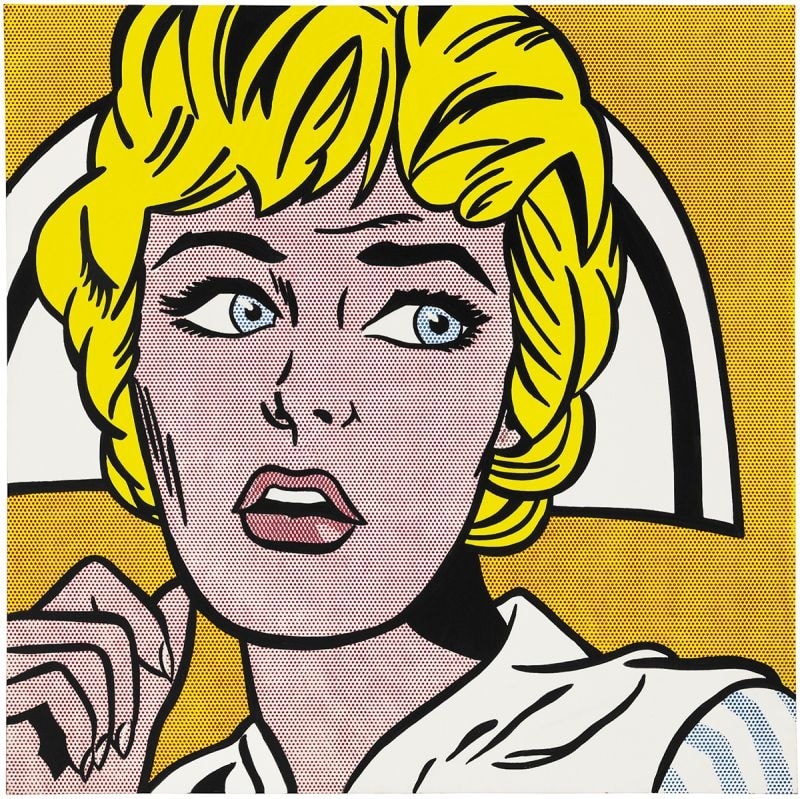
Nurse crystallizes Roy Lichtenstein’s 1964 turn to comic-derived icons, amplifying emotion through Ben‑Day dots, thick black contours, and a high‑contrast palette. The cropped close‑up—blond hair, white cap, parted lips, averted gaze—freezes suspense while stripping away speech bubbles. Lichtenstein converts pulp melodrama into a monumental emblem, making style itself the engine of feeling [1][2].

Study Print Studio

Create a personal study print

Build a companion study sheet around the part of this painting that speaks to you most. Choose a detail, shape an interpretation, and walk away with something personal and display-worthy.

Fast Facts

Year
1964
Medium
Acrylic, oil, and graphite on canvas
Dimensions
122.1 x 122.2 cm (48 1/16 x 48 1/8 in.)
Location
Private collection
Nurse by Roy Lichtenstein (1964) featuring Ben-Day dots, Thick black contour lines, Nurse’s white cap, Averted gaze (blue eyes)

Click on any numbered symbol to learn more about its meaning

Meaning & Symbolism

Lichtenstein constructs Nurse as a machine‑smooth theater of feeling. The mustard field flattens depth and converts space into a signal background, so the figure reads like a broadcast rather than a person. The face is a field of Ben‑Day dots, meticulously stenciled by hand in oil over acrylic grounds—a technical paradox that produces a mechanically printed look while advertising painstaking craft 1. Thick black contours shear curls of yellow hair into stylized locks; the white cap arcs like a halo of authority; the lips part and the eyes slide away from us. With the speech balloon excised, the suspense shifts from narrative to graphic code: dotted flesh equals “drama,” hard contour equals “clarity,” mustard ground equals “spotlight.” In Hal Foster’s terms, feeling is pushed to the surface; affect is not expressed but staged through reproducible conventions 4. Lichtenstein’s edits—tight crop, heightened contrast, eliminated context—make viewers complicit in completing the story, but only with the clichés the image permits 27. As a cultural sign, the nurse occupies a charged crossroads of care, glamour, and heterosexual melodrama in 1950s–60s romance comics. Those stories repeatedly frame women’s labor as a backdrop for romantic duty; uniforms promise authority while plots funnel heroines toward vulnerability and desire 6. Lichtenstein exploits and coolly distances this script. The upraised hand with manicured nails hovers near the jaw like a stage cue; the cap certifies professionalism even as the averted gaze codes jeopardy. The work’s square, billboard scale weaponizes low‑cost print language for high art, enacting Pop’s equalization of subjects and its critique of mass‑culture mythmaking 3. Yet the painting refuses to decide between empathy and satire. The dots and lines successfully manufacture pathos, even as their blatant artifice exposes how easily such pathos is made. In this oscillation—between compassion and spectacle, authority and peril—Nurse becomes a portrait of media itself: a system that packages heroism and desire into instantly legible signs. Lichtenstein’s translation of a romance‑comic fragment into a museum‑scale icon thus operates as both homage and analysis, proving that in the age of reproduction, style is narrative and surface is where culture writes its claims 12347.

Explore Deeper with AI

Ask questions about Nurse

Popular questions:

Powered by AI • Get instant insights about this artwork

💬 Ask questions about this artwork!

Interpretations

Formal/Material Analysis: The Hand Behind the Machine

Nurse’s “mechanical” look is painstakingly handmade. The Roy Lichtenstein Foundation notes the combination of acrylic grounds with oil stenciling for Ben‑Day dots, whose slower drying time enabled adjustments; graphite underdrawing often remains as a faint engineering trace 1. This hybrid procedure yields a paradox: a canvas that reads like offset print yet advertises artisanal control. In 1964, Lichtenstein systematically edited sources—reducing modeling, heightening contrast, and standardizing line weight—so that the viewer confronts the technique as subject rather than an illusionistic world 2. The result is a surface calibrated for legibility at billboard scale: dots regularize “flesh,” black vectors choreograph hair and contour, and the ochre field collapses space into a signal plane. Material choices thus literalize Pop’s wager that process and code, not brushy expressivity, manufacture affect 12.

Source: Roy Lichtenstein Foundation (Catalogue Raisonné RLCR 931); Art Institute of Chicago

Gendered Labor Melodrama: The Nurse as Cultural Script

Mid‑century romance and war comics cast nurses at the crossroads of duty and desire, using uniforms to confer authority while plots re‑inscribe vulnerability and heterosexual resolution 56. Lichtenstein monumentalizes that stock figure yet removes dialogue, leaving only the codes—cap, manicure, parted lips, averted eyes—to carry narrative pressure. This reframing discloses how women’s care labor is aestheticized as spectacle and romantic suspense. By isolating the emblematic close‑up, the painting performs a cool anthropology of mass culture: authority becomes a pose, compassion a graphic shorthand, jeopardy a repeatable template. Rather than parodying a single panel, Nurse reads as a meta‑image of the genre’s repertoire, exposing how gender roles are stabilized through style while also allowing those styles to retain their strange, seductive power 256.

Source: Modern American History (Cambridge University Press); Romance Scholarship Database; Art Institute of Chicago

Theory of Surface: From Expression to Code

Hal Foster argues that Pop relocates feeling to the surface, where reproducible signs replace inwardness; Lichtenstein’s women are “pushed to the surface,” their affect performed by dots, contours, and framing rather than brushy subjectivity 3. Nurse literalizes this shift: with the speech balloon excised, suspense becomes a function of graphic syntax—dotted skin as “drama,” black contour as “clarity,” monochrome ground as “spotlight” 2. In contrast to Abstract Expressionism’s depth metaphors, here affect is staged, calibrated for instant recognition across media circuits 34. The painting thus operates as a primer in mass‑media semiotics: it doesn’t describe emotion; it deploys it through a kit of standardized marks. Such surface‑logic is not a deficit but the work’s critical engine, revealing how modern spectators learn to read—and feel through—codes 324.

Source: Hal Foster (London Review of Books); MoMA (Pop Art term); Art Institute of Chicago

Spectatorship & Montage: Completing the Missing Story

By cropping to a cinematic close‑up and stripping text, Nurse converts panel narrative into an emblem that the viewer must complete from shared clichés 29. MoMA’s account of comics conventions clarifies how thought balloons, gutters, and sequential panels cue time and motive; their removal here suspends causality, leaving only indexical signals—gaze, lips, cap, manicure—to organize desire and peril 9. The square, billboard proportion intensifies face‑to‑face address, while the flat ground blocks diegetic space, pushing us into the role of co‑author who can only fill gaps with culturally available scripts. This is a Pop montage by subtraction: a one‑frame “sequence” that activates learned reading habits and exposes how mass images enlist viewers to suture narrative where none is given 29.

Source: MoMA Magazine (on comics conventions); Art Institute of Chicago

Scale, Market, and Myth: From Cheap Print to Blue‑Chip Icon

Lichtenstein weaponizes the low-cost print language at museum scale, enacting Pop’s leveling of subjects while staging the image for spectacular circulation 4. That logic culminates institutionally and economically: Nurse set the artist’s auction record at $95.4M in 2015, a market alchemy that turns mass‑media codes into luxury commodity and consolidates Pop’s myth of reproducibility as rarity 78. The square, billboard‑like format primes visibility, while the work’s ambivalence—empathy versus satire—feeds both critical discourse and collectible desire. The painting thereby performs a double conversion: graphic shorthand into high art, and cultural stereotype into financial instrument. This trajectory is not incidental but internal to Pop’s project of testing how images migrate across platforms, publics, and price regimes 478.

Source: MoMA (Pop Art term); Christie’s Press Release (2015); Bloomberg

Related Themes

About Roy Lichtenstein

Roy Lichtenstein (1923–1997) was a leading American Pop artist who adapted comic and advertising idioms into large, hand‑painted canvases that probe authorship, reproduction, and art‑historical conventions. After his 1961–62 breakthrough, he developed a sustained strand of reflexive “art about art,” including studio scenes and riffs on modern masters [2].
View all works by Roy Lichtenstein

More by Roy Lichtenstein