Masterpiece

by Roy Lichtenstein

Masterpiece (1962) turns a romance‑comic close‑up into a cool exposé of how praise is manufactured. With a buoyant speech balloon and hand‑made Ben‑Day dots, Roy Lichtenstein converts private flattery into public promotion—an image about the image economy itself [1][2].

Study Print Studio

Create a personal study print

Build a companion study sheet around the part of this painting that speaks to you most. Choose a detail, shape an interpretation, and walk away with something personal and display-worthy.

Fast Facts

Year
1962
Medium
Oil and graphite pencil on canvas
Dimensions
137.2 x 137.2 cm
Location
Private collection (reported Steven A. Cohen)
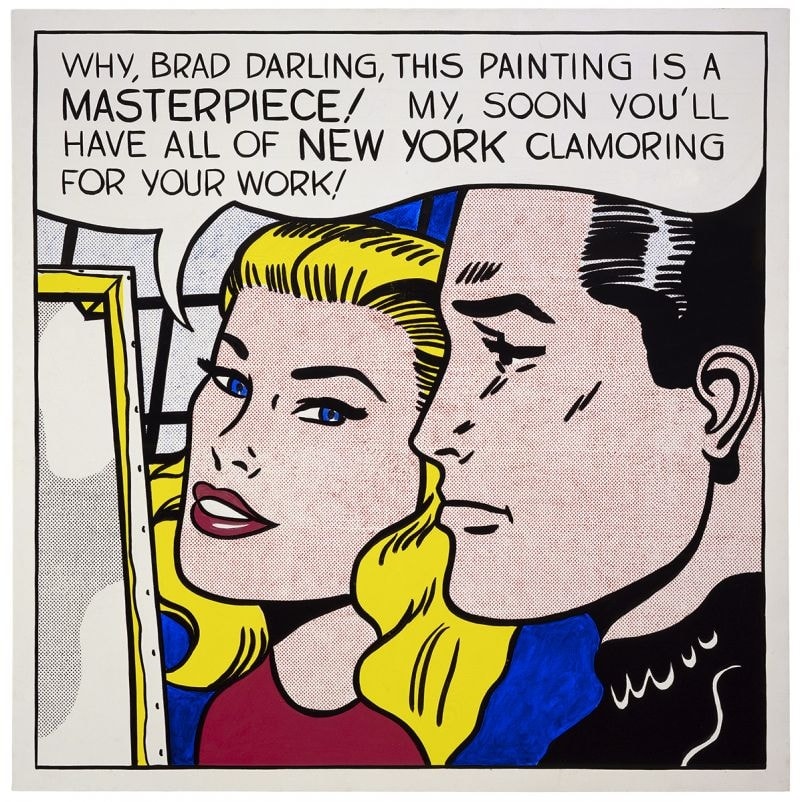
Masterpiece by Roy Lichtenstein (1962) featuring Speech balloon, Ben-Day dots, Thick black contour lines, Cropped canvas edge/yellow stretcher bar

Click on any numbered symbol to learn more about its meaning

Meaning & Symbolism

Masterpiece anchors its argument in the authority of a voice bubble that swallows the picture’s upper register. The bold, evenly spaced lettering and exclamation points transmit the cadence of ad speak, while the blonde’s practiced smile and the squared jaw of “Brad” read as stock types rather than individuals. Their faces, modeled with pink Ben‑Day dots and framed by thick black contours, keep emotion at a safe distance; affect becomes a surface treatment. In this setup, judgment is not earned by the canvas they face—barely glimpsed at the left edge with a yellow stretcher bar—but by a slogan that announces success in advance: “soon you’ll have all of New York clamoring for your work!” Lichtenstein thus equates artistic value with circulatory promise, a boosterish prophecy that parodies the mechanisms by which critics, dealers, and publicity generate demand 12. The painting’s look is crucial to its claim. Although the finish suggests mechanical reproduction, the Roy Lichtenstein Catalogue Raisonné documents graphite underdrawing and an all‑oil surface; the dots are meticulously hand‑painted, with slight variation that betrays the artist’s presence beneath the industrial mask 1. This tension—between the unique, handmade canvas and the language of mass duplication—underwrites the painting’s satire. As Michael Lobel has argued, Lichtenstein’s Pop idiom is a sustained inquiry into how corporate codes and an artist’s “signature” collide; Masterpiece literalizes that collision by making a single canvas double as an advertisement for a career 2. The generic name “Brad,” which recurs across Lichtenstein’s early‑1960s works, signals a type rather than a person, underscoring how identity itself is packaged in romance melodrama and in the art market’s myth of the hot young painter 13. Lichtenstein further intensifies the meta‑picture by situating the couple at the threshold of a studio scene. The sliver of canvas edge at left, the white wall, and the cropped composition convert spectatorship into plot: we are not asked to evaluate the painting’s qualities but to witness the moment of its PR rollout. That is why Masterpiece is important. It articulates, in a single graphic punch, Pop’s broader claim that meaning and value are produced within systems of mediation—comics conventions, gallery apparatus, press coverage—rather than residing invisibly “in” the brushwork 25. The work’s early exposure in foundational Pop exhibitions amplified this reflexive message at the very moment Lichtenstein’s own reputation was crystallizing 1. Decades later, its high‑profile sale funding criminal‑justice reform ironically confirmed the picture’s thesis: the image’s market afterlife and media narrative are inseparable from how we read it, proof that circulation and proclamation continue to shape what counts as a “masterpiece” 6.

Explore Deeper with AI

Ask questions about Masterpiece

Popular questions:

Powered by AI • Get instant insights about this artwork

💬 Ask questions about this artwork!

Interpretations

Media-Economy Lens

Seen through media theory, Masterpiece models how circulation confers value. The balloon’s boosterism simulates the promotional voice that moves goods—and artists—through networks of dealers, critics, and press. Michael Lobel argues Lichtenstein’s Pop idiom probes the friction between mass-media codes and an artist’s “signature,” and here that friction becomes the joke: the painting’s content is the promise of acclaim, not evidence of achievement. Its graphic terseness mirrors ad copy’s efficiency, compressing narrative and valuation into a single declarative beat. In this view, the picture functions like a branding device for a career, making the conditions of publicity not merely background context but the very subject of the work 2.

Source: Michael Lobel

Gendered Melodrama

Drawing on romance‑comic conventions, the image mobilizes melodramatic types—the confident blonde and the stoic “Brad”—to stage how gendered scripts align with art‑world mythology. As Bradford R. Collins shows, Lichtenstein’s early “girls” are built from codified expressions and cropped glamour that perform affect while keeping it at a distance. In Masterpiece, that distance is tactical: the blonde’s practiced smile sells reputation the way romance panels sell desire, and “Brad” condenses the fantasy of the hot young artist into a square‑jawed cipher. The painting thus entwines romantic aspiration with market aspiration, revealing how image formulas migrate across domains—love plots becoming career plots in a culture of mass reproducibility 3.

Source: Bradford R. Collins

Facture Against the Machine

Despite its industrial look, the work is all oil paint over graphite underdrawing; the Ben‑Day fields are hand‑painted with telltale variation. The Catalogue Raisonné corrects older medium attributions, confirming no acrylic was used and underscoring Lichtenstein’s craft under the mask. This small slippage—slight wobble in dots, breathing edges in the speech balloon—keeps the artist’s body faintly legible within an image economy that mimics mechanical print. The result is a productive tension: the painting critiques mass reproduction while relying on manual precision to simulate it, collapsing the divide between “authentic” facture and reproducible style. The evidence of the hand becomes part of the satire’s bite 1.

Source: Roy Lichtenstein: A Catalogue Raisonné (RLCR 711)

Institutional Reflexivity

Masterpiece belongs to Lichtenstein’s strand of art about art: the cropped stretcher edge and studio wall position us within the apparatus of exhibition and judgment. Framed by the Whitney’s historic focus on reflexivity, these cues make spectatorship itself the plot. We are not invited to parse brushwork but to witness the launch—a staged rollout in which value is declared textually. The composition’s white void operates like a gallery field, and the balloon reads as wall label turned slogan. In this account, the work is a diagram of how spaces, labels, and PR choreograph reception, with the image serving as a self-conscious exhibit of institutional mediation 41.

Source: Whitney Museum of American Art

Market Afterlife and Social Use

The painting’s later biography confirms its thesis that value is a function of circulation and narrative. Agnes Gund’s 2017 sale and the redirection of proceeds to seed the Art for Justice Fund folded the image into a new publicity arc—linking Pop’s cool irony to criminal‑justice reform. As the RLCR records the transfer and the fund documents its origin, the work’s market afterlife becomes a case study in how images accrue power through stories told around them: price headlines, philanthropic framing, and media amplification. In effect, the picture’s own “prophecy” of clamoring acclaim is realized as social impact, making its content inseparable from its public life 16.

Source: Art for Justice Fund; Roy Lichtenstein: A Catalogue Raisonné (RLCR 711)

Appropriation Ethics and Transformation

Masterpiece likely reworks a romance‑comic panel, but Lichtenstein’s procedure is not mere lift-and-scale; it is a structural translation that swaps narrative context for a critique of promotion. Lobel cautions against flattening this practice to plagiarism, stressing the negotiation between readymade codes and fine‑art conventions. The Foundation’s image resources show how source panels are recomposed, text rewritten, and graphic syntax tightened to foreground mediation. In this lens, authorship resides in the reframing—turning melodrama into art‑world metacommentary—even as the work keeps appropriation debates alive and visible, which is part of its critical charge 27.

Source: Michael Lobel; Roy Lichtenstein Foundation

Related Themes

About Roy Lichtenstein

Roy Lichtenstein (1923–1997) was a leading American Pop artist who adapted comic and advertising idioms into large, hand‑painted canvases that probe authorship, reproduction, and art‑historical conventions. After his 1961–62 breakthrough, he developed a sustained strand of reflexive “art about art,” including studio scenes and riffs on modern masters [2].
View all works by Roy Lichtenstein

More by Roy Lichtenstein