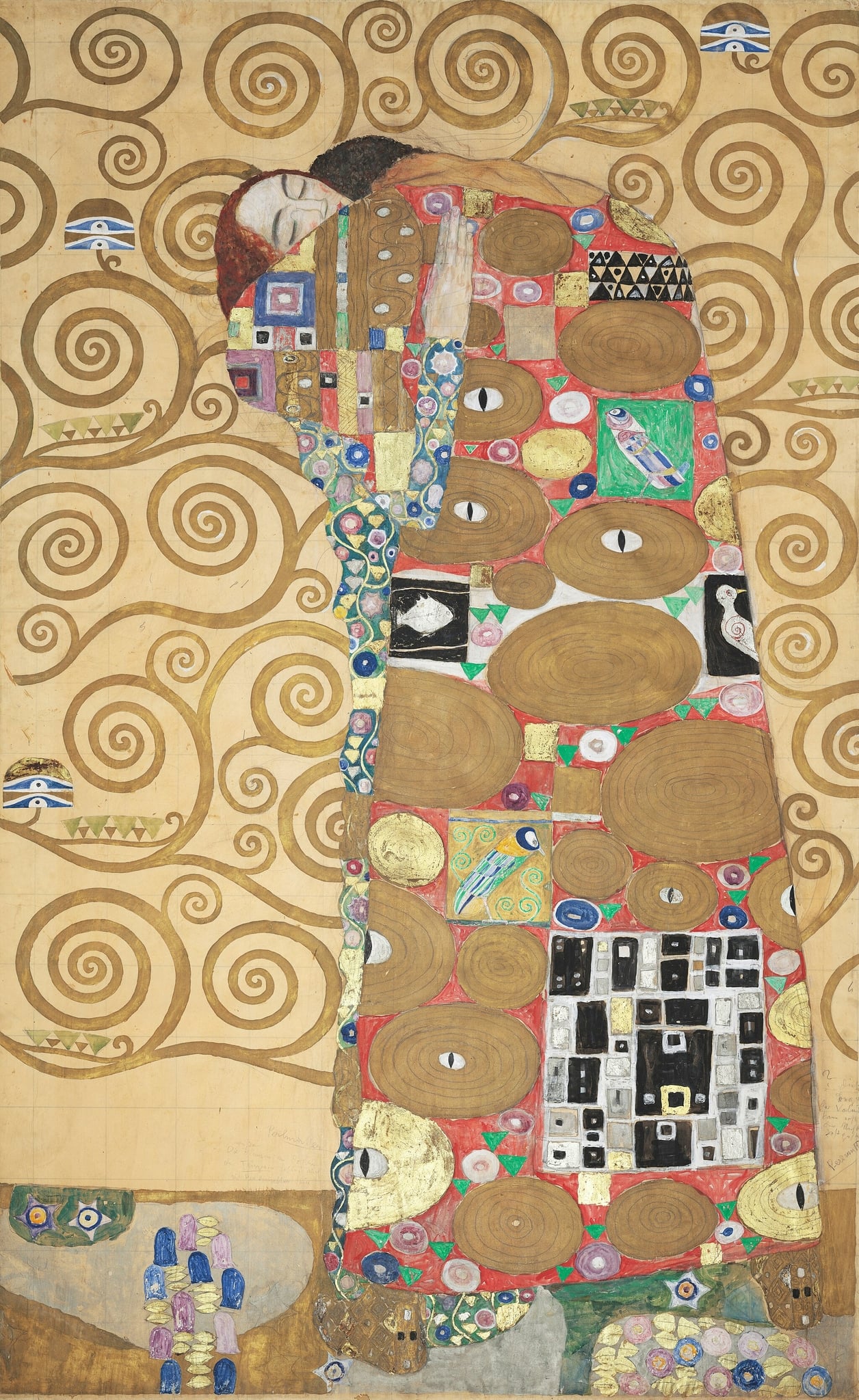
Black-and-white squares/rectangles Symbolism
Black-and-white squares and rectangles often signal measure, stability, and rational design in art. Their hard edges and high contrast read as constructed order, frequently set against curving, organic motifs. In fin-de-siècle decorative and Symbolist contexts, they can mark a masculine or structural principle within a composition.
Black-and-white squares/rectangles in Fulfillment
In Gustav Klimt’s Fulfillment (1910–1911 [cartoon]; mosaic installed by 1911), the lovers’ patterned garments oppose ovals, eyes, and flowers to bands of black-and-white rectangles. The rectilinear units operate as a stabilizing, rational cadence that counters the spiraling Tree of Life and the flowing floral field, clarifying the work’s union of feminine/masculine energies. Here the checked geometry reads as the designed, structural complement to organic forms, sharpening the image’s balance between order and growth.