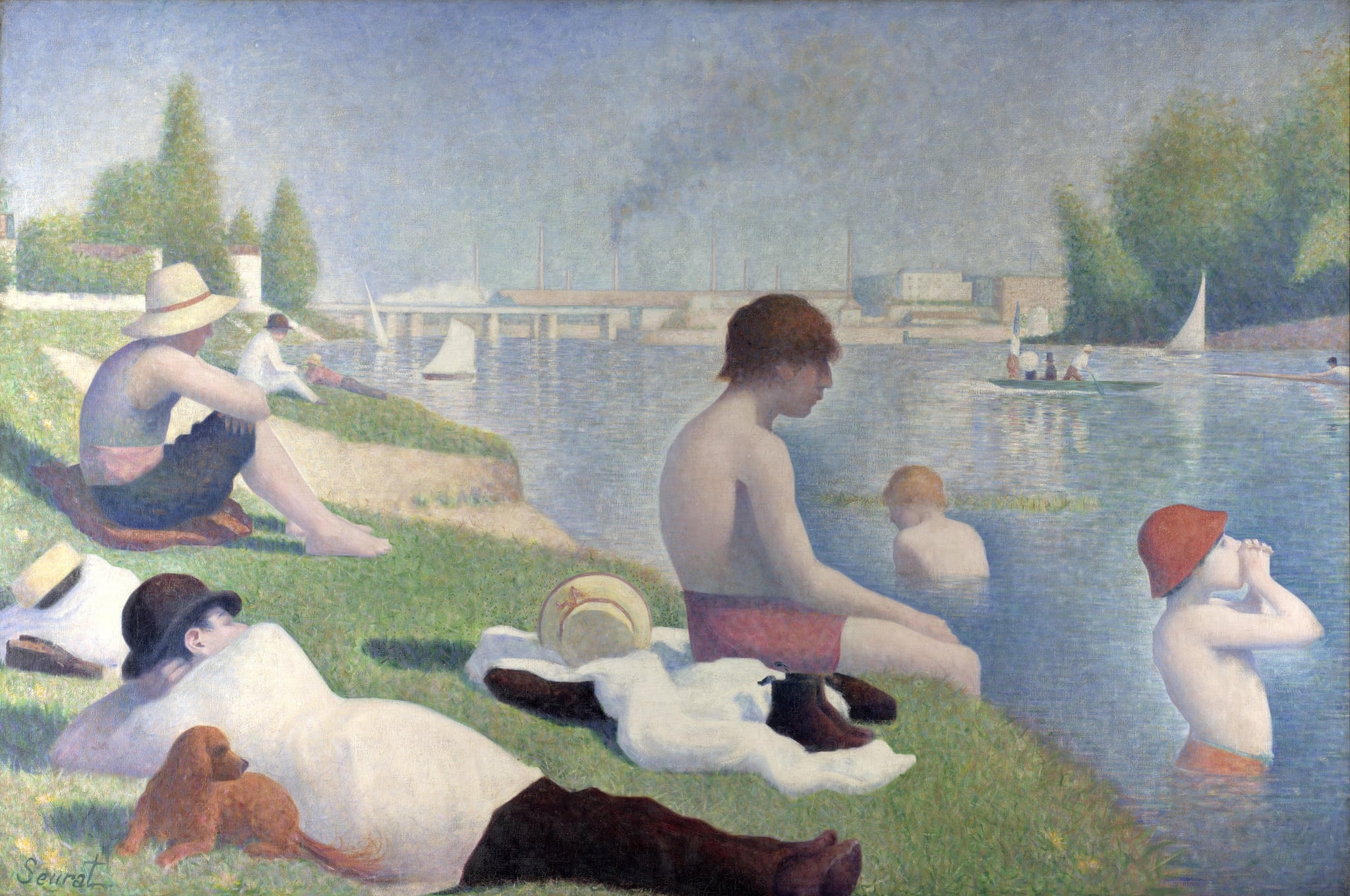
Bridges (rail and road) Symbolism
Bridges in art often symbolize connection, passage, and the engineered order humans impose on the landscape. In modern painting especially, they register urban growth and industry, binding separate shores while introducing strong, rational lines into natural settings. As motifs, they frequently organize a composition, aligning the flux of nature with human-made geometry.
Bridges (rail and road) in Bathers at Asnières
In Georges Seurat’s Bathers at Asnières (1884), bridges appear in the industrial distance along the Seine, paired with chimneys and boats to signal the modern infrastructure surrounding a scene of leisure. Their span literalizes connection across the river and, pictorially, their horizontal and linear forms help structure the view: Seurat balances the soft greens and blues of the riverside with the bridges’ geometric order, turning workers’ rest into a monumental, ordered image of urban life. Here the bridge motif clarifies modernity not as disruption but as a measured framework that integrates industry with everyday recreation.