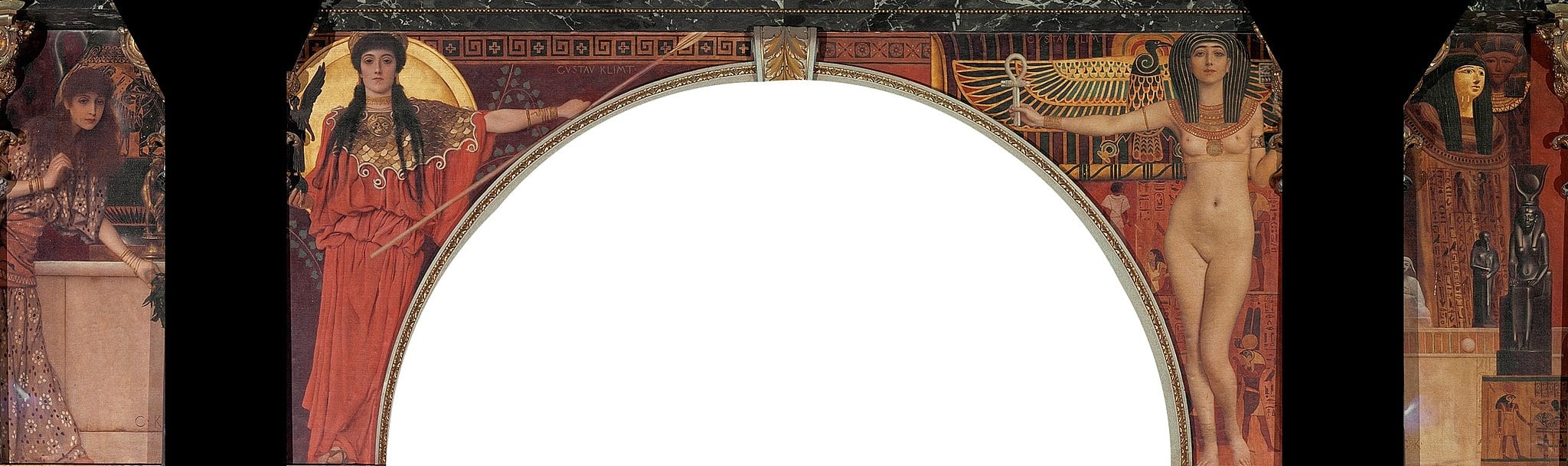
Empty ceremonial arch/portal Symbolism
An empty ceremonial arch or portal marks a threshold—a place of passage between spaces, eras, or belief systems. In art history it often signals transition and entry, using architectural form to legitimize movement from one order or tradition to another. When left unoccupied, the opening emphasizes the idea of passage itself rather than a specific narrative event.
Empty ceremonial arch/portal in Ancient Greece and Egypt
In Gustav Klimt’s staircase pair Ancient Greece and Egypt (1891), an empty arch stands at the center between two female allegories—an animated, robed Athena at left and a frontal, nude Egyptian goddess aligned with Nekhbet’s vulture at right. Framed by ornamental gold, red, and black, this unfilled opening functions as a ceremonial threshold linking the two traditions, staging the passage through which Klimt declares a canon of Western art.
By keeping the portal empty, Klimt directs attention to transition and entry rather than to a single episode. The flanking allegories define the liminal zone, and the composition articulates a movement from Egypt’s sacral permanence to Greece’s humanist clarity.