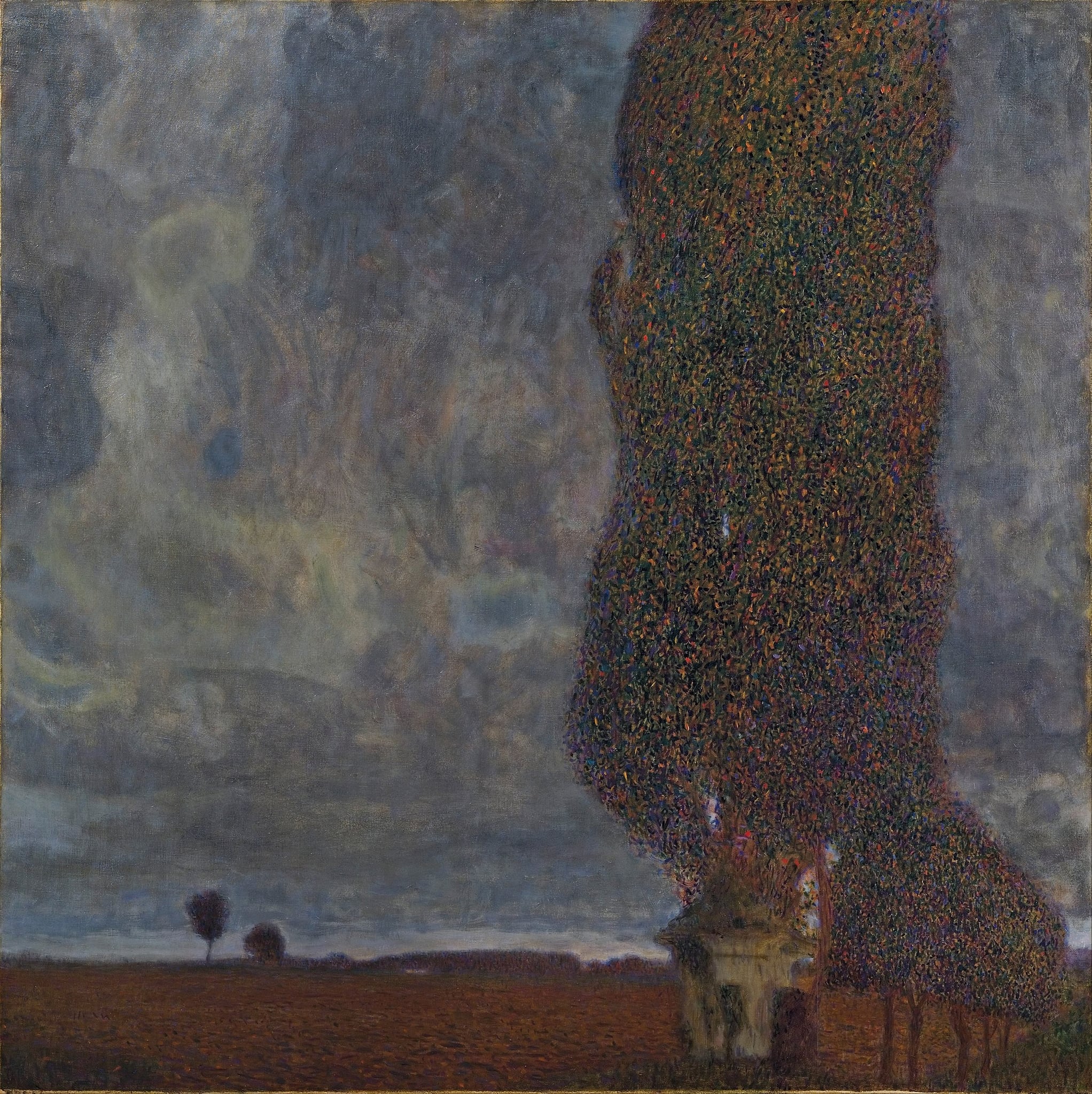
Gathering-Storm Sky Symbolism
In art, a gathering-storm sky signals the sublime—nature’s vast, volatile power that dwarfs human concerns. From Romantic landscape through modernism, darkening clouds and charged atmospheres convey impending change, threat, and psychological pressure. Artists use this motif to externalize unease while keeping the weather itself as the main actor beyond human control.
Gathering-Storm Sky in The Large Poplar II (Gathering Storm)
In The Large Poplar II (Gathering Storm) (1902/03), Gustav Klimt devotes most of the square canvas to a charged, near-monochrome sky, effectively making weather the protagonist. A monumental poplar stands like a sentinel at the right edge, its flecked, shimmering canopy reading as an ominous mosaic against the darkening expanse, while a low rust-toned plain and a tiny chapel compress at the horizon. The emphasized scale—vast sky, minimal ground, and a diminutive sign of human presence—intensifies the sense of sublime threat and psychological pressure. Klimt’s composition turns atmosphere into subject, presenting the gathering storm as a force beyond human control rather than a backdrop.