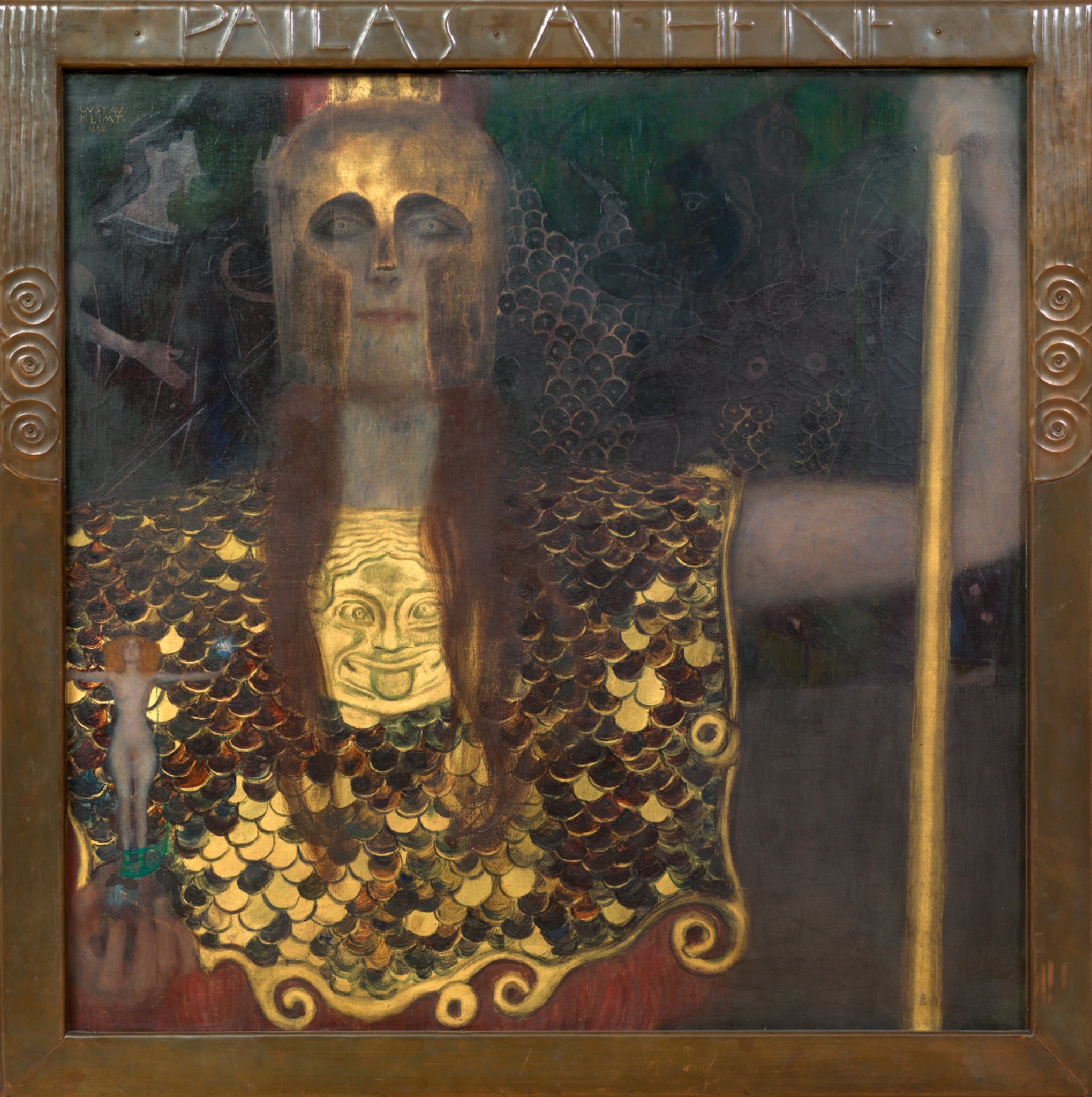
Gorgoneion (Medusa’s head) Symbolism
The Gorgoneion—Medusa’s head rendered as a mask—functions in classical art as an apotropaic sign, confronting viewers to ward off harm and terrify foes. Positioned on armor, shields, or the divine aegis, it signals protection backed by potential violence. Through its close ties to Athena, it can also assert reasoned authority and civic order.
Gorgoneion (Medusa’s head) in Pallas Athena
In Pallas Athena (1898) by Gustav Klimt, the goddess confronts the viewer frontally, helmeted and impassive, her gleaming scale aegis crowned by a gorgoneion. The staring mask concentrates the work’s archaic authority and implacable power, operating as a protective emblem even as it threatens opposition. Klimt fuses this ancient apotropaic device with modern ornament to proclaim Vienna Secession ideals—reason, strategy, and artistic truth—within a single, commanding image.