Horizontal Horizon Bands Symbolism
Horizontal horizon bands are the stacked, lateral zones that organize land and sky across the picture plane. In art history, they conventionally signal stability and measure—a grounded register against which vertical forms and shifting atmospheres can assert tension or movement. By fixing the eye to a calm axis, they clarify contrasts of scale, weather, and temporal change.
Horizontal Horizon Bands in The Large Poplar II (Gathering Storm)
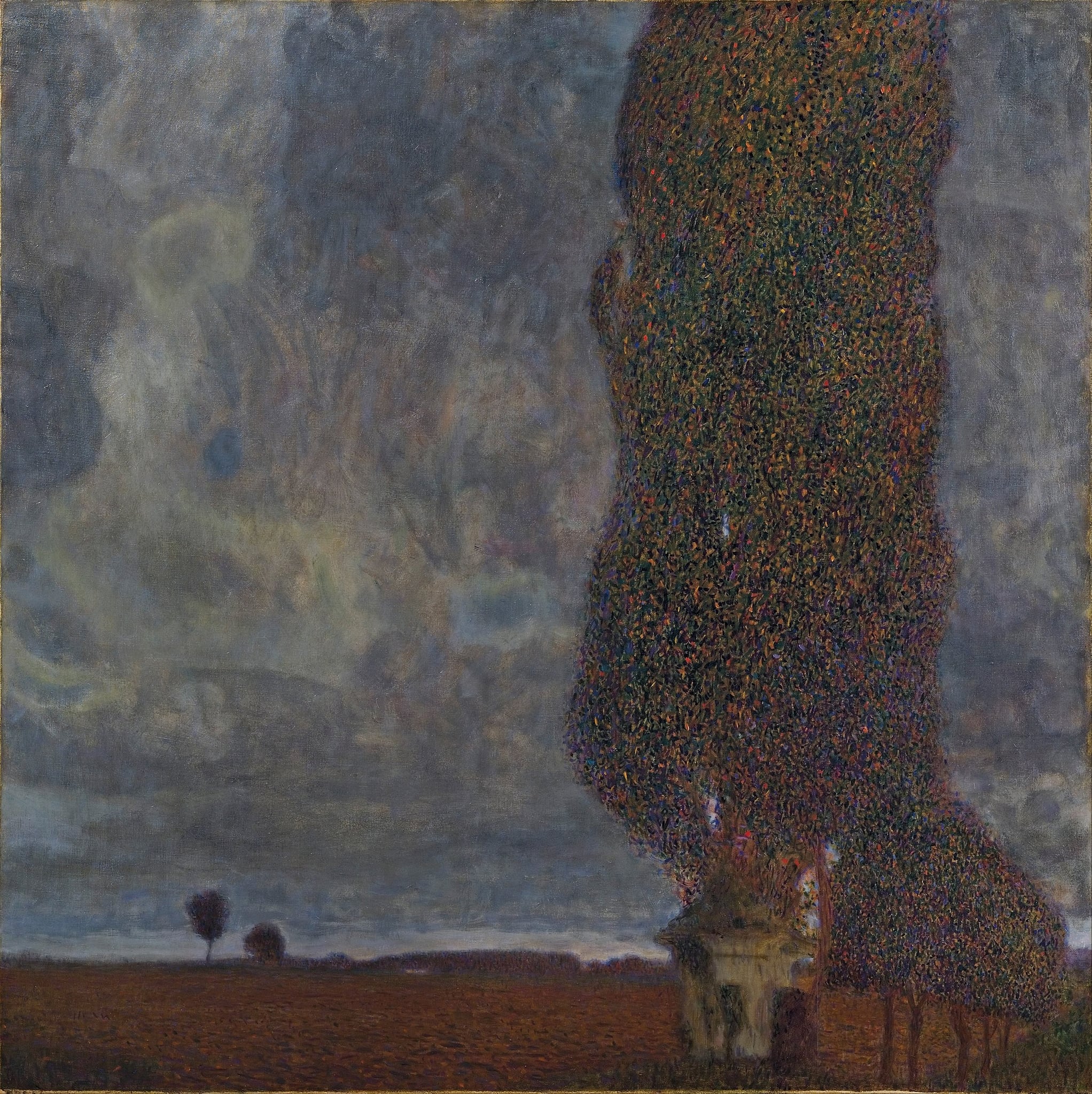
Gustav Klimt’s The Large Poplar II (Gathering Storm) (1902/03) exemplifies the stabilizing force of horizontal horizon bands. A low, rust-toned plain forms a restrained band that anchors the square composition, while a tiny chapel punctuates the horizon to calibrate human scale. Above it, Klimt devotes most of the canvas to a charged, near-monochrome sky, making weather the protagonist.
Against this measured horizontal, the monumental poplar at the right edge rises like a vertical counterforce. The interplay sharpens the symbol’s meaning: the quiet terrestrial band asserts earthly order, even as the tree’s ascent and the ominous, shimmering sky test its equilibrium. In this single horizon band, stability and impending disturbance are held in deliberate balance.