Cow’s Skull: Red, White, and Blue

by Georgia O’Keeffe

Georgia O’Keeffe’s Cow’s Skull: Red, White, and Blue (1931) turns a sun‑bleached bovine skull into a modern American emblem, set against a tricolor field that quietly evokes the flag. The skull’s chalky surface becomes the composition’s white, framed by red side bands and a folded blue ground cleaved by a dark vertical bar, asserting resilience rather than morbidity [1][2].

Study Print Studio

Create a personal study print

Build a companion study sheet around the part of this painting that speaks to you most. Choose a detail, shape an interpretation, and walk away with something personal and display-worthy.

Fast Facts

Year
1931
Medium
Oil on canvas
Dimensions
101.3 × 91.1 cm
Location
The Metropolitan Museum of Art, New York
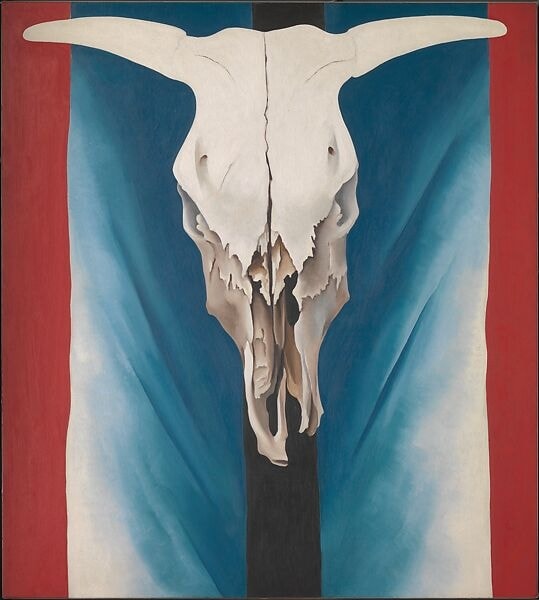
Cow’s Skull: Red, White, and Blue by Georgia O’Keeffe (1931) featuring Cow skull (white bone), Red side bands, Blue field/drapery, Black vertical bar (axis)

Click on any numbered symbol to learn more about its meaning

Meaning & Symbolism

O’Keeffe engineers an emblem through formal decisions that make the skull read as both relic and standard. The horns extend laterally like a crossbar, the brow splits with a hairline seam, and the nasal cavity’s jagged edges descend like torn fabric—details rendered with clinical precision so the object becomes icon rather than specimen. Against this, two solid red bands flank a blue field, while a black vertical stripe bisects the center, sharpening the frontal axis and granting the composition the authority of a banner. Crucially, the bone’s chalky surface supplies the painting’s “white,” so the tricolor is completed by the object itself—nature literally standing in for the nation 12. O’Keeffe later recalled that, hearing East‑Coast talk of the “Great American” painting, she decided to make this one explicitly American by adding the red stripes—an artist’s statement that secures the work’s patriotic intention even as it refuses literal stars and stripes 2. The result is a severe, anti‑bombastic patriotism: the United States distilled to bone, light, and planar color. This emblem emerges from a precise historical moment. After traveling to New Mexico in 1929, O’Keeffe began collecting bones during a period of drought that left the landscape strewn with skeletal remains; the skull motif entered her work immediately thereafter (compare related 1931 canvases) 4. Museums have emphasized that, for O’Keeffe, bones were not morbid trophies but forms that evidenced the desert’s enduring beauty and, by extension, the “strength of the American spirit” during the Depression years 13. The composition’s symmetry and near‑monumental scale (roughly 101 × 91 cm) elevate an ordinary carcass into a totem of resilience. Early critics grasped the dual valence, debating “Death and Transformation” versus “Life and Transformation,” a split that still structures responses to the painting’s oscillation between memento mori and transcendence 2. Yet O’Keeffe’s own framing and the flag‑like field tilt the balance toward durability rather than elegy: this is a skull that refuses to vanish. Within American modernism, the painting operates as a clear entry in the contest over national form. Scholars such as Wanda Corn position it as O’Keeffe’s answer to the “Great American Thing”: a modern iconography rooted in indigenous landscape elements rather than European precedent or urban machine imagery 5. The black axial bar and simplified color planes reflect a modernist taste for structural clarity, while the bone’s fine articulations—scalloped nasal edges, soft horn shadows—refuse cold abstraction, keeping the work tethered to lived geography. In substituting the West’s austere forms for conventional emblems, O’Keeffe builds a language of quiet authority: a flag that does not wave, a nation presented as weathered but intact. That is the meaning of Cow’s Skull: Red, White, and Blue—and why it remains a touchstone for thinking about American identity, regional modernism, and the power of reduced form to carry public symbolism 125.

Explore Deeper with AI

Ask questions about Cow’s Skull: Red, White, and Blue

Popular questions:

Powered by AI • Get instant insights about this artwork

💬 Ask questions about this artwork!

Interpretations

Gendered Authorship and the ‘Great American’ Debate

In a discourse dominated by male critics and machine-age bravura, O’Keeffe asserts a counter‑heroic modernism. Her “severe, anti‑bombastic” national image sidesteps monumental industry and war iconography, insisting that precision, restraint, and place can bear public symbolism. This is a gendered intervention not by subject matter alone but by mode: clarity over clangor, bone over skyscraper. Corn’s account of Americanist modernism helps situate how O’Keeffe’s choices contest masculine-coded tropes of power, offering a quiet authority that is nonetheless public, legible, and unmistakably American 25.

Source: Wanda M. Corn

Regional Modernism as Cultural Politics

Read as a strategic answer to East‑Coast calls for the “Great American” artwork, the skull stages the Southwest as the nation’s visual core. O’Keeffe converts a desert relic into an American icon by completing a tricolor with real bone as “white,” asserting a vernacular, non-urban modernism that refuses European precedent and Manhattan machine-age tropes. This is not pastoral nostalgia but a programmatic regionalism: a language of axial clarity, planar color, and object exactitude that grants the West symbolic sovereignty. Wanda Corn situates this move within interwar contests over national form, where O’Keeffe’s iconography of bones, mesas, and light proposes that American modernism arise from indigenous landscape elements rather than borrowed motifs 25.

Source: Wanda M. Corn

Environmental History and the Making of an Emblem

The painting’s authority is inseparable from the ecology of drought. In 1930 the Southwest’s desiccation left bones scattered across the terrain; O’Keeffe collected them, converting environmental austerity into formal austerity. The skull’s bleached planes index sun, scarcity, and time, while the red bands and blue ground bannerize this ecology into nationhood. Rather than morbidity, the work offers an ecological poetics: the endurance of forms under climatic duress becomes a national allegory during Depression-era hardship. Related 1931 canvases confirm the immediacy of this motif, tracing a pipeline from field-gathered object to gallery emblem—an environmental artifact made public symbol 14.

Source: Art Institute of Chicago; The Metropolitan Museum of Art

Secular Reliquary: Liturgical Echoes without a Church

Formally, the horns stretch like a crossbar, the vertical bar reads as a nave-like axis, and the frontal presentation recalls a reliquary—yet there is no saint, only bovine bone. O’Keeffe reroutes Christian typologies into a civic register, achieving sacredness through modernist means: symmetry, planar fields, and clinical contour. The result is a post‑liturgical icon—a relic purified of doctrine, offered to a national rather than ecclesial congregation. This sacral affect amplifies the painting’s emblematic power, explaining why it reads as more than specimen without resorting to Surrealism or sentimentality 13.

Source: The Metropolitan Museum of Art; Lisa Mintz Messinger

Medium Reflexivity: Nature as Readymade ‘White’

O’Keeffe’s own remark—deciding to make “an American painting” by adding red stripes to a cow’s skull on blue—reveals a sly medium reflexivity: pigment supplies red/blue, but the object supplies white. The skull operates as a quasi‑readymade chroma swatch whose material fact (chalky bone) completes the flag’s palette. This fusion of index and icon tests the boundary of mimesis vs. abstraction: the bone is both depicted and deputized, an image that doubles as a structural component of the emblem it signifies. The result is a banner assembled from world-stuff and paint, collapsing representation into procedural symbolism 23.

Source: Georgia O’Keeffe Museum (Access O’Keeffe); Lisa Mintz Messinger

Related Themes

About Georgia O’Keeffe

Georgia O’Keeffe (1887–1986) emerged within the Stieglitz Circle and became a defining voice of American modernism, using magnification, cropping, and distilled color to bind nature to abstraction. Beginning in the mid‑1920s she painted large‑scale flowers, later expanding to bones, cliffs, and New Mexico landscapes, sustaining a practice devoted to the essential structures of perception [3].
View all works by Georgia O’Keeffe

More by Georgia O’Keeffe