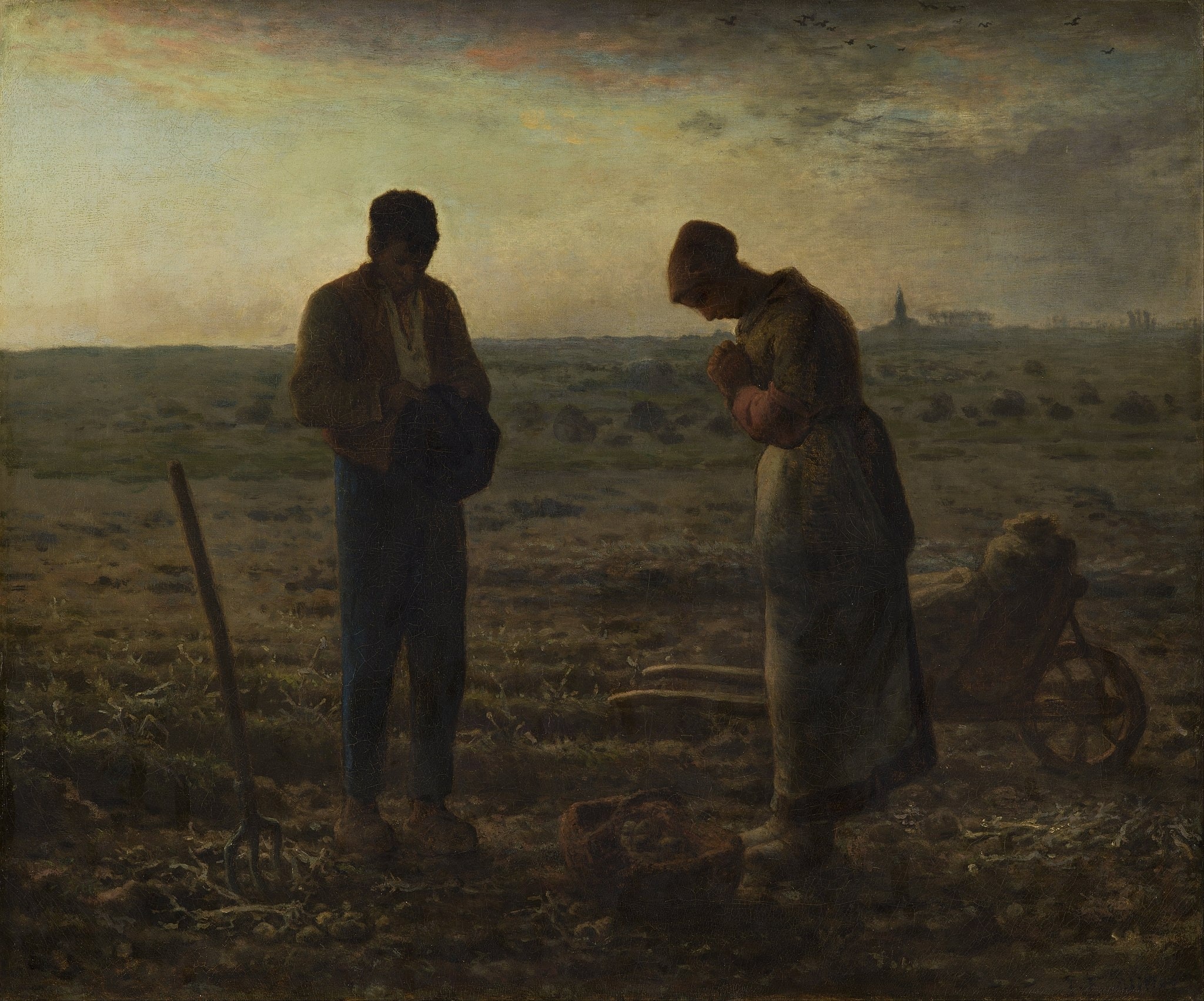
The Angelus
Jean-Francois Millet’s The Angelus (1857–1859) fuses devotion and labor: two peasants pause at dusk, heads bowed, as the Angelus bell sounds from a distant steeple. With a low horizon, earthen palette, and monumental silhouettes, the painting makes a brief pause in fieldwork feel timeless and sacred [1][2].
Study Print Studio
Create a personal study print
Build a companion study sheet around the part of this painting that speaks to you most. Choose a detail, shape an interpretation, and walk away with something personal and display-worthy.
Fast Facts
- Year
- 1857–1859
- Medium
- Oil on canvas
- Dimensions
- 55.5 × 66.0 cm
- Location
- Musée d’Orsay, Paris
Click on any numbered symbol to learn more about its meaning
Meaning & Symbolism
Millet builds meaning through disciplined restraint. The dusk sky recedes in cool bands while the field lies dark and cloddy; against this quiet stage, the man’s cap is removed and the woman’s hands are clasped, their heads tipped in parallel arcs. The vertical fork planted in the soil and the wheelbarrow loaded with sacks brace the composition like punctuation, registering a clean break in labor rather than collapse. The near-silhouette figures read as monumental silhouettes despite the small canvas, because Millet compresses the horizon low and lets the bodies bridge earth and sky. The distant steeple—tiny but insistent—locates the aural source of the Angelus and fixes the time as evening; the birds skimming the upper right carry that hour across the picture plane. These concrete elements—tools, posture, light, horizon—translate a brief, routine act into an archetype of reverence within work 12.
Millet’s realism is declarative, not anecdotal. He rejects sentimentality by muting facial detail and dramatizing gesture; the bowed heads rhyme like paired notes, turning prayer into structure. The paint’s earthen register—browns, grays, low gold—refuses spectacle and instead sanctifies the ordinary. The figures are neither individualized saints nor victims; they are workers whose dignity derives from steadiness, measure, and shared rhythm. That rhythm is liturgical as well as agrarian: the Angelus, rung morning, noon, and evening, makes prayer a clock for the body and the land. By encoding the bell’s summons in a tiny steeple on the horizon, Millet shows how sound orders distance and community; the village projects itself into the field even as the day fades 2. Orsay’s curators stress that Millet, recalling childhood custom more than private piety, sought to “fix the immutable rhythms of peasant life”—which is why the painting reads as collective memory rather than confession 1.
The Angelus is important because it redefines monumentality in modern art. Instead of kings or miracles, it makes a few seconds of pause the site of value, modeling how modern painters could grant epic weight to unheroic time. This ethical scale—work dignified by prayer, prayer grounded in work—shaped later artists: Van Gogh read Millet as “poetry” for the people and pursued similar gravity in The Potato Eaters and his sower motifs 4. The painting also became a cultural emblem of rural France amid industrial change, widely reproduced and fiercely collected, proving how a realist image could acquire the aura of a national icon 1. Even the Surrealist challenge—Dalí’s funerary hypothesis after a 1963 radiograph revealed a rectangular underform beneath the basket—testifies to the canvas’s psychological charge; the technical finding is real, while the coffin reading remains contested 3. Yet such debates only underline Millet’s achievement: by paring narrative to posture, light, and a few tools at rest, he created an image capacious enough to hold devotion, doubt, nostalgia, and modernity at once.
Explore Deeper with AI
Ask questions about The Angelus
Popular questions:
Powered by AI • Get instant insights about this artwork
💬 Ask questions about this artwork!
Interpretations
Liturgical Time as Spatial Architecture
Millet stages sound as structure: the distant steeple pinpoints the Angelus as an aural beacon that orders space and time. The evening bell folds village into field, making prayer a rural chronometer that regulates bodies and tasks. This is not anecdote but a designed temporality—low horizon, receding bands of sky, and silhouettes that hinge between earth and firmament. The result is a “chronotope” of labor, where the halt itself is form. By embedding devotion in tools at rest and light at transition, Millet shows how liturgical cadence becomes a spatial grid for community life, translating memory of custom into pictorial rhythm rather than narrative incident 12.
Source: Musée d’Orsay; TheArtStory
Monumentality by Means of Restraint
Despite its modest scale, The Angelus achieves monumental presence through compressed horizon, near-silhouette figures, and a khaki-gray palette that suppresses anecdotal detail. Millet’s “declarative realism” turns gesture into syntax—the parallel bows read like a visual couplet, while the fork and wheelbarrow punctuate the pause. This rhetoric of reduction sanctifies the ordinary without sentimentality: dignity is built from design, not facial expression. In doing so, Millet expands the category of what can be monumental, pioneering a modern ethics of form in which unheroic time bears epic weight and prepares the ground for later artists who seek gravity in the everyday 12.
Source: Musée d’Orsay; TheArtStory
Class Ethics and the Peasant as Protagonist
Millet displaces academic hierarchies by granting peasants primary pictorial authority. Tools, sacks, and clods are not props for sentiment but evidence in a realist argument about value: steadiness, measure, and shared rhythm. That ethical emphasis on labor’s dignity resonated with later moderns—Van Gogh, for one, read Millet as “poetry” for common life and pursued similar gravitas in The Potato Eaters and sower motifs. The Angelus thus operates as a critique-by-selection: instead of kings or allegories, it elevates subsistence work and communal devotion, offering a counter-canon for modern painting rooted in class experience rather than elite spectacle 15.
Source: Musée d’Orsay; The Guardian
Psychoanalytic Afterlife and the X‑ray Enigma
Dalí’s Le mythe tragique recoded the picture as latent mourning, insisting the couple faces a child’s coffin. The 1963 radiograph confirmed a rectilinear dark form beneath the basket, but the funerary reading remains debated. What matters critically is how a rigorously sober realism could host such projections: the pared narrative, emphatic posture, and frontal stillness create a surplus of psychological potential. Surrealist reception reveals the canvas’s elasticity—its calm functions as a screen for unconscious content—while the technical fact (underdrawing/overpaint) warns against collapsing material evidence into singular meaning 14.
Source: Musée d’Orsay; Dawn Adès (Surrealism studies)
Icon, Market, Nation
From contested 19th‑century sales to Chauchard’s bequest and state acquisition, The Angelus accrued the aura of a national icon. Mass reproduction amplified its reach, making rural piety a metonym for French identity amid industrial change. This social life is not incidental: the painting’s formal austerity enabled broad identification across classes and geographies, while its market trajectory—record prices, prestige collections—demonstrates how realist images can crystallize ideological nostalgia. Legal and economic histories even cite the work in debates on artists’ resale rights, underscoring how reception and circulation can reshape an artwork’s political and cultural valence far beyond the studio 156.
Source: Musée d’Orsay; The Guardian; Oxford Academic (JIPL&P)
Related Themes
About Jean-Francois Millet
Jean-Francois Millet (1814–1875), a leading Realist associated with the Barbizon school, devoted his career to monumental images of rural labor. After settling in Barbizon in 1849, he pursued peasant subjects—The Sower, The Gleaners, The Angelus—seeking to dignify modern work with classical gravity while resisting overt propaganda [2][6].
View all works by Jean-Francois Millet →