Van Gogh's Chair

by Vincent van Gogh

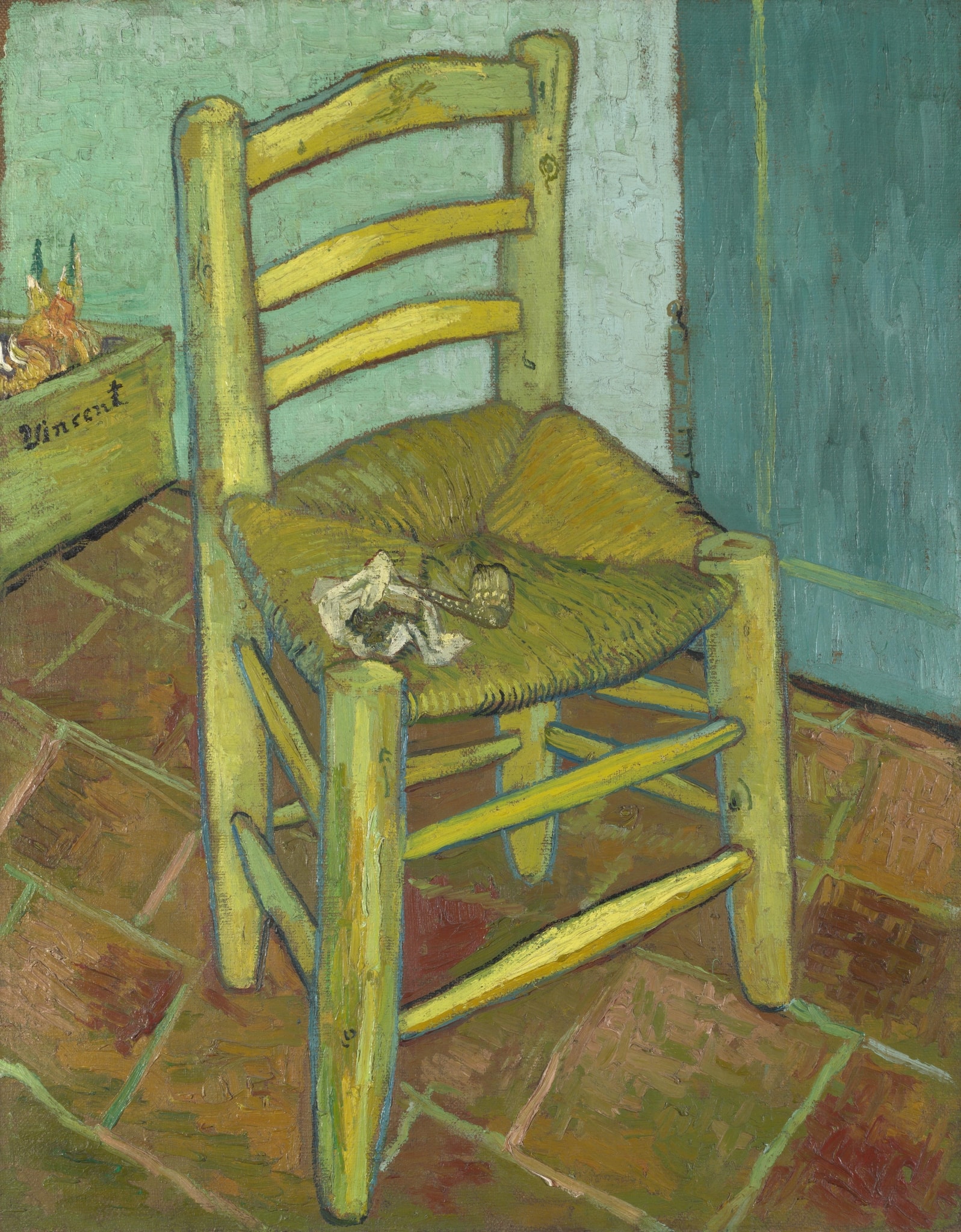
In Van Gogh's Chair, a humble rush-seated chair blazes in radiant yellow against cool teal walls and door, its bold outlines charging the scene with tension. A pipe and tobacco pouch on the seat, a crate marked “Vincent” and sprouting onions turn this empty place into a surrogate presence, a still-life self-portrait built from things rather than a face [1][2].

Study Print Studio

Create a personal study print

Build a companion study sheet around the part of this painting that speaks to you most. Choose a detail, shape an interpretation, and walk away with something personal and display-worthy.

Fast Facts

Year
1888; reworked January 1889
Medium
Oil on canvas
Dimensions
91.8 × 73 cm
Location
The National Gallery, London
See all Vincent van Gogh paintings in London
Van Gogh's Chair by Vincent van Gogh (1888; reworked January 1889) featuring Yellow rush-seated chair, Pipe and tobacco pouch, Crate labeled “Vincent”, Sprouting onions

Click on any numbered symbol to learn more about its meaning

Meaning & Symbolism

Van Gogh’s Chair declares identity without a sitter. The slanted, lemon‑yellow ladder‑back chair, ringed by thick, emphatic contours, occupies the center like a protagonist; the rush seat is indented, lived‑in, and the pipe and crumpled pouch lie where a hand has just left them. To the left, a simple crate bearing the painted name “Vincent” and a clutch of sprouting onions place the artist in the room as surely as any likeness. Across the rear plane, a mint wall and teal door cool the space, while the terracotta tiles pulse with red‑brown chords. The composition is slightly tilted, so the chair feels both stable and precarious, an everyday object held taut by the charged geometry of the floor and the door’s vertical seam. In this staging, the “empty” becomes eloquent: the chair reads as a metonym for habit, labor, and solitary thought, with the pipe and pouch signaling domestic consolation and, in the Dutch still‑life tradition, a whisper of transience 1. Van Gogh himself framed the picture’s aim as “an effect of light by means of bright colour,” and the result is a programmatic demonstration of how color can do psychological work 2. Warm yellows assert candor and hope; the enveloping greens and aquas introduce distance, even chill. That chromatic dialectic is not just decorative. It encodes a temperament he opposed to the pendant image of Gauguin’s Chair: his own is daylight, rustic, functional—a rush seat and a smoker’s tools—whereas Gauguin’s is candlelit, cushioned, and literary, with novels and flame implying nocturnal reverie 13. Hung as a pair, the two chairs become debating portraits: clarity versus mystery, workbench versus salon. Here, Van Gogh’s choice of peasant furniture—sturdy dowels, uneven rungs—declares values of simplicity, endurance, and craft, aligning the chair with his self-conception as a worker among humble things 1. The crate with “Vincent” functions as a built‑in signature, but the sprouting onions add a second, subtler tag: renewal. In Arles, as he struggled to found a “Studio of the South,” these sprouts articulate a hope that life might push up again through winter ground 1. The picture also participates in a broader visual tradition that makes absence do the work of portraiture. Van Gogh knew the Victorian “empty chair” motif, such as Luke Fildes’s memorial image for Dickens, where a vacant seat marks a life by its imprint on a place 15. He explicitly revisited his own chair after his December 1888 collapse and hospital stay, reworking it in January 1889; the painting thus folds biography into genre, the studio into the self 12. What distinguishes Van Gogh’s treatment is how materially the paint behaves as meaning: the compact, ridged strokes build the chair like carpentry in pigment; the dark outlines (Cloisonnist in feeling) make the object read with emblematic clarity; the skewed perspective throws the chair slightly forward, as if offering the seat to the viewer while insisting on the artist’s continued claim to it. In sum, the meaning of Van Gogh’s Chair lies in its fusion of still life and self-portrait, craft and confession. Why Van Gogh’s Chair is important is that it demonstrates, with radical economy, how color, light, and the most ordinary things can bear the full weight of modern identity—an enduring lesson of Post‑Impressionism and of Van Gogh’s art 124.

Explore Deeper with AI

Ask questions about Van Gogh's Chair

Popular questions:

Powered by AI • Get instant insights about this artwork

💬 Ask questions about this artwork!

Interpretations

Historical Context: The Yellow House Program

Composed amid the Arles experiment to found a “Studio of the South,” Van Gogh’s Chair belongs to a cycle of emblematic furnishings (The Bedroom, Sunflowers) designed to make a common space legible through icons of use. The chair’s daylight clarity and utilitarian rush seat contrast pointedly with the pendant’s candle and novels, a split that mirrors the collapsing collaboration with Gauguin in December 1888. After the hospital, Van Gogh returned to the motif, explicitly noting he “worked again” on his “empty chair,” aligning artistic resumption with personal convalescence. In this way the chair acts as a practical emblem of rebuilding a life through work—a functional sign turned autobiographical device, conceived to face its nocturnal double across the room 123.

Source: National Gallery (London); Van Gogh Letters Project

Formal Analysis: Cloisonnist Contours and Built Carpentry

The painting foregrounds technique as meaning. Thick, Cloisonnist contours corrall fields of high‑chroma yellow and aqua, making the chair read as an emblem more than a mere prop. Compact, directional strokes stack like planks—pigment behaving as carpentry—so that facture reiterates the subject’s artisanal ethos. The mint wall and teal door articulate a cool plane receding behind the chair, while terracotta tiles torque the floor’s geometry, tilting the scene so the seat feels offered yet guarded. Far from Impressionist optical flicker, this is Post‑Impressionist construction: color‑planes, bounding lines, and structural rhythm deliver an “effect of light by means of bright colour,” in Van Gogh’s own terms, making sensation legible as temperament 12.

Source: National Gallery (London)

Iconography and Tradition: The Empty Chair as Portrait

Van Gogh adapts a Victorian memorial idiom—the empty chair—to reimagine portraiture without a face. He admired Luke Fildes’s commemorative print for Dickens, where a vacant seat registers presence through absence. In Arles, the strategy becomes more than elegy: the chair’s imprint, the pipe’s residual warmth, and the onions’ green shoots forge a living surrogate, at once vanitas and vital sign. The work thus fuses Dutch still‑life symbolism (smoking implements as transience) with the modern idea that identity can be metonymic, assembled from use‑worn objects and the room’s geometry rather than likeness alone. It is portraiture as stagecraft, a set where the sitter has just stepped out yet remains insistently there 15.

Source: National Gallery (London); Victorian Web (Fildes)

Dialogic Portraiture: Daylight vs. Nocturne

Conceived as a pendant to Gauguin’s Chair, Van Gogh’s version is a daylight credo: rustic, functional, and work‑ready. Gauguin’s cushioned armchair, candle, and novels script a nocturne of reflection; Van Gogh’s pipe and rush‑bottom propose day labor and habit. Hung together, the chairs are argumentative portraits, staging a debate over artistic identity—clarity vs. mystery, craft vs. symbolist reverie. This is not mere contrast of props but an ethics of looking: pure color as candor against candlelit suggestion. The rupture of December 1888 sharpened this polarity; reworking his own chair in January 1889, Van Gogh renewed the claim to a daylight practice grounded in simplicity and endurance 123.

Source: National Gallery (London); Van Gogh Museum (Amsterdam)

Class and Material Culture: Peasant Furniture as Value Statement

The selected object is not neutral. A ladder‑back, rush‑seated chair indexes rural craft traditions and modest economies Van Gogh esteemed, aligning his self‑image with peasant resilience rather than salon refinement. The crate stenciled “Vincent” domesticates authorship as a shipping label—identity as work parcel—while the sprouting onions belong to subsistence fare, not luxury still life. Such choices resist elite decorum and recode the studio as a workroom where making is labor before it is art. In Post‑Impressionist terms, the piece rejects mimetic polish for emblematic clarity, a politics of form that elevates the ordinary into a bearer of modern identity 14.

Source: National Gallery (London); Britannica

Related Themes

About Vincent van Gogh

Vincent van Gogh (1853–1890) developed a radical, emotion‑driven use of color after moving from Paris to Arles in 1888, seeking southern light and an artists’ community. In Arles he created the Sunflowers series to decorate the Yellow House ahead of Gauguin’s visit. His late work fused impasto, high chroma, and symbolic motifs that shaped modern painting [2][5].
View all works by Vincent van Gogh

More by Vincent van Gogh
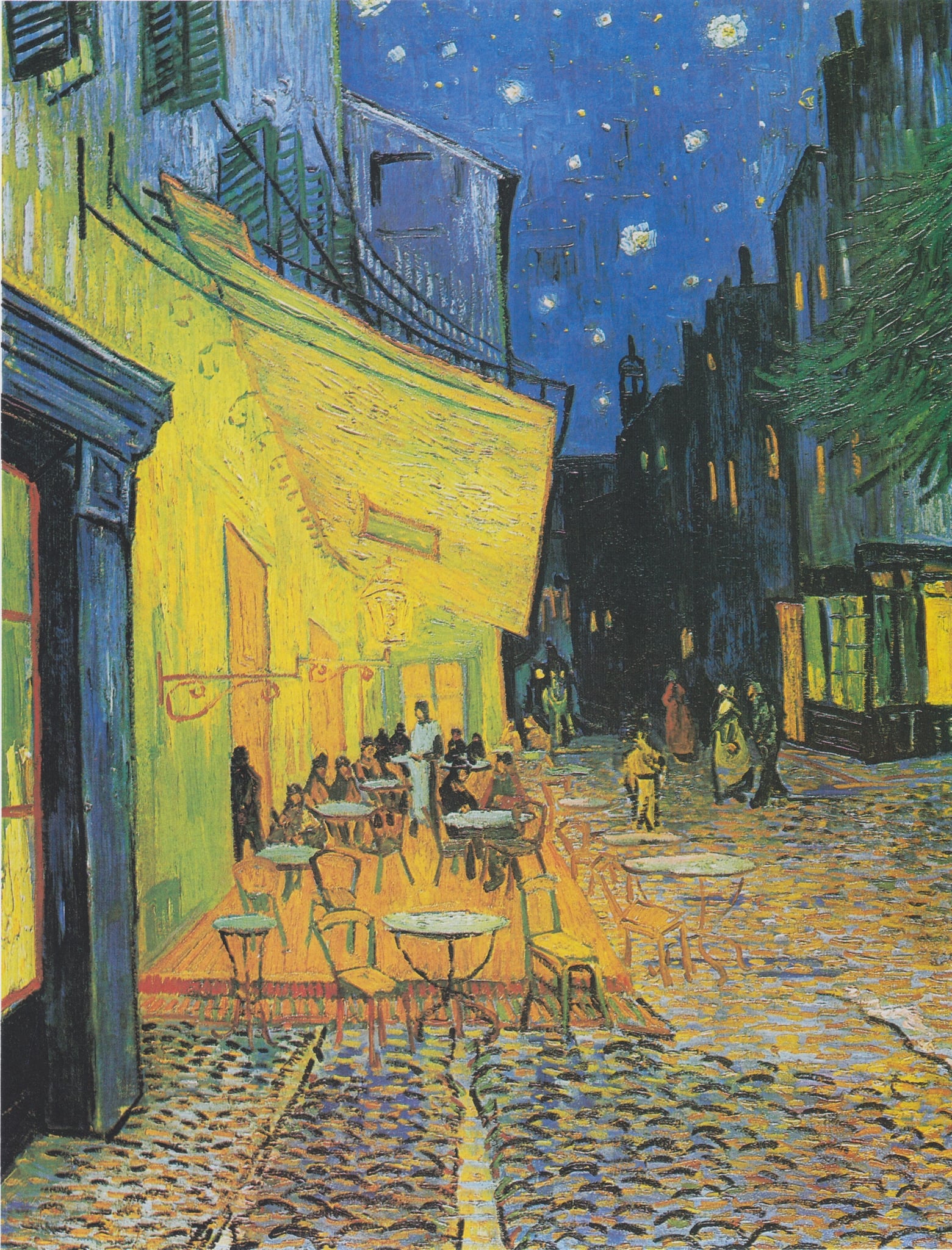
Café Terrace at Night by Vincent van Gogh

Café Terrace at Night

Vincent van Gogh (1888)

In Café Terrace at Night, Vincent van Gogh turns nocturne into <strong>luminous color</strong>: a gas‑lit terrace glows in yellows and oranges against a deep <strong>ultramarine sky</strong> pricked with stars. By building night “<strong>without black</strong>,” he stages a vivid encounter between human sociability and the vastness overhead <sup>[1]</sup><sup>[2]</sup>.
Red Cabbages and Onions by Vincent van Gogh

Red Cabbages and Onions

Vincent van Gogh (1887)

In Red Cabbages and Onions, Vincent van Gogh turns everyday produce into a drama of <strong>complementary color</strong> and <strong>restless brushwork</strong>. Hot red contours cinch violet cabbages and pale yellow bulbs against a cool, striated blue table, while a mustard‑yellow patch in the upper right tilts the space and sharpens the chromatic clash. The result asserts ordinary food as a locus of <strong>resilience</strong> and <strong>experimentation</strong> <sup>[1]</sup><sup>[2]</sup>.

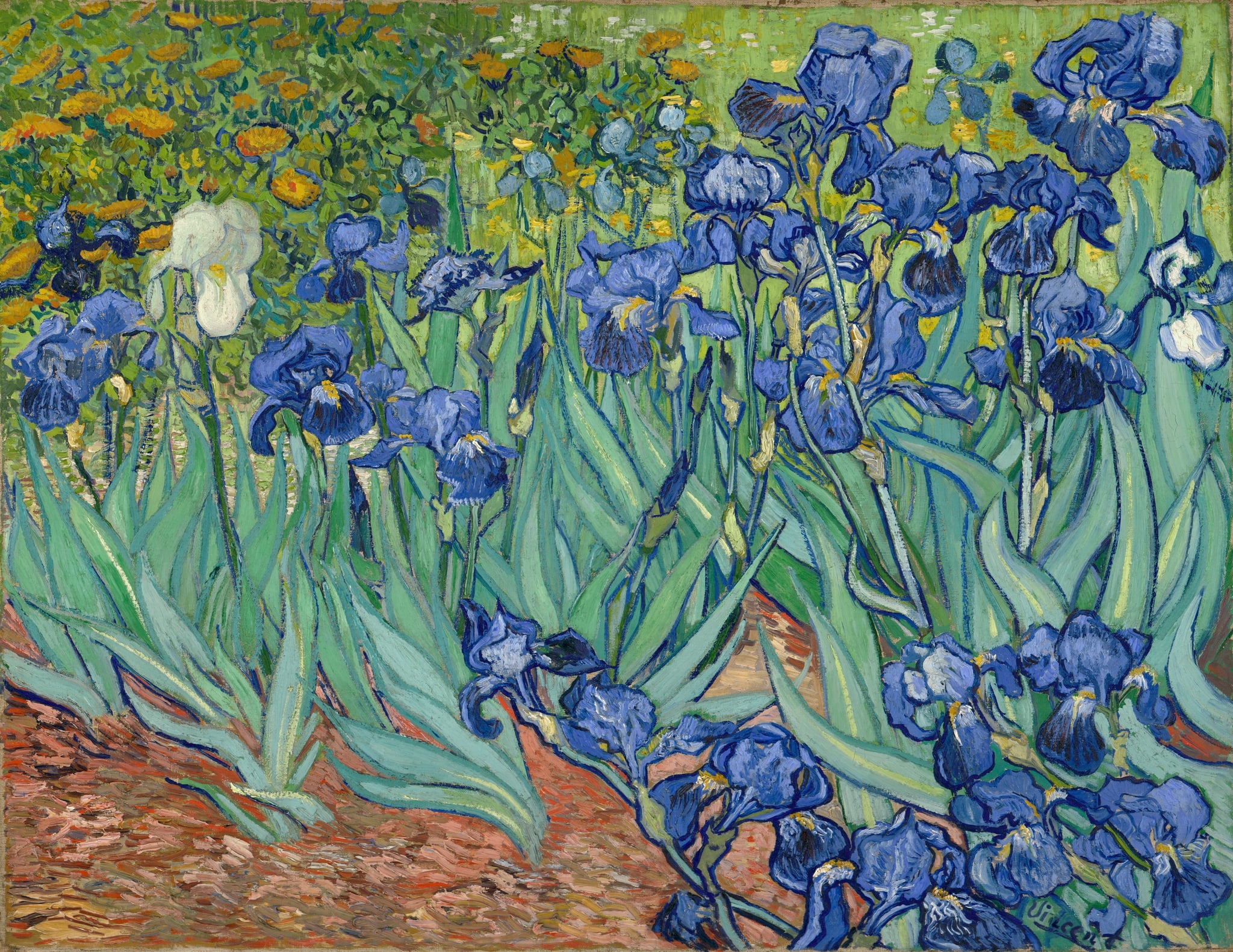
Irises by Vincent van Gogh

Irises

Vincent van Gogh (1889)

Painted in May 1889 at the Saint-Rémy asylum garden, Vincent van Gogh’s <strong>Irises</strong> turns close observation into an act of repair. Dark contours, a cropped, print-like vantage, and vibrating complements—violet/blue blossoms against <strong>yellow-green</strong> ground—stage a living frieze whose lone <strong>white iris</strong> punctuates the field with arresting clarity <sup>[1]</sup><sup>[2]</sup>.
Sunflowers by Vincent van Gogh

Sunflowers

Vincent van Gogh (1888)

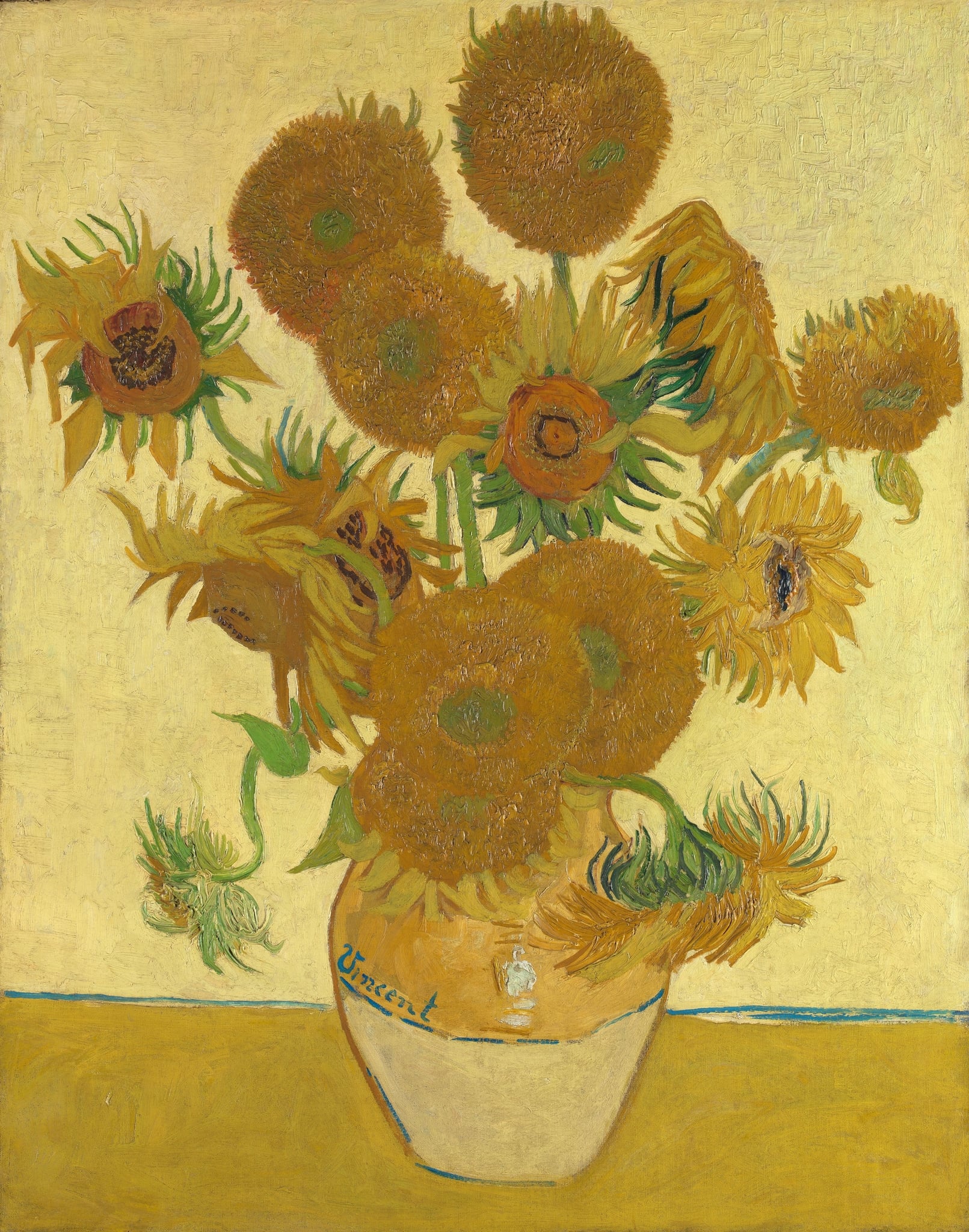
Vincent van Gogh’s Sunflowers (1888) is a <strong>yellow-on-yellow</strong> still life that stages a full <strong>cycle of life</strong> in fifteen blooms, from fresh buds to brittle seed heads. The thick impasto, green shocks of stem and bract, and the vase signed <strong>“Vincent”</strong> turn a humble bouquet into an emblem of endurance and fellowship <sup>[1]</sup><sup>[2]</sup>.

Garden with Courting Couples: Square Saint-Pierre by Vincent van Gogh

Garden with Courting Couples: Square Saint-Pierre

Vincent van Gogh (1887)

In Garden with Courting Couples: Square Saint-Pierre, Vincent van Gogh turns a small Montmartre park into a stage where <strong>spring</strong>, <strong>intimacy</strong>, and <strong>urban leisure</strong> converge. Short, shimmering strokes fuse pink chestnut blossoms, curving paths, and paired figures into one pulse of <strong>renewal</strong> and <strong>togetherness</strong> <sup>[1]</sup><sup>[2]</sup>.

In the Café: Agostina Segatori in Le Tambourin by Vincent van Gogh

In the Café: Agostina Segatori in Le Tambourin

Vincent van Gogh (1887 (Jan–Mar))

Van Gogh casts Agostina Segatori at a tiny, tambourine‑like café table, turning Le Tambourin into a <strong>stage of modern life</strong>. Cool greens and greys make the red <strong>flame‑plume hat</strong> and the foaming <strong>beer</strong> flare, while folded arms and a set‑aside <strong>parasol</strong> register private fatigue amid public display <sup>[1]</sup><sup>[2]</sup><sup>[3]</sup>.