Ritual
Ritual symbolism in modern and early modern painting transforms repeated social, religious, and corporeal practices into visual structures that regulate time, desire, and collective belief, making habit itself a bearer of meaning.
Member Symbols
Featured Artworks
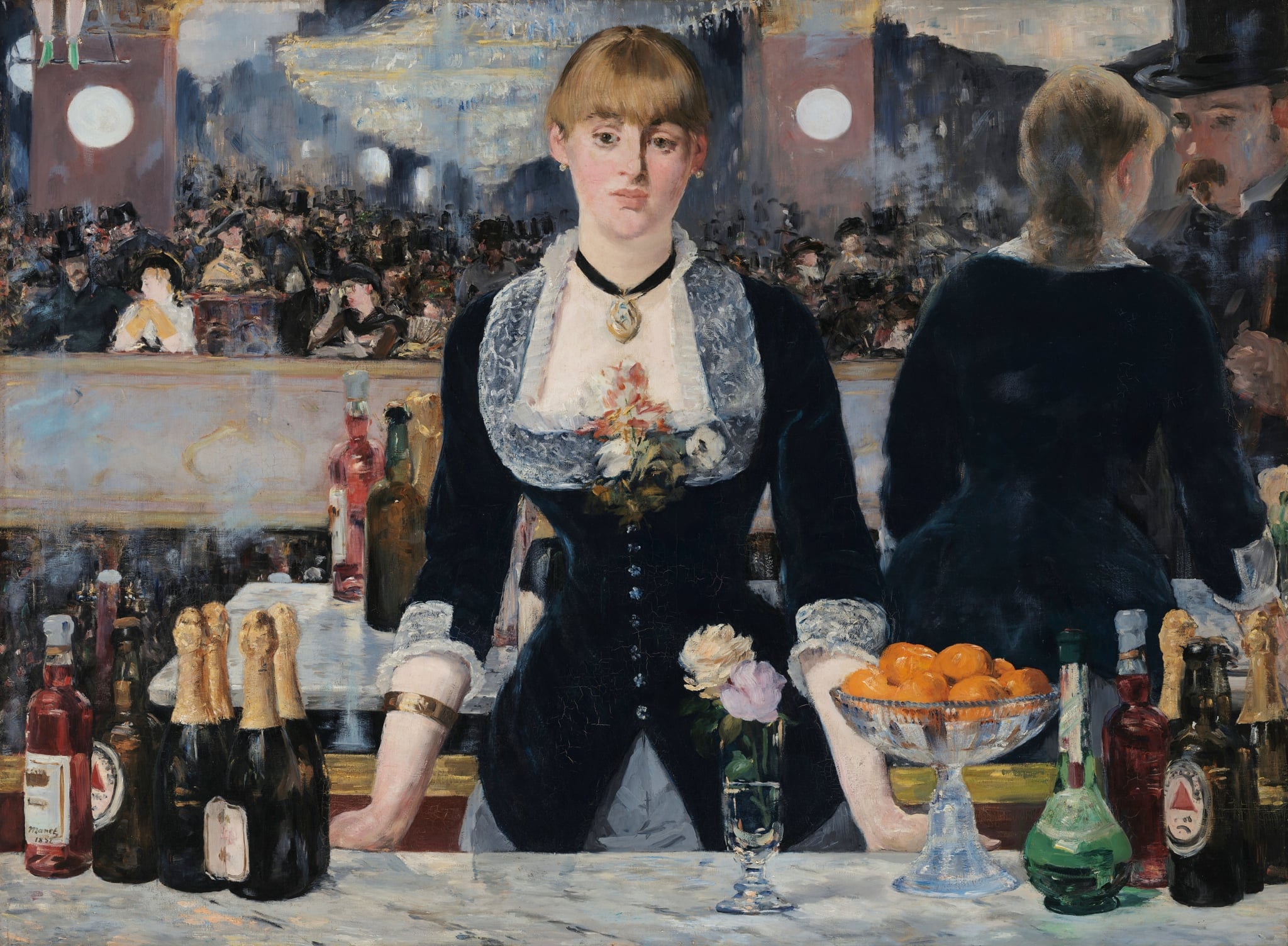
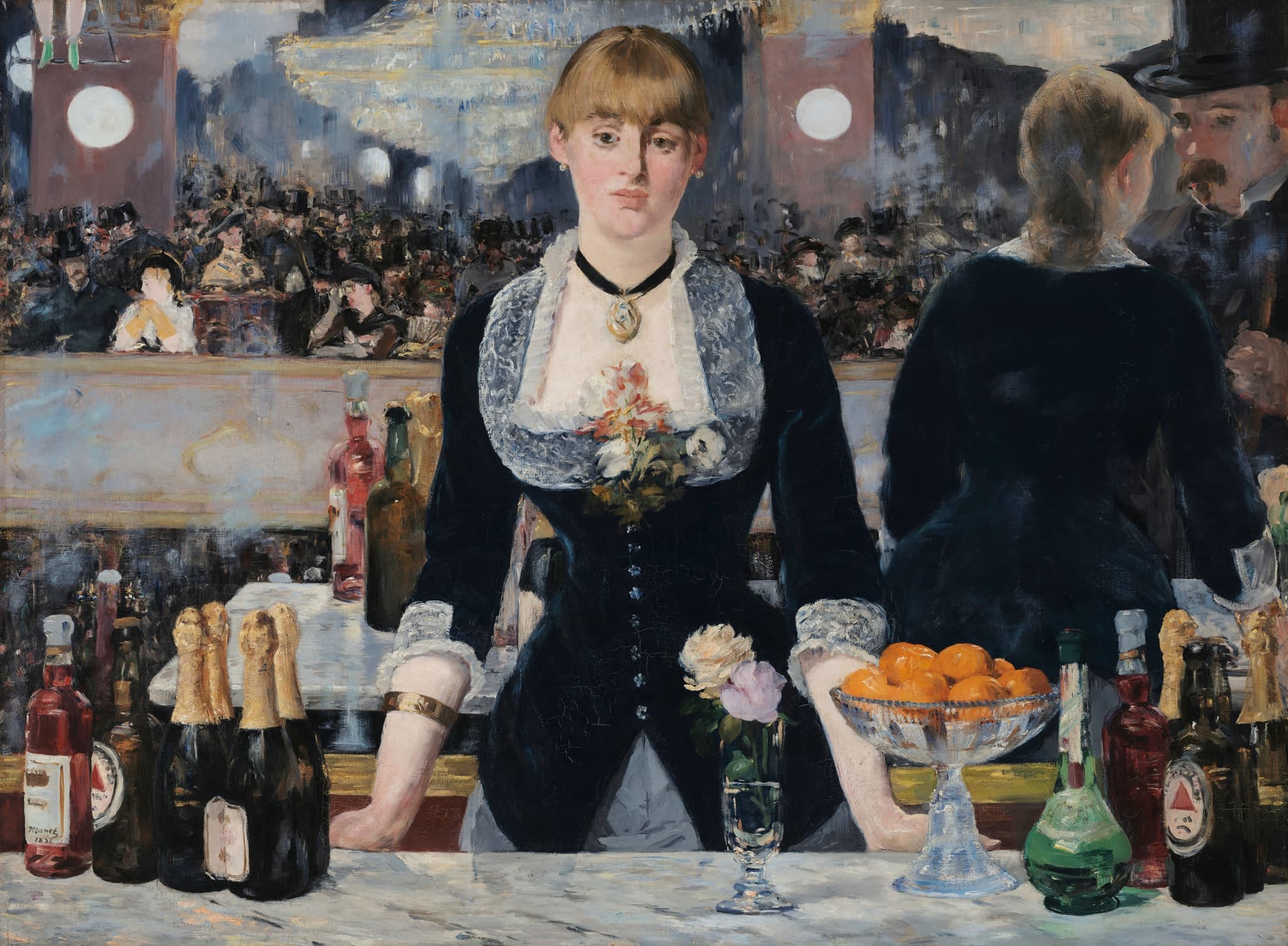
A Bar at the Folies-Bergère
Édouard Manet (1882)
Édouard Manet’s A Bar at the Folies-Bergère stages a face-to-face encounter with modern Paris, where <strong>commerce</strong>, <strong>spectacle</strong>, and <strong>alienation</strong> converge. A composed barmaid fronts a marble counter loaded with branded bottles, flowers, and a brimming bowl of oranges, while a disjunctive <strong>mirror</strong> unravels stable viewing and certainty <sup>[1]</sup><sup>[2]</sup>.
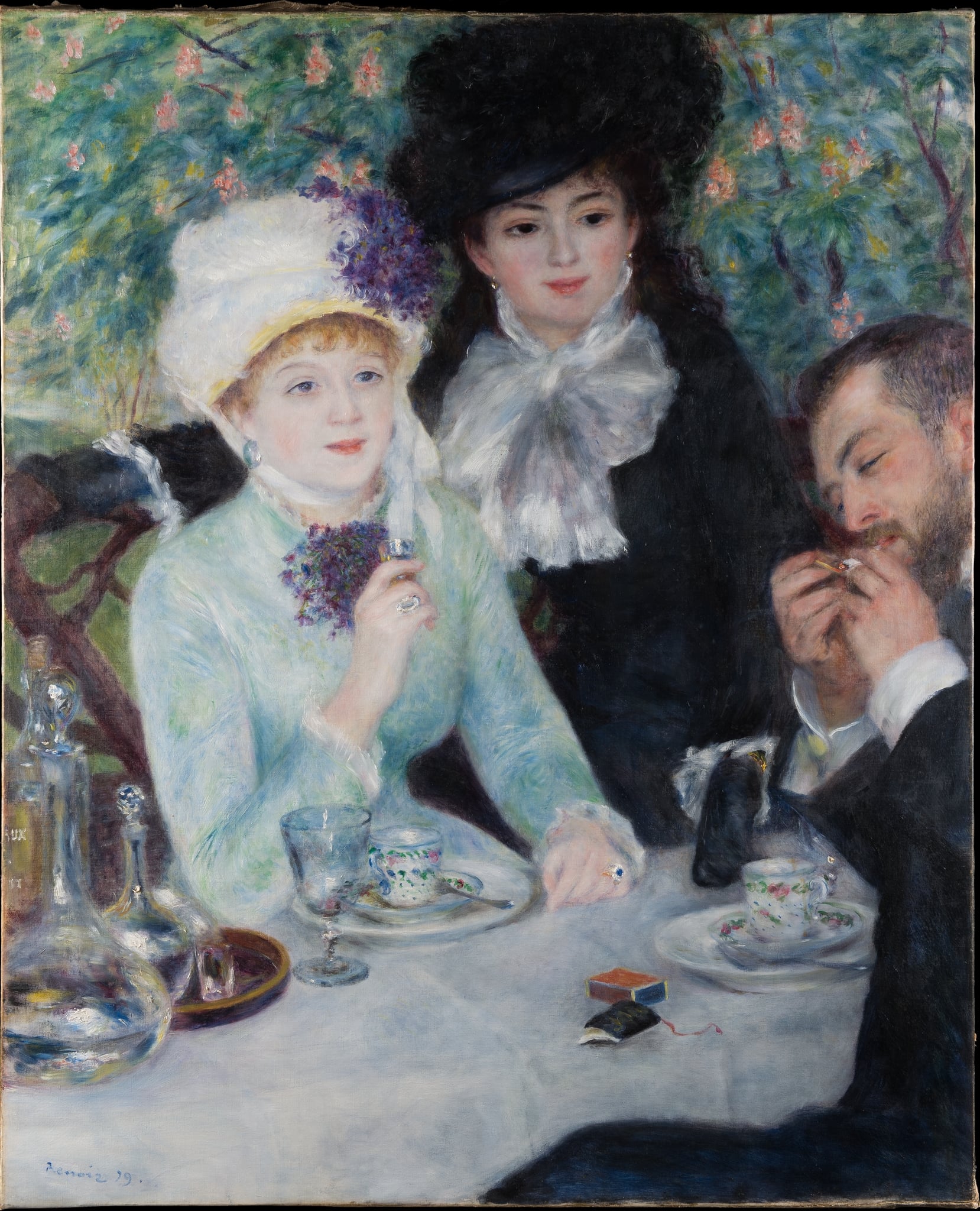
After the Luncheon
Pierre-Auguste Renoir (1879)
After the Luncheon crystallizes a <strong>suspended instant</strong> of Parisian leisure: coffee finished, glasses dappled with light, and a cigarette just being lit. Renoir’s <strong>shimmering brushwork</strong> and the trellised spring foliage turn the scene into a tapestry of conviviality where time briefly pauses.
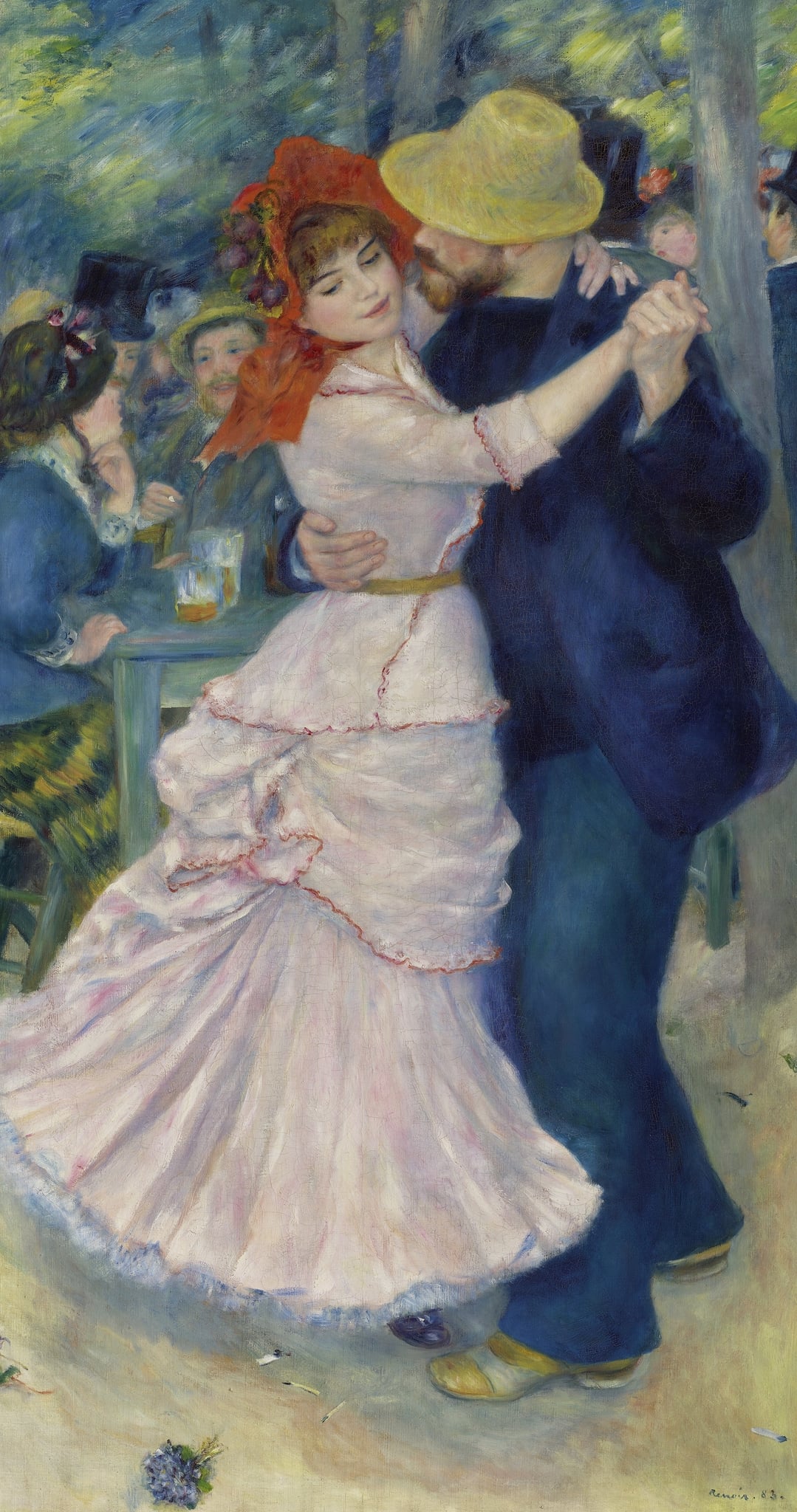
Dance at Bougival
Pierre-Auguste Renoir (1883)
In Dance at Bougival, Pierre-Auguste Renoir turns a crowded suburban dance into a <strong>private vortex of intimacy</strong>. Rose against ultramarine, skin against shade, and a flare of the woman’s <strong>scarlet bonnet</strong> concentrate the scene’s energy into a single turning moment—modern leisure made palpable as <strong>touch, motion, and light</strong> <sup>[1]</sup><sup>[2]</sup>.
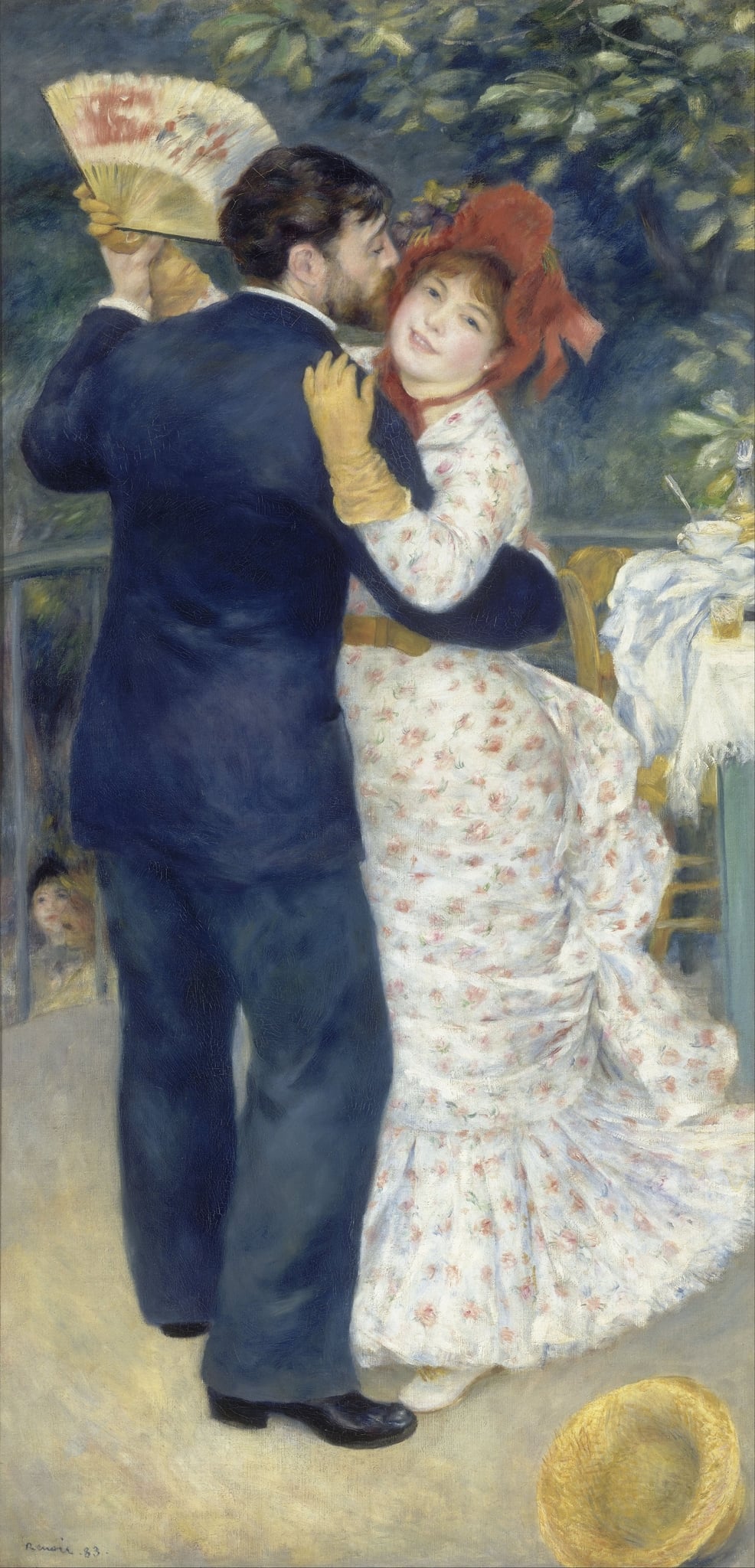
Dance in the Country
Pierre-Auguste Renoir (1883)
Dance in the Country shows a couple swept into a close embrace on a café terrace, their bodies turning in a soft spiral as foliage and sunlight dissolve into <strong>dappled color</strong>. Renoir orchestrates <strong>bourgeois leisure</strong>—the tossed straw boater, a small table with glass and napkin, the woman’s floral dress and red bonnet—to stage a moment where decorum and desire meet. The result is a modern emblem of shared pleasure, poised between Impressionist shimmer and a newly <strong>firm, linear touch</strong>.
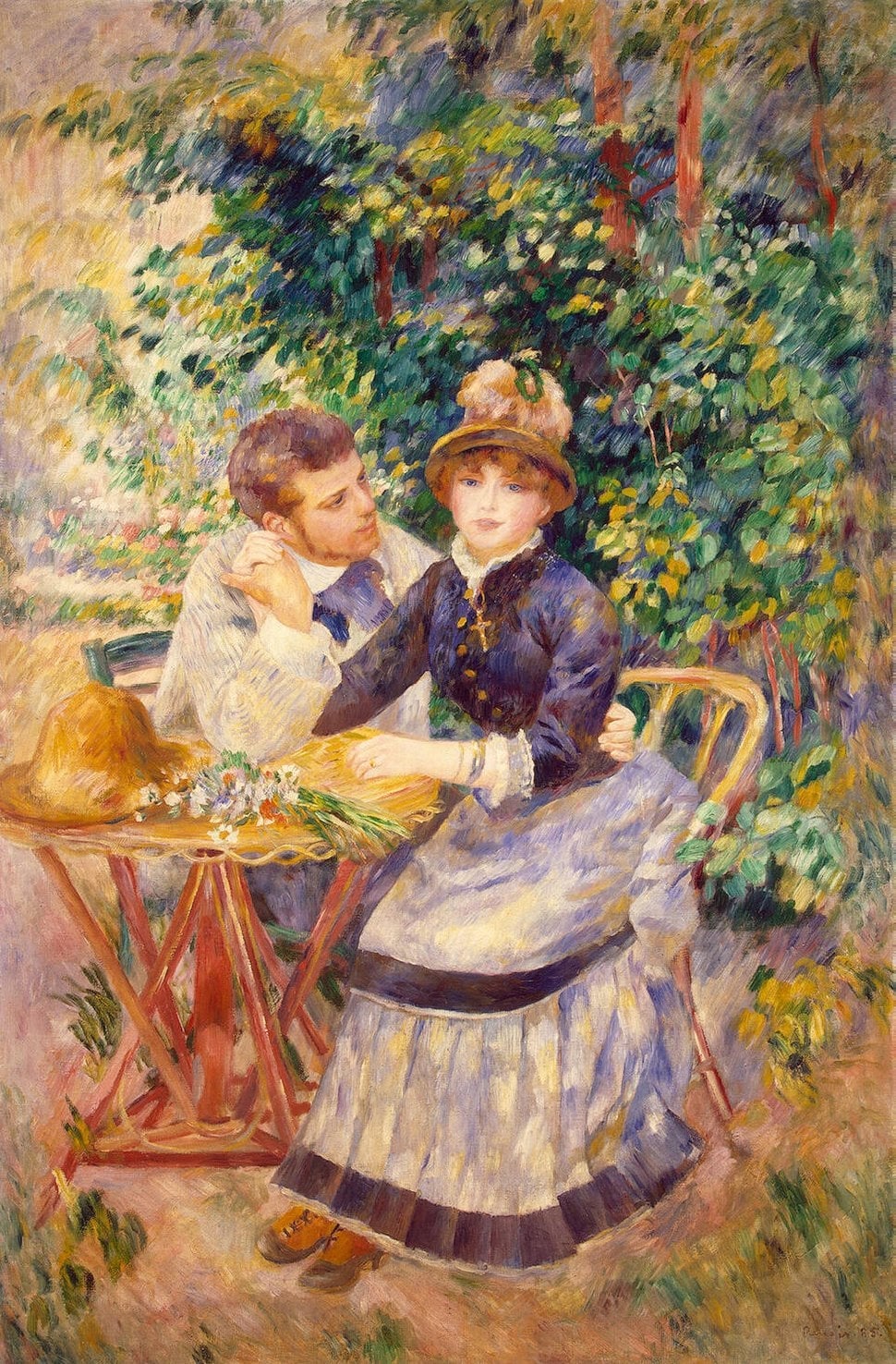
In the Garden
Pierre-Auguste Renoir (1885)
In the Garden presents a charged pause in modern leisure: a young couple at a café table under a living arbor of leaves. Their lightly clasped hands and the bouquet on the tabletop signal courtship, while her calm, front-facing gaze checks his lean. Renoir’s flickering brushwork fuses figures and foliage, rendering love as a <strong>transitory, luminous sensation</strong> <sup>[1]</sup><sup>[3]</sup>.
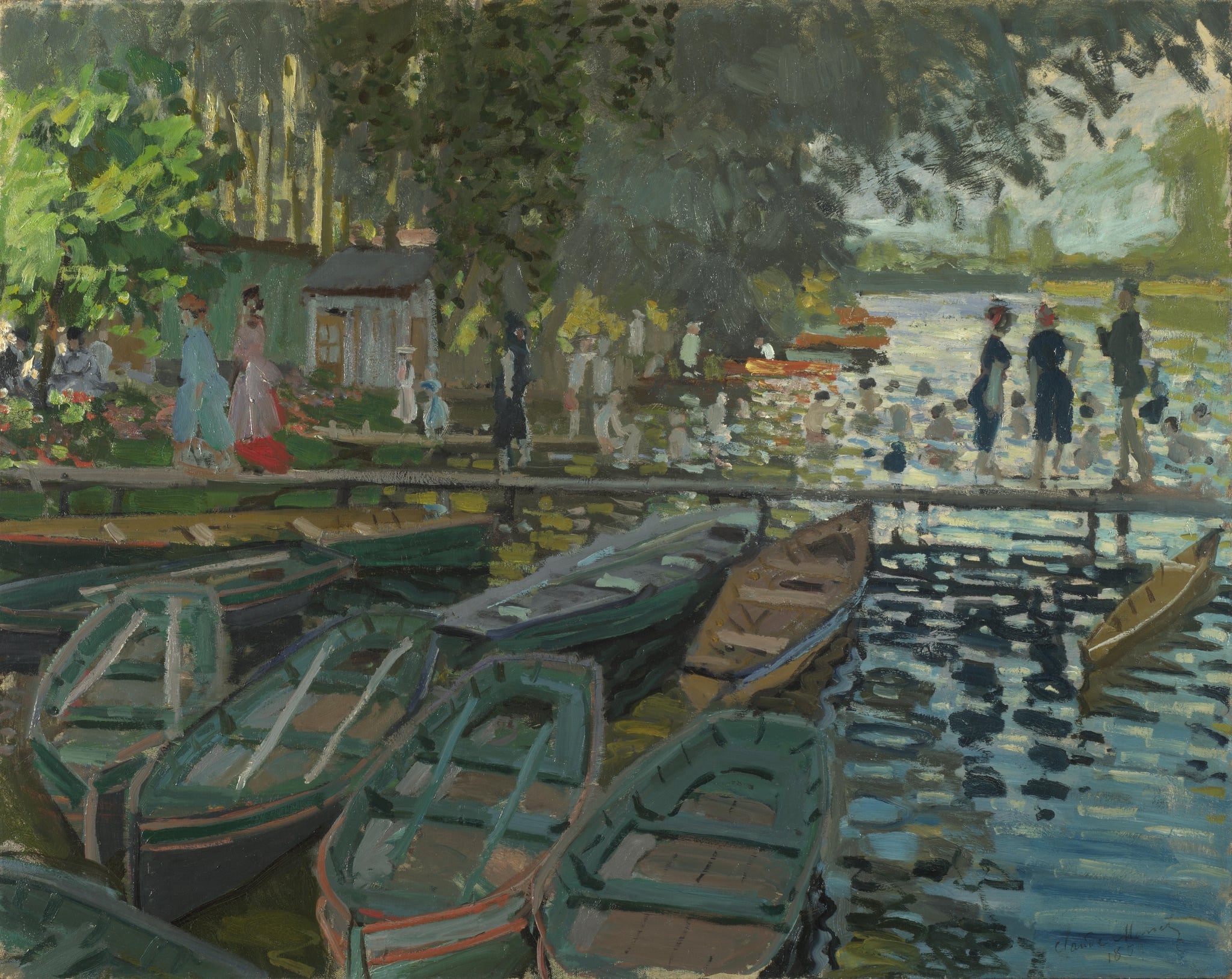
La Grenouillère
Claude Monet (1869)
Monet’s La Grenouillère crystallizes the new culture of <strong>modern leisure</strong> on the Seine: crowded bathers, promenading couples, and rental boats orbit a floating resort. With <strong>flickering brushwork</strong> and a high-key palette, Monet turns water, light, and movement into the true subjects, suspending the scene at the brink of dissolving.
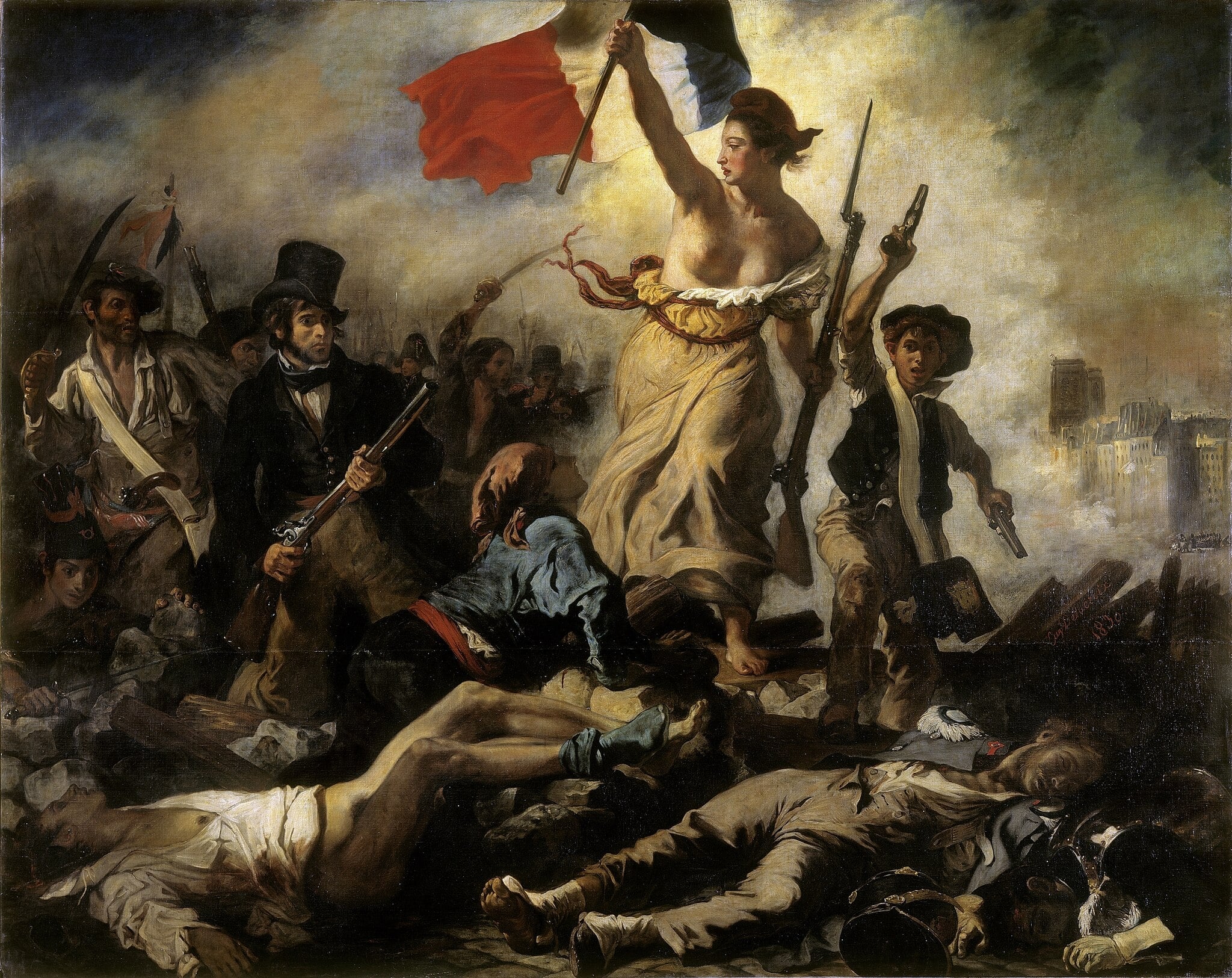
Liberty Leading the People
Eugene Delacroix (1830)
<strong>Liberty Leading the People</strong> turns a real street uprising into a modern myth: a bare‑breasted Liberty in a <strong>Phrygian cap</strong> thrusts the <strong>tricolor</strong> forward as Parisians of different classes surge over corpses and rubble. Delacroix binds allegory to eyewitness detail—Notre‑Dame flickers through smoke, a bourgeois in a top hat shoulders a musket, and a pistol‑waving boy keeps pace—so that freedom appears as both idea and action <sup>[1]</sup><sup>[2]</sup>. After its 2024 cleaning, sharper blues, whites, and reds re‑ignite the painting’s charged color drama <sup>[4]</sup>.
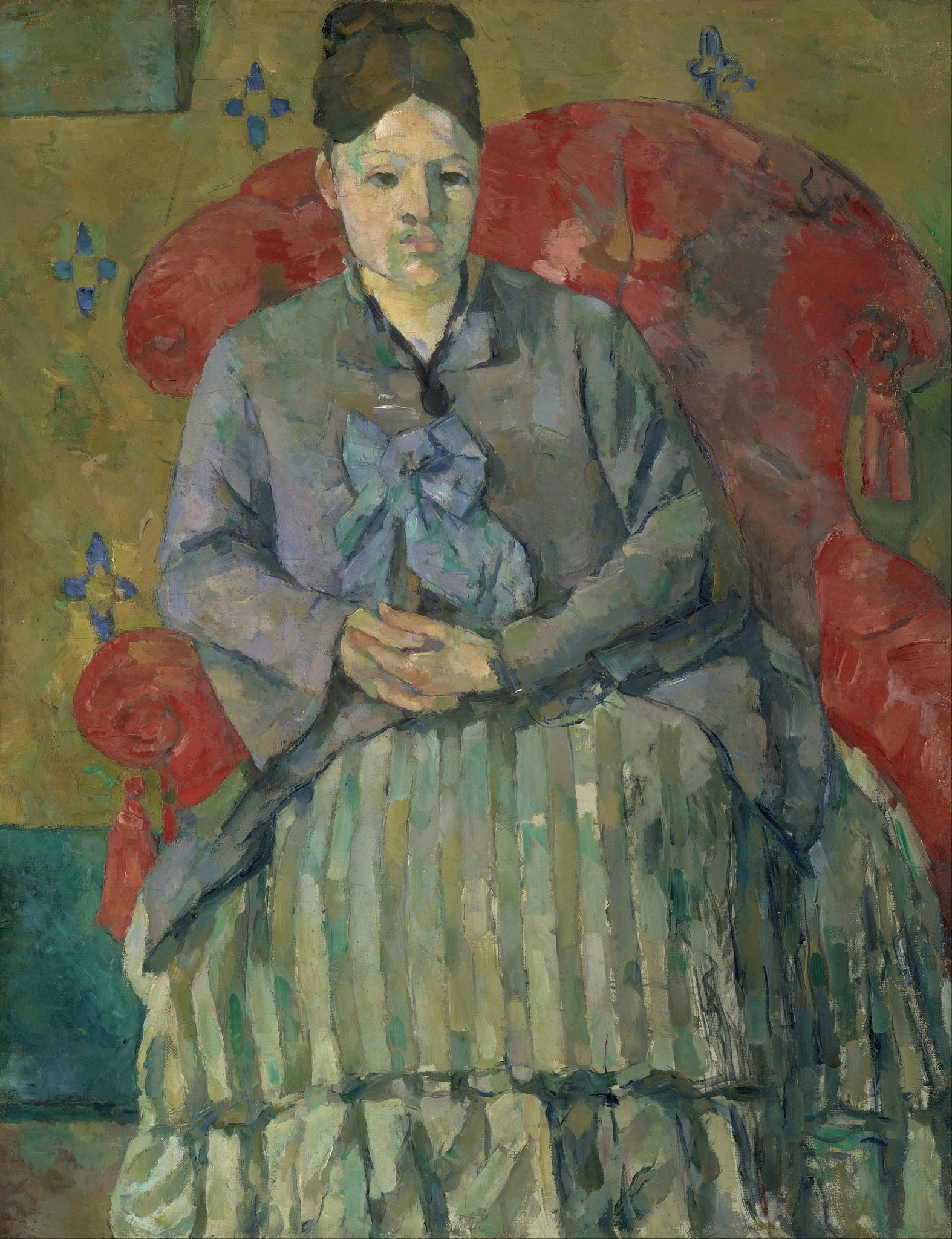
Madame Cézanne in a Red Armchair
Paul Cézanne (about 1877)
Paul Cézanne’s Madame Cézanne in a Red Armchair (about 1877) turns a domestic sit into a study of <strong>color-built structure</strong> and <strong>compressed space</strong>. Cool blue-greens of dress and skin lock against the saturated <strong>crimson armchair</strong>, converting likeness into an inquiry about how painting makes stability visible <sup>[1]</sup><sup>[3]</sup>.
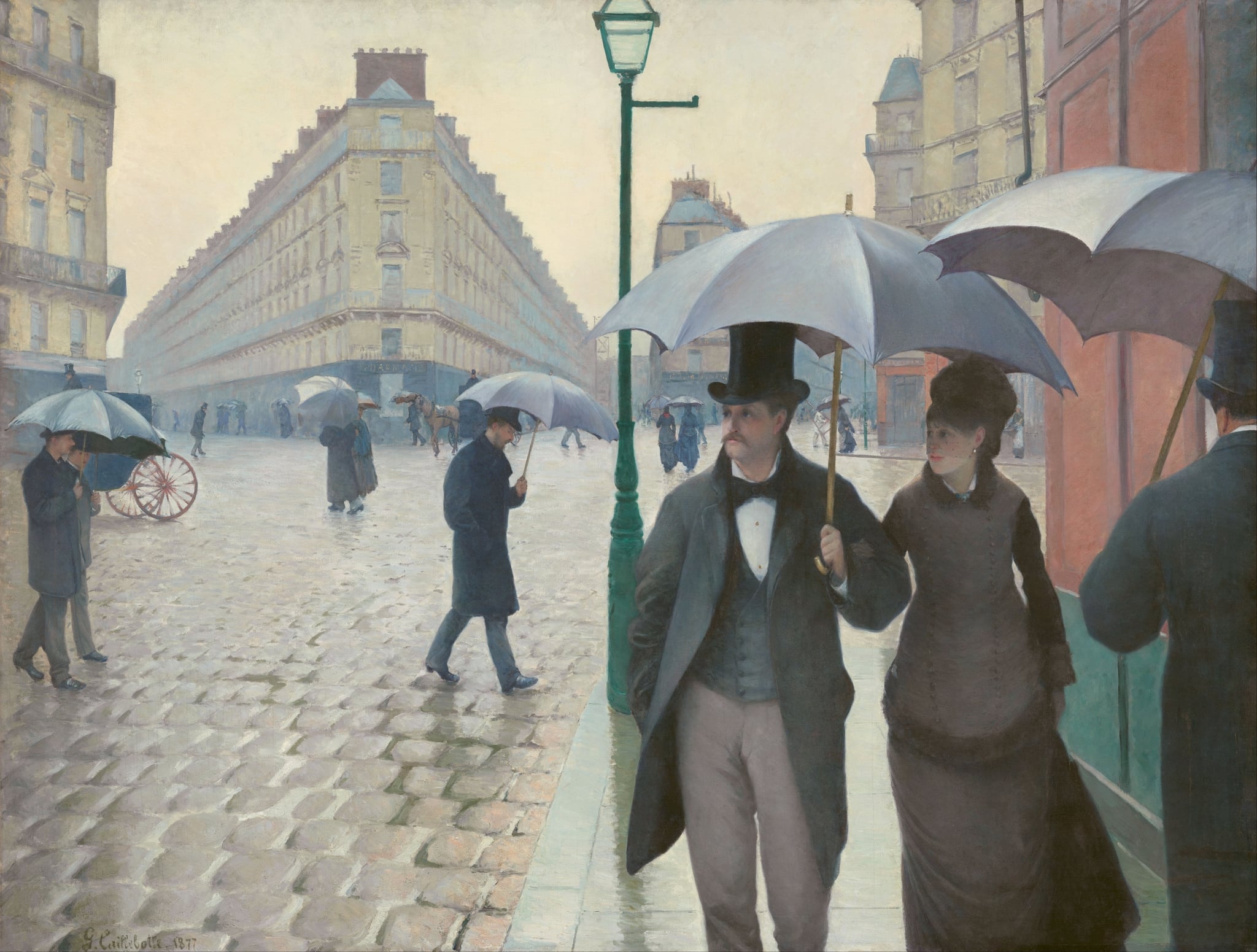
Paris Street; Rainy Day
Gustave Caillebotte (1877)
Gustave Caillebotte’s Paris Street; Rainy Day renders a newly modern Paris where <strong>Haussmann’s geometry</strong> meets the <strong>anonymity of urban life</strong>. Umbrellas punctuate a silvery atmosphere as a <strong>central gas lamp</strong> and knife-sharp façades organize the space into measured planes <sup>[1]</sup><sup>[2]</sup>.
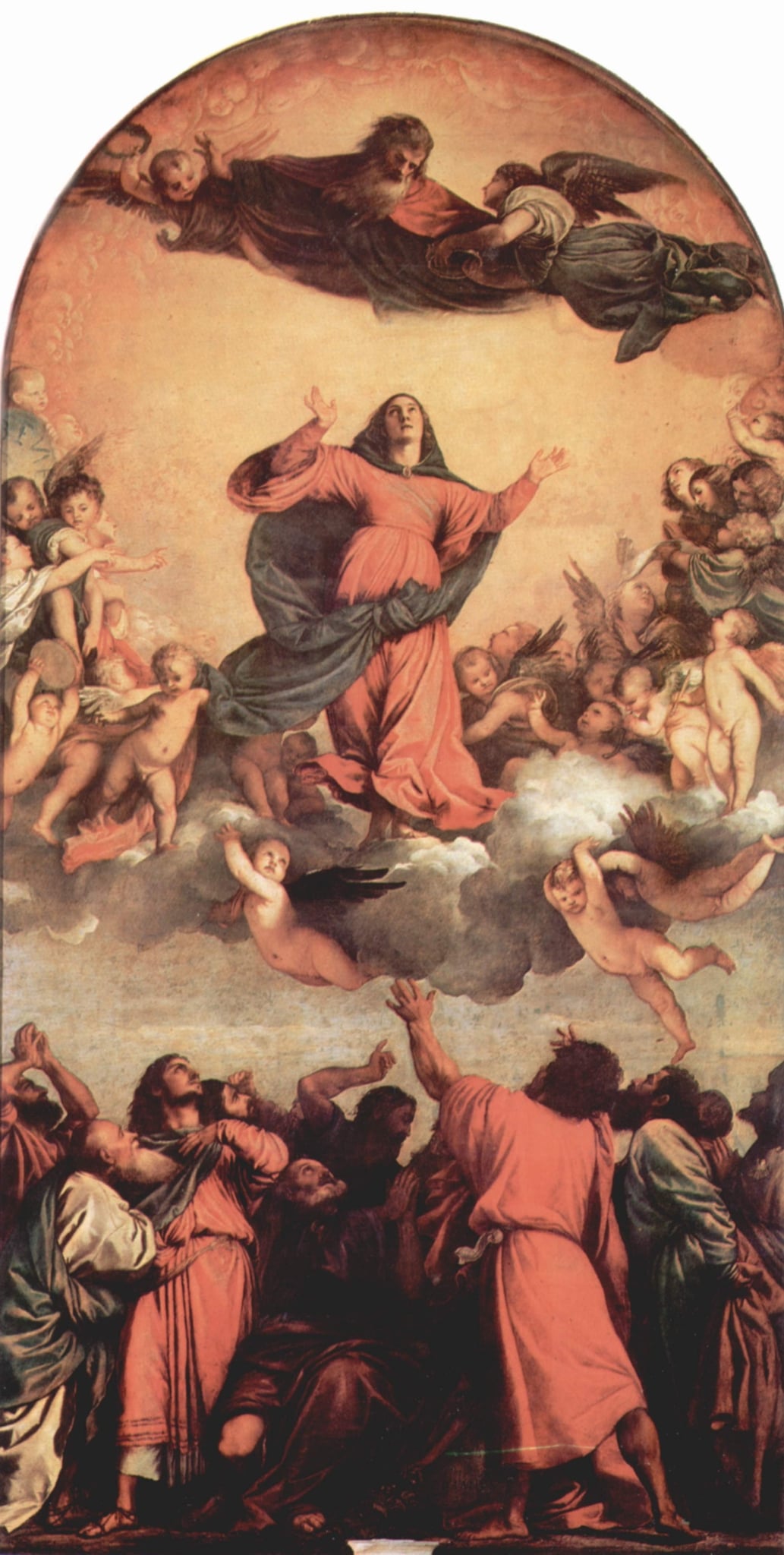
The Assumption of the Virgin
Titian (1516–1518)
Titian’s The Assumption of the Virgin stages a three-tier ascent—apostles below, Mary rising on clouds, and God the Father above—fused by radiant light and Venetian <strong>colorito</strong>. Mary’s red and blue drapery, open <strong>orant</strong> hands, and the vortex of putti visualize grace lifting humanity toward the divine. The painting’s scale and kinetic design turned a doctrinal mystery into a public, liturgical drama for Venice. <sup>[1]</sup><sup>[2]</sup>
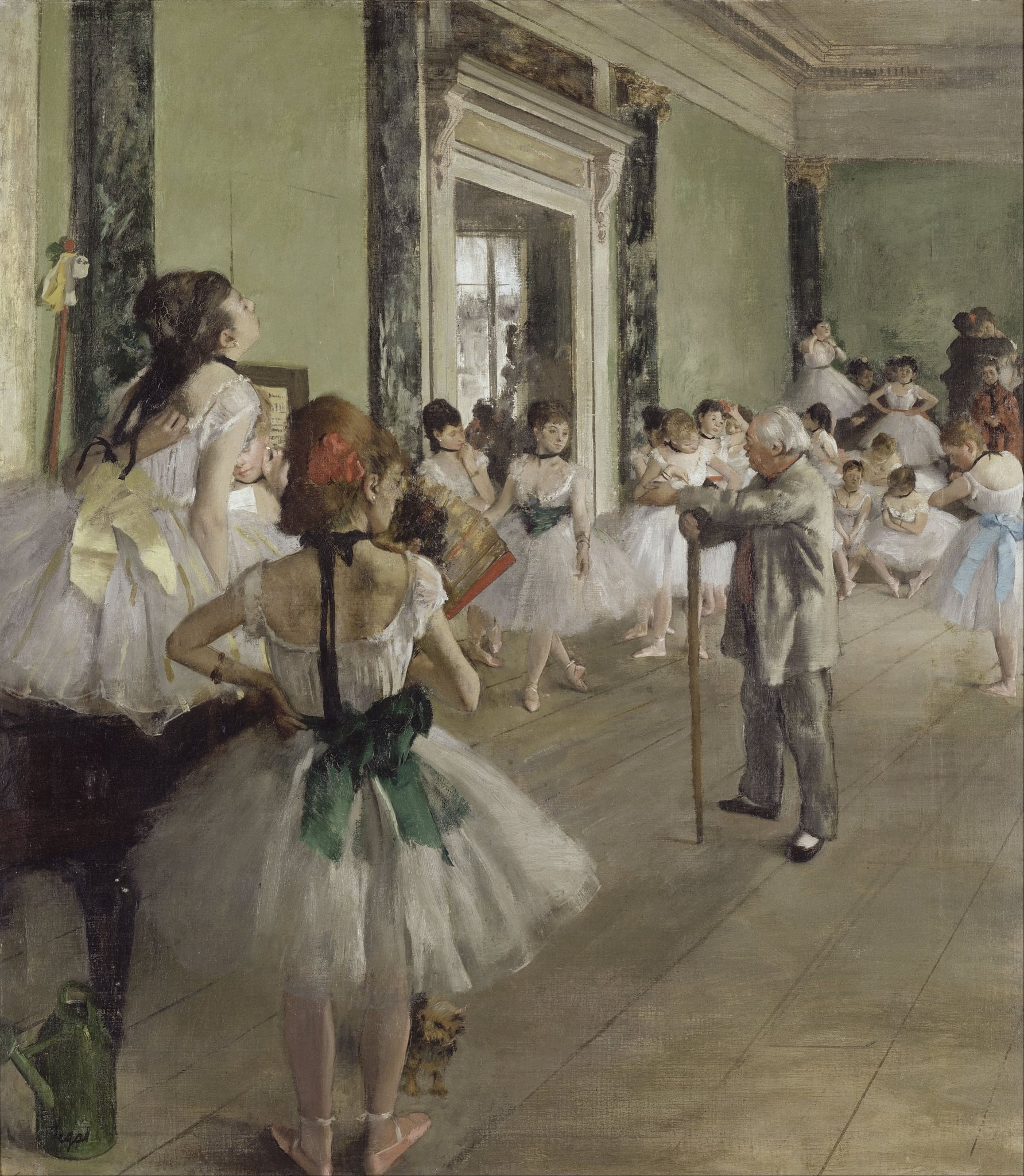
The Ballet Class
Edgar Degas (1873–1876)
<strong>The Ballet Class</strong> shows the work behind grace: a green-walled studio where young dancers in white tutus rest, fidget, and stretch while the gray-suited master stands with his cane. Degas’s diagonal floorboards, cropped viewpoints, and scattered props—a watering can, a music stand, even a tiny dog—stage a candid vision of routine rather than spectacle. The result is a modern image of discipline, hierarchy, and fleeting poise.
The Ballet Rehearsal
Edgar Degas (c. 1874)
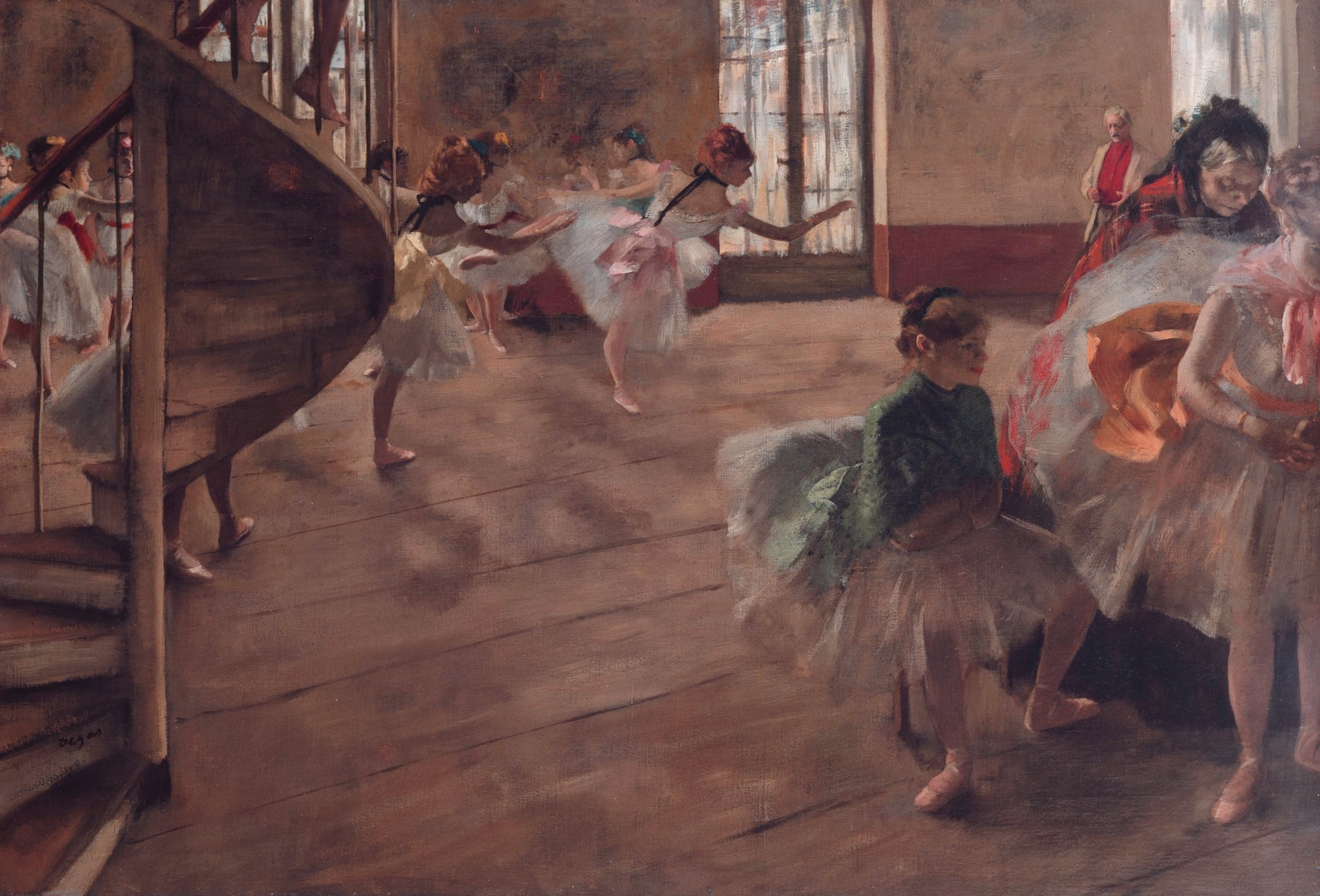
In The Ballet Rehearsal, Edgar Degas turns a practice room into a modern drama where <strong>discipline and desire</strong> collide. A dark <strong>spiral staircase</strong> slices the space, scuffed floorboards yawn open, and clusters of dancers oscillate between poised effort and weary waiting <sup>[1]</sup><sup>[4]</sup>.
The Calling of Saint Matthew
Caravaggio (1599–1600)
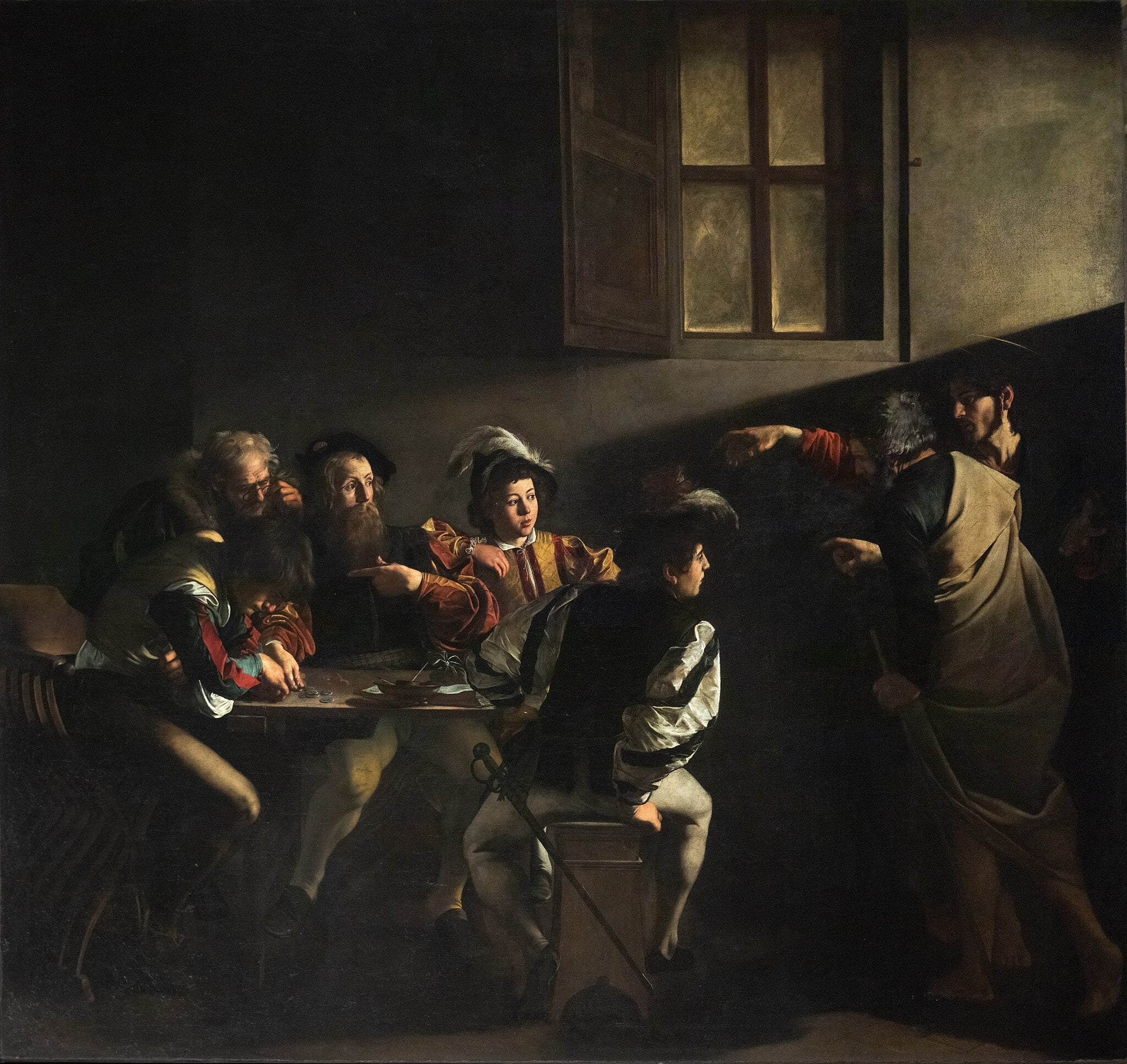
Caravaggio’s The Calling of Saint Matthew stages the instant when <strong>divine grace</strong> pierces ordinary life. A diagonal <strong>beam of light</strong> and Christ’s <strong>Sistine‑echoing hand</strong> single out Matthew at a money table, suspending time between hesitation and assent <sup>[2]</sup><sup>[3]</sup>. The painting fuses Baroque <strong>tenebrism</strong> with contemporary dress to dramatize conversion as a public, present-tense event <sup>[1]</sup><sup>[2]</sup>.
The Milkmaid
Johannes Vermeer (c. 1660)
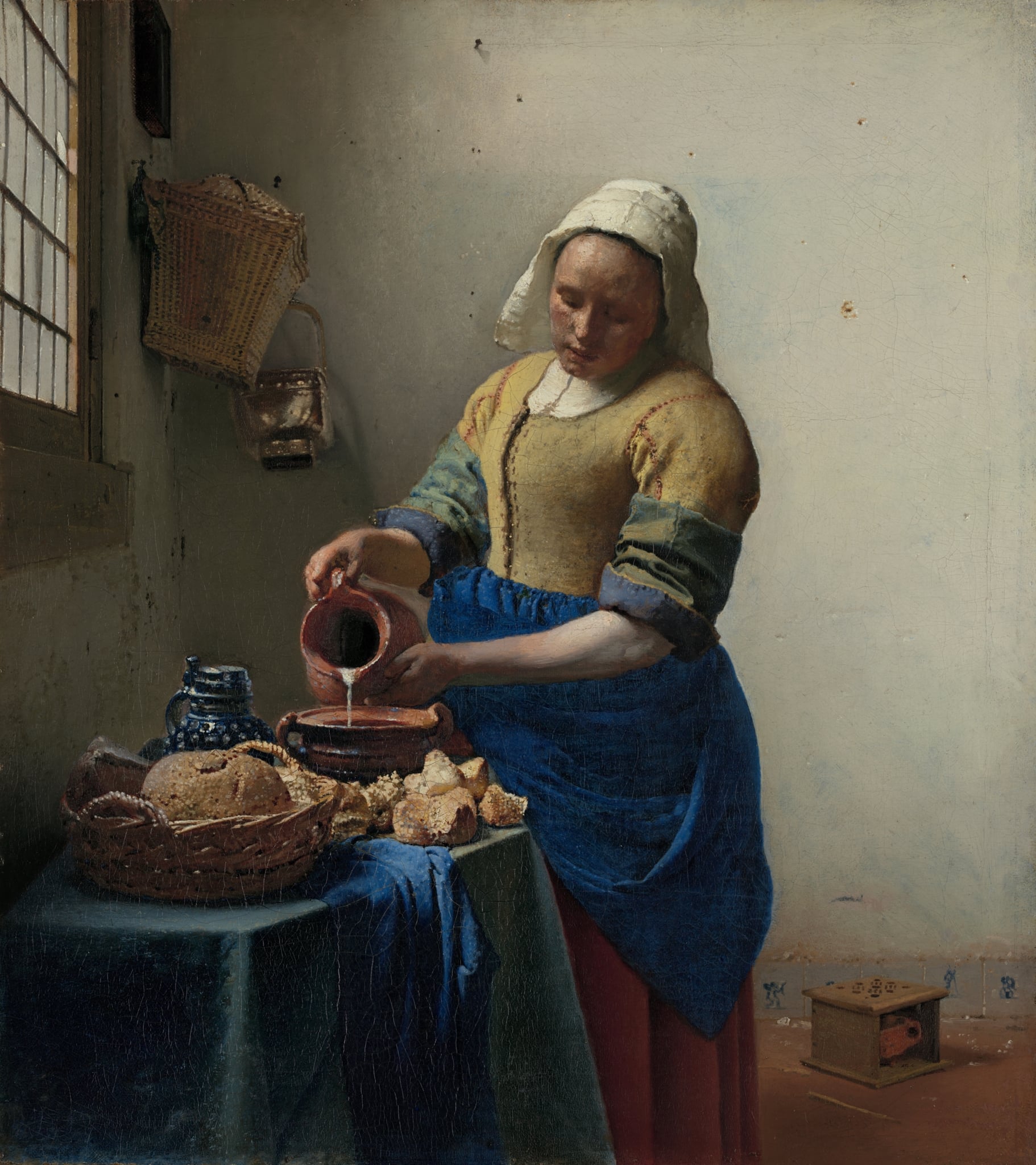
In The Milkmaid, Vermeer turns an ordinary act—pouring milk—into a scene of <strong>quiet monumentality</strong>. Light from the left fixes the maid’s absorbed attention and ignites the <strong>saturated yellow and blue</strong> of her dress, while the slow thread of milk becomes the image’s pulse <sup>[1]</sup><sup>[2]</sup>. Bread, a Delft jug, nail holes, and a small <strong>foot warmer</strong> anchor a world where humble work is endowed with dignity and latent meaning <sup>[1]</sup><sup>[2]</sup>.
The Painter’s Studio
Gustave Courbet (1854–1855)
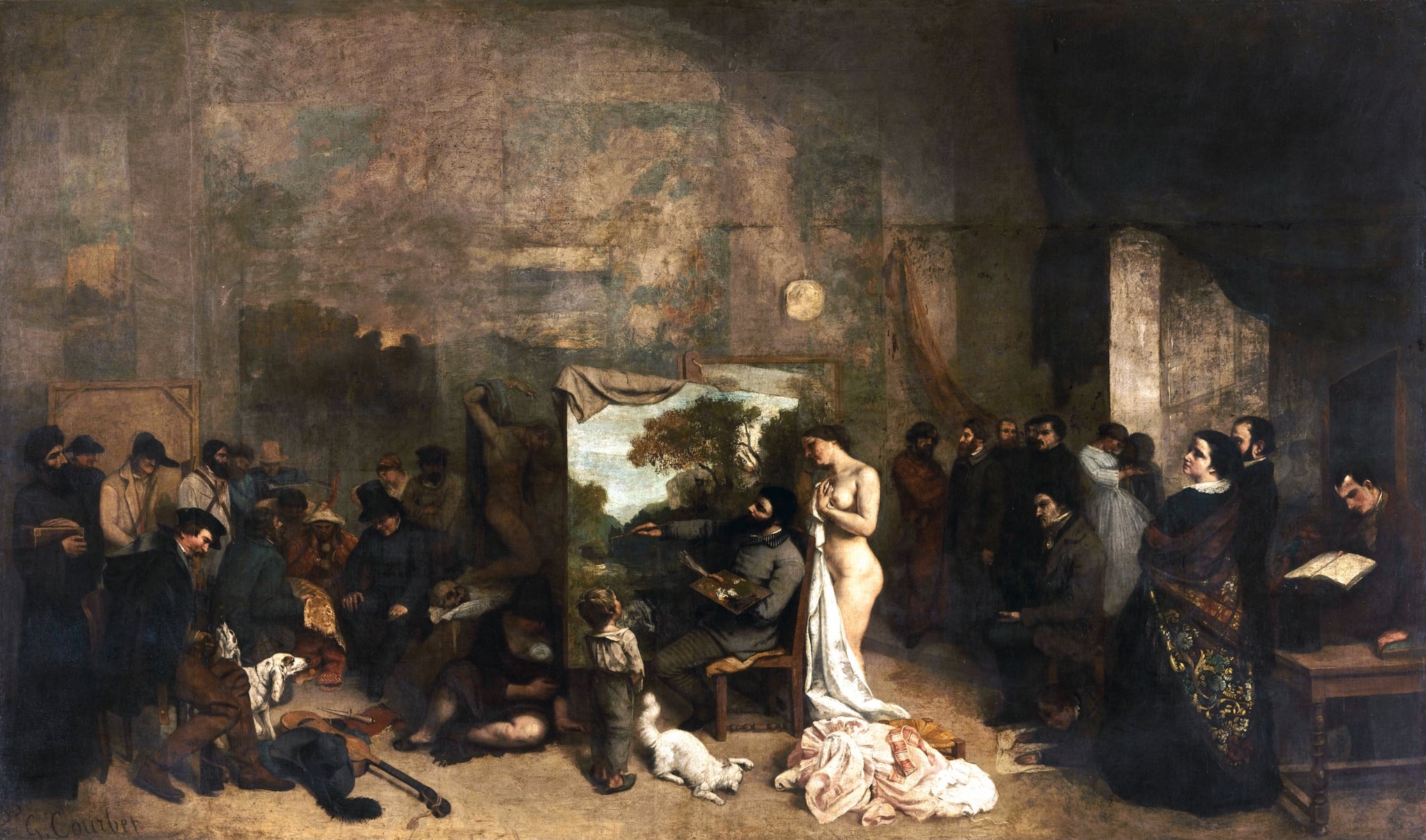
Gustave Courbet’s The Painter’s Studio stages a triptych-like drama: a radiant center where the artist paints a sunlit landscape before a child and a nude figure "naked like <strong>Truth</strong>," flanked by the "other world" of poverty and labor on the left and the "<strong>shareholders</strong>" of culture and patronage on the right <sup>[1]</sup>. The composition asserts <strong>Realism</strong> as a mediating force that translates lived experience into art without idealization.
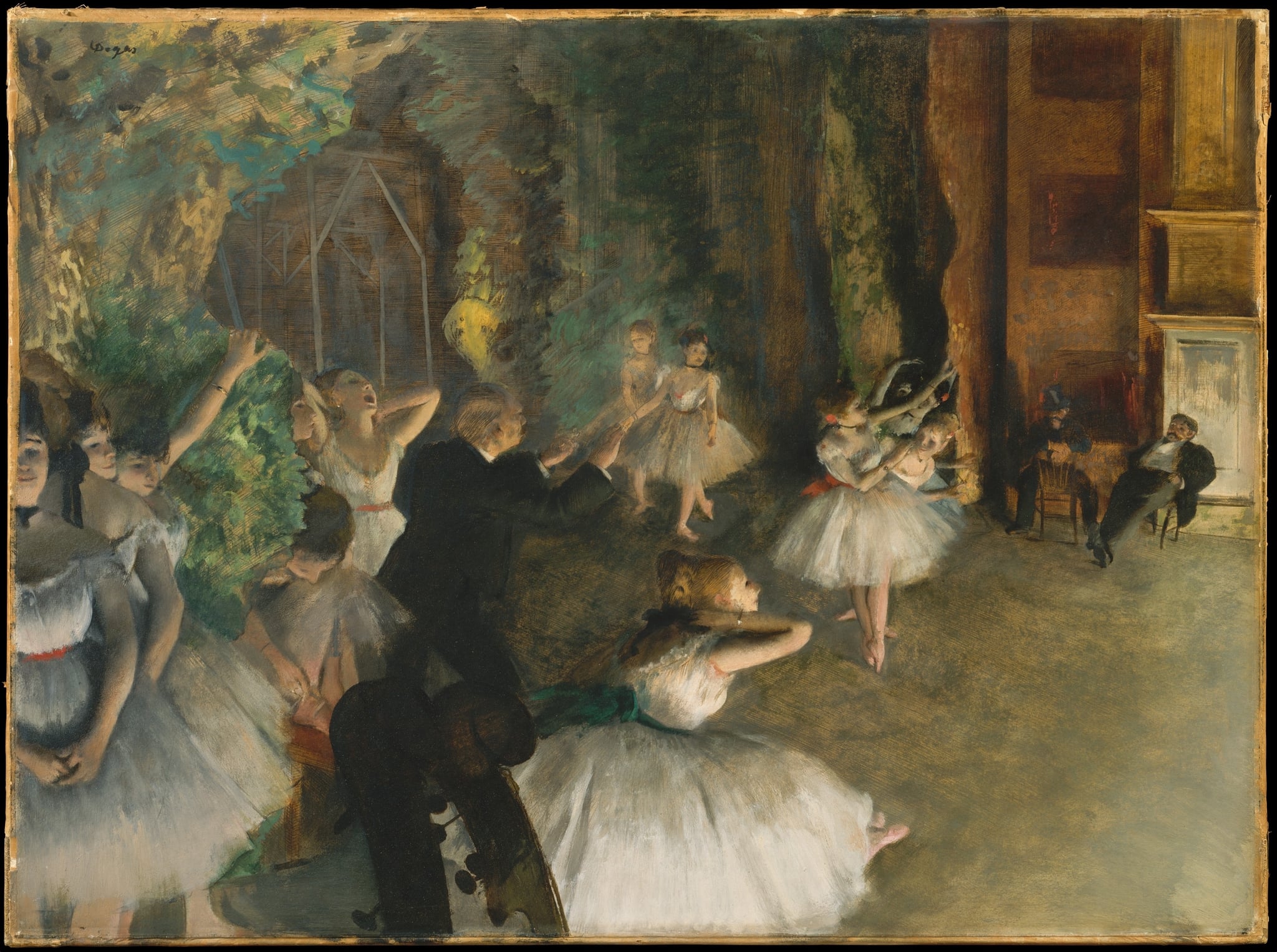
The Rehearsal of the Ballet Onstage
Edgar Degas (ca. 1874)
Degas’s The Rehearsal of the Ballet Onstage turns a moment of practice into a modern drama of work and power. Under <strong>harsh footlights</strong>, clustered ballerinas stretch, yawn, and repeat steps as a <strong>ballet master/conductor</strong> drives the tempo, while <strong>abonnés</strong> lounge in the wings and a looming <strong>double bass</strong> anchors the labor of music <sup>[1]</sup><sup>[3]</sup><sup>[4]</sup>.
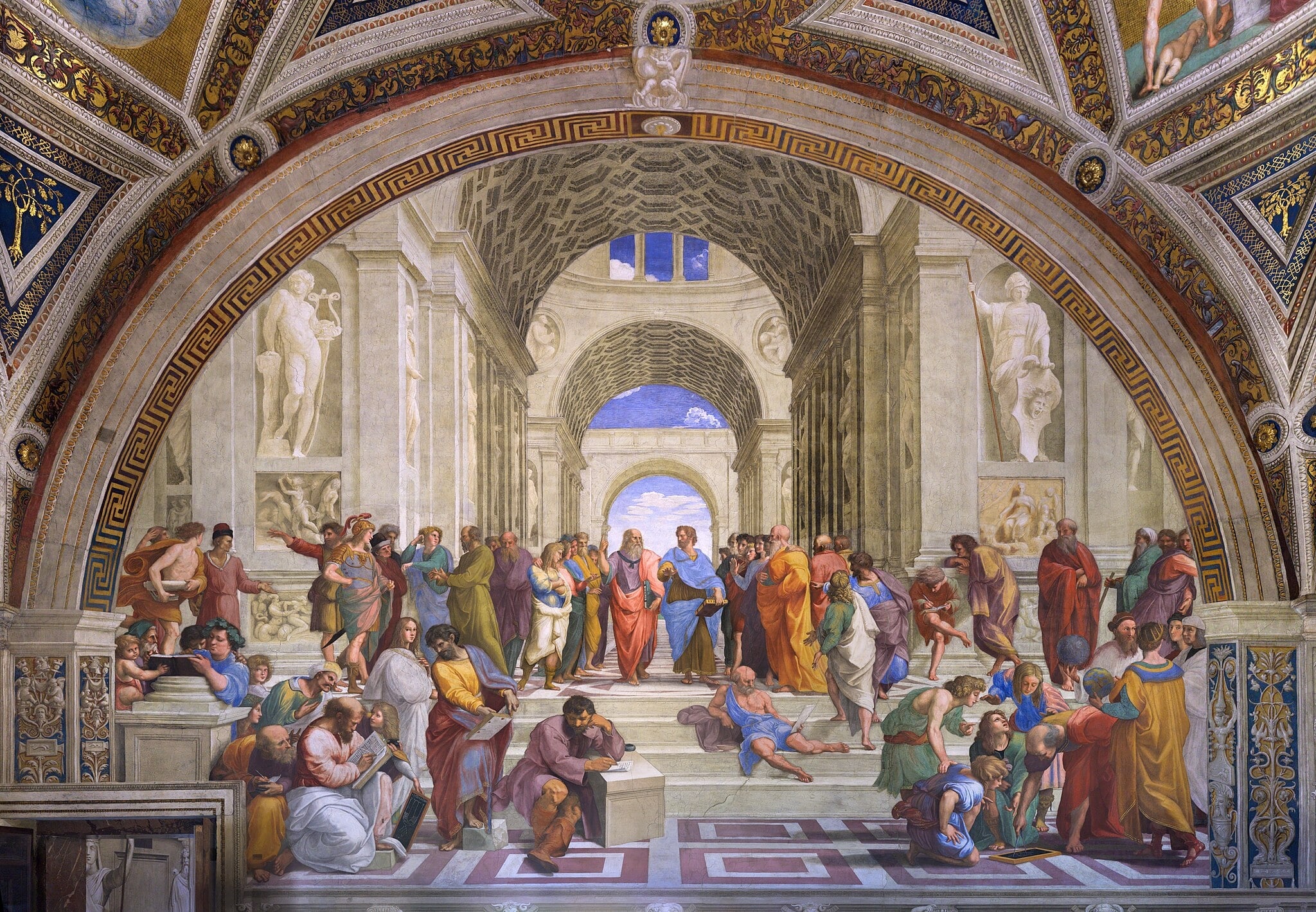
The School of Athens
Raphael (1509–1511)
Raphael’s The School of Athens orchestrates a grand debate on knowledge inside a perfectly ordered, classical hall whose one-point perspective converges on the central pair, <strong>Plato</strong> and <strong>Aristotle</strong>. Their opposed gestures—one toward the heavens, one level to the earth—establish the fresco’s governing dialectic between <strong>ideal forms</strong> and <strong>empirical reason</strong> <sup>[1]</sup><sup>[2]</sup>. Around them, mathematicians, scientists, and poets cluster under statues of <strong>Apollo</strong> and <strong>Athena/Minerva</strong>, turning the room into a temple of <strong>Renaissance humanism</strong> <sup>[1]</sup><sup>[3]</sup>.
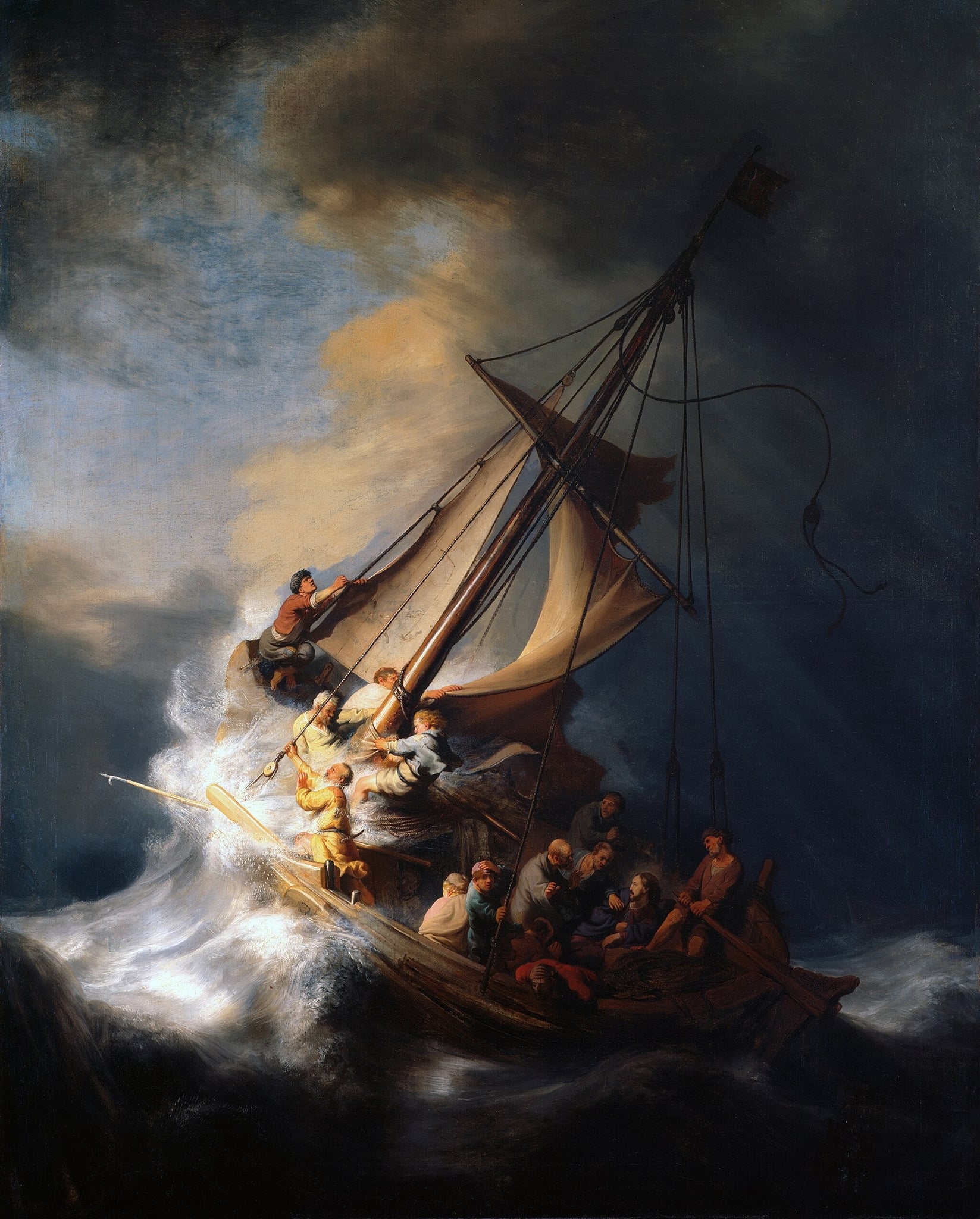
The Storm on the Sea of Galilee
Rembrandt van Rijn (1633)
Rembrandt van Rijn’s The Storm on the Sea of Galilee stages a clash of <strong>human panic</strong> and <strong>divine composure</strong> at the instant before the miracle. A torn mainsail whips across a steeply tilted boat as terrified disciples scramble, while a <strong>serenely lit Christ</strong> anchors a pocket of calm—an image of faith holding within chaos <sup>[1]</sup><sup>[3]</sup>. It is Rembrandt’s only painted seascape, intensifying its dramatic singularity in his oeuvre <sup>[2]</sup>.
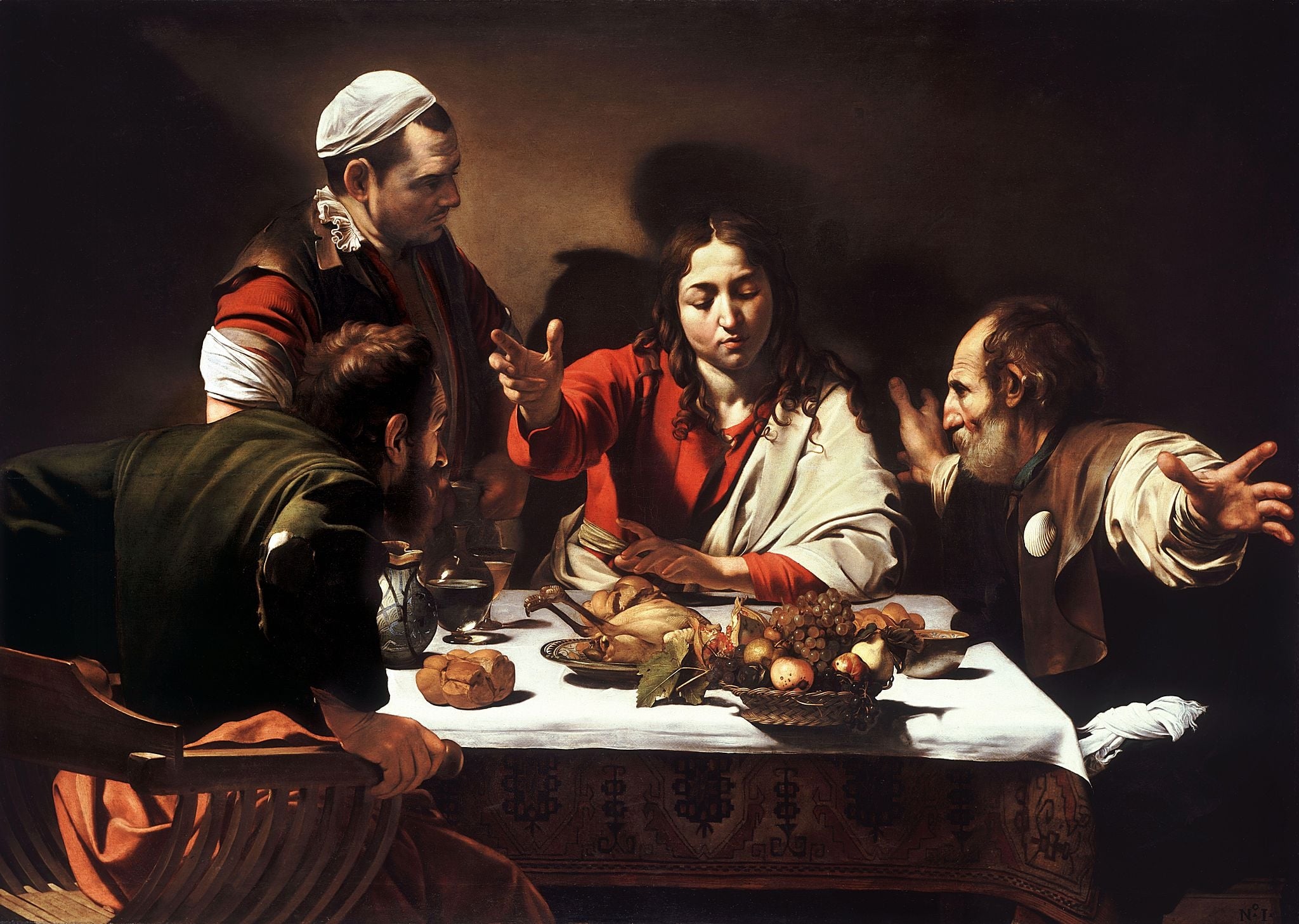
The Supper at Emmaus
Caravaggio (1601)
Caravaggio’s The Supper at Emmaus captures the split-second when two disciples recognize Christ in the <strong>breaking of bread</strong>. A raking light isolates Christ’s calm blessing while the disciples erupt—one surging forward with a torn sleeve, the other flinging his arms wide—so the shock of revelation reads as bodily fact. The teetering <strong>basket of fruit</strong> and Eucharistic table amplify themes of abundance and fragility <sup>[1]</sup><sup>[4]</sup>.
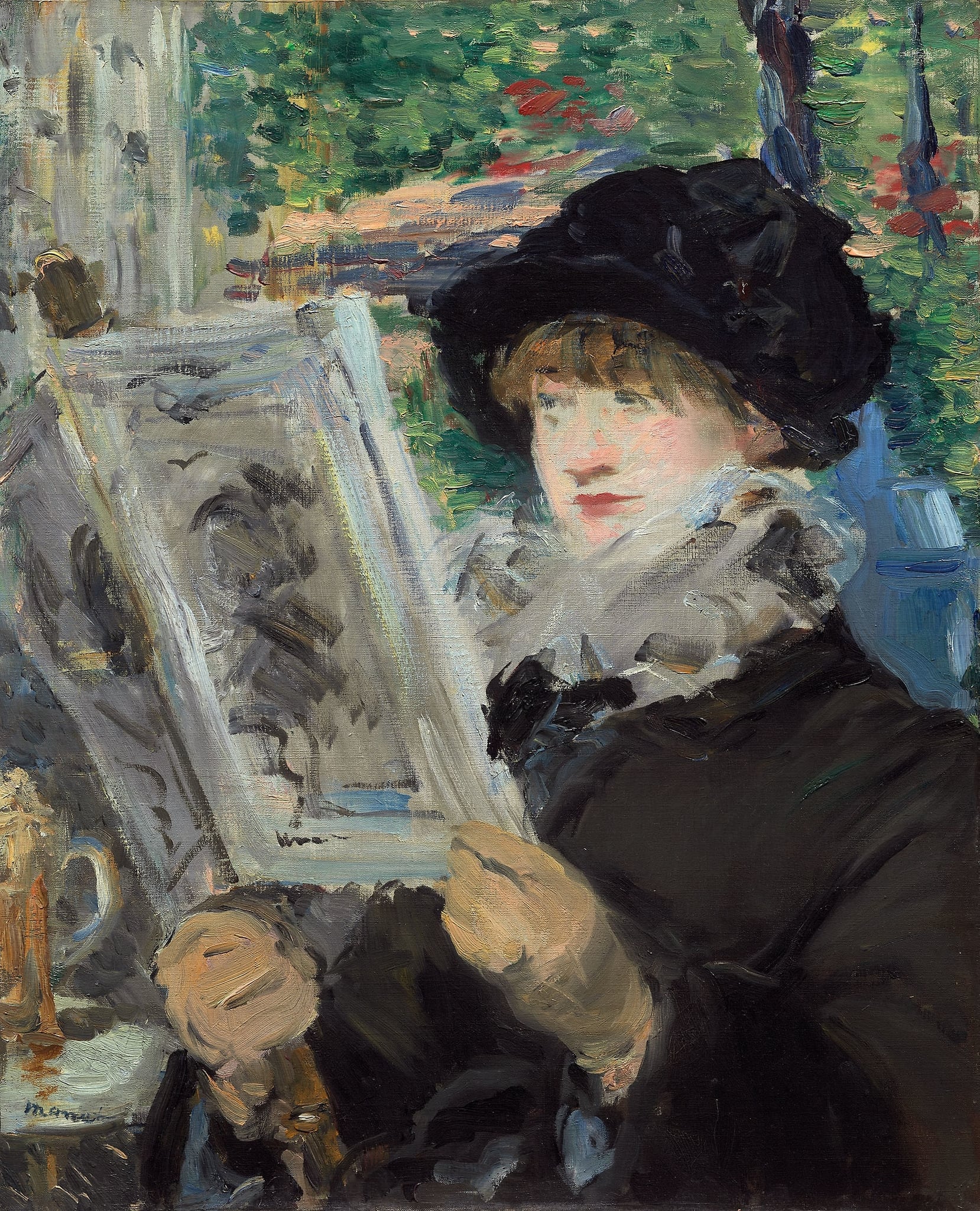
Woman Reading
Édouard Manet (1880–82)
Manet’s Woman Reading distills a fleeting act into an emblem of <strong>modern self-possession</strong>: a bundled figure raises a journal-on-a-stick, her luminous profile set against a brisk mosaic of greens and reds. With quick, loaded strokes and a deliberately cropped <strong>beer glass</strong> and paper, Manet turns perception itself into subject—asserting the drama of a private mind within a public café world <sup>[1]</sup><sup>[2]</sup>.
Related Themes
Related Symbolism Categories
Femininity
In late nineteenth‑century painting, femininity is articulated not as an essence but as a mutable ensemble of fashion, gesture, and setting, through which modern artists probe women’s visibility, labor, and agency within emerging urban and suburban worlds.
Interiority
“Interiority” symbols in modern painting transform gesture, gaze, and domestic props into visual indices of inward life, staging psychological depth, self-consciousness, and mediated subjectivity within scenes of everyday modernity.
Figure
Figure symbolism in modern painting turns the human body into a calibrated sign-system in which posture, gesture, and gaze encode shifting relations among desire, labor, authority, and spectatorship.
Within art history, ritual is not confined to explicitly sacred subjects; it names patterned, repeatable actions through which bodies, objects, and spaces acquire symbolic charge. From Eucharistic meals to café sociability and choreographed dance, artists have seized on ritual as a means to visualize how communities structure time, distribute power, and stage desire. The symbols in this category—bread and wine, bowed prayer, coffee cups and tableware, the barmaid as officiant of commerce, the gas lamppost that times the city’s day—operate as condensed signs for such practices. They function semiotically by indexing specific, historically grounded routines, and iconographically by stabilizing those routines into recognizable motifs that can be rhetorically inflected, critiqued, or transformed.
In Christian painting, ritual is both subject and syntax. The motif of bread and wine carries the heaviest theological freight, since it stands for the Eucharist as the institutionalized reenactment of Christ’s sacrifice. In Leonardo’s The Last Supper (1495–1498), the loaves and glasses before Christ “announce the Eucharist,” shifting the scene from a unique historical meal to an archetypal rite that will be repeated at every Mass. Semiologically, these elements are not mere still life; they are deictic signs pointing beyond the table to liturgical time. Leonardo reinforces this by aligning the perspectival vanishing point with Christ’s head and by casting his body in a triangular pose, so that geometry itself becomes a ritual architecture: Christ’s stable triangle, framed by bread and wine, turns the chaotic reactions of the apostles into a choreographed liturgical drama. The Eucharistic symbols thus mark a double temporality—the once-for-all event and its endless ritual repetition—while the table functions as an altar in potentia.
Caravaggio’s Supper at Emmaus (1601) refines this semiotics by isolating the breaking of bread as the key ritual gesture. Bread here is both index and icon: an index because it records the instant of fracture, and an icon because that fracture re-presents Christ’s body being given. The disciples’ explosive gestures—one lurching forward, the other flinging his arms wide—register recognition as a kind of ritual shock, but it is the humble tabletop, crowded with foodstuffs, that grounds the miracle in daily practice. Ordinary eating is transfigured by a single liturgical act, suggesting that ritual meaning adheres not in exotic objects but in repeated motions invested with belief. The same semantic logic governs the quieter motif of bread and crusts in more modest devotional or genre scenes: these fragments signify thrift and humble abundance, but in a Christian visual culture habituated to Eucharistic symbolism they also whisper of sacrament displaced into domestic space.
Other Christian motifs underscore the bodily posture of ritual. The bowed prayer posture condenses a complex theology of humility and petition into a single silhouette. In Gauguin’s The Yellow Christ (1889), Breton women kneeling before a local calvary enact a shared devotional routine. Their bent backs and folded hands weave communal piety into the very landscape, while the Breton calvary itself relocates the Passion to village soil. Here ritual is not only depicted but localized: the global liturgy of the Mass and the Passion narrative are translated into the repetitive, seasonal rhythms of Brittany. The bowed posture and the wooden cross function iconographically as portable liturgy, signaling that rites of remembrance and intercession can be performed in fields, at roadside shrines, and in the imagination of the painter.
By the nineteenth century, secular modern life develops its own ritual structures, which Impressionist and Realist painters register with acute attentiveness. In Renoir’s After the Luncheon (1879), coffee cups and saucers, a small liqueur glass, and an open matchbox on the white-draped table delineate a precise sequence: wine, then coffee, then digestif, then cigarette. These objects are semiotic markers of an after-meal rite, a bourgeois punctuation of time in which conversation and relaxation congeal. Iconographically, such tableware announces a codified social script as clearly as a chalice does in a religious scene. Renoir’s dissolving brushwork, which lets reflections play across glass and porcelain, visually enacts the transition from the solid business of eating to the more vaporous pleasures of talk and smoke; ritual here is ephemeral but insistently patterned.
A similar logic governs the café and dance-terrace paintings of Renoir and Manet. In A Bar at the Folies-Bergère (1882), the bar counter laid with branded bottles, a brimming bowl of oranges, and chilled champagne forms an altar of commodity. The barmaid, Suzon, assumes the role of officiant in a ritual of urban pleasure: she dispenses drinks rather than sacraments, yet the structuring principles are analogous—repetition, exchange, a codified choreography of gestures. The beer glass, with its foaming head, and the arrangement of bottles function semiotically as emblems of café culture and momentary escape, while the disjunctive mirror folds the viewer into the rite as participant-observer. Manet exploits this symbolism to critique the commodification of bodies: the same ritual that promises sociability also scripts the barmaid as both server and merchandise.
Renoir’s Dance at Bougival (1883) and Dance in the Country (1883) translate ritual into kinetic form. Public dancing in suburban cafés followed stringent codes—gloves, propriety of touch, chaperonage—even as it offered sanctioned spaces for flirtation. Renoir condenses these conventions into the motif of clasped, ungloved hands at Bougival and long yellow gloves in the country scene. At Bougival, bare intertwined fingers are the pivot of the composition: they signal a moment of public intimacy that pushes against decorum. Their circular motion, echoed by skirts, hems, and foliage, turns the dance into a ritual vortex, a collectively understood pattern in which individual desire is momentarily licensed. In Dance in the Country, by contrast, the woman’s gloves insist on etiquette even as she yields to the turn; the abandoned straw boater and half-finished drink on the café table register that this rite of motion has interrupted another set of rituals—drinking, chatting, sitting. These intersecting scripts of leisure exemplify how modern ritual is layered and negotiable, rather than monolithic.
Urban infrastructure too can become a ritual symbol. In Caillebotte’s Paris Street; Rainy Day (1877), the central gas lamppost functions as more than street furniture. It signifies the standardized rhythms of Haussmann’s rebuilt city—lighting schedules, regulated circulation, the choreography of pedestrians under umbrellas. Positioned as a visual pivot that divides the composition into triangles, the lamppost is the axial object around which urban life rotates. Semiologically, it stands for the rationalization of time and space; iconographically, it has become an emblem of the new rituals of the boulevard: the flâneur’s promenade, the anonymous passing of strangers, the calibrated pace of modern existence. Where the church altar once organized communal time around liturgical hours, gaslight organizes it around work and leisure, visibility and rain-slicked nocturnes.
Across these examples, the evolution of ritual symbolism can be traced from overtly sacred rites, articulated through explicit motifs like bread and wine or bowed prayer, to the secular liturgies of modernity—café etiquette, suburban dancing, urban strolling—articulated through coffee cups, beer glasses, gloves, and lampposts. Yet the underlying iconographic mechanics remain strikingly continuous. Artists rely on repeated objects, codified gestures, and stable spatial markers to suggest that what is depicted belongs not to arbitrary incident but to patterned, socially shared practice. Over time, the content of these practices shifts—from Eucharistic sacrifice to consumer exchange, from pilgrimage to weekend excursion—but the visual rhetoric of ritual persists. Painting thus becomes a privileged medium for registering how societies script the body and organize time, turning everyday routines into symbols through which historical transformations of belief, class, and desire can be read.