Urban
Urban symbolism in modern painting transforms streets, stations, and squares into coded fields where infrastructure, light, and crowd dynamics visualize the social logics of the nineteenth- and early twentieth‑century city.
Member Symbols
Featured Artworks
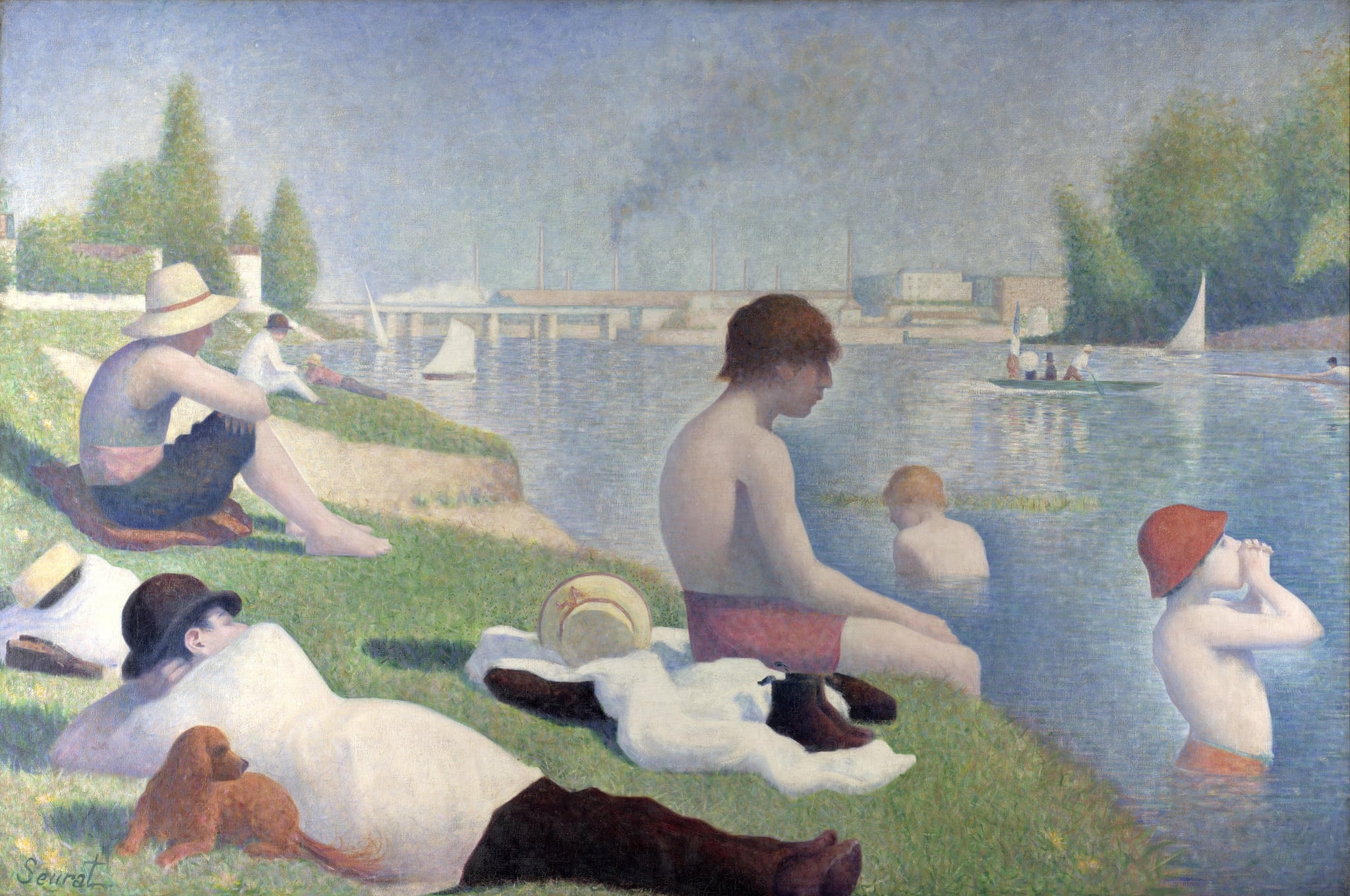
Bathers at Asnières
Georges Seurat (1884)
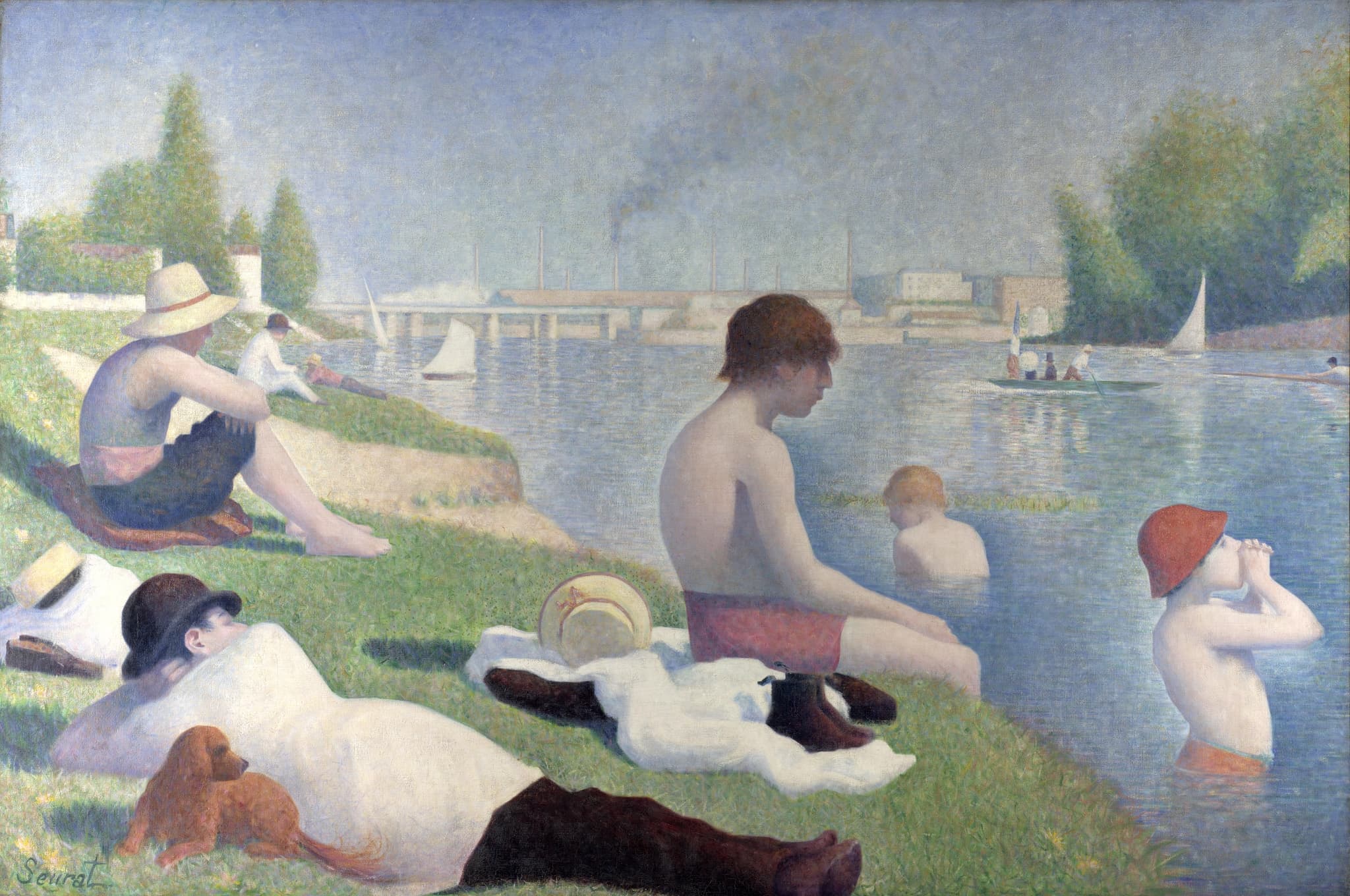
Bathers at Asnières stages a scene of <strong>modern leisure</strong> on the Seine, where workers recline and wade beneath a hazy, unified light. Seurat fuses <strong>classicizing stillness</strong> with an <strong>industrial backdrop</strong> of chimneys, bridges, and boats, turning ordinary rest into a monumental, ordered image of urban life <sup>[1]</sup><sup>[3]</sup>. The canvas balances soft greens and blues with geometric structures, producing a calm yet charged harmony.
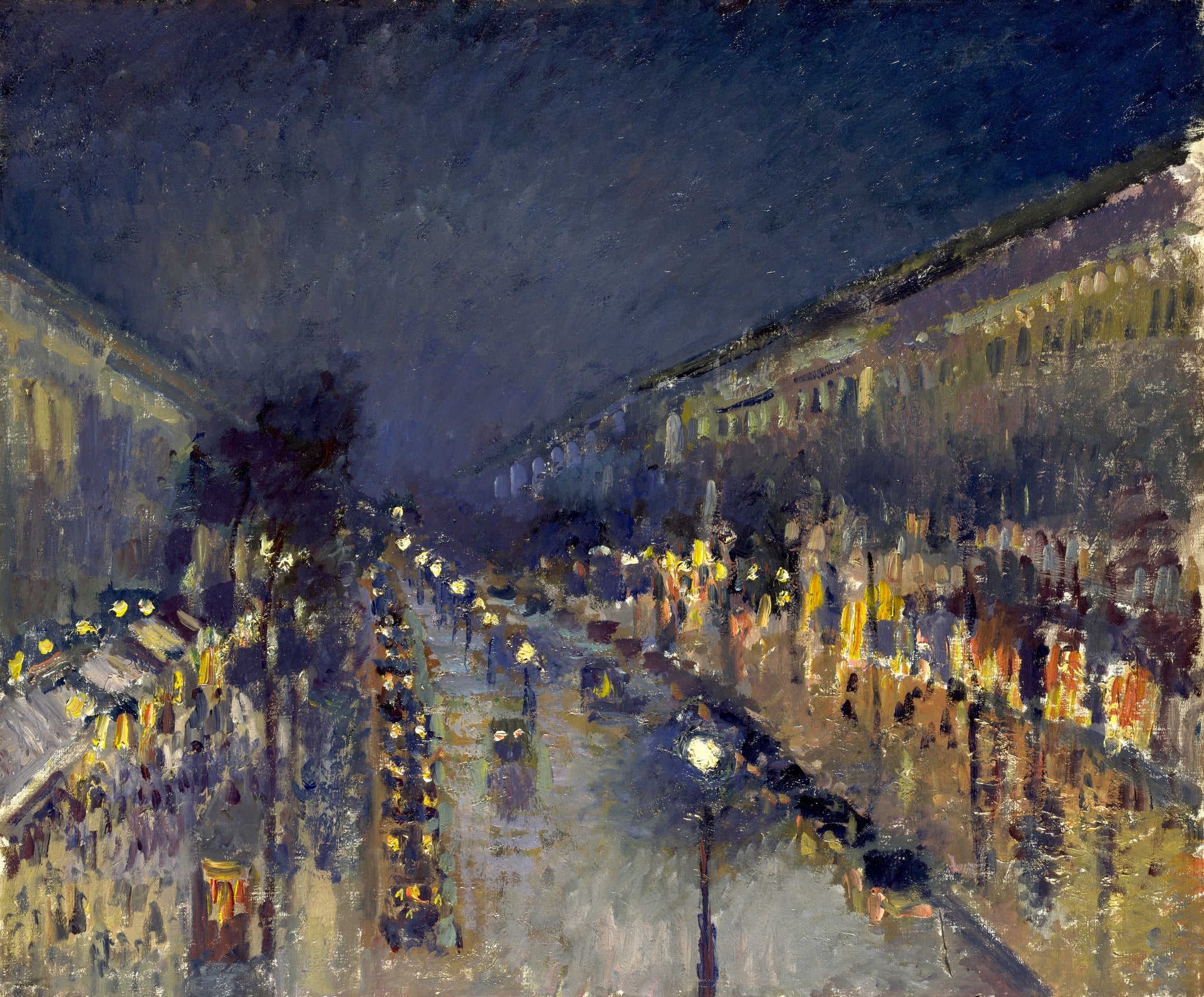
Boulevard Montmartre at Night
Camille Pissarro (1897)
A high window turns Paris into a flowing current: in Boulevard Montmartre at Night, Camille Pissarro fuses <strong>modern light</strong> and <strong>urban movement</strong> into a single, restless rhythm. Cool electric halos and warm gaslit windows shimmer across rain‑slick stone, where carriages and crowds dissolve into <strong>pulse-like blurs</strong> <sup>[1]</sup><sup>[2]</sup>.
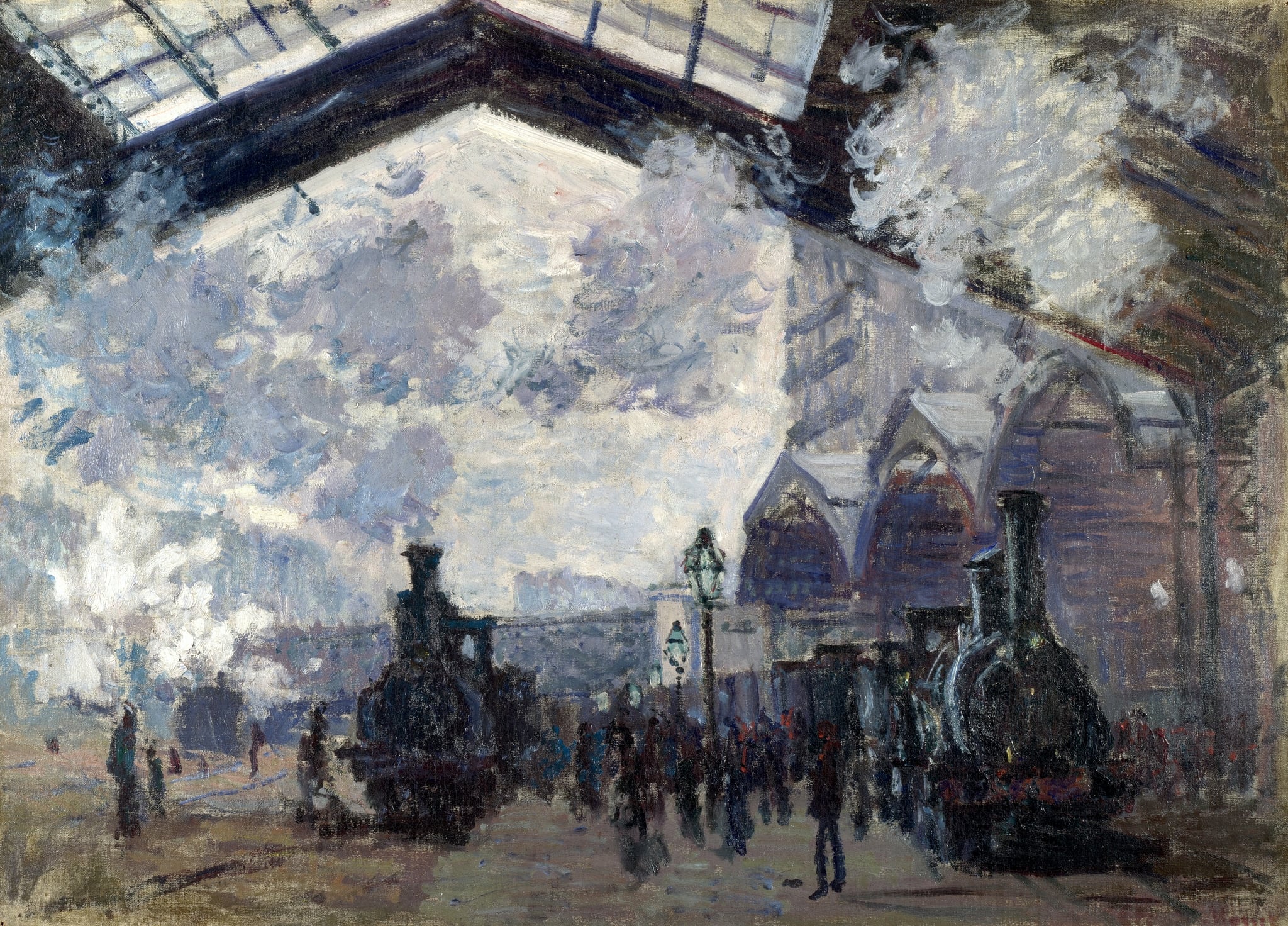
Gare Saint-Lazare
Claude Monet (1877)
Monet’s Gare Saint-Lazare turns an iron-and-glass train shed into a theater of <strong>steam, light, and motion</strong>. Twin locomotives, gas lamps, and a surge of figures dissolve into bluish vapor under the diagonal canopy, recasting industrial smoke as <strong>luminous atmosphere</strong> <sup>[1]</sup><sup>[2]</sup>.
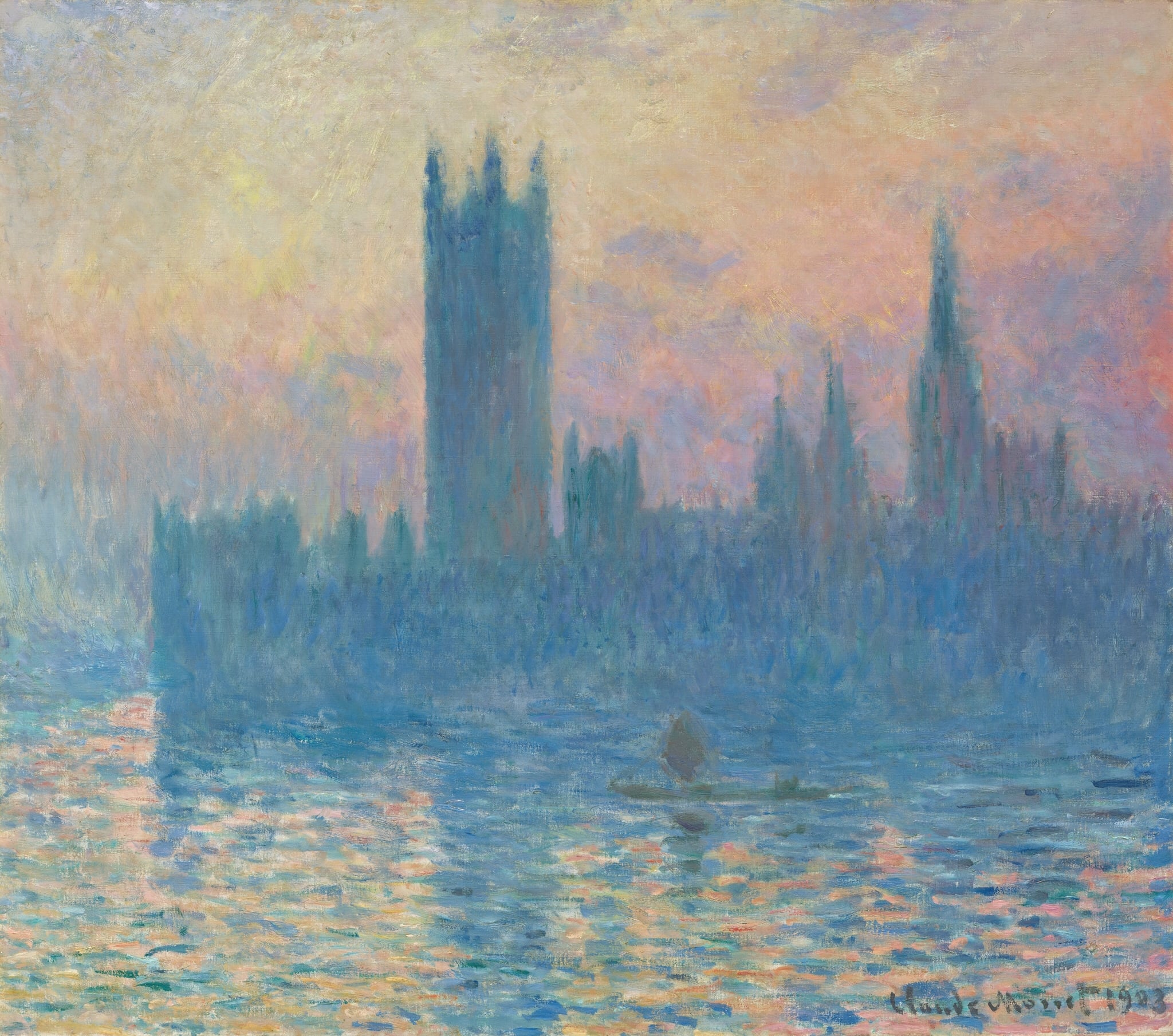
Houses of Parliament
Claude Monet (1903)
Claude Monet’s Houses of Parliament renders Westminster as a <strong>dissolving silhouette</strong> in a wash of peach, mauve, and pale gold, where stone and river are leveled by <strong>luminous fog</strong>. Short, vibrating strokes turn architecture into <strong>atmosphere</strong>, while a tiny boat anchors human scale amid the monumental scene.
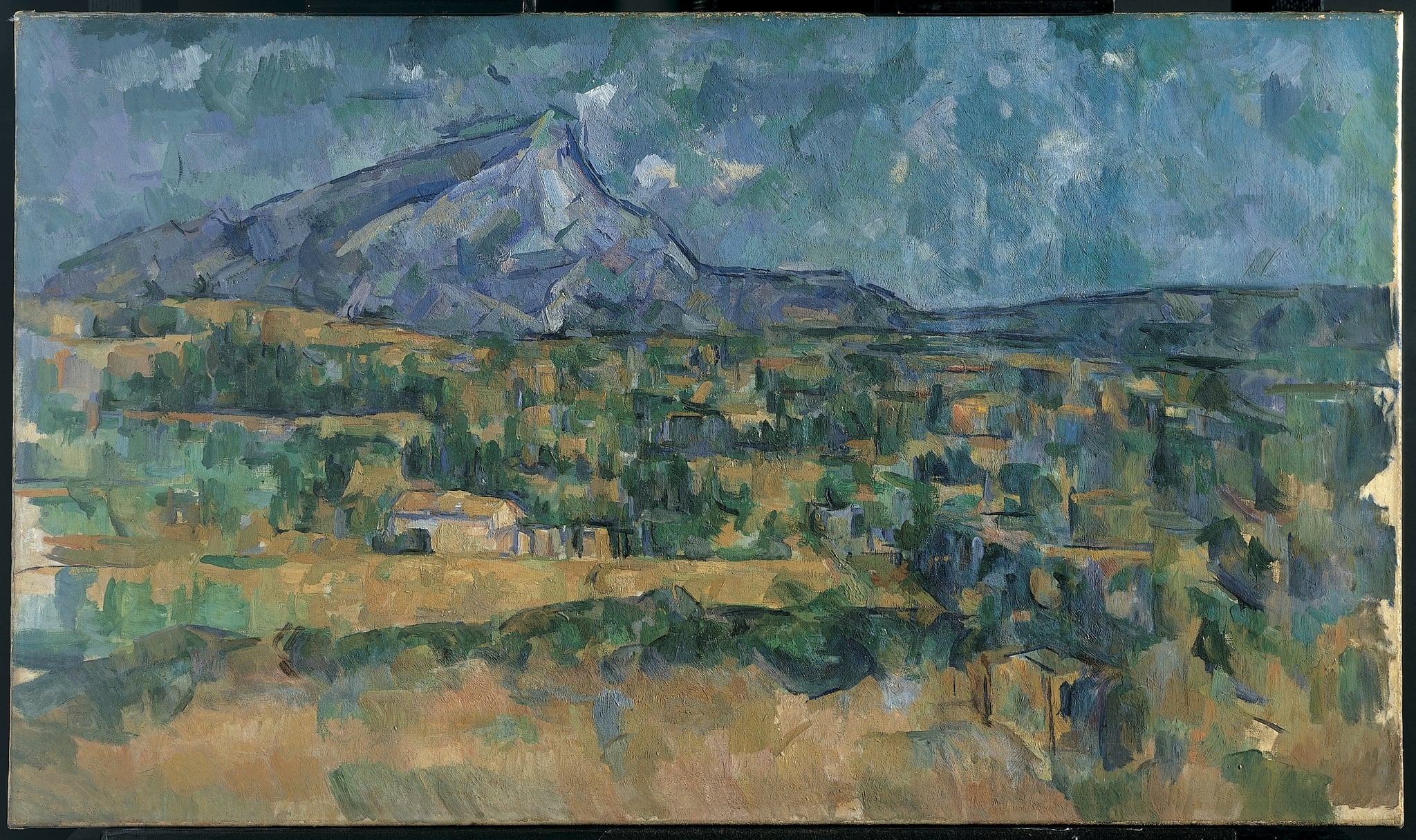
Mont Sainte-Victoire
Paul Cézanne (1902–1906)
Cézanne’s Mont Sainte-Victoire renders the Provençal massif as a constructed order of <strong>planes and color</strong>, not a fleeting impression. Cool blues and violets articulate the mountain’s facets, while <strong>ochres and greens</strong> laminate the fields and blocky houses, binding atmosphere and form into a single structure <sup>[2]</sup><sup>[4]</sup>.
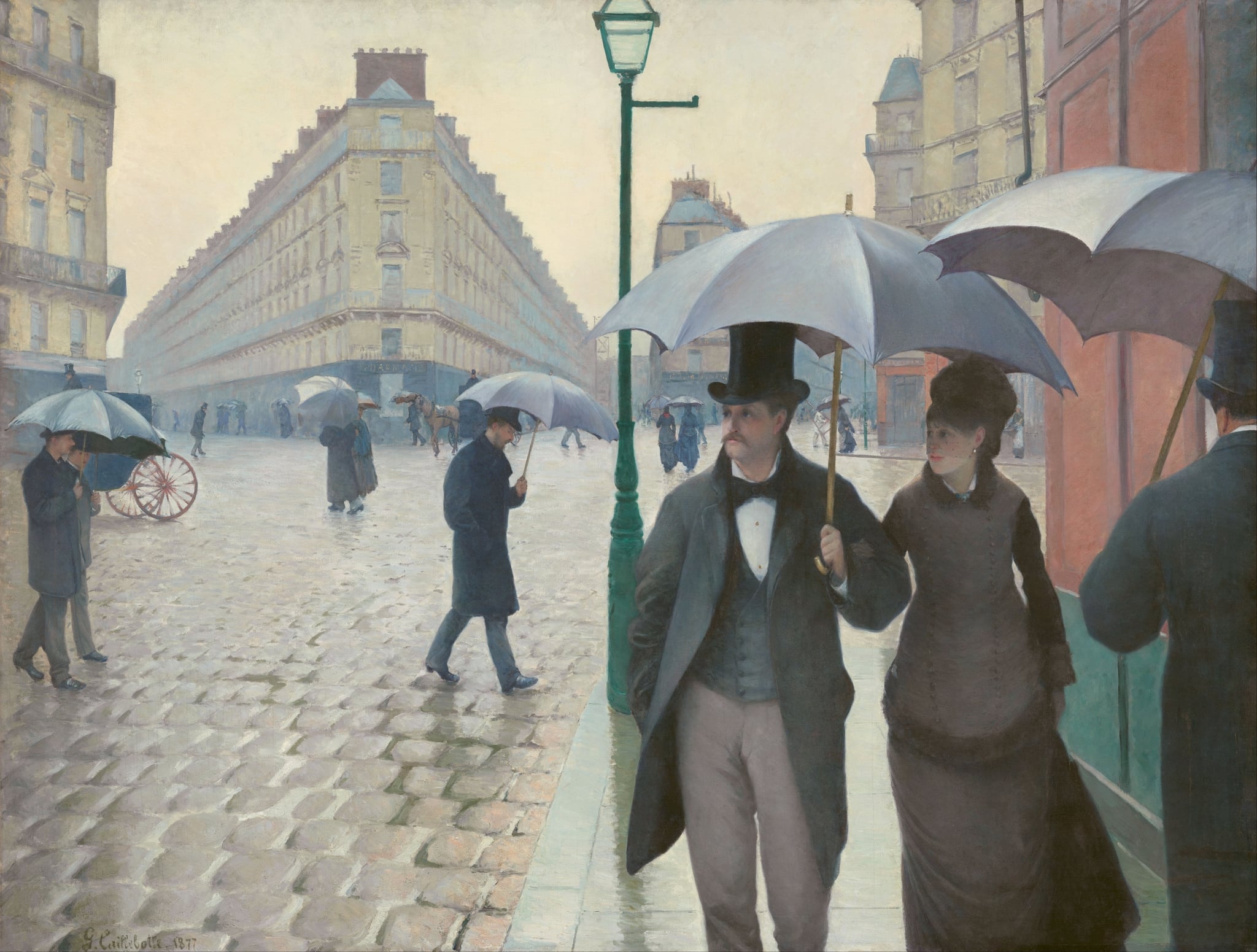
Paris Street; Rainy Day
Gustave Caillebotte (1877)
Gustave Caillebotte’s Paris Street; Rainy Day renders a newly modern Paris where <strong>Haussmann’s geometry</strong> meets the <strong>anonymity of urban life</strong>. Umbrellas punctuate a silvery atmosphere as a <strong>central gas lamp</strong> and knife-sharp façades organize the space into measured planes <sup>[1]</sup><sup>[2]</sup>.
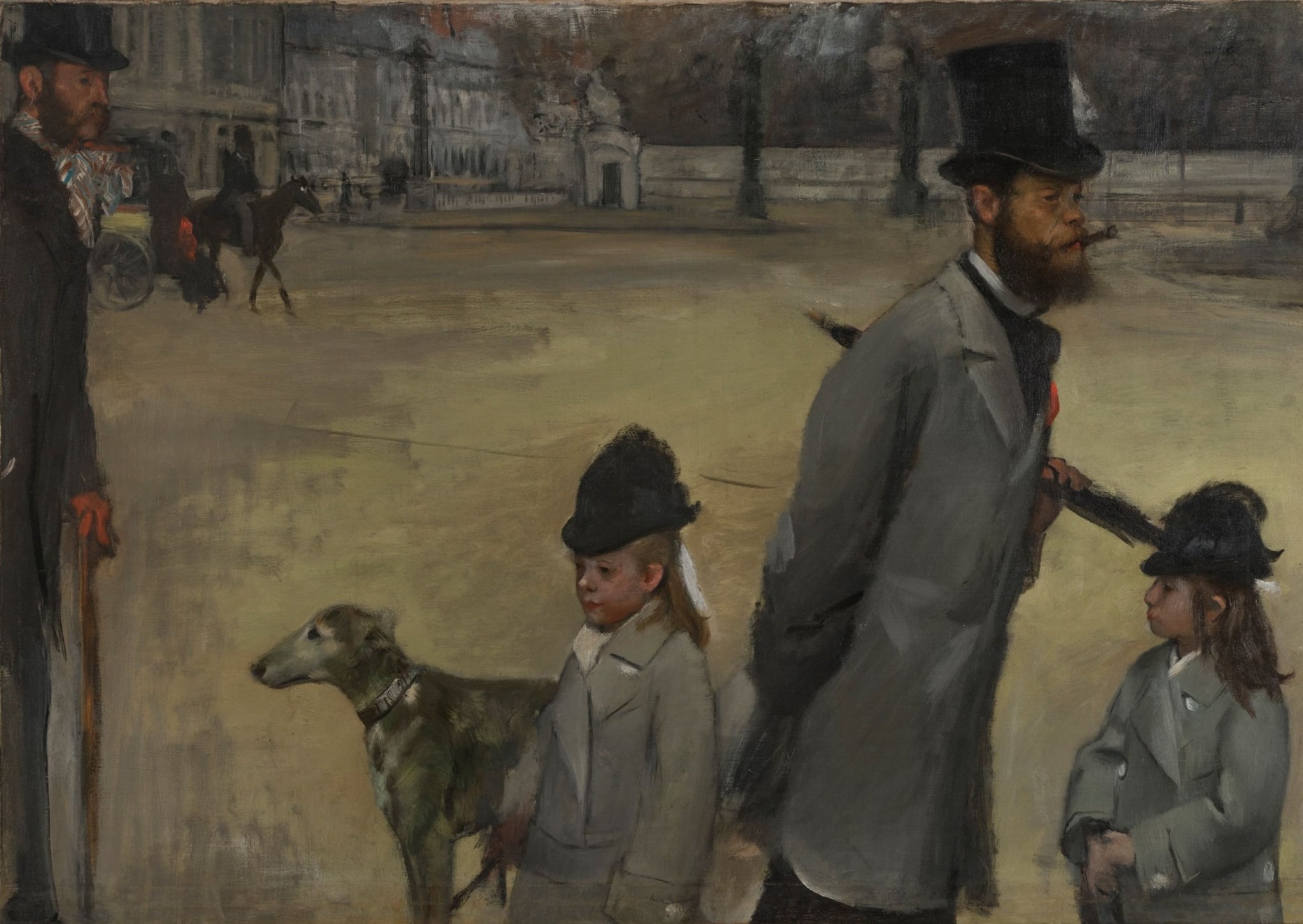
Place de la Concorde
Edgar Degas (1875)
Degas’s Place de la Concorde turns a famous Paris square into a study of <strong>modern isolation</strong> and <strong>instantaneous vision</strong>. Figures stride past one another without contact, their bodies abruptly <strong>cropped</strong> and adrift in a wide, airless plaza—an urban stage where elegance masks estrangement <sup>[1]</sup><sup>[2]</sup>.
Pont Neuf Paris
Pierre-Auguste Renoir (1872)
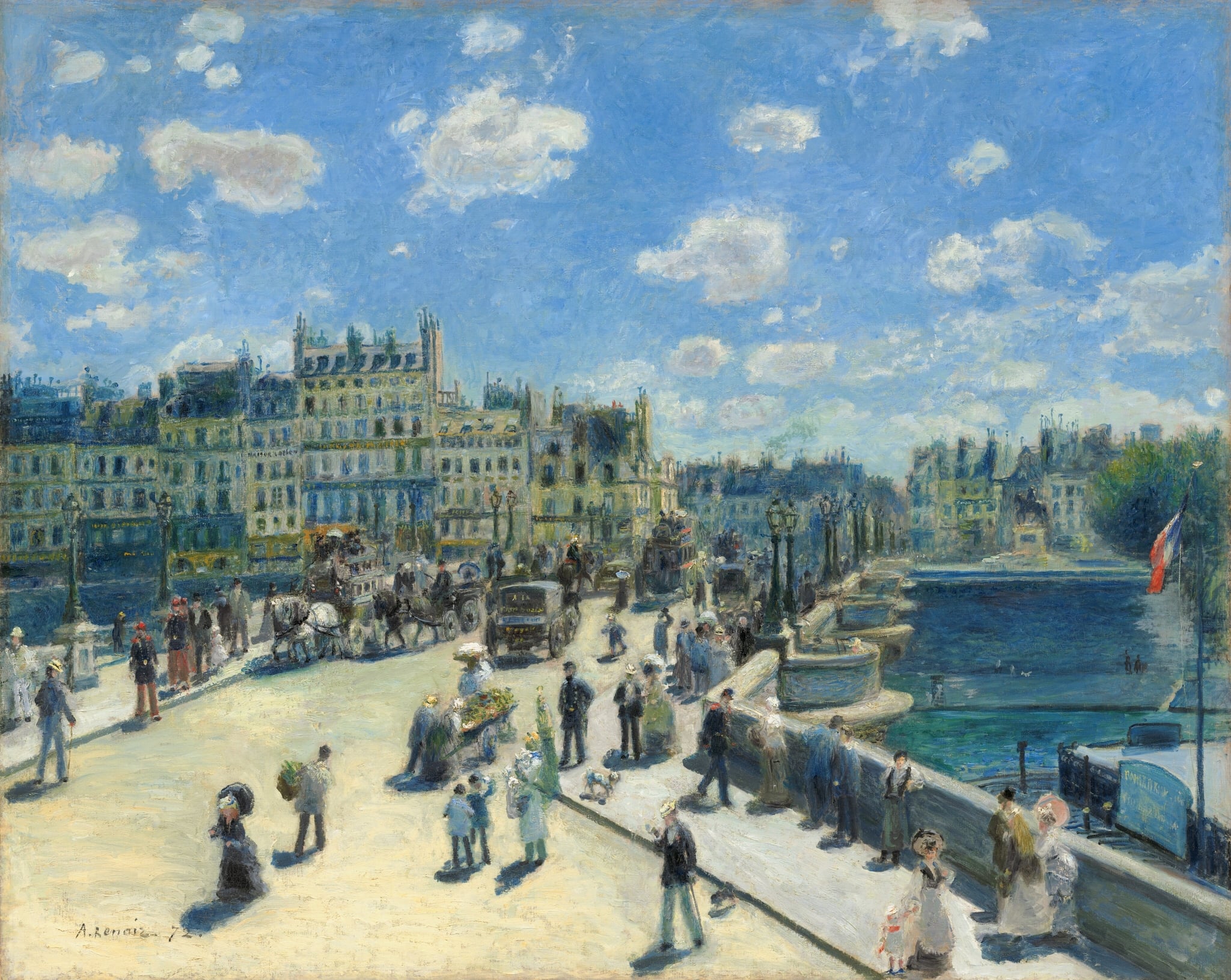
In Pont Neuf Paris, Pierre-Auguste Renoir turns the oldest bridge in Paris into a stage where <strong>light</strong> and <strong>movement</strong> bind a city back together. From a high perch, he orchestrates crowds, carriages, gas lamps, the rippling Seine, and a fluttering <strong>tricolor</strong> so that everyday bustle reads as civic grace <sup>[1]</sup>.
San Giorgio Maggiore at Dusk
Claude Monet (1908–1912)
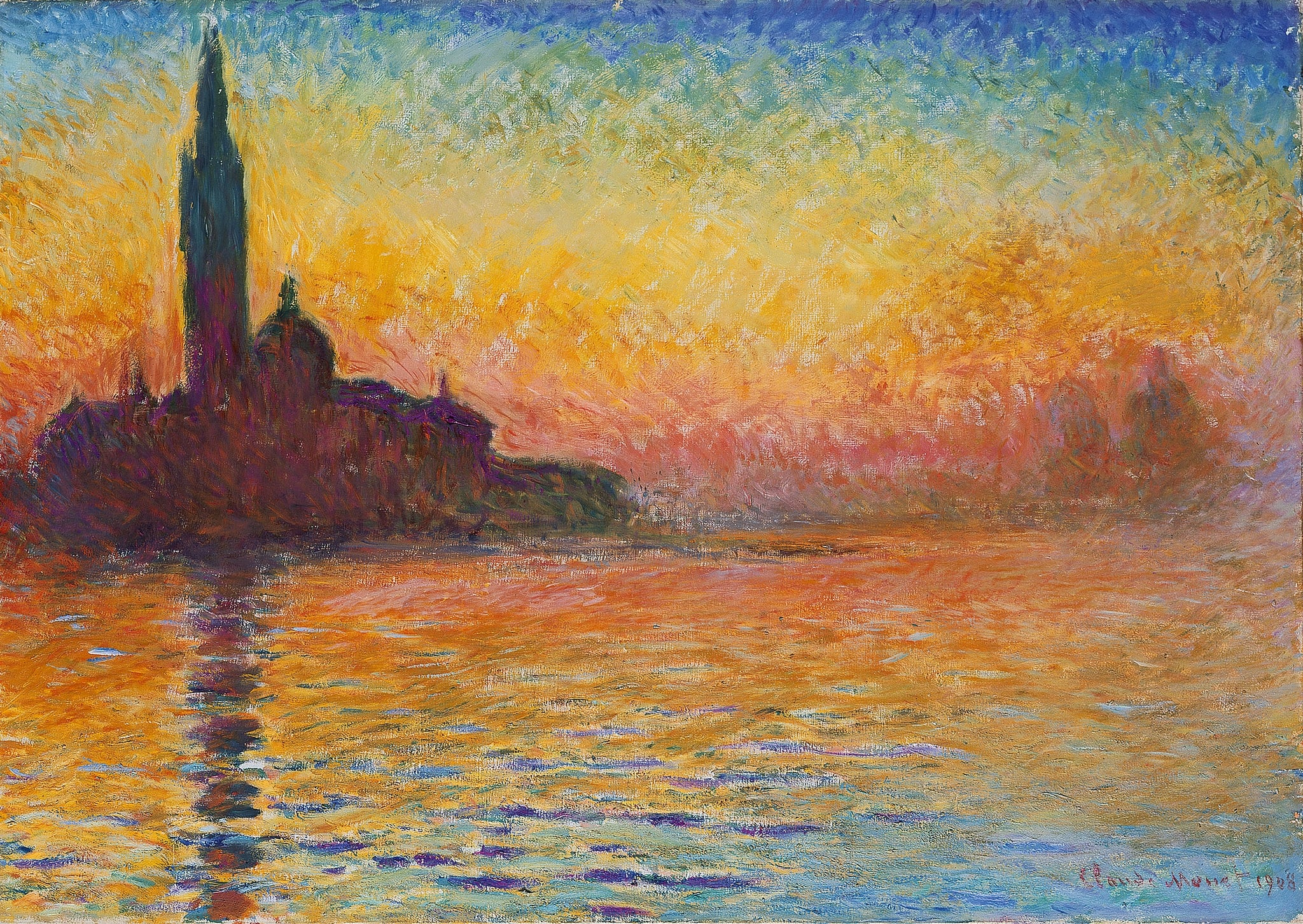
Claude Monet’s San Giorgio Maggiore at Dusk fuses the Benedictine church’s dark silhouette with a sky flaming from apricot to cobalt, turning architecture into atmosphere. The campanile’s vertical and its wavering reflection anchor a sea of trembling color, staging a meditation on <strong>permanence</strong> and <strong>flux</strong>.
Snow at Argenteuil
Claude Monet (1875)
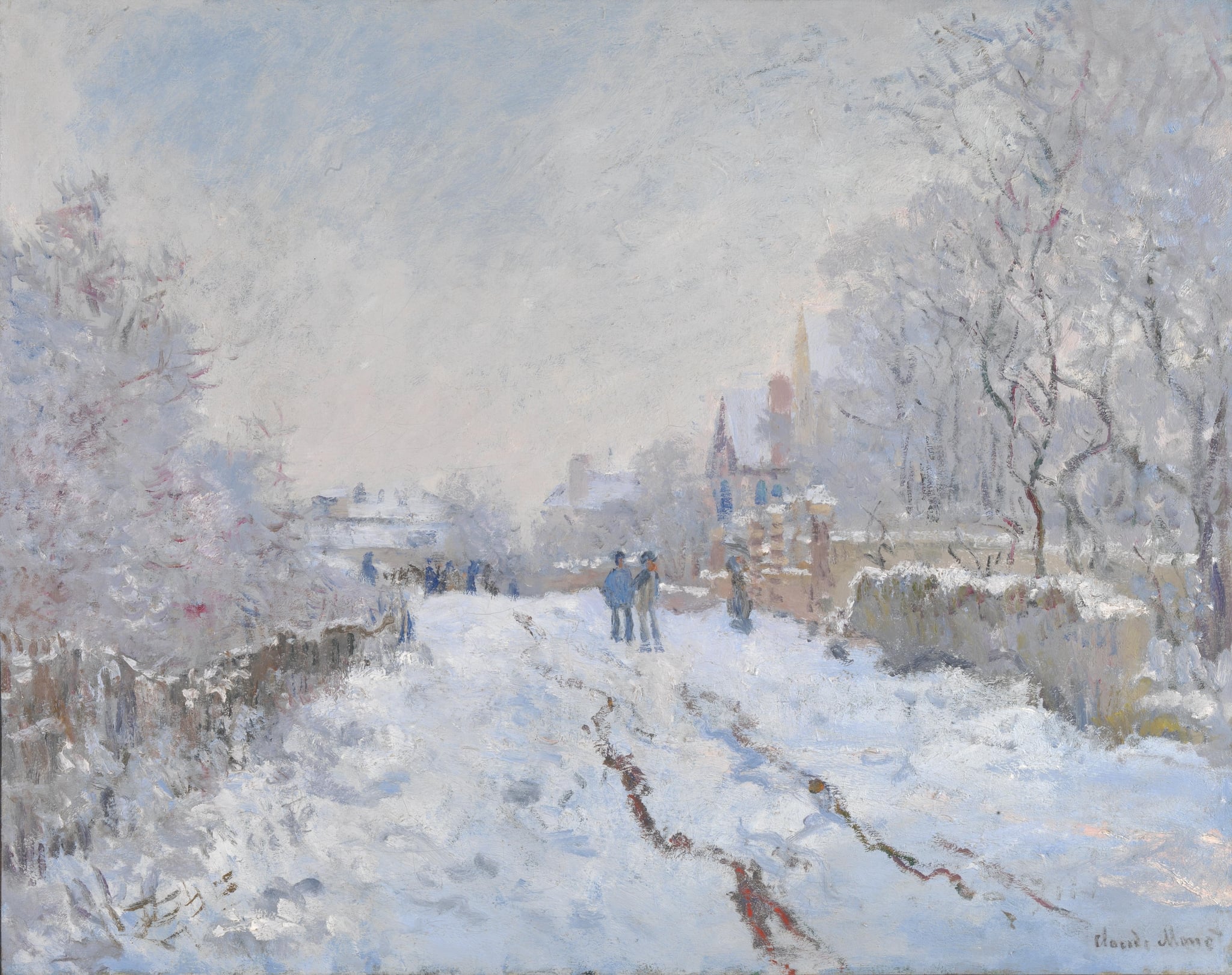
<strong>Snow at Argenteuil</strong> renders a winter boulevard where light overtakes solid form, turning snow into a luminous field of blues, violets, and pearly pinks. Reddish cart ruts pull the eye toward a faint church spire as small, blue-gray figures persist through the hush. Monet elevates atmosphere to the scene’s <strong>protagonist</strong>, making everyday passage a meditation on time and change <sup>[1]</sup><sup>[2]</sup>.
The Ballet Class
Edgar Degas (1873–1876)
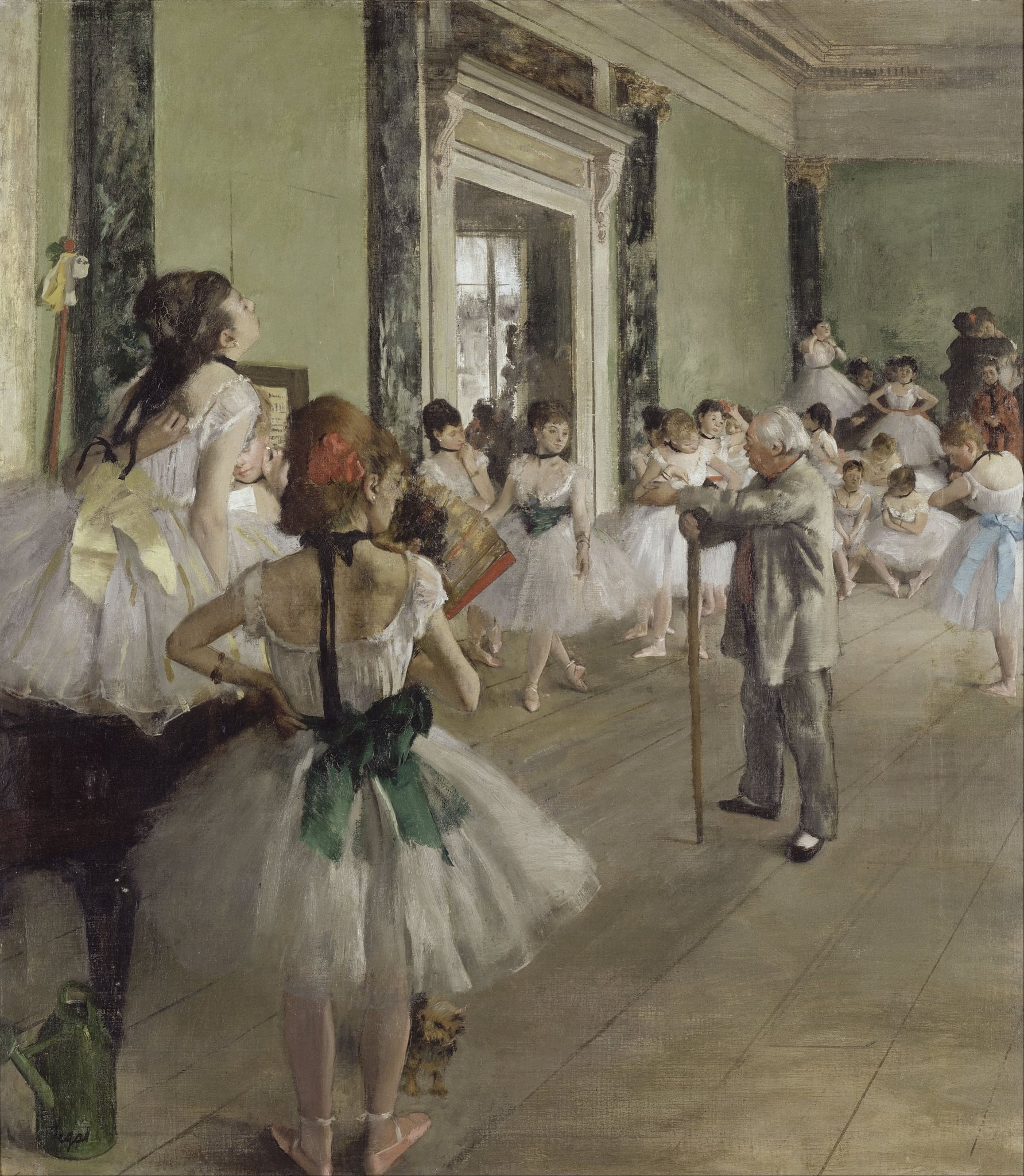
<strong>The Ballet Class</strong> shows the work behind grace: a green-walled studio where young dancers in white tutus rest, fidget, and stretch while the gray-suited master stands with his cane. Degas’s diagonal floorboards, cropped viewpoints, and scattered props—a watering can, a music stand, even a tiny dog—stage a candid vision of routine rather than spectacle. The result is a modern image of discipline, hierarchy, and fleeting poise.
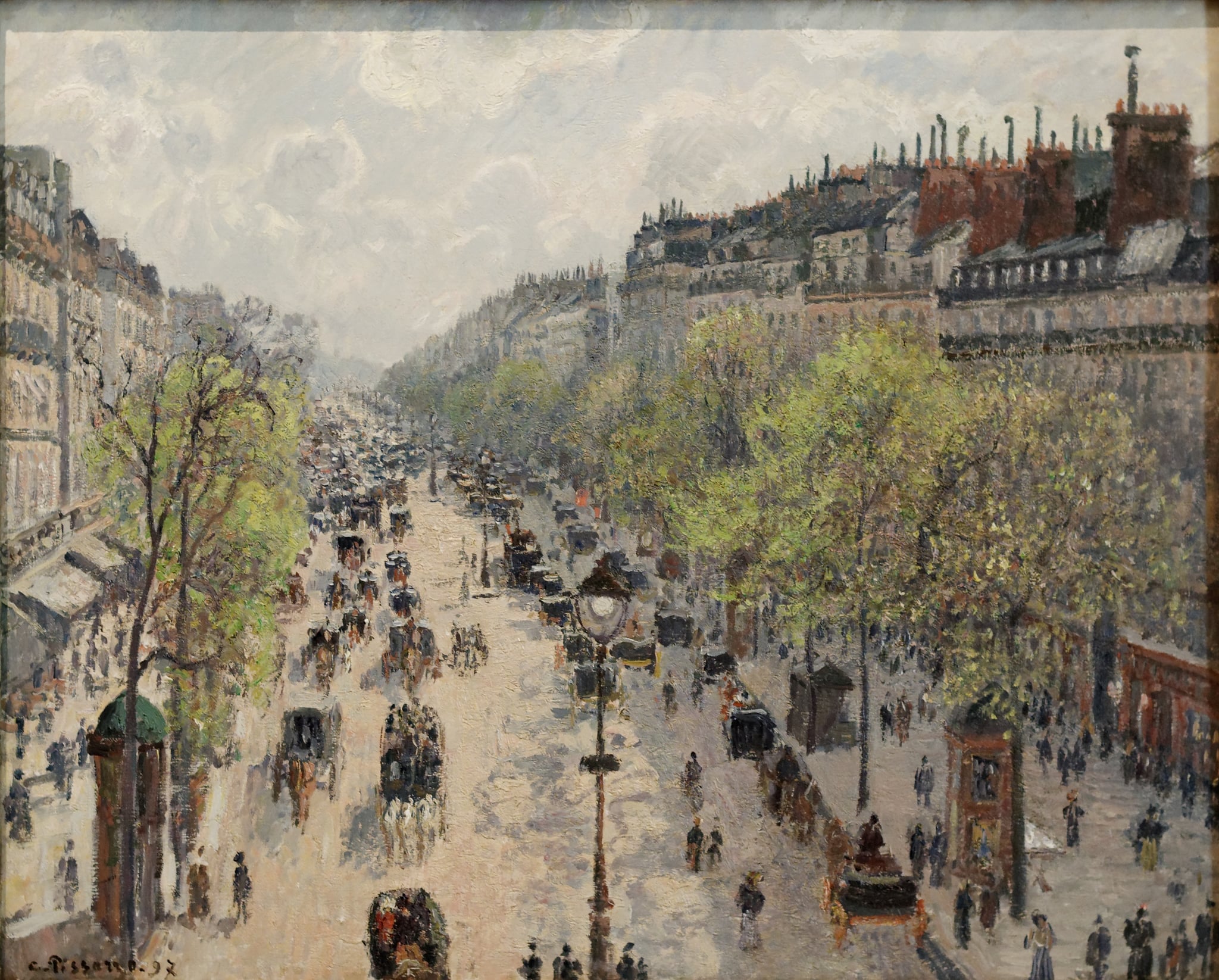
The Boulevard Montmartre on a Spring Morning
Camille Pissarro (1897)
From a high hotel window, Camille Pissarro turns Paris’s grands boulevards into a river of light and motion. In The Boulevard Montmartre on a Spring Morning, pale roadway, <strong>tender greens</strong>, and <strong>flickering brushwork</strong> fuse crowds, carriages, and iron streetlamps into a single urban current <sup>[1]</sup><sup>[2]</sup>. The scene demonstrates Impressionism’s commitment to time, weather, and modern life, distilled through a fixed vantage across a serial project <sup>[1]</sup><sup>[3]</sup>.
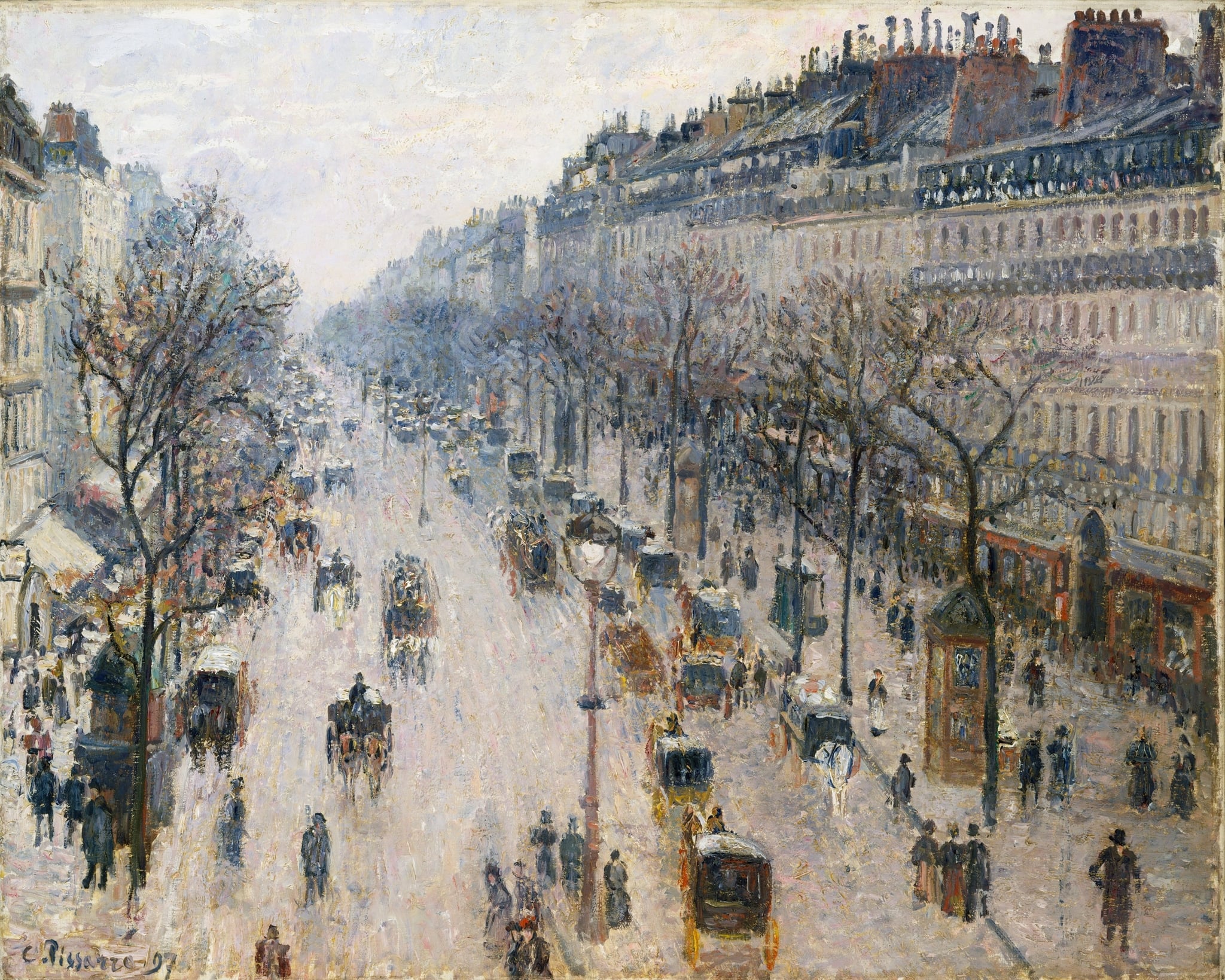
The Boulevard Montmartre on a Winter Morning
Camille Pissarro (1897)
From a high hotel window, Camille Pissarro renders Paris as a living system—its Haussmann boulevard dissolving into winter light, its crowds and vehicles fused into a soft, <strong>rhythmic flow</strong>. Broken strokes in cool grays, lilacs, and ochres turn fog, steam, and motion into <strong>texture of time</strong>, dignifying the city’s ordinary morning pulse <sup>[1]</sup><sup>[3]</sup>.
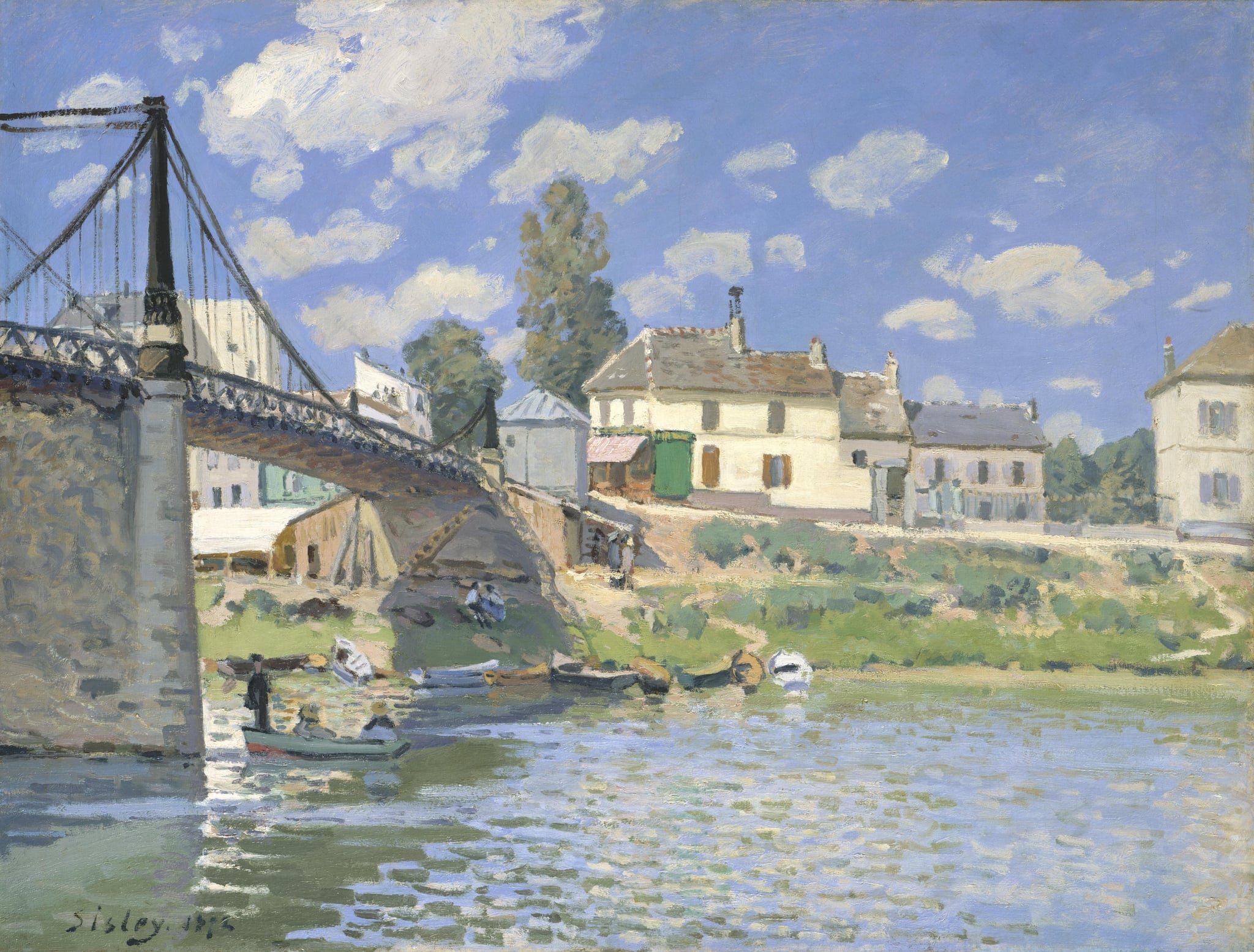
The Bridge at Villeneuve-la-Garenne
Alfred Sisley (1872)
Alfred Sisley's The Bridge at Villeneuve-la-Garenne crystallizes the encounter between <strong>modern engineering</strong> and <strong>riverside leisure</strong> under <strong>Impressionist light</strong>. The diagonal suspension bridge, dark pylons, and filigreed truss command the left foreground while small boats skim the Seine, their wakes breaking into shimmering strokes that echo the sky.
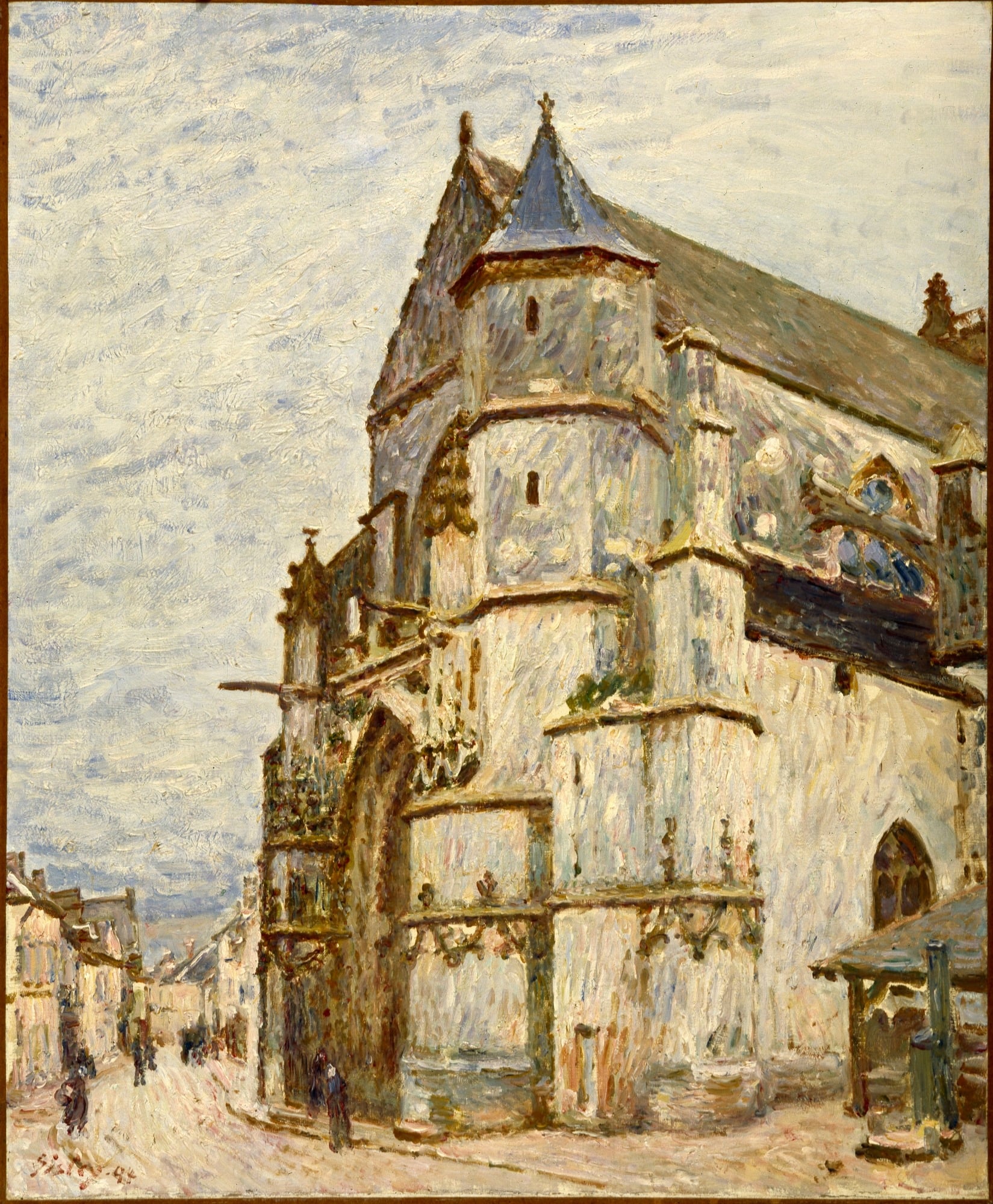
The Church at Moret
Alfred Sisley (1894)
Alfred Sisley’s The Church at Moret turns a Flamboyant Gothic façade into a living barometer of light, weather, and time. With <strong>cool blues, lilacs, and warm ochres</strong> laid in broken strokes, the stone seems to breathe as tiny townspeople drift along the street. The work asserts <strong>permanence meeting transience</strong>: a communal monument held steady while the day’s atmosphere endlessly remakes it <sup>[1]</sup><sup>[2]</sup><sup>[3]</sup>.
The Floor Scrapers
Gustave Caillebotte (1875)
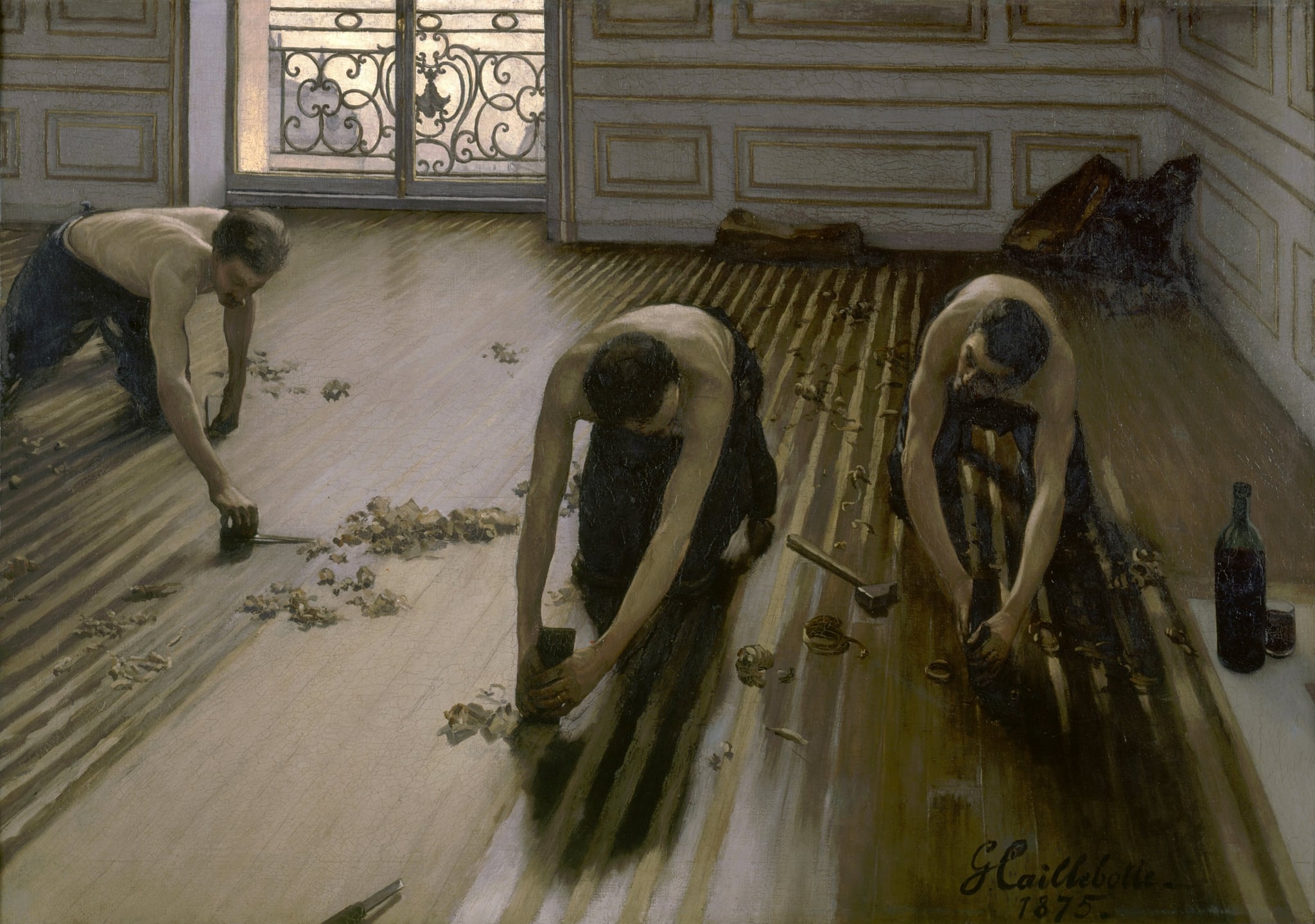
Gustave Caillebotte’s The Floor Scrapers stages three shirtless workers planing a parquet floor as shafts of light pour through an ornate balcony door. The painting fuses <strong>rigorous perspective</strong> with <strong>modern urban labor</strong>, turning curls of wood and raking light into a ledger of time and effort <sup>[1]</sup><sup>[3]</sup>. Its cool, gilded interior makes visible how bourgeois elegance is built on bodily work.
The Hermitage at Pontoise
Camille Pissarro (ca. 1867)
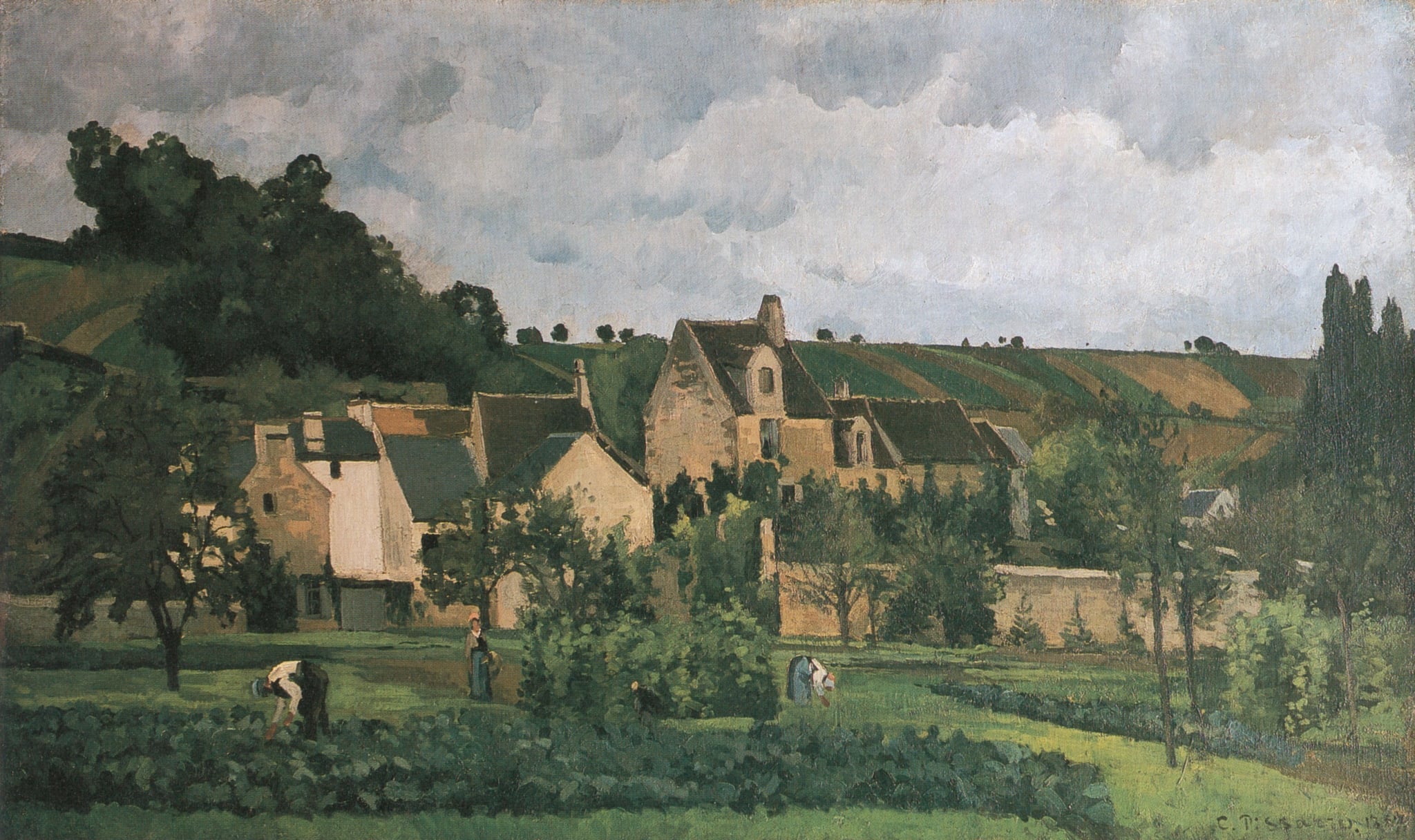
Camille Pissarro’s The Hermitage at Pontoise shows a hillside village interlaced with <strong>kitchen gardens</strong>, stone houses, and workers bent to their tasks under a <strong>low, cloud-laden sky</strong>. The painting binds human labor to place, staging a quiet counterpoint between <strong>architectural permanence</strong> and the <strong>seasonal flux</strong> of fields and weather <sup>[1]</sup><sup>[3]</sup>.
The Loge
Pierre-Auguste Renoir (1874)
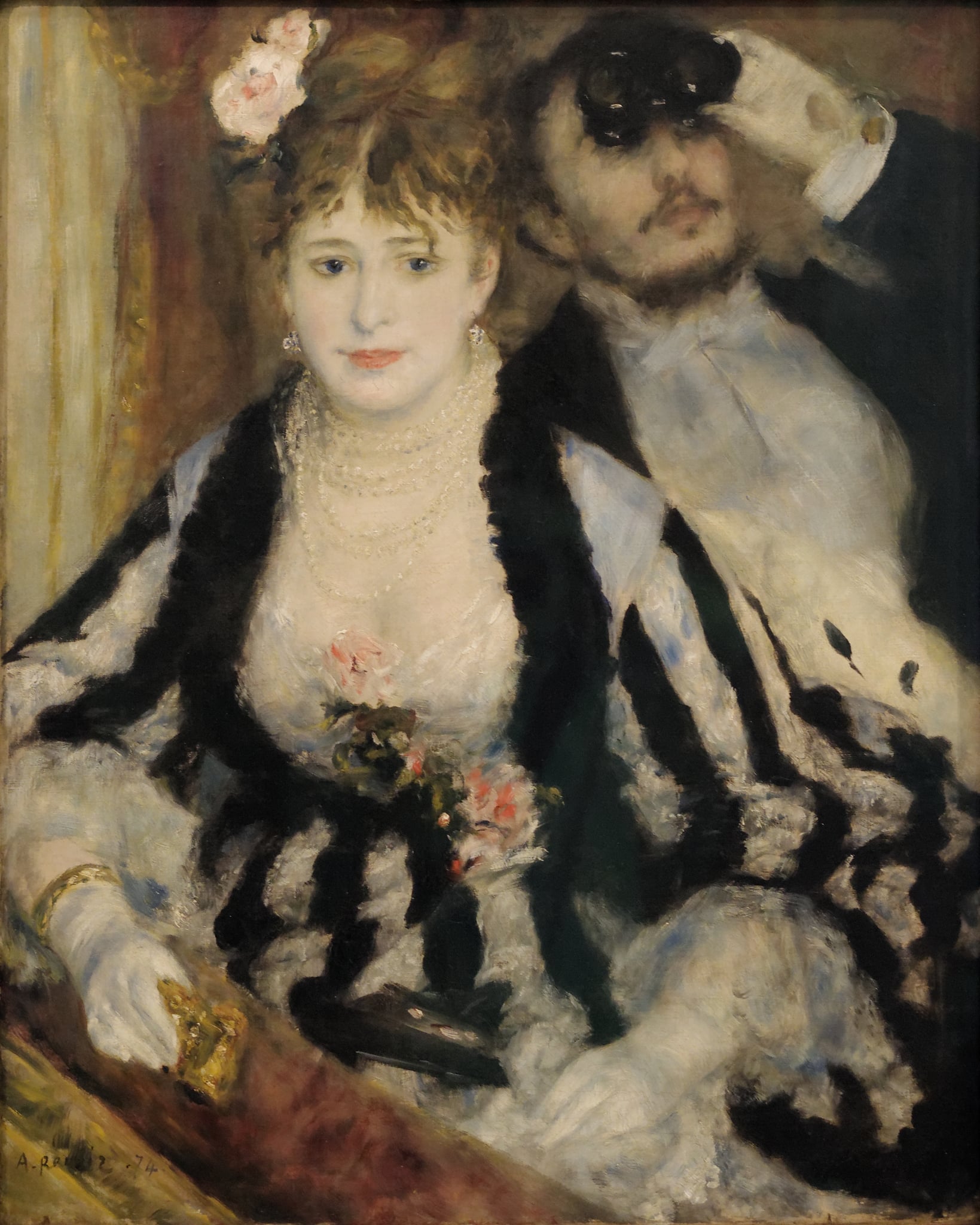
Renoir’s The Loge (1874) turns an opera box into a <strong>stage of looking</strong>, where a woman meets our gaze while her companion scans the crowd through binoculars. The painting’s <strong>frame-within-a-frame</strong> and glittering fashion make modern Parisian leisure both alluring and self-conscious, turning spectators into spectacles <sup>[1]</sup><sup>[2]</sup>.
The Railway
Édouard Manet (1873)
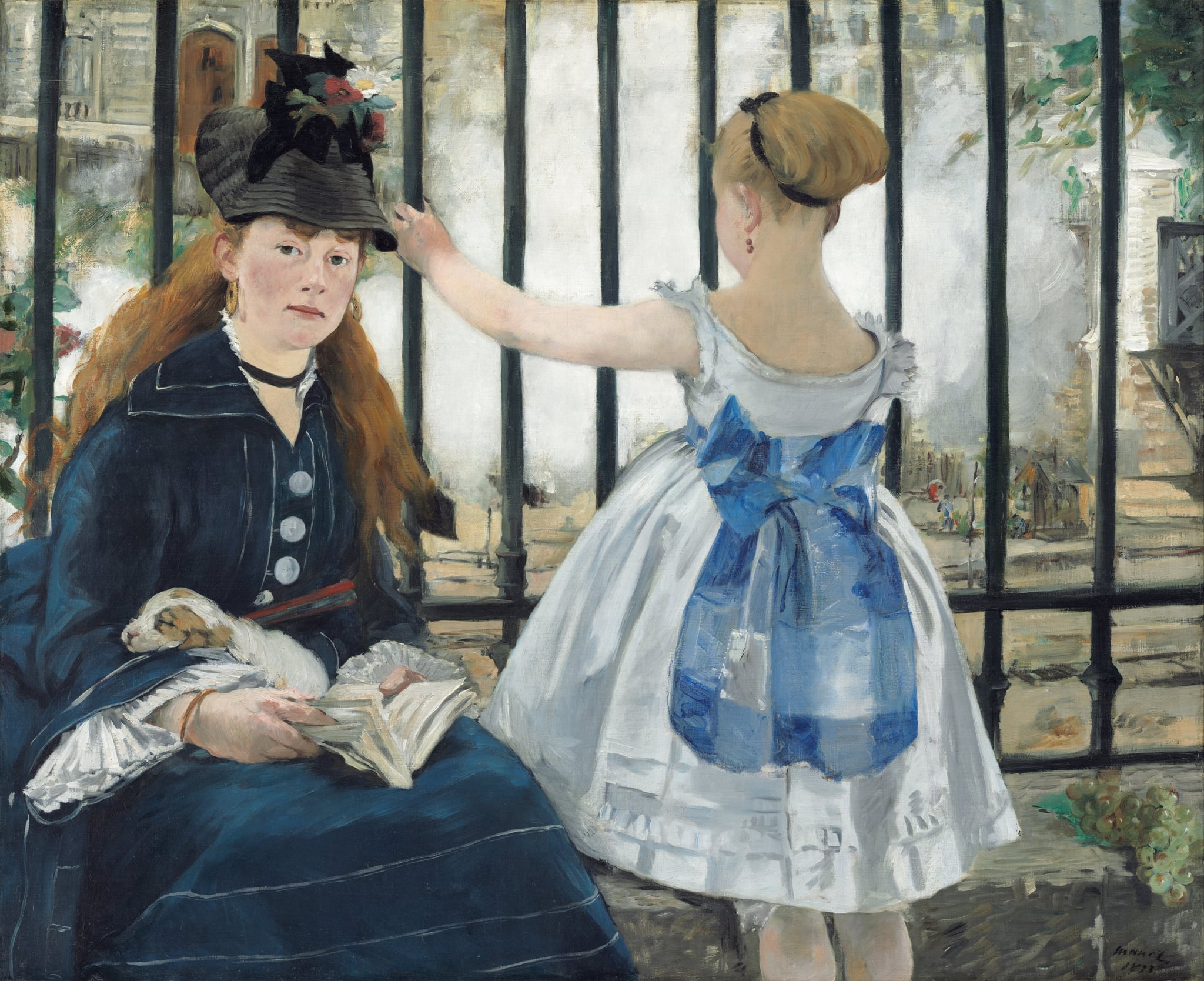
Manet’s The Railway is a charged tableau of <strong>modern life</strong>: a composed woman confronts us while a child, bright in <strong>white and blue</strong>, peers through the iron fence toward a cloud of <strong>steam</strong>. The image turns a casual pause at the Gare Saint‑Lazare into a meditation on <strong>spectatorship, separation, and change</strong> <sup>[1]</sup><sup>[3]</sup>.
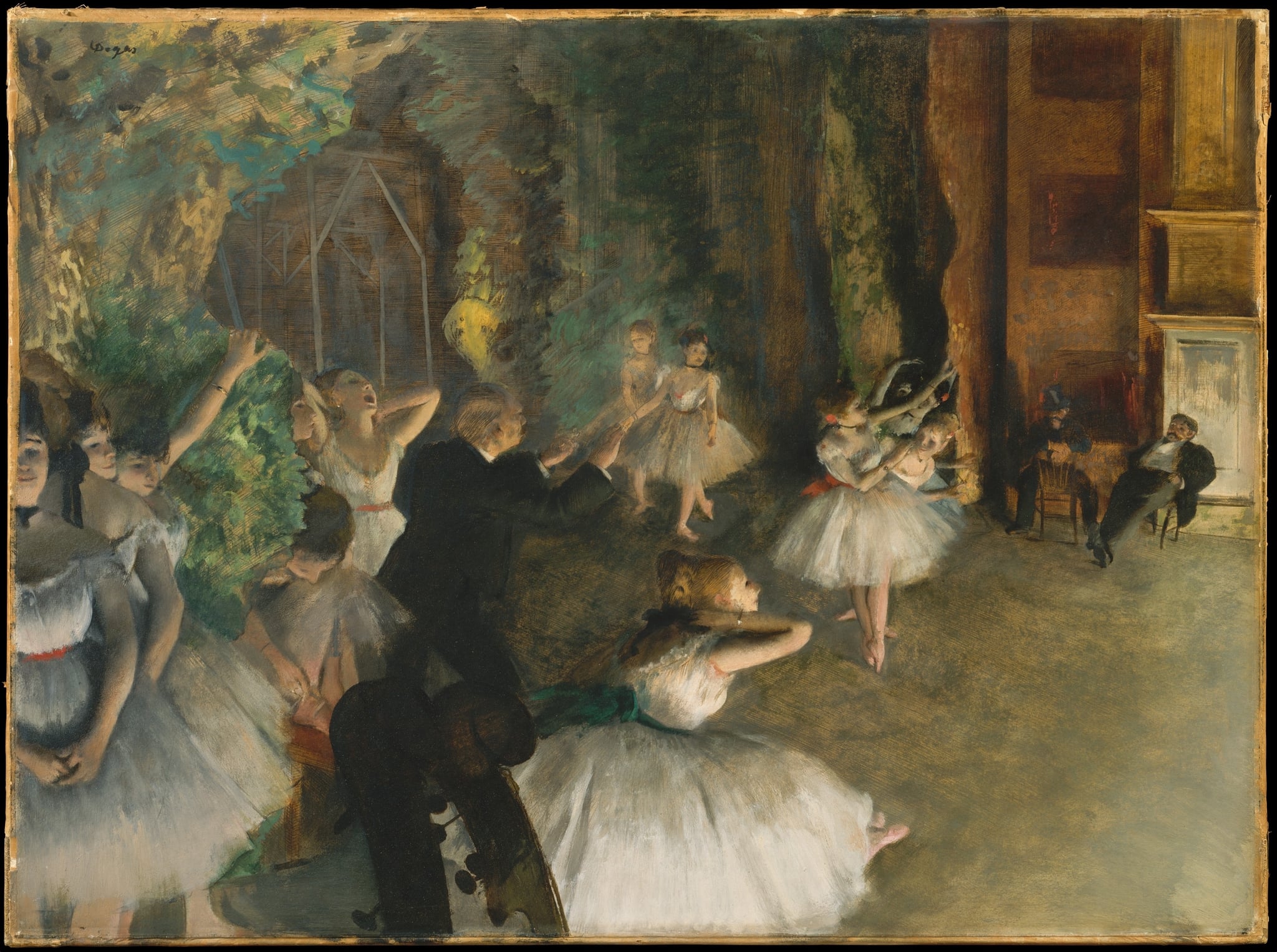
The Rehearsal of the Ballet Onstage
Edgar Degas (ca. 1874)
Degas’s The Rehearsal of the Ballet Onstage turns a moment of practice into a modern drama of work and power. Under <strong>harsh footlights</strong>, clustered ballerinas stretch, yawn, and repeat steps as a <strong>ballet master/conductor</strong> drives the tempo, while <strong>abonnés</strong> lounge in the wings and a looming <strong>double bass</strong> anchors the labor of music <sup>[1]</sup><sup>[3]</sup><sup>[4]</sup>.
Related Themes
Related Symbolism Categories
Society
The Society symbolism category charts how nineteenth‑century artists encoded modern social relations—class hierarchy, gendered labor, spectatorship, and leisure—through recurring motifs of dress, gesture, and urban setting that transform everyday bourgeois and working-class life into a legible iconography of modernity.
Urbanity
Urbanity symbolism charts how modern artists turned lamps, boulevards, bridges, canopies, and crowds into a visual language for municipal order, technological illumination, and the new, anonymous sociability of the nineteenth- and early twentieth‑century city.
Space
In modern painting, spatial symbols become active structures that organize perception, articulate social modernity, and reimagine depth as a charged field of circulation, isolation, and communal ritual.
Within nineteenth- and early twentieth-century painting, the urban scene becomes a privileged site for rethinking the very terms of pictorial symbolism. Rather than relying on inherited allegorical figures, artists encode meaning in the new material facts of the modern city: gas lamps, Haussmannian façades, iron-and-glass canopies, carriage traffic, and crowds seen from vertiginous balconies. These elements operate semiotically as a fresh lexicon of signs through which infrastructure, circulation, and collective experience stand in for older religious or mythological emblems. Iconographically, the city ceases to be a mere backdrop; it becomes the principal vehicle through which questions of class, anonymity, historical memory, and technological change are staged.
Nowhere is this more apparent than in the recurrent use of street lighting and urban planning as symbolic anchors. In Gustave Caillebotte’s Paris Street; Rainy Day, the central gas lamppost is more than an incidental street fixture. Defined as a sign of “modern infrastructure and standardization of the rebuilt city,” it is positioned at the compositional pivot, dividing the canvas into calculated triangles and visually imposing the new metric order of Haussmann’s Paris onto the lives of passersby. Its vertical regularizes the receding wedge block—the “Haussmann Wedge Block” that itself symbolizes “rational urban planning and geometric order.” Together, lamppost and façades form a structural syntax in which bourgeois flâneurs, umbrellas, and paving stones are subordinate clauses. The figures’ detachment and non‑interaction are legible precisely because the infrastructural grid has so thoroughly standardized their environment.
Camille Pissarro radicalizes this infrastructural semiotics in Boulevard Montmartre at Night. Here, iron streetlamps and their electric successors are parsed into two luminous streams: the “central bead-string of cool white orbs” reading as electric arc lamps, and the warm, broken fires of gaslit shopfronts. As symbols of “municipal order guiding public space,” these lamps also differentiate technologies of light and, with them, stages in the city’s modernization. The boulevard’s converging façades and vanishing point “funnel” the crowd toward an obscure distance, so that Haussmann façades and streetlamps together choreograph what the text aptly calls “urban circulation and entertainment economy moving through the night.” The crowd appears as a pulsating continuum rather than a congregation of portraits because light and perspective have reconstituted the street itself as an optical apparatus that absorbs individual identities into motion.
If the boulevard is a horizontal vector of circulation, the urban square supplies a contrasting iconography of emptiness and estrangement. Edgar Degas’s Place de la Concorde recognizes the “negative space of the plaza” as a sign in its own right: “emptiness as social distance; wide, ordered urban space that gathers people without connecting them.” The gracefully dressed figures—Viscount Lepic, his daughters, the greyhound, the partly cropped man at the left—are scattered across a pale, scumbled expanse that functions semantically as a buffer. The absent center of the composition, rather than any monument, is what signifies: the plaza becomes an image of a city that can assemble bodies without forming a public. Compared to Renoir’s Pont Neuf Paris, where the Pont Neuf parapet stands for “connection and cohesion—linking separate parts of the city and its people,” Degas’s square renders the urban field as disjunction, its spaciousness operating as a symbolic negation of civic communion.
Bridges and riverfronts form another crucial strand in this urban semiotic. In Renoir’s Pont Neuf Paris, the bridge parapet and aligned gas lamps orchestrate movement into “a single current,” so that the bridge itself comes to emblematize cohesion. The equestrian statue of Henri IV, explicitly defined as “historical memory and continuity amid modern life,” is set against crowds, carriages, and the fluttering tricolor. Here, infrastructure (the bridge) and monument (the statue) are conjoined symbols: one embodies the physical linking of quarters and classes; the other, temporal linkage across centuries. In Georges Seurat’s Bathers at Asnières, bridges reappear as distant, industrial structures along the Seine, associated with “modern infrastructure and connection” and placed in counterpoint to working-class leisure. The factory chimneys and smoke that line the horizon frame the bathers’ repose, reminding the viewer that even apparent escape from the city unfolds under the sign of metropolitan industry.
Claude Monet’s Gare Saint-Lazare extends the symbolism of bridges into that of the railway station, the paradigmatic node of urban modernity. The “iron-and-glass train shed” and “iron-and-glass canopy (V-shaped roof truss)” function iconographically as a secular nave—a “framework of modernity and order” that recasts the station as a kind of industrial cathedral. The “twin steam locomotives,” with their “steam from the train” understood as “change, motion, and the ephemeral nature of modern life,” anchor this nave like altarpieces of progress. Semiotic tension arises from the juxtaposition of rigid iron geometry with dissolving vapor: architecture is the sign of standardized time and coordinated movement; steam is the sign of perception’s contingency. Passengers and workers, described only as a “crowd of passengers and workers,” appear as rhythm rather than individuality. In such a setting, urban symbolism is carried less by emblematic figures than by the choreography of bodies within an engineered envelope.
Even when the city recedes to a distance, its symbolic charge persists through silhouettes and atmospheres. Monet’s London series, exemplified here by Houses of Parliament, treats the “Parliament silhouette (Victoria Tower and spires)” as an icon of “institutional power and permanence,” yet deliberately undermines that solidity by wrapping it in fog and sunset. The Gothic mass is rendered as a dark, wavering plane whose meaning depends on “the conditions of seeing” rather than on iconographic detail. The Thames water, with its “gridded reflections” that epitomize “flux and reciprocity,” binds architecture and river into a single vibrating field. In this late phase, urban symbolism has shifted: light and pollution, rather than streets and carriages, have become the principal signs through which the city’s power is registered and relativized.
Across these works a network of recurring motifs—lamps, façades, bridges, plazas, canopies, crowds—reveals how urban symbolism evolves from concrete markers of planning and infrastructure to more atmospheric meditations on flux. Early Haussmannian vistas, whether in Caillebotte or Pissarro, foreground the city as a newly rationalized organism whose lamps, boulevards, and traffic encode a disciplined, standardized modernity. Degas and Renoir probe the ambivalence of this order, staging the same spaces as sites of either social disconnection or civic cohesion. Monet, whether at Saint-Lazare or Westminster, eventually abstracts the urban lexicon into a play of light and vapor, where power, industry, and history are experienced as optical events. The urban symbol thus migrates from the level of object (lamppost, bridge, façade) to that of field (plaza, fog, gridded reflection), mapping the broader modernist shift from narrative iconography to a more structural, perceptual form of signification.