Society
The Society symbolism category charts how nineteenth‑century artists encoded modern social relations—class hierarchy, gendered labor, spectatorship, and leisure—through recurring motifs of dress, gesture, and urban setting that transform everyday bourgeois and working-class life into a legible iconography of modernity.
Member Symbols
Featured Artworks
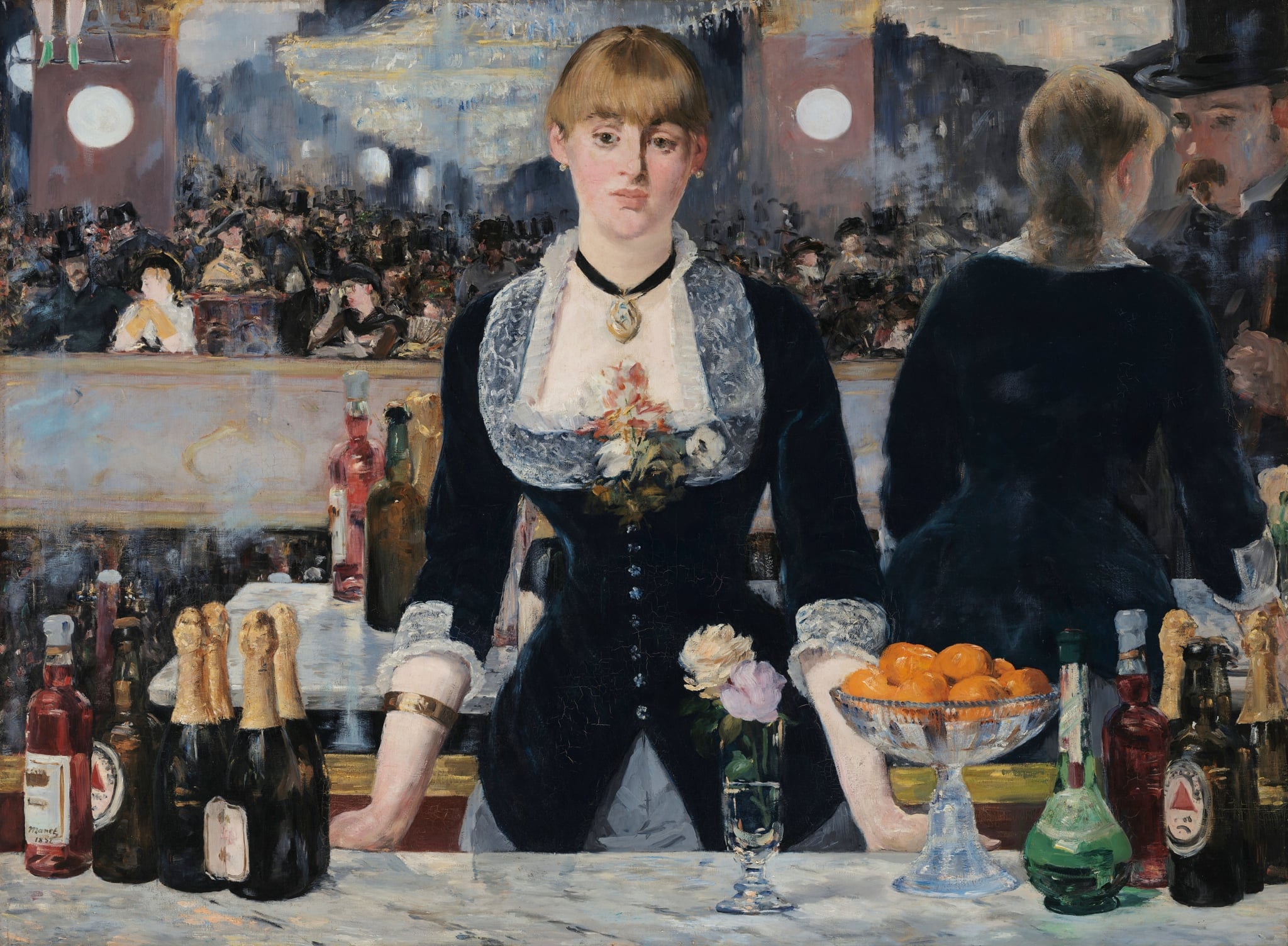
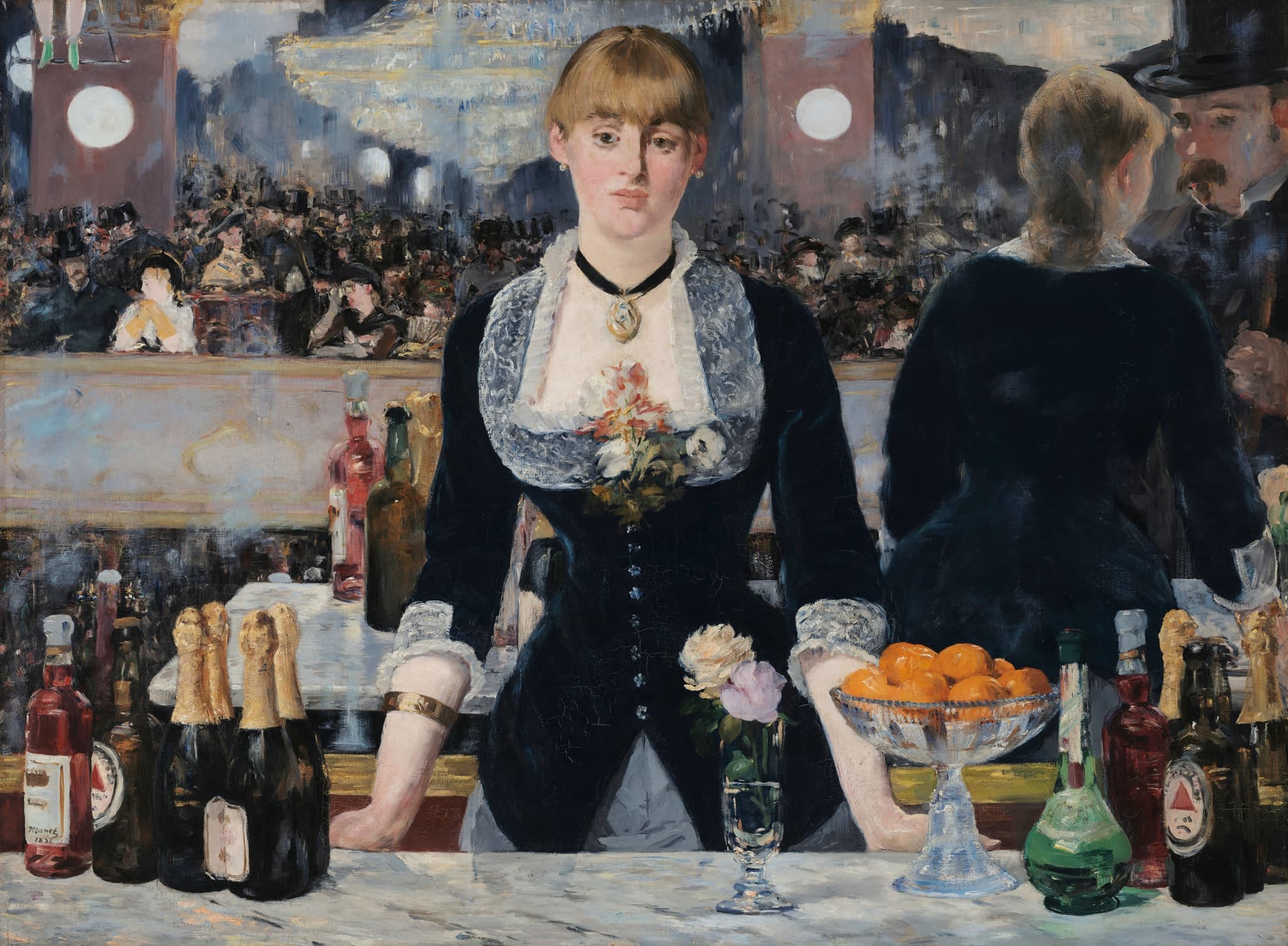
A Bar at the Folies-Bergère
Édouard Manet (1882)
Édouard Manet’s A Bar at the Folies-Bergère stages a face-to-face encounter with modern Paris, where <strong>commerce</strong>, <strong>spectacle</strong>, and <strong>alienation</strong> converge. A composed barmaid fronts a marble counter loaded with branded bottles, flowers, and a brimming bowl of oranges, while a disjunctive <strong>mirror</strong> unravels stable viewing and certainty <sup>[1]</sup><sup>[2]</sup>.
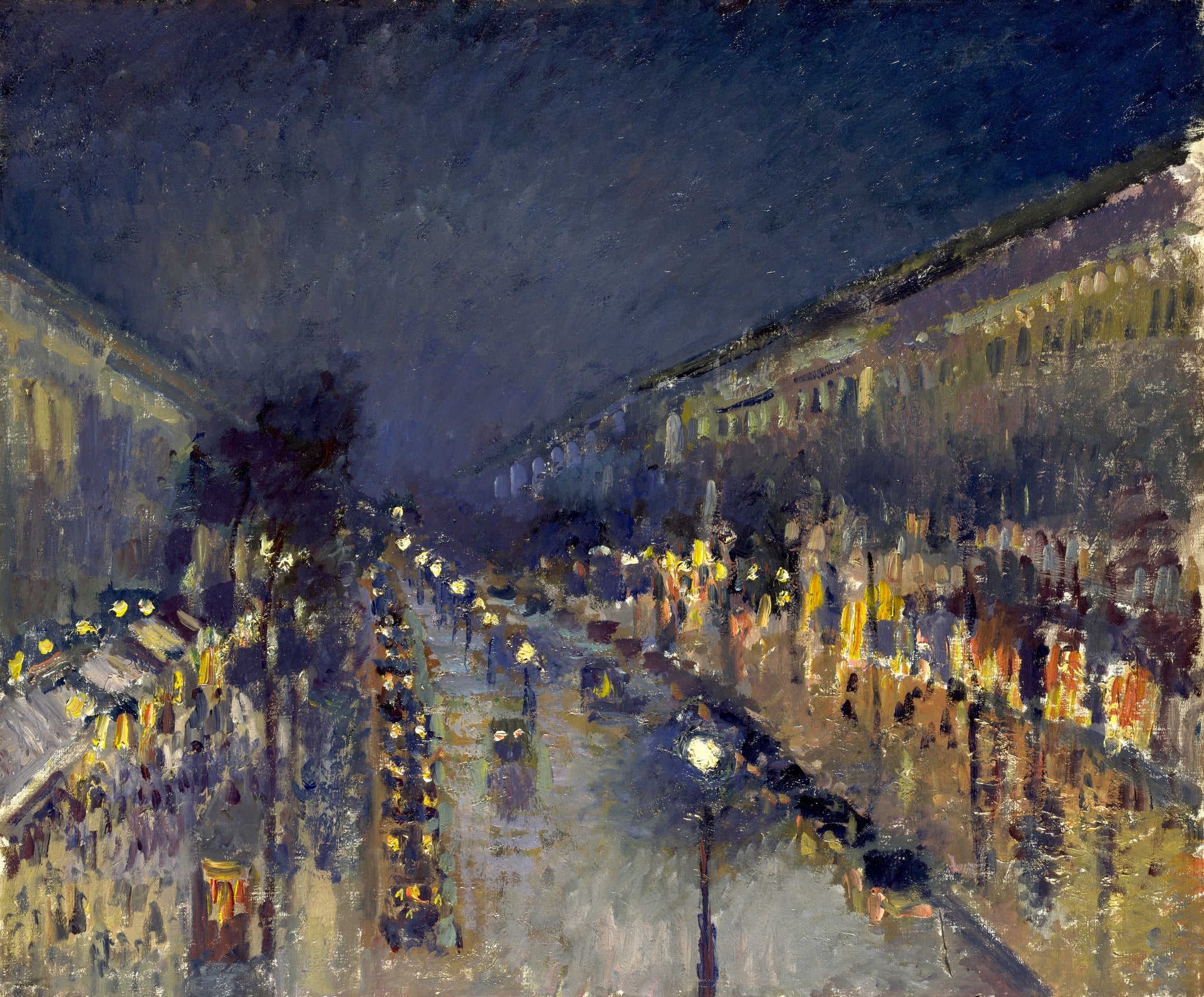
Boulevard Montmartre at Night
Camille Pissarro (1897)
A high window turns Paris into a flowing current: in Boulevard Montmartre at Night, Camille Pissarro fuses <strong>modern light</strong> and <strong>urban movement</strong> into a single, restless rhythm. Cool electric halos and warm gaslit windows shimmer across rain‑slick stone, where carriages and crowds dissolve into <strong>pulse-like blurs</strong> <sup>[1]</sup><sup>[2]</sup>.
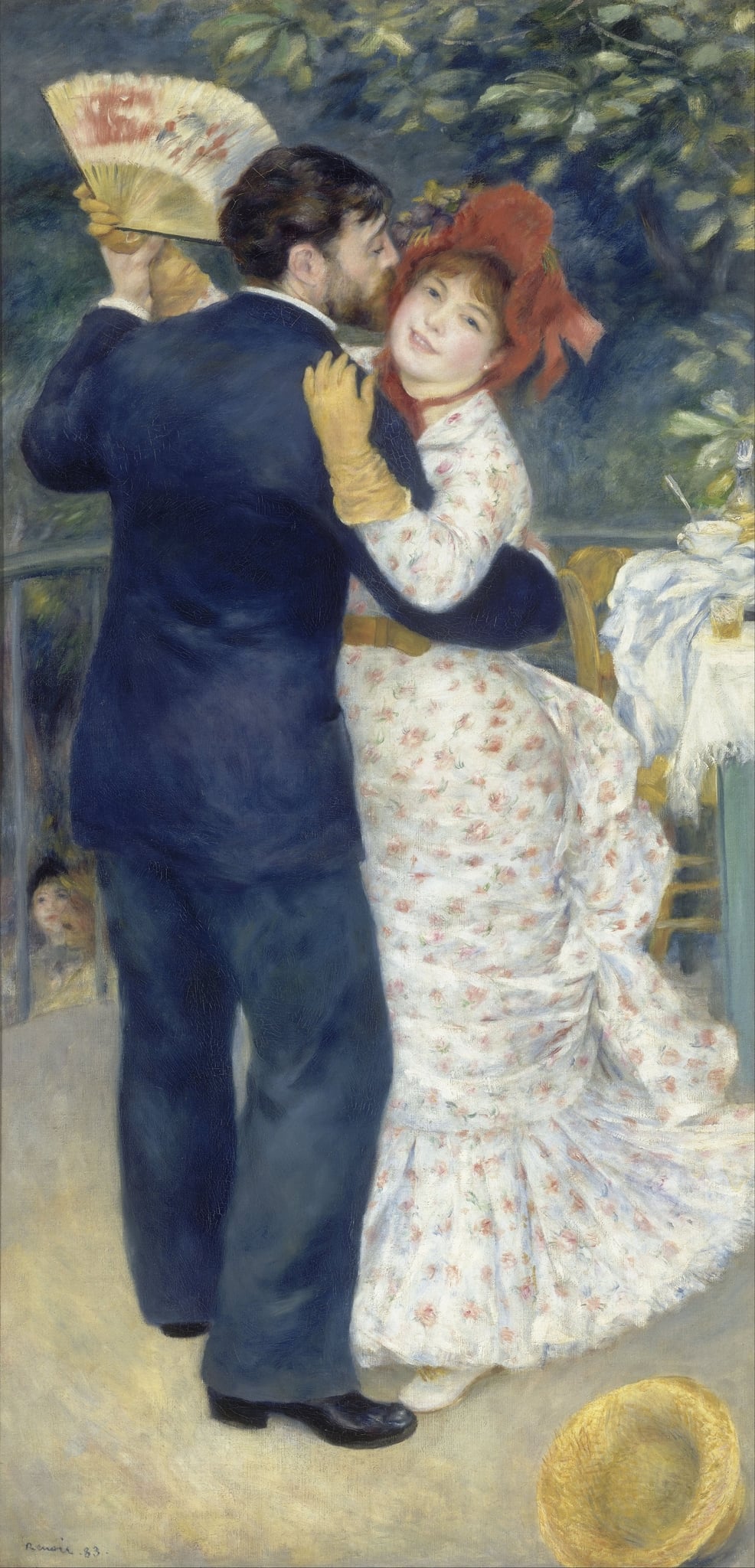
Dance in the Country
Pierre-Auguste Renoir (1883)
Dance in the Country shows a couple swept into a close embrace on a café terrace, their bodies turning in a soft spiral as foliage and sunlight dissolve into <strong>dappled color</strong>. Renoir orchestrates <strong>bourgeois leisure</strong>—the tossed straw boater, a small table with glass and napkin, the woman’s floral dress and red bonnet—to stage a moment where decorum and desire meet. The result is a modern emblem of shared pleasure, poised between Impressionist shimmer and a newly <strong>firm, linear touch</strong>.
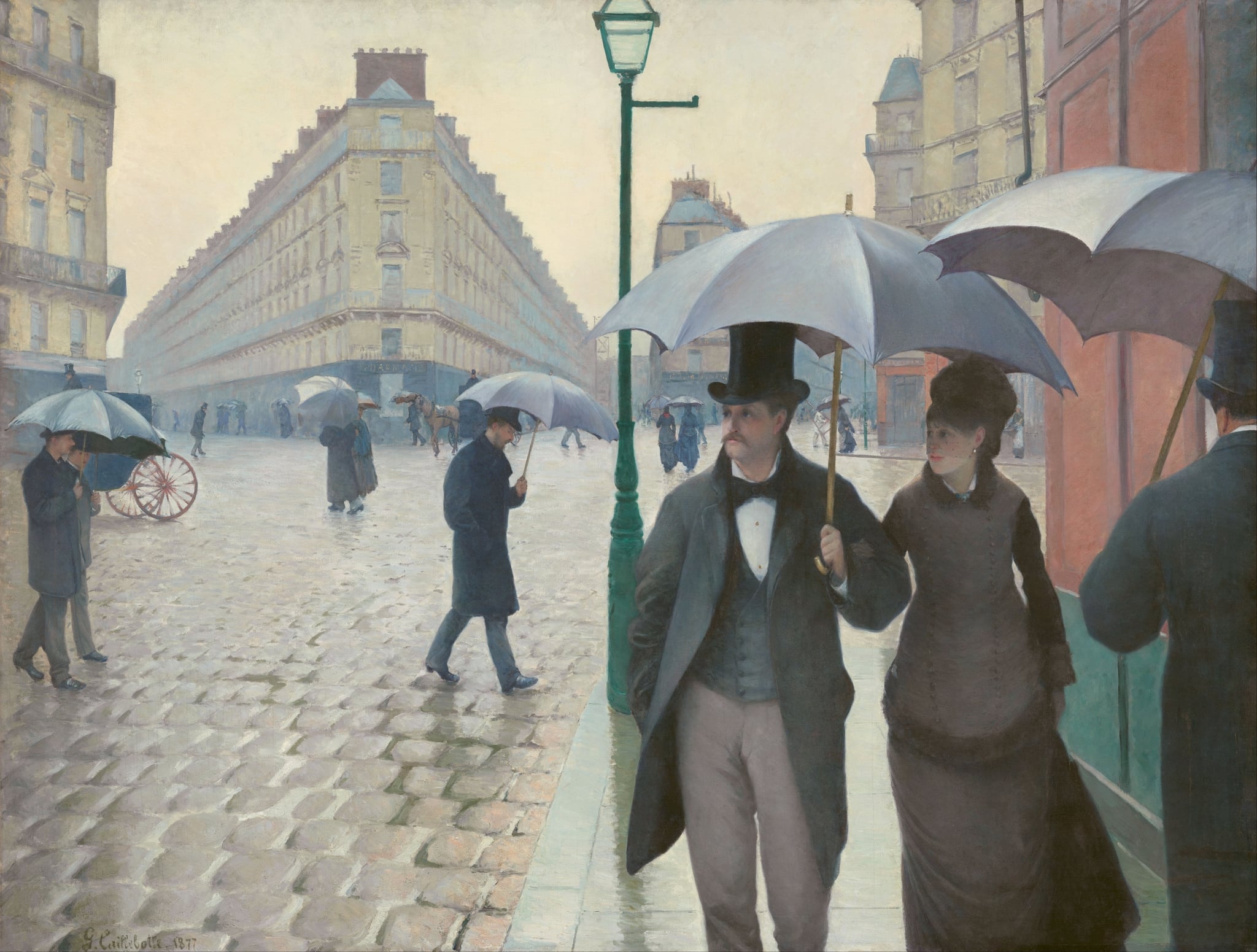
Paris Street; Rainy Day
Gustave Caillebotte (1877)
Gustave Caillebotte’s Paris Street; Rainy Day renders a newly modern Paris where <strong>Haussmann’s geometry</strong> meets the <strong>anonymity of urban life</strong>. Umbrellas punctuate a silvery atmosphere as a <strong>central gas lamp</strong> and knife-sharp façades organize the space into measured planes <sup>[1]</sup><sup>[2]</sup>.
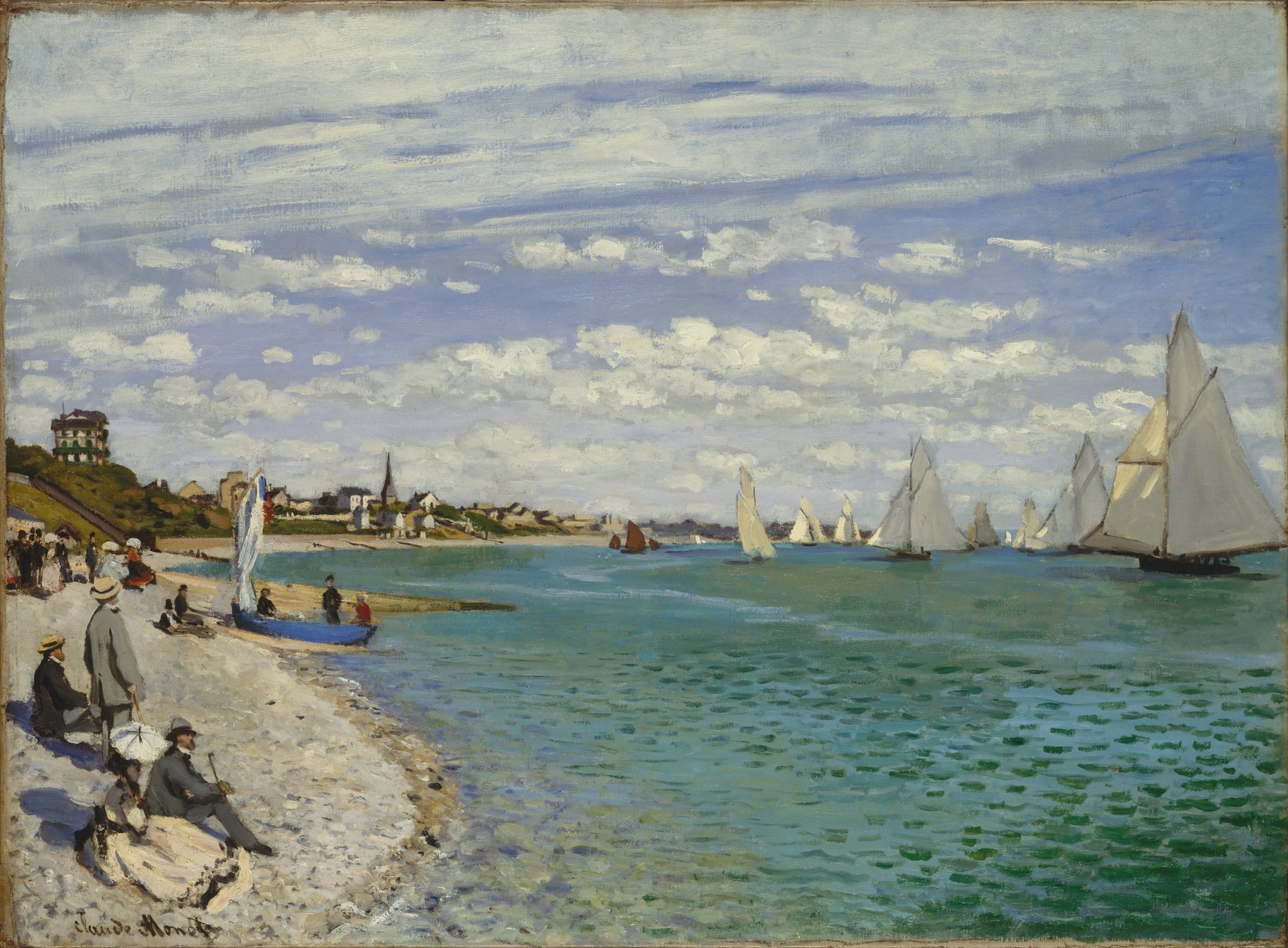
Regatta at Sainte-Adresse
Claude Monet (1867)
On a brilliant afternoon at the Normandy coast, a diagonal <strong>pebble beach</strong> funnels spectators with parasols toward a bay scattered with <strong>white-sailed yachts</strong>. Monet’s quick, broken strokes set <strong>wind, water, and light</strong> in synchrony, turning a local regatta into a modern scene of leisure held against the vastness of sea and sky <sup>[1]</sup><sup>[2]</sup>.
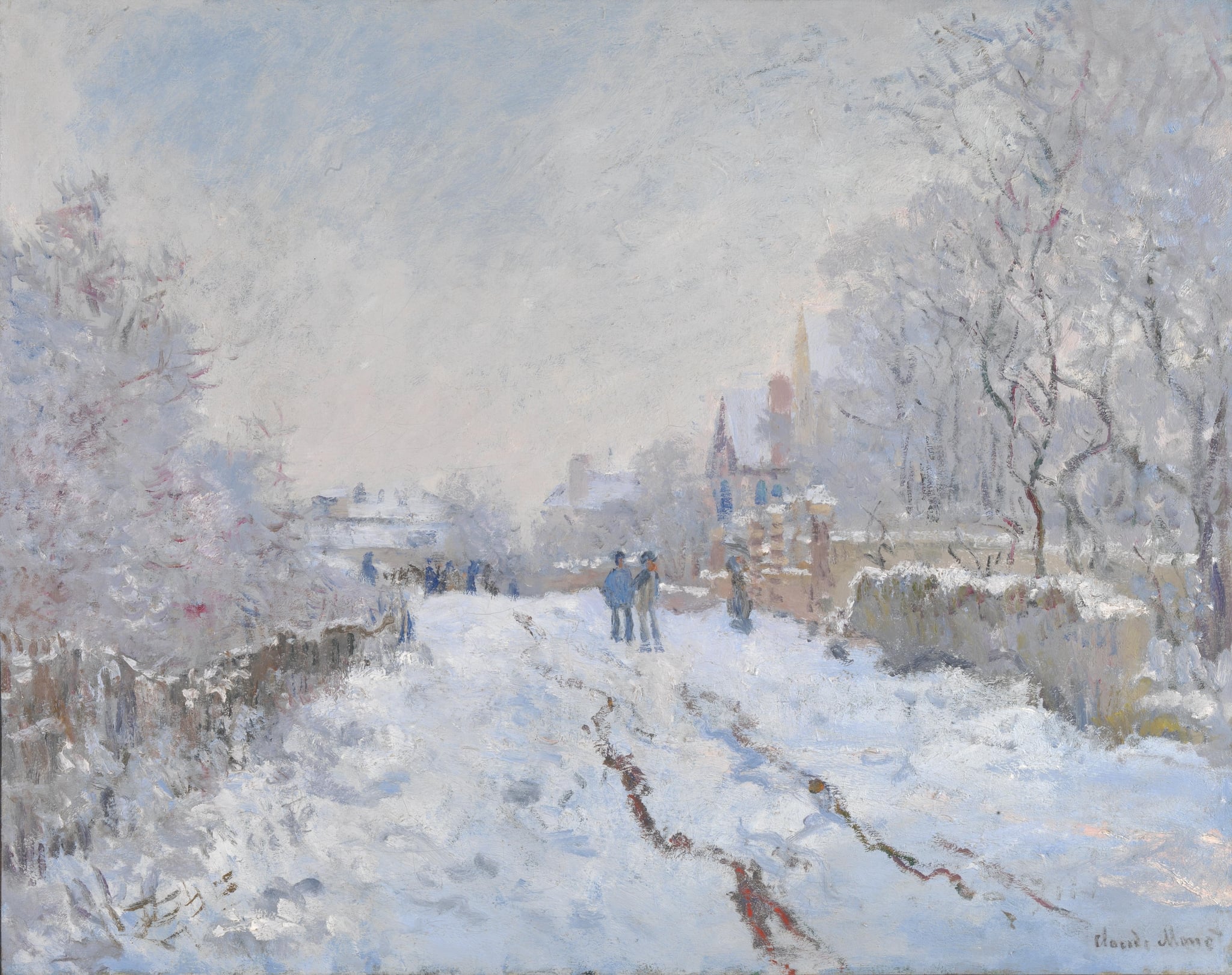
Snow at Argenteuil
Claude Monet (1875)
<strong>Snow at Argenteuil</strong> renders a winter boulevard where light overtakes solid form, turning snow into a luminous field of blues, violets, and pearly pinks. Reddish cart ruts pull the eye toward a faint church spire as small, blue-gray figures persist through the hush. Monet elevates atmosphere to the scene’s <strong>protagonist</strong>, making everyday passage a meditation on time and change <sup>[1]</sup><sup>[2]</sup>.
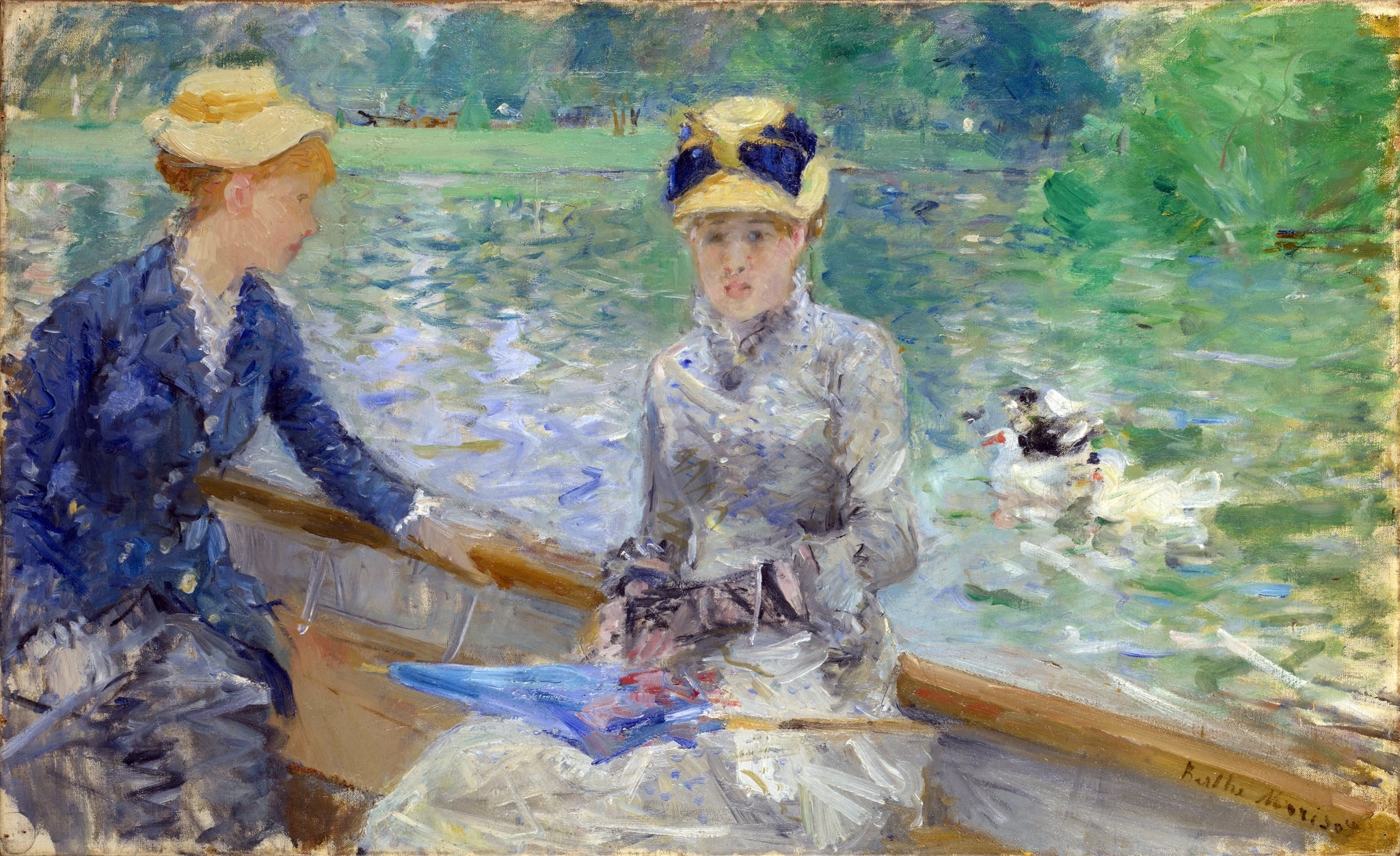
Summer's Day
Berthe Morisot (about 1879)
Two women drift on a boat in the Bois de Boulogne, their dresses, hats, and a bright blue parasol fused with the lake’s flicker by Morisot’s swift, <strong>zig‑zag brushwork</strong>. The scene turns a brief outing into a poised study of <strong>modern leisure</strong> and <strong>female companionship</strong> in public space <sup>[1]</sup>.
The Ballet Class
Edgar Degas (1873–1876)
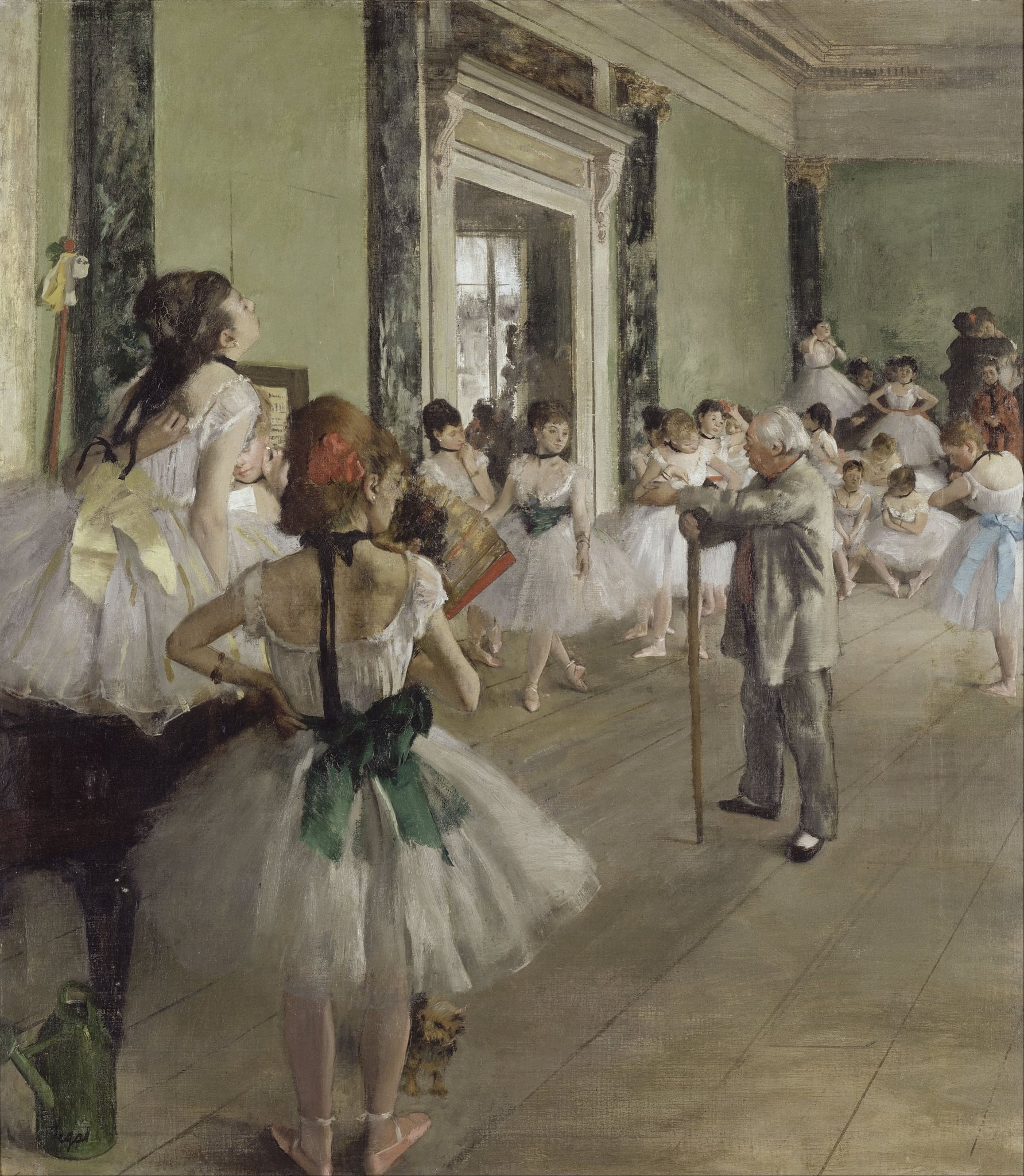
<strong>The Ballet Class</strong> shows the work behind grace: a green-walled studio where young dancers in white tutus rest, fidget, and stretch while the gray-suited master stands with his cane. Degas’s diagonal floorboards, cropped viewpoints, and scattered props—a watering can, a music stand, even a tiny dog—stage a candid vision of routine rather than spectacle. The result is a modern image of discipline, hierarchy, and fleeting poise.
The Boating Party
Mary Cassatt (1893–1894)
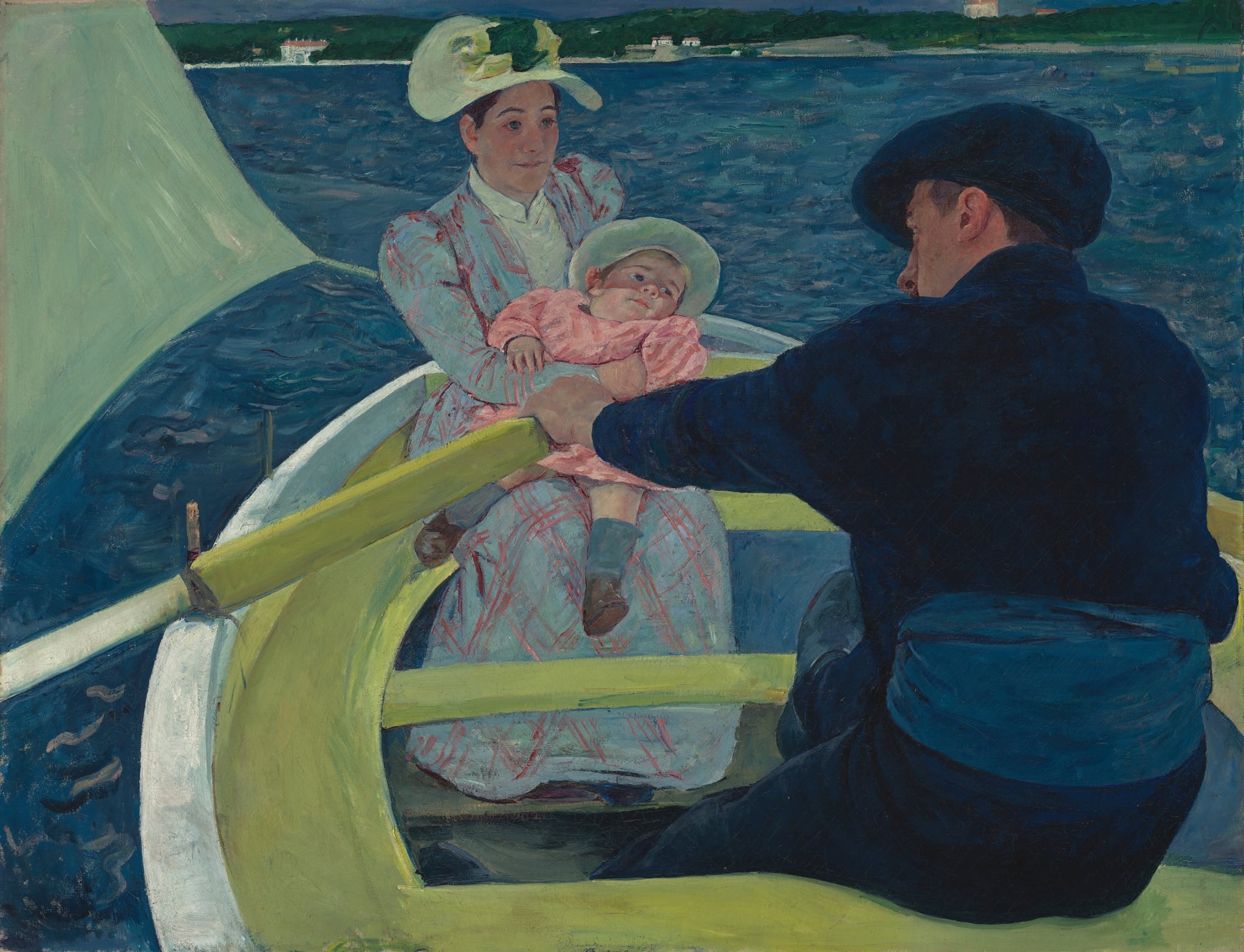
In The Boating Party, Mary Cassatt fuses <strong>intimate caregiving</strong> with <strong>modern mobility</strong>, compressing mother, child, and rower inside a skiff that cuts diagonals across ultramarine water. Bold arcs of citron paint and a high, flattened horizon reveal a deliberate <strong>Japonisme</strong> logic that stabilizes the scene even as motion surges around it <sup>[1]</sup>. The painting asserts domestic life as a public, modern subject while testing the limits of Impressionist space and color.
The Boulevard Montmartre on a Winter Morning
Camille Pissarro (1897)
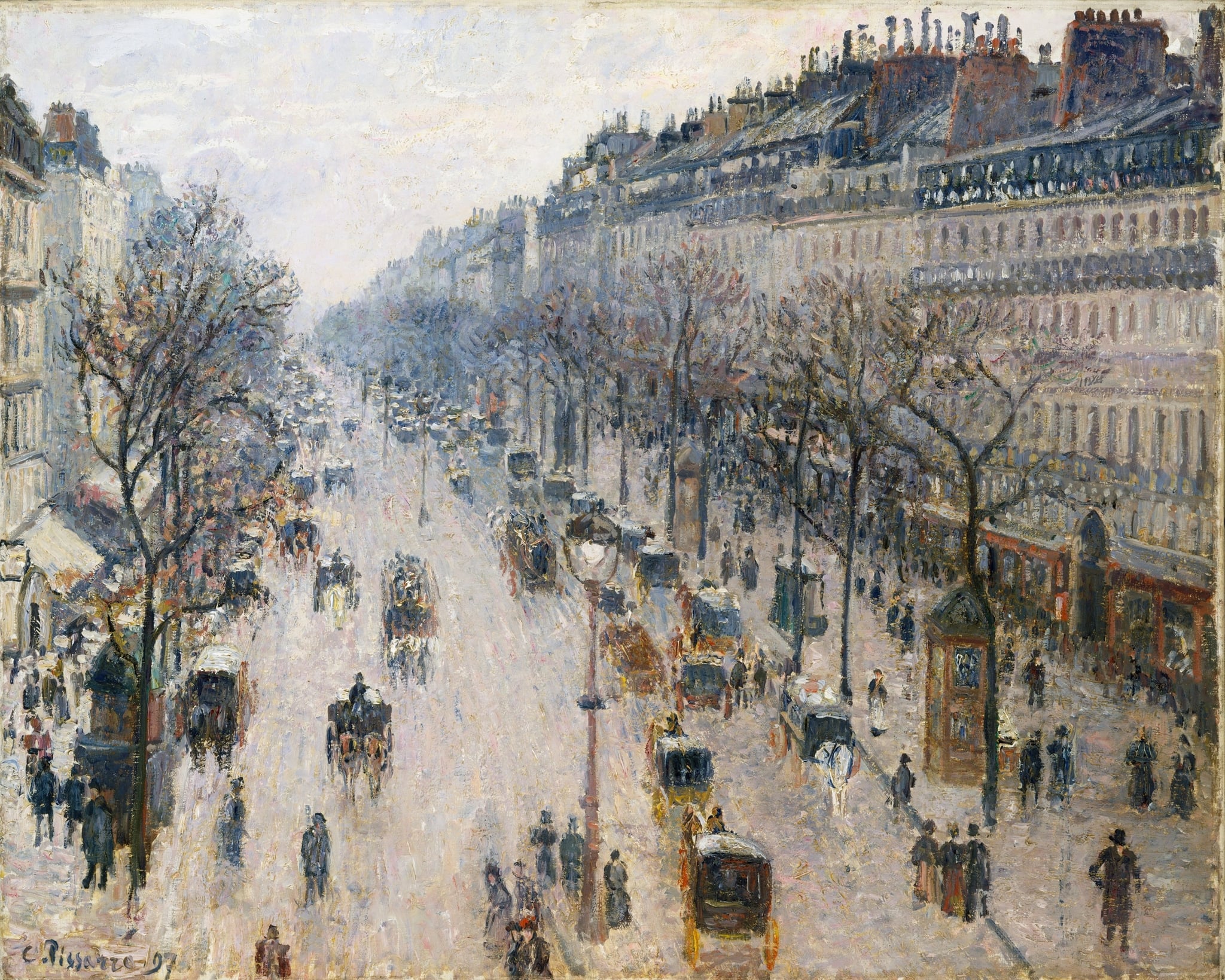
From a high hotel window, Camille Pissarro renders Paris as a living system—its Haussmann boulevard dissolving into winter light, its crowds and vehicles fused into a soft, <strong>rhythmic flow</strong>. Broken strokes in cool grays, lilacs, and ochres turn fog, steam, and motion into <strong>texture of time</strong>, dignifying the city’s ordinary morning pulse <sup>[1]</sup><sup>[3]</sup>.
The Card Players by Paul Cézanne | Equilibrium and Form
Paul Cézanne
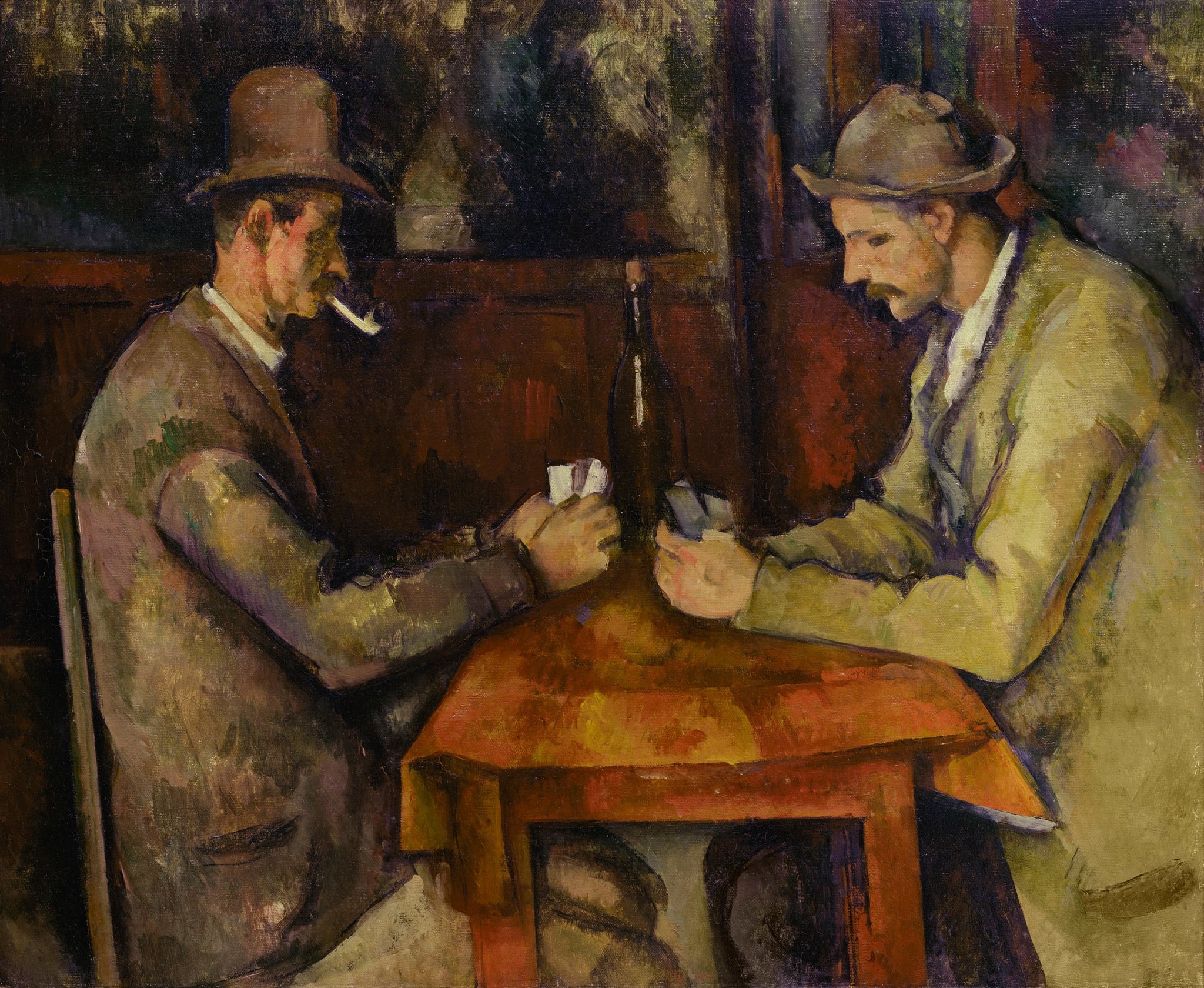
In The Card Players, Paul Cézanne turns a rural café game into a study of <strong>equilibrium</strong> and <strong>monumentality</strong>. Two hated peasants lean inward across an orange-brown table while a dark bottle stands upright between them, acting as a calm, vertical <strong>axis</strong> that stabilizes their mirrored focus <sup>[2]</sup><sup>[3]</sup>.
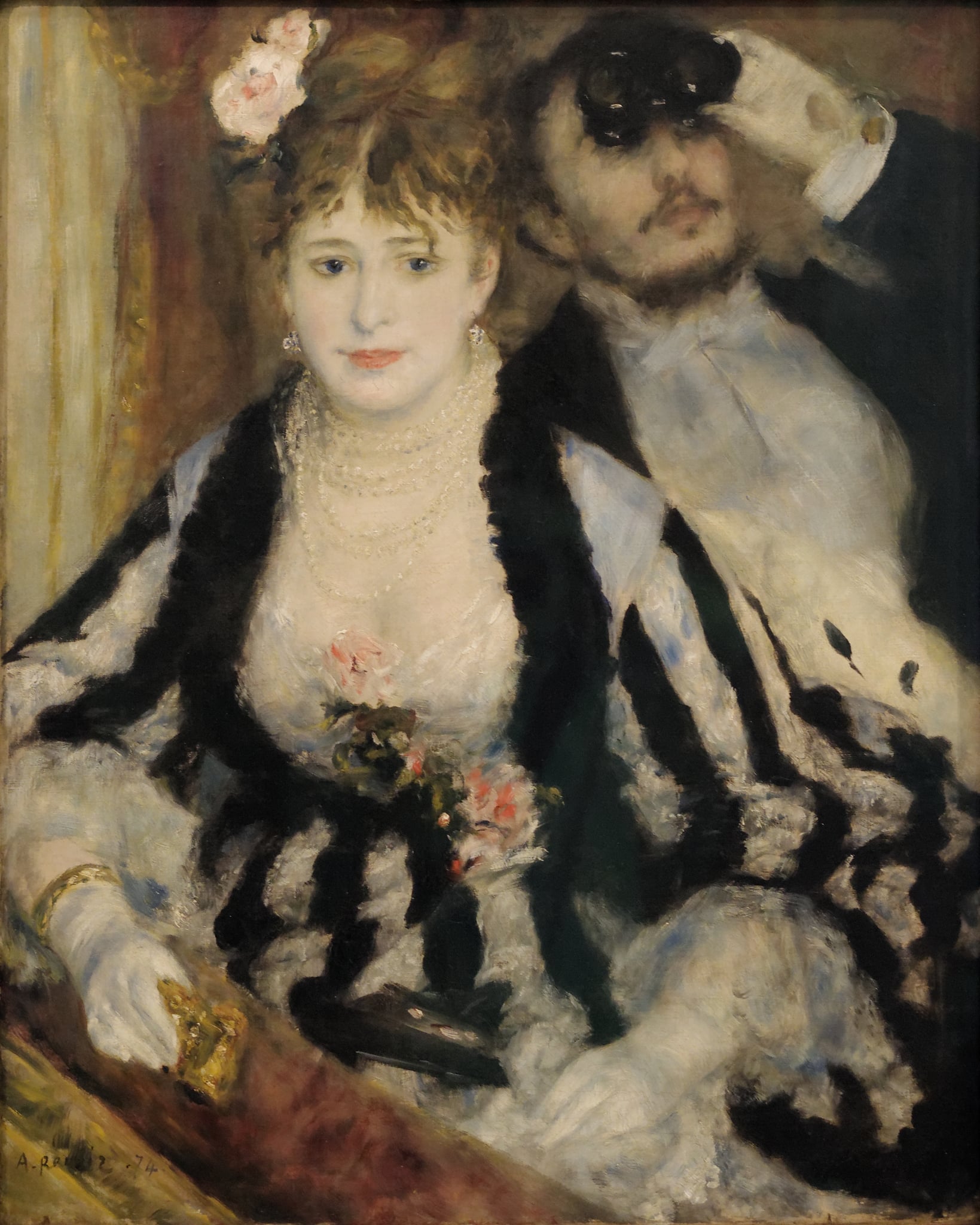
The Loge
Pierre-Auguste Renoir (1874)
Renoir’s The Loge (1874) turns an opera box into a <strong>stage of looking</strong>, where a woman meets our gaze while her companion scans the crowd through binoculars. The painting’s <strong>frame-within-a-frame</strong> and glittering fashion make modern Parisian leisure both alluring and self-conscious, turning spectators into spectacles <sup>[1]</sup><sup>[2]</sup>.
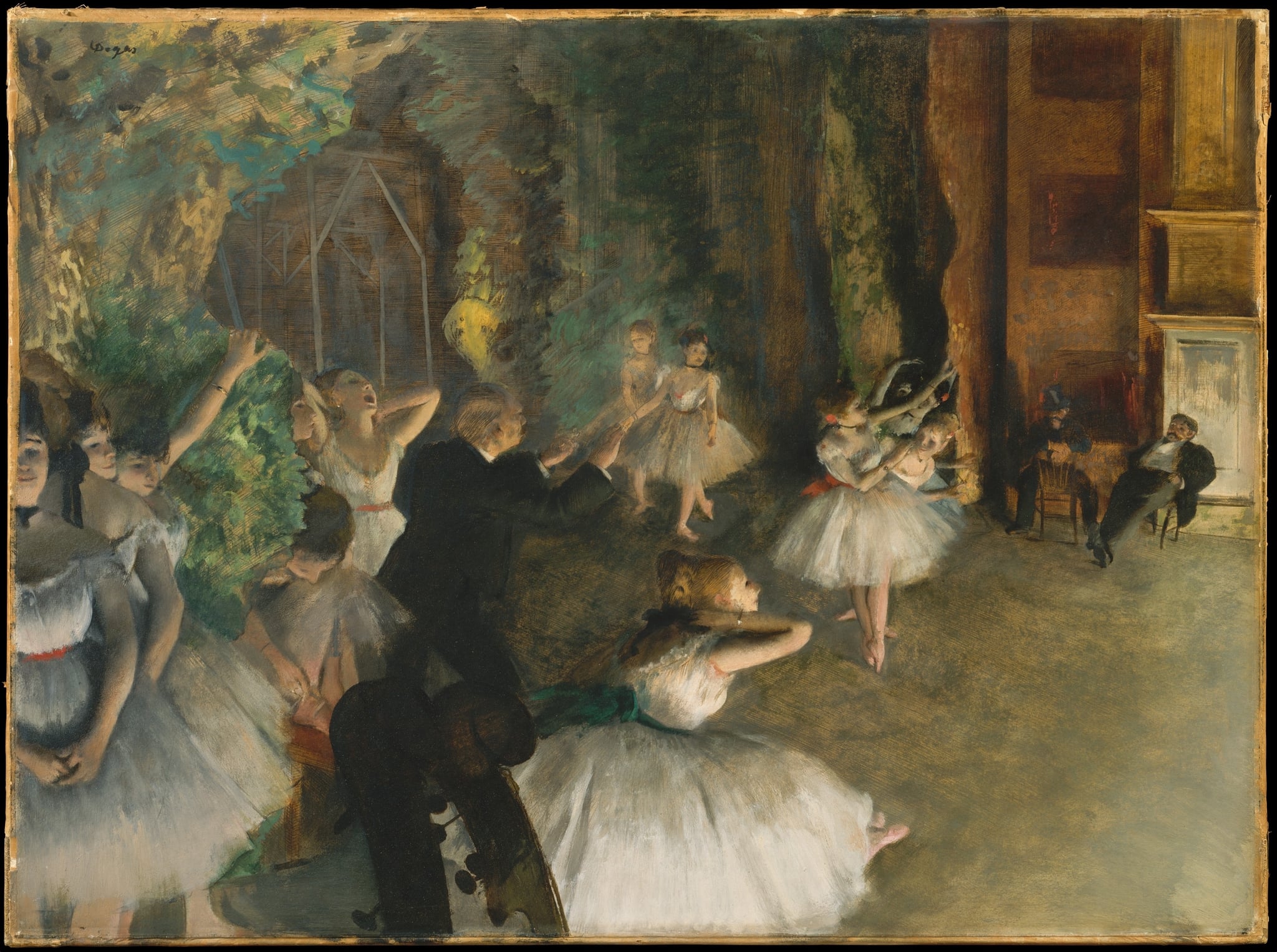
The Rehearsal of the Ballet Onstage
Edgar Degas (ca. 1874)
Degas’s The Rehearsal of the Ballet Onstage turns a moment of practice into a modern drama of work and power. Under <strong>harsh footlights</strong>, clustered ballerinas stretch, yawn, and repeat steps as a <strong>ballet master/conductor</strong> drives the tempo, while <strong>abonnés</strong> lounge in the wings and a looming <strong>double bass</strong> anchors the labor of music <sup>[1]</sup><sup>[3]</sup><sup>[4]</sup>.
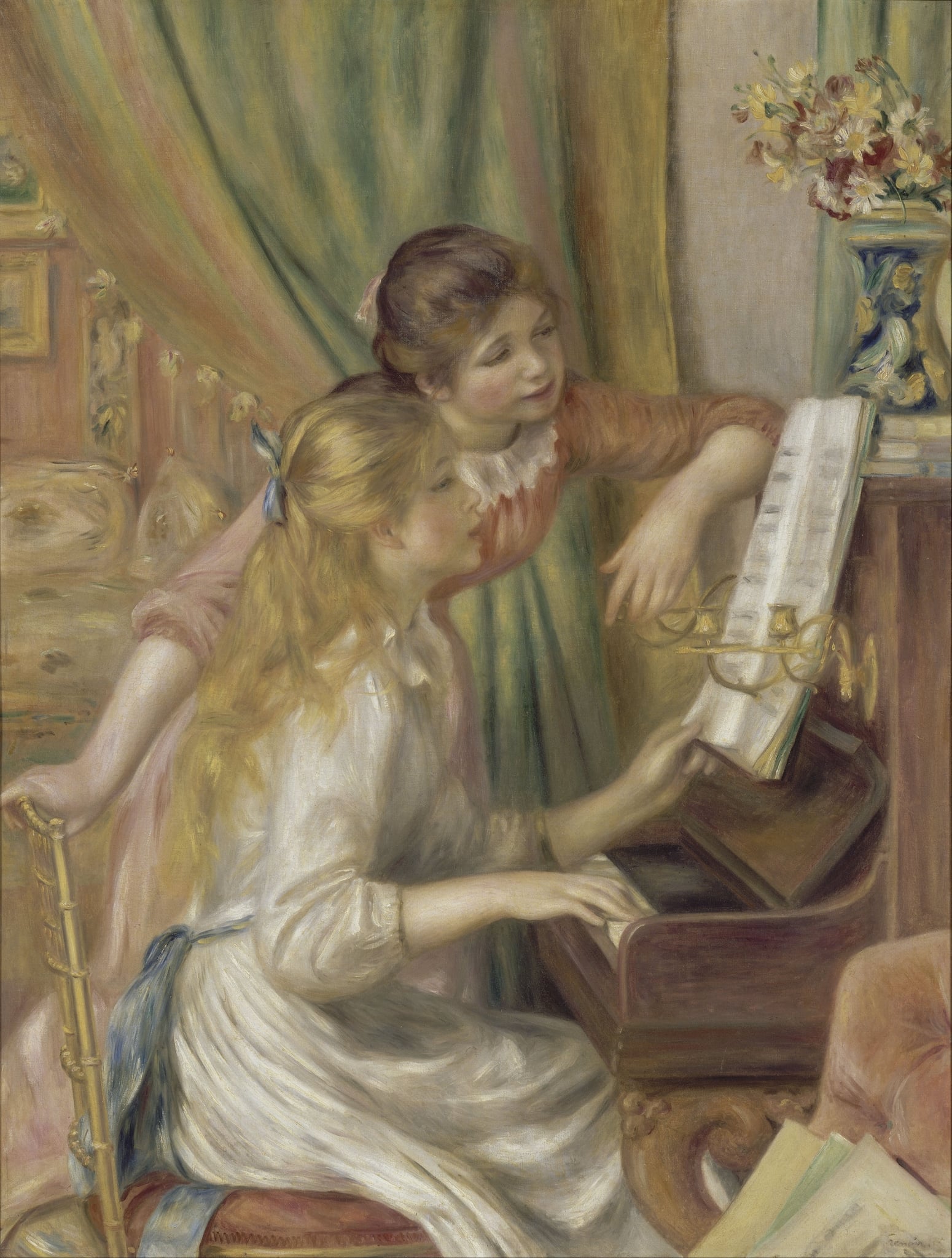
Young Girls at the Piano
Pierre-Auguste Renoir (1892)
Renoir’s Young Girls at the Piano turns a quiet lesson into a scene of <strong>attunement</strong> and <strong>bourgeois grace</strong>. Two adolescents—one seated at the keys, the other leaning to guide the score—embody harmony between discipline and delight, rendered in Renoir’s late, <strong>luminous</strong> touch <sup>[1]</sup><sup>[2]</sup>.
Related Themes
Related Symbolism Categories
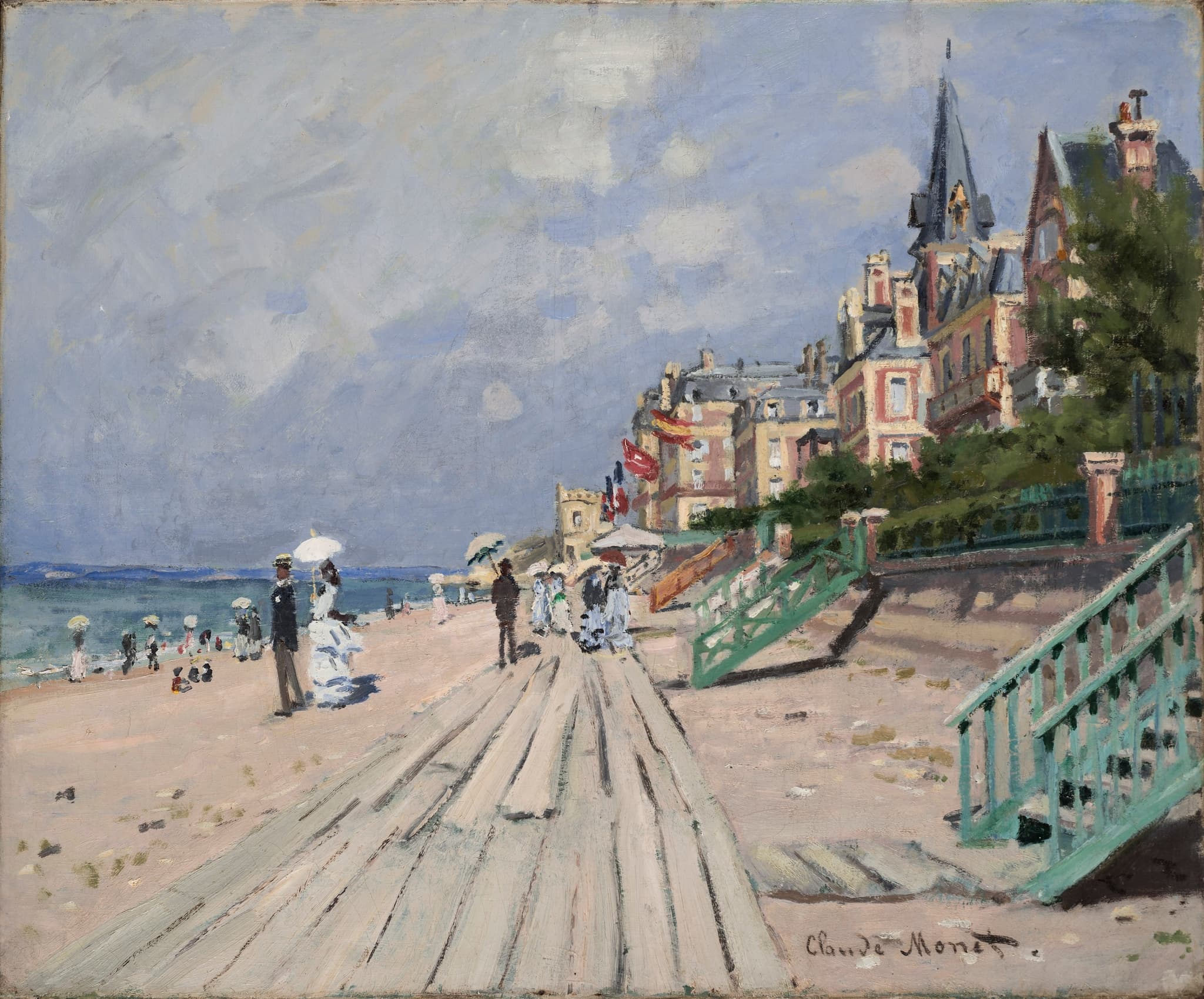
Fashion
In Impressionist and related modern painting, fashion functions as a coded system of class, gender, and spectatorship, translating older allegorical and mythic meanings into the language of couture, accessories, and regulated bodily comportment.
Humanity
The symbolism of humanity in art encompasses markers of personal connection, social roles, and emotional dynamics, reflecting complex layers of identity and interaction within modern life.
Mortality
The “Mortality” symbolism category in nineteenth‑century painting translates death from theological drama into terse, often secular signs—blood, smoke, wilted flowers, exhausted bodies—through which modern artists register the finitude of life and the procedural, sometimes anonymized character of modern violence.
In the later nineteenth century, artists of the Paris-centered avant-garde increasingly turned from myth and history to the theater, the boulevard, and the café-concert as primary arenas of representation. With that shift came a new repertoire of symbols that registered “society” not as an abstract moral order but as a dense fabric of class codes, gendered roles, and choreographed looking. Hats, gloves, carriages, café tables, and backstage figures assume an iconographic weight comparable to earlier religious attributes: they condense patterns of behavior and power into visible form. The Society symbolism category names this emergent lexicon, in which modern social life becomes legible through a set of recurrent props, garments, and spatial positions.
Many of these symbols operate first of all through dress, the primary marker of modern class visibility. In Caillebotte’s Paris Street; Rainy Day (1877), top hats and tailored coats define the central Bourgeois Couple as flâneur and companion, a type further elaborated in the symbol of the Bourgeois Couple (Flâneur and Companion) itself. Their clothing functions semiotically as a uniform of bourgeois modernity: dark, fitted, and understated, it signals both economic security and a cultivated anonymity. The couple’s measured stride and the self-contained bubble of their umbrella echo Haussmann’s rectilinear façades and the vertical gas lamp, aligning sartorial discipline with urban order. Surrounding figures, reduced to a humbler register of hats that indicate “working-class identity and anonymity,” complete a social scale in which headgear alone indexes one’s place within the hierarchy of the street.
Accessories refine this sartorial code into a subtler discourse on comportment. Gloves, a recurrent motif, condense “respectability and public composure” by literally mediating touch. In Morisot’s Summer’s Day (c. 1879), the women’s gloved hands reinforce their composed, self-possessed presence within the Bois de Boulogne, a public leisure space newly open to female promenade yet still hedged by decorum. Morisot’s swift, zig-zag facture visually unsettles the scene, but the gloves anchor propriety within that shimmering flux. In Renoir’s Dance in the Country (1883), the woman’s “long yellow gloves” carry similar symbolic weight: they maintain etiquette—required at public dances—even as the waltz embrace draws bodies into “controlled intimacy and mutual desire.” Here the glove’s function is double: it is both barrier and enabling device, making close contact socially admissible by regulating it.
If hats and gloves articulate class and propriety, other symbols define the spaces and infrastructures in which social interactions unfold. In Pissarro’s The Boulevard Montmartre on a Winter Morning (1897), a Street Kiosk stands near the right foreground as a “node of information and commerce; a pause point within circulation.” It punctuates the otherwise continuous stream of Traffic and Pedestrians (Urban Flow), embodying the modern city as a system of organized movement periodically crystallized around exchange. The composition’s high, axial vantage translates Haussmann’s rational plan into pictorial rhythm; pedestrians and vehicles blur into a “ceaseless movement and exchange,” an abstract pulse of modernity rather than individualized narrative. In Boulevard Montmartre at Night (1897), the related symbol of the Procession of carriages (cab lights) advances this logic into nocturnal spectacle: cab lamps become moving points of light that record the “urban circulation and entertainment economy moving through the night.” Pissarro’s bead-like strokes render traffic as a continuous stream in which individual conveyances matter less than the collective tempo they create.
Where the boulevard is horizontal and transitional, other paintings foreground nodal social interiors. Manet’s A Bar at the Folies-Bergère (1882) is paradigmatic. The bar itself, stocked with bottles and fruit, is framed by the symbol of café tableware, those “props of café sociability—conversation, drinking, and public leisure.” Yet the key figure is the Barmaid (Suzon), defined as the “human face of urban commerce—both salesperson and potential commodity; the mediator between viewer and marketplace.” Frontally posed, Suzon stands between us and the mirrored tumult of the music hall; the skewed reflection that places an unseen male customer only in the mirror underscores the asymmetry of looking and power. She is at once subject and object: her role as vendor masks and exposes the possibility that her own presence is for sale. The barmaid becomes an iconographic condensation of late nineteenth-century anxieties about commodified intimacy and female labor in public venues.
Renoir’s Dance in the Country spatializes similar concerns in a lighter key. The couple’s waltz embrace is visually framed by witnesses at the edge—figures who, even when only glancingly described, constitute the “public gaze and social surveillance that frame flirtation within acceptable decorum.” The woman’s Feathered Hat and Buttoned Bodice further codify the scene as respectable: fashionably adorned yet tightly fastened, her clothing signals “social propriety and self-control within public flirtation.” The discarded straw boater and scattered café tableware at the margin—glass, napkin—tie the dance back to the world of café sociability, but Renoir’s iconography insists that desire is always mediated by collective oversight and sartorial codes.
By contrast, Mary Cassatt’s The Boating Party (1893–94) reorients the symbolic vocabulary of society away from flirtation and urban spectacle toward caregiving and relational presence. The central mother-and-child unit functions as a “secular Madonna-and-Child motif,” asserting “caregiving, continuity, and guidance” as the core of modern life. Cassatt situates this triangle within a vessel propelled by a rower, so that familial intimacy is literally borne along by the infrastructure of leisure mobility. Compared with Manet and Renoir, Cassatt’s symbols of society emphasize interdependence rather than exchange: the boat becomes a provisional social cell, an interior within public water, in which the ethics of modernity are redefined as attentiveness rather than consumption.
Across these examples, symbols frequently work in concert, forming constellations that articulate complex social scripts. In Paris Street; Rainy Day, the Bourgeois Couple, fashionable hats, and Traffic and Pedestrians together stage the street as a theater of mutual yet asymmetrical looking: the flâneur observes; working-class figures are observed. In Pissarro’s boulevard scenes, the kiosk, cab lights, and anonymous crowds collectively depict the city as a managed flow whose very impersonality is the new civic condition. Manet’s bar condenses this same logic of circulation inward, transforming the entertainment hall into a micro-economy of glances, goods, and desires, all funneled through the figure of the barmaid.
Over the last third of the century, these symbols evolve in two related ways. First, they shift from merely descriptive markers of social milieu to reflexive instruments that question the very systems they represent. The Barmaid (Suzon) no longer simply signifies the presence of commerce; she embodies the uneasy permeability between subjectivity and commodity form. Second, they move from stable, central emblems—such as the top-hatted flâneur—toward more dispersed, process-oriented signs like Traffic and Pedestrians (Urban Flow) or the Procession of carriages. Society becomes less a hierarchy of fixed types than a set of circulating forces: light, movement, exchange, and surveillance. In this sense, the Society symbolism of Impressionism and its circle charts an art-historical transition from the iconography of status to the iconography of systems, registering modernity as a lived, contested, and perpetually mobile social field.