Intimacy
In the 'Intimacy' category, late nineteenth‑century artists redeploy traditional emblems of affection, care, and erotic exchange—hands, flowers, mirrors, and children—to probe the fragile, negotiated character of closeness in an age of public leisure, urban spectacle, and modern subjectivity.
Member Symbols
Featured Artworks
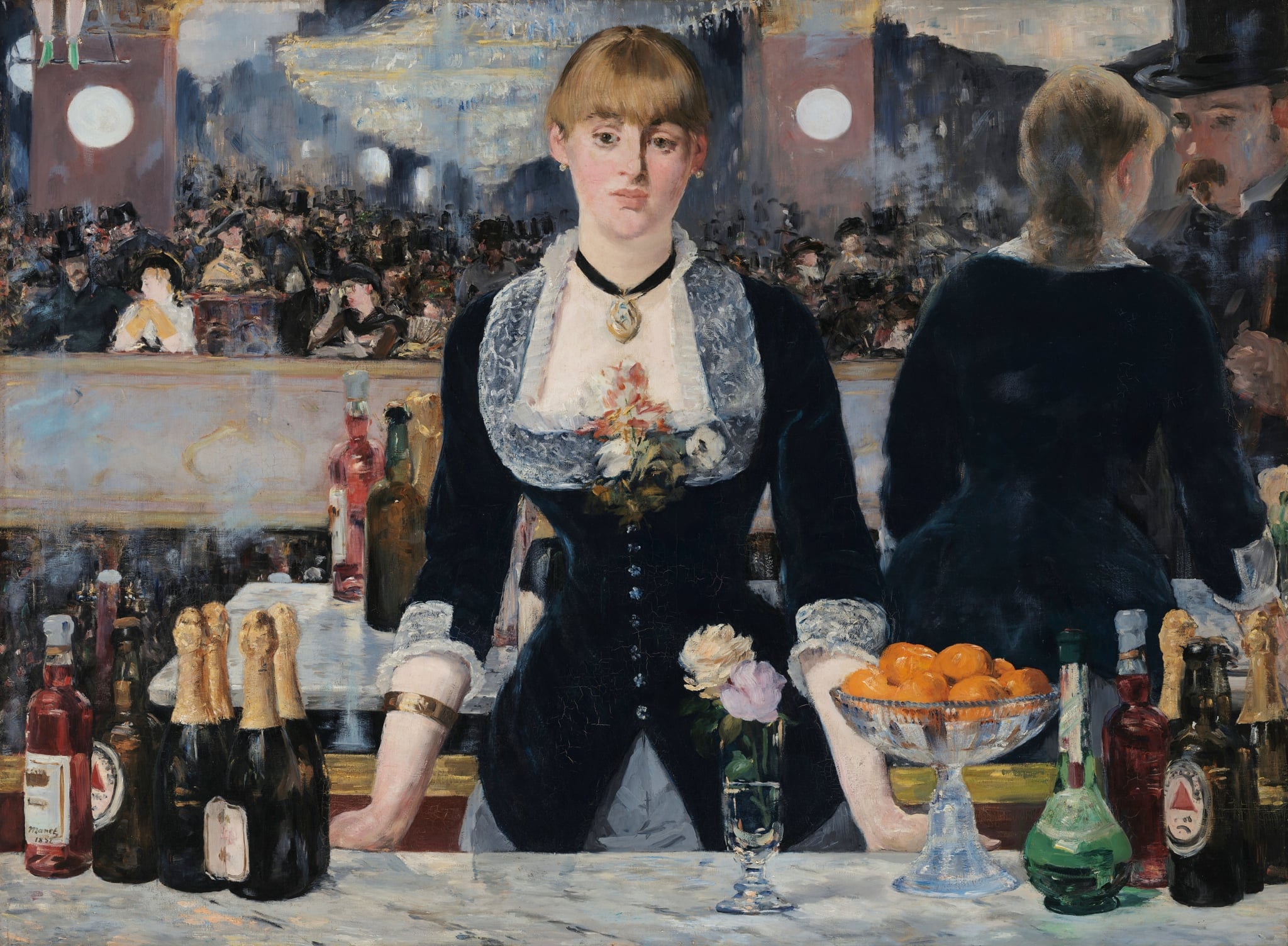
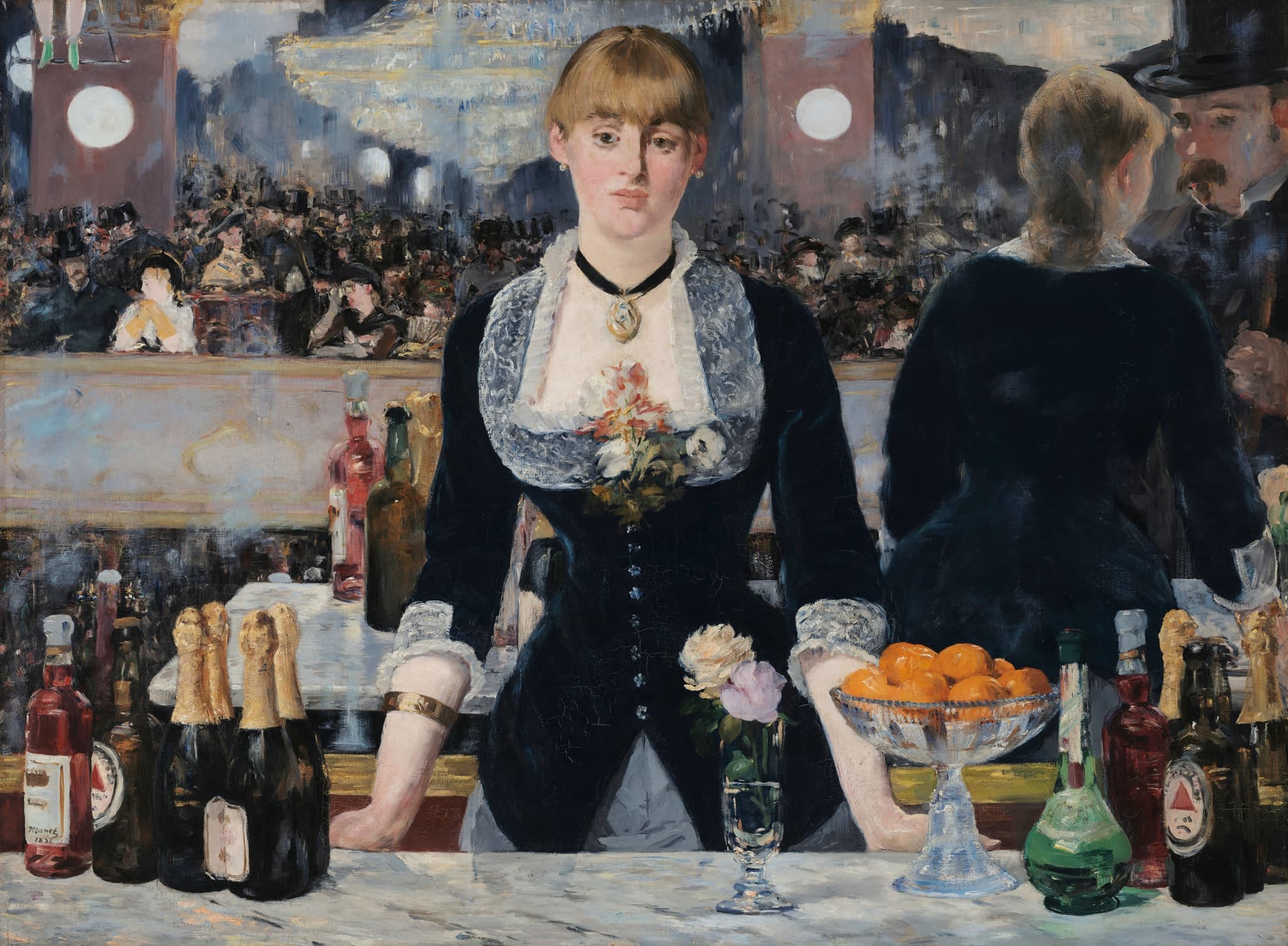
A Bar at the Folies-Bergère
Édouard Manet (1882)
Édouard Manet’s A Bar at the Folies-Bergère stages a face-to-face encounter with modern Paris, where <strong>commerce</strong>, <strong>spectacle</strong>, and <strong>alienation</strong> converge. A composed barmaid fronts a marble counter loaded with branded bottles, flowers, and a brimming bowl of oranges, while a disjunctive <strong>mirror</strong> unravels stable viewing and certainty <sup>[1]</sup><sup>[2]</sup>.
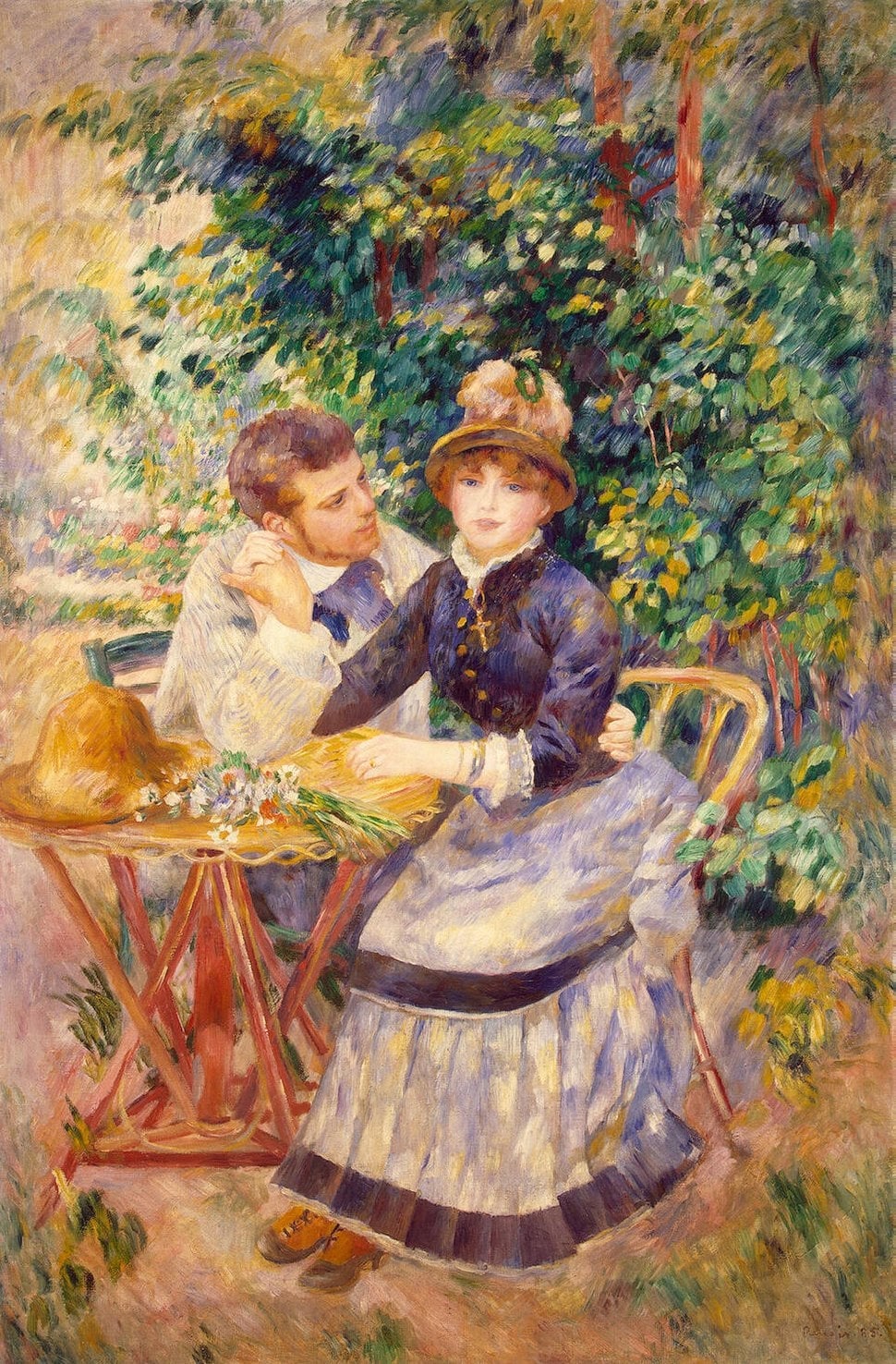
In the Garden
Pierre-Auguste Renoir (1885)
In the Garden presents a charged pause in modern leisure: a young couple at a café table under a living arbor of leaves. Their lightly clasped hands and the bouquet on the tabletop signal courtship, while her calm, front-facing gaze checks his lean. Renoir’s flickering brushwork fuses figures and foliage, rendering love as a <strong>transitory, luminous sensation</strong> <sup>[1]</sup><sup>[3]</sup>.
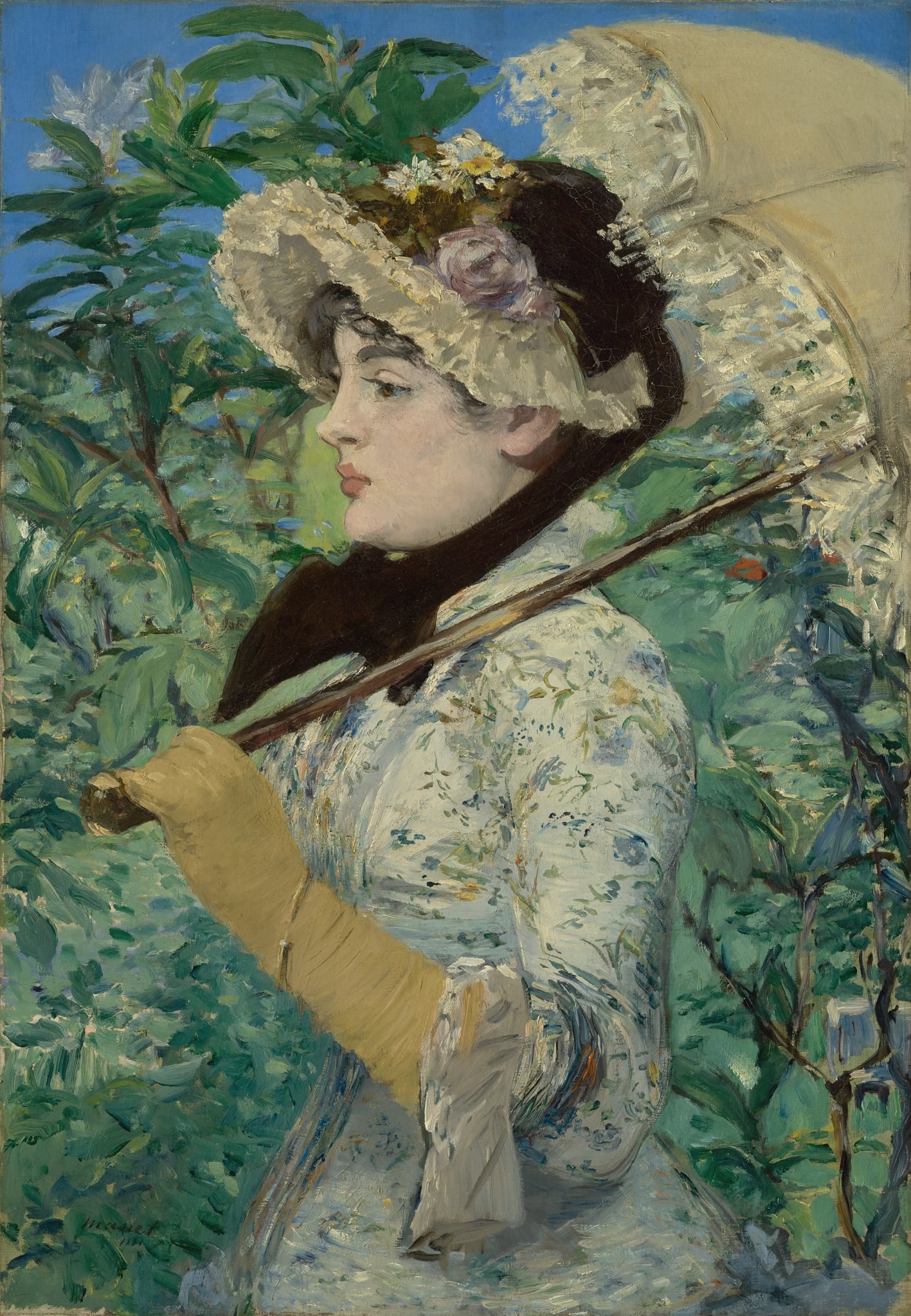
Jeanne (Spring)
Édouard Manet (1881)
Édouard Manet’s Jeanne (Spring) fuses a time-honored allegory with <strong>modern Parisian fashion</strong>: a crisp profile beneath a cream parasol, set against <strong>luminous, leafy greens</strong>. Manet turns couture—hat, glove, parasol—into the language of <strong>renewal and youth</strong>, making spring feel both perennial and up-to-the-minute <sup>[1]</sup><sup>[2]</sup>.
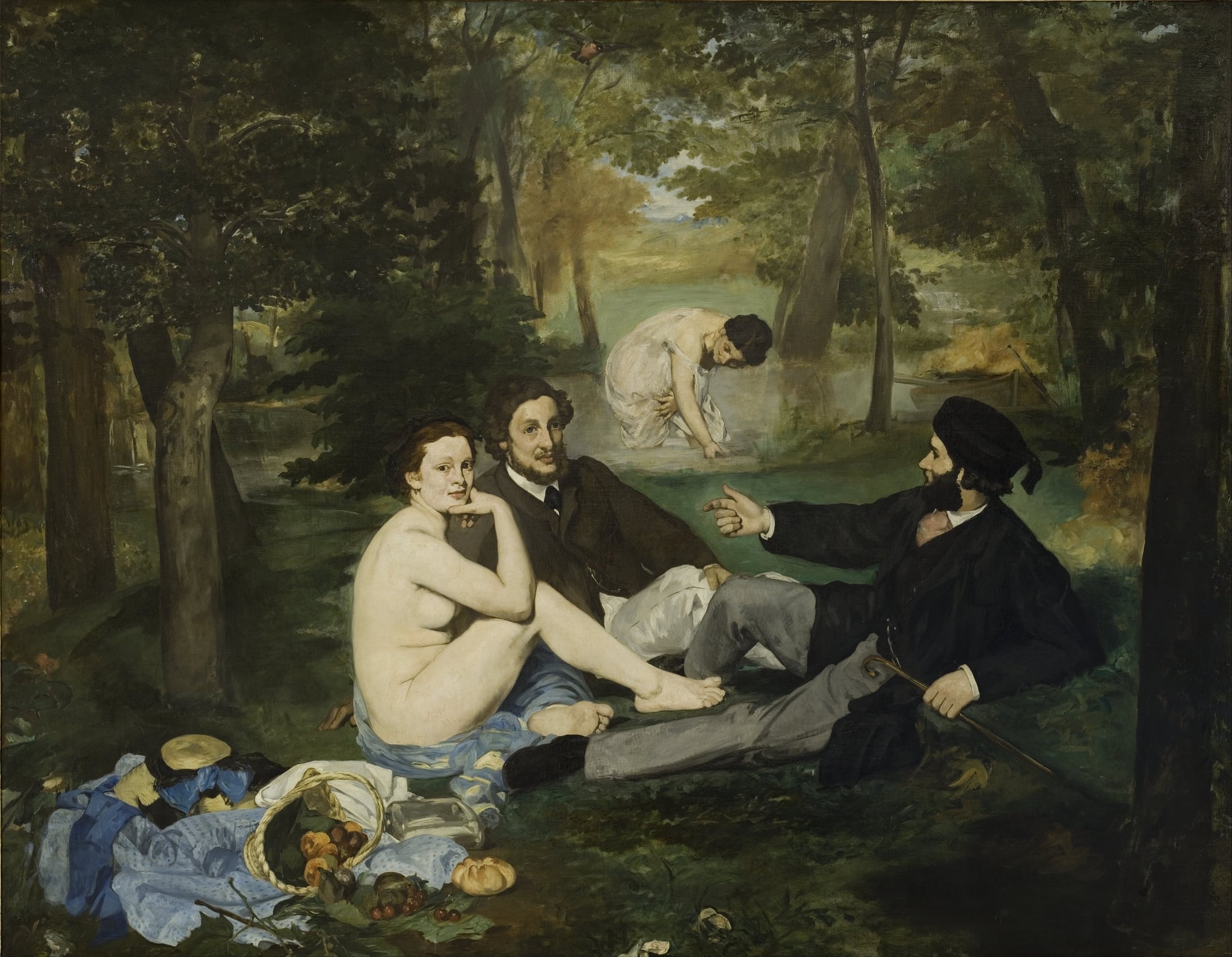
Luncheon on the Grass
Édouard Manet (1863)
Luncheon on the Grass stages a confrontation between <strong>modern Parisian leisure</strong> and <strong>classical precedent</strong>. A nude woman meets our gaze beside two clothed men, while a distant bather and an overturned picnic puncture naturalistic illusion. Manet’s scale and flat, studio-like light convert a park picnic into a manifesto of <strong>modern painting</strong> <sup>[1]</sup><sup>[2]</sup>.
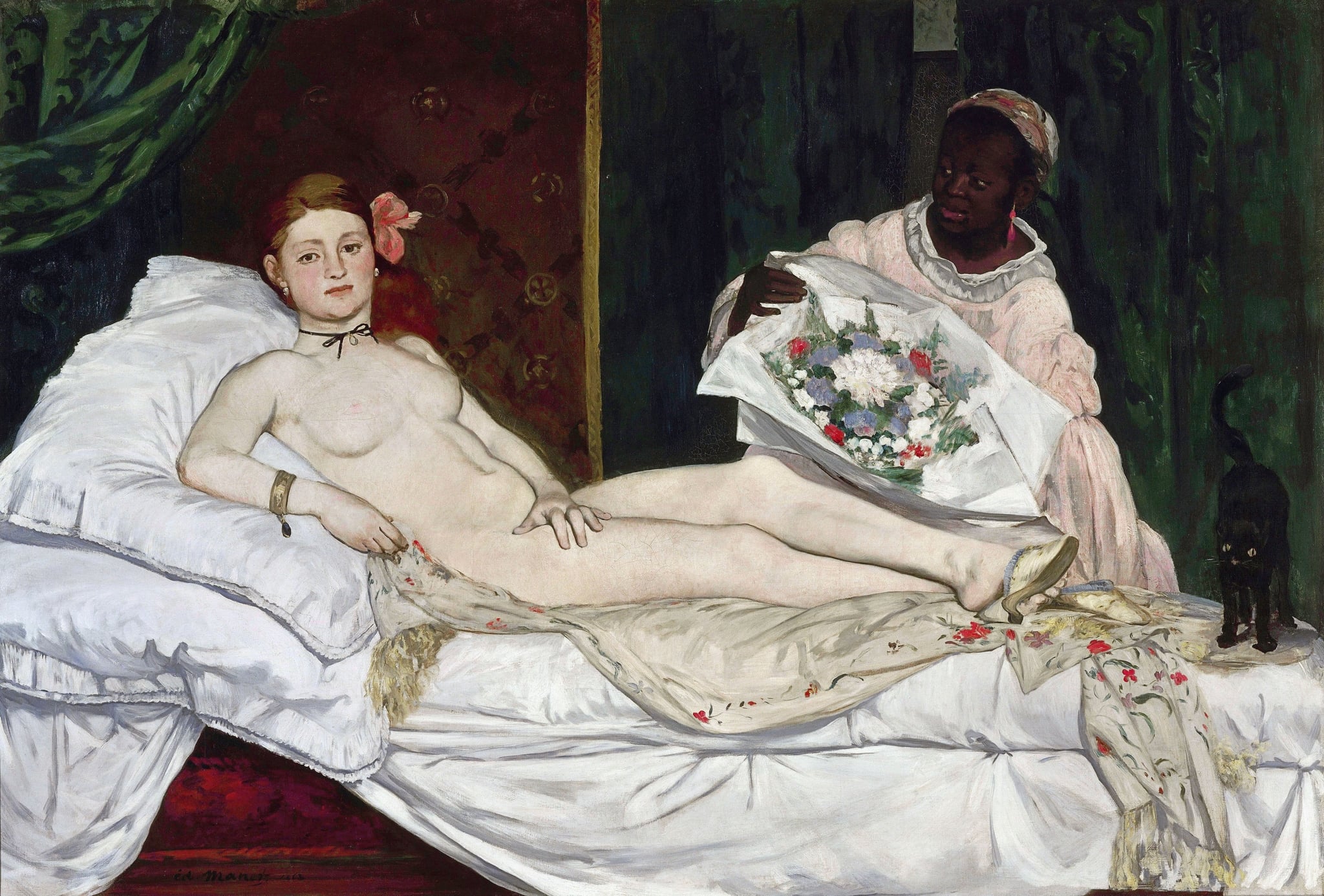
Olympia
Édouard Manet (1863 (Salon 1865))
A defiantly contemporary nude confronts the viewer with a steady gaze and a guarded pose, framed by crisp light and luxury trappings. In Olympia, <strong>Édouard Manet</strong> strips myth from the female nude to expose the <strong>modern economy of desire</strong>, power, and looking <sup>[1]</sup><sup>[3]</sup>.
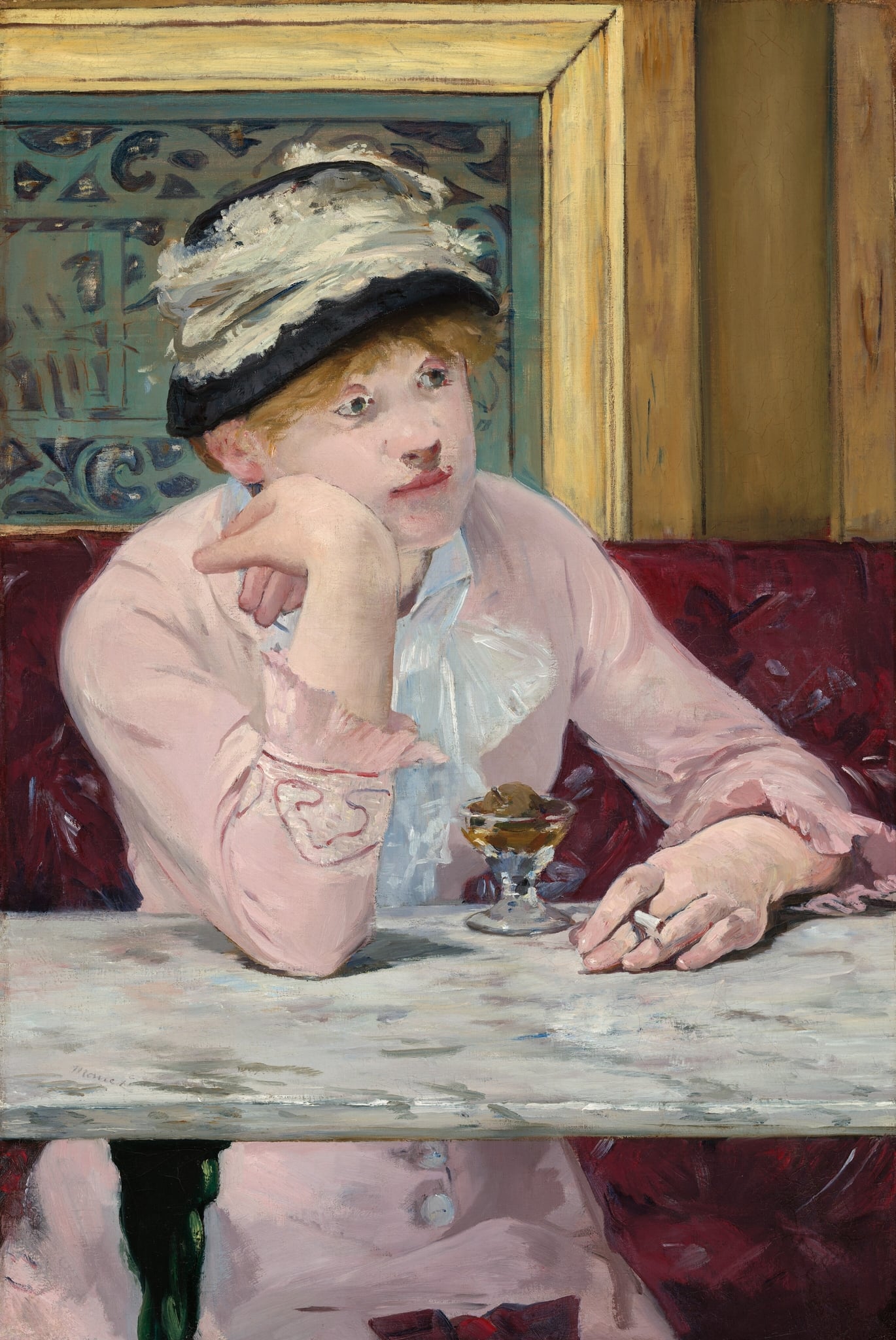
Plum Brandy
Édouard Manet (ca. 1877)
Manet’s Plum Brandy crystallizes a modern pause—an urban <strong>interval of suspended action</strong>—through the idle tilt of a woman’s head, an <strong>unlit cigarette</strong>, and a glass cradling a <strong>plum in amber liquor</strong>. The boxed-in space—marble table, red banquette, and decorative grille—turns a café moment into a stage for <strong>solitude within public life</strong> <sup>[1]</sup><sup>[2]</sup>.
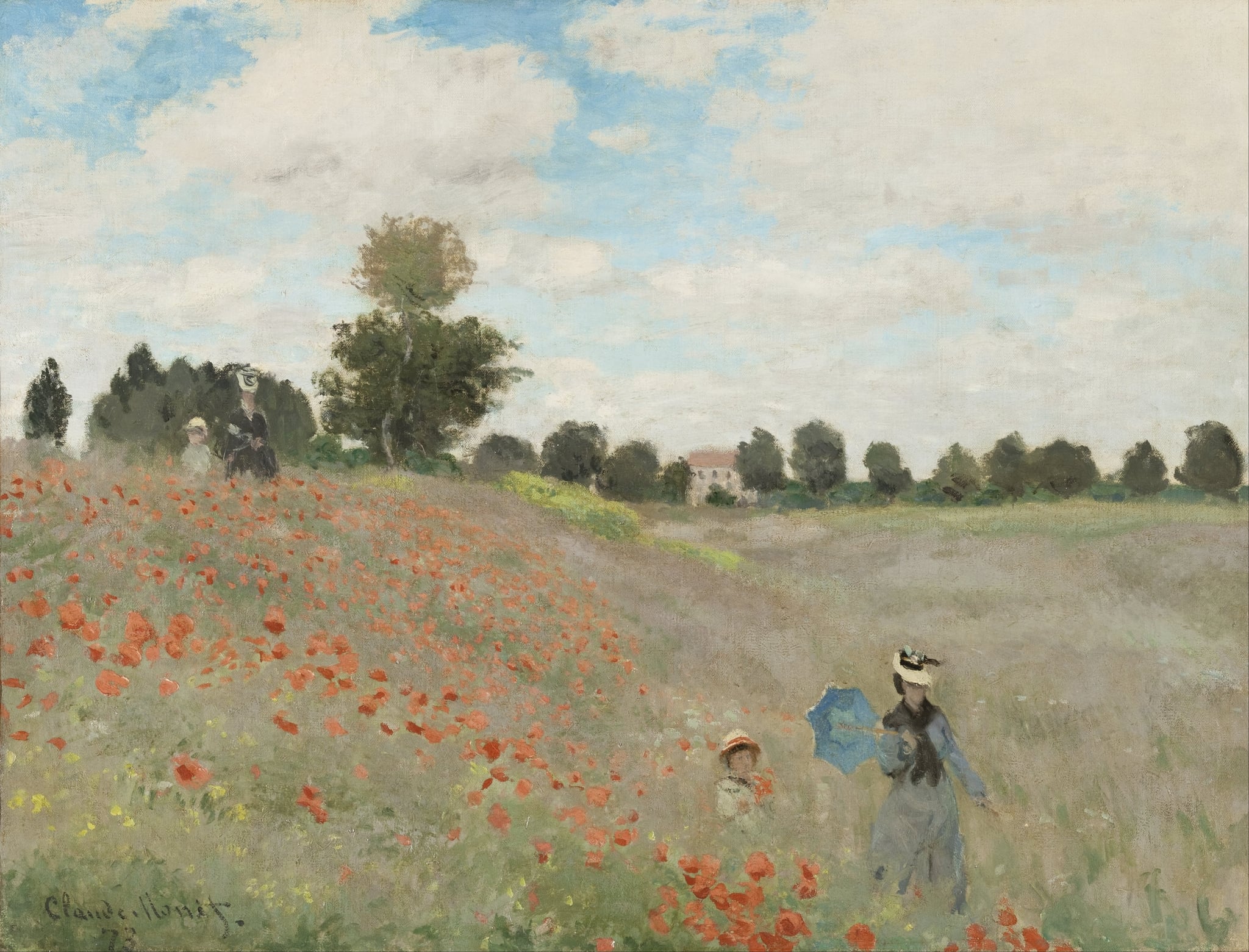
Poppies
Claude Monet (1873)
Claude Monet’s Poppies (1873) turns a suburban hillside into a theater of <strong>light, time, and modern leisure</strong>. A red diagonal of poppies counters cool fields and sky, while a woman with a <strong>blue parasol</strong> and a child appear twice along the slope, staging a gentle <strong>echo of moments</strong> rather than a single event <sup>[1]</sup>. The painting asserts sensation over contour, letting broken touches make the day itself the subject.
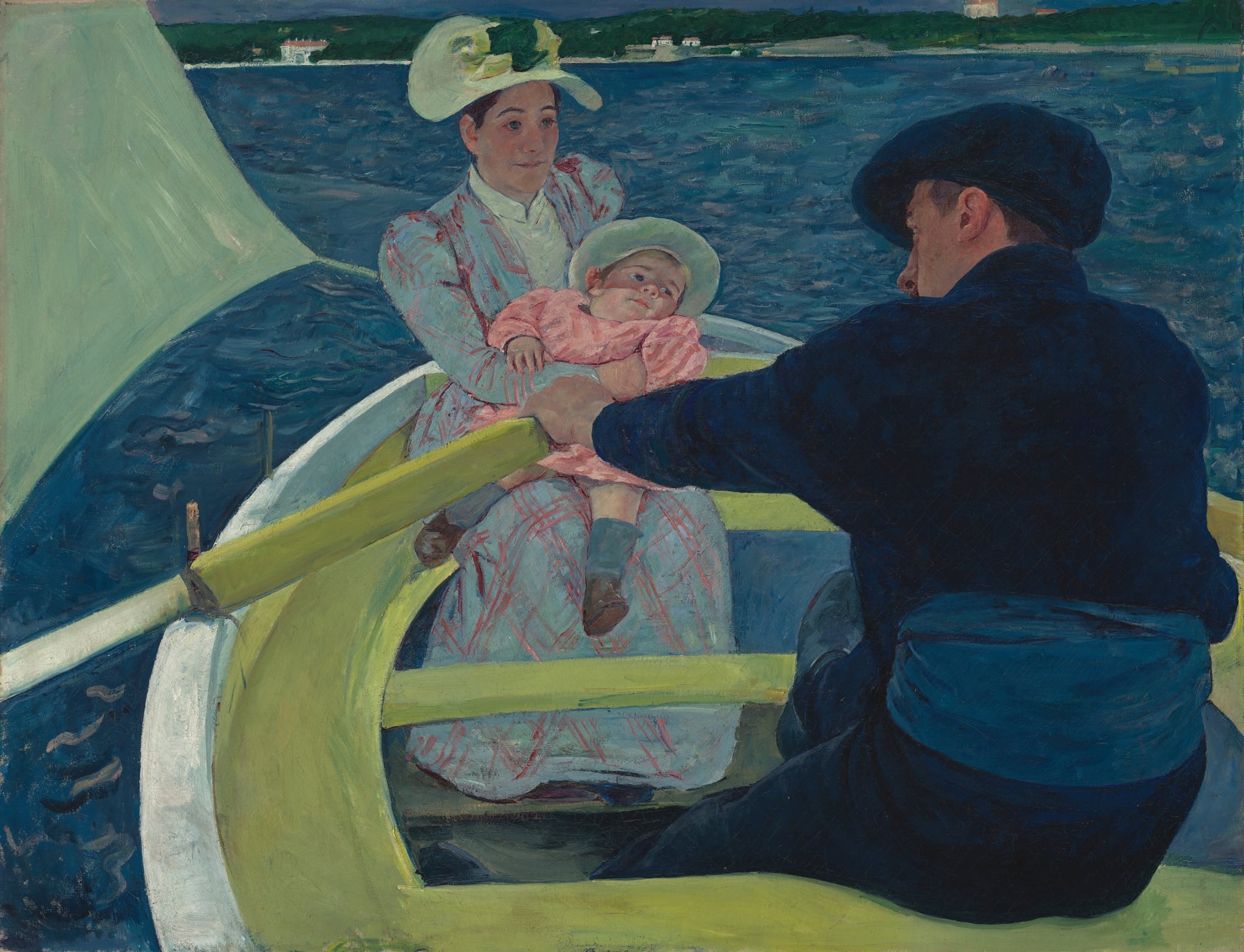
The Boating Party
Mary Cassatt (1893–1894)
In The Boating Party, Mary Cassatt fuses <strong>intimate caregiving</strong> with <strong>modern mobility</strong>, compressing mother, child, and rower inside a skiff that cuts diagonals across ultramarine water. Bold arcs of citron paint and a high, flattened horizon reveal a deliberate <strong>Japonisme</strong> logic that stabilizes the scene even as motion surges around it <sup>[1]</sup>. The painting asserts domestic life as a public, modern subject while testing the limits of Impressionist space and color.
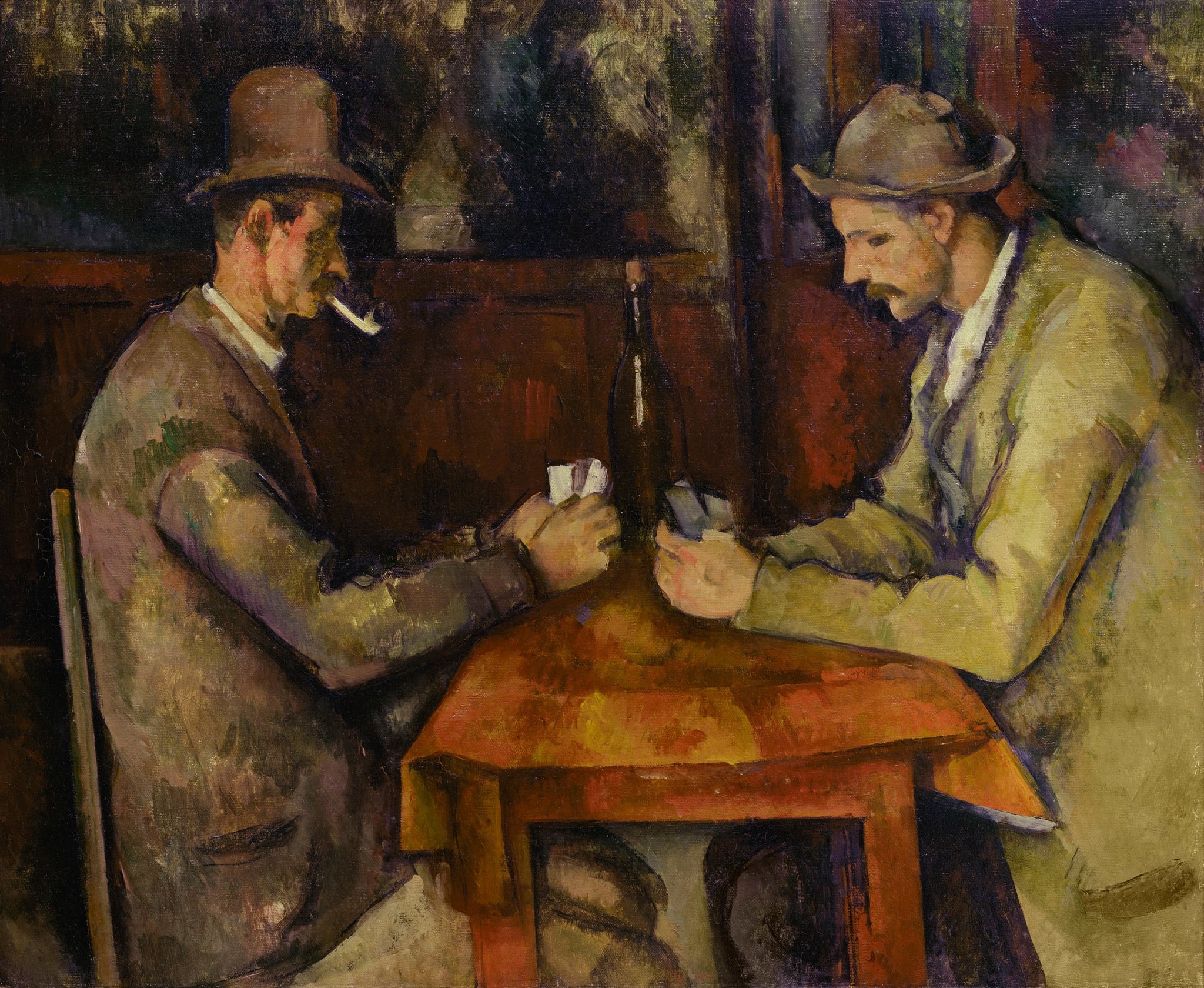
The Card Players by Paul Cézanne | Equilibrium and Form
Paul Cézanne
In The Card Players, Paul Cézanne turns a rural café game into a study of <strong>equilibrium</strong> and <strong>monumentality</strong>. Two hated peasants lean inward across an orange-brown table while a dark bottle stands upright between them, acting as a calm, vertical <strong>axis</strong> that stabilizes their mirrored focus <sup>[2]</sup><sup>[3]</sup>.
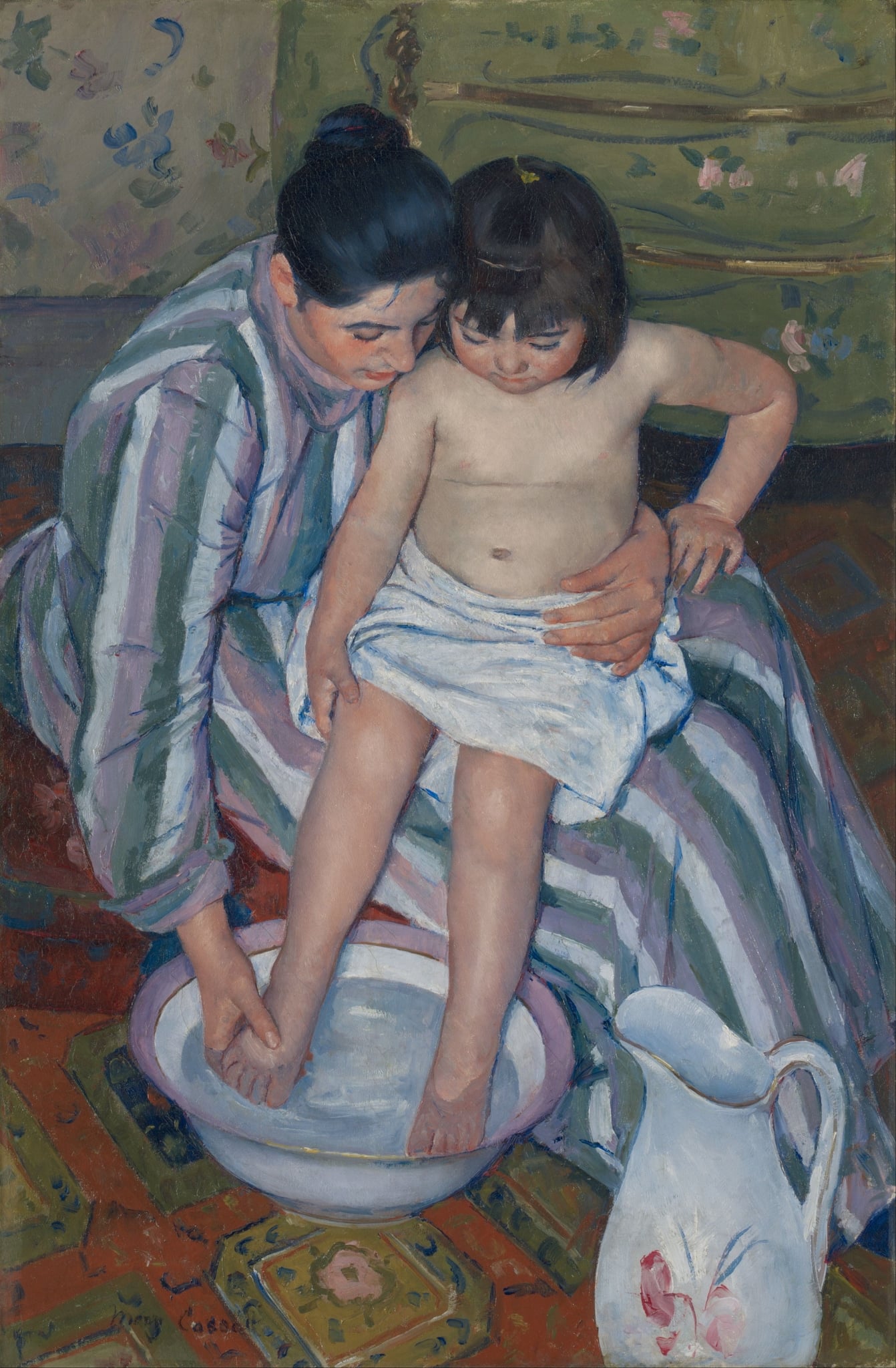
The Child's Bath
Mary Cassatt (1893)
Mary Cassatt’s The Child’s Bath (1893) recasts an ordinary ritual as <strong>modern devotion</strong>. From a steep, print-like vantage, interlocking stripes, circles, and diagonals focus attention on <strong>touch, care, and renewal</strong>, turning domestic labor into a subject of high art <sup>[1]</sup><sup>[3]</sup>. The work synthesizes Impressionist sensitivity with <strong>Japonisme</strong> design to monumentalize the private sphere <sup>[1]</sup><sup>[2]</sup>.
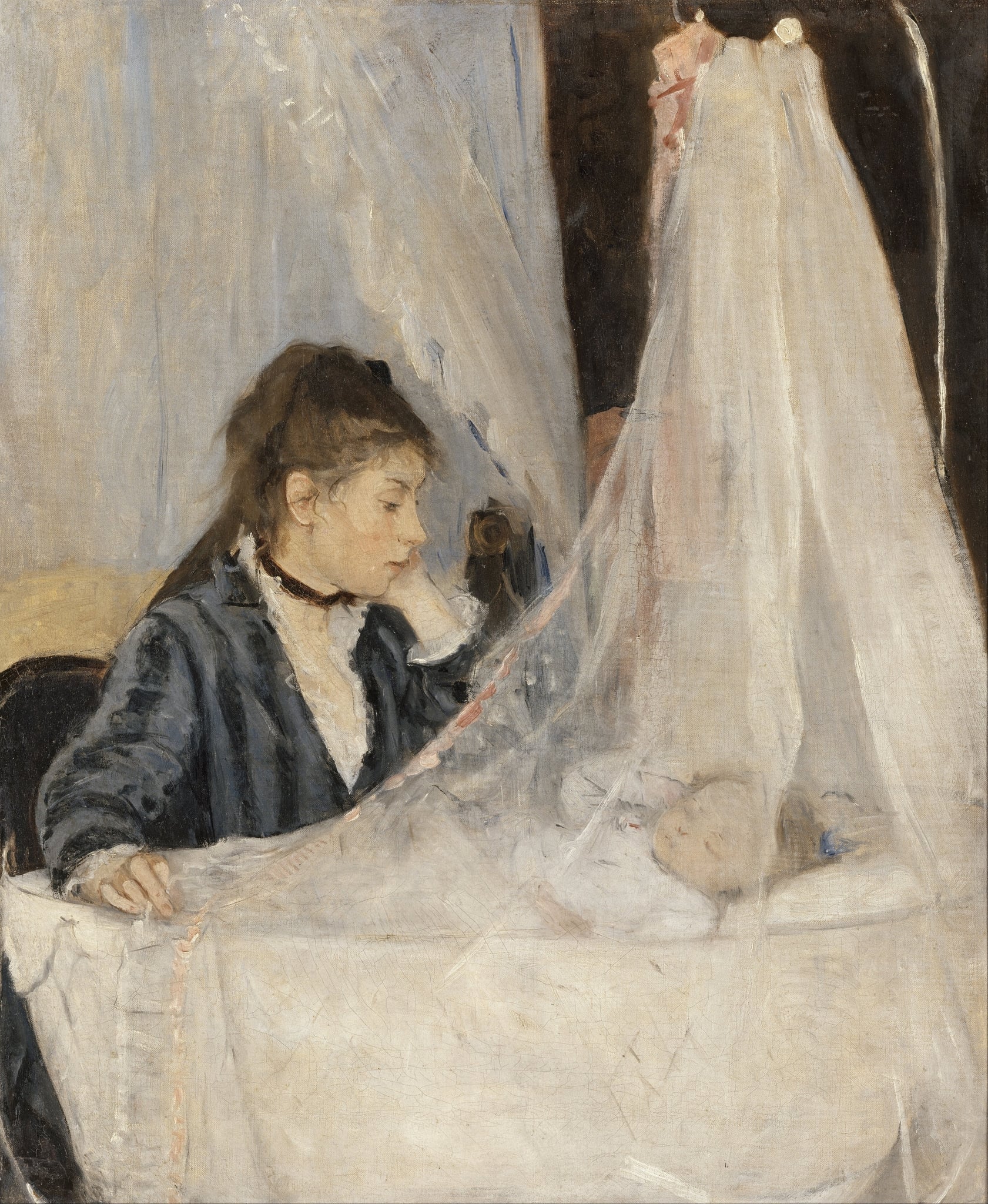
The Cradle
Berthe Morisot (1872)
Berthe Morisot’s The Cradle turns a quiet nursery into a scene of <strong>vigilant love</strong>. A gauzy veil, lifted by the watcher’s hand, forms a <strong>protective boundary</strong> that cocoons the sleeping child in light while linking the two figures through a decisive diagonal <sup>[1]</sup><sup>[2]</sup>. The painting crystallizes modern maternity as a form of attentiveness rather than display—an <strong>unsentimental icon</strong> of care.
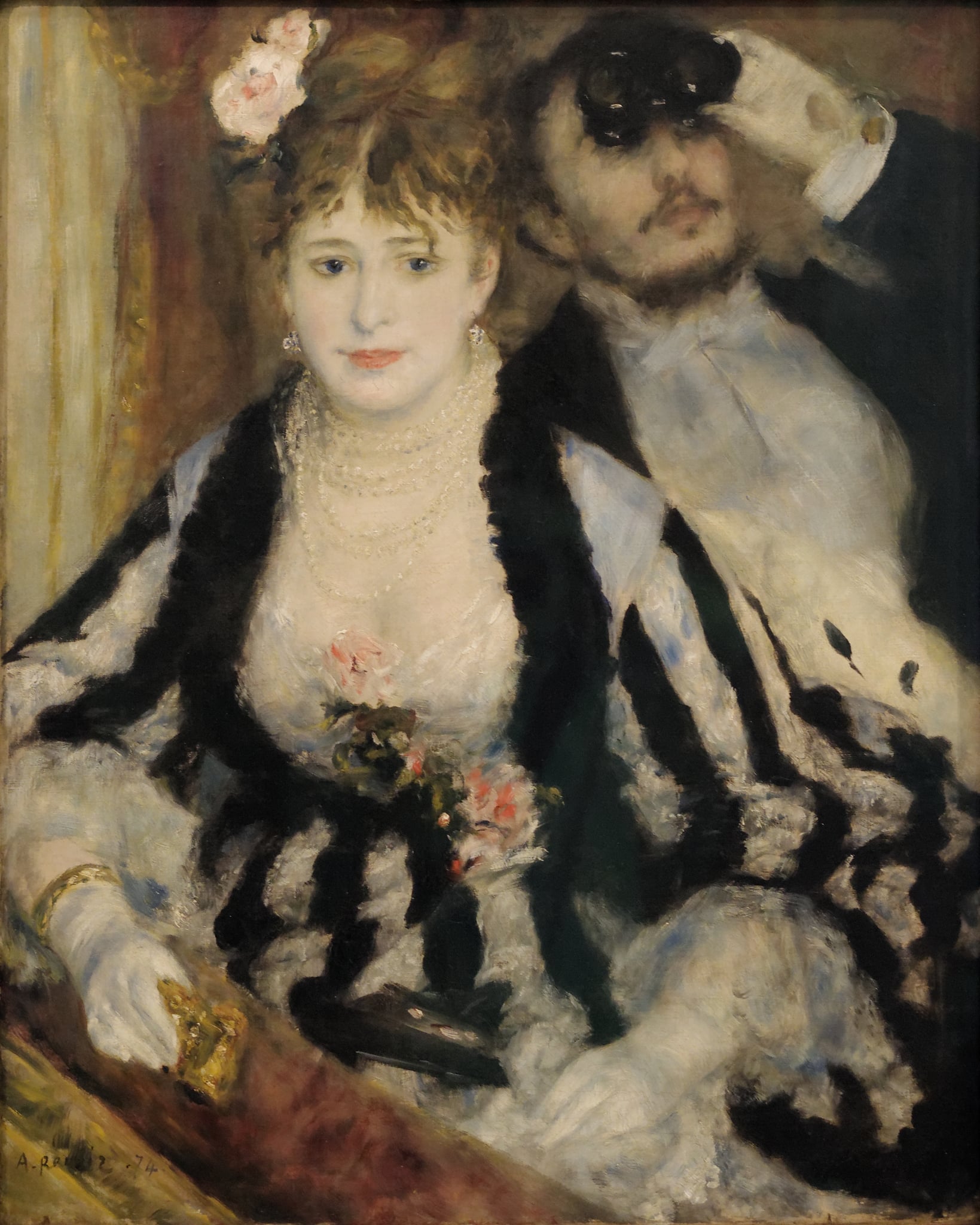
The Loge
Pierre-Auguste Renoir (1874)
Renoir’s The Loge (1874) turns an opera box into a <strong>stage of looking</strong>, where a woman meets our gaze while her companion scans the crowd through binoculars. The painting’s <strong>frame-within-a-frame</strong> and glittering fashion make modern Parisian leisure both alluring and self-conscious, turning spectators into spectacles <sup>[1]</sup><sup>[2]</sup>.
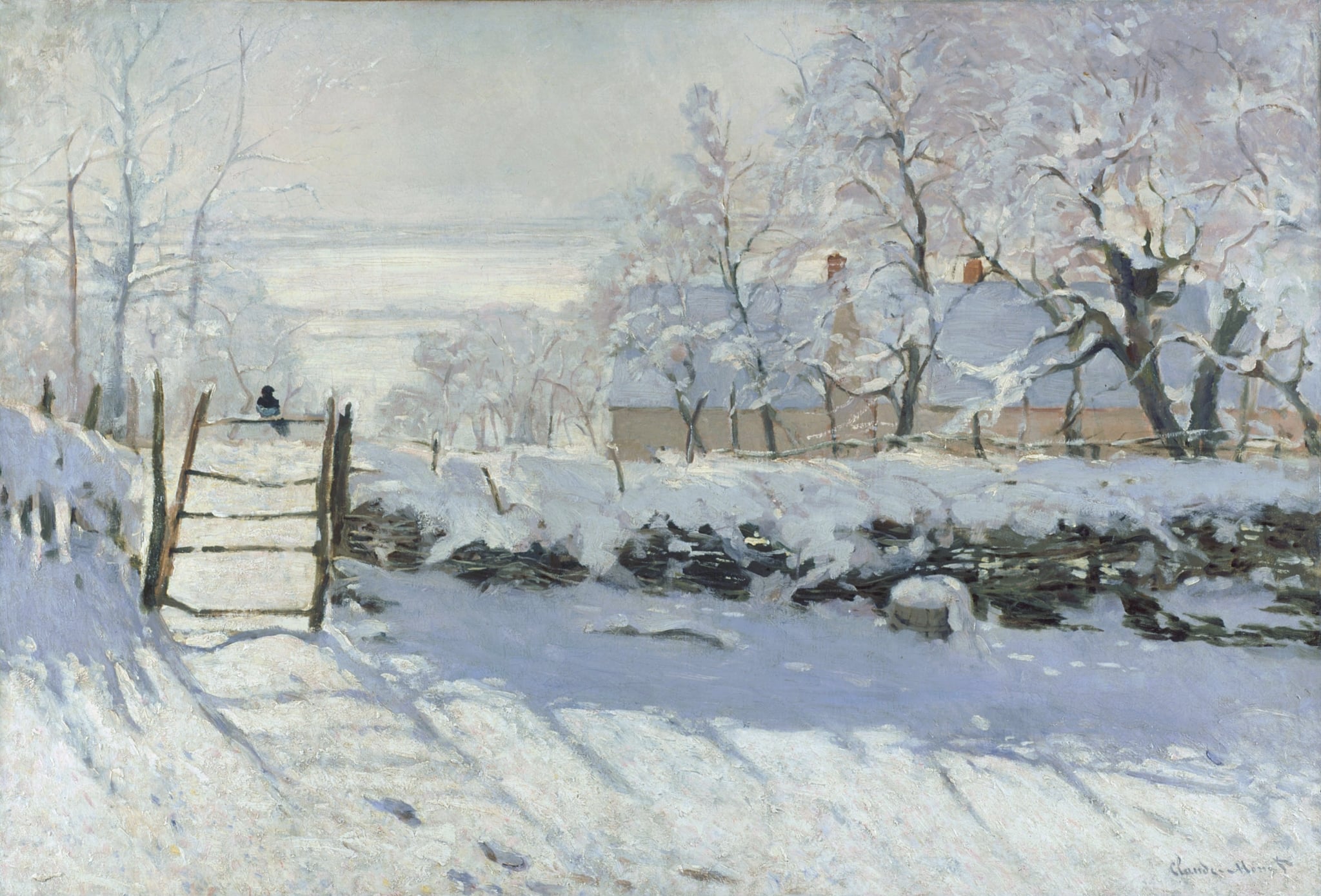
The Magpie
Claude Monet (1868–1869)
Claude Monet’s The Magpie turns a winter field into a study of <strong>luminous perception</strong>, where blue-violet shadows articulate snow’s light. A lone <strong>magpie</strong> perched on a wooden gate punctuates the silence, anchoring a scene that balances homestead and open countryside <sup>[1]</sup>.
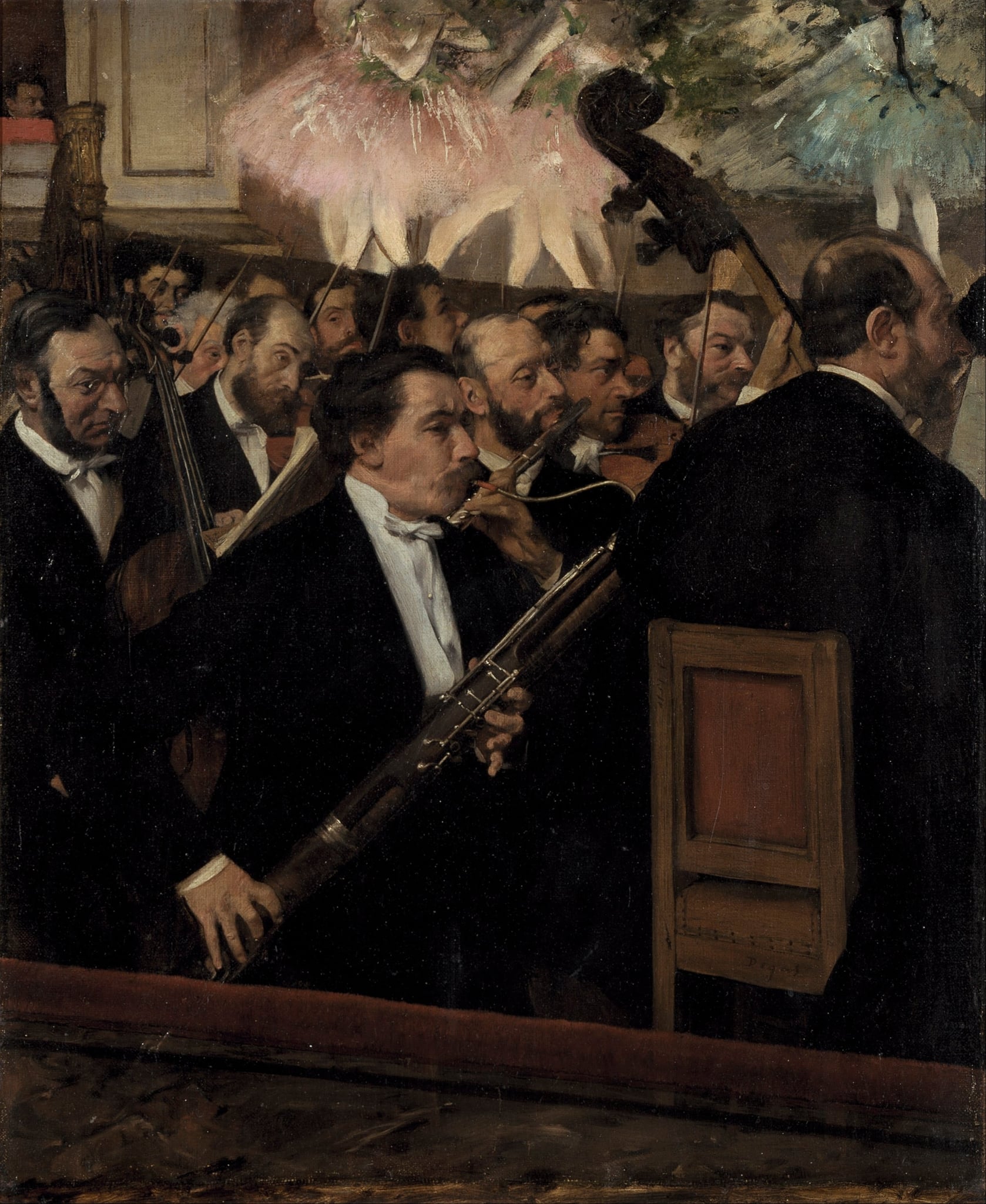
The Opera Orchestra by Edgar Degas | Analysis
Edgar Degas
In The Opera Orchestra, Degas flips the theater’s hierarchy: the black-clad pit fills the frame while the ballerinas appear only as cropped tutus and legs, glittering above. The diagonal <strong>bassoon</strong> and looming <strong>double bass</strong> marshal a dense field of faces lit by footlights, turning backstage labor into the subject and spectacle into a fragment <sup>[1]</sup><sup>[2]</sup>.
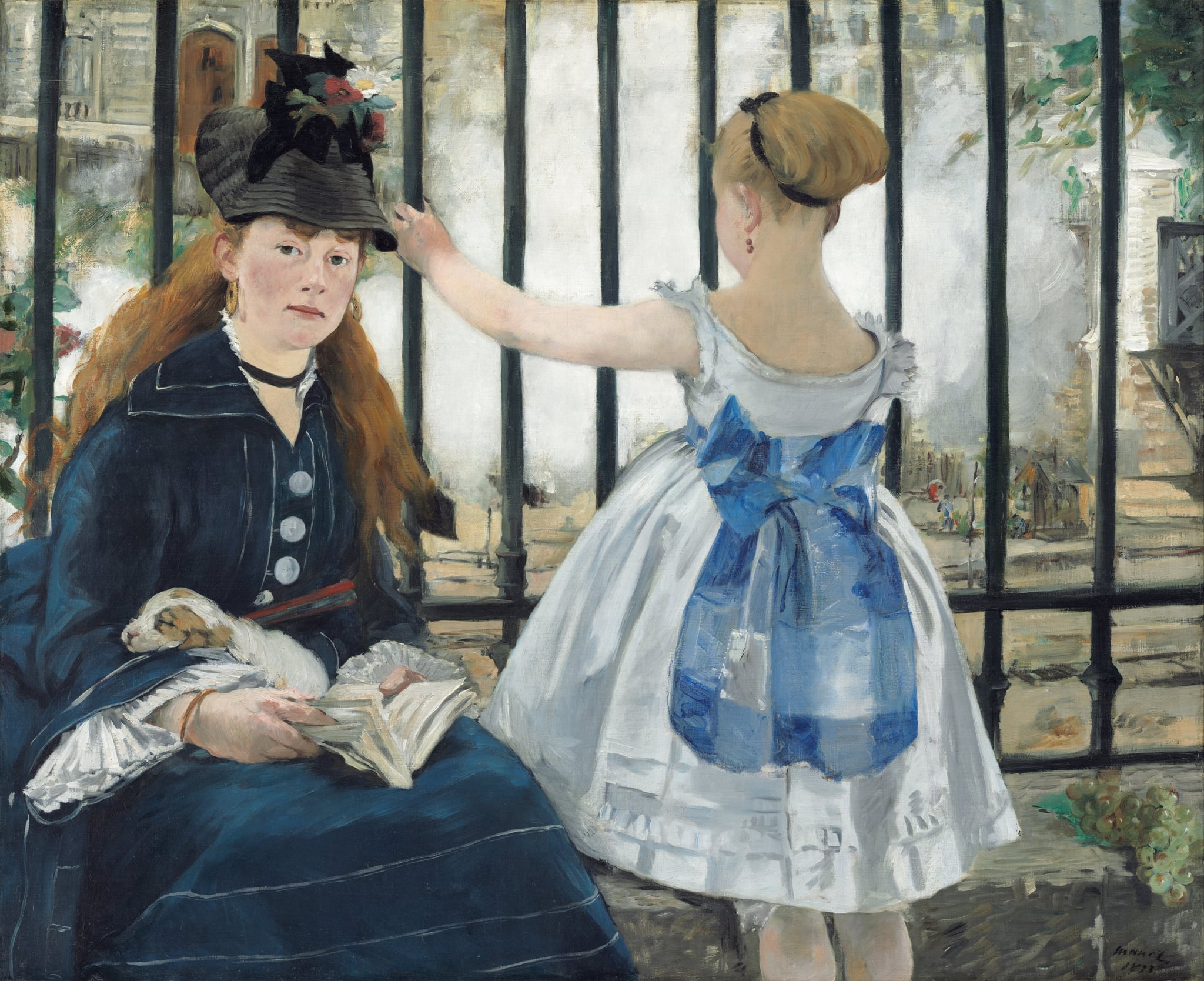
The Railway
Édouard Manet (1873)
Manet’s The Railway is a charged tableau of <strong>modern life</strong>: a composed woman confronts us while a child, bright in <strong>white and blue</strong>, peers through the iron fence toward a cloud of <strong>steam</strong>. The image turns a casual pause at the Gare Saint‑Lazare into a meditation on <strong>spectatorship, separation, and change</strong> <sup>[1]</sup><sup>[3]</sup>.
The Tub
Edgar Degas (1886)
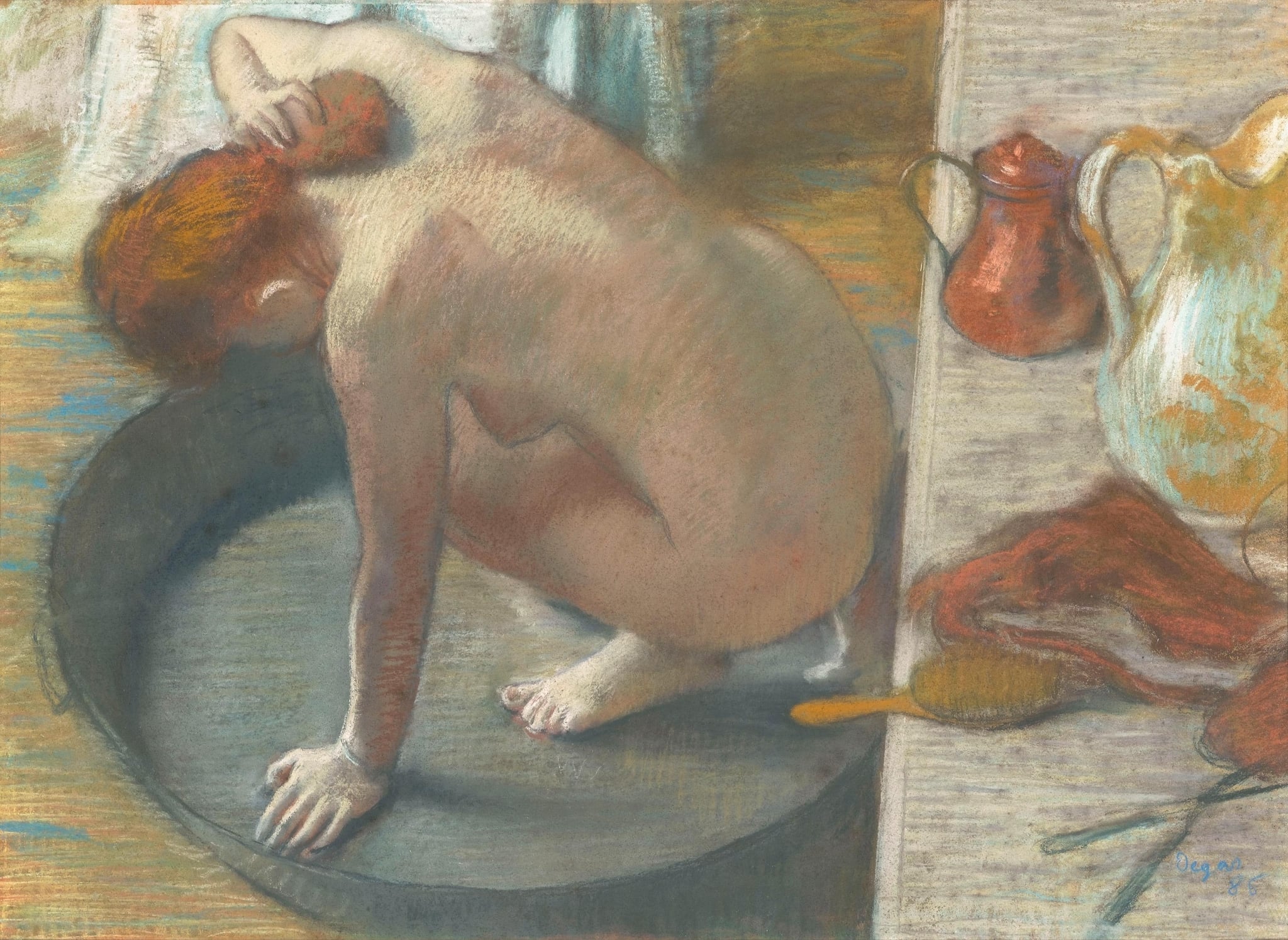
In The Tub (1886), Edgar Degas turns a routine bath into a study of <strong>modern solitude</strong> and <strong>embodied labor</strong>. From a steep, overhead angle, a woman kneels within a circular basin, one hand braced on the rim while the other gathers her hair; to the right, a tabletop packs a ewer, copper pot, comb/brush, and cloth. Degas’s layered pastel binds skin, water, and objects into a single, breathing field of <strong>warm flesh tones</strong> and blue‑greys, collapsing distance between body and still life <sup>[1]</sup>.
Vase of Flowers
Pierre-Auguste Renoir (c. 1889)
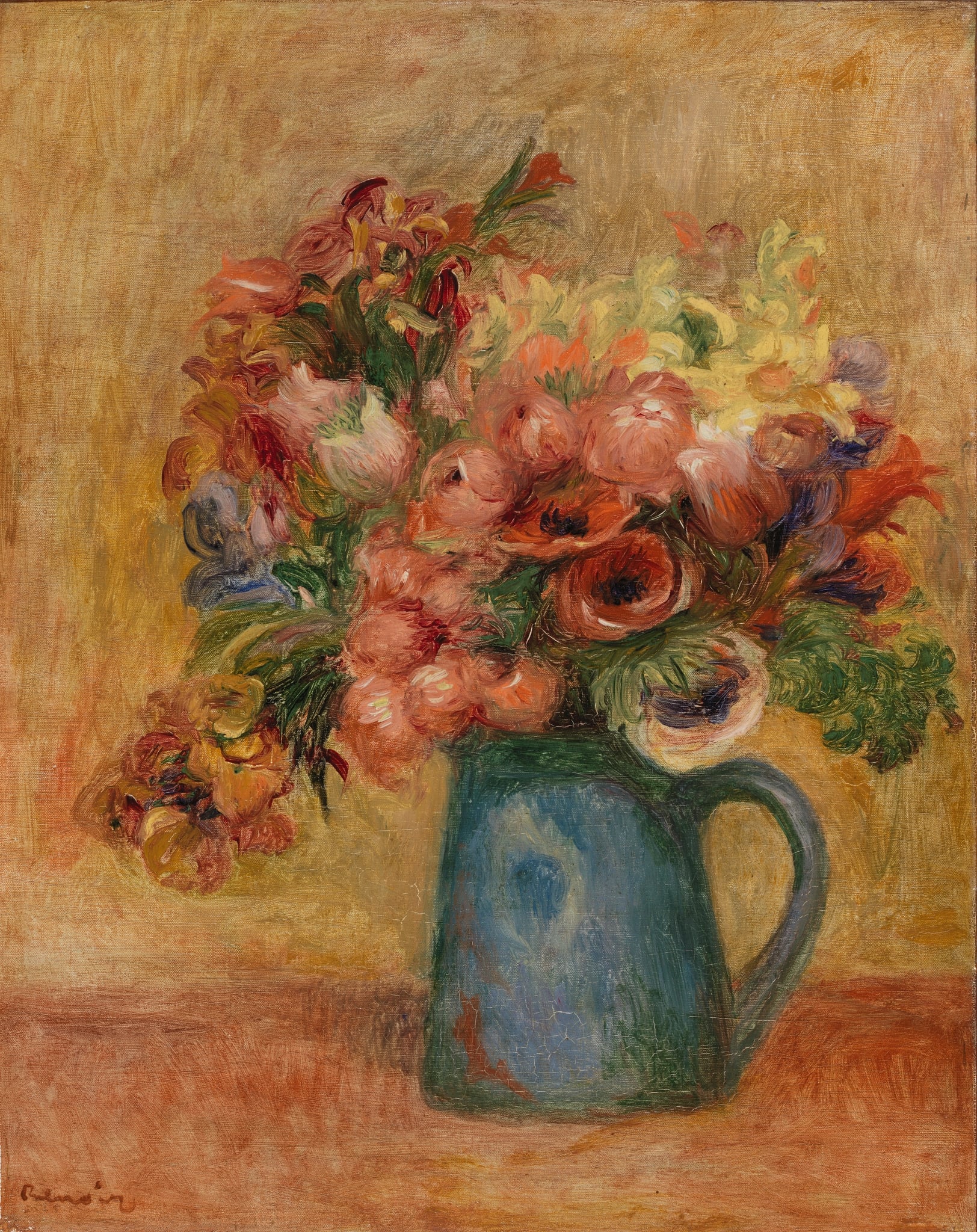
Vase of Flowers is a late‑1880s still life in which Pierre-Auguste Renoir turns a humble blue‑green jug and a tumbling bouquet into a <strong>laboratory of color and touch</strong>. Against a warm ocher wall and reddish tabletop, coral and vermilion blossoms flare while cool greens and violets anchor the mass, letting <strong>color function as drawing</strong> <sup>[1]</sup><sup>[4]</sup>. The work affirms Renoir’s belief that flower painting was a space for bold experimentation that fed his figure art.
Woman Ironing
Edgar Degas (c. 1876–1887)
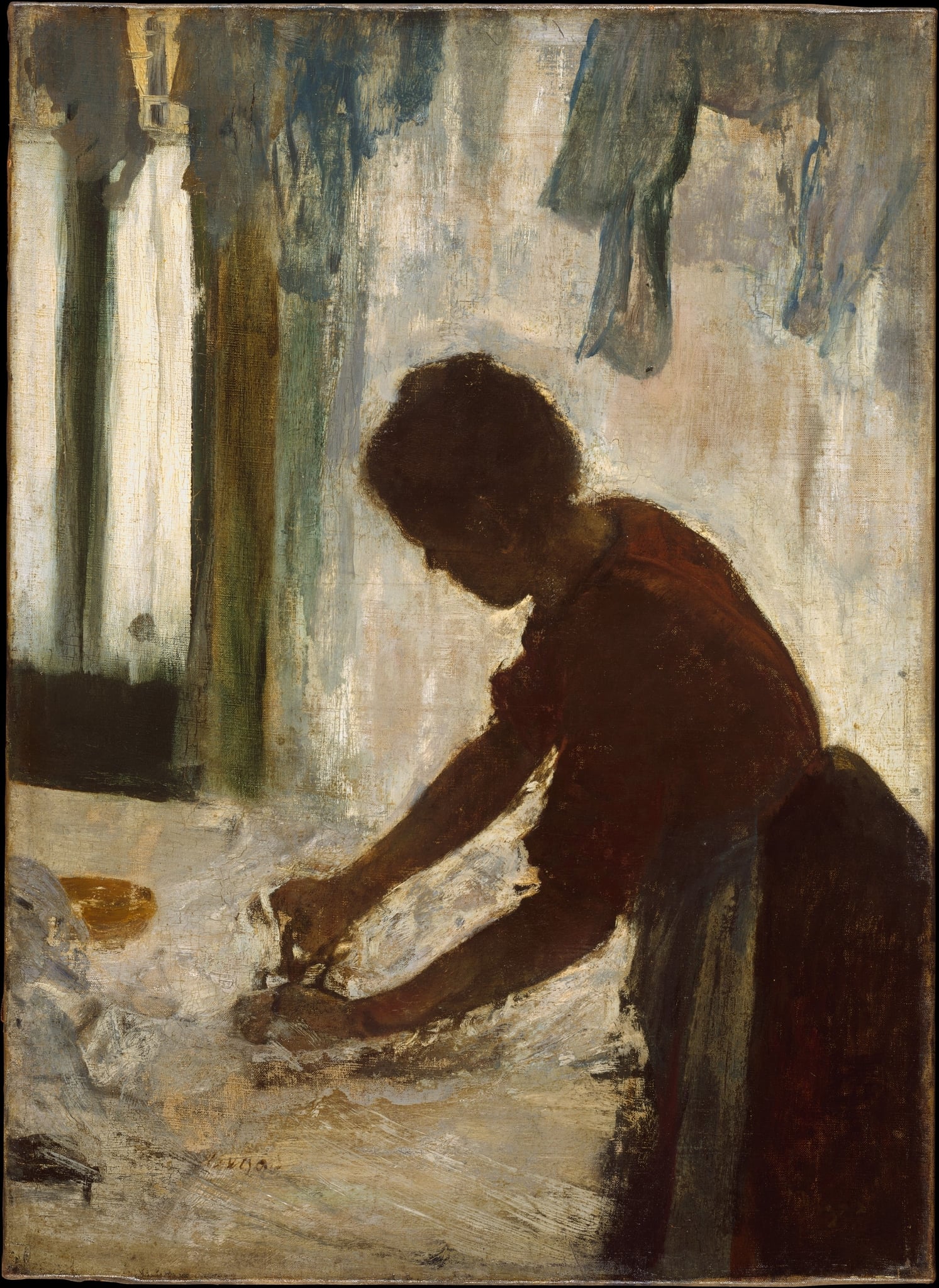
In Woman Ironing, Degas builds a modern icon of labor through <strong>contre‑jour</strong> light and a forceful diagonal from shoulder to iron. The worker’s silhouette, red-brown dress, and the cool, steamy whites around her turn repetition into <strong>ritualized transformation</strong>—wrinkled cloth to crisp order <sup>[1]</sup><sup>[2]</sup>.
Woman with a Parasol
Claude Monet (1875)
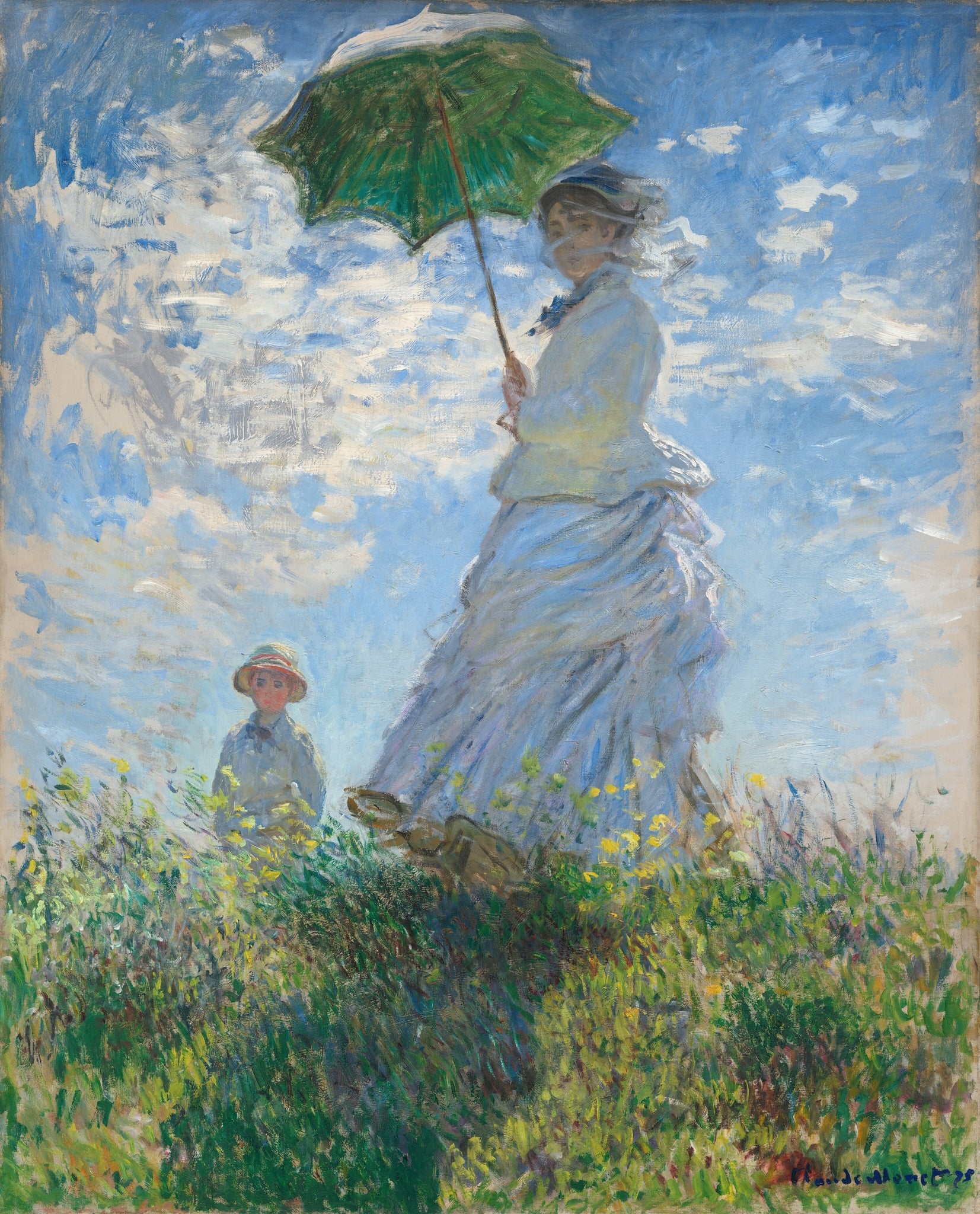
Claude Monet’s Woman with a Parasol fixes a breezy hillside instant in high, shifting light, setting a figure beneath a <strong>green parasol</strong> against a vast, vibrating sky. The low vantage and <strong>broken brushwork</strong> merge dress, clouds, and grasses into one atmosphere, while a child at the rise anchors depth and intimacy <sup>[1]</sup>. It is a manifesto of <strong>plein-air</strong> perception—painting the sensation of air in motion rather than the contours of things <sup>[2]</sup>.
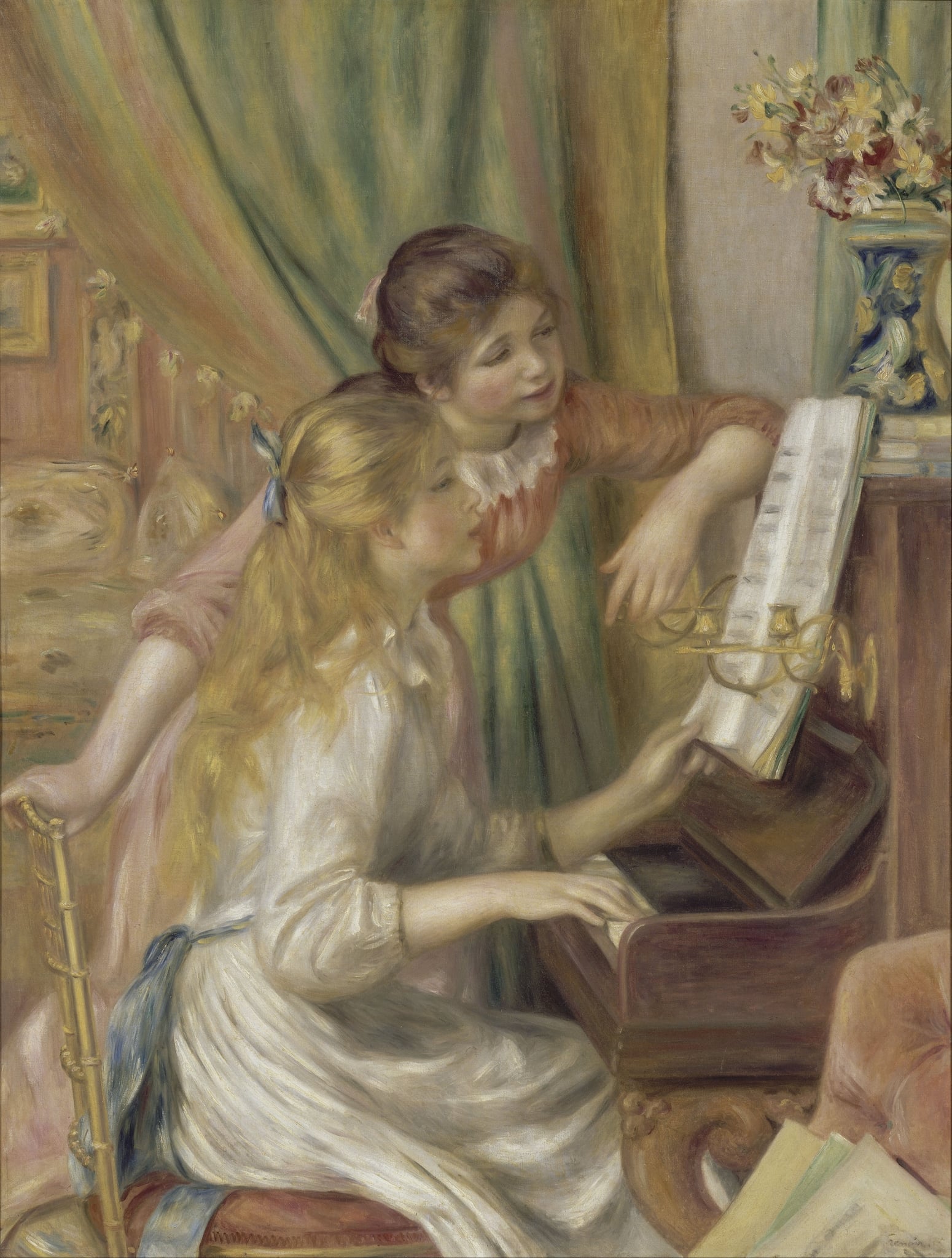
Young Girls at the Piano
Pierre-Auguste Renoir (1892)
Renoir’s Young Girls at the Piano turns a quiet lesson into a scene of <strong>attunement</strong> and <strong>bourgeois grace</strong>. Two adolescents—one seated at the keys, the other leaning to guide the score—embody harmony between discipline and delight, rendered in Renoir’s late, <strong>luminous</strong> touch <sup>[1]</sup><sup>[2]</sup>.
Related Themes
Related Symbolism Categories
Mortality
The “Mortality” symbolism category in nineteenth‑century painting translates death from theological drama into terse, often secular signs—blood, smoke, wilted flowers, exhausted bodies—through which modern artists register the finitude of life and the procedural, sometimes anonymized character of modern violence.
Femininity
In late nineteenth‑century painting, femininity is articulated not as an essence but as a mutable ensemble of fashion, gesture, and setting, through which modern artists probe women’s visibility, labor, and agency within emerging urban and suburban worlds.
Ritual
Ritual symbolism in modern and early modern painting transforms repeated social, religious, and corporeal practices into visual structures that regulate time, desire, and collective belief, making habit itself a bearer of meaning.
Within the long history of Western art, intimacy has often been figured through touch, proximity, and the careful staging of thresholds between private and public life. In religious painting the bond between mother and child, or between worshipper and sacred image, organized visual access to the divine; in early modern portraiture and genre scenes, hands, glances, and domestic objects registered bonds of kinship, courtship, or clandestine desire. By the later nineteenth century, in the works of Manet, Monet, Renoir, Cassatt, and Cézanne, these intimate codes are neither abandoned nor merely repeated. Instead, they are recast within new arenas of modern life—cafés, music halls, suburban fields, and garden cafés—where closeness is mediated by commerce, spectatorship, and mobility. The symbols gathered under the category of “Intimacy” thus form a semiotic field in which inherited devices for signaling affection and care are subjected to new pressures of visibility and exchange.
Many of these symbols operate through the language of touch and bodily proximity. In Renoir’s In the Garden (1885), the couple’s clasped hands function as a hinge between emotional petition and restraint. Their contact is light, almost provisional, yet Renoir articulates it as the painting’s pivot: the man’s fingers fold over the woman’s, while the diagonal table edge interposes a polite barrier. Semiotic meaning condenses along this axis of touch: intimacy is both offered and hedged, a tentative contract staged in a semi‑public garden café. When we compare this to Mary Cassatt’s The Child’s Bath (1893), the nature of tactile symbolism shifts. There, the “encircling hands and arms” form what commentators term a “circle of touch,” a Diagonal Axis of Care that binds caregiver and child. The hands that in Renoir’s scene negotiate erotic possibility here enforce protection and guidance. Iconographically, Cassatt secularizes the Madonna‑and‑Child typology; yet by monumentalizing an everyday bathing ritual, she invests the domestic gesture with the same gravity traditionally accorded sacred intimacy.
If touch is one pole of intimate symbolism, the child is another. In Monet’s Poppies (1873), the child and the doubled mother‑and‑child unit anchor human scale amid the rolling field. The repetition of the pair higher on the slope works as a quiet “time‑lapse,” a visual echo that transforms a simple walk into a duration shared. The child’s presence, small but persistent, turns a landscape into a scene of family continuity; intimacy is registered less as dramatic gesture than as the ongoing, habitual accompaniment of everyday leisure. Cassatt radicalizes this domestic register. In The Child’s Bath, the child’s bent head, bare foot, and the caretaker’s supporting hands create a dense knot of forms at the picture’s center. The basin, pitcher, and white towel/cloth—traditional emblems of purification—are reinterpreted as tools of maternal care. Semiologically, they still mark transition from soiling to cleanliness, but their primary function is to materialize the labor and attentiveness through which intimacy is sustained.
Flowers—long‑standing tokens of love, transience, and exchange—become especially charged in this modern repertoire. In Renoir’s In the Garden, the bouquet of small flowers on the tabletop crystallizes the moment of courtship. Its scattering across the red trestle table hints at fragility; the gift may as easily fall apart as be treasured. Manet turns similar floral signs toward sharper social critique. In Olympia (1863), the bouquet of cut flowers offered by the Black maid Laure arrives as the “client’s offering—evidence of exchange.” Isolated from any vases or garden setting, the blooms signify a transactional intimacy, their very cut state insisting on the temporality and commodification of desire. Suzon’s bar in A Bar at the Folies‑Bergère (1882) likewise bears a crisp vase of flowers and a brimming pile of oranges, staging commodities as bright surrogates for sensual pleasure. Here, the barmaid herself becomes the human face of that economy: both salesperson and potential commodity. Intimacy is displaced onto objects—bottles, fruit, and bouquets—which mediate the distance between viewer and figure.
Mirrors and reflective devices, central to nineteenth‑century explorations of subjectivity, also reframe intimacy as a question of mediated looking. Manet’s A Bar at the Folies‑Bergère orchestrates a complex play between the spectator and Suzon through the skewed mirror behind her. The glass reveals a crowded music‑hall interior and the figure of a male customer, but its disjunctive reflection—Suzon shifted laterally, the man visible only in reflection—undermines any stable relation between physical proximity and psychological access. The artist’s signature on the mirror (inscribed on the front marble) underscores the painter’s presence within this circuit of looks; authorship inserts itself into the very act of gazing at a woman whose labor is to meet and manage eyes. If intimacy traditionally suggested transparency or mutual recognition, Manet recasts it as a scene of misalignment, in which the viewer’s desire to “read” the barmaid meets a carefully guarded, opaque façade.
By contrast, Cassatt’s domestic interiors typically refuse such specular ambiguity, yet they are no less concerned with self‑fashioning and relational distance. In The Child’s Bath, the absence of a mirror is telling: the focus rests on tactile engagement, not on the subject’s self‑image. The child’s downcast gaze and the caretaker’s bowed head enclose attention within the pictorial space; no reflective surface opens a path outward to a watching public. This difference marks a crucial iconographic divergence within the broader field of intimate symbols: in the café and music hall, the mirror complicates and potentially corrupts intimacy; in the home, its absence signals a protected interiority.
Even where explicit symbols of care and affection are absent, painters of the period explore a quieter, often more solitary mode of intimacy with the self. Manet’s Plum Brandy (ca. 1877) centers on a woman whose head is propped on her hand, the classic pose of reverie or mild melancholy. The glass with plum brandy sits untouched, the cigarette unlit; pleasure is postponed, and the scene becomes a study of inwardness within public space. Here intimacy is not interpersonal but introspective, a temporary withdrawal from the social world even as it physically surrounds her. The hand‑to‑cheek gesture, which Van Gogh would later intensify in his Portrait of Dr. Gachet, functions semiotically as a shorthand for psychological depth, for thought charged with feeling. In this guise, the symbol of intimacy marks not union with another but a concentrated rapport with one’s own interior life.
Across these examples, symbols of intimacy prove highly adaptable. Hands may clasp in tentative courtship, encircle a child in protective care, or support a solitary head in fatigued contemplation. Flowers can stand for romantic overture, sexual transaction, or the mere decorative surplus of commodity culture. Mirrors alternately promise self‑knowledge and expose the instability of perception in urban modernity. Over the course of the nineteenth century, these signs do not shed their earlier iconographic residues; rather, artists mobilize those inherited meanings to register the pressures of new environments—the garden café, the café‑concert, the suburban hillside, the bourgeois interior. Intimacy becomes less a stable condition than a negotiated relation continually tested by public leisure, economic exchange, and changing conceptions of the self. The evolving symbolism in works by Manet, Monet, Renoir, Cassatt, and Cézanne thus charts a broader historical shift: from intimacy as an idealized, often sacred bond to intimacy as a fragile, contingent experience embedded in the textures of modern life.