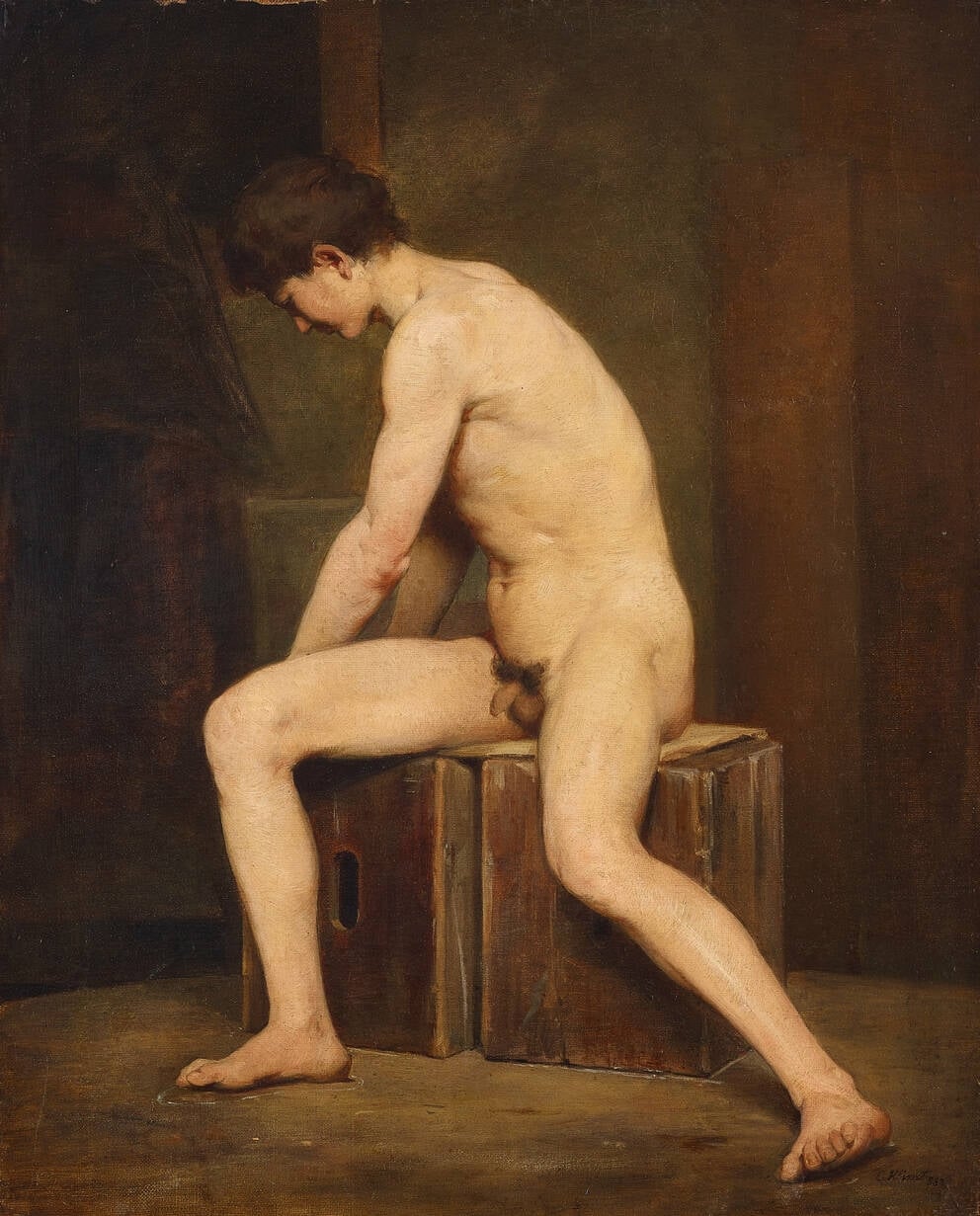
Bowed Head Symbolism
In art, a bowed head signals inward focus—contemplation, concentration, or disciplined effort—rather than outward display. By turning the gaze downward and minimizing facial address, artists shift expression to posture and structure, a device common in academic and naturalist study.
Bowed Head in Sitting Nude Man Turned to the Left
In Gustav Klimt’s Sitting Nude Man Turned to the Left (1883), the model’s bowed head completes a compact triangular pose with splayed legs and braced forearms, set against rough wooden crates. With the face angled down and withdrawn from the viewer’s address, attention shifts to the figure’s weight, balance, and the meeting of soft flesh with hard geometry. Klimt’s restrained, earthy chiaroscuro intensifies this inward reading, isolating the body and turning an academic exercise into a quiet study of concentrated presence.