Central blue band (threshold) Symbolism
In art, a central blue band often functions as a threshold—a horizon-like zone that both separates and links contrasting areas. In modern abstract painting, especially Color Field practice, blue frequently serves as a spatial cue that slows looking and guides the viewer across visual and emotional registers. It reads less as an object than as a passage, inviting a measured crossing between states.
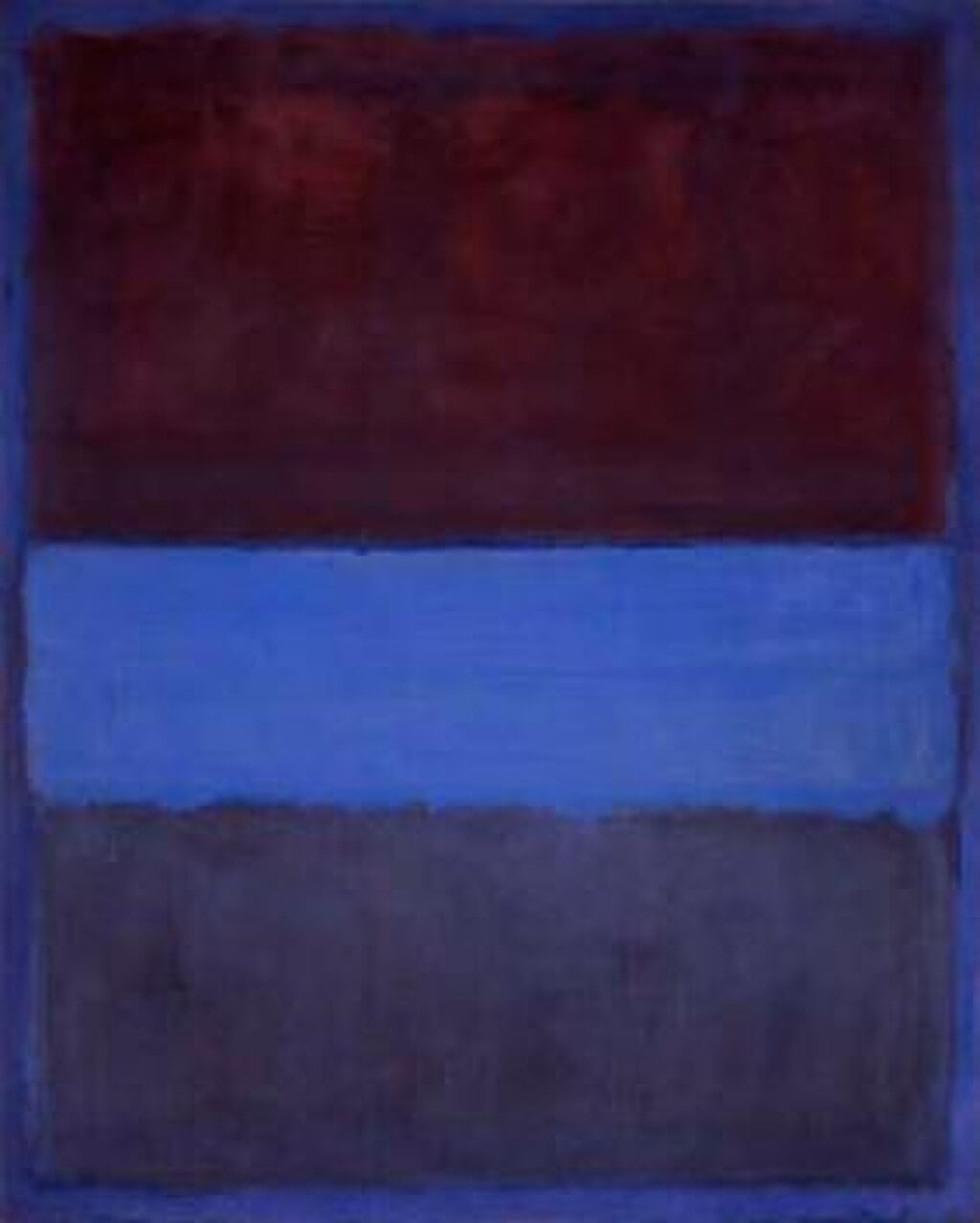
Central blue band (threshold) in No. 61 (Rust and Blue)
In Mark Rothko’s No. 61 (Rust and Blue) (1953), a saturated blue band hovers at the center, flanked by rust and indigo within a deep blue perimeter. Rendered in thin, layered oil with feathered borders, this blue interval is neither a hard divider nor a solid block; its softened edges allow the adjacent fields to breathe into it, making the transition between warmth and dusk palpable.
Here the central blue band acts as a liminal passage. It separates and connects the painting’s extremes, establishing a horizon-like pause that organizes the composition and the viewer’s attention. The result is a contemplative, immersive encounter in which color becomes felt space, and the blue band marks the threshold between distinct yet communicating zones.