Golden scintillation of light Symbolism
Golden scintillation of light denotes the translation of sound into flickering, gold‑tinged radiance that suffuses space and softens contours. In late nineteenth‑century Vienna, exemplified by Gustav Klimt, it frames listening as a shared aura, making resonance visible as atmosphere. The motif aligns with decorative modernism’s drive to fuse figure and ground into a continuous, sensuous field.
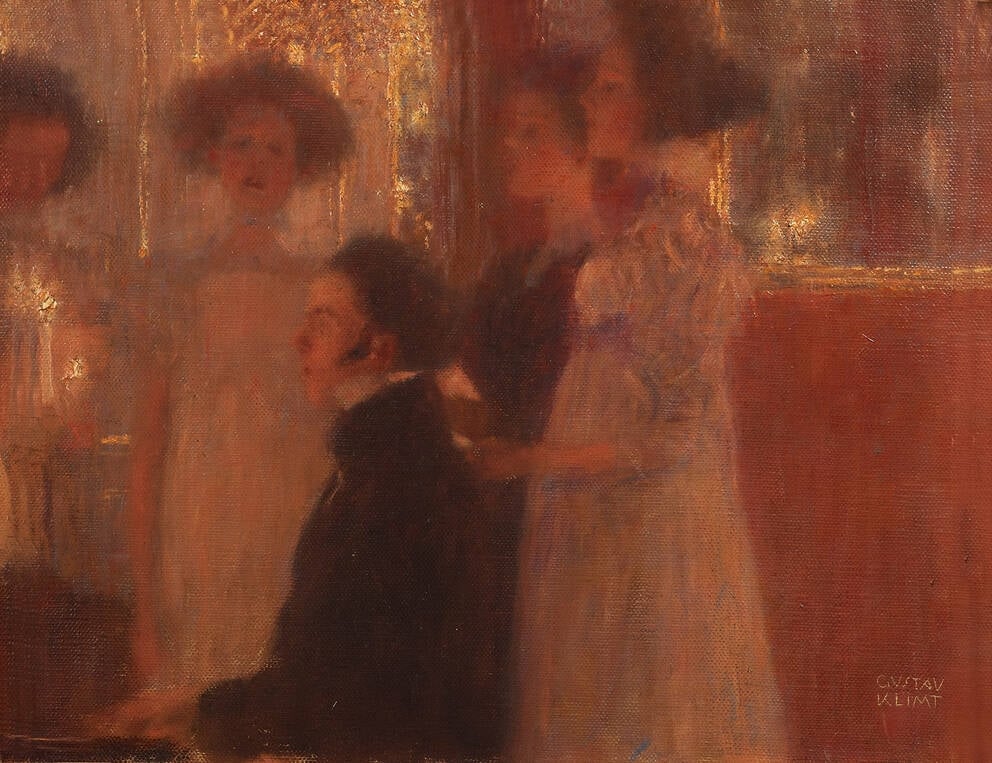
Golden scintillation of light in Schubert at the Piano. Design for the music room by Nikolaus Dumba
In Schubert at the Piano. Design for the music room by Nikolaus Dumba (1896), Gustav Klimt bathes a domestic recital in dim, rosy‑gold light. The dark‑clad pianist is encircled by a soft choir of women whose blurred faces dissolve into the room’s shimmer, so that contour and illumination merge and sound seems to become radiance.
Here the golden scintillation functions as the image of vibration spreading through space: light gathers around listeners, softens edges, and binds figures into a single resonant field. Klimt’s study thus turns a domestic moment into a glowing myth of listening, anticipating the decorative modernism that his later work would refine.