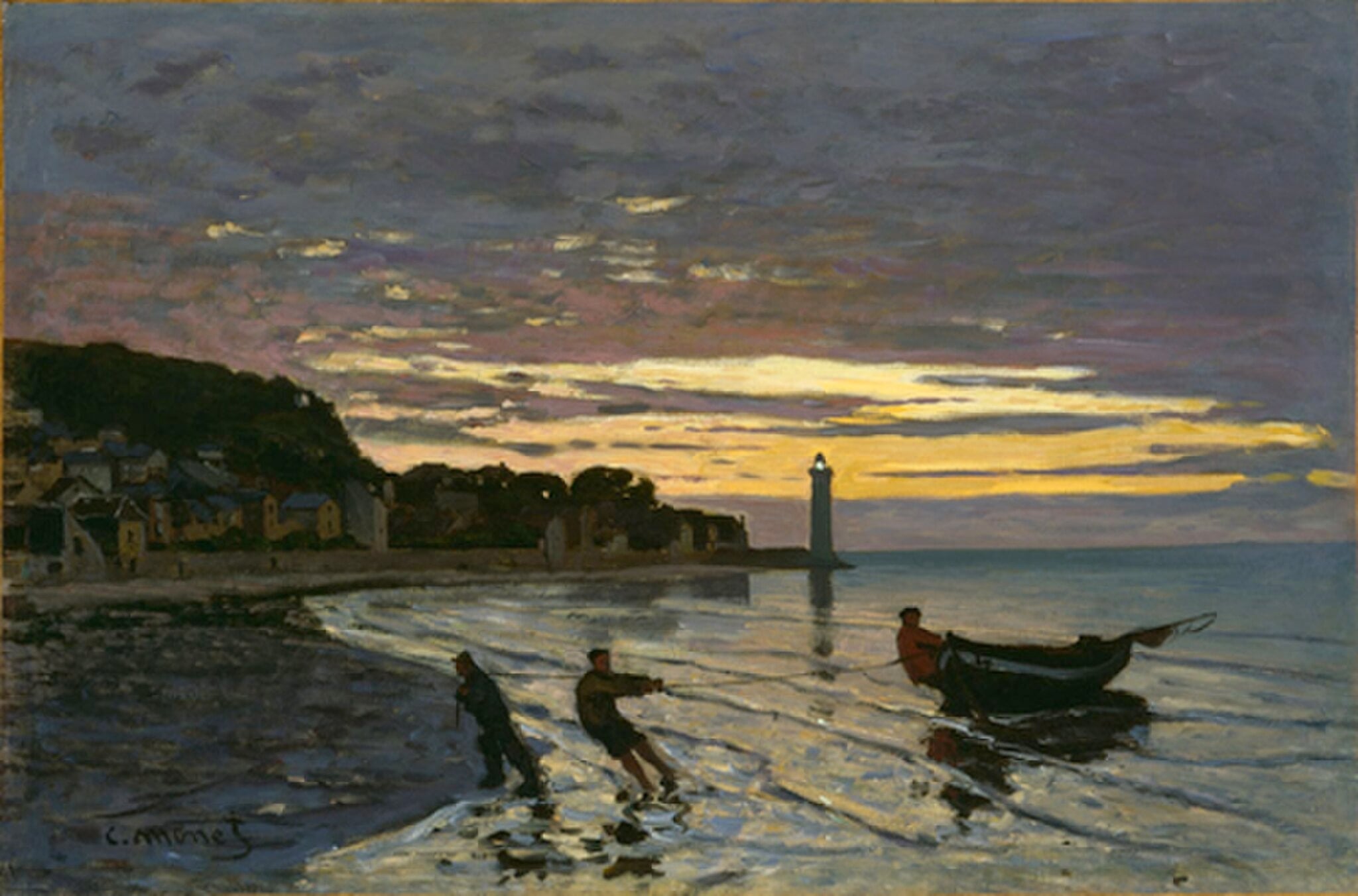
Lighthouse (and reflection) Symbolism
In art, the lighthouse commonly signals guidance, safety, and watchful civic oversight at the threshold between land and sea. Its steady vertical form and beam provide orientation amid changeable weather and light, while mirrored glows on water or wet sand can double the motif to suggest reflection and the passage of time. Artists use it to anchor human activity against unstable elements.
Lighthouse (and reflection) in Towing a Boat, Honfleur
In Claude Monet’s Towing a Boat, Honfleur (1864), a lighthouse holds steady on the horizon as three figures strain on taut ropes across dusk-lit, reflective sands. The beacon’s fixed, civic presence frames the labor as purposeful and protected, while its visual echo in the wet shore extends the idea of guidance into the path the workers tread. Monet’s interplay of fugitive light and steadfast tower turns a routine coastal task into a meditation on endurance, orientation, and time’s passage.