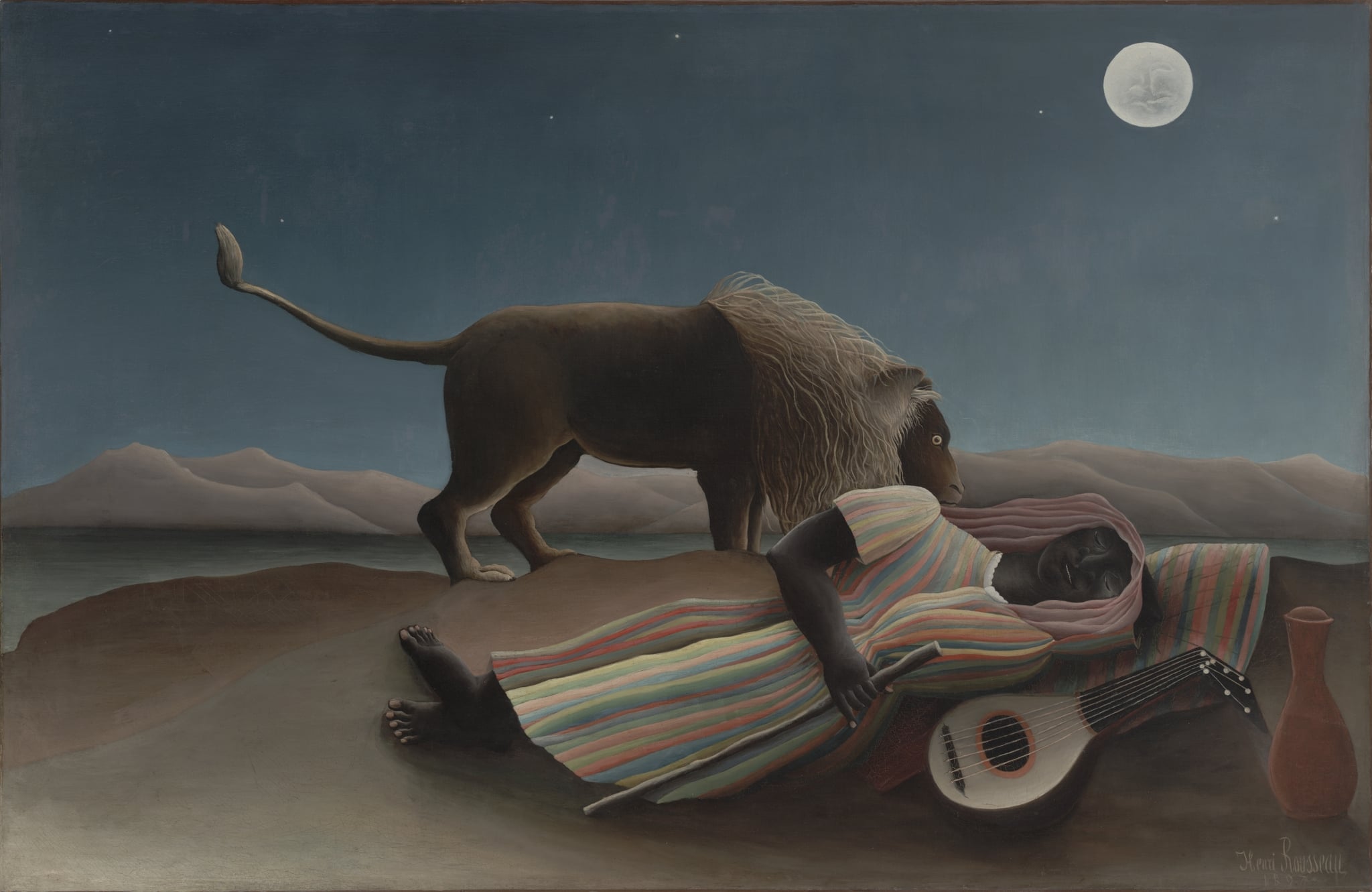
The Sleeping Shepherdess
Henri Rousseau (1897)
In The Sleeping Shepherdess, a moonlit desert holds a poised balance between <strong>vulnerability</strong> and <strong>watchful restraint</strong>. A striped‑clad traveler sleeps on a matching cushion, a <strong>mandolin</strong> and <strong>water jar</strong> at her side, while a lion, paw raised and eye wide, draws close yet does not strike. Rousseau’s flattened forms and echoing stripes create a hypnotic <strong>dream logic</strong> that turns danger into a guarded calm <sup>[1]</sup><sup>[2]</sup>.