Mirror/reflection band Symbolism
Mirror/reflection band denotes a visual strategy of doubling and diffusion—figures, light, or surfaces form a reflective perimeter that echoes a central action. In art history, such reflective groupings translate sensation into image, turning sound or emotion into a visible halo that amplifies presence and suggests afterimage or memory. The effect is one of perception multiplied and softened, as if seen or heard again.
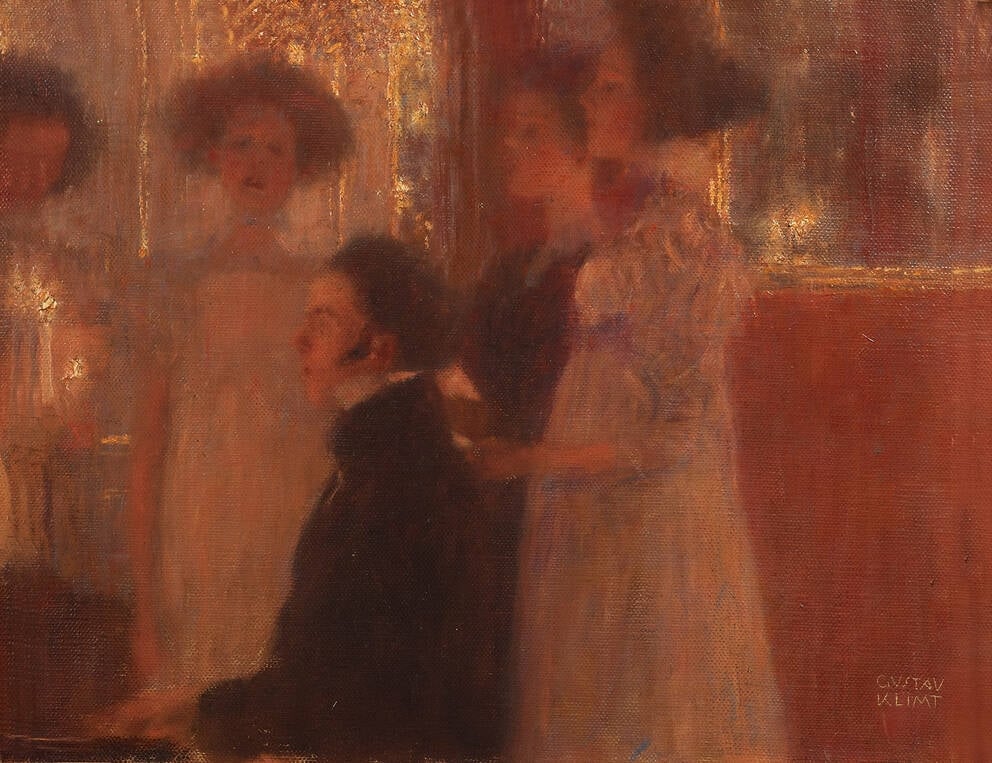
Mirror/reflection band in Schubert at the Piano. Design for the music room by Nikolaus Dumba
In Gustav Klimt’s Schubert at the Piano. Design for the music room by Nikolaus Dumba (1896), the mirror/reflection band appears as a luminous circle of listeners. A dark-clad pianist is encircled by a soft choir of women whose blurred faces dissolve into the rosy-gold shimmer of the room; Klimt fuses contour and light so that sound seems to become radiance. This encircling, with its softened repetition of forms along a glowing perimeter, functions as a reflective band that doubles the musical event—amplifying the act of listening while diffusing it into atmosphere. In this single work from the collection, the motif conveys amplification and memory through visual echo: the music’s presence is mirrored in the room’s sheen and in the chorus that surrounds, repeats, and gently dissolves the scene.