Camille Monet (1847–1879) in the Garden at Argenteuil

by Claude Monet

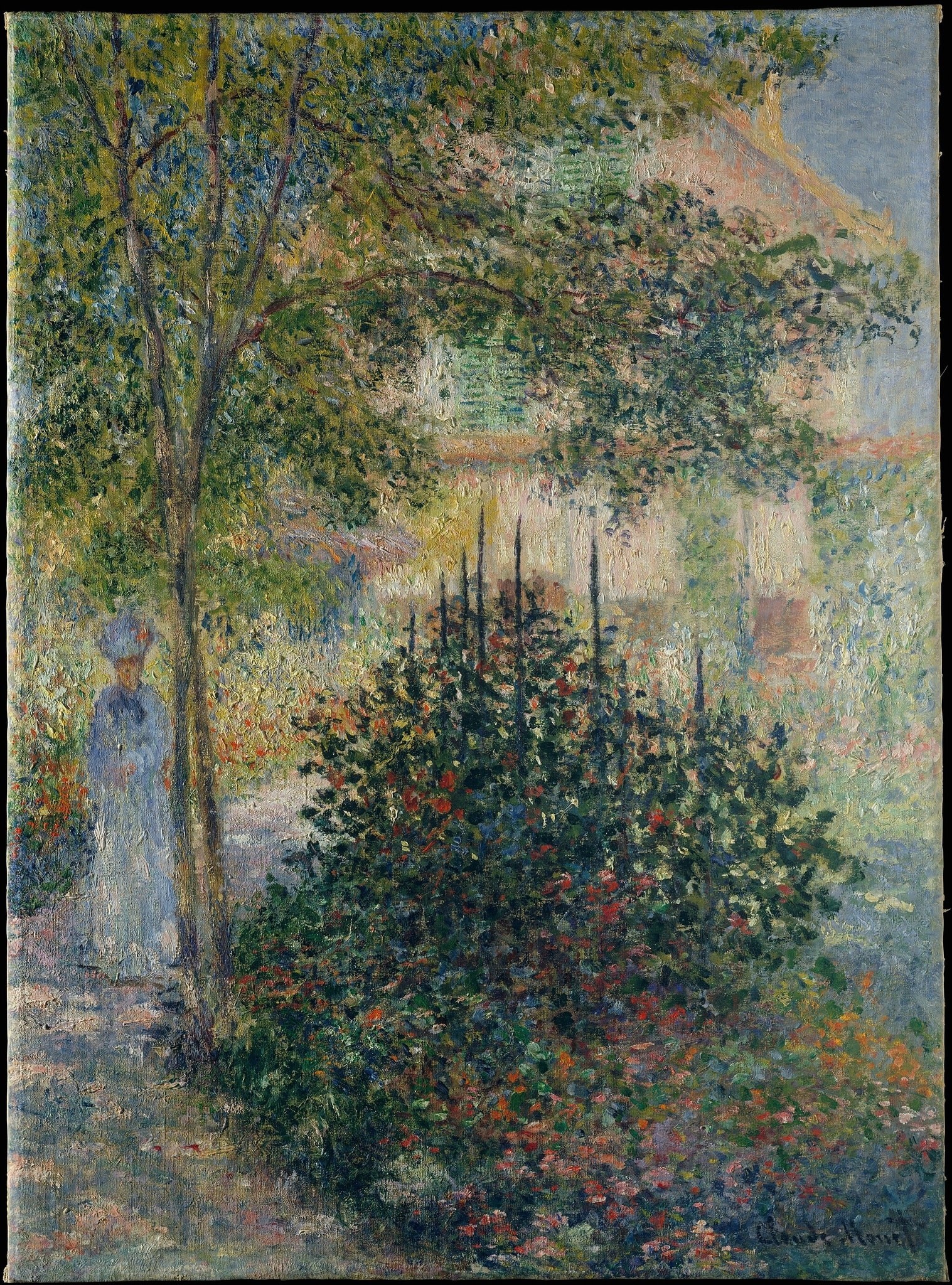
Claude Monet’s Camille Monet (1847–1879) in the Garden at Argenteuil captures a fleeting, sunstruck interval where a blue‑clad figure hovers at the shaded path while a corbeille of spiked flowers ignites the foreground. The pink house with green shutters flickers through a veil of leaves, its surfaces dissolved into vibrating strokes of light. Monet subordinates likeness to the sensation of air and color, turning the garden into a living field of time and perception [1][2].

Fast Facts

Year
1876
Medium
Oil on canvas
Dimensions
81.6 x 60 cm
Location
The Metropolitan Museum of Art, New York
See all Claude Monet paintings in New York
Camille Monet (1847–1879) in the Garden at Argenteuil by Claude Monet (1876) featuring Corbeille of spiked flowers, Green shutters on the pink house, Dappled garden path, Figure in blue

Click on any numbered symbol to learn more about its meaning

Meaning & Symbolism

Monet composes the canvas around a dense, circular corbeille—a fashion of nineteenth‑century bourgeois gardening—its dark foliage pricked by vertical spikes that thrust upward like a vegetal armature. Those spikes echo the tree trunks and the attenuated silhouette at left, collapsing figure and flora into one rhythmic structure. The house’s pink façade, banded by green shutters, is not architecturally explained but breathed into being by broken strokes; it shimmers through a scrim of leaves rather than presenting itself as solid mass. In this oscillation, Monet redirects attention from identity to atmosphere: the woman in blue—cool, shaded, scarcely individuated—registers as a tonal accent within a field of chromatic events, not as a portrait that fixes her in time. The dappled path, marked by short, slurred strokes of lilac, rose, and pale yellow, stages a passage from shade to glare; the eye tracks around the corbeille, slips under the canopy, and emerges at the light‑struck wall. This choreography of seeing is the work’s subject. As The Met notes, the impressive stand of hollyhocks can eclipse Madame Monet herself, and the picture surface “pulsates with light,” making sensation paramount 1. Nineteenth‑century viewers would also have recognized the corbeille as a token of cultivated abundance, a designed nature that signals taste and status; here it becomes the compositional protagonist, a modern emblem of domestic display that Monet turns into pure optical event 4. The painting’s tension—intimacy versus exposure—emerges from its asymmetry. At left, the figure recedes into cool shadow; at right, the house glows as if seen through heat. Rather than describing objects, Monet dissolves contours in air, a strategy critics like Mallarmé associated with the era’s poetics of evanescence; scholars have read Camille’s wraithlike presence as a vertical interval that appears and vanishes with the light, one more stem among stems 2. This is not sentimentality but an ethics of modern vision: the self is contingent, provisional, absorbed into the rhythms of weather, hour, and breath. The Argenteuil setting sharpens that argument. In the 1870s this rail‑linked suburb epitomized new rhythms of metropolitan life—speed, leisure, gardened domesticity—and Impressionists seized upon it as a proving ground for painting the present 35. Monet’s mid‑1876 burst of garden pictures, documented in letters and museum records, treats the house‑garden as a serial motif where the constants (façade, shutters, corbeille) meet the variables (sun, breeze, flowering spikes), allowing him to paint not stability but duration—the ceaseless flicker by which moments succeed one another 13. Read this way, the picture declares a program. First, it subordinates narrative incident to a phenomenology of light: the important event is the garden’s breathing surface, not what the figure does. Second, it reframes private space as modern spectacle: the bourgeois garden, with its fashionable hollyhocks and gladioli, is both a stage of identity and a generator of pure optical pleasure 4. Finally, it asks us to accept uncertainty as truth. Forms blur; leaves interpose; shutters close off any glimpse of interior life; and yet the scene feels exact because it is faithful to perception as lived—partial, vibrating, and time‑bound. In Camille Monet (1847–1879) in the Garden at Argenteuil, Monet achieves a quiet radicalism: he turns a domestic plot into a field of modern experience where self, house, and flowers are equal actors in the theater of light 125.

Explore Deeper with AI

Ask questions about Camille Monet (1847–1879) in the Garden at Argenteuil

Popular questions:

Powered by AI • Get instant insights about this artwork

💬 Ask questions about this artwork!

Interpretations

Historical Context: Argenteuil as a Laboratory of Modernity

Argenteuil in the mid‑1870s was not pastoral retreat but a rail‑borne suburb where urban tempo met domestic leisure. Monet’s garden is thus a modern interface: a private stage exposed to new rhythms of speed, weekend outing, and curated display. The painting’s high viewpoint and path that loops the corbeille mimic circulation, echoing trains that brought Parisians upriver. In 1876 Monet reported working on “a series of rather interesting new things,” and this canvas belongs to that push to test how a house‑garden—stable in plan yet volatile in weather—could model modern life’s variability. Here, suburban domesticity is not anecdote but infrastructure for optical experiment, aligning with Argenteuil’s status as an Impressionist proving ground 361.

Source: National Gallery of Art (Paul Hayes Tucker); Musée d’Orsay; The Met

Formal/Poetic Reading: Mallarméan Air and Dissolving Contours

Critics aligned with Mallarmé spoke of contours that dissolve in air—a phrase that illuminates Monet’s handling here. Camille’s vertical, scarcely individuated, rhymes with the flower spikes and trunks; edges fray into colored atmosphere so that figure becomes a tonal interval rather than a portrait. The façade’s pinks and the shutters’ greens breathe through a foliage scrim, refusing architectural solidity. This generates multiple temporalities: a near‑instant optical “pulse” at the surface and a slower oscillation as forms appear, flicker, and recede. The work’s uncanny quiet comes from this doubleness—domestic specificity rendered as evanescence, a garden both present and perpetually slipping away 21.

Source: Nonsite.org (Mallarmé and Impressionism in 1876); The Met

Garden History: The Corbeille as Bourgeois Display Turned Optical Engine

The circular corbeille—planted with tall hollyhocks and gladioli—was a fashionable feature of mid‑19th‑century bourgeois gardening. As a token of cultivated abundance, it typically signaled taste and means. Monet upends its merely decorative role by making the bed the compositional protagonist: a dark, dense hub pricked by verticals that structure the eye’s circuit. In doing so, he converts designed nature into a motor of chromatic events, where status‑laden flora become agents of optical research. The painting thus compresses horticultural fashion, social aspiration, and avant‑garde facture into one revolving device of seeing 451.

Source: Detroit Institute of Arts; The Met (Public Parks, Private Gardens); The Met

Temporality & Serial Method: From Motif to Duration

Monet’s 1876 burst of house‑garden pictures operationalizes a serial method: repeat the same motif (façade, shutters, corbeille) under shifting light, breeze, and bloom to paint not stability but duration. Documented by his July 12, 1876 letter and The Met’s note of “no less than ten paintings,” the project treats constants as a grid to register variables across hours and days. In this canvas the path’s lilac‑rose dapple and the façade’s tremor through leaves parse the moment as time‑slice, anticipating later series like haystacks and cathedrals. The garden becomes a clock without numbers, its hands the shadows and spikes that mark passing light 617.

Source: Musée d’Orsay; The Met; The Met (Heilbrunn Timeline)

Gender and Visibility: Camille Between Ornament and Presence

The Met observes that the “impressive stand of hollyhocks” can eclipse Madame Monet, a clue to how femininity in suburban space risks becoming ornamental surface within bourgeois display. Camille’s cool blue, set in shadow and pared of facial detail, reads less as subject than as a register of tonality, aligning her with cultivated flora rather than asserting individuated agency. This is not simple effacement; it is a modern optics that absorbs persons into ambient effects. Yet the effect maps onto gendered domesticity: the private garden as a sphere where women are seen but not necessarily disclosed. Monet’s image thus stages a tension between spectacle and personhood in the modern home 13.

Source: The Met; National Gallery of Art (Argenteuil exhibition)

Related Themes

About Claude Monet

Claude Monet (1840–1926) led Impressionism’s pursuit of open-air painting and optical immediacy, especially during his Argenteuil years focused on modern leisure and light. He later developed serial studies of changing conditions, culminating in the Water Lilies cycle [2].
View all works by Claude Monet

More by Claude Monet

Boating by Claude Monet

Boating

Claude Monet (1887)

Monet’s Boating crystallizes modern leisure as a drama of perception, setting a slim skiff and two pale dresses against a field of dark, mobile water. Bold cropping, a thrusting oar, and the complementary flash of hull and foliage convert a quiet outing into an experiment in <strong>modern vision</strong> and the <strong>materiality of water</strong> <sup>[1]</sup><sup>[2]</sup>.

The Thames below Westminster by Claude Monet

The Thames below Westminster

Claude Monet (about 1871)

Claude Monet’s The Thames below Westminster turns London into <strong>light-made architecture</strong>, where Parliament’s mass dissolves into mist and the river shivers with <strong>industrial motion</strong>. Tugboats, a timber jetty with workers, and the rebuilt Westminster Bridge assert a modern city whose power is felt through atmosphere more than outline <sup>[1]</sup>.

Haystacks Series by Claude Monet | Light, Time & Atmosphere by Claude Monet

Haystacks Series by Claude Monet | Light, Time & Atmosphere

Claude Monet

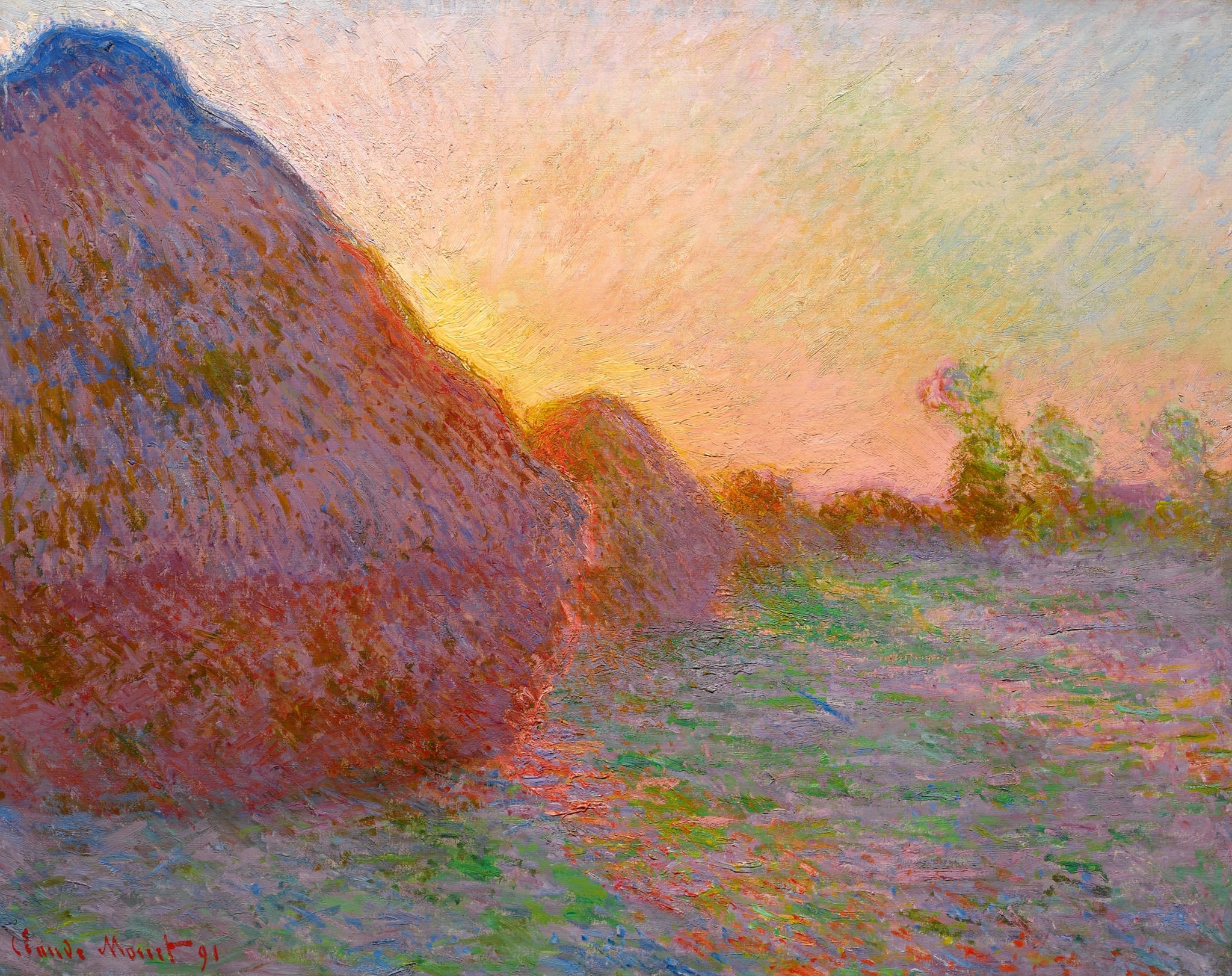
Claude Monet’s <strong>Haystacks Series</strong> transforms a routine rural subject into an inquiry into <strong>light, time, and perception</strong>. In this sunset view, the stacks swell at the left while the sun burns through the gap, making the field shimmer with <strong>apricot, lilac, and blue</strong> vibrations.
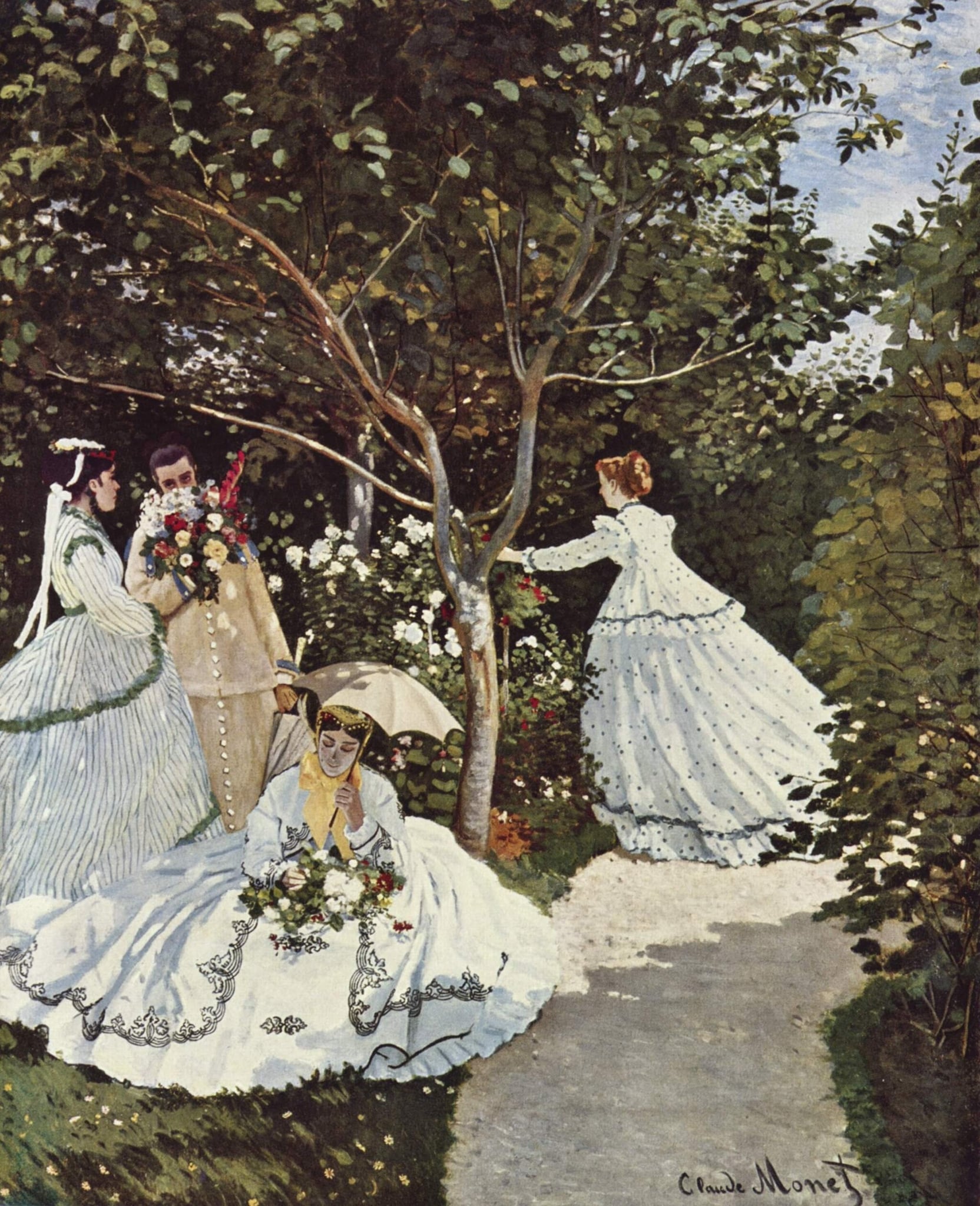
Women in the Garden by Claude Monet

Women in the Garden

Claude Monet (1866–1867)

Claude Monet’s Women in the Garden choreographs four figures in a sunlit bower to test how <strong>white dresses</strong> register <strong>dappled light</strong> and shadow. The path, parasol, and clipped flowers frame a modern ritual of leisure while turning fashion into an instrument of <strong>perception</strong>. The scene reads less as portraiture than as a manifesto for painting the <strong>momentary</strong> outdoors <sup>[1]</sup><sup>[3]</sup>.
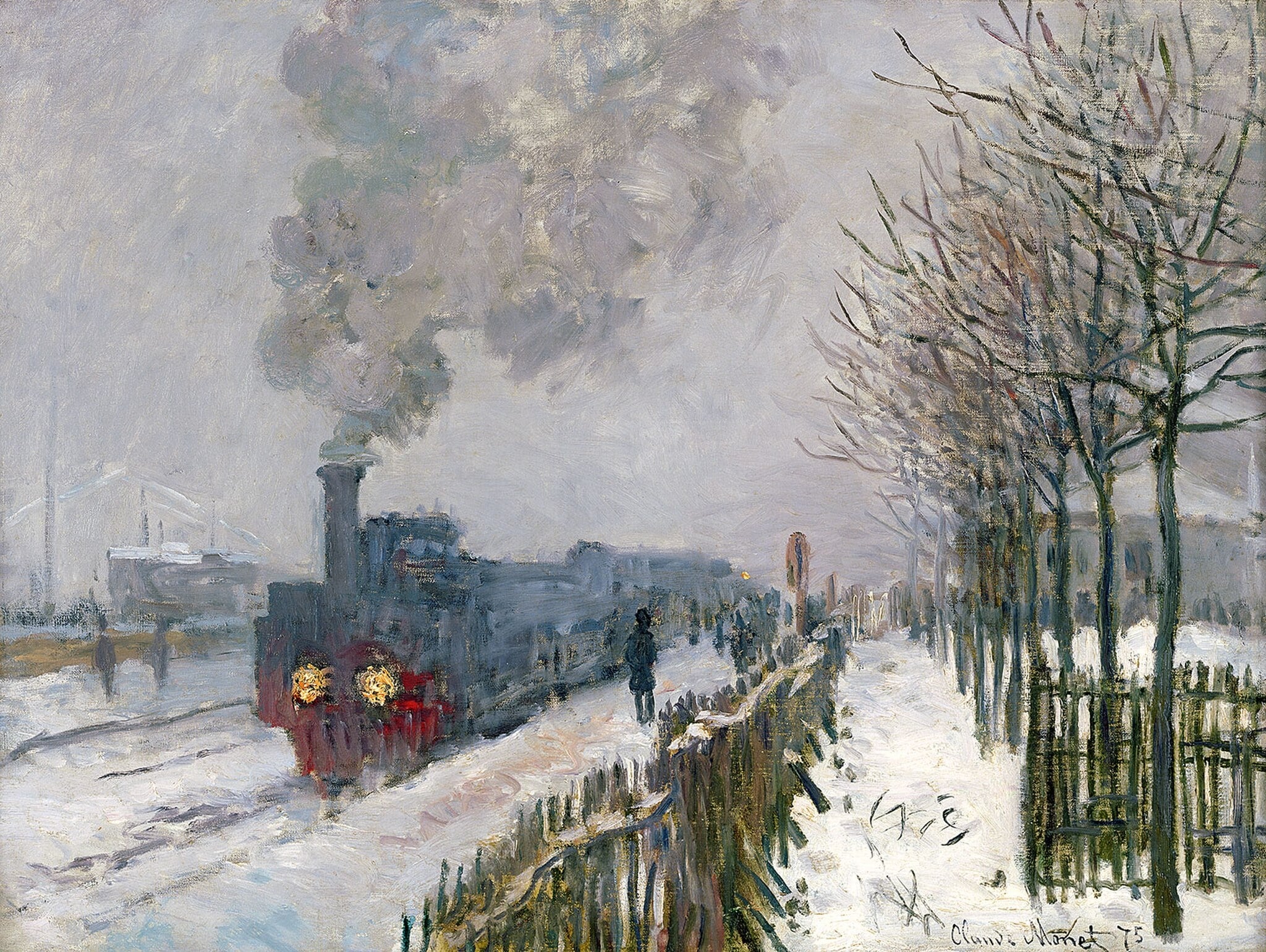
The Train in the Snow (The Locomotive) by Claude Monet

The Train in the Snow (The Locomotive)

Claude Monet (1875)

Claude Monet’s The Train in the Snow (The Locomotive) (1875) turns a suburban winter platform into a study of <strong>modernity absorbed by atmosphere</strong>. The engine’s twin yellow headlights and a smear of red push through a world of greys and violets as steam fuses with the low sky, while the right-hand fence and bare trees drill depth and cadence into the scene <sup>[1]</sup><sup>[4]</sup>. Monet fixes not an object but a <strong>moment of perception</strong>, where industry seems to dematerialize into weather <sup>[1]</sup><sup>[2]</sup>.
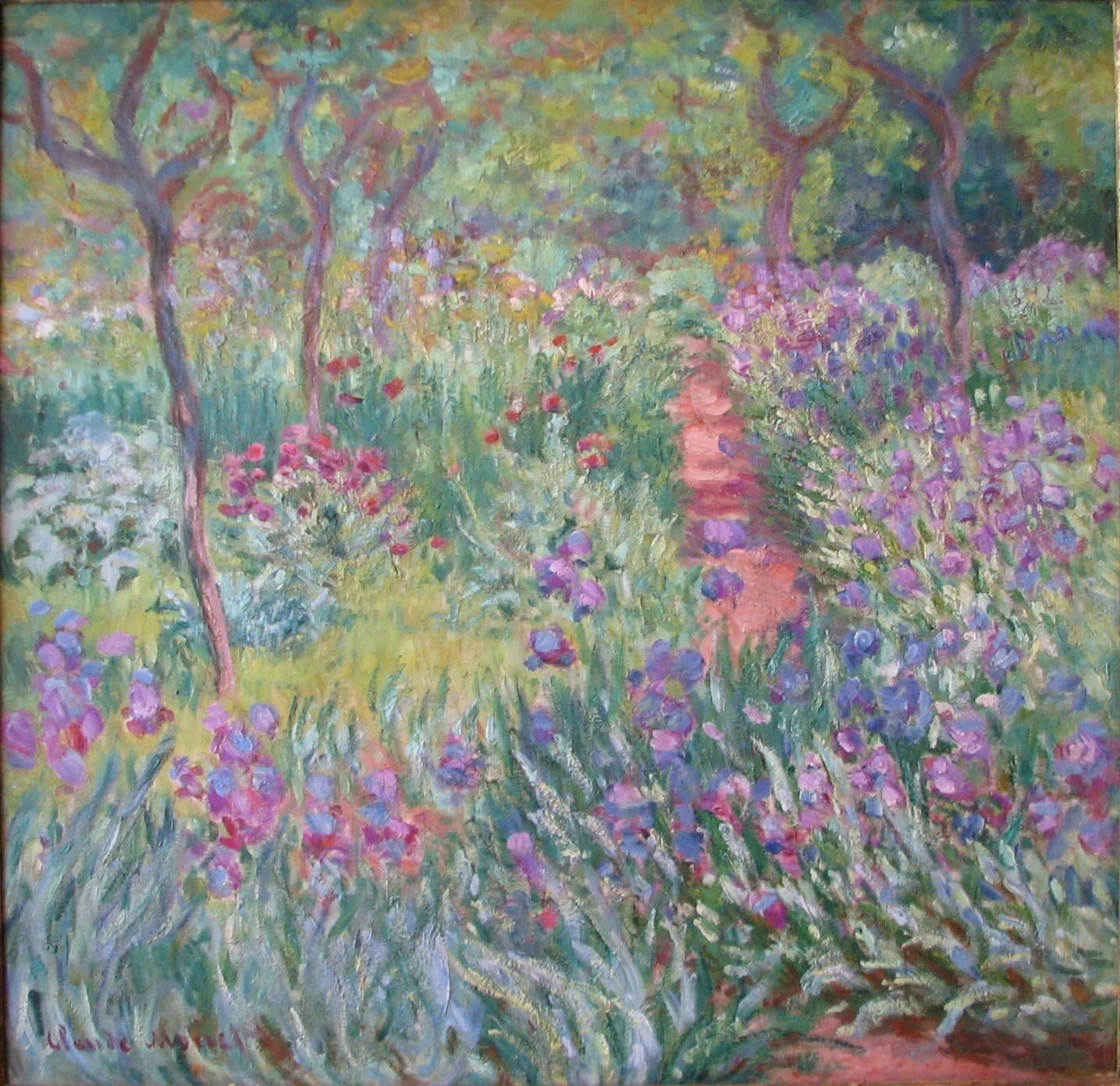
The Artist's Garden at Giverny by Claude Monet

The Artist's Garden at Giverny

Claude Monet (1900)

In The Artist's Garden at Giverny, Claude Monet turns his cultivated Clos Normand into a field of living color, where bands of violet <strong>irises</strong> surge toward a narrow, rose‑colored path. Broken, flickering strokes let greens, purples, and pinks mix optically so that light seems to tremble across the scene, while lilac‑toned tree trunks rhythmically guide the gaze inward <sup>[1]</sup><sup>[3]</sup>.