Camille Monet (1847–1879) on a Garden Bench

by Claude Monet

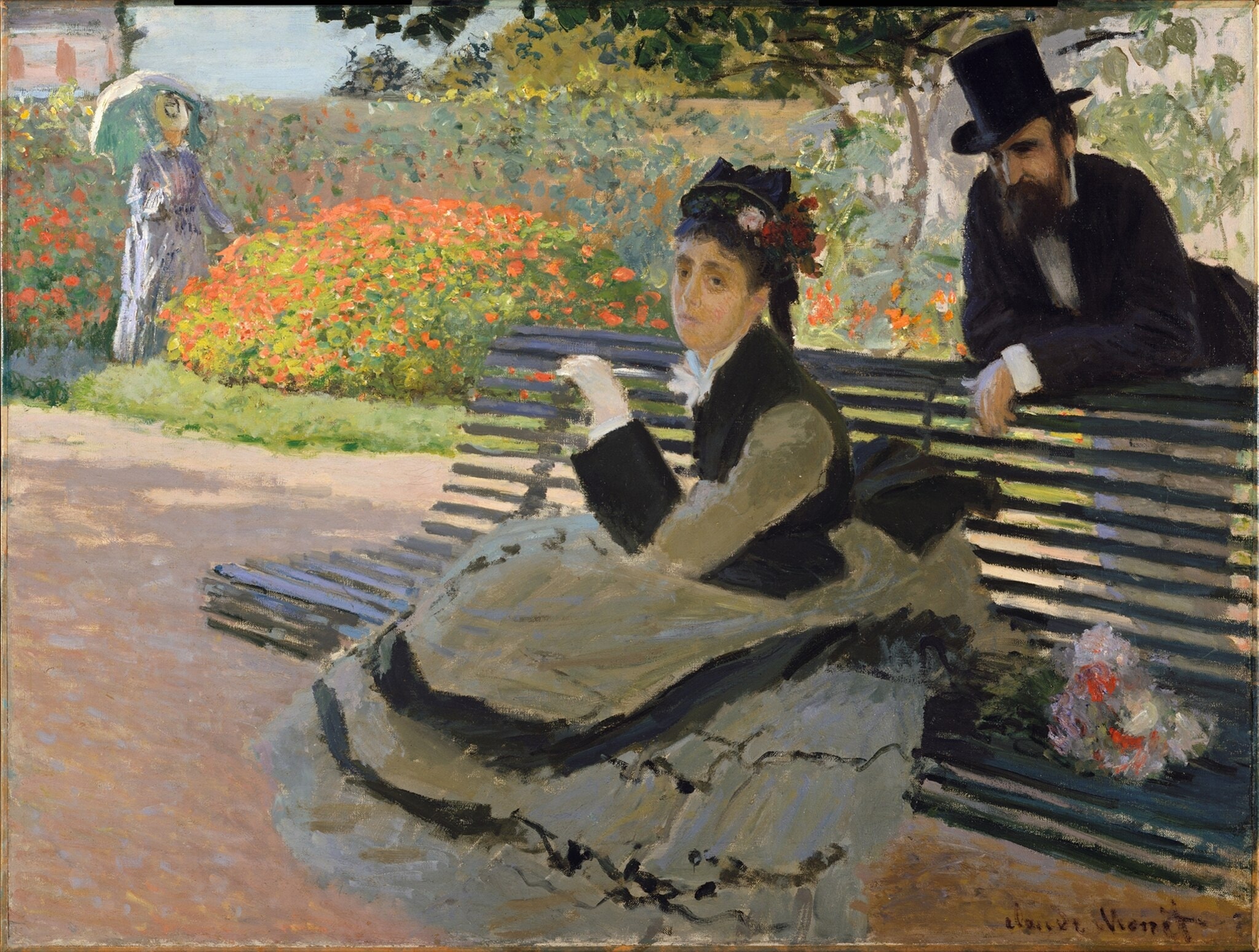
Monet stages a modern garden drama along the diagonal bench that slices the foreground, setting Camille’s poised figure against a blaze of geraniums and dappled light. A top‑hatted neighbor leans over the slats as a second woman with a parasol wanders among blooms, while a note and a slightly tumbled bouquet cue a moment interrupted. Light, not contour, builds the scene, suspending private feeling within public leisure [1][2].

Fast Facts

Year
1873
Medium
Oil on canvas
Dimensions
60.6 x 80.3 cm
Location
The Metropolitan Museum of Art, New York
See all Claude Monet paintings in New York
Camille Monet (1847–1879) on a Garden Bench by Claude Monet (1873) featuring Diagonal slatted bench, Folded note/letter, Bouquet, Geraniums in bloom

Click on any numbered symbol to learn more about its meaning

Meaning & Symbolism

Monet composes the scene around the long oblique of the garden bench, a man‑made stripe that both anchors the foreground and becomes a permeable screen between figures. Camille, turned three‑quarters toward us, holds a folded note at mid‑gesture; her lowered, inward‑drawn gaze resists social exchange. The neighbor in a top hat, identified by Monet in later remarks, leans across the bench back with casual familiarity, yet the slats keep his weight and words at a remove from her lap and hands 2. At the painting’s edge a loosely placed bouquet slides toward the ground, its reds echoing the hot embers of geraniums at left, as if a consoling offering has arrived out of step with Camille’s private time. Monet’s choice to let light articulate form—cool flickers for shade, warm strokes for petals and skin—refuses sharp contour and keeps every figure slightly provisional, as though the moment might dissolve with the next movement of sun or cloud 1. The garden’s abundance intensifies this felt disjunction. A woman shades herself with a parasol amid geranium mounds, an emblem of suburban leisure in Argenteuil, the fast‑modernizing railway suburb where Monet turned his rented house and garden into a display of taste and color—a literal pictorial theater for modern life 34. Her leisurely drift marks one tempo; Camille’s stilled, self‑contained pose marks another. The bench’s slatted rhythm binds these tempos while also parsing space into subtle social zones: Camille on the viewer’s plane; the neighbor behind the bars; the parasol figure in a shimmering distance. This is not a coded literary tableau; curators emphasize the absence of a fixed source while noting a specific biographical hinge—the September 1873 death of Camille’s father—which plausibly connects the note and bouquet to a condolence call 12. Monet thus shapes a narrative that is legible but open: modern feeling conveyed by posture, interval, and light rather than by emblem or plot. Fashion grounds the scene in the present. Camille’s velvet bodice and pale damask skirt align with looks promoted in La Mode Illustrée, aligning her presence with Parisian style culture even as her affect withdraws from it 1. The brushwork reinforces this doubleness. Hard edges give way to keyed color patches; the bench’s dark slats are interleaved with sun, turning a rigid object into a vibrating measure of lived time. Across related Argenteuil canvases of 1873—often paired with a companion garden scene that moves toward brighter domesticity—Monet tests how the garden can hold both spectacle and introspection, public display and private thought 35. In this canvas, the suspended bouquet, the half‑read letter, and the slight torque of Camille’s body fix a threshold instant: a world of modern leisure proceeding in full bloom while an unseen message tilts it toward loss. That tension—between outward brightness and inward distance—defines the painting’s quiet audacity and its lasting narrative charge 123.

Explore Deeper with AI

Ask questions about Camille Monet (1847–1879) on a Garden Bench

Popular questions:

Powered by AI • Get instant insights about this artwork

💬 Ask questions about this artwork!

Interpretations

Formal Analysis: The Bench as Social Diaphragm

Monet’s diagonal bench operates like a visual diaphragm: a strong planar thrust that both anchors the foreground and filters social contact through its slatted “screen.” The neighbor’s casual lean is visually segmented by these slats, registering his presence as pressure without penetration—speech and weight meet a rhythmic barrier. Monet’s light‑led modeling—sun‑interleaved darks, color patches for skin and blossoms—keeps contours soft, so relations feel permeable yet constrained. The bouquet’s precarious tilt and the slats’ beat synchronize with the garden’s pulse, turning furniture into meter. Rather than mere seating, the bench times the scene, parsing zones (Camille/visitor/background flâneur) while converting a suburban prop into a compositional instrument that measures distance, tact, and hesitation 14.

Source: The Metropolitan Museum of Art; Art Institute of Chicago

Historical Context: Argenteuil as Modern Stage

Argenteuil’s status as a railway suburb and Impressionist hub inflects the picture’s dramaturgy. Monet’s rented house and cultivated garden—documented as a showcase of taste—function as a modern stage where leisure rituals perform middle‑class aspiration. Within this display culture, a condolence call becomes a public‑private scene negotiated in open air, not parlor. The parasol figure indexes suburban flânerie, while Camille’s stillness interrupts the flow—two tempos coexisting under the same modern sky. Monet’s circle used Argenteuil to test how light, speed, and seasonal color reframe everyday life; this canvas turns a garden border into a threshold of modernity, where social tact and horticultural spectacle are choreographed by changing light and commuter‑age time 34.

Source: National Gallery of Art; Art Institute of Chicago

Fashion Studies: Surface Style vs. Interior Reserve

The ensemble—velvet bodice, pale damask skirt—echoes La Mode Illustrée of spring 1873, situating Camille in the circuits of Parisian fashion and print culture. Yet Monet sets these refined textures against an averted gaze and a hand paused on a note, producing a friction between display and withdrawal. Rather than codified mourning, curators emphasize contemporaneity: chic materials, seasonal bloom, and the garden as showroom. Fashion’s rhetoric of public sociability is thus underwritten by reticence, as broken strokes disperse sheen across fabric and foliage, refusing portrait‑studio crispness. The result is a modern optics of dress: clothes that signal present‑tense style but also register mood as a surface phenomenon—gloss that flickers, softens, and nearly dematerializes under sunlight 12.

Source: The Metropolitan Museum of Art

Narrative Openness: An Enigma Without a Source

Curators stress the absence of a literary or theatrical source, framing this as a deliberately modern tableau whose cues—letter, bouquet, oblique bench—suggest but do not legislate plot. Monet’s later identification of the man as a neighbor anchors the scene socially while preserving ambiguity of intent and outcome. The painting’s narrative method is indexical rather than emblematic: objects and postures point, but meanings remain contingent, like the light that dissolves hard edges. Such open form aligns with Impressionism’s refusal of academic storytelling in favor of phenomenological immediacy, where sequence and causality feel suspended in a shared air of tact and temporality. The image reads as a poised interruption—less anecdote than situation 12.

Source: The Metropolitan Museum of Art

Comparative Reading: The Pendant Logic

Seen alongside the related Argenteuil canvas with Camille, Jean, and a nurse, this work reads as the introspective half of a pendant structure: one canvas staging domestic continuity, the other registering pause and condolence. Similar scale and setting suggest intentional pairing, with the bench’s diagonal and garden borders serving as a shared syntax. The contrast maps modern life’s dual registers—public display/home routine versus private news/time‑out—within a single horticultural theater. This diptych logic clarifies Monet’s experiment: can a suburban garden hold simultaneous narratives of bloom and bereavement? The answer is formal rather than programmatic: differences in pose, interval, and light establish complementary, not illustrative, plots across the pair 35.

Source: National Gallery of Art

Phenomenology of Time: Light as Event

Monet’s handling makes light the true protagonist: forms cohere by chromatic adjacency, faces and fabrics breathe with reflected color, and the bench’s slats alternate sun and shade like beats in time. This temporal facture destabilizes narrative closure—the moment feels revisable with the next cloud. Such painting “from light” enacts Impressionism’s wager that perception is event‑based, not object‑based. The condolence reading thus lives at the threshold of becoming: a note mid‑gesture, a bouquet mid‑slide, a visitor mid‑lean. In a rail‑paced suburb where time was newly segmented by timetables, the canvas slows experience to a present tense thick with potential, letting the eye do the clock’s work through rhythmic strokes and intervals 13.

Source: The Metropolitan Museum of Art; National Gallery of Art

Related Themes

About Claude Monet

Claude Monet (1840–1926) led Impressionism’s pursuit of open-air painting and optical immediacy, especially during his Argenteuil years focused on modern leisure and light. He later developed serial studies of changing conditions, culminating in the Water Lilies cycle [2].
View all works by Claude Monet

More by Claude Monet

Boating by Claude Monet

Boating

Claude Monet (1887)

Monet’s Boating crystallizes modern leisure as a drama of perception, setting a slim skiff and two pale dresses against a field of dark, mobile water. Bold cropping, a thrusting oar, and the complementary flash of hull and foliage convert a quiet outing into an experiment in <strong>modern vision</strong> and the <strong>materiality of water</strong> <sup>[1]</sup><sup>[2]</sup>.

The Thames below Westminster by Claude Monet

The Thames below Westminster

Claude Monet (about 1871)

Claude Monet’s The Thames below Westminster turns London into <strong>light-made architecture</strong>, where Parliament’s mass dissolves into mist and the river shivers with <strong>industrial motion</strong>. Tugboats, a timber jetty with workers, and the rebuilt Westminster Bridge assert a modern city whose power is felt through atmosphere more than outline <sup>[1]</sup>.

Haystacks Series by Claude Monet | Light, Time & Atmosphere by Claude Monet

Haystacks Series by Claude Monet | Light, Time & Atmosphere

Claude Monet

Claude Monet’s <strong>Haystacks Series</strong> transforms a routine rural subject into an inquiry into <strong>light, time, and perception</strong>. In this sunset view, the stacks swell at the left while the sun burns through the gap, making the field shimmer with <strong>apricot, lilac, and blue</strong> vibrations.
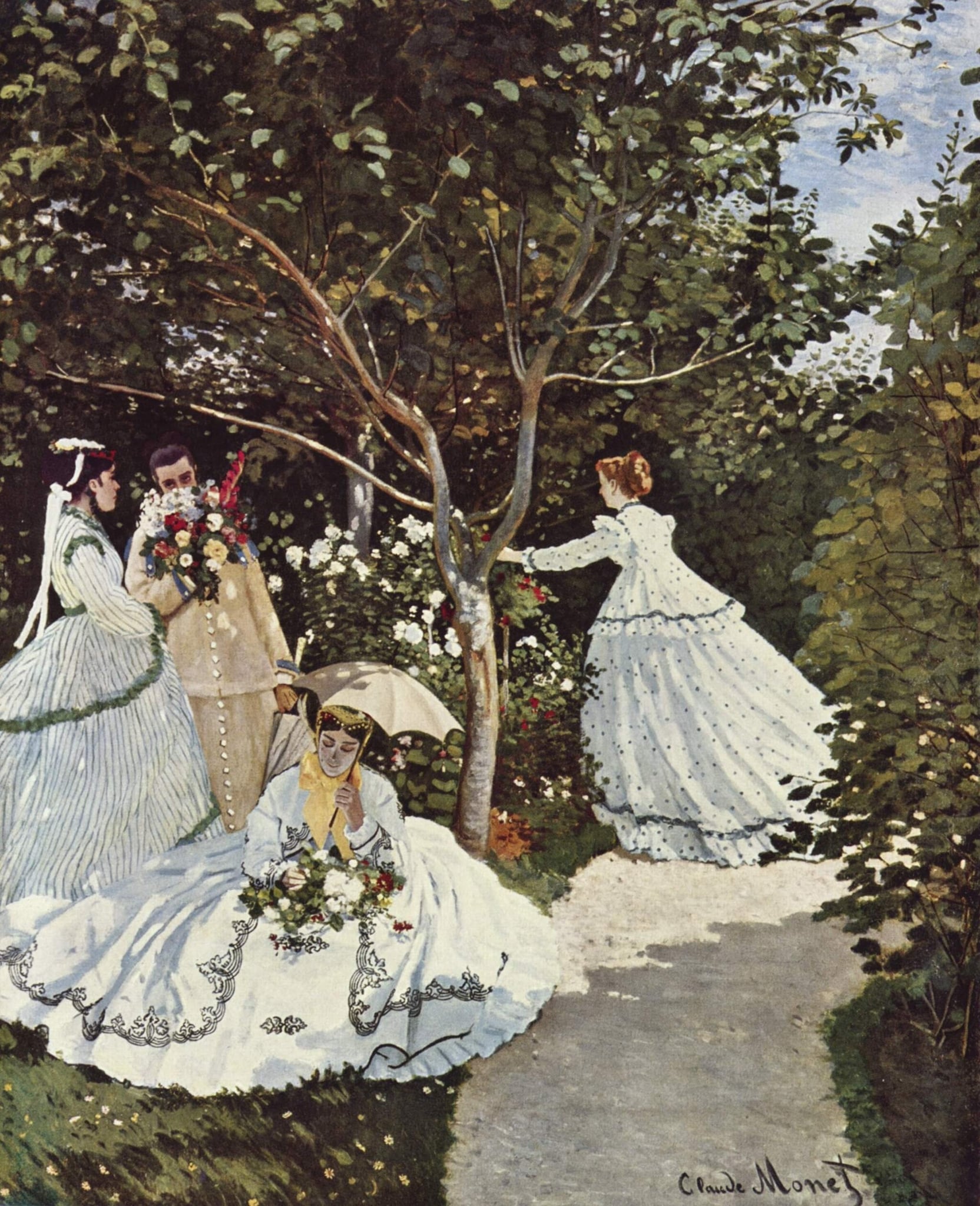
Women in the Garden by Claude Monet

Women in the Garden

Claude Monet (1866–1867)

Claude Monet’s Women in the Garden choreographs four figures in a sunlit bower to test how <strong>white dresses</strong> register <strong>dappled light</strong> and shadow. The path, parasol, and clipped flowers frame a modern ritual of leisure while turning fashion into an instrument of <strong>perception</strong>. The scene reads less as portraiture than as a manifesto for painting the <strong>momentary</strong> outdoors <sup>[1]</sup><sup>[3]</sup>.
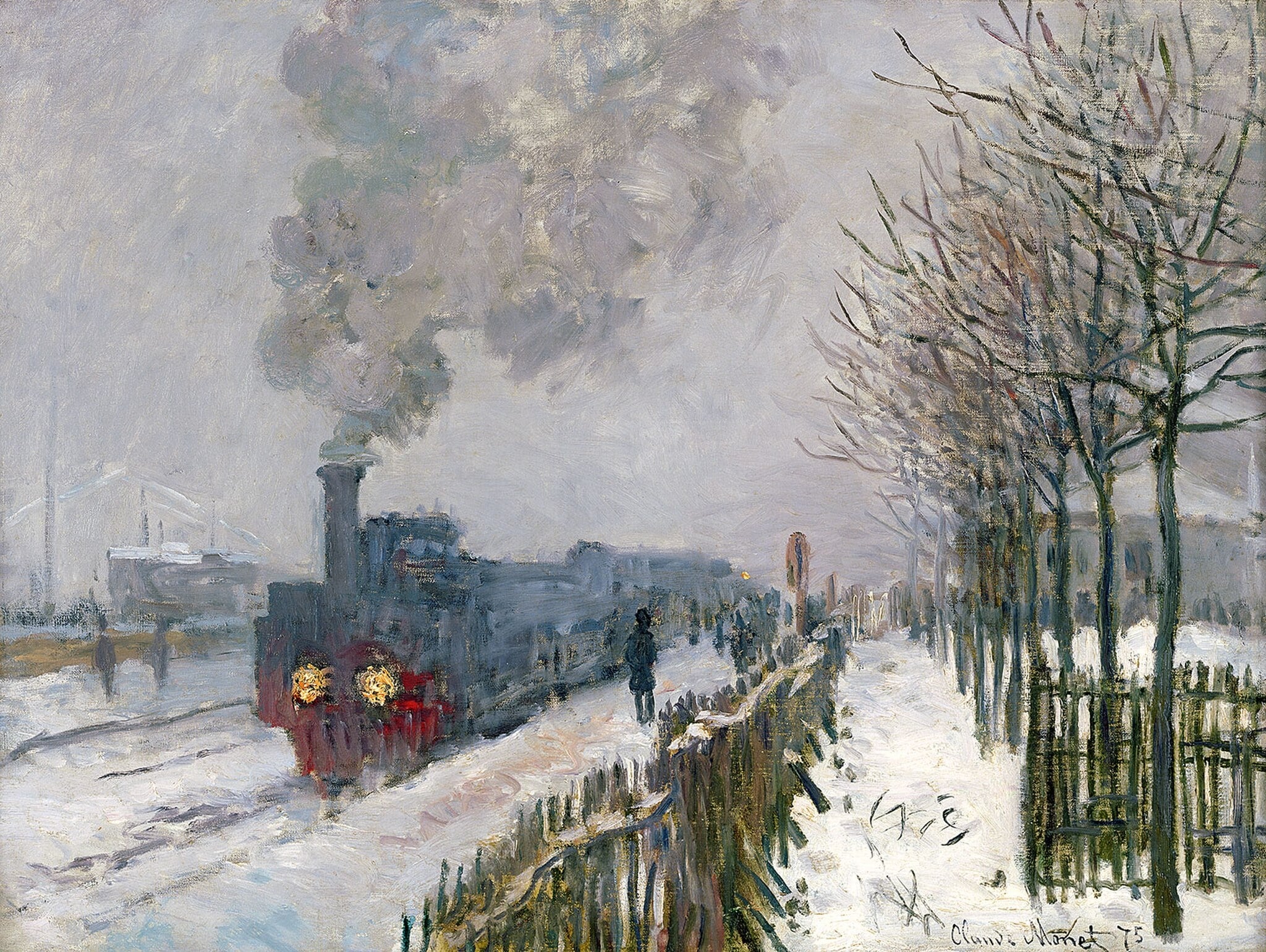
The Train in the Snow (The Locomotive) by Claude Monet

The Train in the Snow (The Locomotive)

Claude Monet (1875)

Claude Monet’s The Train in the Snow (The Locomotive) (1875) turns a suburban winter platform into a study of <strong>modernity absorbed by atmosphere</strong>. The engine’s twin yellow headlights and a smear of red push through a world of greys and violets as steam fuses with the low sky, while the right-hand fence and bare trees drill depth and cadence into the scene <sup>[1]</sup><sup>[4]</sup>. Monet fixes not an object but a <strong>moment of perception</strong>, where industry seems to dematerialize into weather <sup>[1]</sup><sup>[2]</sup>.
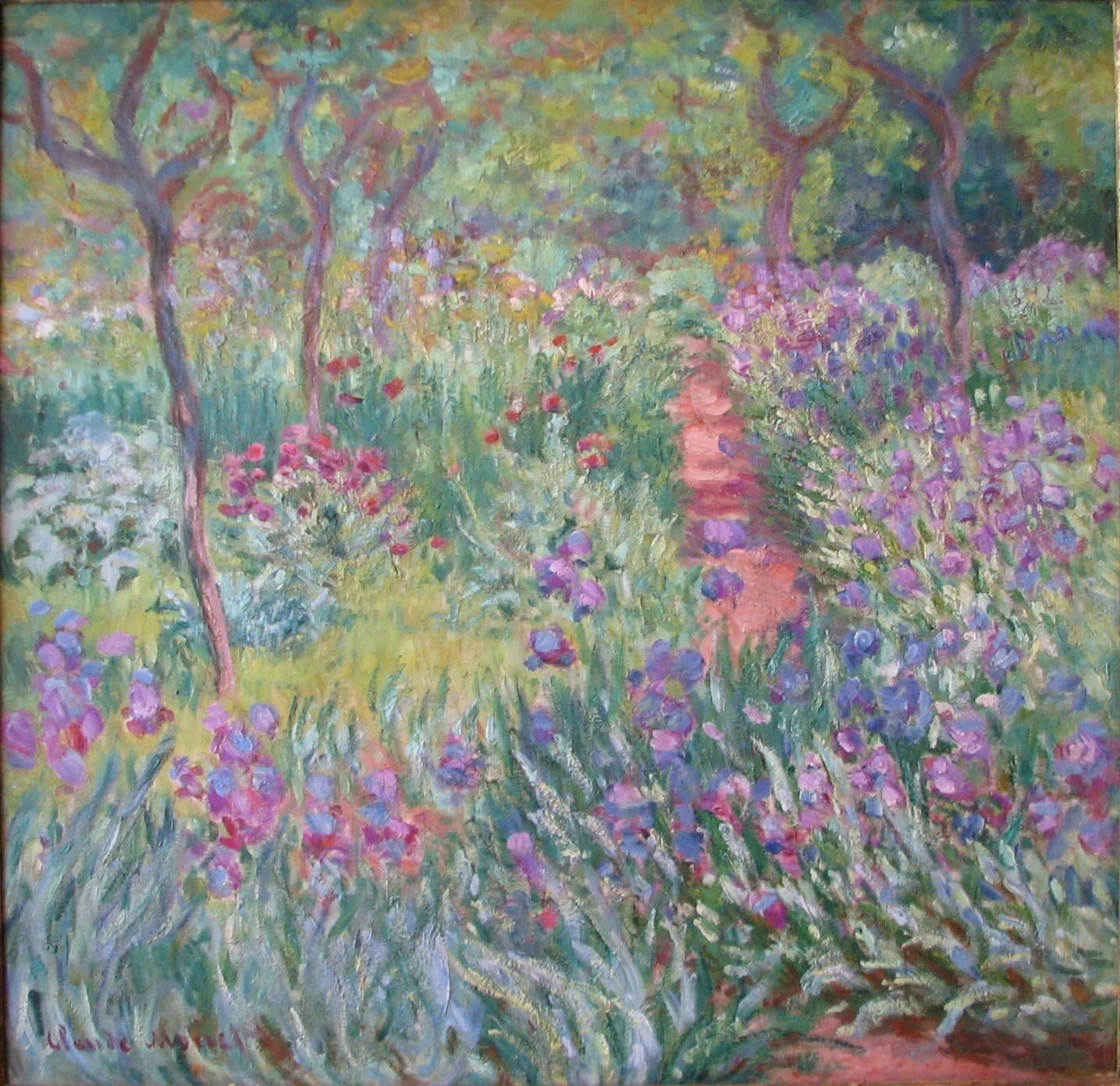
The Artist's Garden at Giverny by Claude Monet

The Artist's Garden at Giverny

Claude Monet (1900)

In The Artist's Garden at Giverny, Claude Monet turns his cultivated Clos Normand into a field of living color, where bands of violet <strong>irises</strong> surge toward a narrow, rose‑colored path. Broken, flickering strokes let greens, purples, and pinks mix optically so that light seems to tremble across the scene, while lilac‑toned tree trunks rhythmically guide the gaze inward <sup>[1]</sup><sup>[3]</sup>.