L'Arlésienne

by Vincent van Gogh

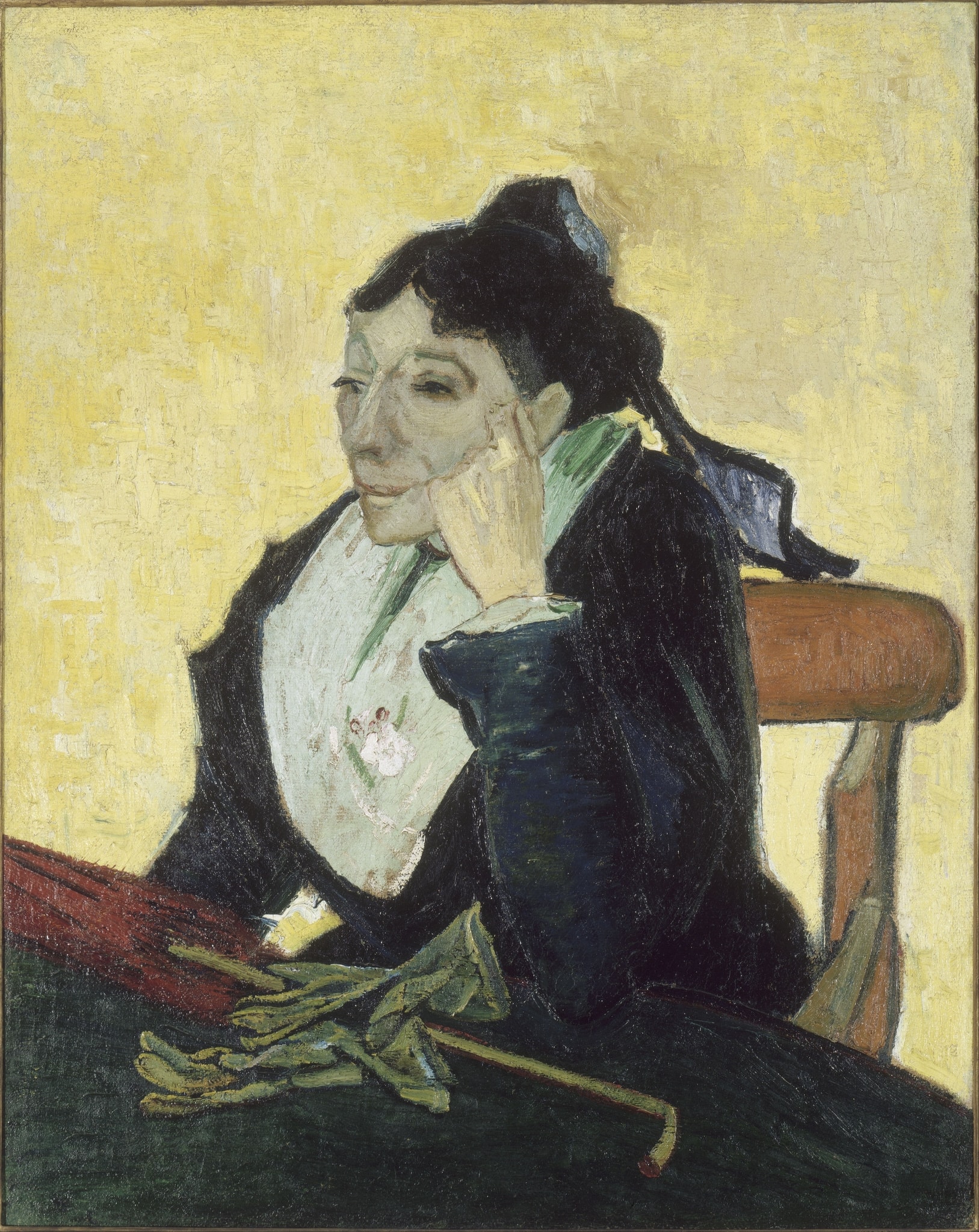
In L'Arlésienne, Vincent van Gogh distills a moment of inward pause: a woman from Arles leans her cheek on her hand before a butter‑yellow wall, her black-and-blue silhouette set against a warm field. The red parasol and green gloves lie unused on the table, signaling a suspension of public persona in favor of private thought [1][3].

Study Print Studio

Create a personal study print

Build a companion study sheet around the part of this painting that speaks to you most. Choose a detail, shape an interpretation, and walk away with something personal and display-worthy.

Fast Facts

Year
1888
Medium
Oil on canvas
Dimensions
92.5 × 73.5 cm
Location
Musée d’Orsay, Paris
See all Vincent van Gogh paintings in Paris
L'Arlésienne by Vincent van Gogh (1888) featuring Butter‑yellow wall, Red parasol, Green gloves, Black-and-blue silhouette (dress and coiffe)

Click on any numbered symbol to learn more about its meaning

Meaning & Symbolism

Van Gogh builds the picture as a dialectic of surfaces and signs. The wall is an even, pale lemon plane, the kind of high-key ground he described to Theo when he said the figure was “slashed on in an hour… background pale lemon… clothes black… raw Prussian blue” 3. That chromatic recipe is legible in the sitter’s dark dress—its edge stitched in cold blue—and in the tabletop triad of red parasol and green gloves set against the near-black cloth. The warm field behind her reads as daylit Arles; the cool silhouette registers reserve. Resting her cheek on her right hand, eyes lowered, she turns slightly away; Van Gogh crops the orange chair and pushes her forward, flattening depth so that contour, not recession, carries expression 1. This cloisonné-like handling, indebted to Japanese prints that both he and Gauguin studied, converts background into a plane of pressure that meets the figure’s outline, making the sitter’s stillness feel deliberate rather than passive—an act of withholding in a luminous world 4. The tabletop objects function as narrative pivots. In late‑nineteenth‑century etiquette, the parasol and gloves were badges of public decorum; here they are unused, a public self temporarily laid aside. Their diagonal, leading from the lower left toward the sitter’s hand and temple, connects “outside” to “inside,” redirecting action from the street to thought. Van Gogh knew exactly what he was doing with such substitutions: in his other 1888 version (Metropolitan Museum), he replaces these items with books, shifting the portrait toward intellectual interiority rather than social pause 2. That controlled interchange is why L’Arlésienne is important: it demonstrates that a portrait’s meaning can be constructed through portable signs, not just physiognomy, anticipating twentieth‑century strategies of symbolic portraiture. At the same time, the title invokes the regional Arlésienne type—lace coiffe, dark dress—yet Van Gogh refuses folkloric anecdote; instead, he abstracts costume into blocks of tone and line to frame a distinctly modern psychology 1. Context intensifies the work’s charge. Painted in early November 1888 during the short, volatile “Studio of the South” partnership, the canvas exemplifies Van Gogh’s rapid facture and Gauguin‑inflected simplification: big areas of unmixed color, rhythmic brushwork, and assertive contour that compress space into emotion 4. The portrait would later seed a cluster of 1890 reworkings made at Saint‑Rémy after Gauguin’s charcoal drawing, underscoring how the motif became a site of memory and exchange during Van Gogh’s convalescence 54. But the Orsay version remains the most tersely argued: a few planes, a handful of signs, and a decisive pose convert daily life—the moment one sets down gloves and parasol—into a meditation on solitude, dignity, and the bittersweet interlude between public role and private thinking. In short, the meaning of L’Arlésienne is that modern selfhood is staged at the boundary of surface and symbol; why L’Arlésienne is important is that it makes that boundary visible, legible, and unforgettable through color, contour, and things laid gently aside 123.

Explore Deeper with AI

Ask questions about L'Arlésienne

Popular questions:

Powered by AI • Get instant insights about this artwork

💬 Ask questions about this artwork!

Interpretations

Semiotics of the Tabletop (Symbolic Reading)

The portrait’s meaning pivots on the substitutional logic of things. In the Orsay canvas, a red parasol and green gloves signal the etiquette of public appearance; set aside, they enact a temporary suspension of that role. In the Met variant, the same armature is reloaded with books, recoding the sitter as a reflective reader. This deliberate swapping of tabletop motifs functions like a modern sign‑system: portable, legible, and rhetorically precise. The diagonal of objects choreographs a vector from “outside” to “inside,” making thought the true event of the picture. Rather than mere props, these items are operators of meaning that anticipate twentieth‑century symbolic portraiture and semiotic approaches to image‑making 12.

Source: The Metropolitan Museum of Art; Musée d’Orsay

Type vs. Person: Regional Costume and Modern Womanhood (Identity Lens)

The title invokes the celebrated Arlésienne—a regional type canonized by Daudet and by tourist imagery—yet Van Gogh resists anecdote. He compresses the coiffe and dark dress into planar units that stage a tension between type and individual. In 1890 letters he would frame the motif as an “ideal image,” and even call one version a kind of joint effort with Gauguin, confirming that typology and collaboration shaped his aim. The Met’s “books” variant also touches a late‑nineteenth‑century trope of the female reader, aligning regional identity with a modern, thoughtful subject. The portrait thus negotiates costume’s social legibility while insisting on an interior, contemporary self 261.

Source: MASP (curatorial text); The Metropolitan Museum of Art; Musée d’Orsay

Planar Pressure and Japonisme (Formal Analysis)

The even, pale lemon wall operates as an active plane, pressing against the figure’s edged silhouette. This is Japonisme as structure, not ornament: a compression of space and a cloisonné contour that turns boundary into expression. Van Gogh’s own note—“background pale lemon… clothes black… raw Prussian blue”—confirms a program of high‑contrast fields that communicate mood without modeling. Set against Gauguin’s synthetist program in Arles, the handling here is a hybrid: rapid facture wedded to planar design. The result is a portrait where contour carries psychology, and figure–ground becomes a live hinge between outer radiance and inner reserve 14.

Source: Art Institute of Chicago, The Studio of the South; Musée d’Orsay

Authorship as Exchange: Gauguin’s Drawing and the 1890 Reprises (Historiographic Lens)

In 1890 at Saint‑Rémy, Van Gogh remade the Arlésienne from Gauguin’s charcoal left in Arles, describing one version as effectively a collaboration. This reworking during convalescence transforms the motif into a site of memory—of Arles, of the Studio of the South experiment, and of friendship under strain. The practice troubles a single‑author myth: Van Gogh freely appropriates another artist’s schema, reinflecting it through his own palette and touch. The Kröller‑Müller and MASP versions materialize this dialogue, while letters from March–June 1890 record both the intent to gift a portrait to Madame Ginoux and the interruption of illness, binding authorship to contingency and care 563.

Source: Kröller‑Müller Museum; MASP; Van Gogh Museum, Letters

Care, Crisis, and the Ethical Gaze (Psychological/Social Reading)

Madame Ginoux was not only a sitter but part of Van Gogh’s care network during and after the Arles crisis. Read against that history, her lowered gaze and composed “withholding” register as reciprocal dignity: a presence that neither exploits nor sentimentalizes vulnerability. The artist’s January 1890 relapse brackets his return to the motif, so the image holds an undercurrent of convalescence—for painter and portrayed. The ethics here are quiet: objects of decorum set down, attention gathered inward, and the viewer asked to look without intrusion. It is a modern portrait of mutual regard, made in the wake of illness and sustained by small acts of steadiness 183.

Source: Musée d’Orsay; JAMA (medical humanities); Van Gogh Museum, Letters

Etiquette, Class, and Color Economy (Social/Formal Synthesis)

The parasol and gloves index late‑nineteenth‑century bourgeois etiquette—portable signs of respectability and outdoor leisure—yet their chromatic task is just as pointed: red and green accents keyed against a lemon ground and black attire to maximize perceptual tension. Van Gogh fuses social code and color economy, letting decorum’s tools become engines of composition. The pause they imply—leisure deferred—folds into the sitter’s inward turn, so that classed objects yield a non‑classed affect: concentration. In this synthesis, the painting demonstrates how modern life’s accessories can be both cultural markers and abstract units in a rigorous chromatic architecture 12.

Source: Musée d’Orsay; The Metropolitan Museum of Art

Related Themes

About Vincent van Gogh

Vincent van Gogh (1853–1890) developed a radical, emotion‑driven use of color after moving from Paris to Arles in 1888, seeking southern light and an artists’ community. In Arles he created the Sunflowers series to decorate the Yellow House ahead of Gauguin’s visit. His late work fused impasto, high chroma, and symbolic motifs that shaped modern painting [2][5].
View all works by Vincent van Gogh

More by Vincent van Gogh
Café Terrace at Night by Vincent van Gogh

Café Terrace at Night

Vincent van Gogh (1888)

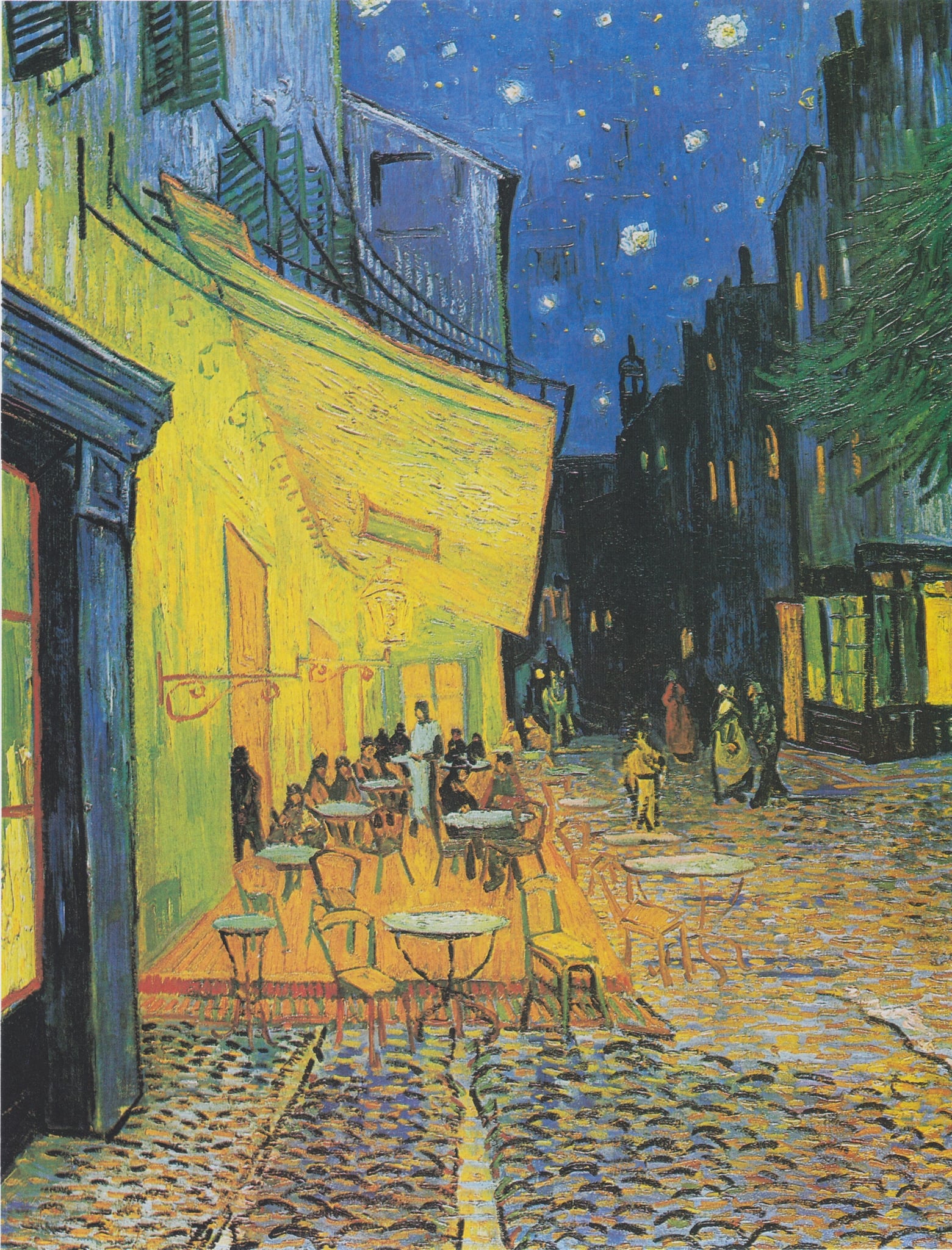
In Café Terrace at Night, Vincent van Gogh turns nocturne into <strong>luminous color</strong>: a gas‑lit terrace glows in yellows and oranges against a deep <strong>ultramarine sky</strong> pricked with stars. By building night “<strong>without black</strong>,” he stages a vivid encounter between human sociability and the vastness overhead <sup>[1]</sup><sup>[2]</sup>.
Red Cabbages and Onions by Vincent van Gogh

Red Cabbages and Onions

Vincent van Gogh (1887)

In Red Cabbages and Onions, Vincent van Gogh turns everyday produce into a drama of <strong>complementary color</strong> and <strong>restless brushwork</strong>. Hot red contours cinch violet cabbages and pale yellow bulbs against a cool, striated blue table, while a mustard‑yellow patch in the upper right tilts the space and sharpens the chromatic clash. The result asserts ordinary food as a locus of <strong>resilience</strong> and <strong>experimentation</strong> <sup>[1]</sup><sup>[2]</sup>.

Irises by Vincent van Gogh

Irises

Vincent van Gogh (1889)

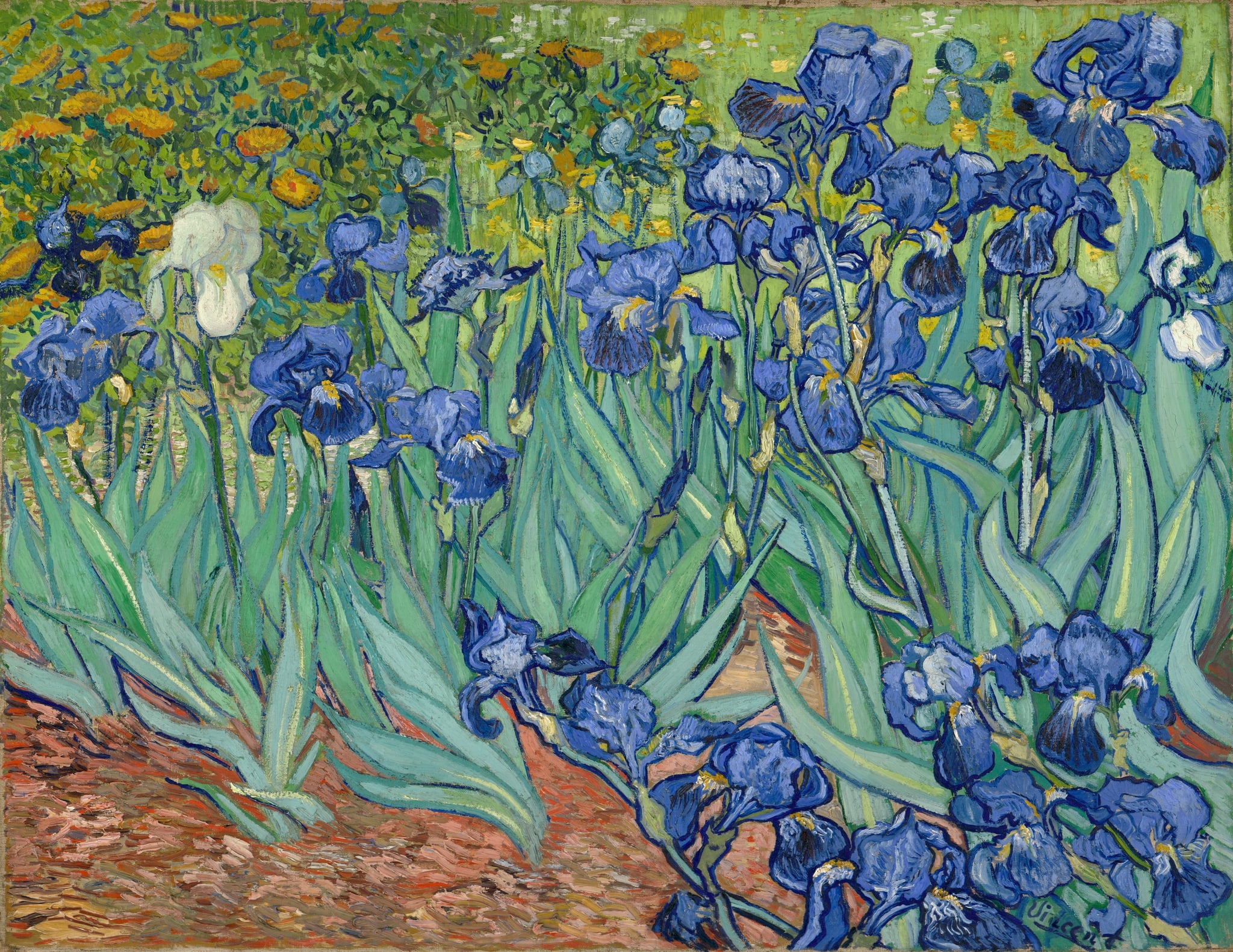
Painted in May 1889 at the Saint-Rémy asylum garden, Vincent van Gogh’s <strong>Irises</strong> turns close observation into an act of repair. Dark contours, a cropped, print-like vantage, and vibrating complements—violet/blue blossoms against <strong>yellow-green</strong> ground—stage a living frieze whose lone <strong>white iris</strong> punctuates the field with arresting clarity <sup>[1]</sup><sup>[2]</sup>.
Sunflowers by Vincent van Gogh

Sunflowers

Vincent van Gogh (1888)

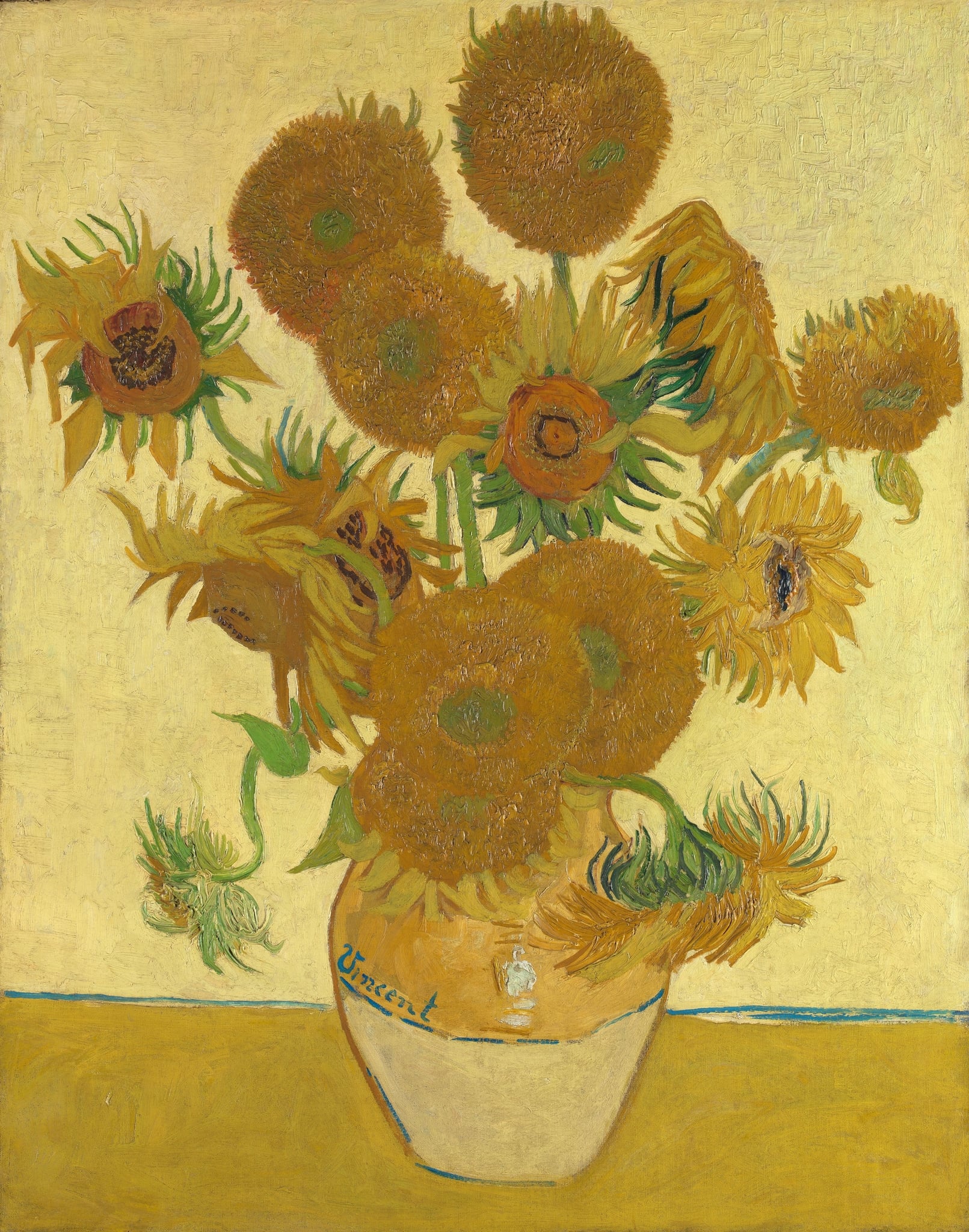
Vincent van Gogh’s Sunflowers (1888) is a <strong>yellow-on-yellow</strong> still life that stages a full <strong>cycle of life</strong> in fifteen blooms, from fresh buds to brittle seed heads. The thick impasto, green shocks of stem and bract, and the vase signed <strong>“Vincent”</strong> turn a humble bouquet into an emblem of endurance and fellowship <sup>[1]</sup><sup>[2]</sup>.

Garden with Courting Couples: Square Saint-Pierre by Vincent van Gogh

Garden with Courting Couples: Square Saint-Pierre

Vincent van Gogh (1887)

In Garden with Courting Couples: Square Saint-Pierre, Vincent van Gogh turns a small Montmartre park into a stage where <strong>spring</strong>, <strong>intimacy</strong>, and <strong>urban leisure</strong> converge. Short, shimmering strokes fuse pink chestnut blossoms, curving paths, and paired figures into one pulse of <strong>renewal</strong> and <strong>togetherness</strong> <sup>[1]</sup><sup>[2]</sup>.

In the Café: Agostina Segatori in Le Tambourin by Vincent van Gogh

In the Café: Agostina Segatori in Le Tambourin

Vincent van Gogh (1887 (Jan–Mar))

Van Gogh casts Agostina Segatori at a tiny, tambourine‑like café table, turning Le Tambourin into a <strong>stage of modern life</strong>. Cool greens and greys make the red <strong>flame‑plume hat</strong> and the foaming <strong>beer</strong> flare, while folded arms and a set‑aside <strong>parasol</strong> register private fatigue amid public display <sup>[1]</sup><sup>[2]</sup><sup>[3]</sup>.