Wheatfield

by Vincent van Gogh

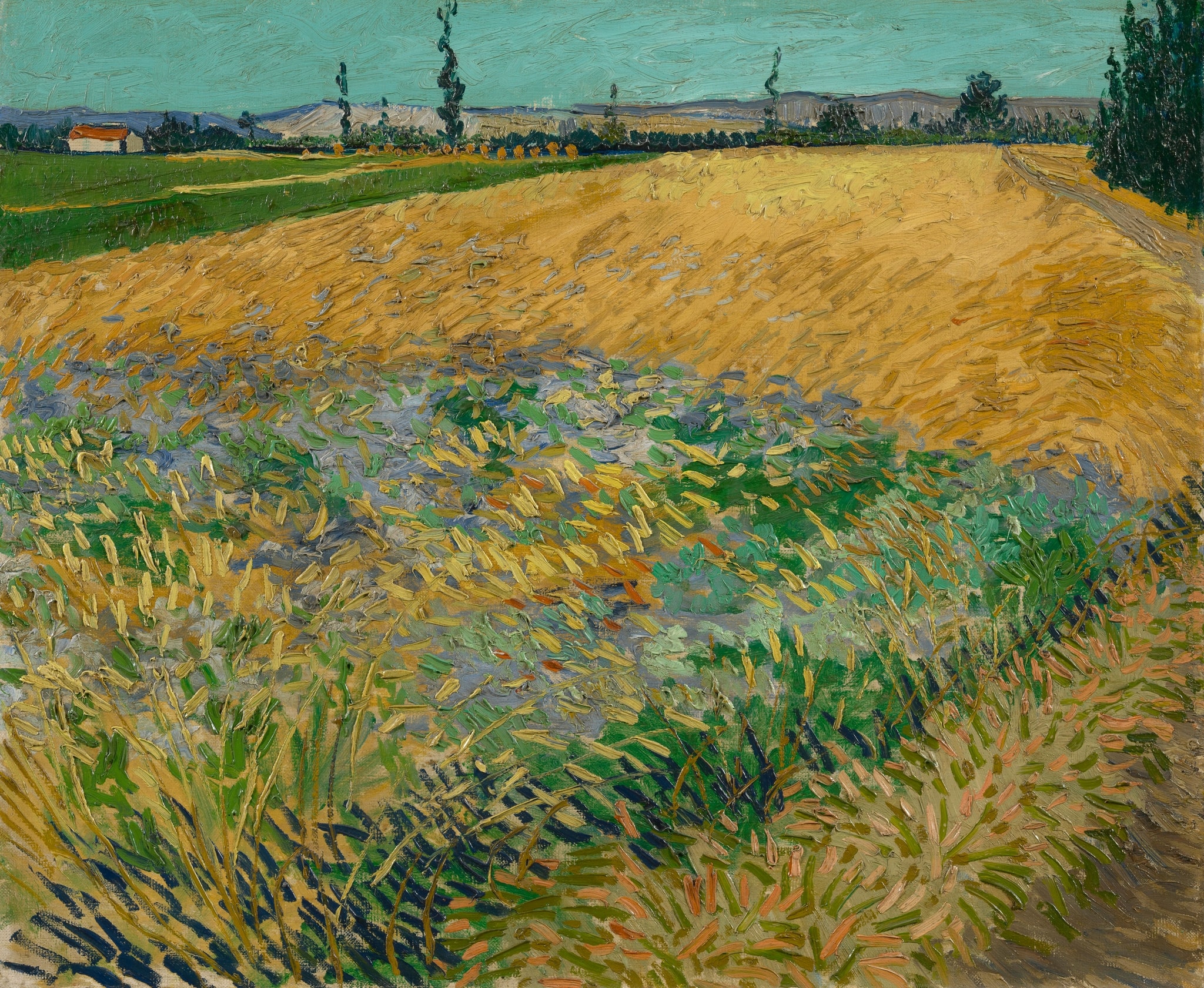
Wheatfield converts a Provençal field into a drama of living motion and complementary color. A high horizon compresses the turquoise sky so the gold expanse dominates, while a narrow path at right and a modest farmhouse at left anchor human presence within restless nature [1][2]. Painted in Arles in June 1888, it crystallizes Van Gogh’s pursuit of expressive brushwork and yellow–blue vibration.
💰

Market Value

$90-120 million

How much is Wheatfield worth?

Study Print Studio

Create a personal study print

Build a companion study sheet around the part of this painting that speaks to you most. Choose a detail, shape an interpretation, and walk away with something personal and display-worthy.

Fast Facts

Year
1888
Medium
Oil on canvas
Dimensions
54 × 65 cm
Location
Van Gogh Museum, Amsterdam
See all Vincent van Gogh paintings in Amsterdam
Wheatfield by Vincent van Gogh (1888) featuring Wheatfield, Narrow path, Farmhouse, Compressed turquoise sky (high horizon)

Click on any numbered symbol to learn more about its meaning

Meaning & Symbolism

Wheatfield declares that nature’s surface can carry thought. Van Gogh drives the horizon unusually high so the wheat becomes a near-total environment, a “sea” whose diagonal, short strokes tilt with the gusts. The painting’s structure—golden bands sweeping from center-right toward the lower left, crossed by cooler blue‑gray and emerald eddies—engineers a palpable rhythm. That rhythm is not scenic garnish; it is the subject. By amplifying yellow against intensified blues and greens, he sets up a vibrating harmony that balances heat and cool, earth and air, body and mind 12. The turquoise sky, squeezed thin, refuses theatrical cloud effects and instead presses a calm lid on the restless field, heightening the sensation that movement, not motif, rules the scene. In this optic, the field reads as energy made visible—agitation, uplift, and drift—what later critics call Van Gogh’s “inner weather,” substantiated here by strokes that are both grain and gust at once 5. Specific cues place humanity within this living expanse without letting it dominate. At the far left, a simplified farmhouse sits beyond a dark hedgerow; at the right edge, a narrow ocher track slides forward before bending out of sight. These quiet signs of habitation imply labor and passage rather than anecdote. Van Gogh’s own letters frame the wheat campaign as work “right out in the sun,” which ties the image to exertion and endurance 3. That link thickens symbolically across his wheatfield cycle: in Saint‑Rémy he would state that the reaper is the image of death and humanity the wheat being cut, making harvest a figure for life’s brevity and renewal 4. Even without a reaper here, the painting seeds that meaning. Wheat destined for bread encodes sustenance; the unharvested, wind-tossed stalks acknowledge fragility, the time before cutting. The painting suspends that charged interval, a luminous present tense between growth and fate. Formally, Van Gogh’s brushwork operationalizes these ideas. The foreground is a woven mesh of ocher dashes, green flicks, and slate swipes that catch light like chaff in motion. These marks are laid at varying angles and speeds, producing optical tremor—a crafted “nervous system” for the land 5. The path’s curve and the field’s diagonal grain set vectors that pull the eye forward, a compositional nudge toward movement and choice. The farmhouse and cypresses on the horizon punctuate this forward thrust with verticals, stabilizing the rush so the painting never slips into chaos. Such calibrations show why Wheatfield is important: it demonstrates how color theory and touch can be mobilized to carry existential content. The high horizon, the compression of sky, the insistence on complementary conflict, the human trace of road and house—each is a formal decision engineered to convert a local field in Arles into a universal image of cyclical time, labor, nourishment, and the beauty of life held in a gust just before harvest 1234.

Explore Deeper with AI

Ask questions about Wheatfield

Popular questions:

Powered by AI • Get instant insights about this artwork

💬 Ask questions about this artwork!

Interpretations

Mortality in Suspension

A year later at Saint-Rémy, Van Gogh wrote that the reaper is “the image of death” and humanity “the wheat being reaped,” fixing the wheatfield within a mortality allegory. Read back onto the 1888 Arles canvas, the uncut, wind-tossed stalks mark the charged interlude before harvest—a luminous pause between growth and fate. The painting’s compressed sky and surging surface intensify this suspended kairos, keeping the scythe offstage while letting inevitability vibrate through the field. Here, cyclical time offers both consolation (renewal) and unease (brevity), a doubleness embedded in the very medium of charged strokes 53.

Source: Van Gogh Museum (Wheatfield with a Reaper); Van Gogh Letters

Landscape & Agency: Human Trace vs. Vast Nature

Van Gogh often threads a narrow path and a modest farmhouse into the wheat belt—a minimal human signature against nature’s scale. In related Arles views of the same weeks, a white track pulls the eye forward under a turquoise sky, a compositional invitation to enter that also concedes how quickly the route bends out of sight. This small itinerary set within a dominant field sharpens the painting’s dialectic: human purpose meets wind-driven contingency. The high horizon compresses the sky like a lid, staging a negotiation between personal journey and environmental force rather than a pastoral idyll 61.

Source: National Gallery of Art (Farmhouse in Provence); Van Gogh Museum

Seriality and Object Identity

There isn’t a single Wheatfield from 1888 but at least two closely related canvases—F411 (Van Gogh Museum) and F564 (Rijksmuseum)—painted during a documented week of intense work in June at Arles. Treating the motif serially allowed Van Gogh to recalibrate the high horizon, chromatic complements, and stroke direction from canvas to canvas, functioning like a laboratory of effects rather than a one-off view. The differing formats and handling register how he tuned yellow–blue tensions and the weave of marks to produce various degrees of optical vibration. Recognizing this serial method guards against title confusion and clarifies that “Wheatfield” names a research program in color and facture as much as a place in Provence 1237.

Source: Van Gogh Museum; Rijksmuseum; Van Gogh Letters; Ronald Pickvance

Labor & Work: The Field as Workshop

Van Gogh’s letter of 21 June 1888—“a week of concentrated hard work in the wheatfields right out in the sun”—folds agrarian toil into artistic practice: the field is both subject and studio. The dazzled yellow heat is not just depicted; it is endured, binding the painting’s facture to the body’s exertion. In Arles, bread grain was a local economy; painting it under harsh light situates art within rural work rhythms and sustenance, where the glare that ripens wheat also tests the painter’s eye and stamina. The resulting impasto and rapid, angled strokes feel like labor translated into touch—sweat becoming texture, endurance becoming form 13.

Source: Van Gogh Letters; Van Gogh Museum

Formal Modernism: From Field to Pattern

Wheatfield edges toward an “all-over” surface before the term existed: short, slanted dashes aggregate into a continuous field of marks whose meaning rides on their directionality and tempo. Complementary contrasts—intensified blues/greens pitched against golden ochers—generate optical vibration that reads less as local color than as engineered sensation. Yet Van Gogh anchors this drift into pattern with compositional counterpoints: a path’s curve, horizon’s band, and verticals (house, trees) stabilize flow so the picture doesn’t dissolve. The result is a negotiation between mimesis and abstraction where facture becomes the carrier of experience—grain and gust, simultaneously 24.

Source: Rijksmuseum; National Gallery of Art (Green Wheat Fields, Auvers)

Medium Reflexivity: Painting as Weather

Wheatfield doubles as a demonstration of painting’s capacity to simulate force. Van Gogh’s quick execution—he spoke of doing summer landscapes “quick quick quick”—and loaded, directional strokes convert oil into kinetic indices: the brush doesn’t just describe wind; it performs it. Wet-into-wet passages, scumbled highlights, and alternating dash orientations create an optical tremor that changes with viewing distance, making looking itself a analogue to standing in the gusts. In this sense the work is medium-reflexive: it is about what paint can do under pressure—register time, speed, and touch—no less than about what wheat looks like 61.

Source: National Gallery of Art (Farmhouse in Provence); Van Gogh Museum

Related Themes

About Vincent van Gogh

Vincent van Gogh (1853–1890) developed a radical, emotion‑driven use of color after moving from Paris to Arles in 1888, seeking southern light and an artists’ community. In Arles he created the Sunflowers series to decorate the Yellow House ahead of Gauguin’s visit. His late work fused impasto, high chroma, and symbolic motifs that shaped modern painting [2][5].
View all works by Vincent van Gogh

More by Vincent van Gogh
Café Terrace at Night by Vincent van Gogh

Café Terrace at Night

Vincent van Gogh (1888)

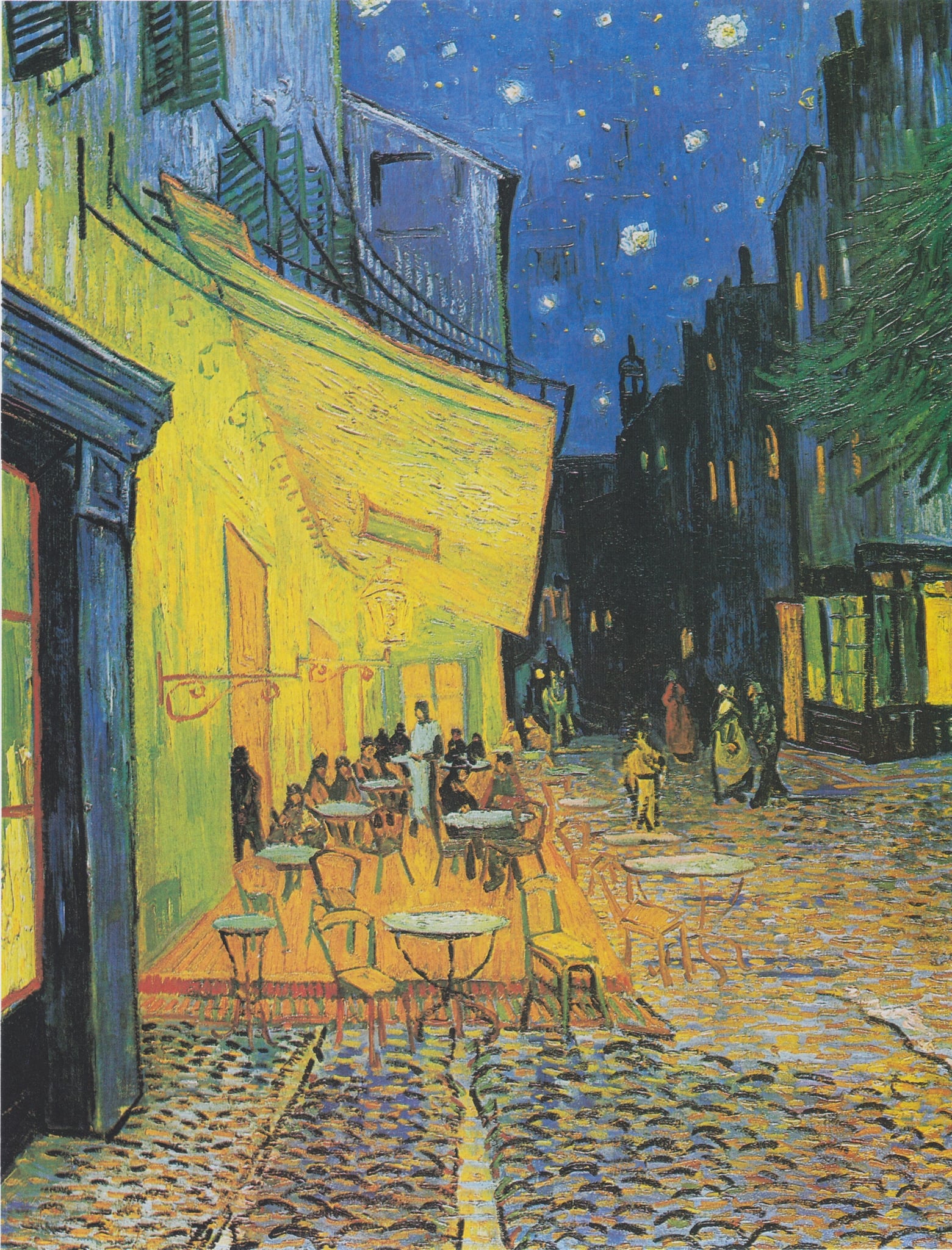
In Café Terrace at Night, Vincent van Gogh turns nocturne into <strong>luminous color</strong>: a gas‑lit terrace glows in yellows and oranges against a deep <strong>ultramarine sky</strong> pricked with stars. By building night “<strong>without black</strong>,” he stages a vivid encounter between human sociability and the vastness overhead <sup>[1]</sup><sup>[2]</sup>.
Red Cabbages and Onions by Vincent van Gogh

Red Cabbages and Onions

Vincent van Gogh (1887)

In Red Cabbages and Onions, Vincent van Gogh turns everyday produce into a drama of <strong>complementary color</strong> and <strong>restless brushwork</strong>. Hot red contours cinch violet cabbages and pale yellow bulbs against a cool, striated blue table, while a mustard‑yellow patch in the upper right tilts the space and sharpens the chromatic clash. The result asserts ordinary food as a locus of <strong>resilience</strong> and <strong>experimentation</strong> <sup>[1]</sup><sup>[2]</sup>.

Irises by Vincent van Gogh

Irises

Vincent van Gogh (1889)

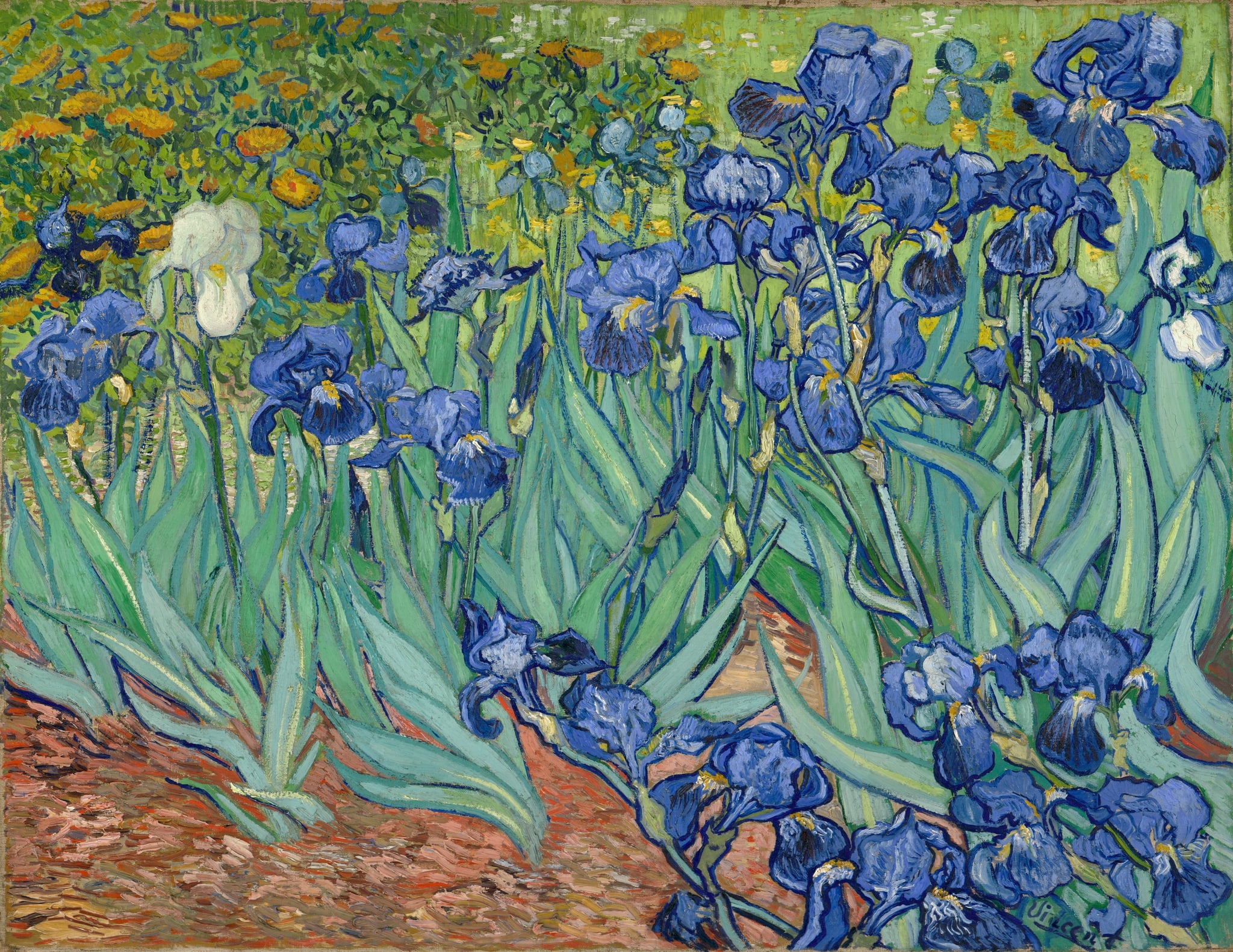
Painted in May 1889 at the Saint-Rémy asylum garden, Vincent van Gogh’s <strong>Irises</strong> turns close observation into an act of repair. Dark contours, a cropped, print-like vantage, and vibrating complements—violet/blue blossoms against <strong>yellow-green</strong> ground—stage a living frieze whose lone <strong>white iris</strong> punctuates the field with arresting clarity <sup>[1]</sup><sup>[2]</sup>.
Sunflowers by Vincent van Gogh

Sunflowers

Vincent van Gogh (1888)

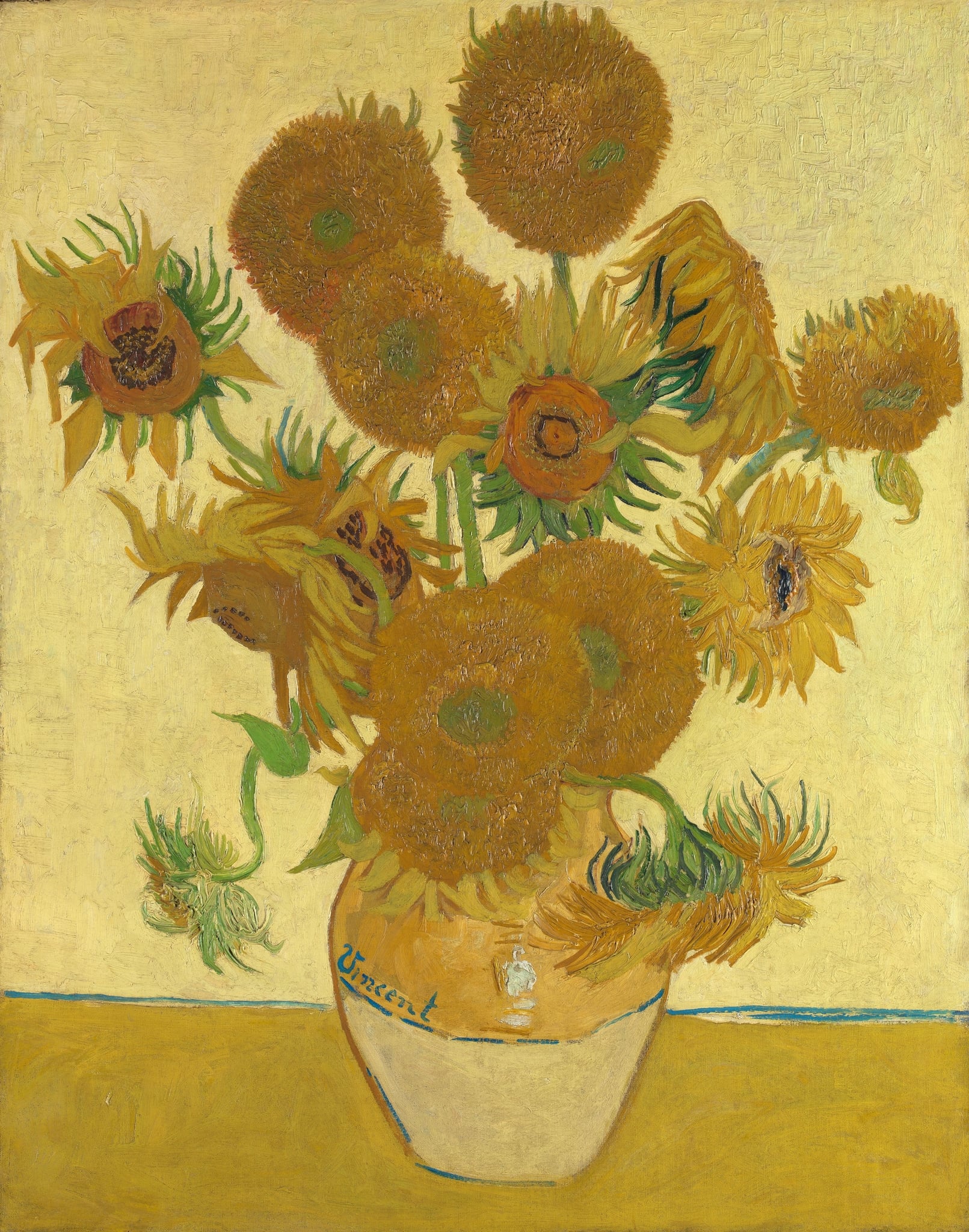
Vincent van Gogh’s Sunflowers (1888) is a <strong>yellow-on-yellow</strong> still life that stages a full <strong>cycle of life</strong> in fifteen blooms, from fresh buds to brittle seed heads. The thick impasto, green shocks of stem and bract, and the vase signed <strong>“Vincent”</strong> turn a humble bouquet into an emblem of endurance and fellowship <sup>[1]</sup><sup>[2]</sup>.

Garden with Courting Couples: Square Saint-Pierre by Vincent van Gogh

Garden with Courting Couples: Square Saint-Pierre

Vincent van Gogh (1887)

In Garden with Courting Couples: Square Saint-Pierre, Vincent van Gogh turns a small Montmartre park into a stage where <strong>spring</strong>, <strong>intimacy</strong>, and <strong>urban leisure</strong> converge. Short, shimmering strokes fuse pink chestnut blossoms, curving paths, and paired figures into one pulse of <strong>renewal</strong> and <strong>togetherness</strong> <sup>[1]</sup><sup>[2]</sup>.

In the Café: Agostina Segatori in Le Tambourin by Vincent van Gogh

In the Café: Agostina Segatori in Le Tambourin

Vincent van Gogh (1887 (Jan–Mar))

Van Gogh casts Agostina Segatori at a tiny, tambourine‑like café table, turning Le Tambourin into a <strong>stage of modern life</strong>. Cool greens and greys make the red <strong>flame‑plume hat</strong> and the foaming <strong>beer</strong> flare, while folded arms and a set‑aside <strong>parasol</strong> register private fatigue amid public display <sup>[1]</sup><sup>[2]</sup><sup>[3]</sup>.