Objecthood
The “Objecthood” symbolism category traces how seemingly ordinary implements—bottles, clocks, mirrors, gloves, café tableware—become charged mediators of labor, time, spectacle, and selfhood in modern painting, shifting from stable attributes to critical signs of fractured, commodity-driven experience.
Member Symbols
Featured Artworks
A Bar at the Folies-Bergère
Édouard Manet (1882)
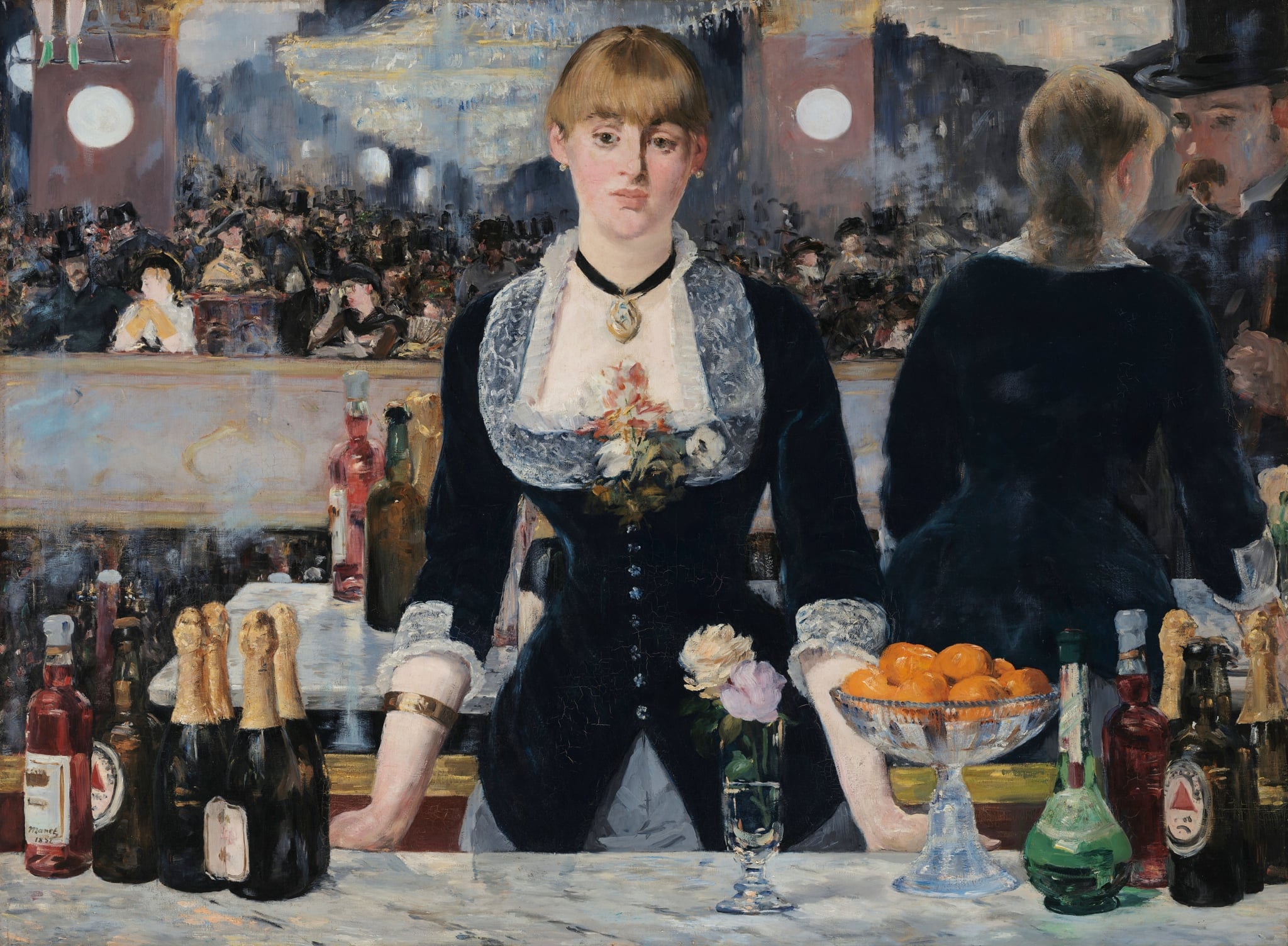
Édouard Manet’s A Bar at the Folies-Bergère stages a face-to-face encounter with modern Paris, where <strong>commerce</strong>, <strong>spectacle</strong>, and <strong>alienation</strong> converge. A composed barmaid fronts a marble counter loaded with branded bottles, flowers, and a brimming bowl of oranges, while a disjunctive <strong>mirror</strong> unravels stable viewing and certainty <sup>[1]</sup><sup>[2]</sup>.
Dance in the Country
Pierre-Auguste Renoir (1883)
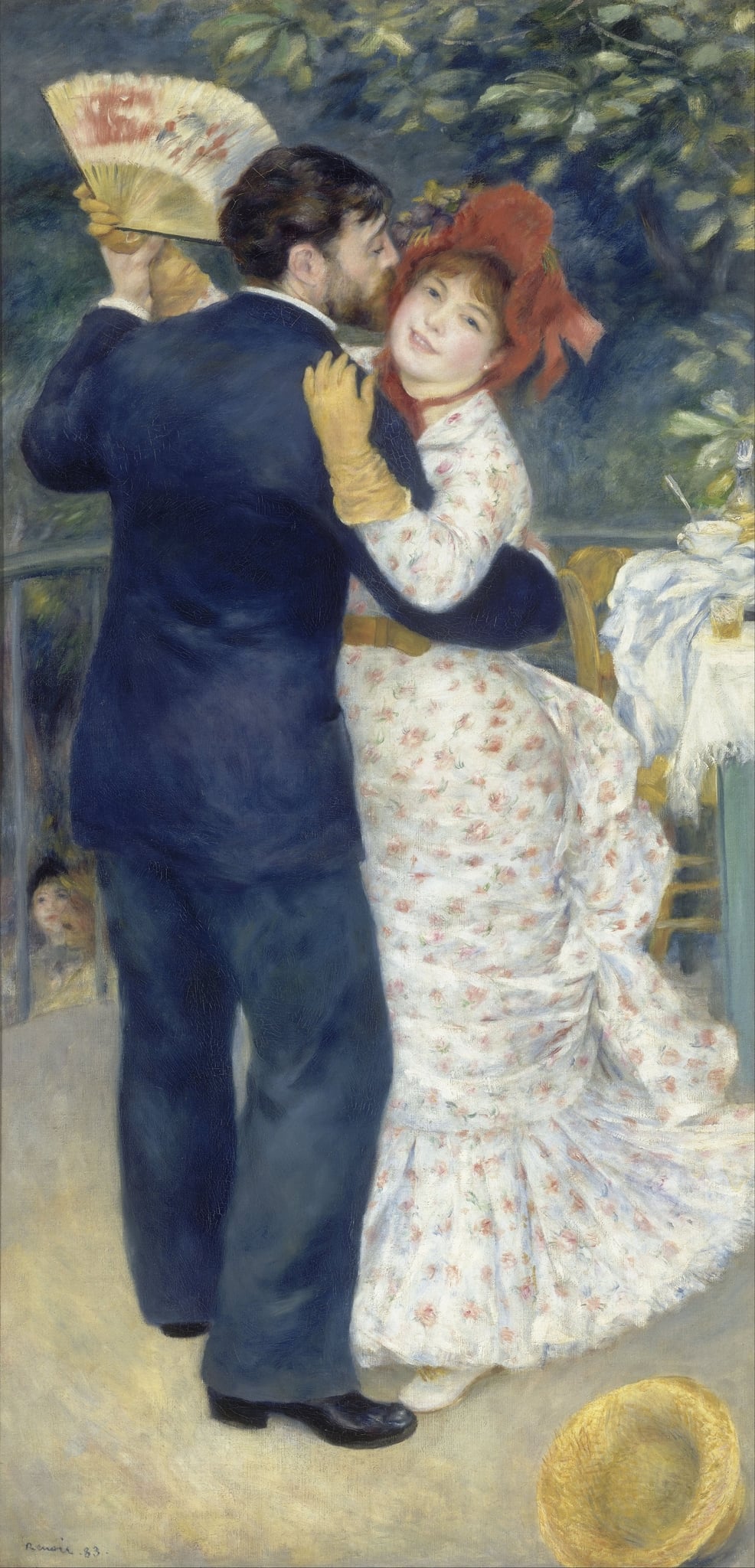
Dance in the Country shows a couple swept into a close embrace on a café terrace, their bodies turning in a soft spiral as foliage and sunlight dissolve into <strong>dappled color</strong>. Renoir orchestrates <strong>bourgeois leisure</strong>—the tossed straw boater, a small table with glass and napkin, the woman’s floral dress and red bonnet—to stage a moment where decorum and desire meet. The result is a modern emblem of shared pleasure, poised between Impressionist shimmer and a newly <strong>firm, linear touch</strong>.
In the Garden
Pierre-Auguste Renoir (1885)
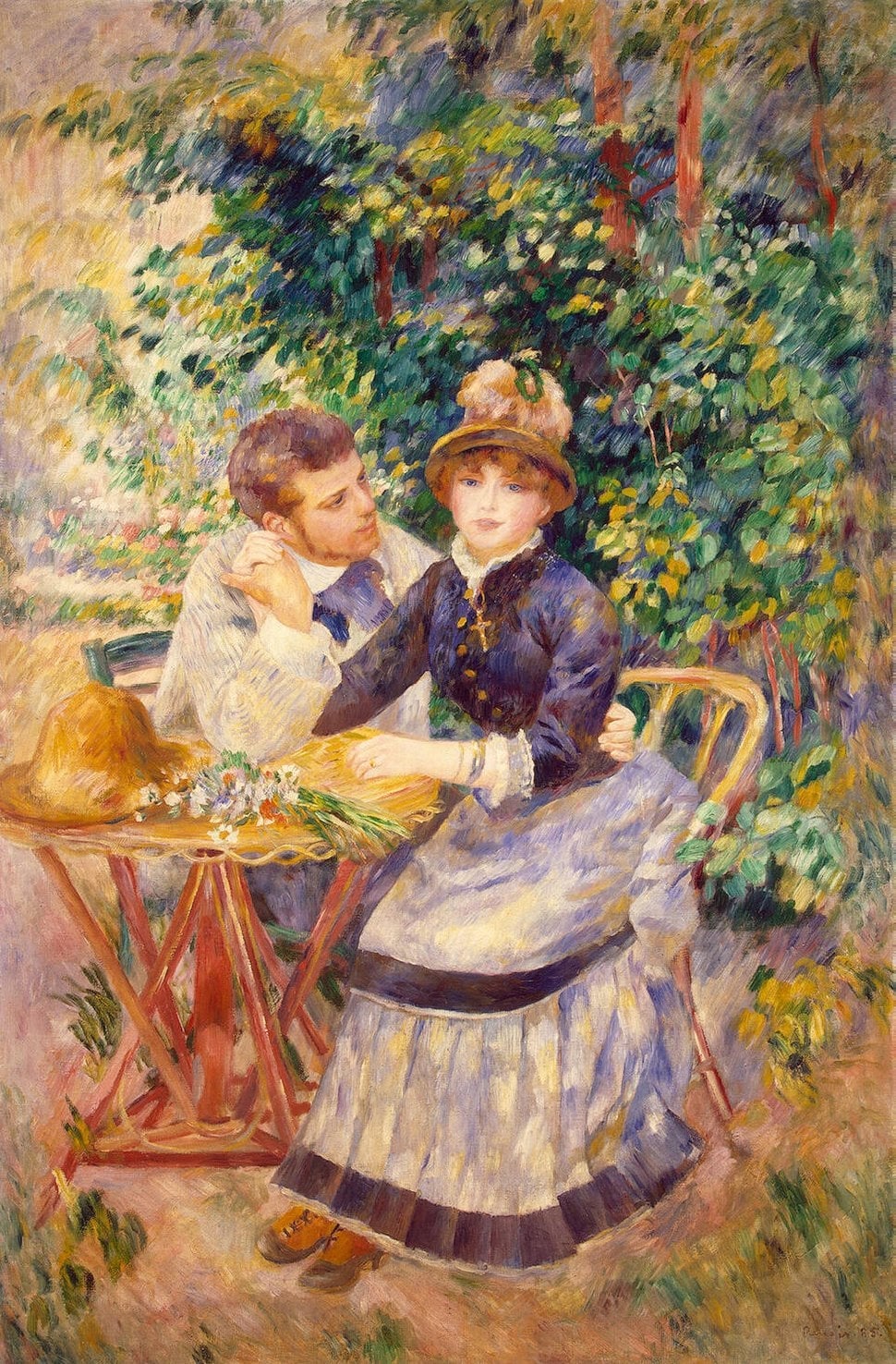
In the Garden presents a charged pause in modern leisure: a young couple at a café table under a living arbor of leaves. Their lightly clasped hands and the bouquet on the tabletop signal courtship, while her calm, front-facing gaze checks his lean. Renoir’s flickering brushwork fuses figures and foliage, rendering love as a <strong>transitory, luminous sensation</strong> <sup>[1]</sup><sup>[3]</sup>.
Jeanne (Spring)
Édouard Manet (1881)
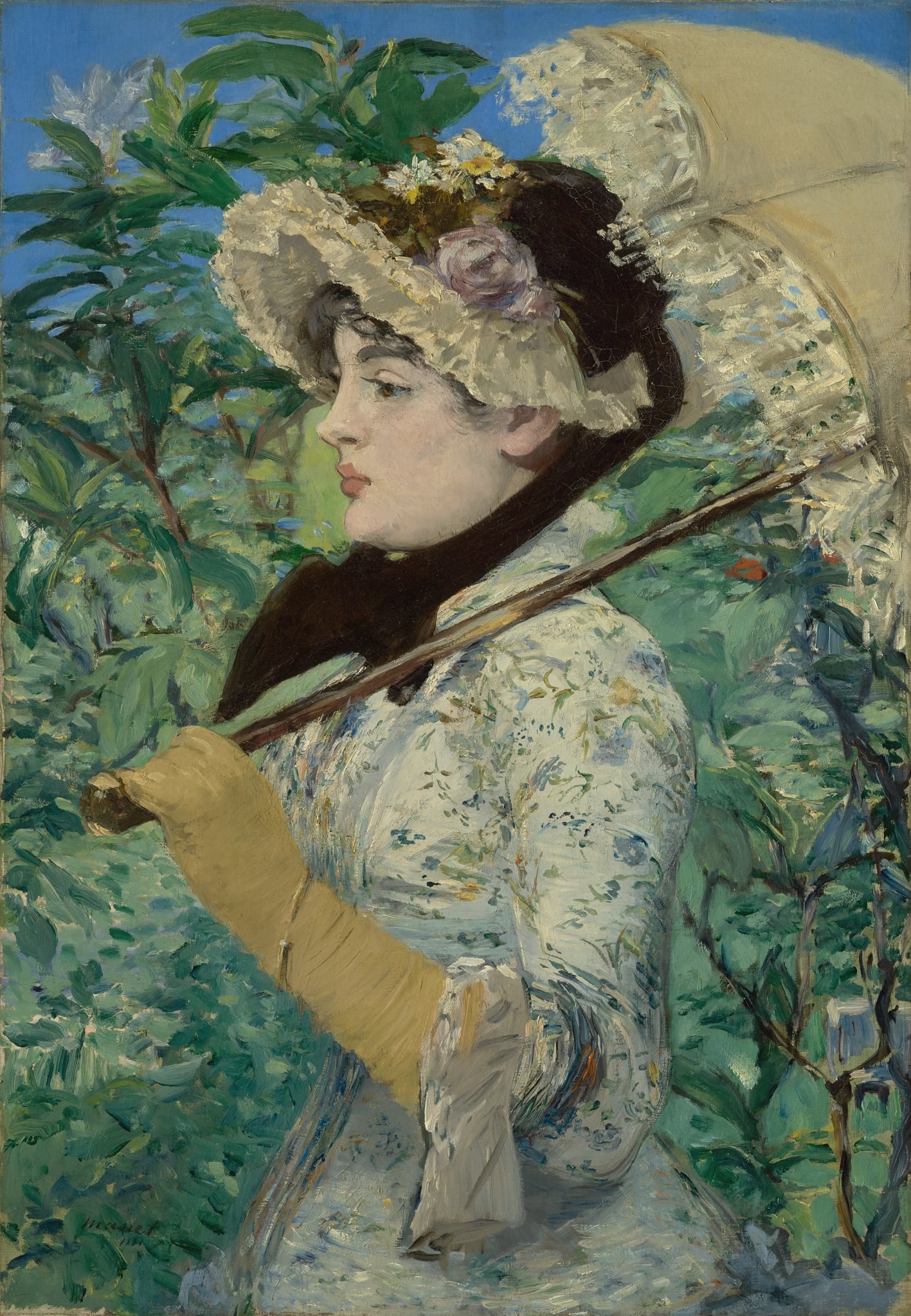
Édouard Manet’s Jeanne (Spring) fuses a time-honored allegory with <strong>modern Parisian fashion</strong>: a crisp profile beneath a cream parasol, set against <strong>luminous, leafy greens</strong>. Manet turns couture—hat, glove, parasol—into the language of <strong>renewal and youth</strong>, making spring feel both perennial and up-to-the-minute <sup>[1]</sup><sup>[2]</sup>.
Madame Monet and Her Son
Pierre-Auguste Renoir (1874)
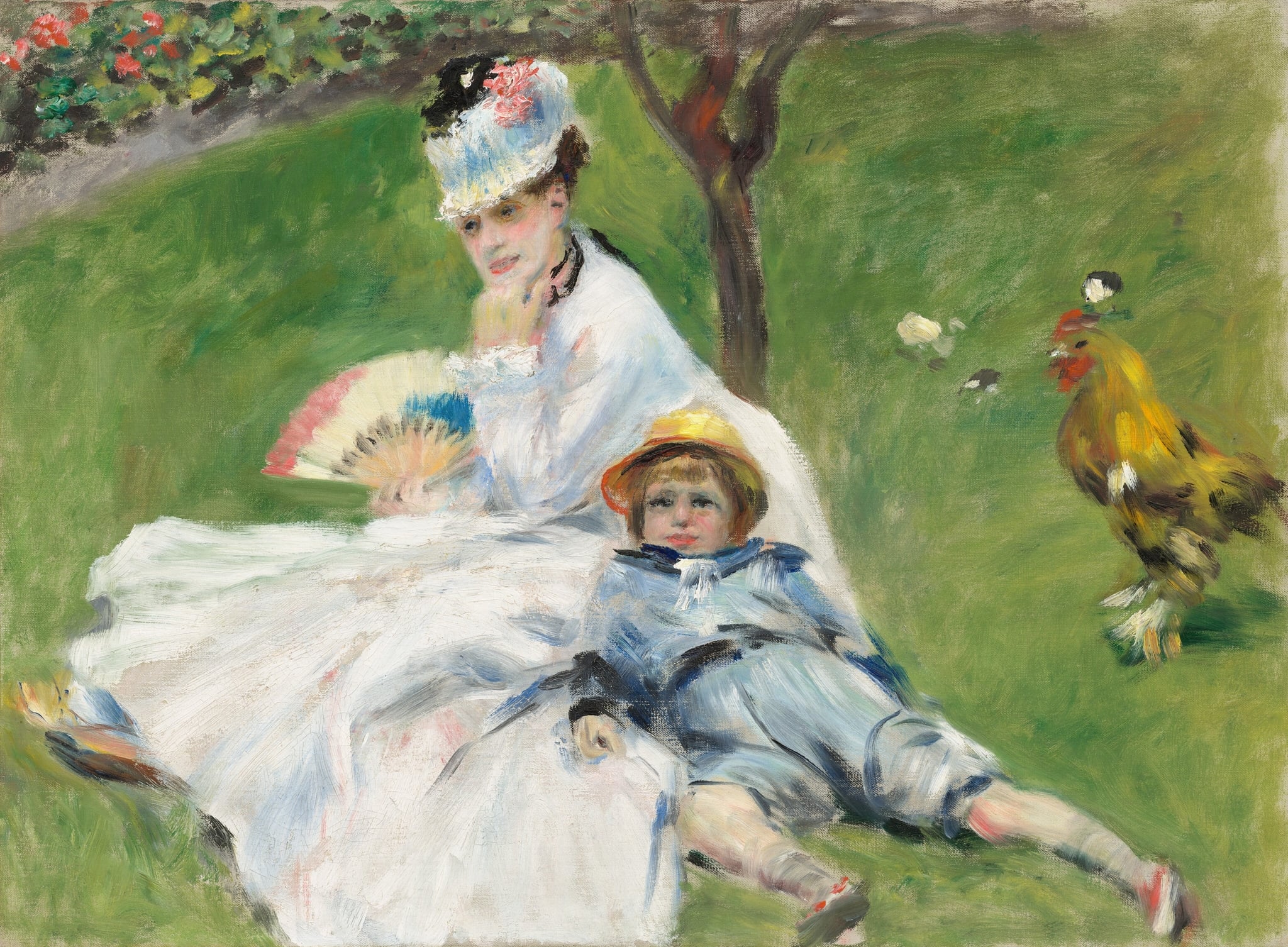
Renoir’s 1874 canvas Madame Monet and Her Son crystallizes <strong>modern domestic leisure</strong> and <strong>plein‑air immediacy</strong> in Argenteuil. A luminous white dress pools into light while a child in a pale‑blue sailor suit reclines diagonally; a strutting rooster punctuates the greens with warm color. The brushwork fuses figure and garden so the moment reads as <strong>lived, not staged</strong> <sup>[1]</sup><sup>[2]</sup><sup>[5]</sup>.
Olympia
Édouard Manet (1863 (Salon 1865))
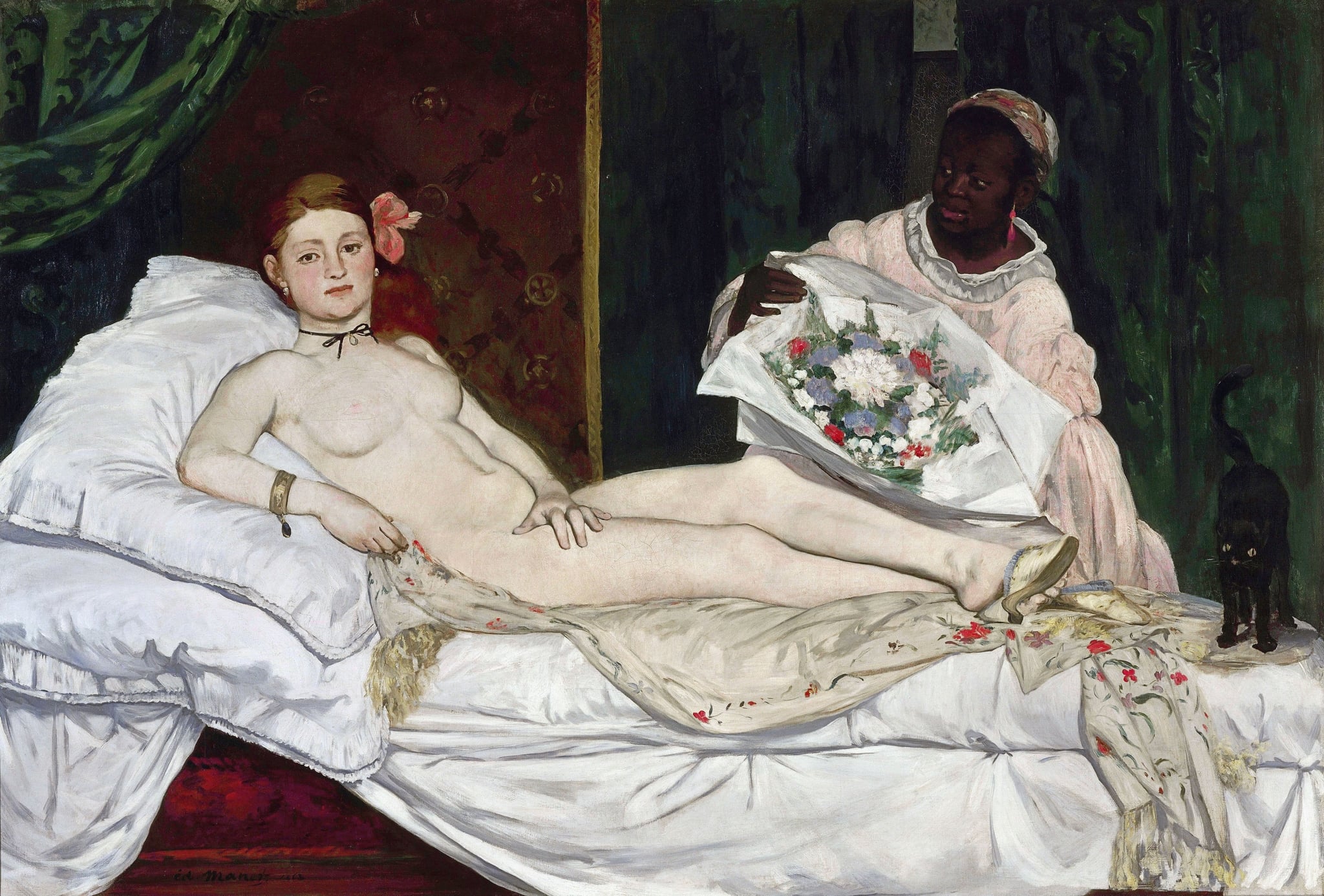
A defiantly contemporary nude confronts the viewer with a steady gaze and a guarded pose, framed by crisp light and luxury trappings. In Olympia, <strong>Édouard Manet</strong> strips myth from the female nude to expose the <strong>modern economy of desire</strong>, power, and looking <sup>[1]</sup><sup>[3]</sup>.
Plum Brandy
Édouard Manet (ca. 1877)
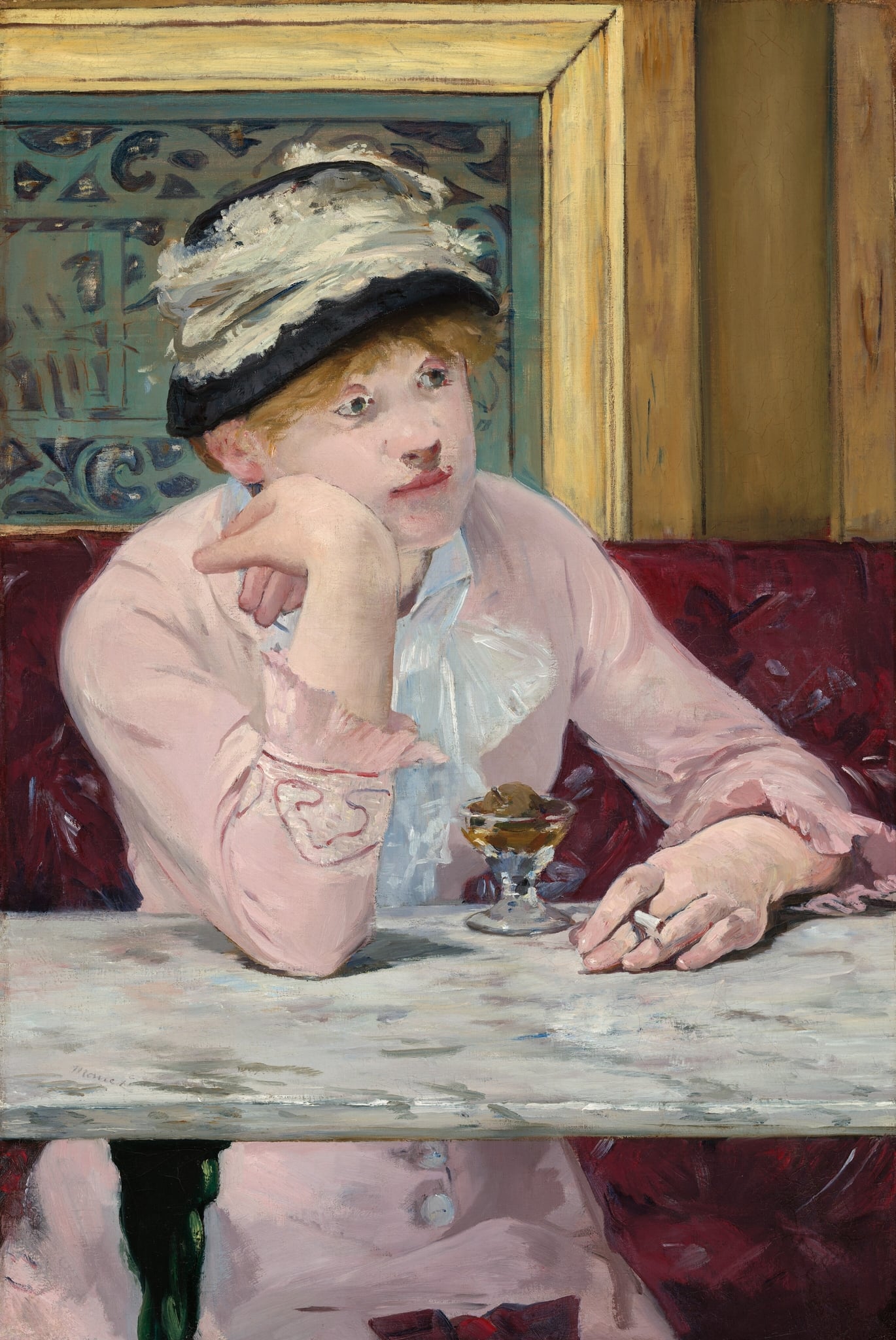
Manet’s Plum Brandy crystallizes a modern pause—an urban <strong>interval of suspended action</strong>—through the idle tilt of a woman’s head, an <strong>unlit cigarette</strong>, and a glass cradling a <strong>plum in amber liquor</strong>. The boxed-in space—marble table, red banquette, and decorative grille—turns a café moment into a stage for <strong>solitude within public life</strong> <sup>[1]</sup><sup>[2]</sup>.
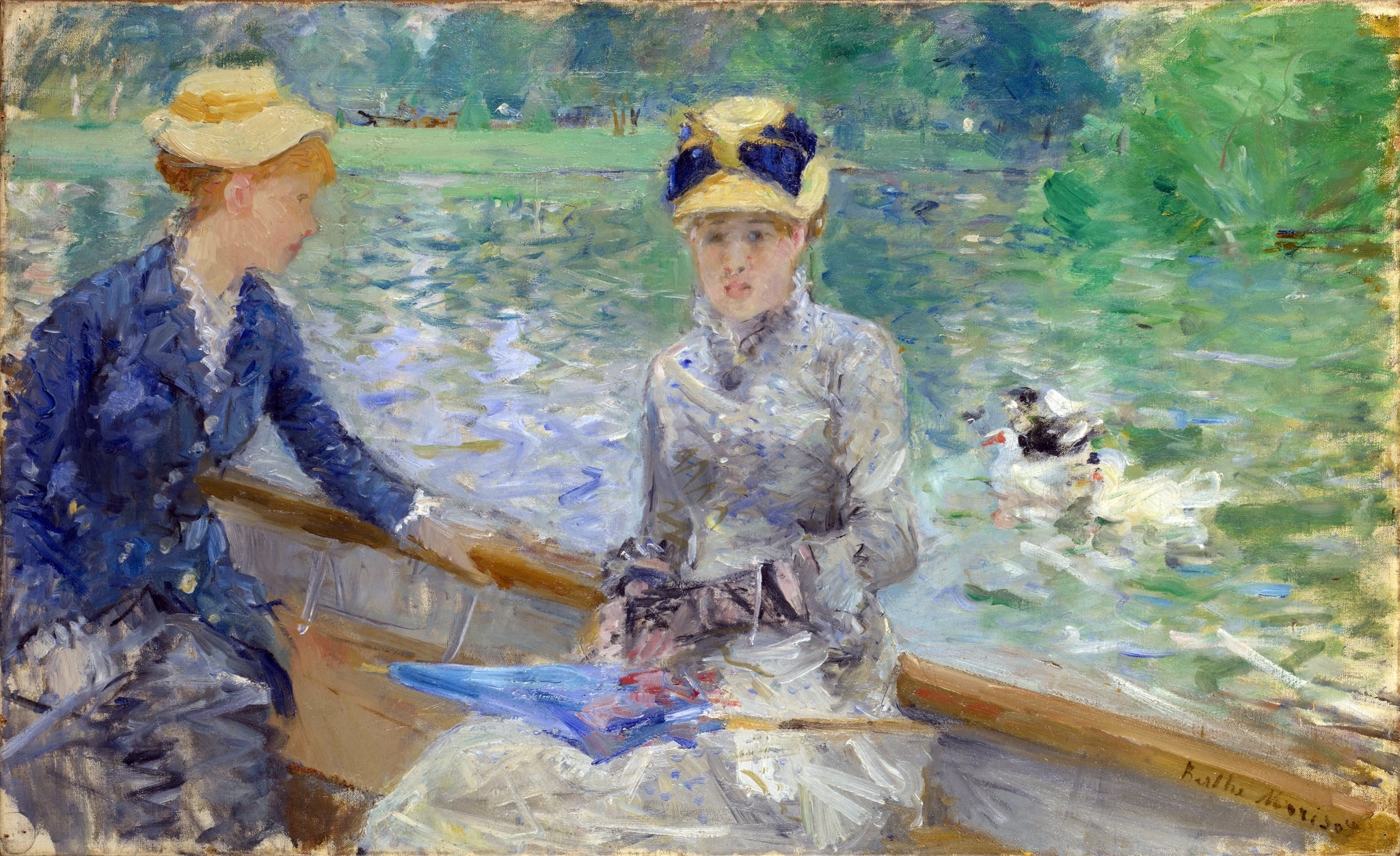
Summer's Day
Berthe Morisot (about 1879)
Two women drift on a boat in the Bois de Boulogne, their dresses, hats, and a bright blue parasol fused with the lake’s flicker by Morisot’s swift, <strong>zig‑zag brushwork</strong>. The scene turns a brief outing into a poised study of <strong>modern leisure</strong> and <strong>female companionship</strong> in public space <sup>[1]</sup>.
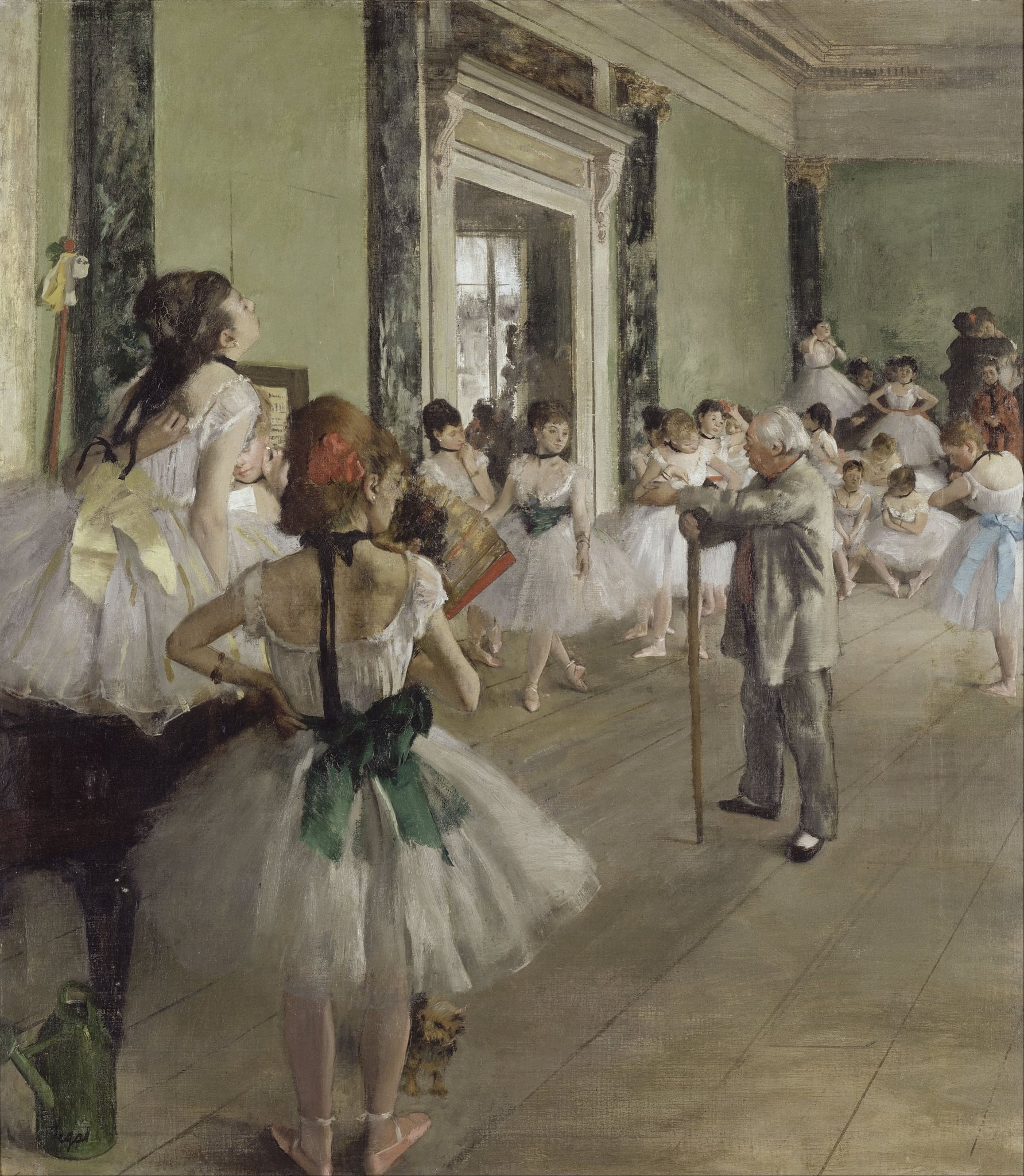
The Ballet Class
Edgar Degas (1873–1876)
<strong>The Ballet Class</strong> shows the work behind grace: a green-walled studio where young dancers in white tutus rest, fidget, and stretch while the gray-suited master stands with his cane. Degas’s diagonal floorboards, cropped viewpoints, and scattered props—a watering can, a music stand, even a tiny dog—stage a candid vision of routine rather than spectacle. The result is a modern image of discipline, hierarchy, and fleeting poise.
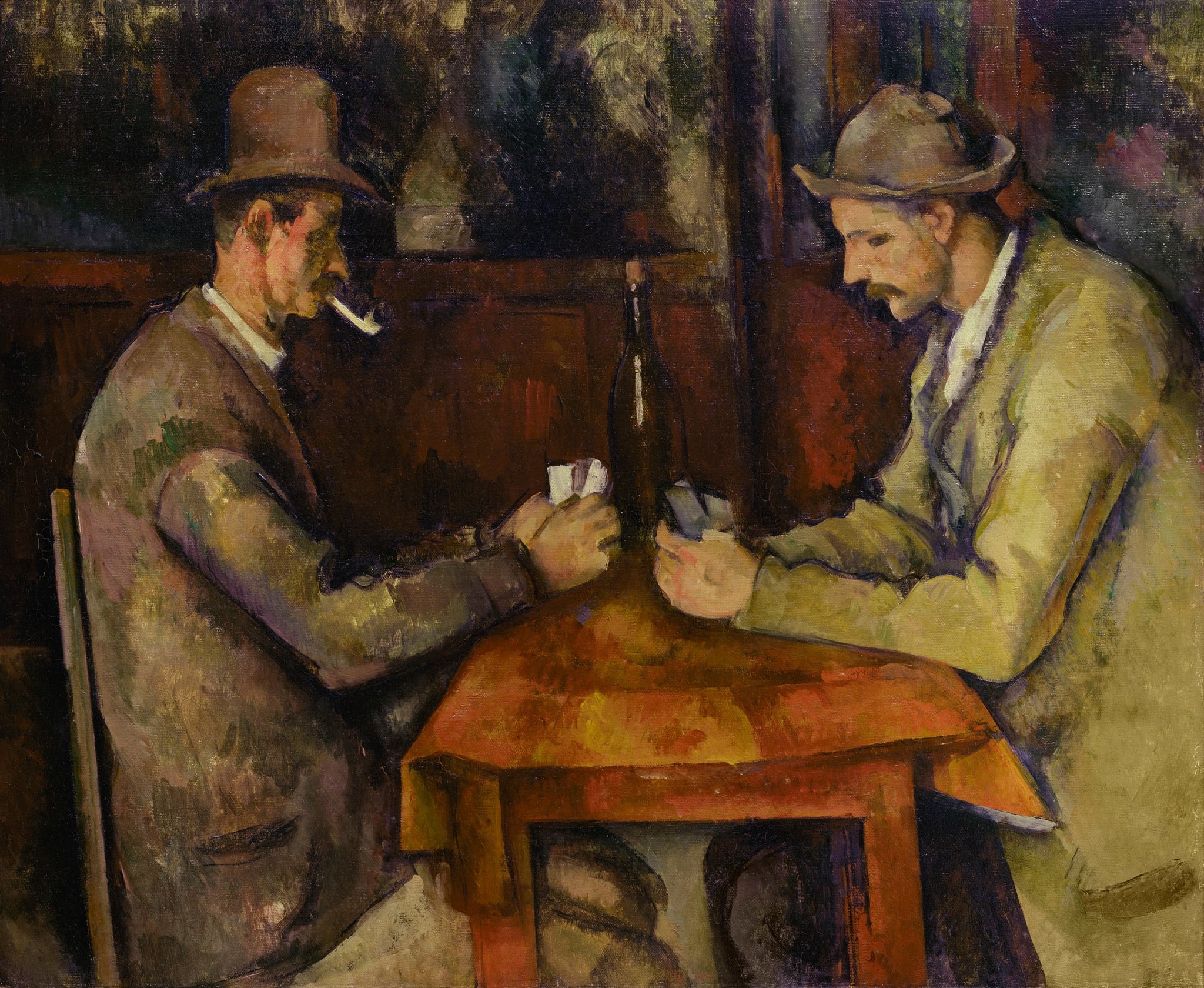
The Card Players by Paul Cézanne | Equilibrium and Form
Paul Cézanne
In The Card Players, Paul Cézanne turns a rural café game into a study of <strong>equilibrium</strong> and <strong>monumentality</strong>. Two hated peasants lean inward across an orange-brown table while a dark bottle stands upright between them, acting as a calm, vertical <strong>axis</strong> that stabilizes their mirrored focus <sup>[2]</sup><sup>[3]</sup>.
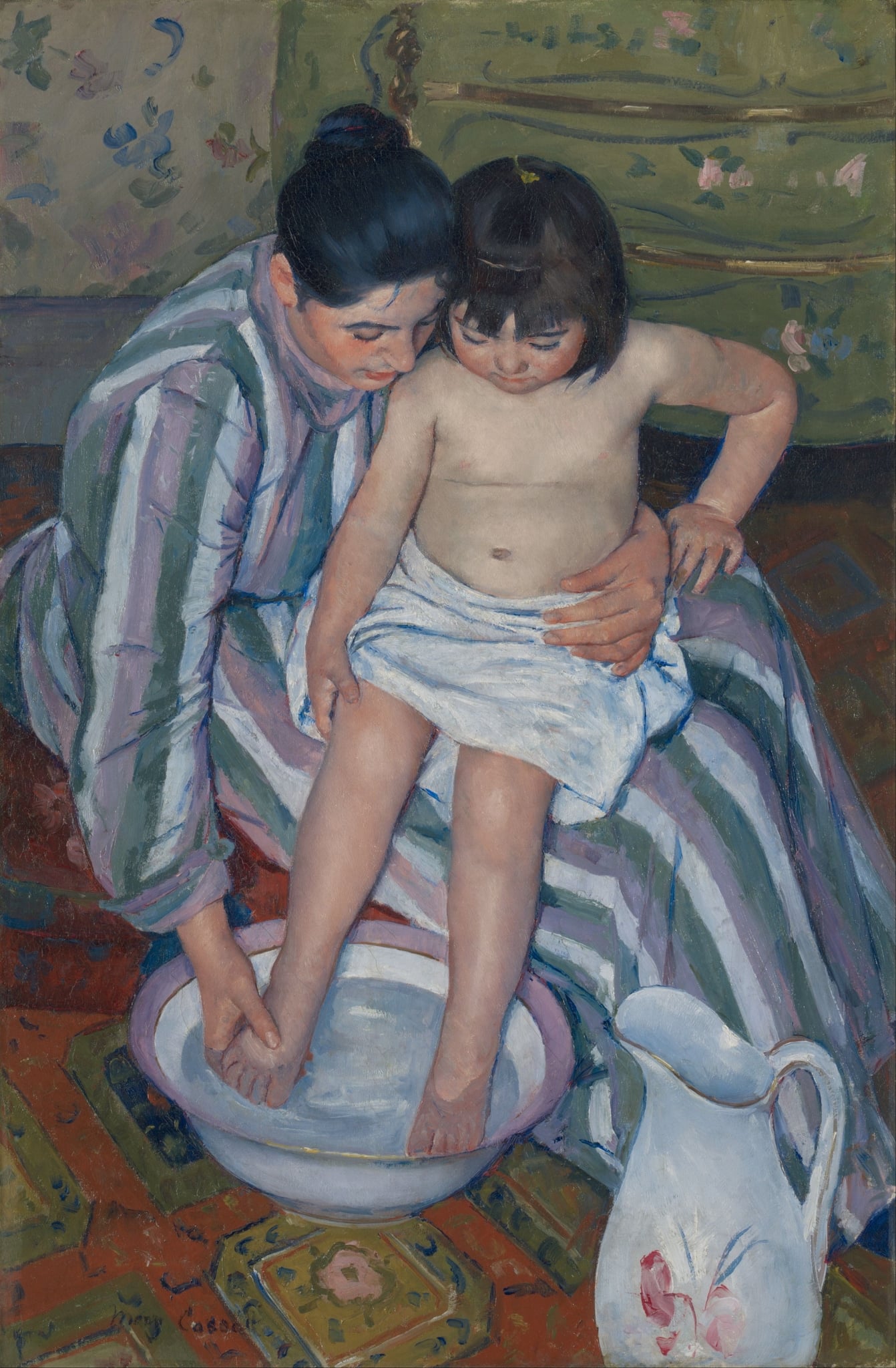
The Child's Bath
Mary Cassatt (1893)
Mary Cassatt’s The Child’s Bath (1893) recasts an ordinary ritual as <strong>modern devotion</strong>. From a steep, print-like vantage, interlocking stripes, circles, and diagonals focus attention on <strong>touch, care, and renewal</strong>, turning domestic labor into a subject of high art <sup>[1]</sup><sup>[3]</sup>. The work synthesizes Impressionist sensitivity with <strong>Japonisme</strong> design to monumentalize the private sphere <sup>[1]</sup><sup>[2]</sup>.
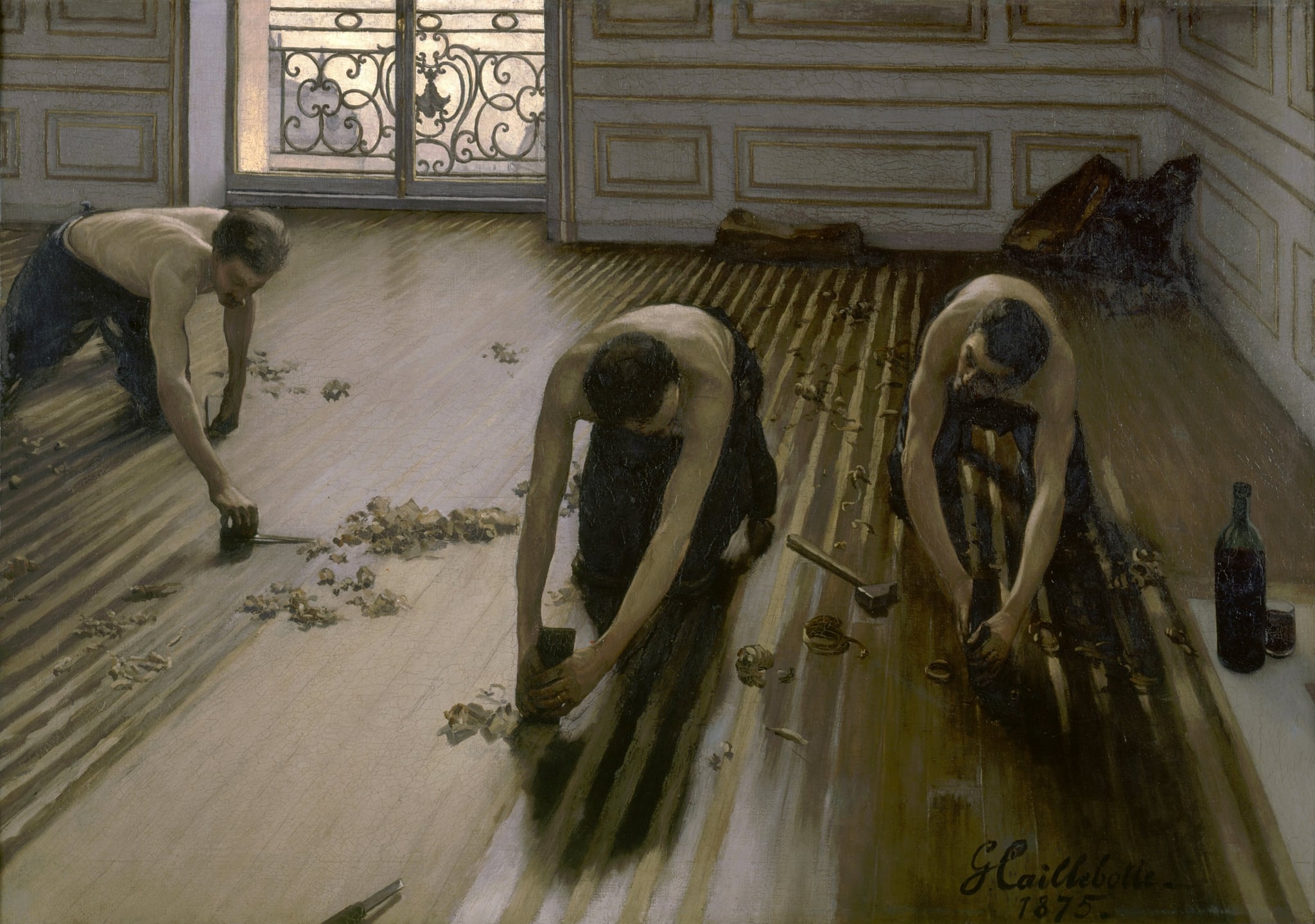
The Floor Scrapers
Gustave Caillebotte (1875)
Gustave Caillebotte’s The Floor Scrapers stages three shirtless workers planing a parquet floor as shafts of light pour through an ornate balcony door. The painting fuses <strong>rigorous perspective</strong> with <strong>modern urban labor</strong>, turning curls of wood and raking light into a ledger of time and effort <sup>[1]</sup><sup>[3]</sup>. Its cool, gilded interior makes visible how bourgeois elegance is built on bodily work.
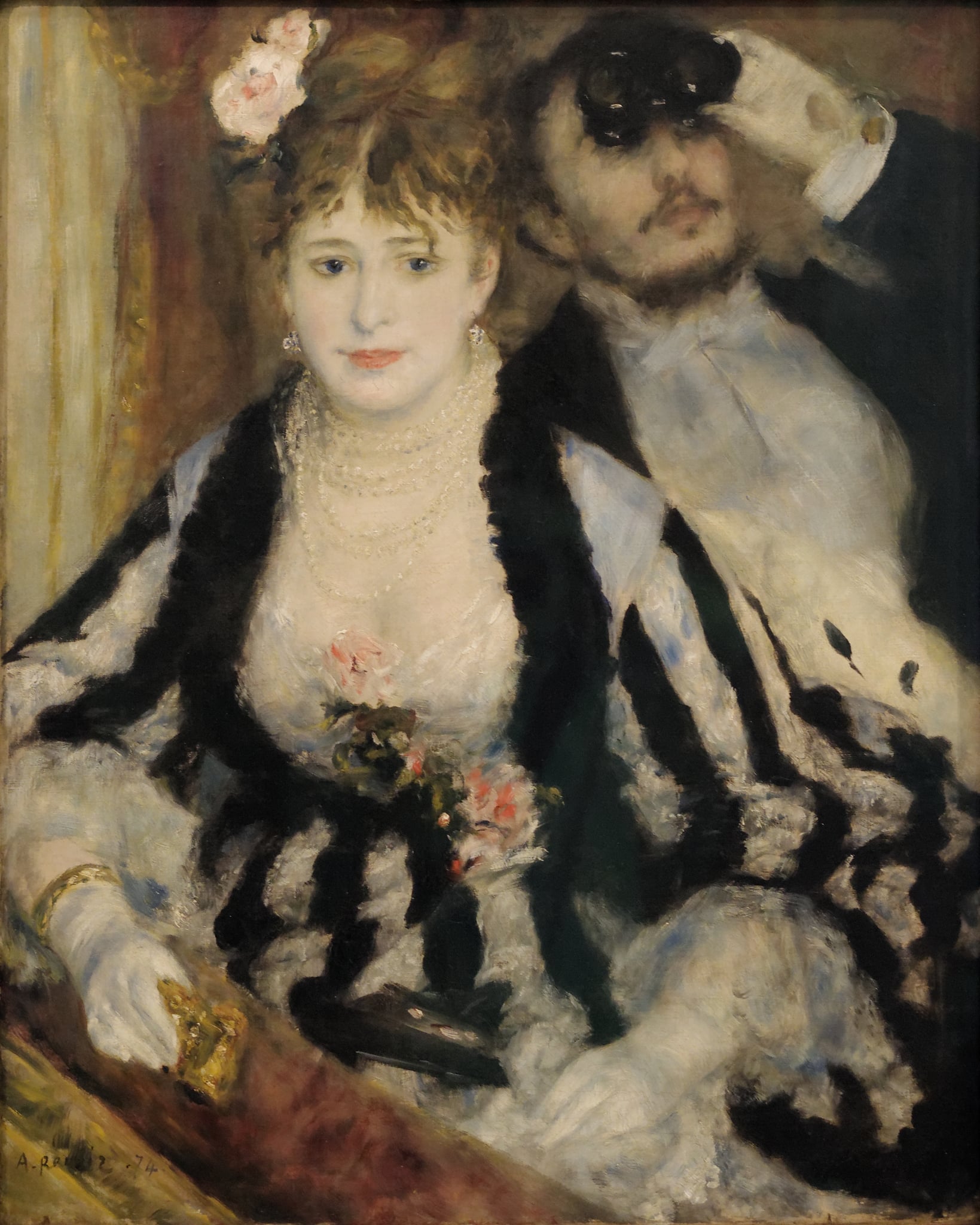
The Loge
Pierre-Auguste Renoir (1874)
Renoir’s The Loge (1874) turns an opera box into a <strong>stage of looking</strong>, where a woman meets our gaze while her companion scans the crowd through binoculars. The painting’s <strong>frame-within-a-frame</strong> and glittering fashion make modern Parisian leisure both alluring and self-conscious, turning spectators into spectacles <sup>[1]</sup><sup>[2]</sup>.
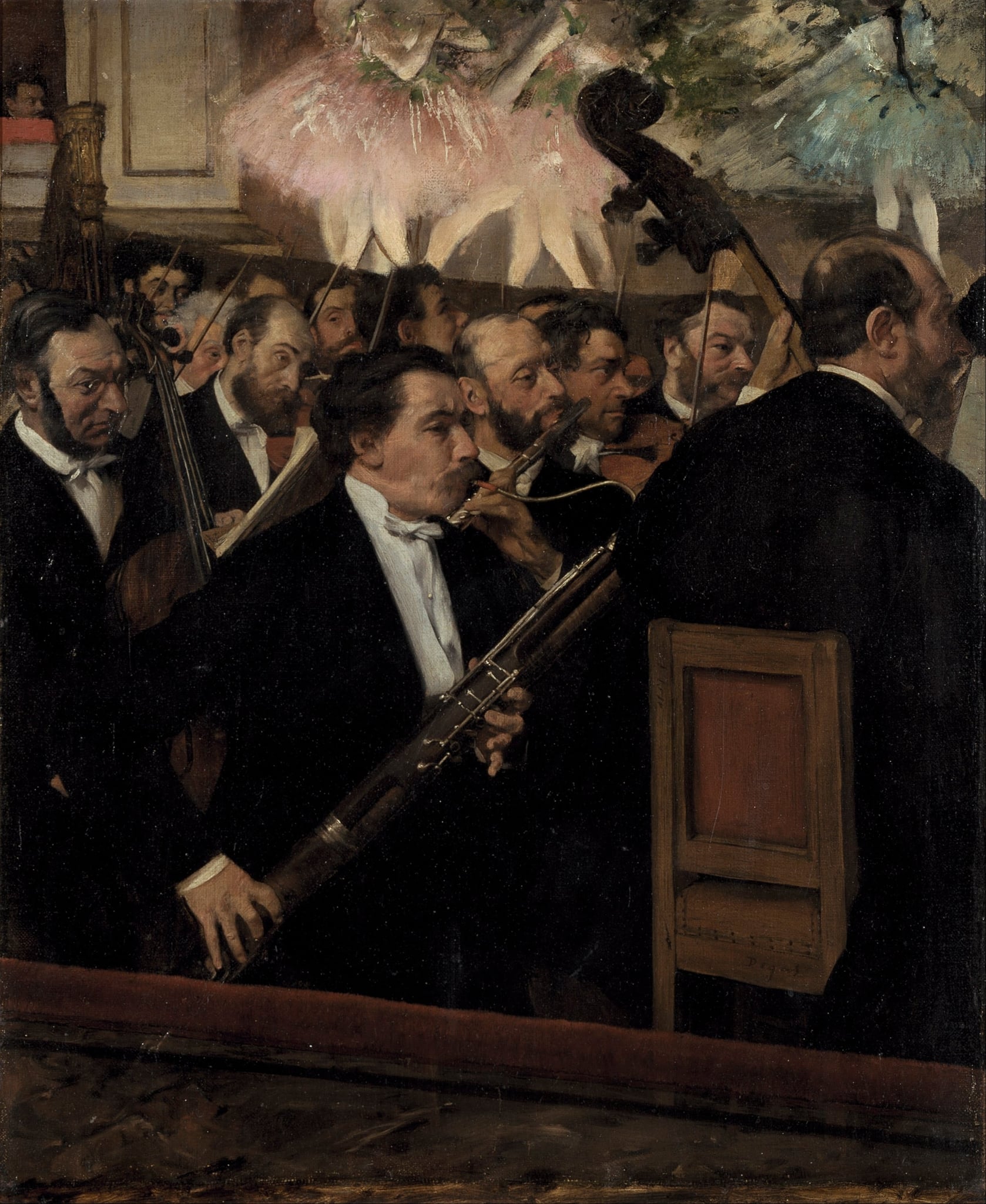
The Opera Orchestra by Edgar Degas | Analysis
Edgar Degas
In The Opera Orchestra, Degas flips the theater’s hierarchy: the black-clad pit fills the frame while the ballerinas appear only as cropped tutus and legs, glittering above. The diagonal <strong>bassoon</strong> and looming <strong>double bass</strong> marshal a dense field of faces lit by footlights, turning backstage labor into the subject and spectacle into a fragment <sup>[1]</sup><sup>[2]</sup>.
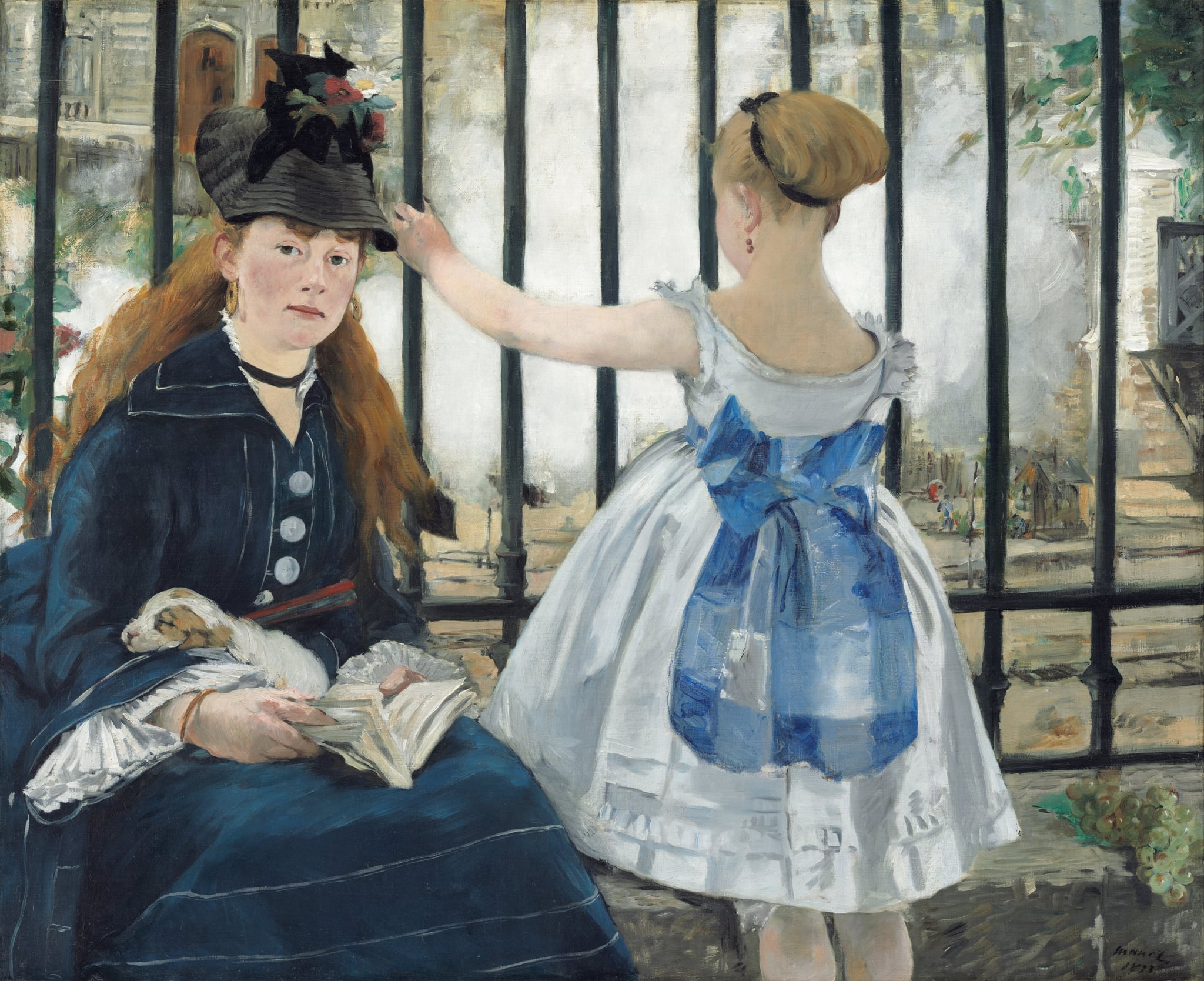
The Railway
Édouard Manet (1873)
Manet’s The Railway is a charged tableau of <strong>modern life</strong>: a composed woman confronts us while a child, bright in <strong>white and blue</strong>, peers through the iron fence toward a cloud of <strong>steam</strong>. The image turns a casual pause at the Gare Saint‑Lazare into a meditation on <strong>spectatorship, separation, and change</strong> <sup>[1]</sup><sup>[3]</sup>.
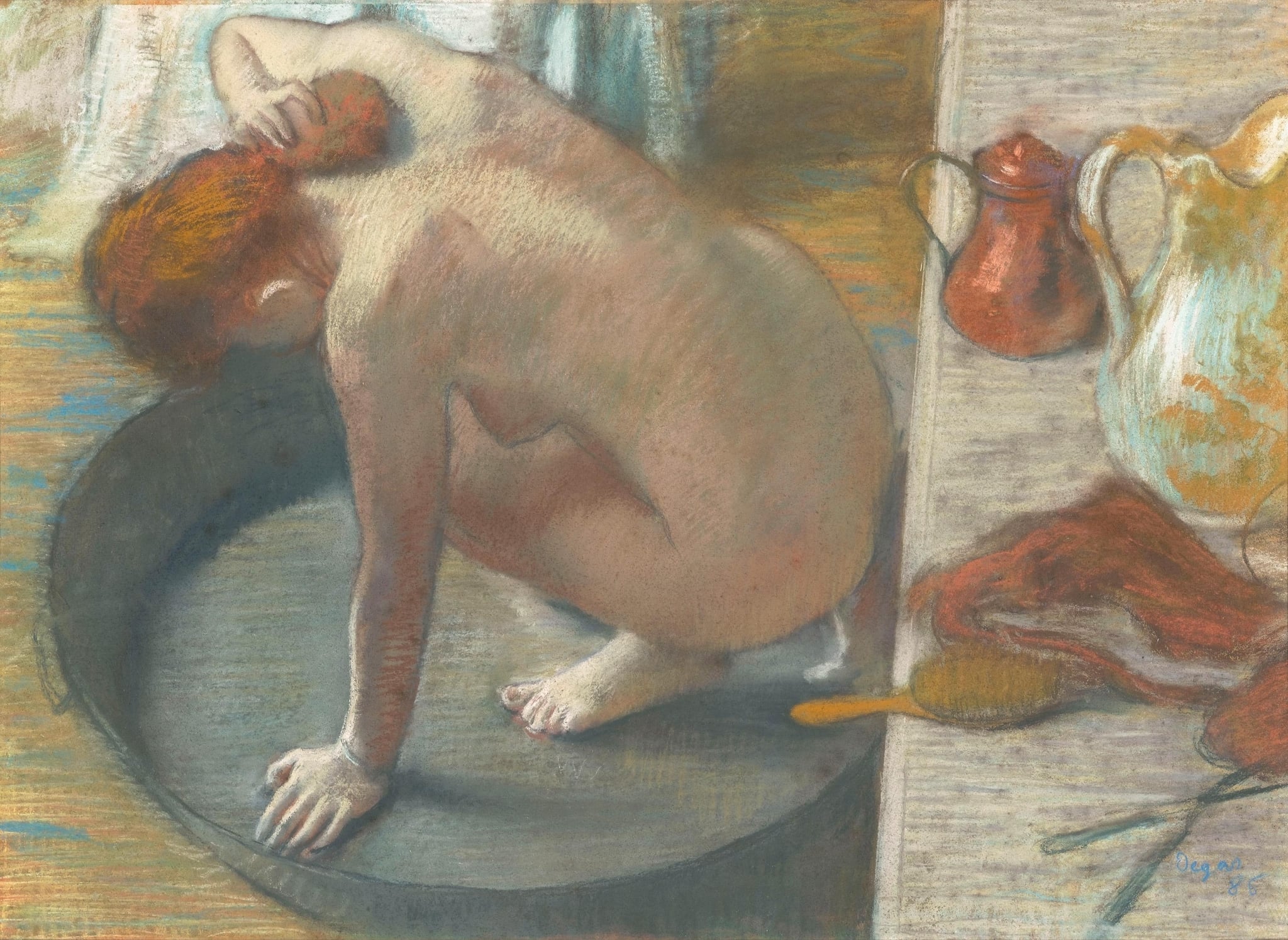
The Tub
Edgar Degas (1886)
In The Tub (1886), Edgar Degas turns a routine bath into a study of <strong>modern solitude</strong> and <strong>embodied labor</strong>. From a steep, overhead angle, a woman kneels within a circular basin, one hand braced on the rim while the other gathers her hair; to the right, a tabletop packs a ewer, copper pot, comb/brush, and cloth. Degas’s layered pastel binds skin, water, and objects into a single, breathing field of <strong>warm flesh tones</strong> and blue‑greys, collapsing distance between body and still life <sup>[1]</sup>.
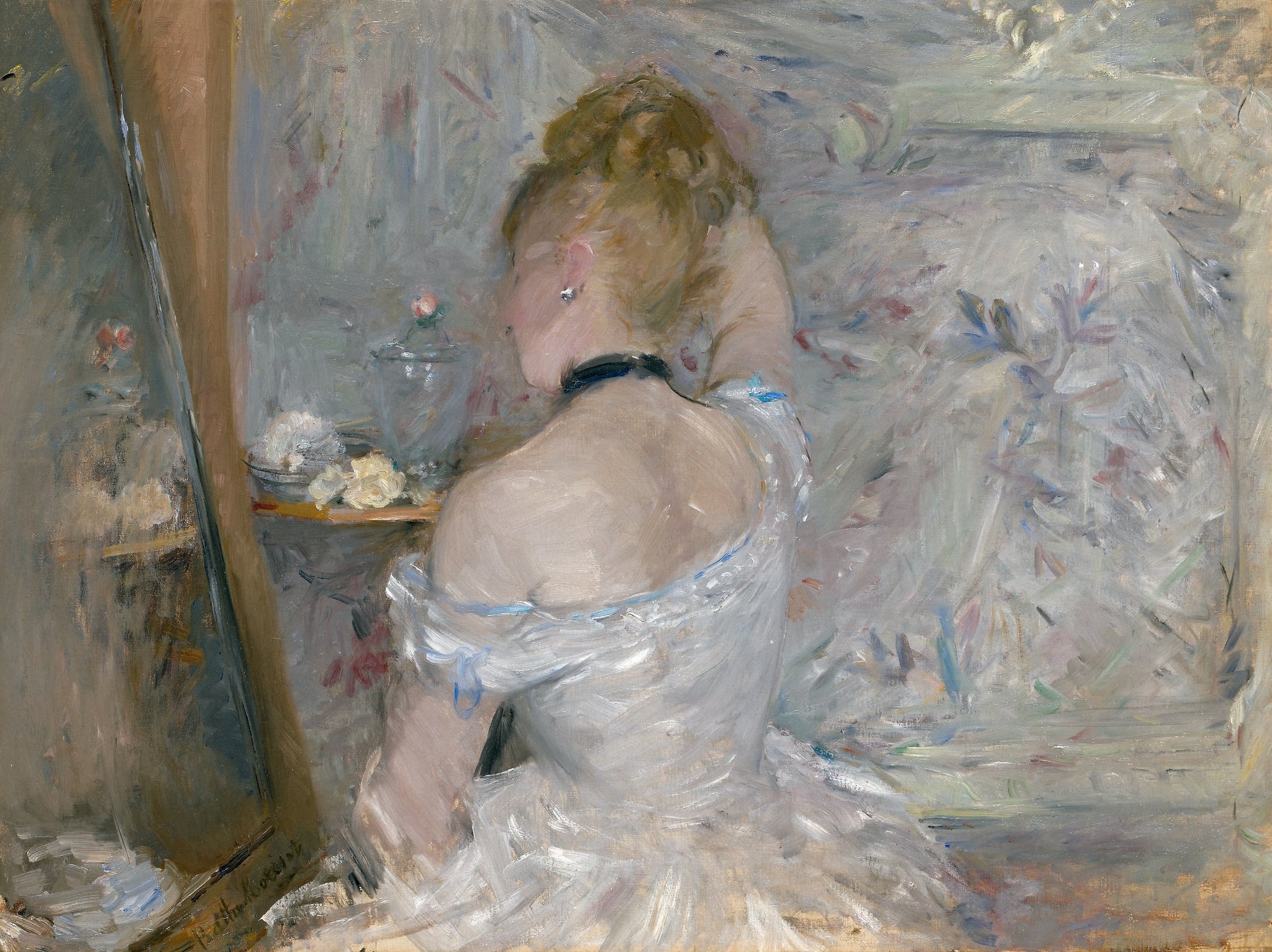
Woman at Her Toilette
Berthe Morisot (1875–1880)
Woman at Her Toilette stages a private ritual of self-fashioning, not a spectacle of vanity. A woman, seen from behind, lifts her arm to adjust her hair as a <strong>black velvet choker</strong> punctuates Morisot’s silvery-violet haze; the <strong>mirror’s blurred reflection</strong> with powders, jars, and a white flower refuses a clear face. Morisot’s <strong>feathery facture</strong> turns a fleeting toilette into modern subjectivity made visible <sup>[1]</sup>.
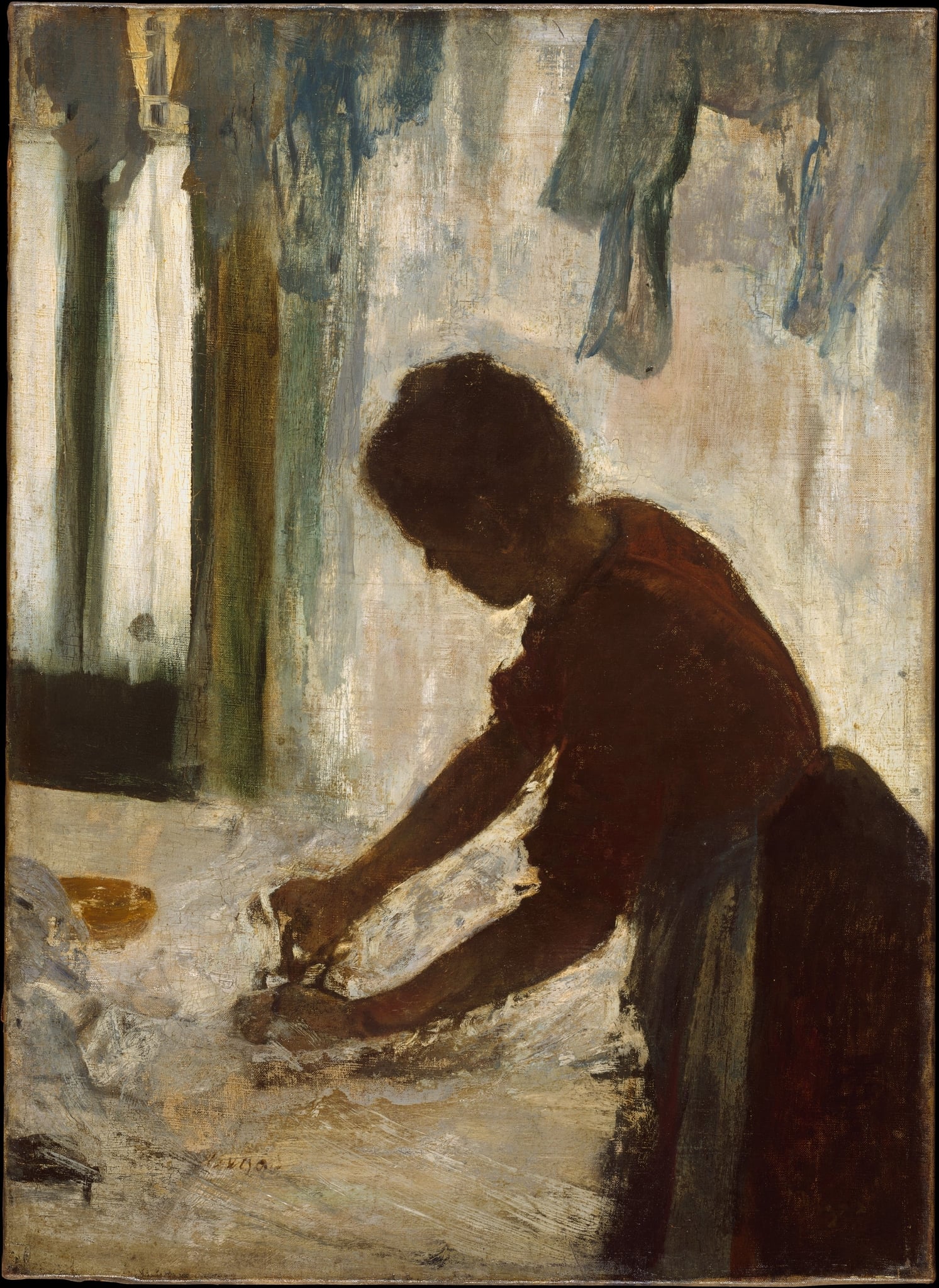
Woman Ironing
Edgar Degas (c. 1876–1887)
In Woman Ironing, Degas builds a modern icon of labor through <strong>contre‑jour</strong> light and a forceful diagonal from shoulder to iron. The worker’s silhouette, red-brown dress, and the cool, steamy whites around her turn repetition into <strong>ritualized transformation</strong>—wrinkled cloth to crisp order <sup>[1]</sup><sup>[2]</sup>.
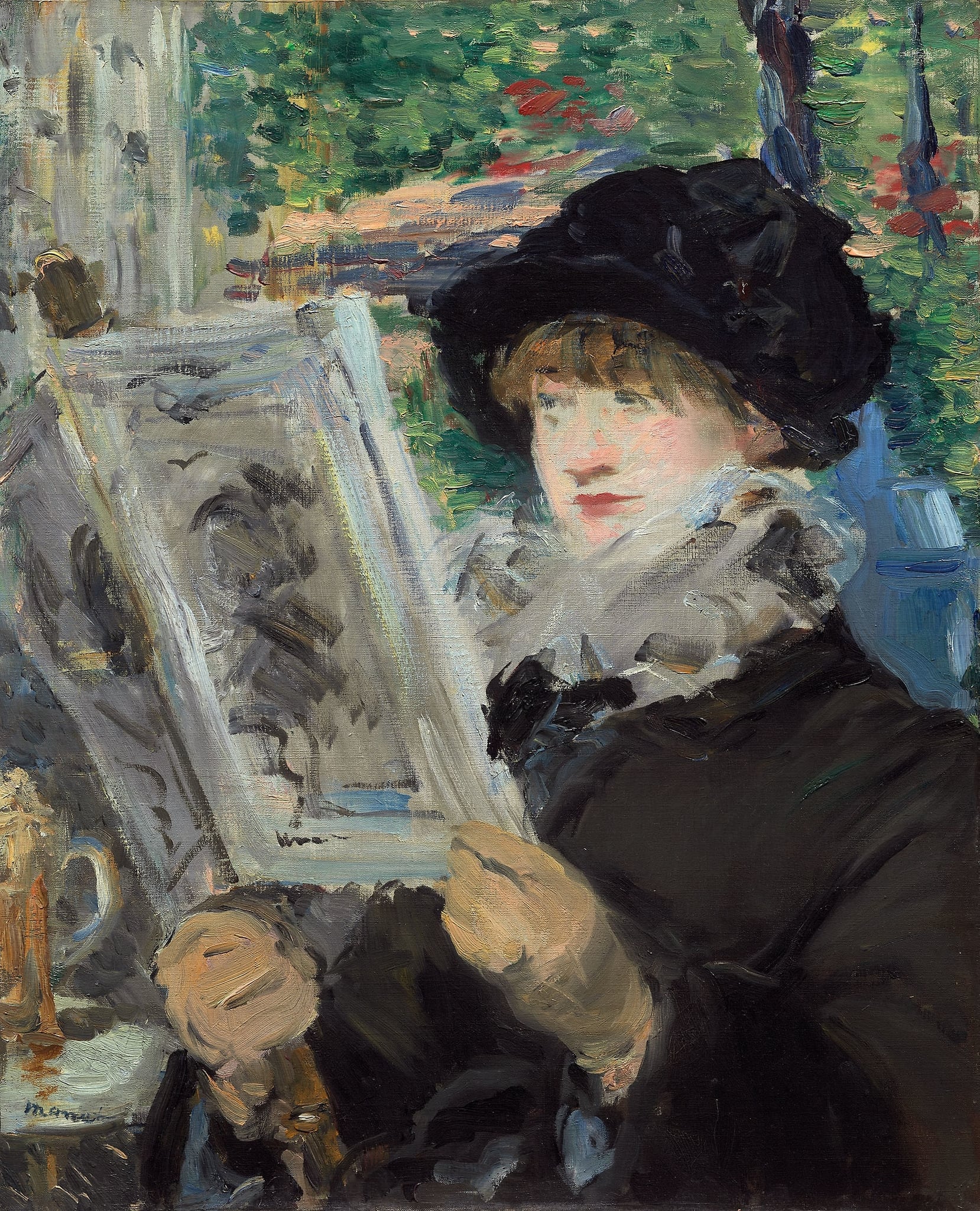
Woman Reading
Édouard Manet (1880–82)
Manet’s Woman Reading distills a fleeting act into an emblem of <strong>modern self-possession</strong>: a bundled figure raises a journal-on-a-stick, her luminous profile set against a brisk mosaic of greens and reds. With quick, loaded strokes and a deliberately cropped <strong>beer glass</strong> and paper, Manet turns perception itself into subject—asserting the drama of a private mind within a public café world <sup>[1]</sup><sup>[2]</sup>.
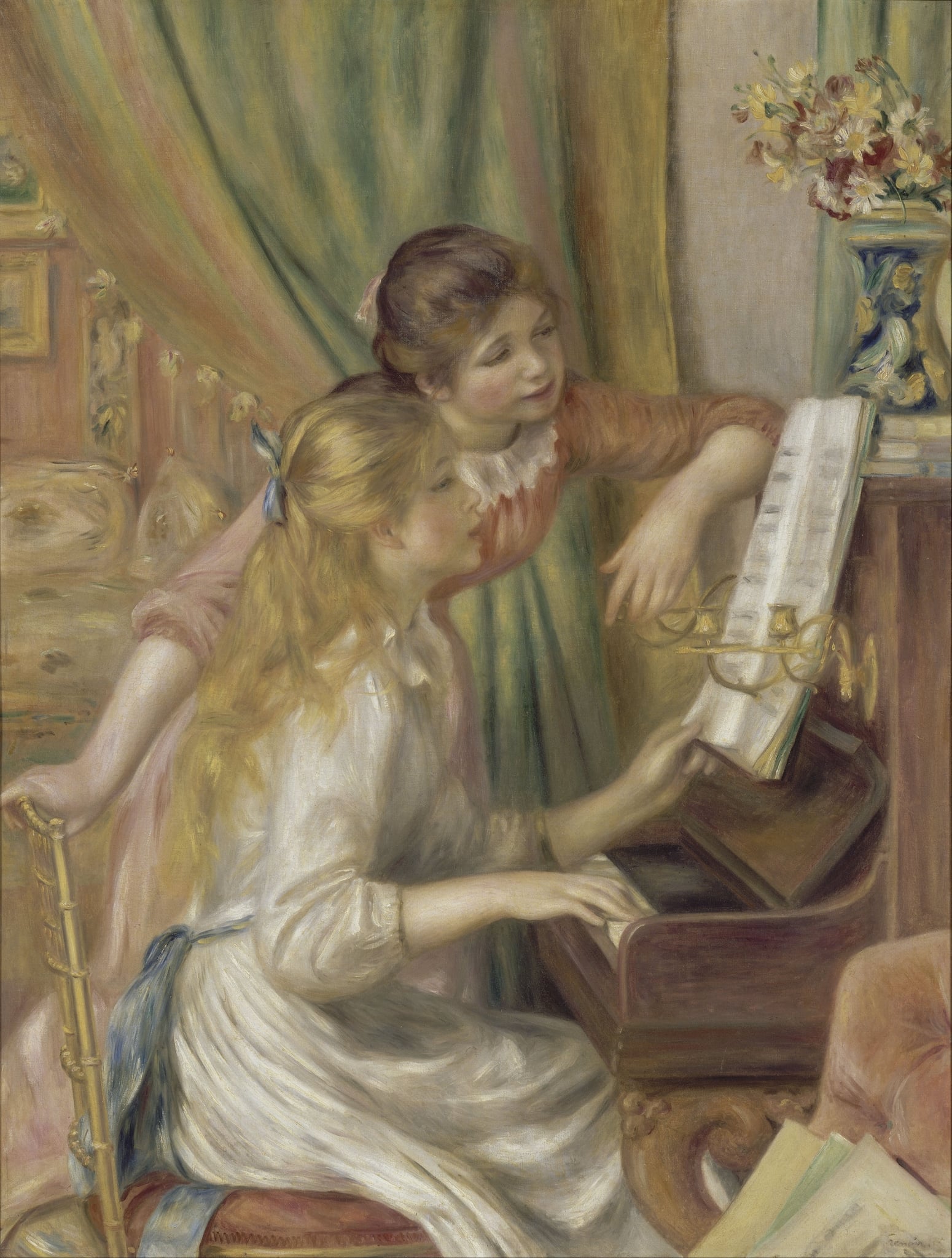
Young Girls at the Piano
Pierre-Auguste Renoir (1892)
Renoir’s Young Girls at the Piano turns a quiet lesson into a scene of <strong>attunement</strong> and <strong>bourgeois grace</strong>. Two adolescents—one seated at the keys, the other leaning to guide the score—embody harmony between discipline and delight, rendered in Renoir’s late, <strong>luminous</strong> touch <sup>[1]</sup><sup>[2]</sup>.
Related Themes
Related Symbolism Categories
Object
Object symbolism charts how seemingly ordinary tools, vessels, and furnishings—books, bottles, clocks, tables, instruments—become dense sign-carriers of labor, leisure, desire, and modern perception from early modern iconography to Impressionist and post‑Impressionist painting.
Domesticity
The “Domesticity” symbolism category traces how modern artists transform humble household objects, routines, and furnishings into a complex visual language of labor, intimacy, and psychological tension within the home and its adjacent social spaces.
Interiority
“Interiority” symbols in modern painting transform gesture, gaze, and domestic props into visual indices of inward life, staging psychological depth, self-consciousness, and mediated subjectivity within scenes of everyday modernity.
Within European painting, everyday objects long served as relatively stable carriers of meaning—attributes of saints, emblems of vanitas, or markers of social rank. In the nineteenth century, however, this inherited vocabulary is retooled under the pressures of urbanization, consumer culture, and new regimes of spectatorship. In works by Manet, Degas, Morisot, Renoir, and Cézanne, things cease to be mute accessories and instead crystallize the modern condition: they mediate looking, structure social encounters, register labor and time, and expose the commodification of desire. The category of “Objecthood” thus names not simply the presence of props in the pictorial field but their elevation into semiotic instruments that articulate the terms on which bodies meet, work, and are seen.
In this register, café culture offers a privileged laboratory. Manet’s Plum Brandy compresses an entire psychology into the small constellation of marble table, unlit cigarette, and glass with plum brandy. The marble café table is not a neutral support but a literal and metaphorical barrier; it cuts across the foreground, separating viewer from sitter and staging her solitude “within public life.” The unlit cigarette functions semiotically as deferred ignition—“an action paused before it begins”—so that smoking, a socialized rhythm of modern leisure, becomes a suspended possibility rather than an act. The glass with plum brandy, its “caramel liquid catching light,” stands for sweetness and indulgence held in reserve. Together these objects reorder the genre of the café scene away from anecdotal bustle toward what might be called object-driven introspection: the woman’s interiority is read through the status of things that should signal pleasure but here mark delay and isolation.
In A Bar at the Folies-Bergère, Manet amplifies this logic into a full-scale critique of commodity spectacle. Branded bottles—most famously those with the Bass red triangle—operate iconographically as emblems of “commercial spectacle and globalized consumer culture; pleasure standardized into purchasable labels.” They frame the barmaid and recast her, in turn, as another commodity among commodities, aligning her presence with the champagne and liqueurs she sells. A central bottle functions compositionally as an axis stabilizing the counter, but semiotically it acts as a mediator: a cool, vertical presence that divides the viewer’s space from the mirror’s disjunctive world. Café tableware—glasses, the bowl of oranges—further thickens the scene’s commercial texture, but these are no longer neutral still-life elements; they are tokens in a system that turns sociability into transaction. The marble café table, again, marks the front edge of this economy, a stone threshold across which money, and gazes, must pass.
Objects of timekeeping and domestic order articulate a different dimension of modern objecthood. Degas’s The Bellelli Family (invoked in the entry on the gilt mantel clock) deploys that ornate clock as an index of “time, routine, and the pressure of domestic order/status.” The gilt case signifies bourgeois refinement, yet the dial’s inexorable measure bears down on the tense grouping of mother, daughters, and father. Iconographically the clock inherits the vanitas tradition—time’s passage, the temporality of life—but in Degas’s hands it also becomes a bureaucrat of the interior, regulating behavior and inheritance. A similar temporal symbolism is later radicalized in the notion of “soft (melting) pocket watches,” defined here as “time made malleable; the collapse of rigid, measured chronology.” Although not represented in the collection, this Surrealist deformation marks a historical shift: where the gilt clock embodies the disciplining of time, the melting watch embodies its psychic unbinding. The evolution from rigid to pliable timekeeping devices tracks the broader modernist move from external order to subjective experience.
Mirrors, signatures, and toilette tools, by contrast, address the instability of selfhood under these new conditions. The mirror itself is defined as a sign of “instability of perception and fractured modern identity; doubles reality and reveals off-angle social relations.” In Morisot’s Woman at Her Toilette, the “mirror with blurred reflection” refuses to deliver a legible face; instead, it redirects the viewer to “toilette objects (powder puff, jars, white flower)”—“tools of performance and transformation, marking beauty as an event rather than fixed essence.” The woman’s identity is thus dispersed across implements of grooming, turning the act of self-fashioning into the real subject. When an “artist’s inscription” or “artist’s signature on the mirror” is added—as in Manet’s name brushed on the marble slab in Plum Brandy—authorship is inserted into this circuit of looking. The signature validates the moment (“the artist was here”) but also underscores that every surface—a bar, a mirror, a café table—can double as a pictorial proscenium. In works where the signature appears on reflective surfaces, authorship inhabits the very site of unstable vision, suggesting that self and maker alike are mediated through the act of representation.
Gloves and related accessories refine this focus on public identity. In Renoir’s Dance in the Country, the woman’s “long yellow gloves” epitomize “polished urban elegance and self-possession; a controlled, composed public self.” Etiquette demanded gloves in such settings; iconographically, they signal respectability and the deliberate mediation of touch. A similar function is visible in Morisot’s Summer’s Day, where the women’s gloves “reinforce propriety and self-containment amid leisure.” Gloves thus belong to the same symbolic field as the hand fan and parasol—“accessory of comfort and style; a marker of modern bourgeois ease”—in Manet’s Jeanne (Spring). There, the gloved hand, straw hat, and angled parasol forge an allegory of the season through fashion, translating an abstract cycle (spring) into the curated language of couture. These objects stabilize identity outwardly even as mirrors and blurred reflections destabilize it inwardly; the tension between covered hands and elusive faces is one of modern painting’s most persistent dialectics.
Other objects speak more directly to labor and backstage economies. Degas’s The Ballet Class is punctuated by the watering can, defined as “practical labor behind grace; the workmanlike means that make dancing possible.” The can, like the bassoon in Degas’s The Opera Orchestra (noted here as a “guiding baton-like line and emblem of backstage labor and sound production”), shifts attention from spectacle to infrastructure. Both motifs insist that aesthetic experience rests on repetitive, often invisible work. In a similar key, the bandbox or hatbox is marked as a “marker of work and mobility—specifically millinery labor—contrasting with leisurely fashion.” Such containers index the circulation of bodies and garments that make public display possible, aligning them with “wood shavings (curls)” and “copper pot” as residues or tools of maintenance. These signs of labor complicate the apparent ease of café and dance scenes, reminding the viewer that modern leisure is scaffolded by persistent domestic and artisanal work.
Finally, still-life structures such as the “footed compote (bowl),” “central bottle (axis),” and “kinked table edge” reveal how objecthood itself becomes a means of rethinking pictorial space. In Cézanne’s Still Life with Apples and Oranges (invoked in the compote entry), the raised bowl “elevates and concentrates forms” while its “slight forward lean introduces controlled instability.” The compote mediates between table, cloth, and fruit, formalizing the instability of vision that Impressionism had already foregrounded. The “kinked table edge” further registers “shifting viewpoints and deliberate spatial dislocation,” while in Cézanne’s The Card Players the “central bottle” becomes a “calm, impartial presence that divides and balances opposing forces.” Here objecthood shades into metaphysics: the bottle is less a drink than a vertical measure anchoring human interaction, much as the walking stick—“an emblem of guidance, support, and the human attempt to orient and steady oneself before vastness”—figures the desire to find orientation in a world of fractured perspectives.
Across these works, the evolution of object symbolism is stark. Where earlier traditions assigned fixed iconographic meanings, nineteenth-century painting treats objects as dynamic mediators: they structure social relations (café tableware, marble tables), regulate experience (clocks, watches, hemostats as “medicalized control”), or expose their own role in economies of spectacle (branded bottles, PHILLIES cigar signs). Later modernisms radicalize this trajectory by softening clocks, melting watches, or turning painted pipes and cigar signs into reflections on representation itself. Within the “Objecthood” category, then, the ordinary thing is never merely present; it is a small but potent device through which modern artists scrutinize time, labor, desire, and the unstable construction of the self.