Object
Object symbolism charts how seemingly ordinary tools, vessels, and furnishings—books, bottles, clocks, tables, instruments—become dense sign-carriers of labor, leisure, desire, and modern perception from early modern iconography to Impressionist and post‑Impressionist painting.
Member Symbols
Featured Artworks
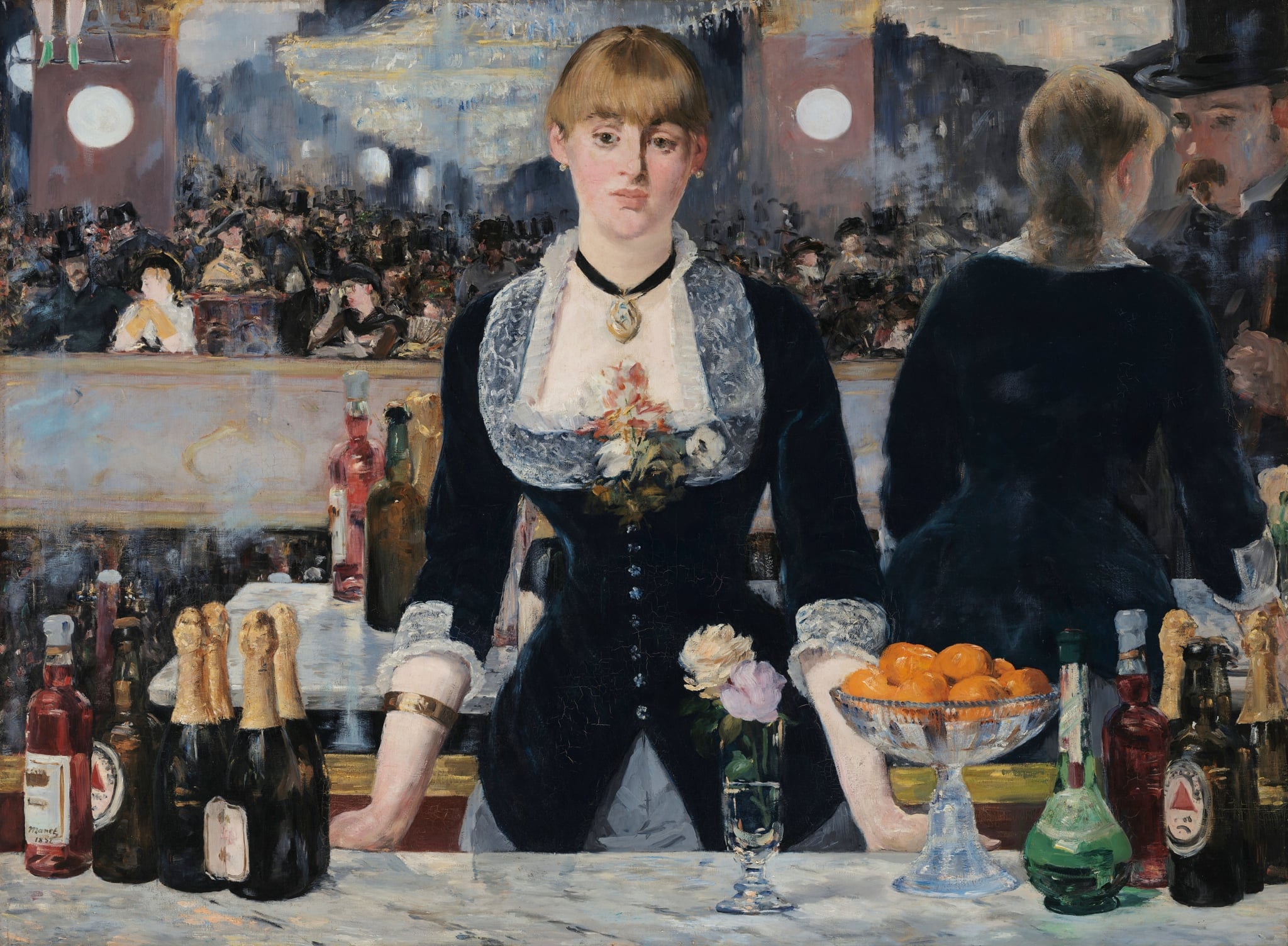
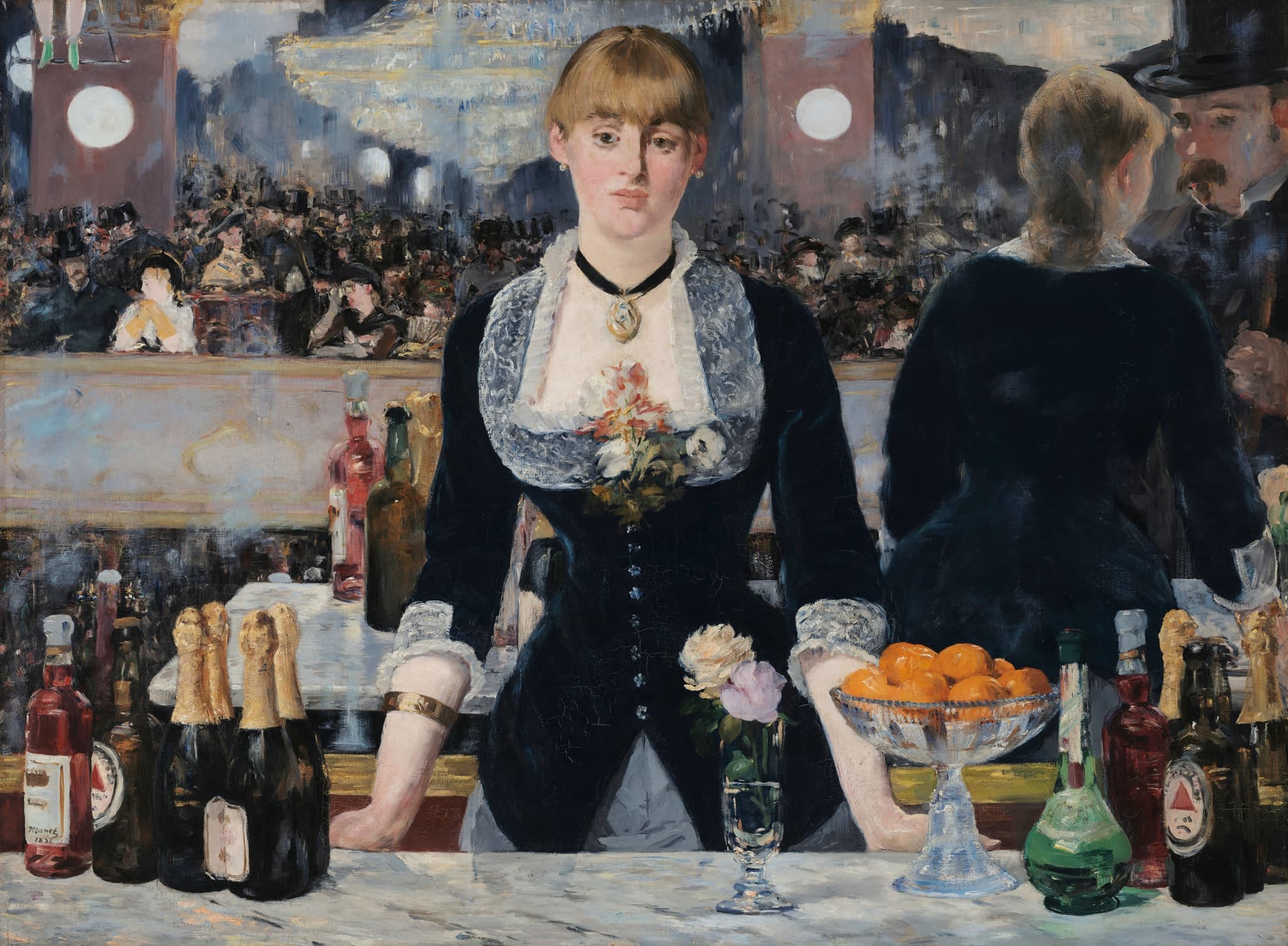
A Bar at the Folies-Bergère
Édouard Manet (1882)
Édouard Manet’s A Bar at the Folies-Bergère stages a face-to-face encounter with modern Paris, where <strong>commerce</strong>, <strong>spectacle</strong>, and <strong>alienation</strong> converge. A composed barmaid fronts a marble counter loaded with branded bottles, flowers, and a brimming bowl of oranges, while a disjunctive <strong>mirror</strong> unravels stable viewing and certainty <sup>[1]</sup><sup>[2]</sup>.
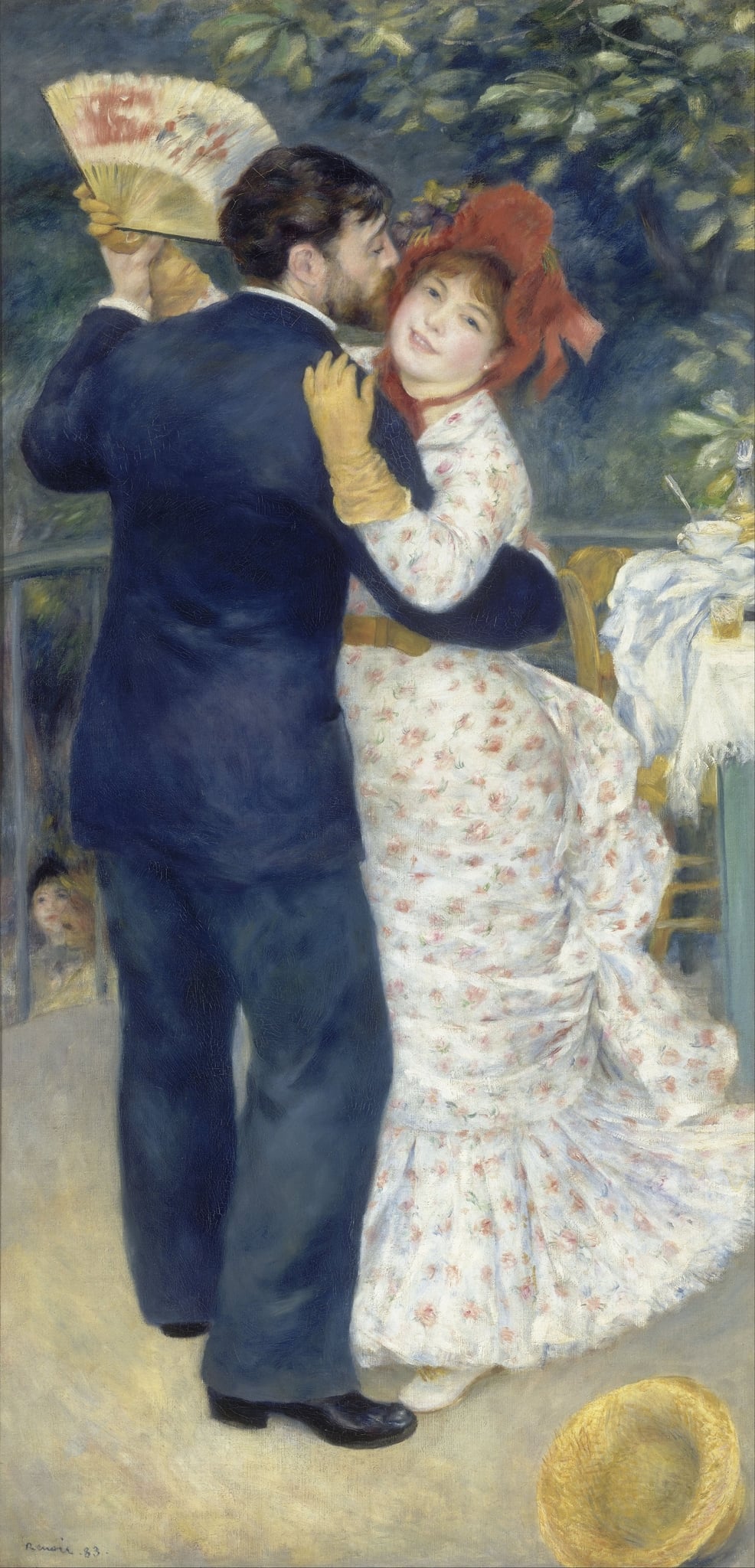
Dance in the Country
Pierre-Auguste Renoir (1883)
Dance in the Country shows a couple swept into a close embrace on a café terrace, their bodies turning in a soft spiral as foliage and sunlight dissolve into <strong>dappled color</strong>. Renoir orchestrates <strong>bourgeois leisure</strong>—the tossed straw boater, a small table with glass and napkin, the woman’s floral dress and red bonnet—to stage a moment where decorum and desire meet. The result is a modern emblem of shared pleasure, poised between Impressionist shimmer and a newly <strong>firm, linear touch</strong>.
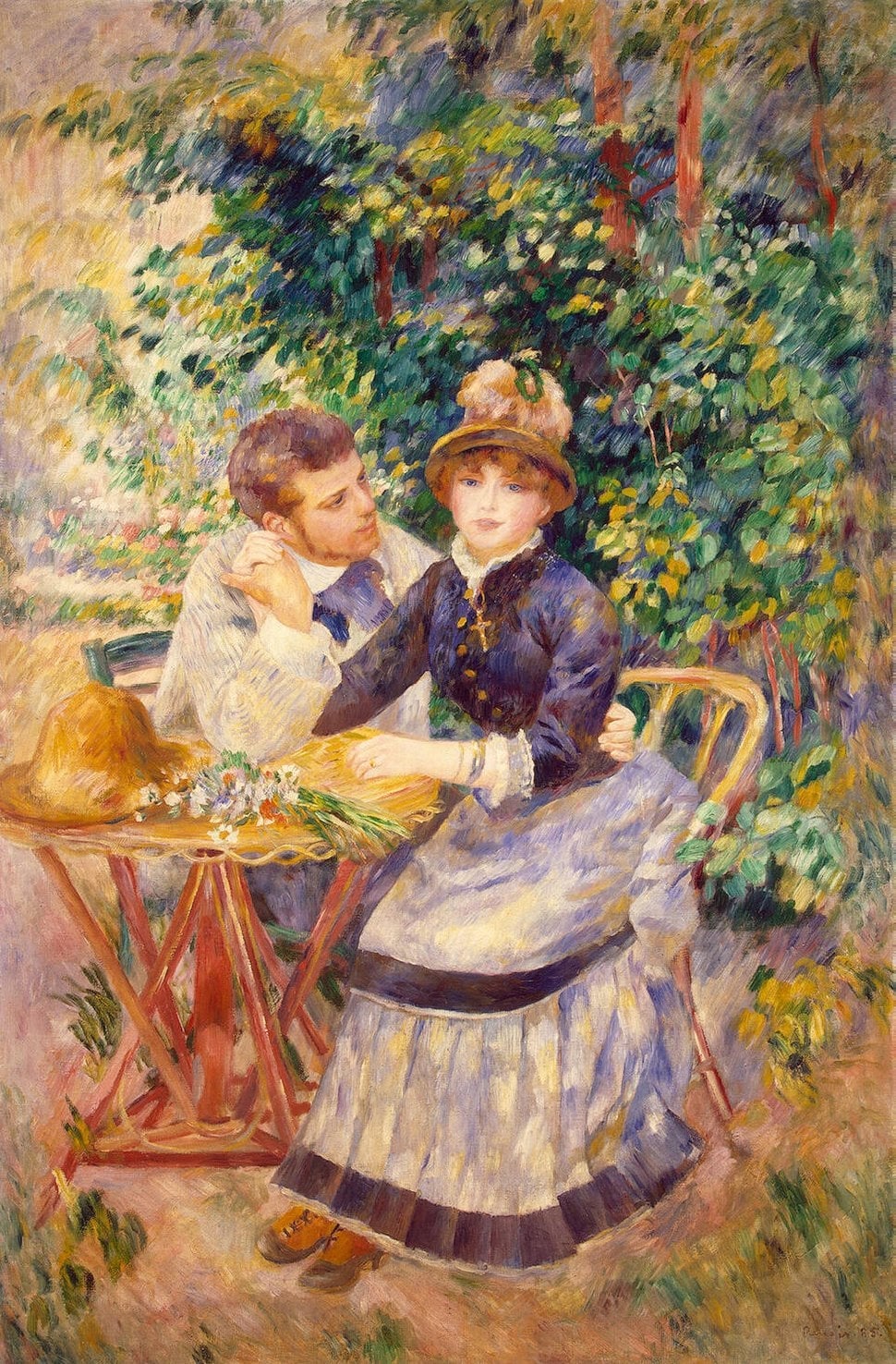
In the Garden
Pierre-Auguste Renoir (1885)
In the Garden presents a charged pause in modern leisure: a young couple at a café table under a living arbor of leaves. Their lightly clasped hands and the bouquet on the tabletop signal courtship, while her calm, front-facing gaze checks his lean. Renoir’s flickering brushwork fuses figures and foliage, rendering love as a <strong>transitory, luminous sensation</strong> <sup>[1]</sup><sup>[3]</sup>.
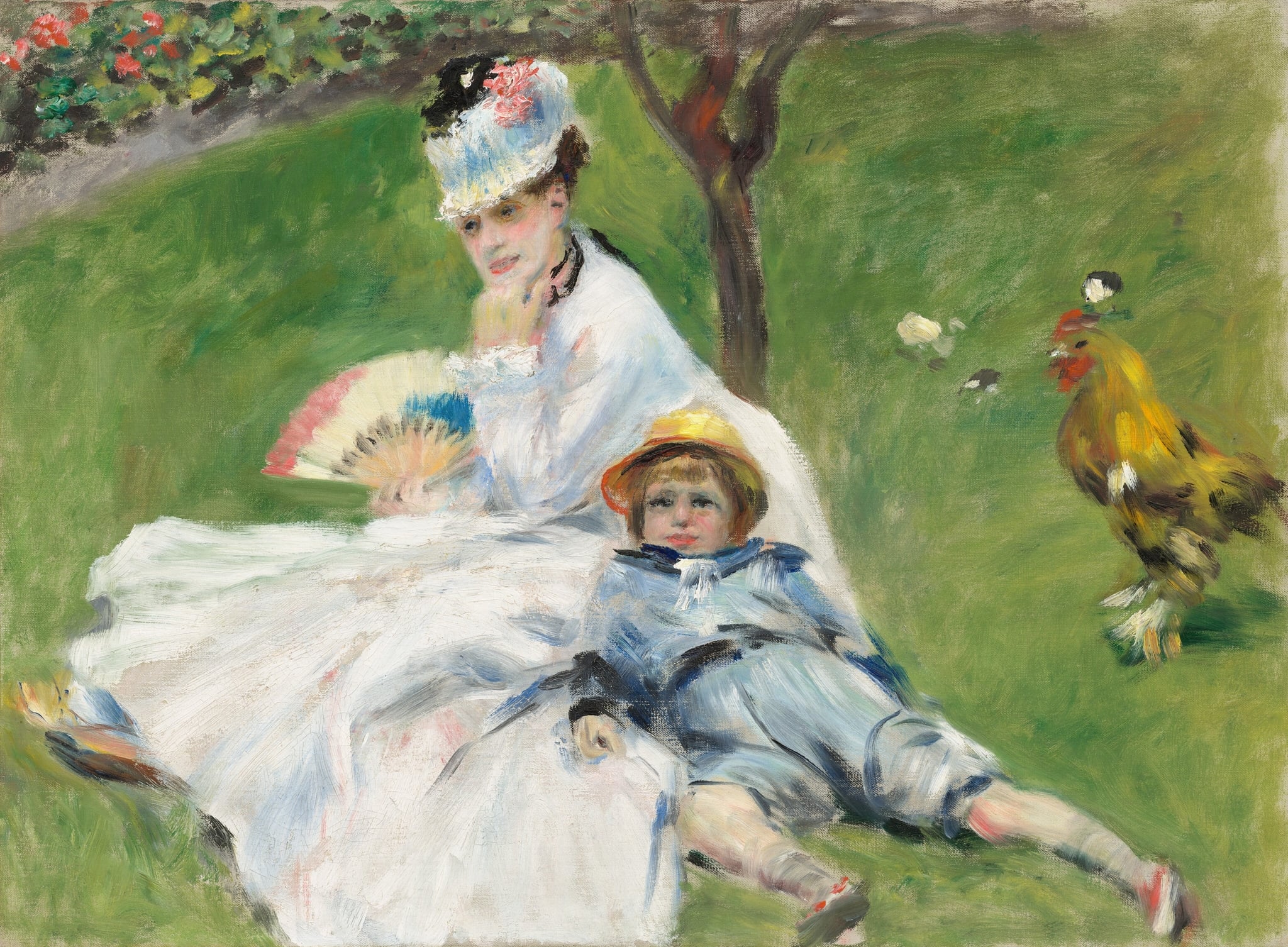
Madame Monet and Her Son
Pierre-Auguste Renoir (1874)
Renoir’s 1874 canvas Madame Monet and Her Son crystallizes <strong>modern domestic leisure</strong> and <strong>plein‑air immediacy</strong> in Argenteuil. A luminous white dress pools into light while a child in a pale‑blue sailor suit reclines diagonally; a strutting rooster punctuates the greens with warm color. The brushwork fuses figure and garden so the moment reads as <strong>lived, not staged</strong> <sup>[1]</sup><sup>[2]</sup><sup>[5]</sup>.
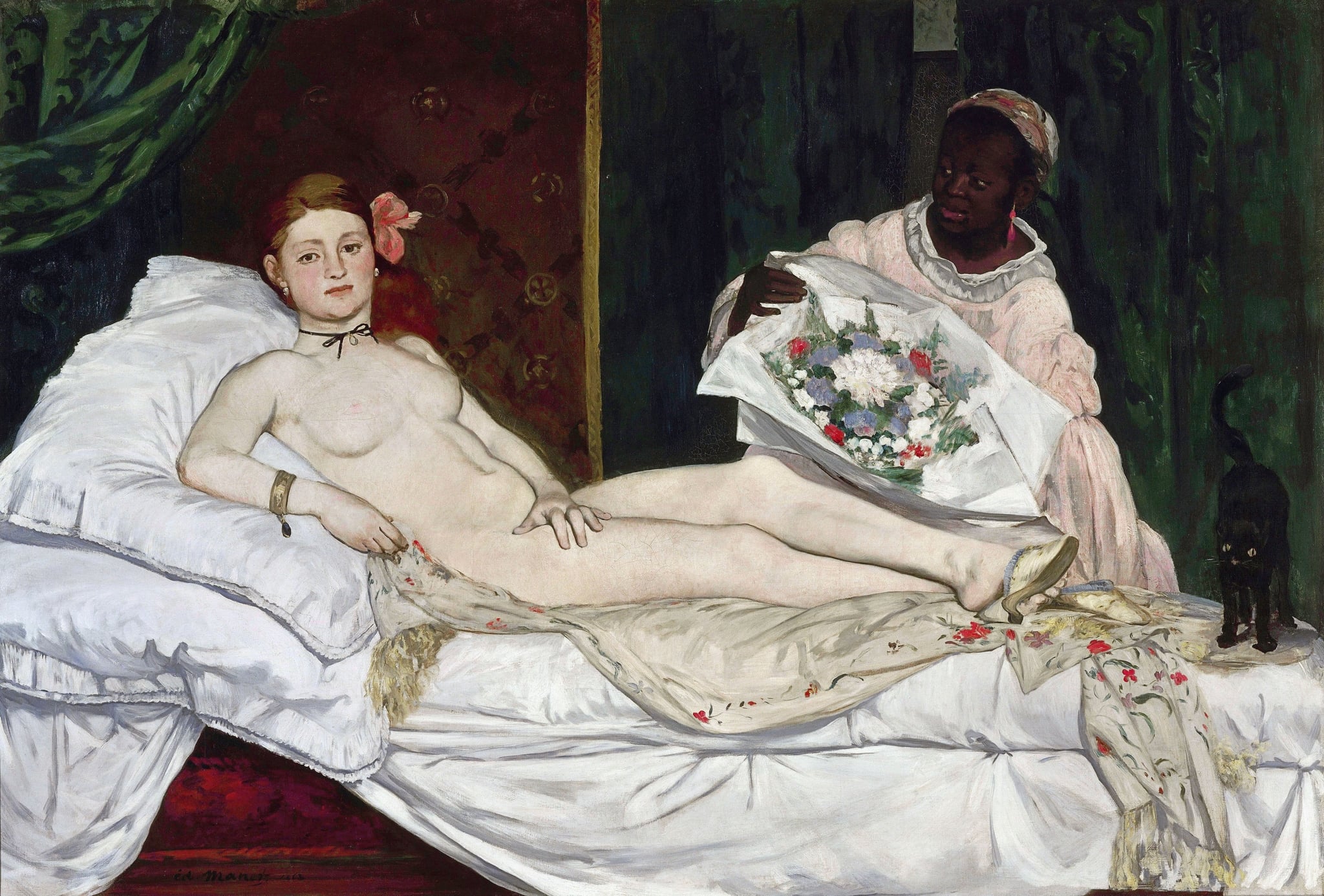
Olympia
Édouard Manet (1863 (Salon 1865))
A defiantly contemporary nude confronts the viewer with a steady gaze and a guarded pose, framed by crisp light and luxury trappings. In Olympia, <strong>Édouard Manet</strong> strips myth from the female nude to expose the <strong>modern economy of desire</strong>, power, and looking <sup>[1]</sup><sup>[3]</sup>.
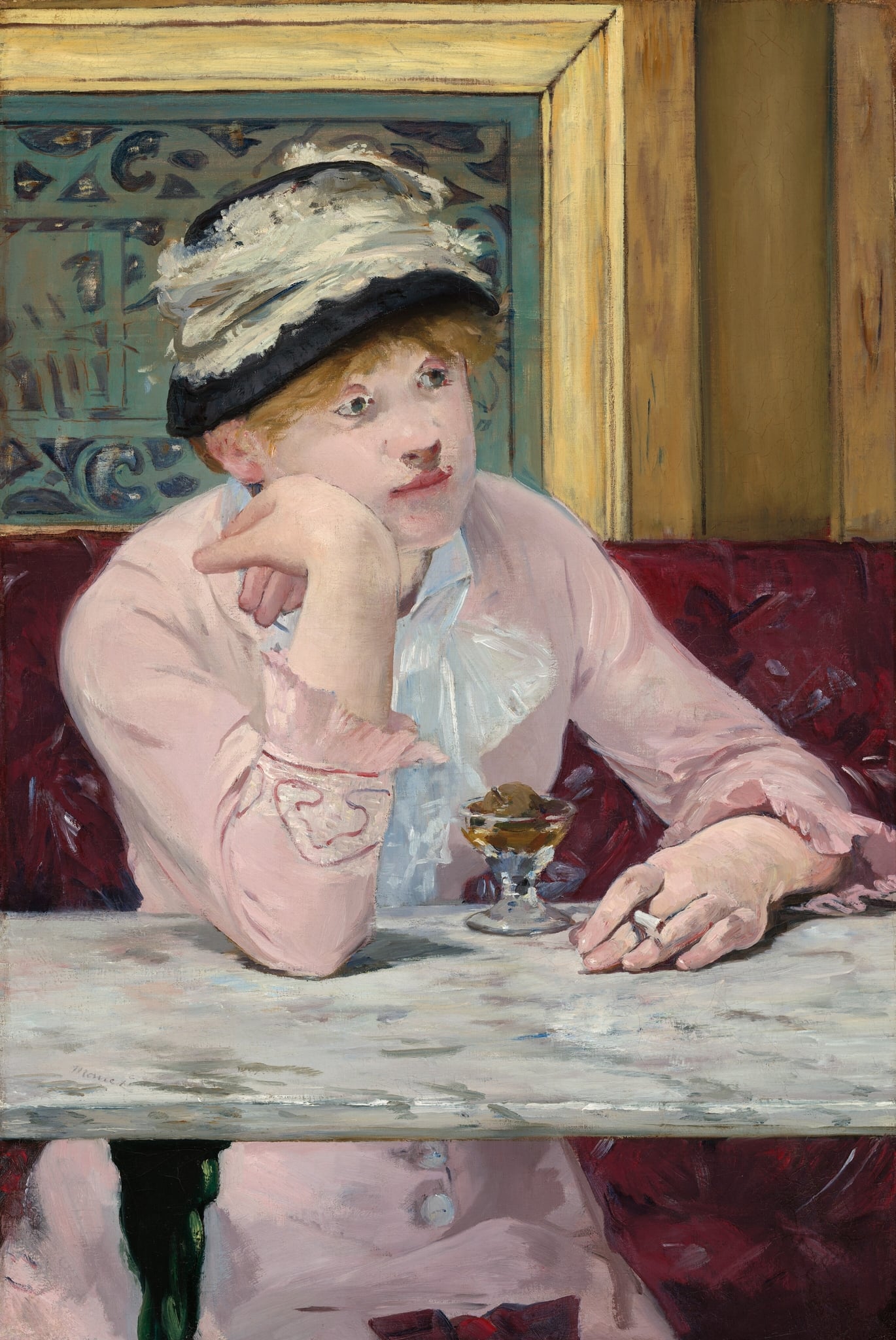
Plum Brandy
Édouard Manet (ca. 1877)
Manet’s Plum Brandy crystallizes a modern pause—an urban <strong>interval of suspended action</strong>—through the idle tilt of a woman’s head, an <strong>unlit cigarette</strong>, and a glass cradling a <strong>plum in amber liquor</strong>. The boxed-in space—marble table, red banquette, and decorative grille—turns a café moment into a stage for <strong>solitude within public life</strong> <sup>[1]</sup><sup>[2]</sup>.
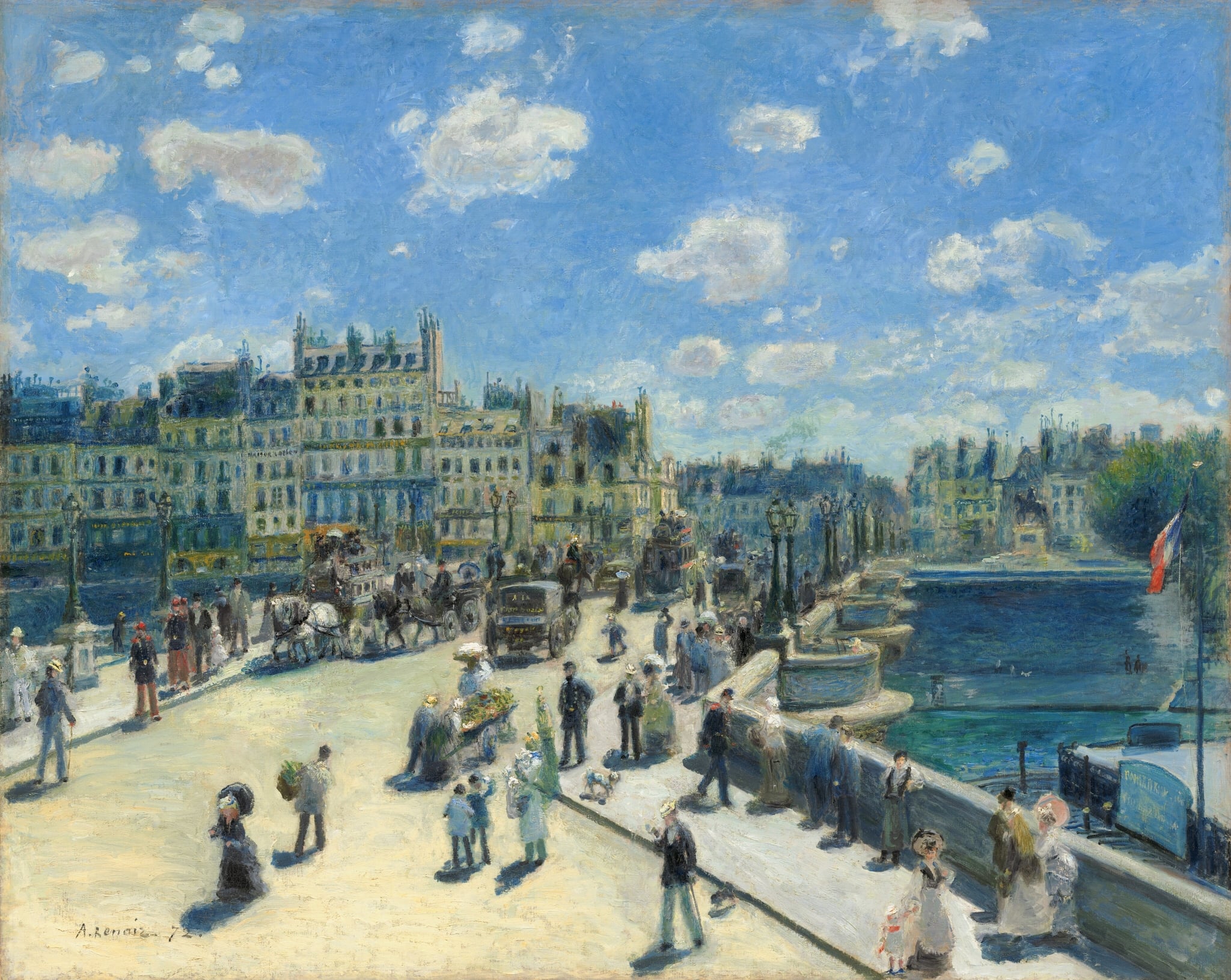
Pont Neuf Paris
Pierre-Auguste Renoir (1872)
In Pont Neuf Paris, Pierre-Auguste Renoir turns the oldest bridge in Paris into a stage where <strong>light</strong> and <strong>movement</strong> bind a city back together. From a high perch, he orchestrates crowds, carriages, gas lamps, the rippling Seine, and a fluttering <strong>tricolor</strong> so that everyday bustle reads as civic grace <sup>[1]</sup>.
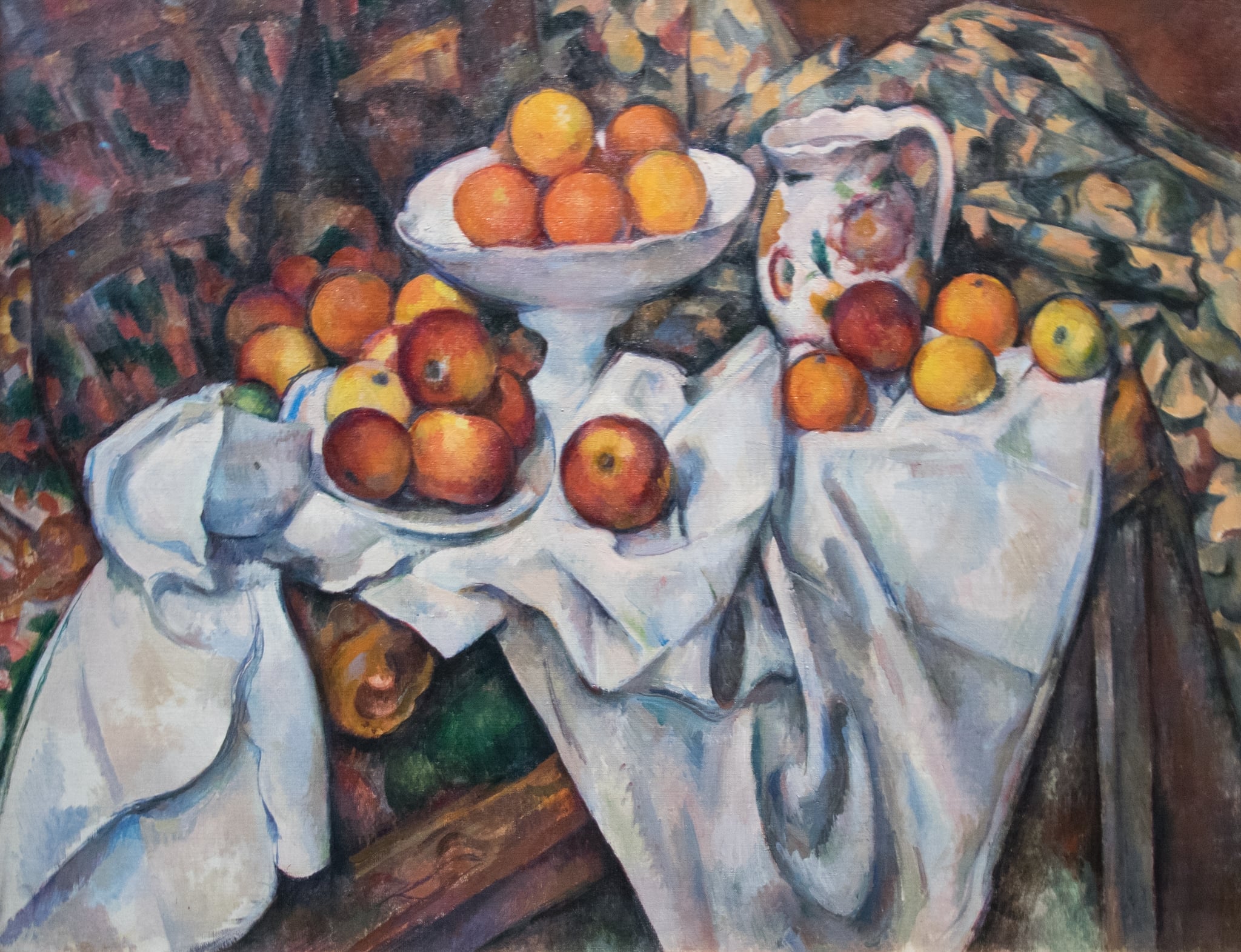
Still Life with Apples and Oranges
Paul Cézanne (c. 1899)
Paul Cézanne’s Still Life with Apples and Oranges builds a quietly monumental world from domestic things. A tilting table, a heaped white compote, a flowered jug, and cascading cloths turn fruit into <strong>durable forms</strong> stabilized by <strong>color relationships</strong> rather than single‑point perspective <sup>[1]</sup><sup>[2]</sup>. The result is a still life that feels both solid and subtly <strong>unstable</strong>, a meditation on how we construct vision.
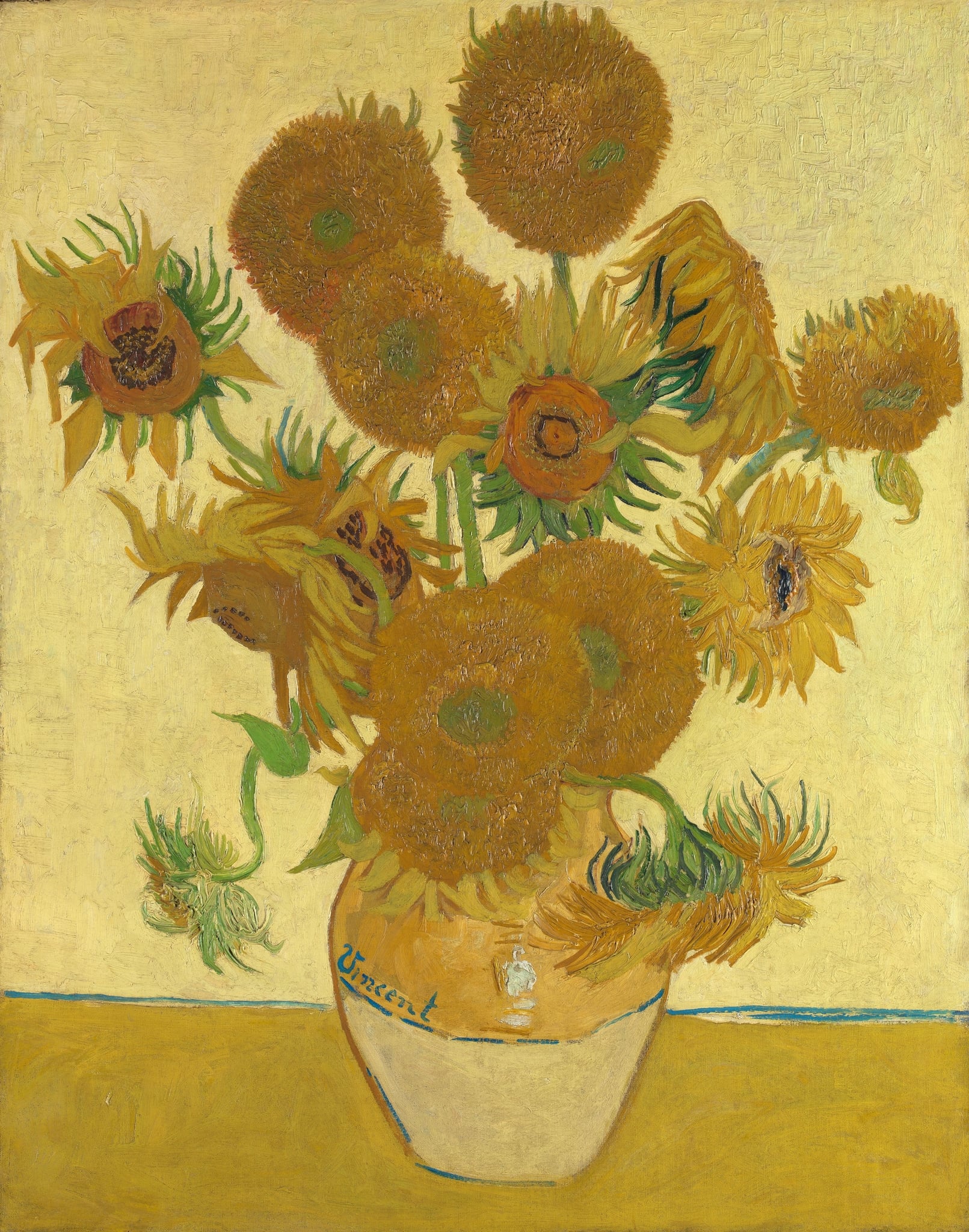
Sunflowers
Vincent van Gogh (1888)
Vincent van Gogh’s Sunflowers (1888) is a <strong>yellow-on-yellow</strong> still life that stages a full <strong>cycle of life</strong> in fifteen blooms, from fresh buds to brittle seed heads. The thick impasto, green shocks of stem and bract, and the vase signed <strong>“Vincent”</strong> turn a humble bouquet into an emblem of endurance and fellowship <sup>[1]</sup><sup>[2]</sup>.
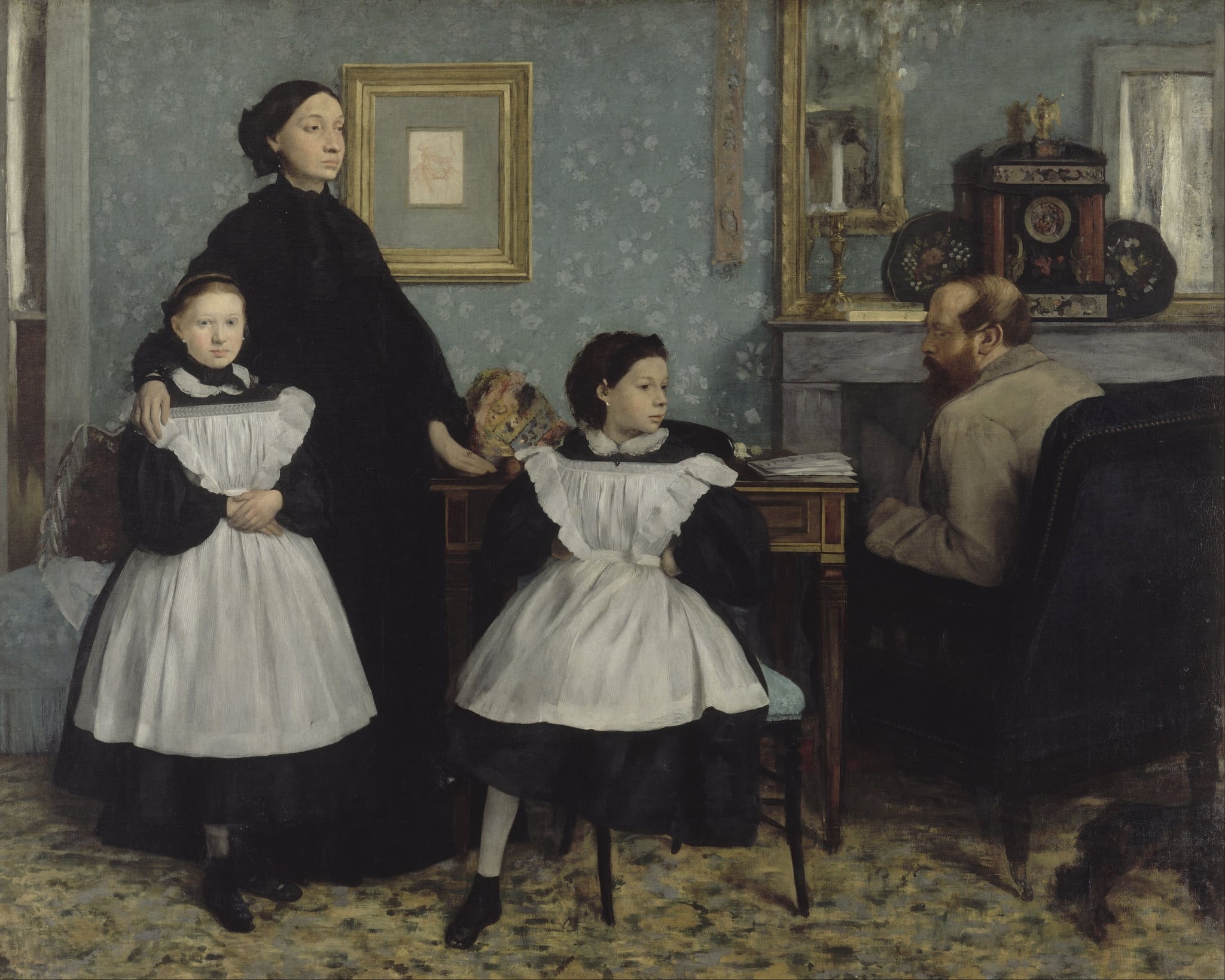
The Bellelli Family
Edgar Degas (1858–1869)
In The Bellelli Family, Edgar Degas orchestrates a poised domestic standoff, using the mother’s column of <strong>mourning black</strong>, the daughters’ <strong>mediating whiteness</strong>, and the father’s turned-away profile to script roles and distance. Rigid furniture lines, a gilt <strong>clock</strong>, and the ancestor’s red-chalk portrait create a stage where time, duty, and inheritance press on a family held in uneasy equilibrium.
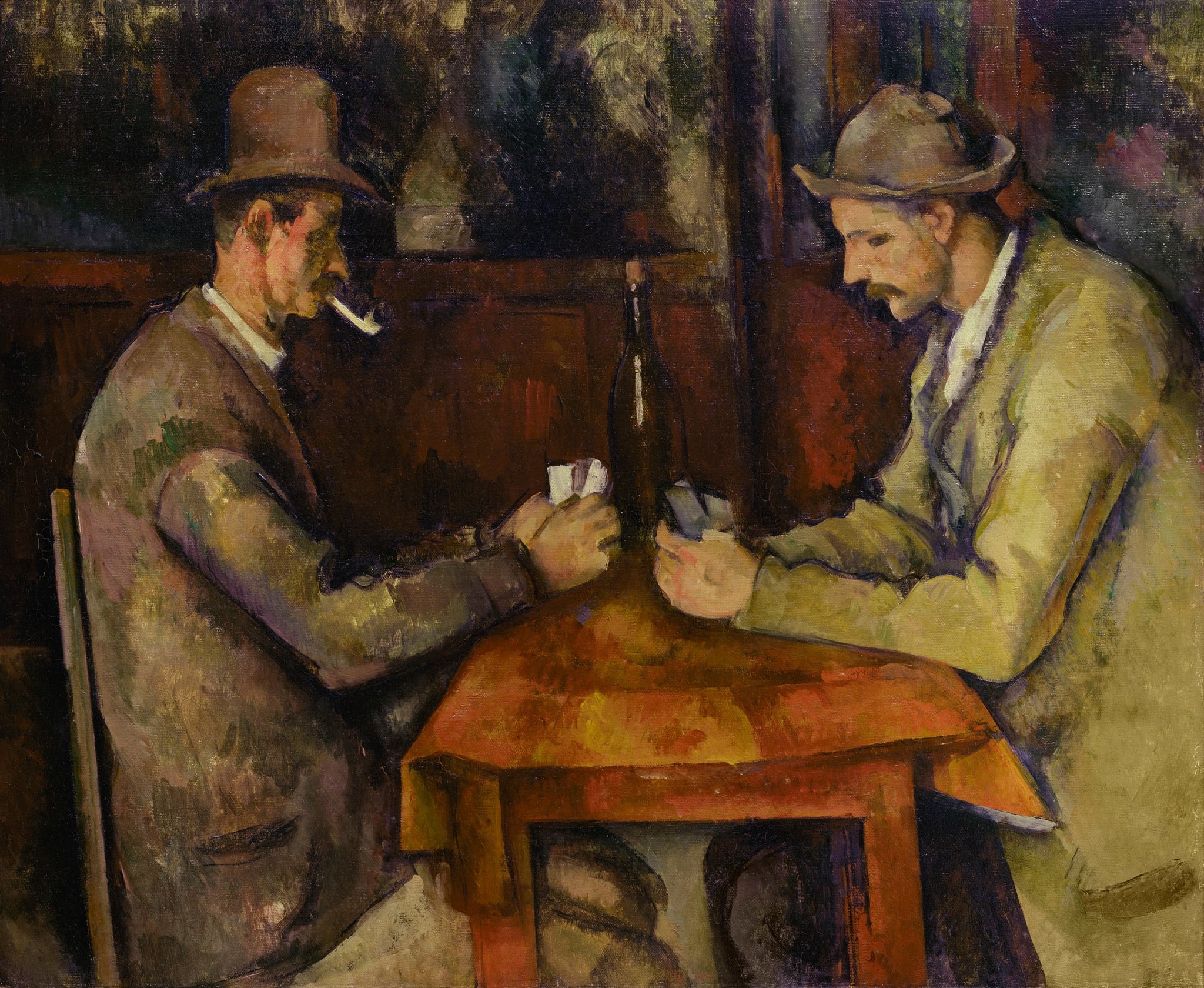
The Card Players by Paul Cézanne | Equilibrium and Form
Paul Cézanne
In The Card Players, Paul Cézanne turns a rural café game into a study of <strong>equilibrium</strong> and <strong>monumentality</strong>. Two hated peasants lean inward across an orange-brown table while a dark bottle stands upright between them, acting as a calm, vertical <strong>axis</strong> that stabilizes their mirrored focus <sup>[2]</sup><sup>[3]</sup>.
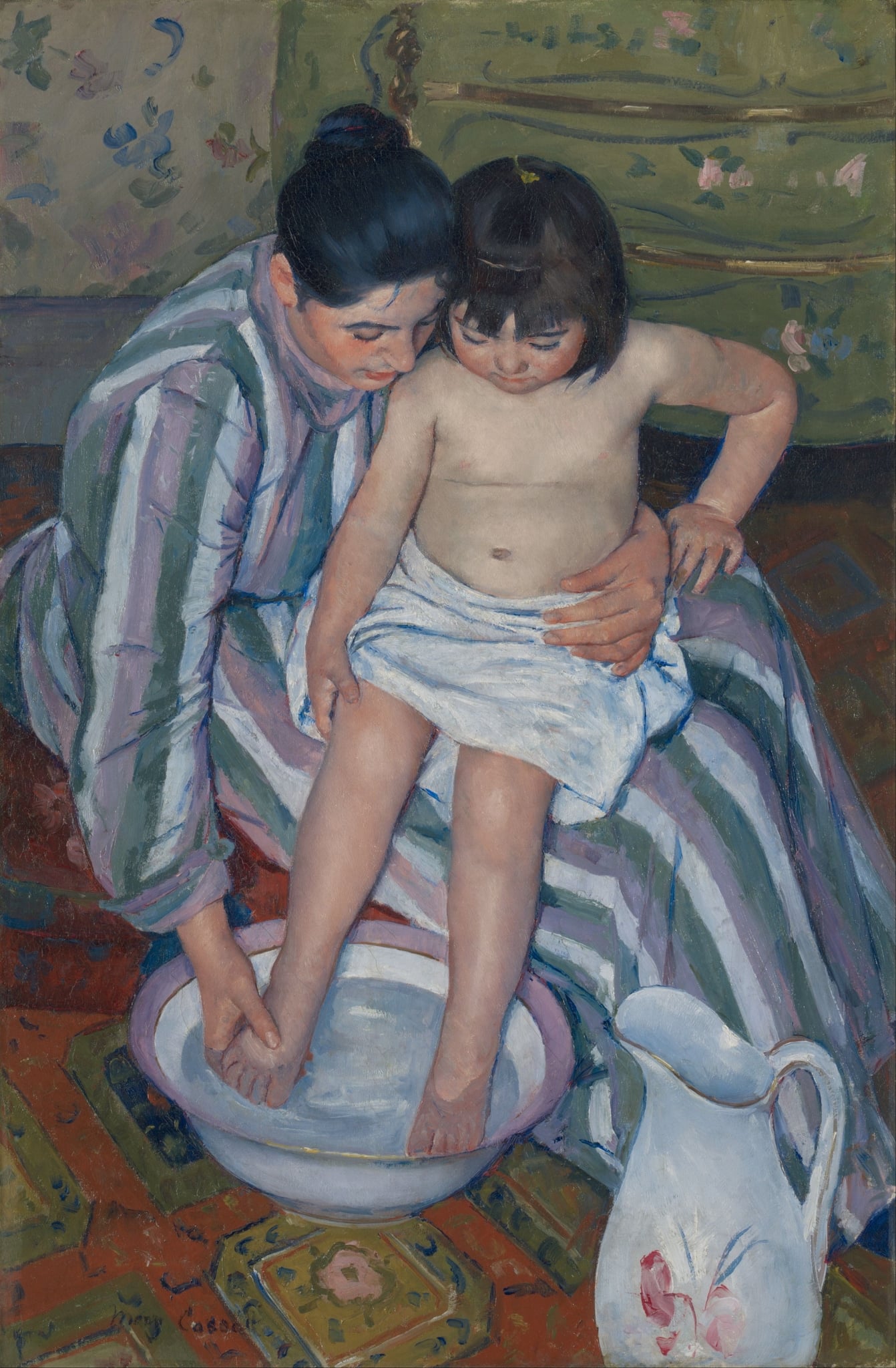
The Child's Bath
Mary Cassatt (1893)
Mary Cassatt’s The Child’s Bath (1893) recasts an ordinary ritual as <strong>modern devotion</strong>. From a steep, print-like vantage, interlocking stripes, circles, and diagonals focus attention on <strong>touch, care, and renewal</strong>, turning domestic labor into a subject of high art <sup>[1]</sup><sup>[3]</sup>. The work synthesizes Impressionist sensitivity with <strong>Japonisme</strong> design to monumentalize the private sphere <sup>[1]</sup><sup>[2]</sup>.
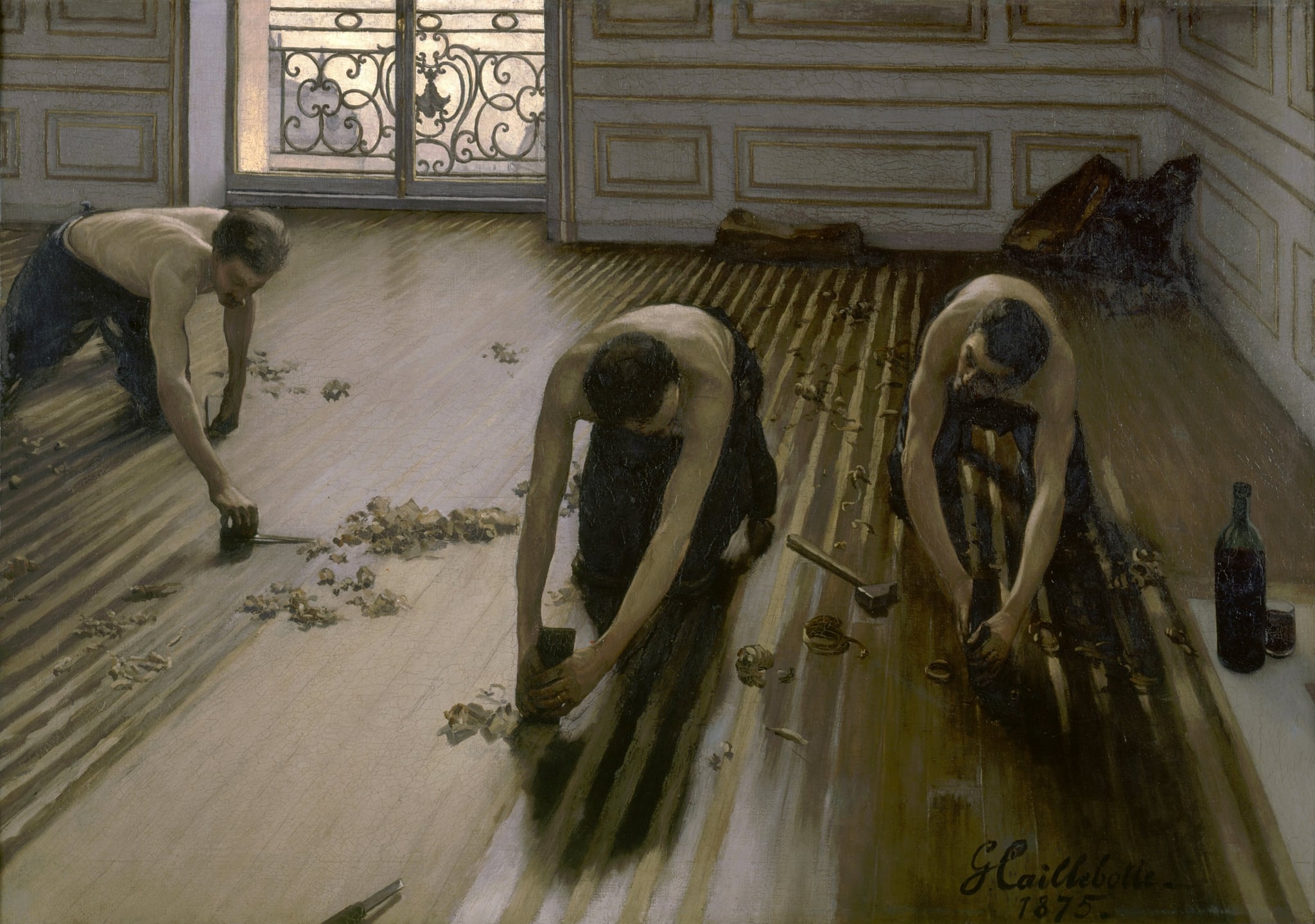
The Floor Scrapers
Gustave Caillebotte (1875)
Gustave Caillebotte’s The Floor Scrapers stages three shirtless workers planing a parquet floor as shafts of light pour through an ornate balcony door. The painting fuses <strong>rigorous perspective</strong> with <strong>modern urban labor</strong>, turning curls of wood and raking light into a ledger of time and effort <sup>[1]</sup><sup>[3]</sup>. Its cool, gilded interior makes visible how bourgeois elegance is built on bodily work.
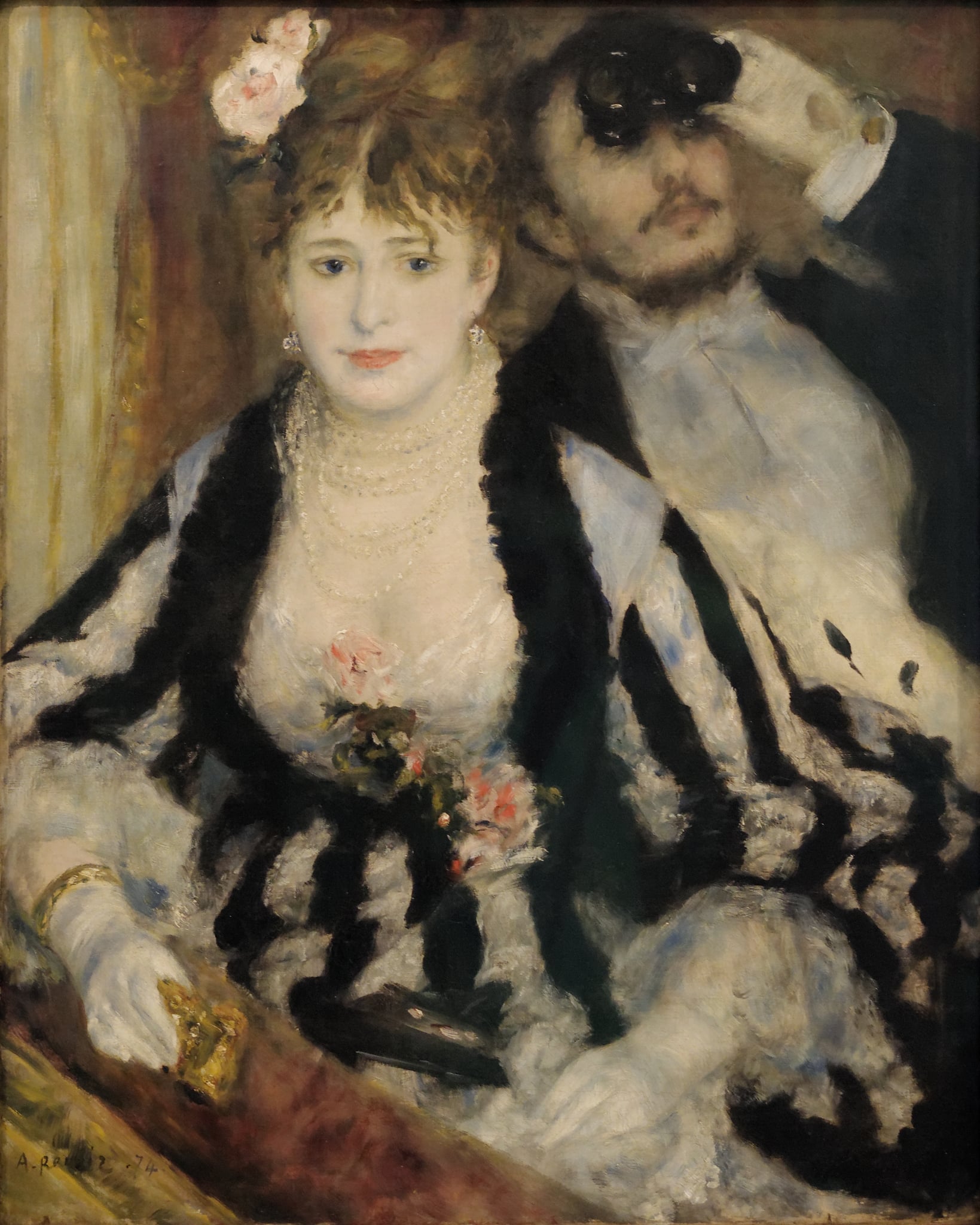
The Loge
Pierre-Auguste Renoir (1874)
Renoir’s The Loge (1874) turns an opera box into a <strong>stage of looking</strong>, where a woman meets our gaze while her companion scans the crowd through binoculars. The painting’s <strong>frame-within-a-frame</strong> and glittering fashion make modern Parisian leisure both alluring and self-conscious, turning spectators into spectacles <sup>[1]</sup><sup>[2]</sup>.
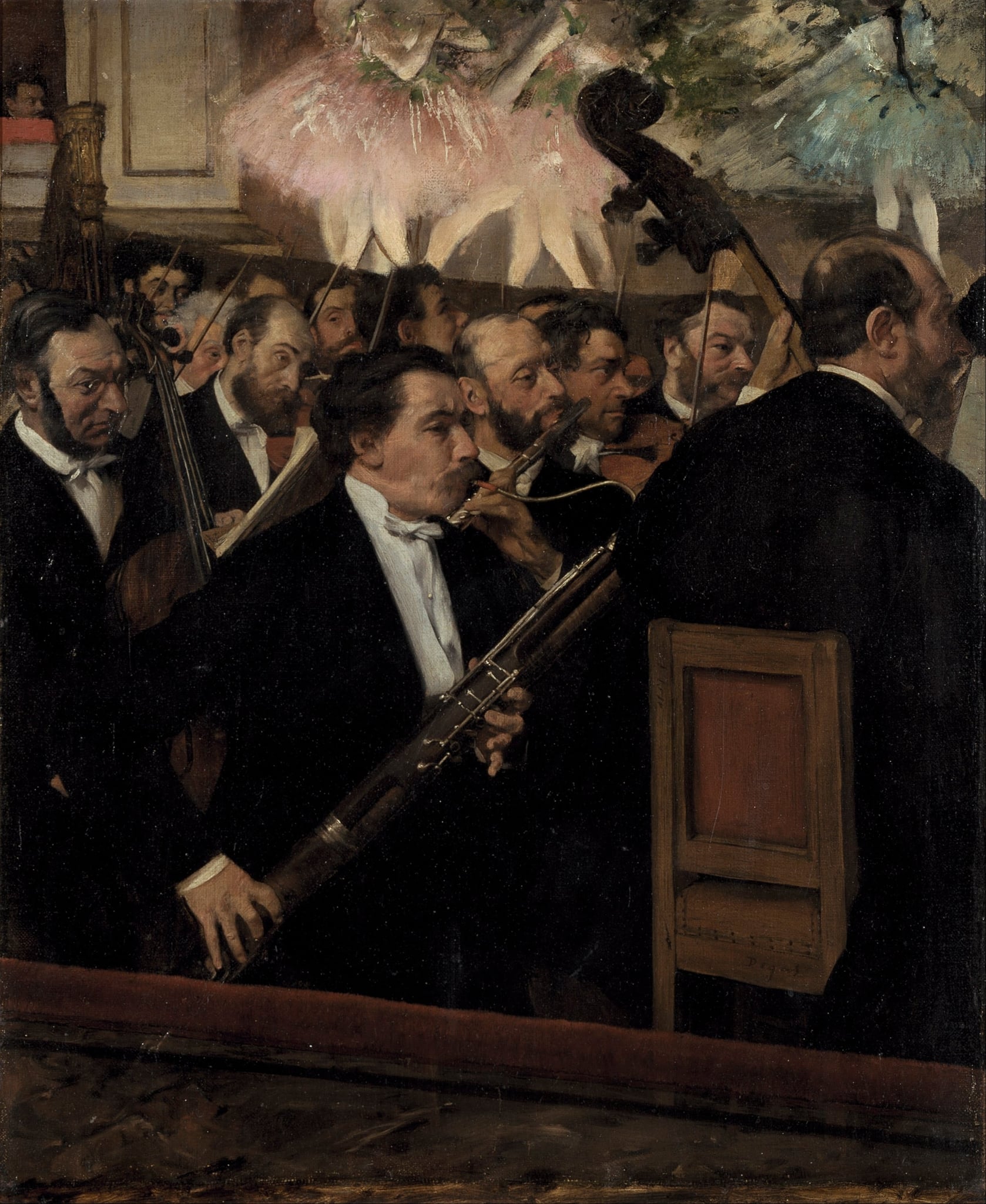
The Opera Orchestra by Edgar Degas | Analysis
Edgar Degas
In The Opera Orchestra, Degas flips the theater’s hierarchy: the black-clad pit fills the frame while the ballerinas appear only as cropped tutus and legs, glittering above. The diagonal <strong>bassoon</strong> and looming <strong>double bass</strong> marshal a dense field of faces lit by footlights, turning backstage labor into the subject and spectacle into a fragment <sup>[1]</sup><sup>[2]</sup>.
The Railway
Édouard Manet (1873)
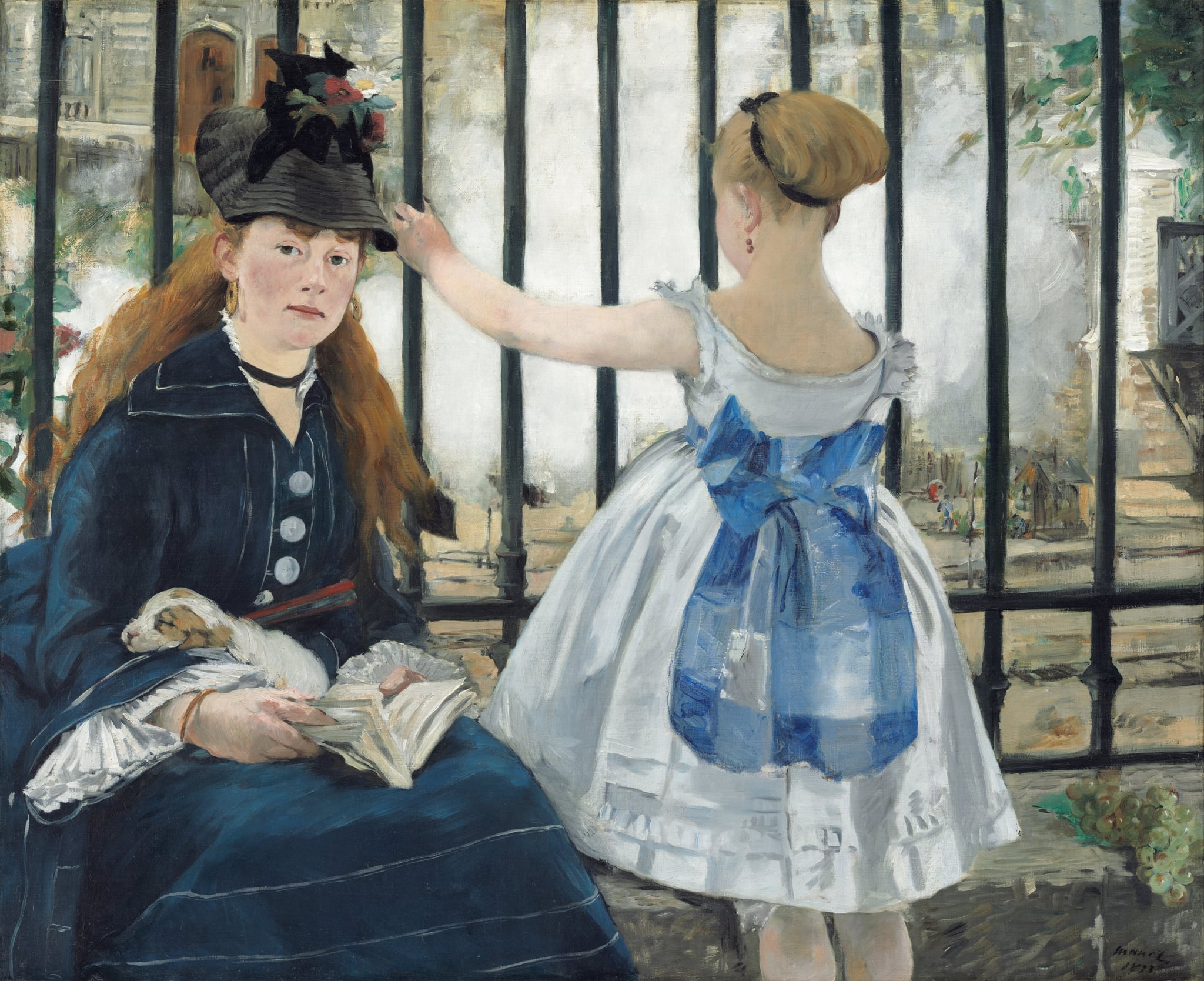
Manet’s The Railway is a charged tableau of <strong>modern life</strong>: a composed woman confronts us while a child, bright in <strong>white and blue</strong>, peers through the iron fence toward a cloud of <strong>steam</strong>. The image turns a casual pause at the Gare Saint‑Lazare into a meditation on <strong>spectatorship, separation, and change</strong> <sup>[1]</sup><sup>[3]</sup>.
The Tub
Edgar Degas (1886)
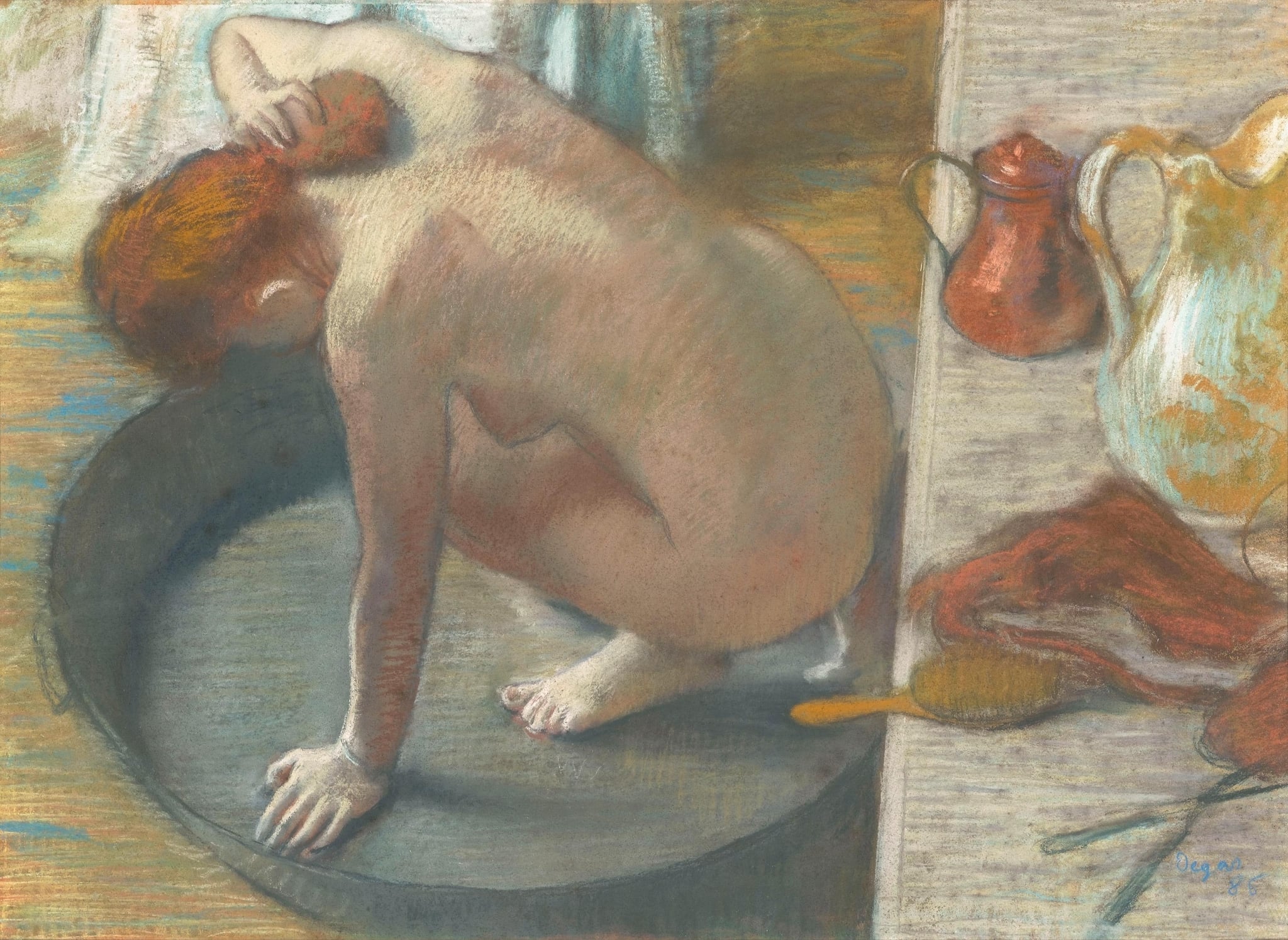
In The Tub (1886), Edgar Degas turns a routine bath into a study of <strong>modern solitude</strong> and <strong>embodied labor</strong>. From a steep, overhead angle, a woman kneels within a circular basin, one hand braced on the rim while the other gathers her hair; to the right, a tabletop packs a ewer, copper pot, comb/brush, and cloth. Degas’s layered pastel binds skin, water, and objects into a single, breathing field of <strong>warm flesh tones</strong> and blue‑greys, collapsing distance between body and still life <sup>[1]</sup>.
Woman Ironing
Edgar Degas (c. 1876–1887)
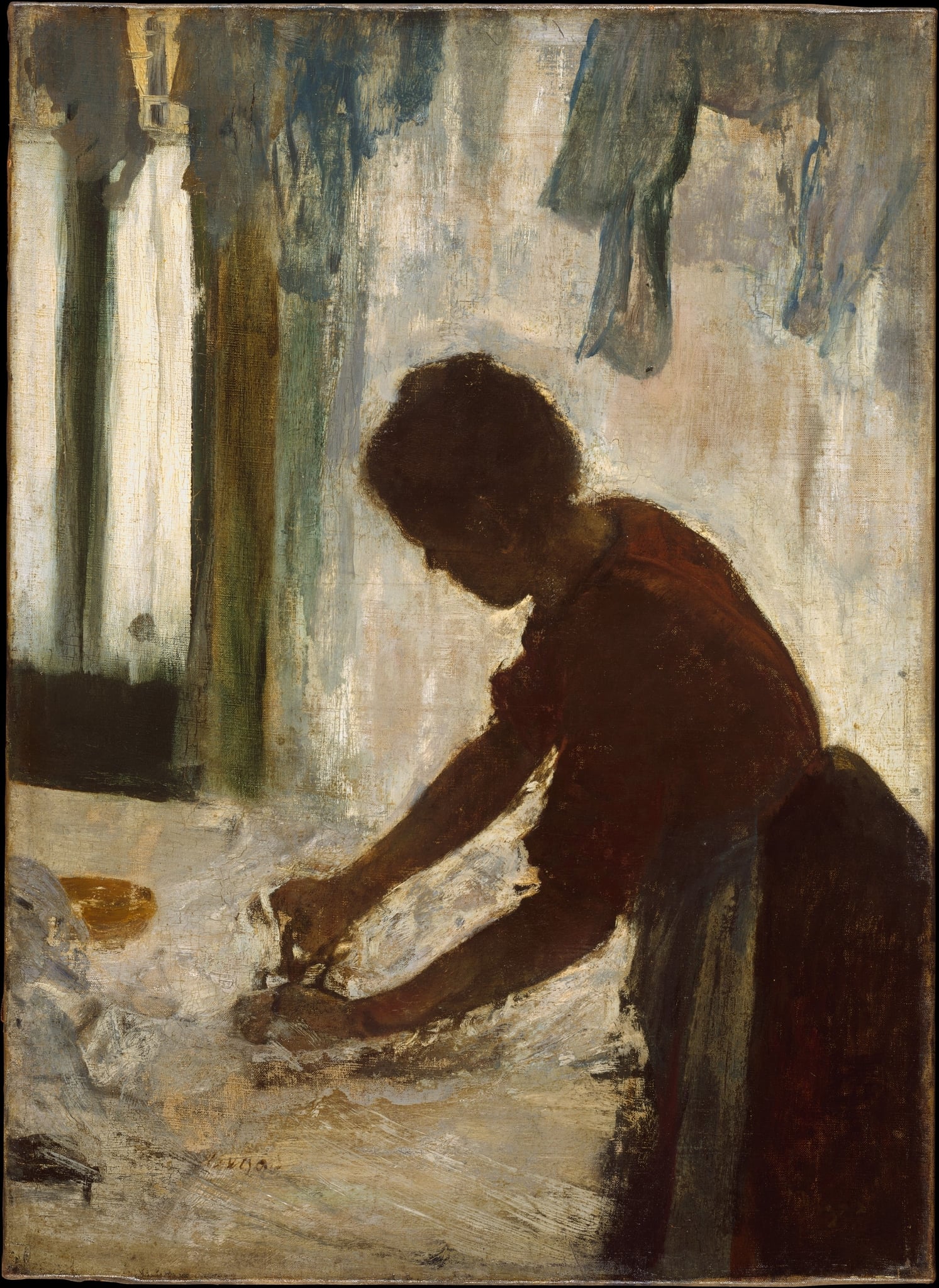
In Woman Ironing, Degas builds a modern icon of labor through <strong>contre‑jour</strong> light and a forceful diagonal from shoulder to iron. The worker’s silhouette, red-brown dress, and the cool, steamy whites around her turn repetition into <strong>ritualized transformation</strong>—wrinkled cloth to crisp order <sup>[1]</sup><sup>[2]</sup>.
Woman Reading
Édouard Manet (1880–82)
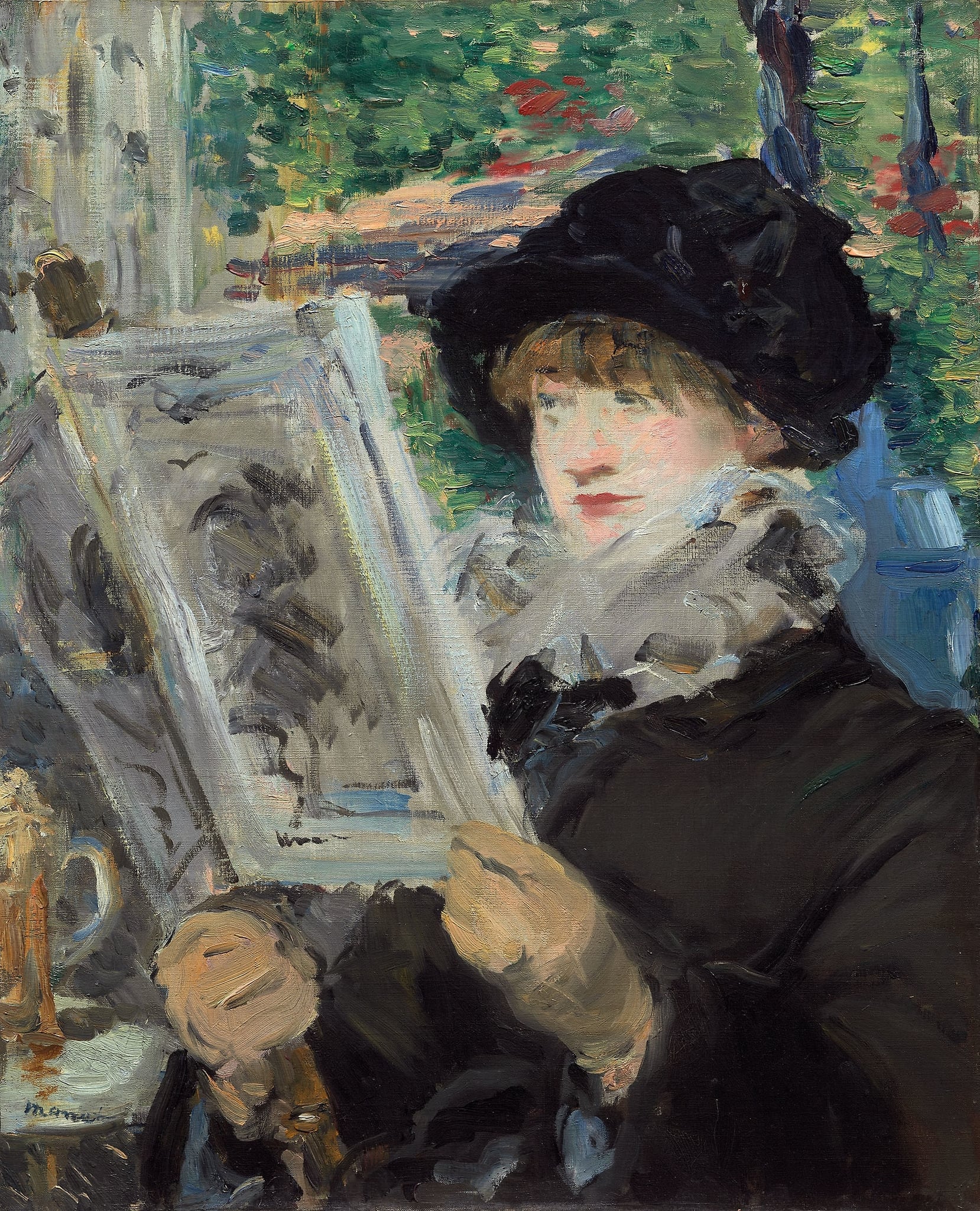
Manet’s Woman Reading distills a fleeting act into an emblem of <strong>modern self-possession</strong>: a bundled figure raises a journal-on-a-stick, her luminous profile set against a brisk mosaic of greens and reds. With quick, loaded strokes and a deliberately cropped <strong>beer glass</strong> and paper, Manet turns perception itself into subject—asserting the drama of a private mind within a public café world <sup>[1]</sup><sup>[2]</sup>.
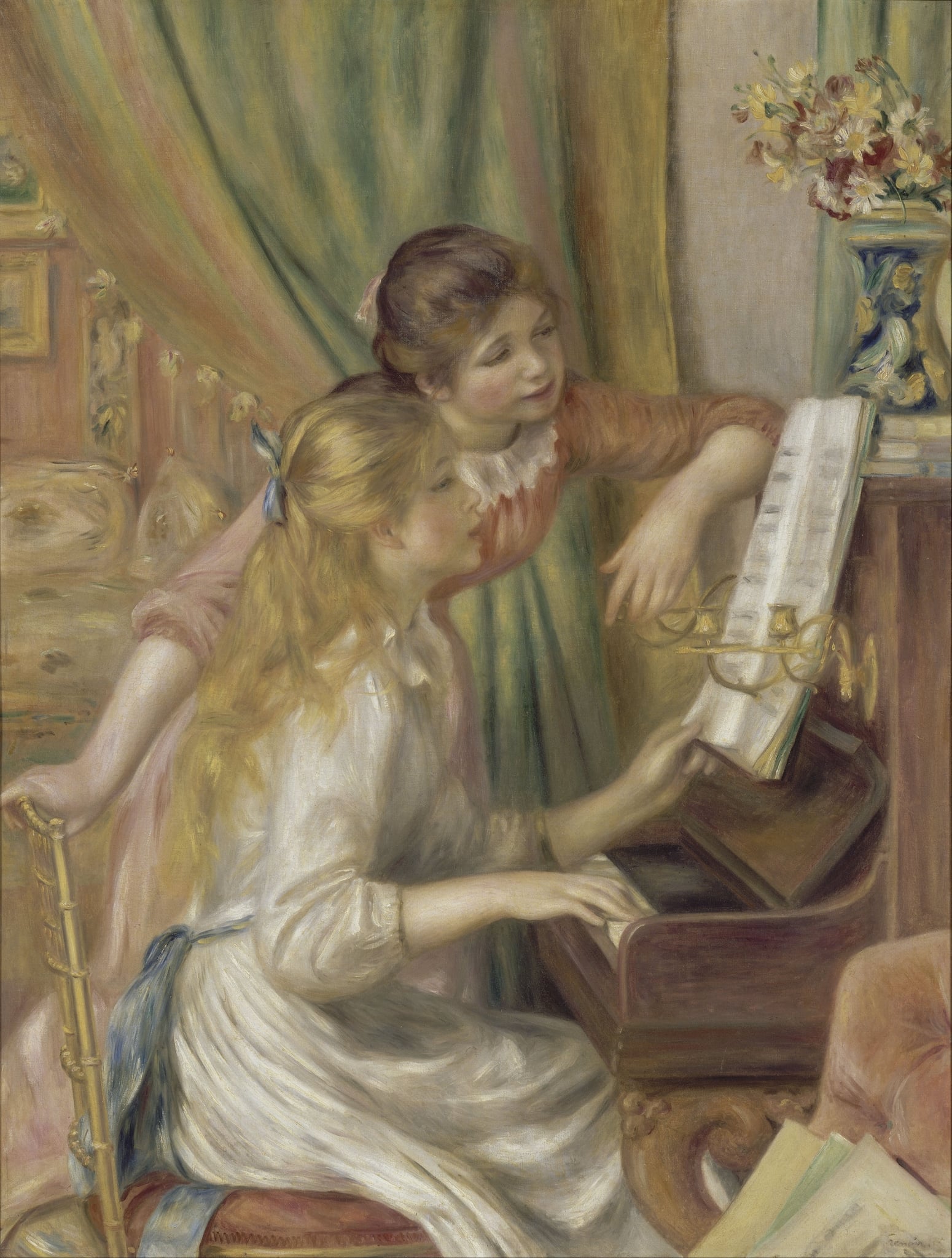
Young Girls at the Piano
Pierre-Auguste Renoir (1892)
Renoir’s Young Girls at the Piano turns a quiet lesson into a scene of <strong>attunement</strong> and <strong>bourgeois grace</strong>. Two adolescents—one seated at the keys, the other leaning to guide the score—embody harmony between discipline and delight, rendered in Renoir’s late, <strong>luminous</strong> touch <sup>[1]</sup><sup>[2]</sup>.
Related Themes
Related Symbolism Categories
Objecthood
The “Objecthood” symbolism category traces how seemingly ordinary implements—bottles, clocks, mirrors, gloves, café tableware—become charged mediators of labor, time, spectacle, and selfhood in modern painting, shifting from stable attributes to critical signs of fractured, commodity-driven experience.
Domesticity
The “Domesticity” symbolism category traces how modern artists transform humble household objects, routines, and furnishings into a complex visual language of labor, intimacy, and psychological tension within the home and its adjacent social spaces.
Interiority
“Interiority” symbols in modern painting transform gesture, gaze, and domestic props into visual indices of inward life, staging psychological depth, self-consciousness, and mediated subjectivity within scenes of everyday modernity.
Within the long history of Western painting, objects rarely appear as neutral decor. From early modern emblem books to nineteenth‑century realism and Impressionism, things—be they books, clocks, bottles, or musical instruments—act as semiotic nodes where social practice, ideology, and visual structure converge. The symbolic category of “object” thus encompasses not only inherited iconographic codes (bread as Eucharistic sign, the lute as harmony) but also newer, historically specific props of modern life: café tableware, branded bottles, gas lamps, and locomotives. In the works considered here, artists mobilize such objects to negotiate the relation between work and leisure, private ritual and public spectacle, and, crucially, between looking and being looked at.
Semiotically, these objects function as both indices of concrete practices and symbols of more abstract states. In Cézanne’s Still Life with Apples and Oranges, the footed compote, kinked table edge, and plate of biscuits are first of all domestic furnishings set upon a table; yet the compote becomes a mediating vertical axis, the biscuits a sign of ordered habit, and the table’s deliberate misalignment an emblem of vision as constructed from multiple viewpoints rather than anchored in a single, sovereign gaze. The objects anchor perception even as they call its stability into question.
In Manet’s A Bar at the Folies-Bergère, objects are explicitly bound to the economy of modern spectacle. Branded bottles—Bass beer with its red triangle and carefully rendered champagne labels—operate as emblems of commercial spectacle and globalized consumer culture, aligning pleasure with standardized, purchasable labels. The central bottle acts as a vertical axis mediating between viewer and barmaid, an impartial presence that divides the pictorial field into reciprocal halves: our frontal encounter with Suzon, and the skewed theater of mirror and crowd behind her. Café tableware and the marble café table itself underscore that this is a scene of consumption and nightlife commerce, where intoxication lubricates sociability at a cost. These objects do not merely populate the bar; they frame the barmaid as both vendor and commodity, so that the very apparatus of serving—bottles, glasses, polished marble—becomes a visual grammar for the commodification of people.
Manet’s Plum Brandy pursues the opposite pole of café life: isolation within the public sphere. Here the cool marble café table forms a barrier across the foreground, a horizontal band that both separates and connects viewer and sitter. On it stand the glass with plum brandy and an unlit cigarette. The glass, cradling a preserved plum suspended in amber liquid, signifies sweet indulgence held in reserve—consumption deferred rather than enacted. The open matchbox, implied by the presence of an unlit cigarette and the after‑meal setting, would mark a transition from eating to repose, yet the cigarette remains idle. Tableware, carafe, and glass are thus semiotic markers of an after‑meal ritual of refinement and sociability, and at the same time signs of interruption: the woman’s attention has drifted elsewhere, making these props tokens of a pause rather than of convivial exchange.
Renoir’s café and terrace scenes elaborate a related but more overtly social object-world. In Dance in the Country, the small table with cup, spoon, decanter, and half‑filled glass documents the material culture of café sociability. The couple have just risen, leaving behind the residue of conversation—the unfinished drink, the displaced napkin—so that café tableware becomes a trace of conviviality interrupted by music. In In the Garden, Renoir sharpens the mediating role of the red folding café table: structurally, it creates a diagonal barrier between suitor and young woman; symbolically, it embodies modern leisure and a polite, negotiable distance, allowing a tentative handclasp while maintaining decorum. The bouquet on the table, accompanied by a straw hat, reads as a conventional sign of courtship, but its scattering across the slatted surface hints at the fragility of the bond. Here, the table is not a neutral support but a social instrument that stages both opportunity and constraint.
If the café table and its accessories articulate new rituals of sociability, other objects in these works index modern urban order and infrastructure. In Renoir’s Pont Neuf Paris, aligned gas lamps punctuate the bridge’s sweep, their even spacing turning illumination into a symbol of planned civic rhythm. They guide the movement of pedestrians and carriages, inscribing a new, technologically enabled order onto the historic fabric of the city. The long urban parapet, like the long mahogany counters and brass instrument cases that structure interiors in other modern scenes, functions as a subtle barrier and organizer of social space: everyday order materialized in wood and metal.
Time and inheritance enter this system of objects in more overtly emblematic form in Degas’s The Bellelli Family. The gilt mantel clock, poised atop the rigid mantelpiece, embodies measured domestic time and the pressure of routine. Its gilded case signals status, while its very function—keeping time—stitches the family’s frozen standoff to an inexorable temporal flow. Together with the gilt mirror and ornamental box, the clock transforms the mantel into a shallow stage where duty, inheritance, and social order are displayed and regulated. In this context, the clock is a moral object: a visible metronome of obligation that bears down on the separated figures, especially on the mother, whose vertical black column aligns with the ancestor’s portrait above and thus with genealogical time.
Cézanne’s and Van Gogh’s still lifes approach objects from yet another angle: they investigate not only what things mean but how they mean. In Still Life with Apples and Oranges, the footed compote—its bowl leaning slightly forward—concentrates fruit into a compact mound, acting as a mediating structure that both elevates and threatens instability. The plate of biscuits, seen from shifting viewpoints along with the kinked table edge, symbolizes domestic routine while making that routine the site of epistemological inquiry: perception itself is shown to be pieced together from sequential glances. In Van Gogh’s Sunflowers, the signed earthenware vase is remarkably plain, yet it functions as a self‑presentation: the artist posits himself as host and maker, offering a bouquet whose fifteen heads chart a full cycle from bud to desiccated seed head. The vase, a humble domestic vessel, becomes a pedestal for an entire meditation on endurance, fellowship, and time, its inscription “Vincent” binding personal identity to the act of giving.
Across these examples, one can trace both continuity and transformation in object symbolism. Traditional iconographic meanings persist—bread remains charged with Eucharistic connotations; musical instruments still connote harmony and discipline—but they are increasingly joined, and sometimes displaced, by historically specific sign systems: branded labels, café paraphernalia, gaslight, locomotives, gilt clocks of bourgeois interiors. Objects in nineteenth‑century painting no longer serve merely as stable emblems; they become tools for thinking about spectatorship, social relations, and the constructed nature of perception itself. Bottles measure not only thirst but commodity culture; tables articulate not simply support but negotiated distance; clocks register not just passing time but the temporal discipline of modern domesticity. The evolution of object symbolism thus charts the passage from a world of relatively fixed iconographic codes to one in which the semiotics of everyday things are themselves a central subject of art.