Devotion
The Devotion symbolism category traces how Christian and later European artists crystallized acts of faith—personal, communal, and civic—into recurring visual motifs that bind doctrine to lived practice and interior belief to public ritual.
Featured Artworks
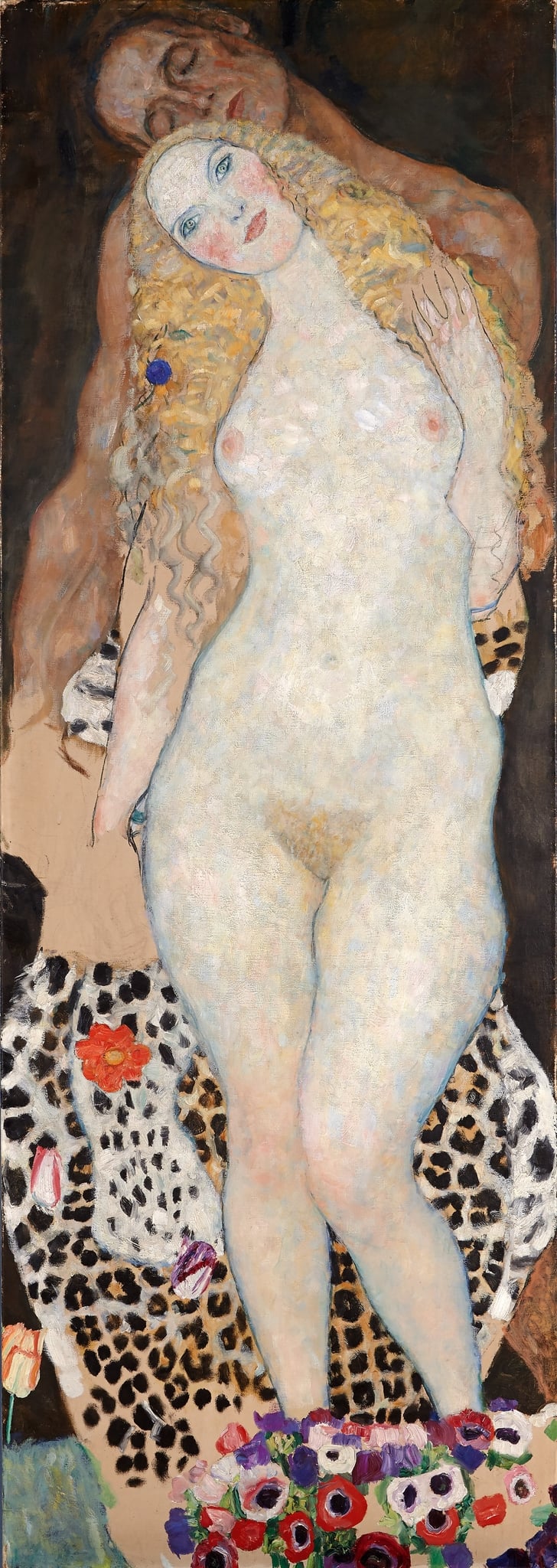
Adam and Eve
Gustav Klimt (1916–1918 (unfinished))
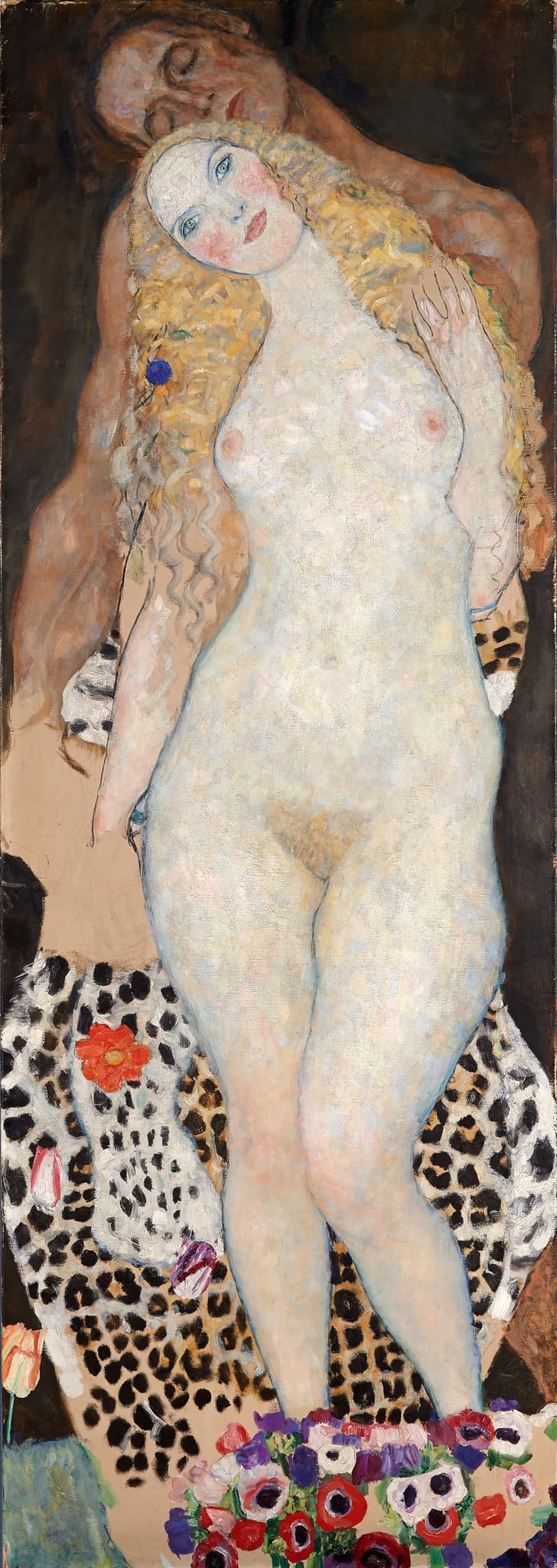
Gustav Klimt’s Adam and Eve recasts the biblical pair as a <strong>sensual, timeless allegory</strong> rather than a didactic tale. Eve’s <strong>luminous, opalescent body</strong> and direct gaze dominate, while Adam recedes in shadow, enfolding her amid a <strong>leopard pelt</strong> and a <strong>carpet of anemones</strong> that signal erotic vitality and fertility <sup>[2]</sup><sup>[3]</sup>.
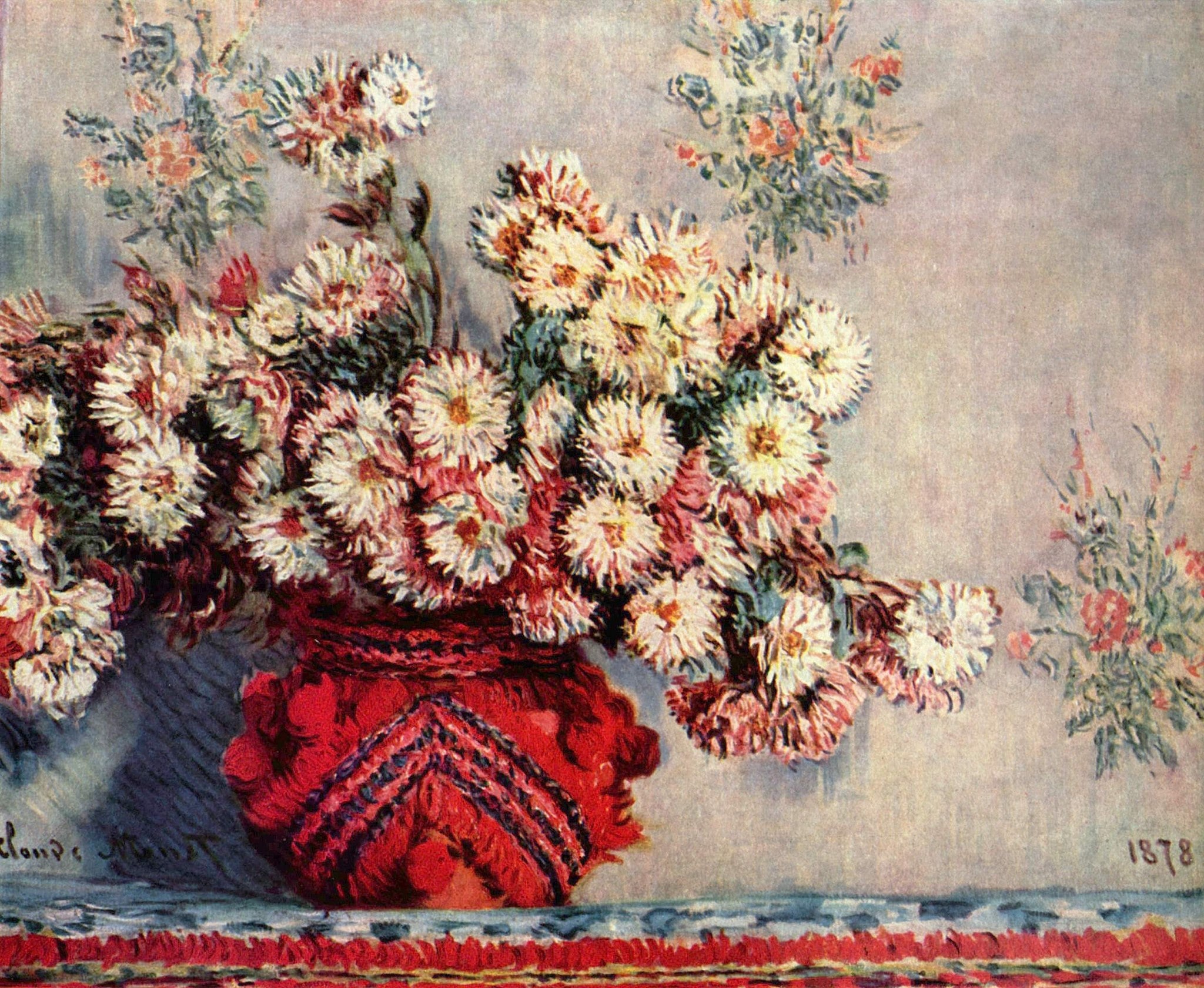
Chrysanthemums
Claude Monet (1878)
Claude Monet’s Chrysanthemums fixes a burst of late‑season bloom in a <strong>scarlet, plush‑textured vase</strong> against a cool <strong>blue‑gray wall</strong> where faint floral <strong>sprigs</strong> echo the bouquet. The painting privileges <strong>vibration of color</strong> over contour, turning still life into a decorative field. It condenses autumnal abundance and the fleetingness of light into a single, shimmering sensation <sup>[1]</sup><sup>[2]</sup>.
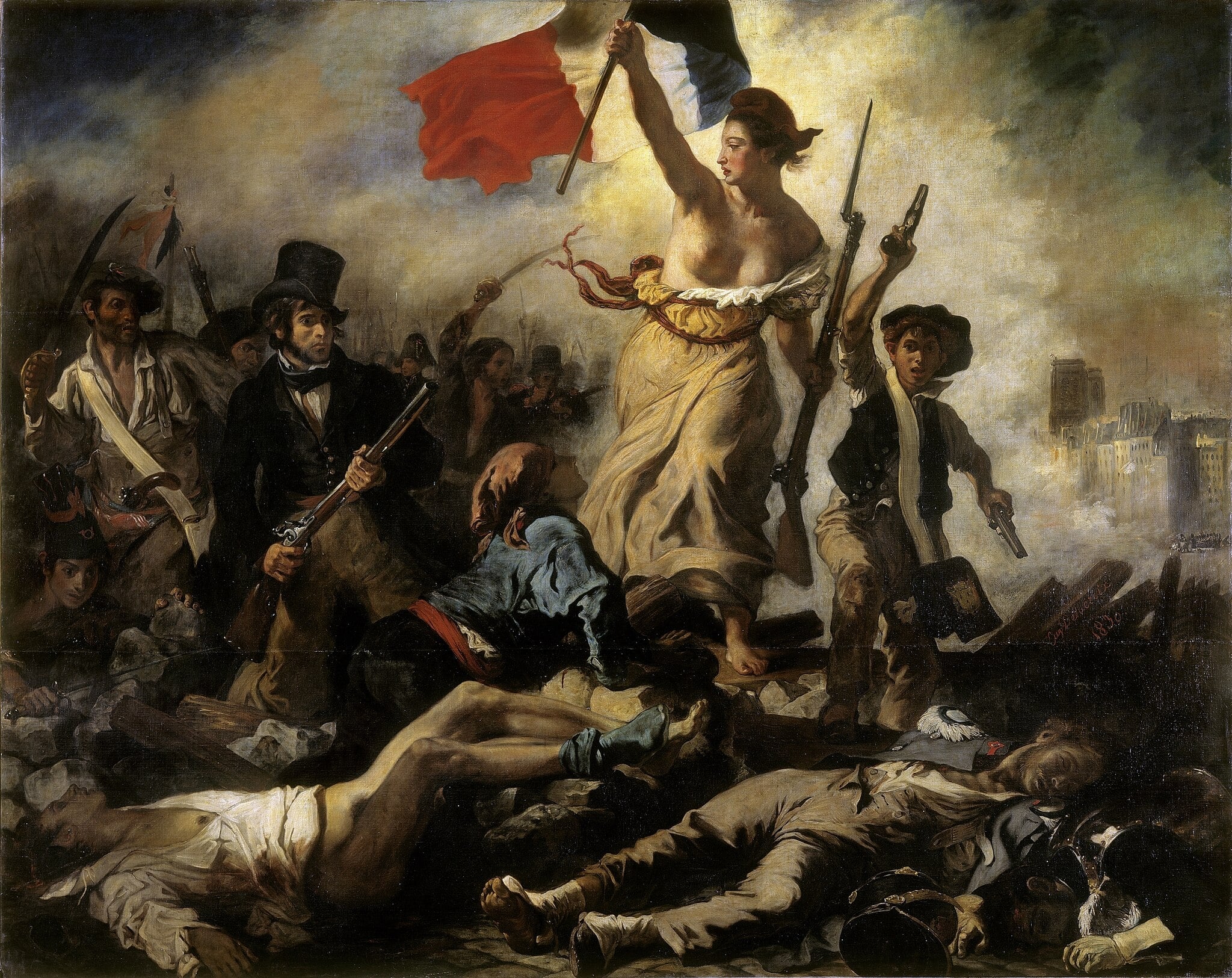
Liberty Leading the People
Eugene Delacroix (1830)
<strong>Liberty Leading the People</strong> turns a real street uprising into a modern myth: a bare‑breasted Liberty in a <strong>Phrygian cap</strong> thrusts the <strong>tricolor</strong> forward as Parisians of different classes surge over corpses and rubble. Delacroix binds allegory to eyewitness detail—Notre‑Dame flickers through smoke, a bourgeois in a top hat shoulders a musket, and a pistol‑waving boy keeps pace—so that freedom appears as both idea and action <sup>[1]</sup><sup>[2]</sup>. After its 2024 cleaning, sharper blues, whites, and reds re‑ignite the painting’s charged color drama <sup>[4]</sup>.
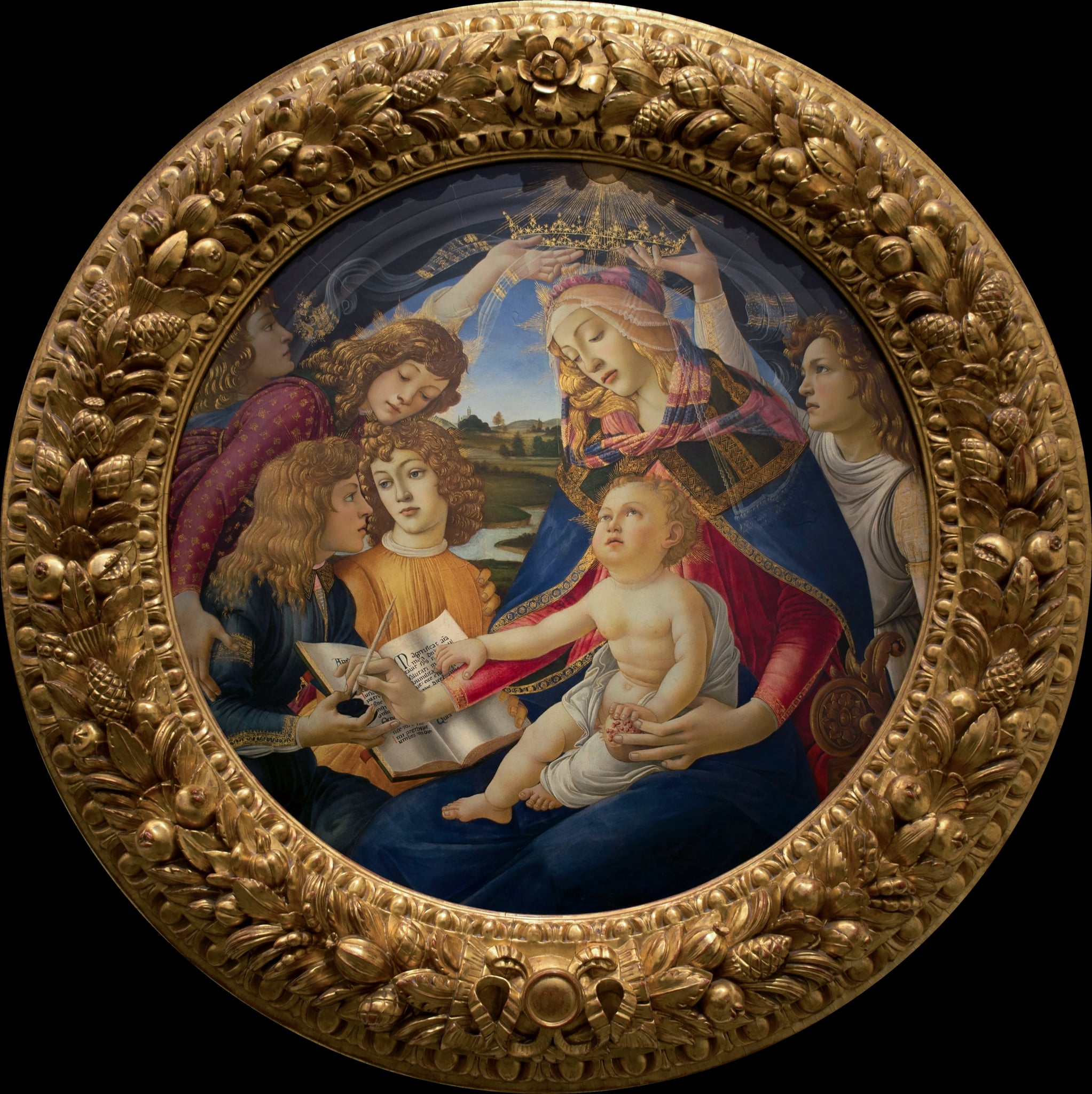
Madonna of the Magnificat
Sandro Botticelli (c. 1483)
Botticelli’s Madonna of the Magnificat is a circular panel where the Virgin, <strong>crowned by angels</strong>, writes the <strong>Magnificat</strong> as the Christ Child guides her hand. A split <strong>pomegranate</strong> in the Child’s grasp prefigures the Passion while the wingless, courtly angels and a Tuscan view bind sacred mystery to Florentine life <sup>[1]</sup><sup>[2]</sup>. The tondo’s swirl of fabrics and gold makes theology visible as a choreography of <strong>praise, prophecy, and sacrifice</strong>.
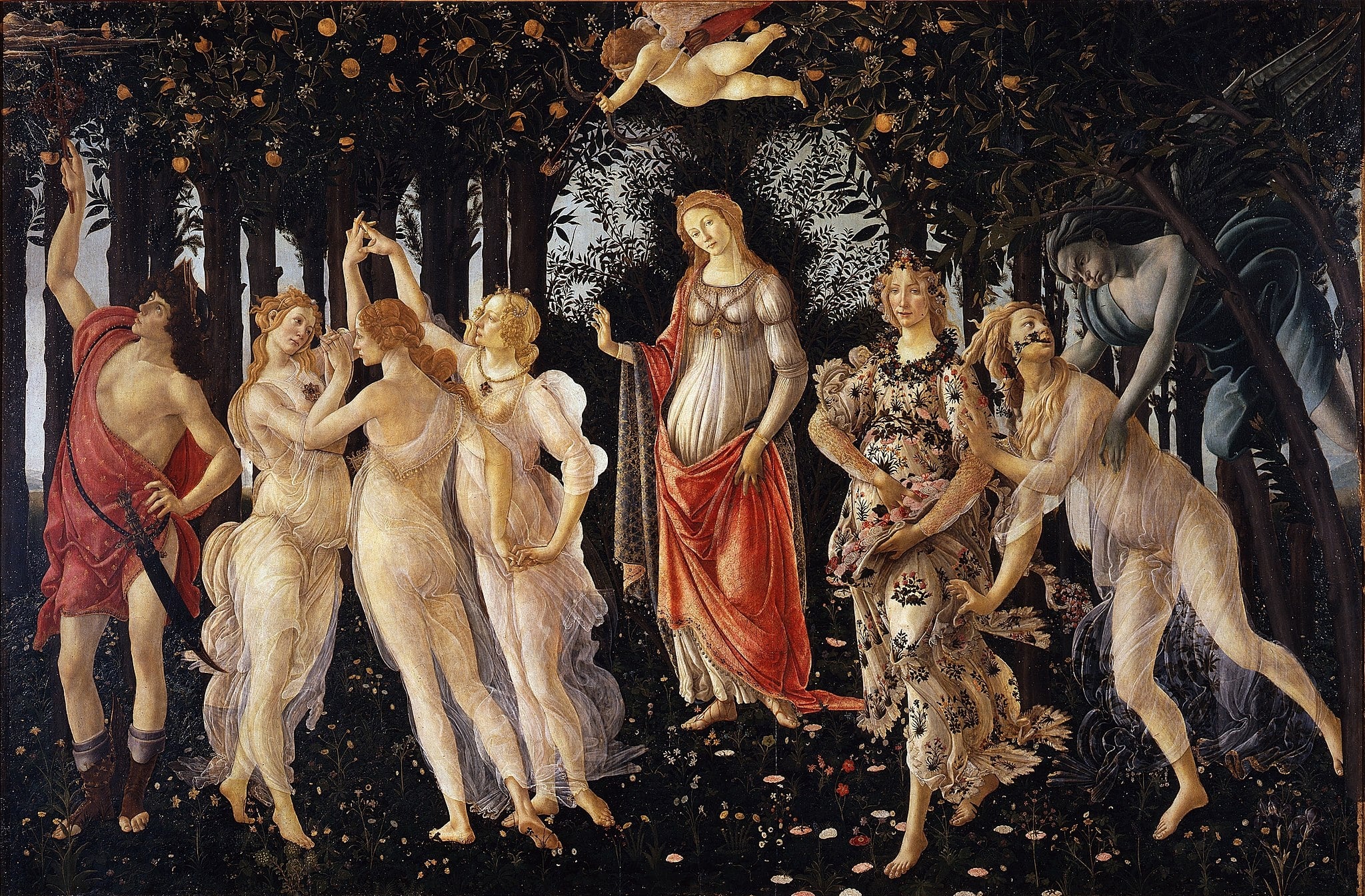
Primavera
Sandro Botticelli (c. 1480 (1477–1482))
Primavera stages a mythic procession of <strong>Spring</strong> in an orange and laurel grove: <strong>Venus</strong> presides beneath a myrtle canopy as <strong>Cupid</strong> looses an arrow, <strong>Mercury</strong> clears the last clouds, the <strong>Three Graces</strong> dance, and <strong>Zephyrus</strong> pursues <strong>Chloris</strong>, who blossoms into <strong>Flora</strong>. The carpet of more than a hundred identifiable flowers and the Medici-laden orchard declare <strong>fertility, peace, and ordered prosperity</strong> under Venus’s benign rule <sup>[1]</sup><sup>[2]</sup>.
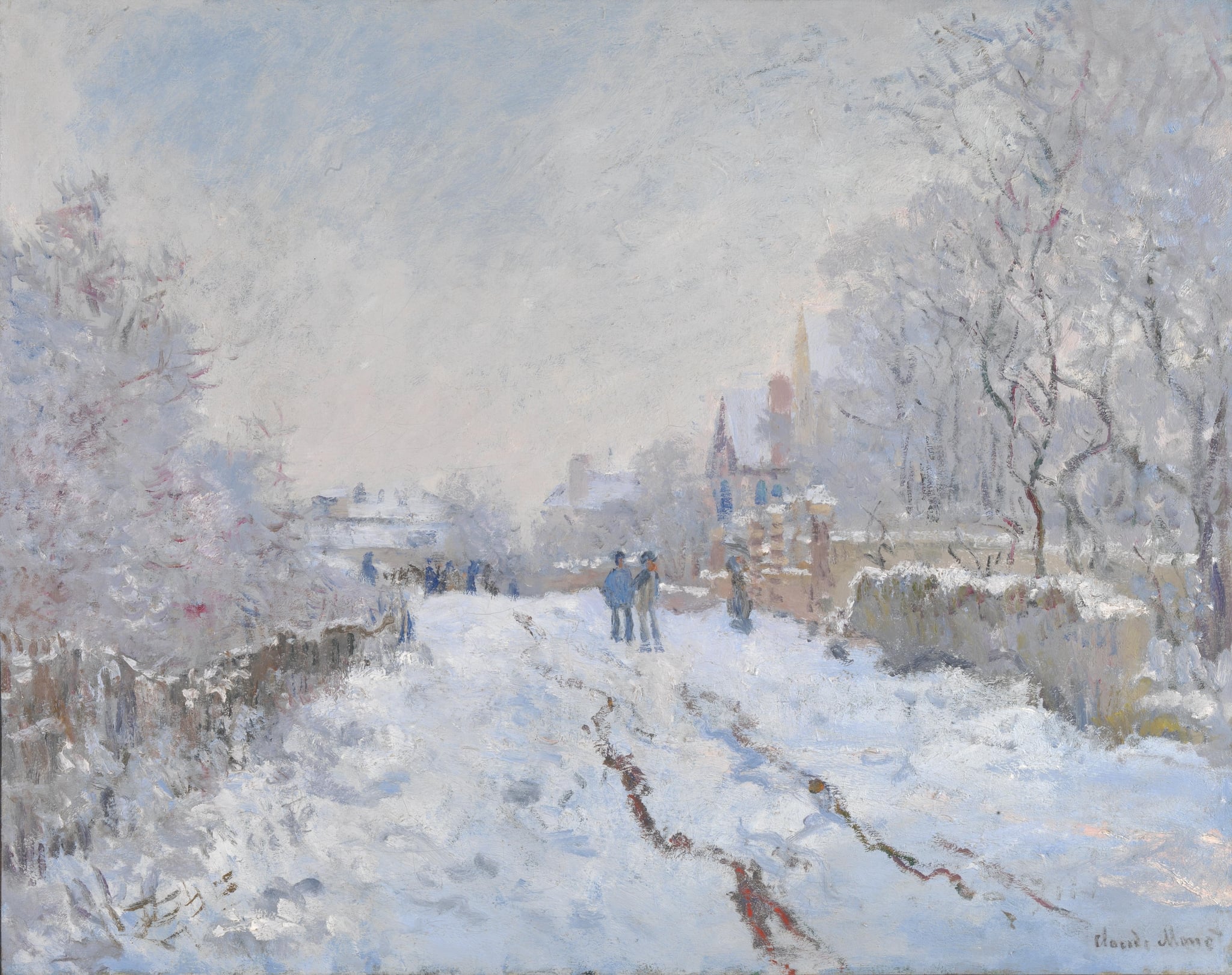
Snow at Argenteuil
Claude Monet (1875)
<strong>Snow at Argenteuil</strong> renders a winter boulevard where light overtakes solid form, turning snow into a luminous field of blues, violets, and pearly pinks. Reddish cart ruts pull the eye toward a faint church spire as small, blue-gray figures persist through the hush. Monet elevates atmosphere to the scene’s <strong>protagonist</strong>, making everyday passage a meditation on time and change <sup>[1]</sup><sup>[2]</sup>.
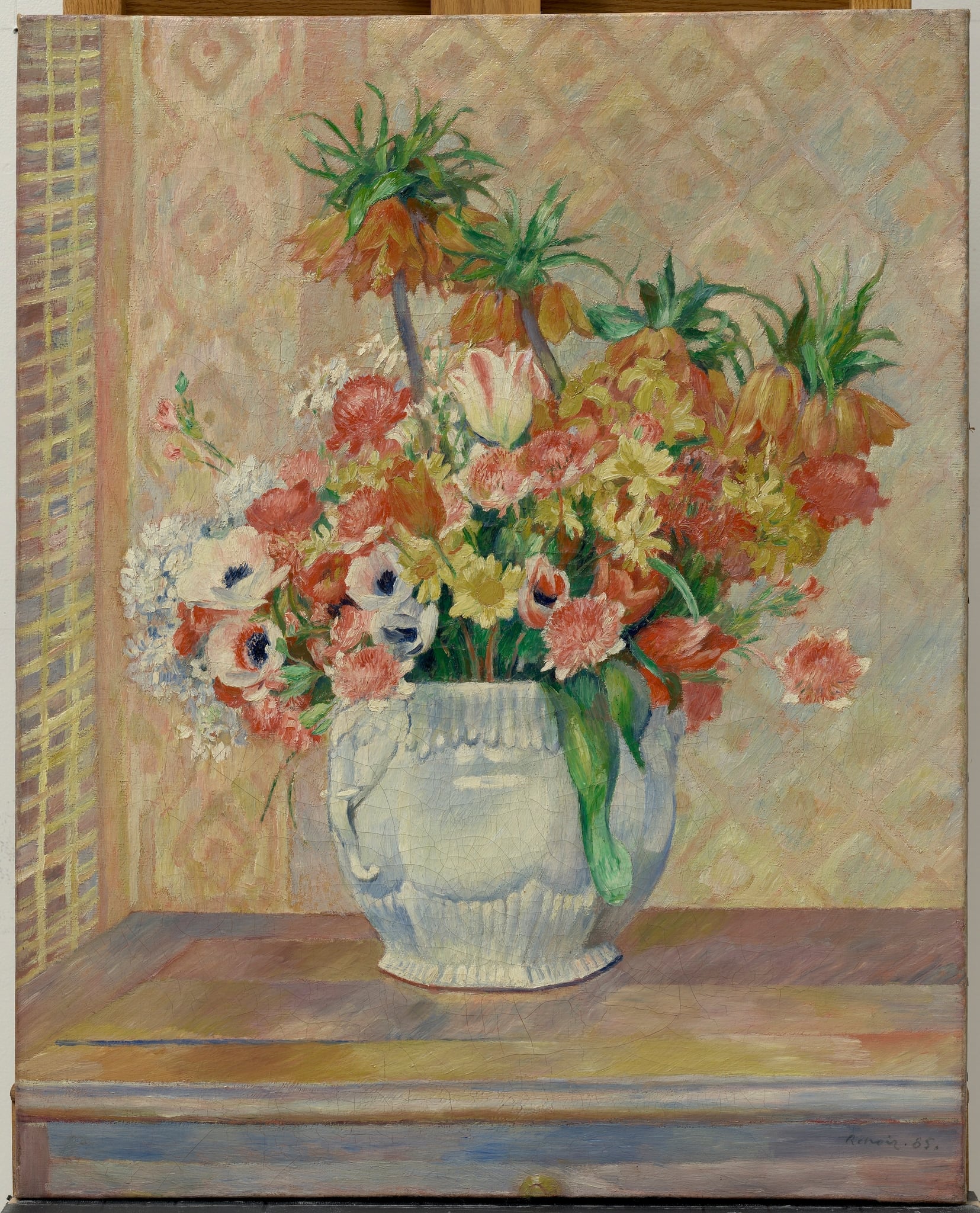
Still Life with Flowers
Pierre-Auguste Renoir (1885)
Pierre-Auguste Renoir’s Still Life with Flowers (1885) sets a jubilant bouquet in a pale, crackled vase against softly dissolving wallpaper and a wicker screen. With quick, clear strokes and a centered, oval mass, the painting unites <strong>Impressionist color</strong> with a <strong>classical, post-Italy structure</strong> <sup>[1]</sup><sup>[2]</sup><sup>[4]</sup>. The slight droop of blossoms turns the domestic scene into a gentle <strong>vanitas</strong>—a savoring of beauty before it fades <sup>[5]</sup>.
The Ambassadors
Hans Holbein the Younger (1533)
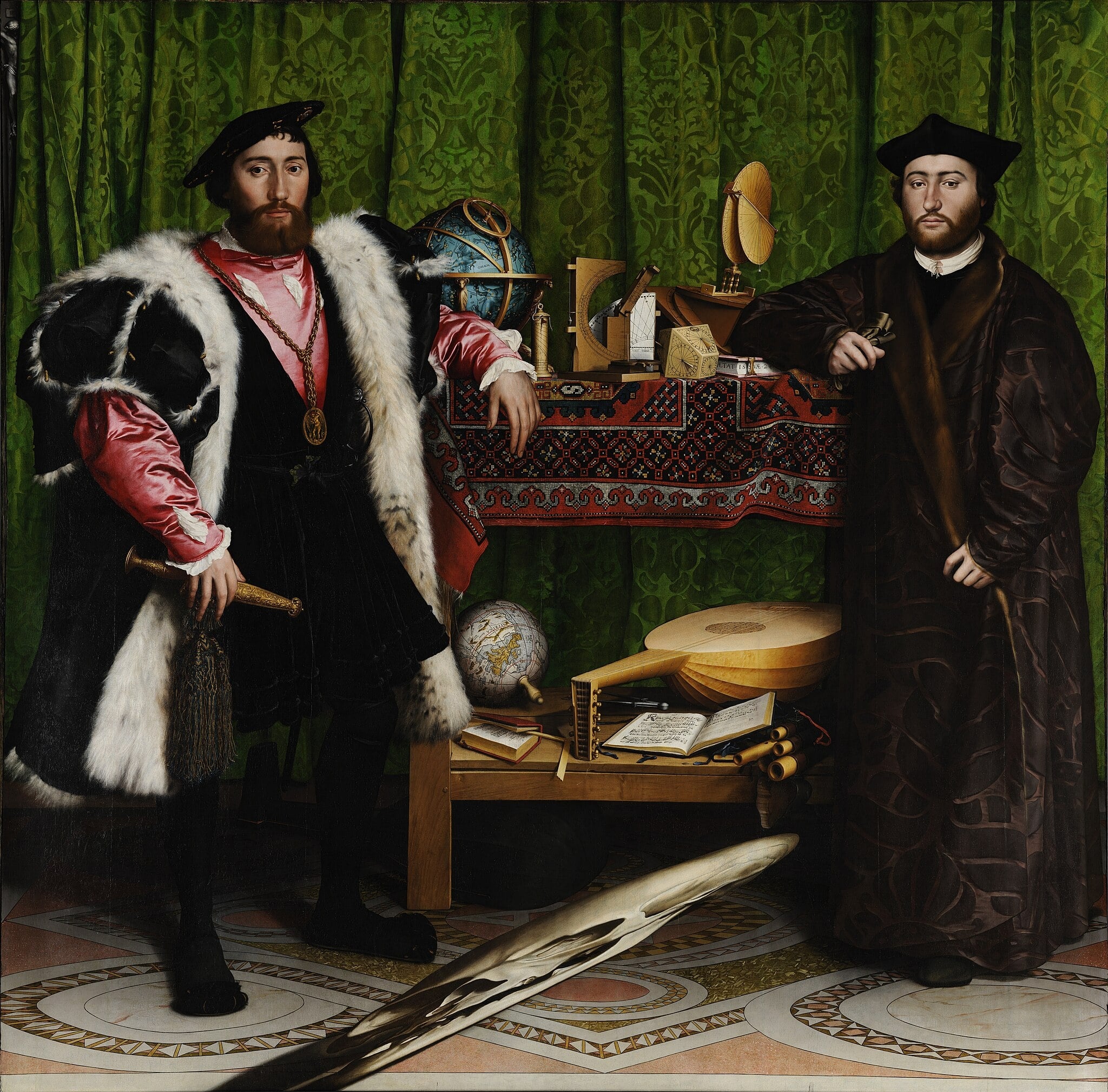
Holbein’s The Ambassadors is a double-portrait staged before a green curtain, where shelves of scientific instruments, books, and musical devices enact <strong>Renaissance learning</strong> while an anamorphic <strong>skull</strong> and a veiled <strong>crucifix</strong> counter it with mortality and salvation <sup>[1]</sup><sup>[2]</sup>. The work balances worldly status—fur, velvet, Oriental carpet—with a sober theology of limits amid the <strong>Reformation’s discord</strong> <sup>[1]</sup><sup>[2]</sup>.
The Angelus
Jean-Francois Millet (1857–1859)
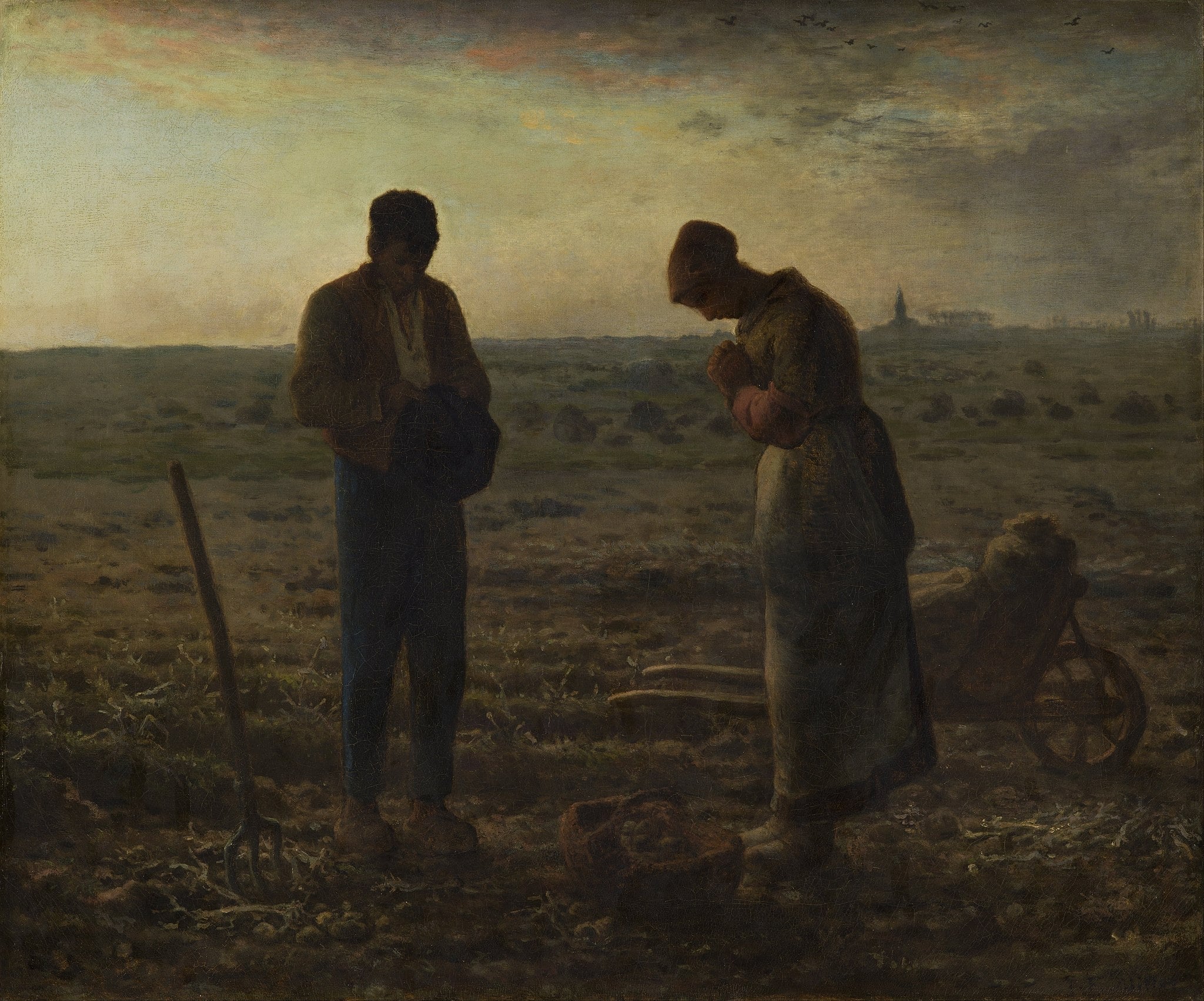
Jean-Francois Millet’s The Angelus (1857–1859) fuses <strong>devotion</strong> and <strong>labor</strong>: two peasants pause at dusk, heads bowed, as the Angelus bell sounds from a distant steeple. With a <strong>low horizon</strong>, earthen palette, and monumental silhouettes, the painting makes a brief pause in fieldwork feel timeless and sacred <sup>[1]</sup><sup>[2]</sup>.
The Assumption of the Virgin
Titian (1516–1518)
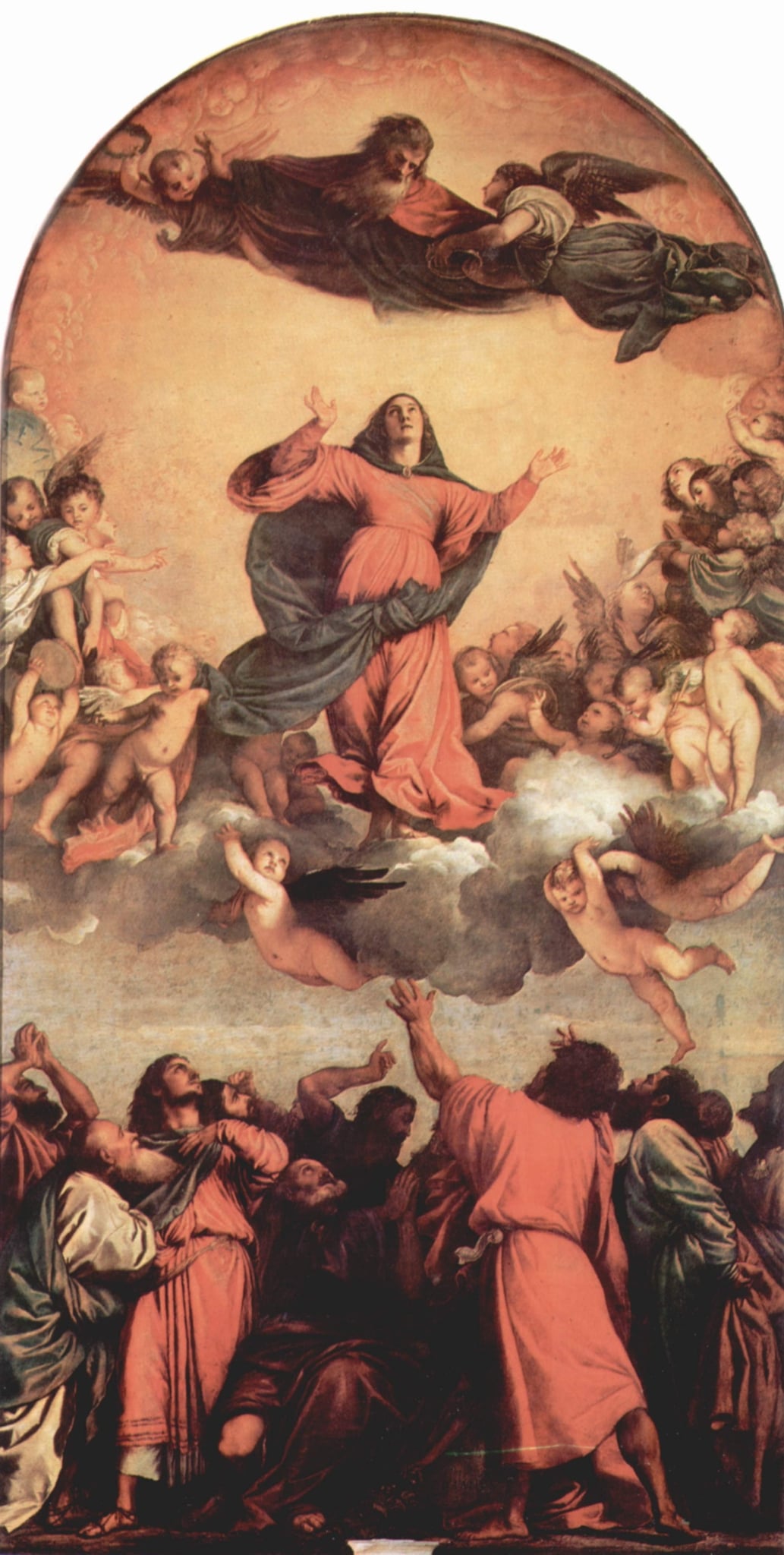
Titian’s The Assumption of the Virgin stages a three-tier ascent—apostles below, Mary rising on clouds, and God the Father above—fused by radiant light and Venetian <strong>colorito</strong>. Mary’s red and blue drapery, open <strong>orant</strong> hands, and the vortex of putti visualize grace lifting humanity toward the divine. The painting’s scale and kinetic design turned a doctrinal mystery into a public, liturgical drama for Venice. <sup>[1]</sup><sup>[2]</sup>
The Birth of Venus
Sandro Botticelli (c. 1484–1486)
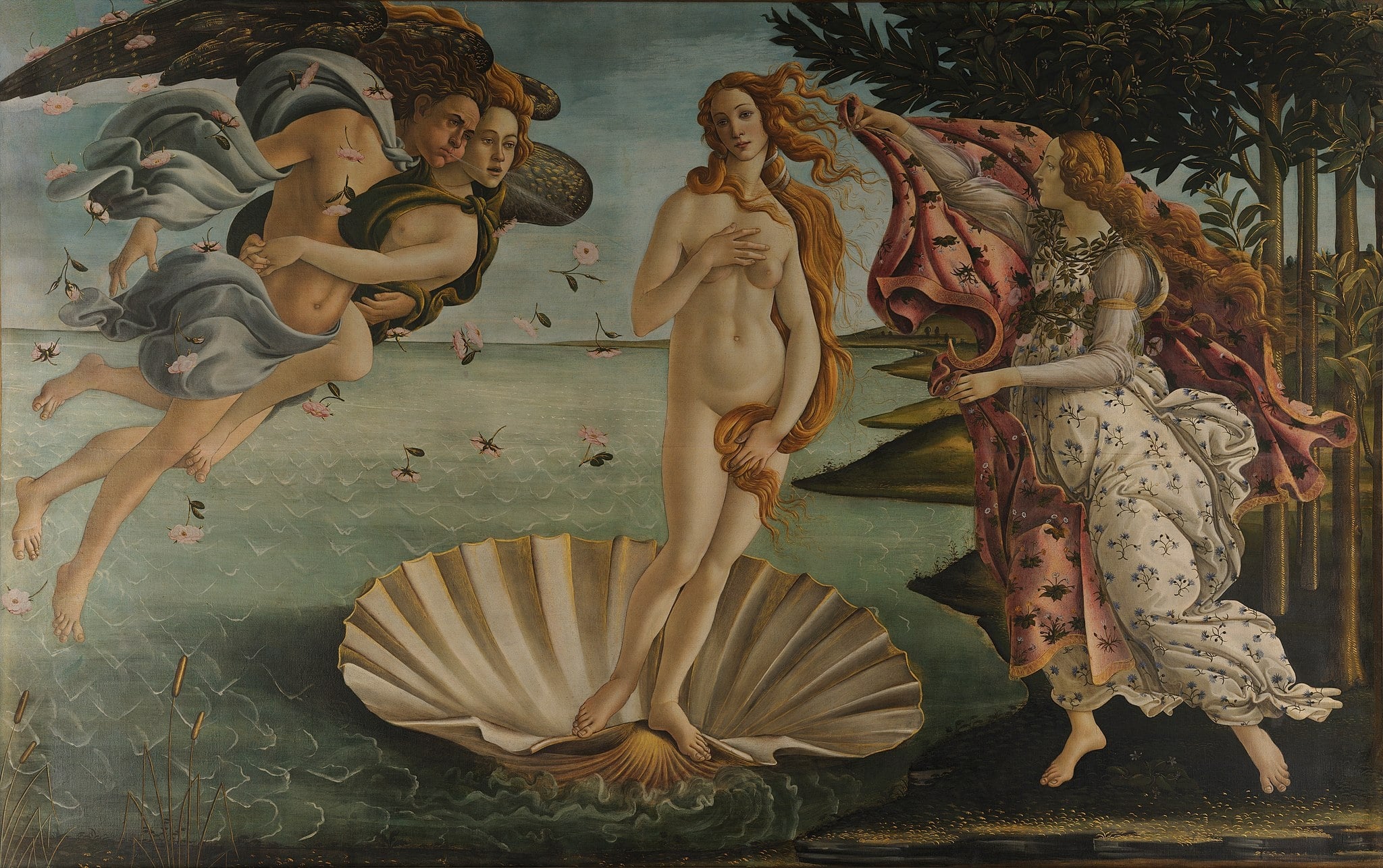
In The Birth of Venus, <strong>Sandro Botticelli</strong> stages the sea-born goddess arriving on a <strong>scallop shell</strong>, blown ashore by intertwined <strong>winds</strong> and greeted by a flower-garlanded attendant who lifts a <strong>rose-patterned mantle</strong>. The painting’s crisp contours, elongated figures, and gilded highlights transform myth into an <strong>ideal of beauty</strong> that signals love, spring, and renewal <sup>[1]</sup><sup>[2]</sup>.
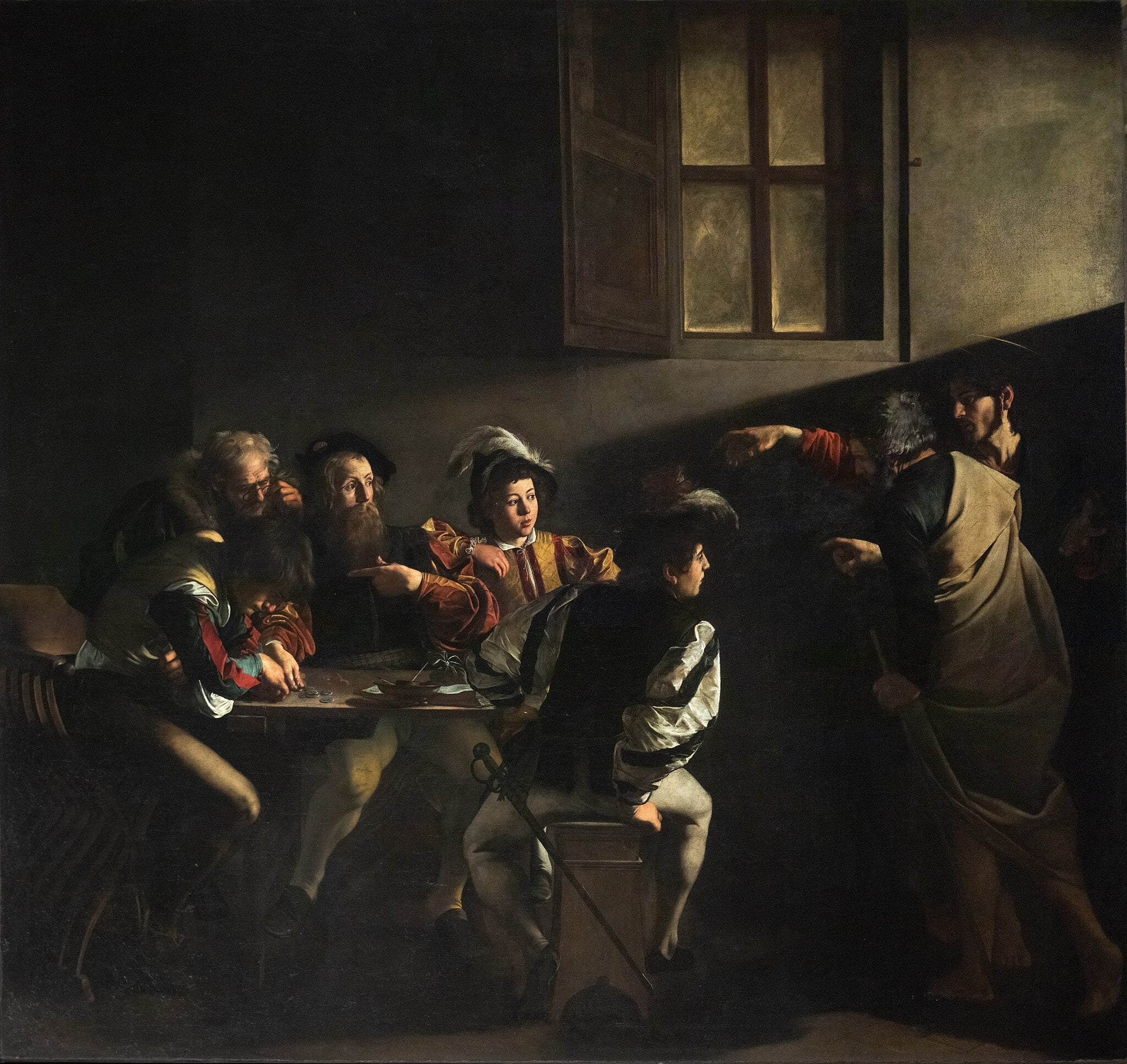
The Calling of Saint Matthew
Caravaggio (1599–1600)
Caravaggio’s The Calling of Saint Matthew stages the instant when <strong>divine grace</strong> pierces ordinary life. A diagonal <strong>beam of light</strong> and Christ’s <strong>Sistine‑echoing hand</strong> single out Matthew at a money table, suspending time between hesitation and assent <sup>[2]</sup><sup>[3]</sup>. The painting fuses Baroque <strong>tenebrism</strong> with contemporary dress to dramatize conversion as a public, present-tense event <sup>[1]</sup><sup>[2]</sup>.
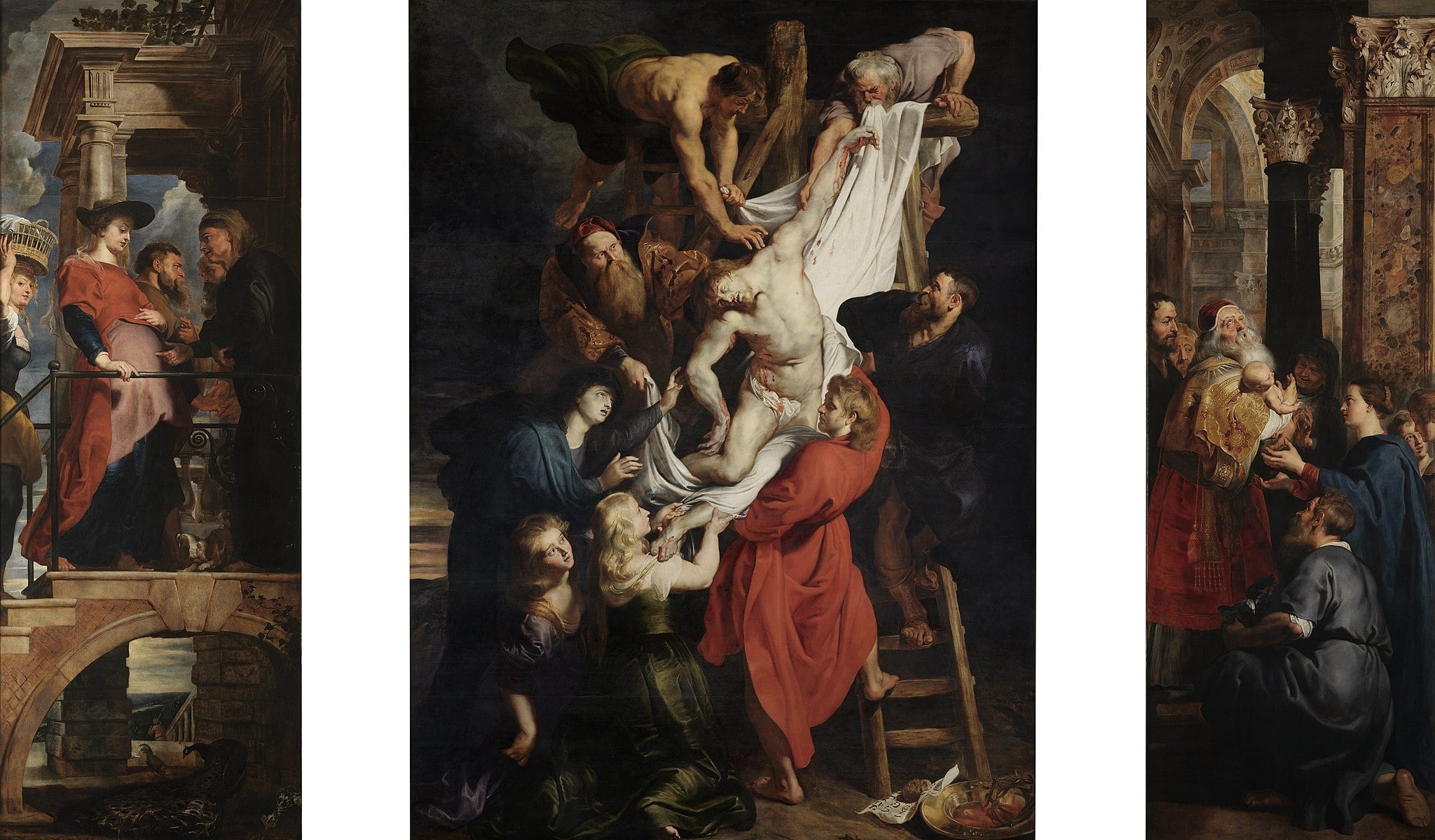
The Descent from the Cross
Peter Paul Rubens (1611–1614)
At night beneath a black sky, The Descent from the Cross stages a solemn transfer of Christ’s body along a luminous <strong>white shroud</strong> that cuts diagonally across the scene. The flanking wings—<strong>The Visitation</strong> and <strong>The Presentation in the Temple</strong>—frame the central tragedy with beginnings and revelation, turning the triptych into a single arc from Incarnation to Redemption. Rubens fuses <strong>Baroque chiaroscuro</strong> with tender, communal gestures to make grief a shared act of devotion.
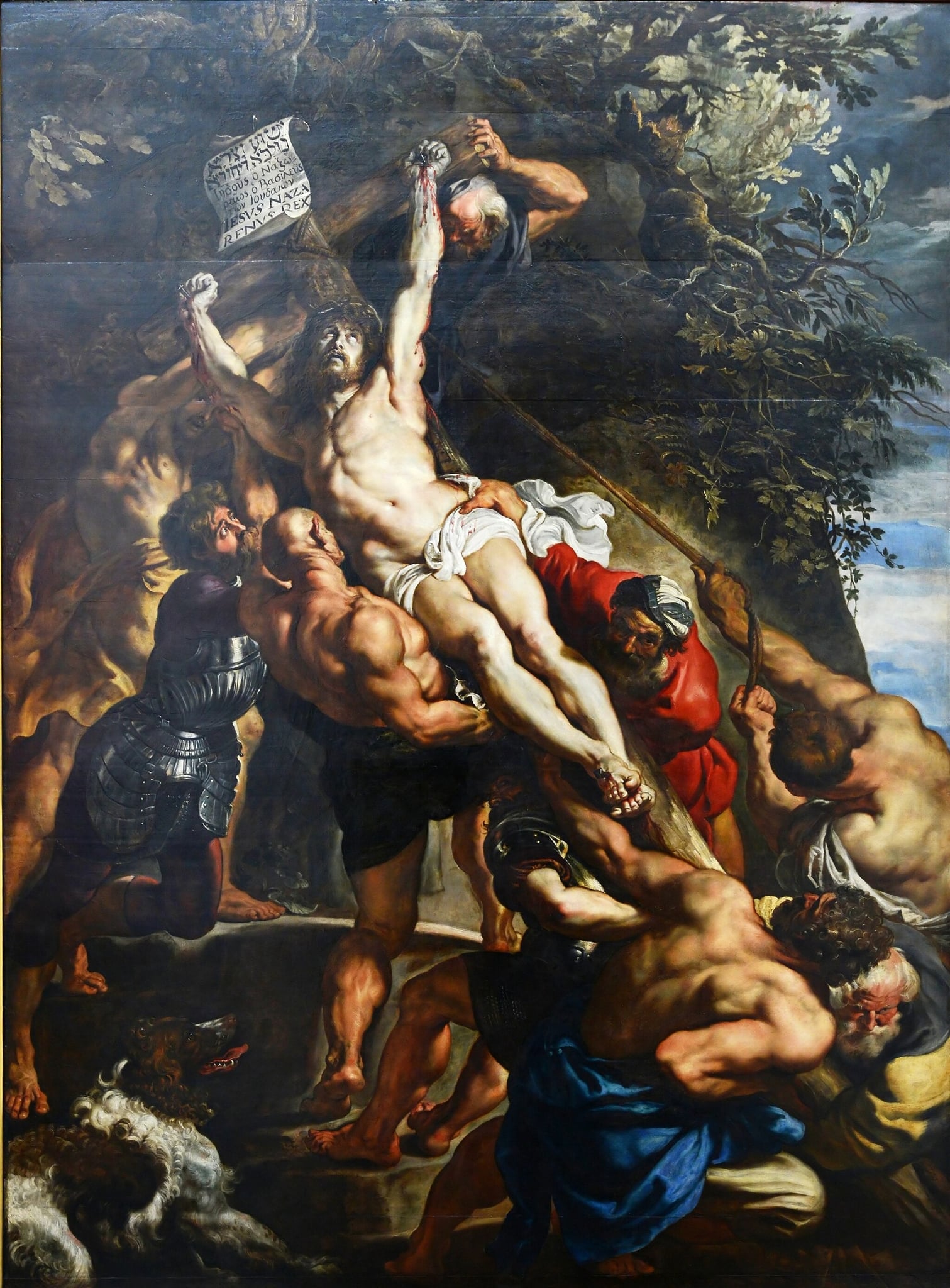
The Elevation of the Cross
Peter Paul Rubens (1609–1610)
A single, surging diagonal drives The Elevation of the Cross as straining executioners heave the timber while Christ’s pale body becomes the calm, radiant fulcrum. Rubens fuses muscular anatomy, flashing armor, taut ropes, and storm-dark landscape into a Baroque crescendo where <strong>divine light</strong> confronts <strong>human violence</strong> <sup>[1]</sup><sup>[3]</sup>.
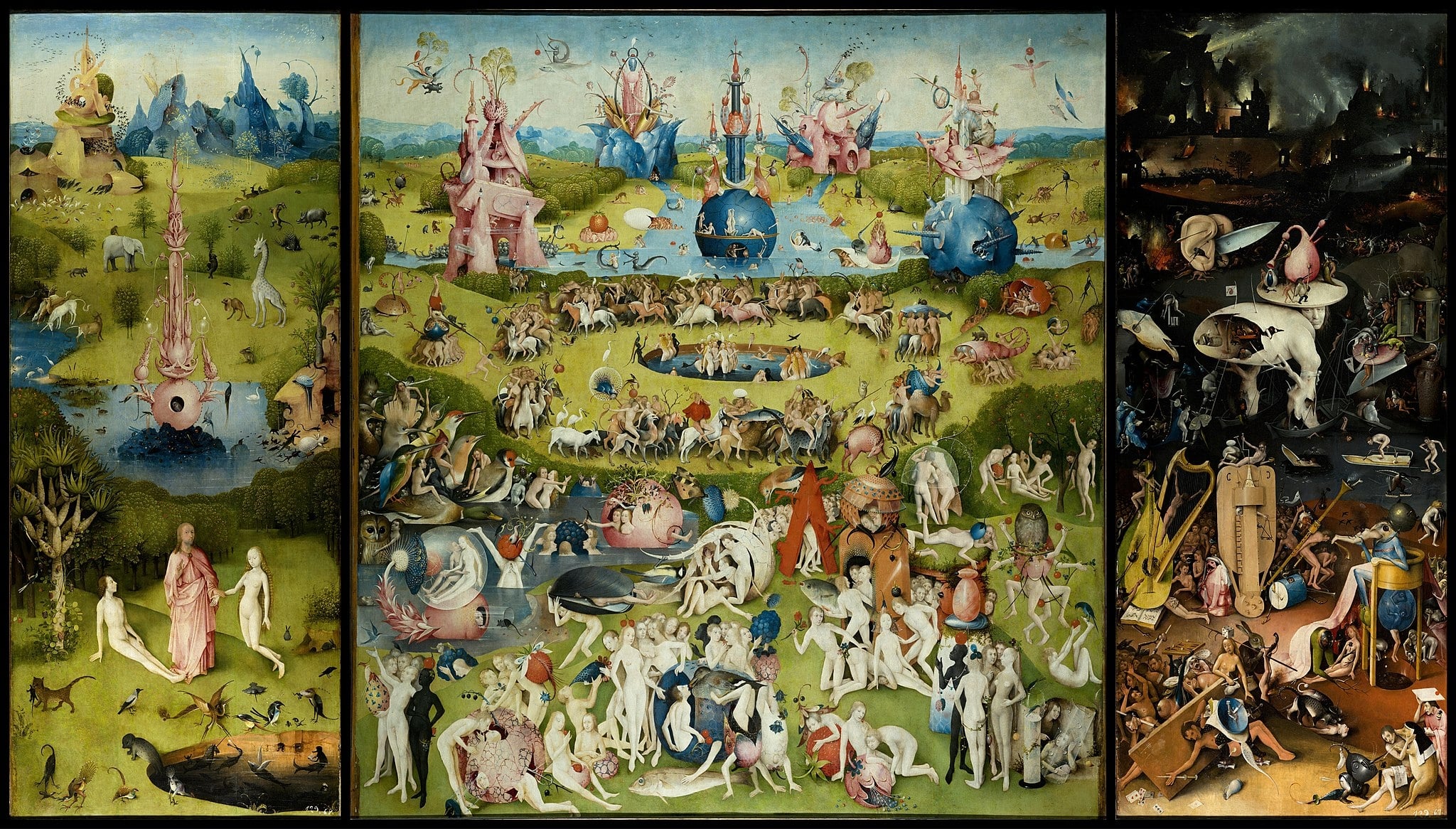
The Garden of Earthly Delights
Hieronymus Bosch (c.1490–1500)
The Garden of Earthly Delights unfolds a three‑act moral narrative—<strong>innocence</strong>, <strong>seduction</strong>, and <strong>retribution</strong>—from Eden to a punitive <strong>Musical Hell</strong>. Bosch binds the scenes through recurring emblems (notably the <strong>owl</strong>) and by echoing Eden’s crystalline fountain in the center’s fragile, candy‑colored architectures, then in Hell’s broken bodies and instruments. The work dazzles with invention while insisting that <strong>sweet, ephemeral pleasures</strong> end in ruin <sup>[1]</sup>.
The Garden of Eden with the Fall of Man
Peter Paul Rubens (c. 1615)
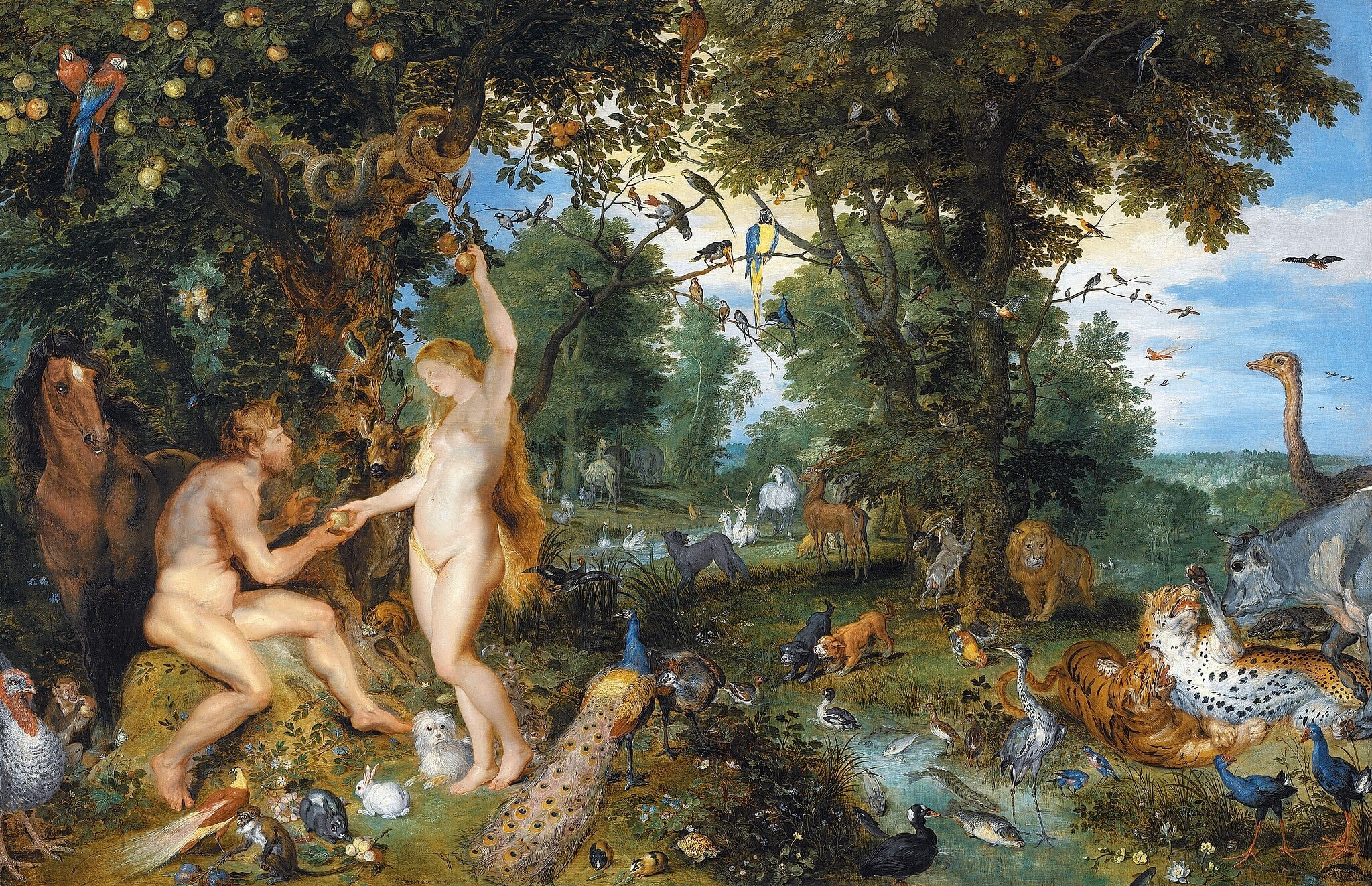
<strong>The Garden of Eden with the Fall of Man</strong> stages the instant Eve passes the forbidden fruit to Adam as the serpent coils above and a teeming paradise encircles them. The panel fuses Peter Paul Rubens’s dramatic nudes with Jan Brueghel the Elder’s encyclopedic fauna and flora, turning Eden into a lush theatre of temptation and consequence <sup>[1]</sup>. Light isolates Eve’s raised arm and golden hair while predators stir at the margins, signaling paradise in the act of unraveling.
The School of Athens
Raphael (1509–1511)
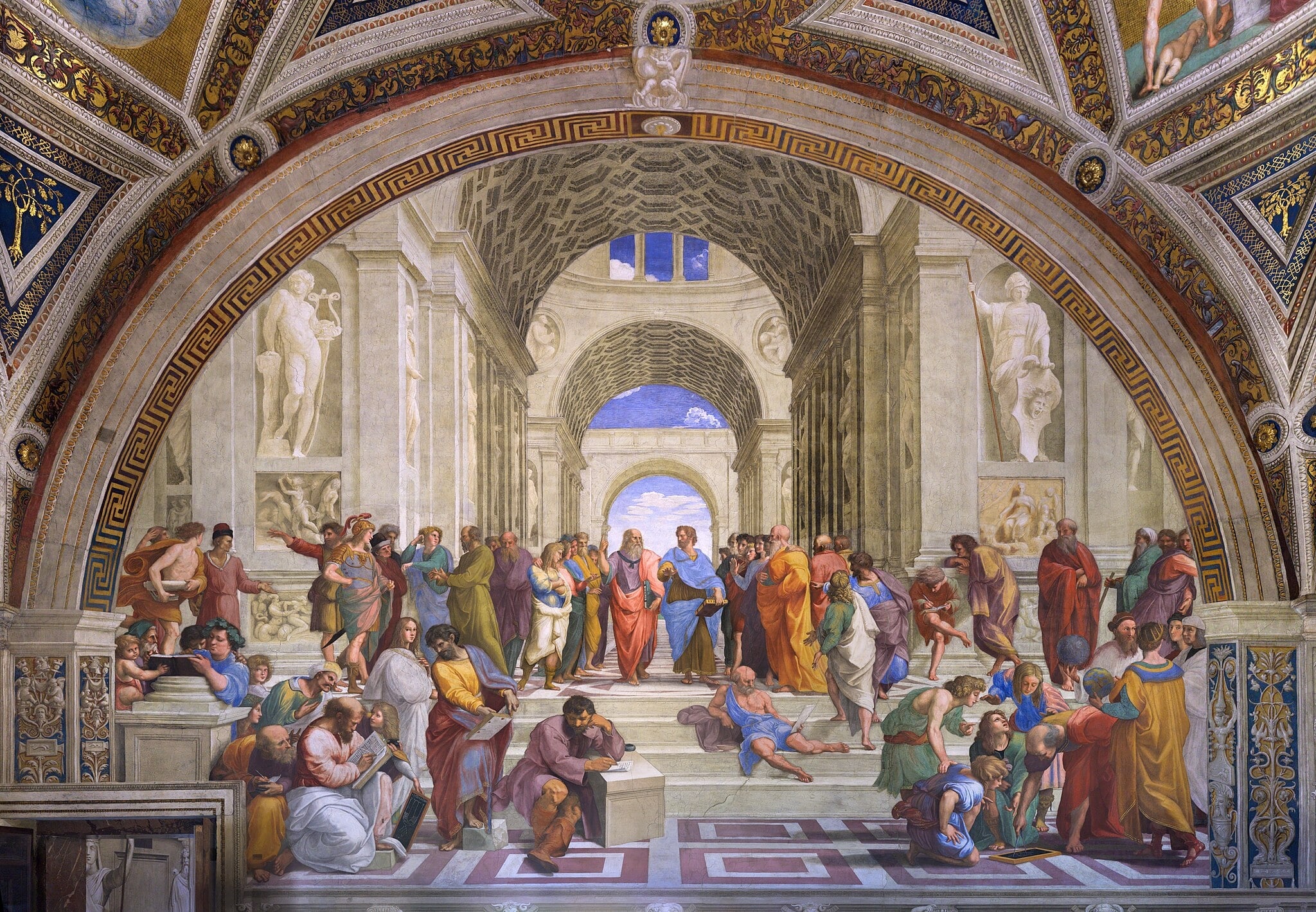
Raphael’s The School of Athens orchestrates a grand debate on knowledge inside a perfectly ordered, classical hall whose one-point perspective converges on the central pair, <strong>Plato</strong> and <strong>Aristotle</strong>. Their opposed gestures—one toward the heavens, one level to the earth—establish the fresco’s governing dialectic between <strong>ideal forms</strong> and <strong>empirical reason</strong> <sup>[1]</sup><sup>[2]</sup>. Around them, mathematicians, scientists, and poets cluster under statues of <strong>Apollo</strong> and <strong>Athena/Minerva</strong>, turning the room into a temple of <strong>Renaissance humanism</strong> <sup>[1]</sup><sup>[3]</sup>.
The Storm on the Sea of Galilee
Rembrandt van Rijn (1633)
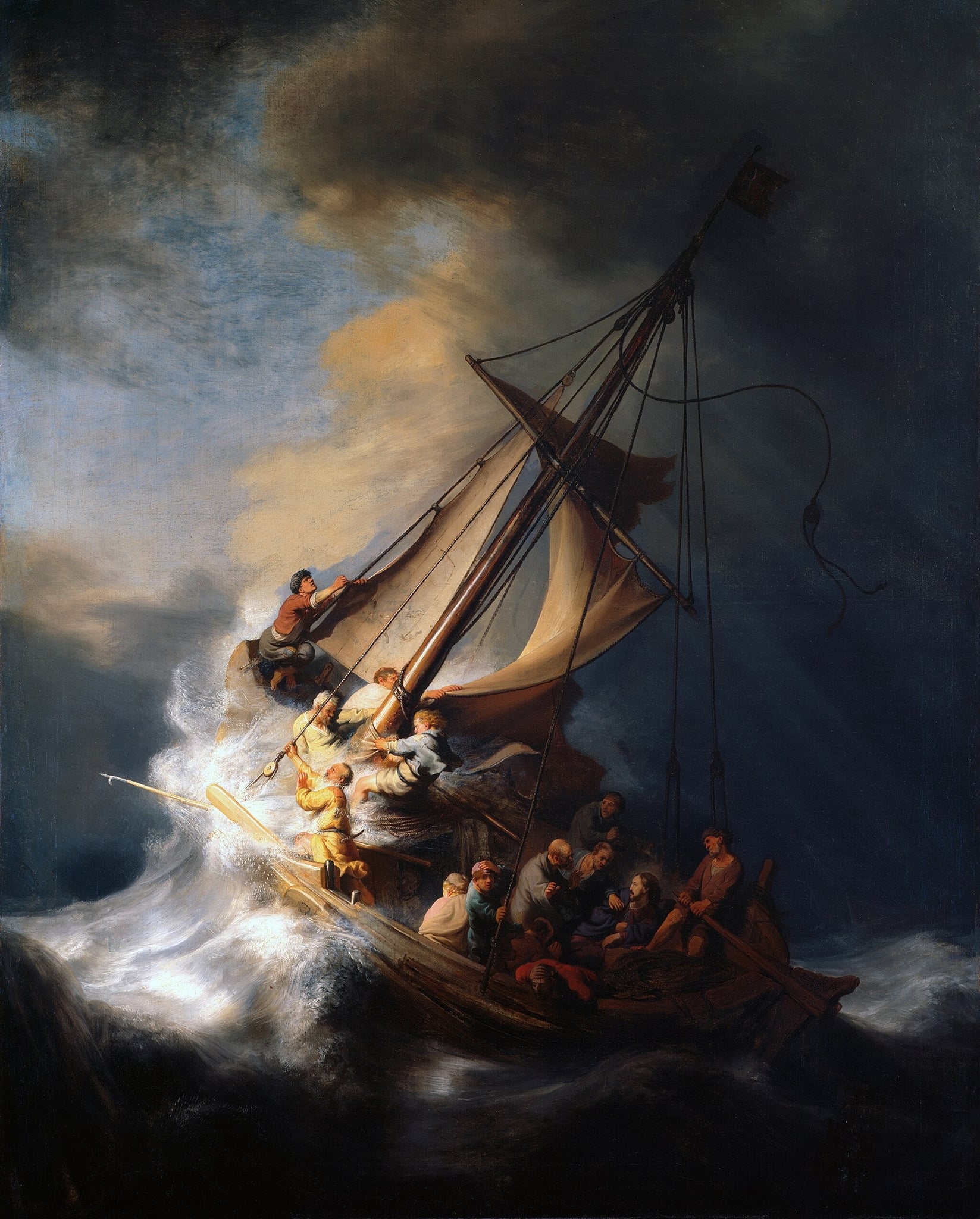
Rembrandt van Rijn’s The Storm on the Sea of Galilee stages a clash of <strong>human panic</strong> and <strong>divine composure</strong> at the instant before the miracle. A torn mainsail whips across a steeply tilted boat as terrified disciples scramble, while a <strong>serenely lit Christ</strong> anchors a pocket of calm—an image of faith holding within chaos <sup>[1]</sup><sup>[3]</sup>. It is Rembrandt’s only painted seascape, intensifying its dramatic singularity in his oeuvre <sup>[2]</sup>.
The Supper at Emmaus
Caravaggio (1601)
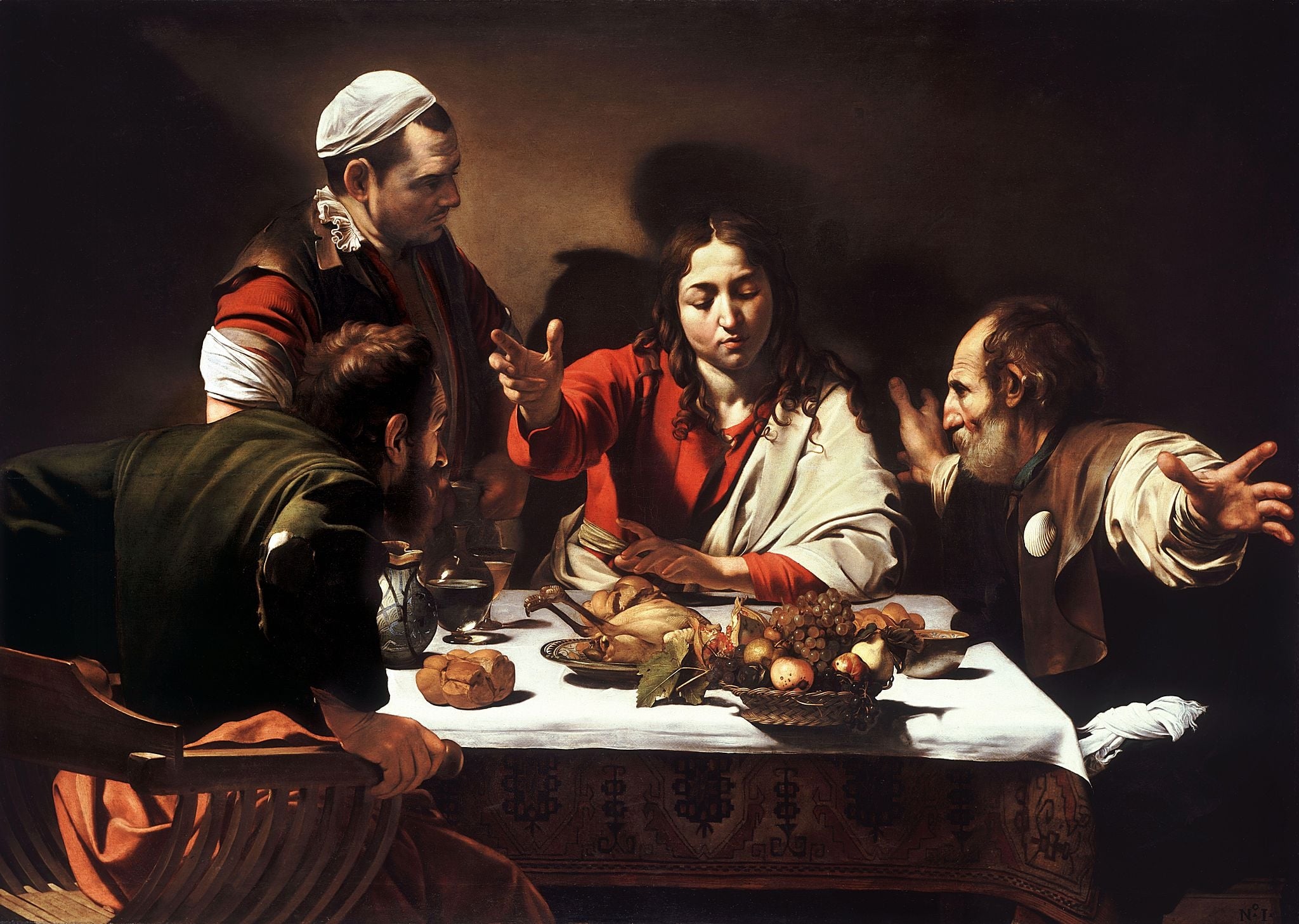
Caravaggio’s The Supper at Emmaus captures the split-second when two disciples recognize Christ in the <strong>breaking of bread</strong>. A raking light isolates Christ’s calm blessing while the disciples erupt—one surging forward with a torn sleeve, the other flinging his arms wide—so the shock of revelation reads as bodily fact. The teetering <strong>basket of fruit</strong> and Eucharistic table amplify themes of abundance and fragility <sup>[1]</sup><sup>[4]</sup>.
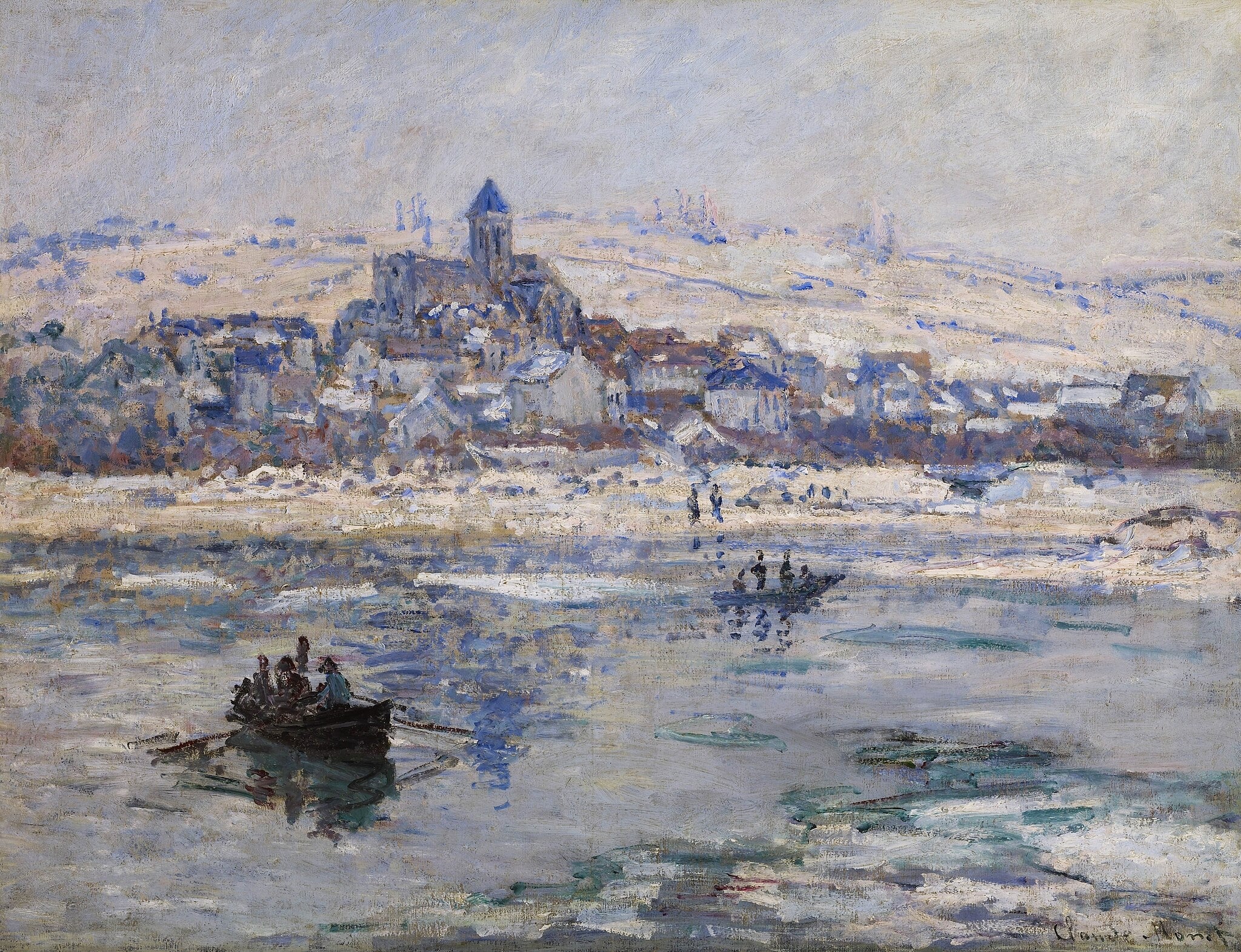
Vétheuil in Winter
Claude Monet (1878–79)
Claude Monet’s Vétheuil in Winter renders a riverside village in a <strong>silvery, frost-laden light</strong>, where the Seine carries <strong>broken ice</strong> past clustered houses and the tall church tower. The scene’s <strong>granular blue-green palette</strong> and softened edges make the town appear to crystallize out of air and water, while small boats and figures signal quiet persistence.
Related Themes
Within European art, symbols of devotion serve as hinges between invisible belief and visible practice. Far from being marginal ornaments, they organize pictorial space, choreograph viewing, and translate doctrine into bodily gesture or communal setting. From Quattrocento Florence to Impressionist France, these motifs—centered figures of Christ, Marian crowns, sacramental bread and wine, bowed postures, chapels and steeples—construct what might be called the visual syntax of piety. They operate both semiotically, as signs with legible theological content, and iconographically, as historically sedimented conventions that teach viewers how to see, remember, and participate in acts of worship.
At the core of this symbolic field stands Christ himself, and particularly the notion of Christ at the center. In Leonardo da Vinci’s The Last Supper, Christ’s triangular pose and axial placement do more than organize a crowded refectory wall; they inscribe his sacrificial and eucharistic status into the very geometry of the image. All orthogonals converge at his head, and his calm, pyramidal body anchors a composition otherwise fragmented by the apostles’ agitated groupings and apostolic gestures. Semiologically, the triangle functions doubly: as a sign of the Trinity and as a stable form of equilibrium, rendering Christ’s impending Passion as willed, ordered self-offering rather than chaotic arrest. The bread and wine before him, explicitly described as announcing the Eucharist, convert the narrative of betrayal into a sacramental prefiguration, pointing viewers beyond the historic meal toward the liturgy celebrated before the painted wall.
Leonardo’s followers and later artists extend this logic of compositional centrality into more overtly devotional formats. Masaccio’s Holy Trinity, a canonical Throne of Mercy, recenters Christ in vertical rather than horizontal terms: the crucified Son is physically supported by God the Father, with the Dove of the Holy Spirit between them. Here the symbol of God the Father supporting the cross fuses Trinitarian theology and pious contemplation. The fictive barrel-vaulted chapel creates a perspectival tunnel that leads the viewer’s eye to the cruciform axis, then out again to the kneeling donors at our own level. The result is a carefully staged encounter in which devotion is both theological assent to divine mercy and an enacted posture of prayer before the altar beneath the fresco. The dove, small yet centrally aligned, completes this triune sign system: it is at once an iconographic tag for the Spirit and a visual ligament binding Father and Son, heaven and nave.
Acts of devotion are not confined to the divine persons alone; they are modeled in the human witnesses clustered around them. In Titian’s Assumption of the Virgin, the apostles exemplify apostles as earthly witnesses whose astonishment is structurally necessary. Their torsions and upflung arms form a dark, earthy register against which Mary’s ascent reads as both miraculous and responsive: their wonder, like that of the beholder, is transmuted into faith as the eye follows their gestures upward into the vortex of putti and finally to God the Father. This semiotic relay—gesture to gaze to ascending figure—turns the altarpiece into a devotional machine. Mary’s own orant posture, hands wide and face upturned, embodies perfected reception: where the apostles register shock, she personifies willing, intercessory devotion on behalf of those watching below.
Marian imagery further refines the symbolism of exalted devotion. In Botticelli’s Madonna of the Magnificat, the Crown of Mary is not an isolated emblem but part of an intricate iconographic ensemble. Angels hold a delicate diadem above her head while she writes the Magnificat, her hand guided by the Christ Child. Coronation, text, and authorship converge: the crown affirms her as Queen of Heaven precisely as she articulates her scriptural song of praise. The book, quill, and inkwell become instruments of inspired devotion, while the act of crowning inscribes that devotion into a courtly, quasi-liturgical ceremony. Semiologically, the crown signals status; iconographically, in this context, it specifies a Marian theology in which humble praise is the royal road to exaltation.
Devotion also takes humbler, more quotidian forms that yet bear a dense symbolic charge. Millet’s The Angelus distills piety into the bowed prayer posture of two peasants pausing at dusk. Their bent heads, the man’s removed cap, the woman’s clasped hands—all are legible as signs of reverence, but they acquire iconographic specificity through the distant church steeple that anchors the horizon. That tiny vertical, source of the Angelus bell, marks institutional faith and timekeeping; the very hour of prayer is inscribed in the landscape. The fork planted upright and the loaded wheelbarrow render this moment a “pause for devotion amid daily life,” not an escape from labor. Semiotic opposition—work versus prayer, motion versus stillness—is here collapsed into a single, continuous habitus of faith.
Architectural and urban motifs serve a parallel function in Impressionist treatments of modern life. In Monet’s Snow at Argenteuil, the faint church spire that closes the snowy boulevard is more than a picturesque accent. As a sign, it encodes “communal continuity and tradition,” offering a fixed point in a field otherwise dominated by transient weather and the tracks of recent traffic. The figures moving along the rutted street, rendered as quick blue-gray notes, inhabit a secularizing present, yet the spire quietly insists on an older axis of communal orientation. In Vétheuil in Winter (described in relation to the church tower symbol), Monet intensifies this role: the tower becomes the stabilizing vertical around which drifting ice and atmospheric haze seem to revolve. Devotion here is no longer foregrounded in gesture but residual, embedded in the very skyline that structures memory and place.
The semiotics of devotion can be extended, finally, beyond explicitly Christian contexts into the political sacralization of ideals. Delacroix’s Liberty Leading the People mobilizes the figure of Allegorical Liberty (Marianne) as an object of quasi-religious commitment. Bare-breasted, flag-bearing, she assumes the compositional and symbolic privileges previously reserved for saints or the Virgin: a pyramidal ascent crowns her raised arm with the tricolor, while the bodies of the dead form a somber base reminiscent of martyrdom. Notre-Dame’s distant towers, one bearing a second tricolor, relocate ecclesial authority into the body politic. The painting translates devotional structure—central personification, sacrificial foundation, collective following—into a secular key, depicting “popular freedom” as a cause to which citizens might owe not merely assent but fervent, risk-laden dedication.
Across these works, devotional symbols evolve from tightly codified theological markers to more diffuse, experiential cues. Early Renaissance images such as Masaccio’s Holy Trinity and Botticelli’s Madonna of the Magnificat hinge on clear iconographic programs in which crowns, doves, and compositional axes systematically articulate doctrine for a liturgical public. High Renaissance and Baroque compositions—Leonardo, Titian—retain this clarity while heightening affect, using gesture and light to convert doctrinal content into interiorized faith. By the nineteenth century, in Monet and Millet, traditional emblems like spires or bowed heads persist but are embedded within broader meditations on time, labor, and atmosphere; devotion is intimated rather than didactically staged. In Delacroix, finally, the very grammar of devotional representation migrates to the political sphere, where Liberty assumes the visual logic of a saintly intercessor. The Devotion category thus records not the disappearance of piety from art, but its successive rearticulations as Western societies renegotiated the relations of the sacred, the communal, and the everyday.