Water
In modern painting, water becomes a privileged field for thinking about flux, perception, and social modernity, as artists mobilize boats, bridges, reflections, and horizons to negotiate the tensions between labor and leisure, permanence and change.
Member Symbols
Featured Artworks
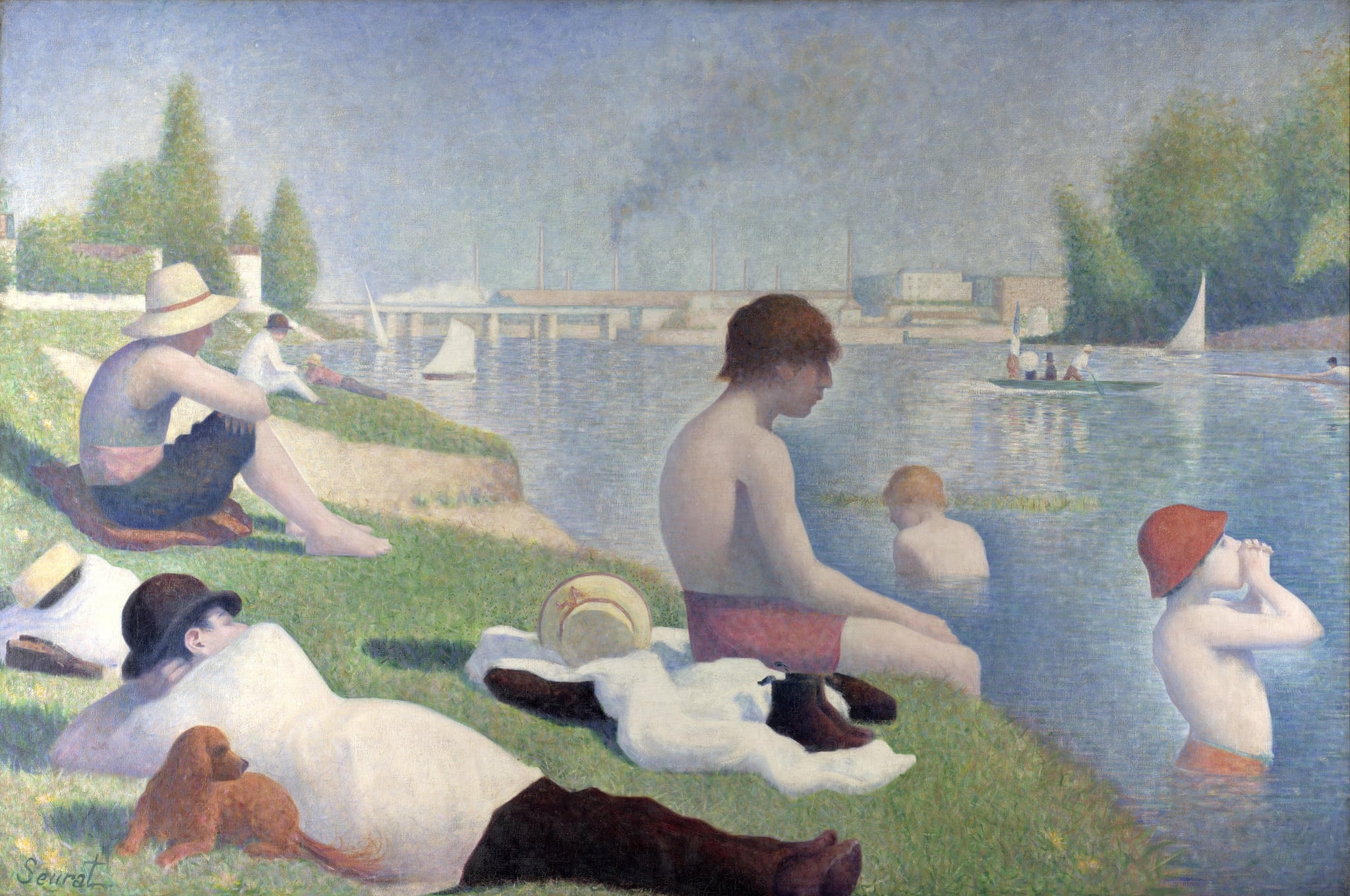
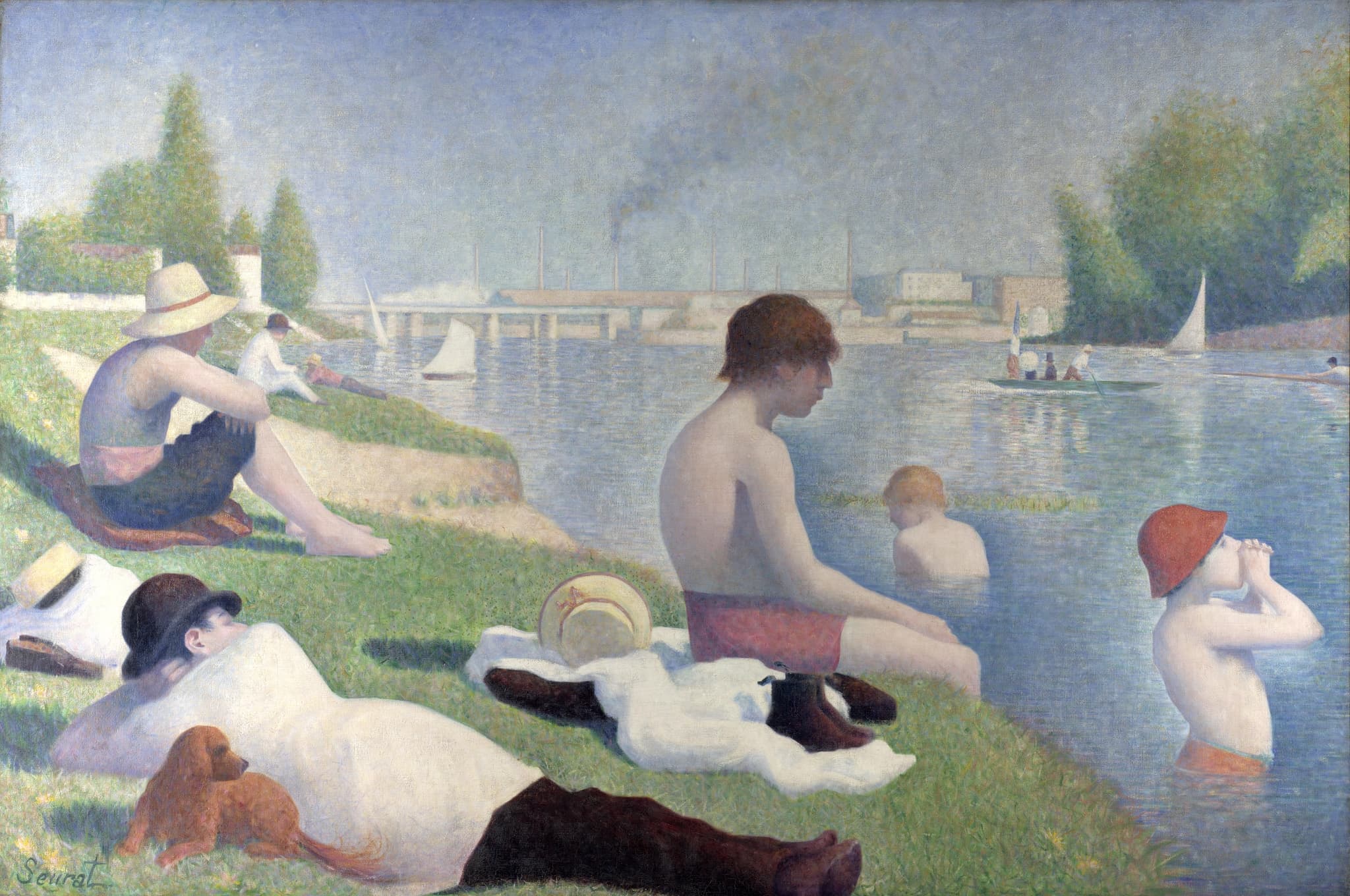
Bathers at Asnières
Georges Seurat (1884)
Bathers at Asnières stages a scene of <strong>modern leisure</strong> on the Seine, where workers recline and wade beneath a hazy, unified light. Seurat fuses <strong>classicizing stillness</strong> with an <strong>industrial backdrop</strong> of chimneys, bridges, and boats, turning ordinary rest into a monumental, ordered image of urban life <sup>[1]</sup><sup>[3]</sup>. The canvas balances soft greens and blues with geometric structures, producing a calm yet charged harmony.
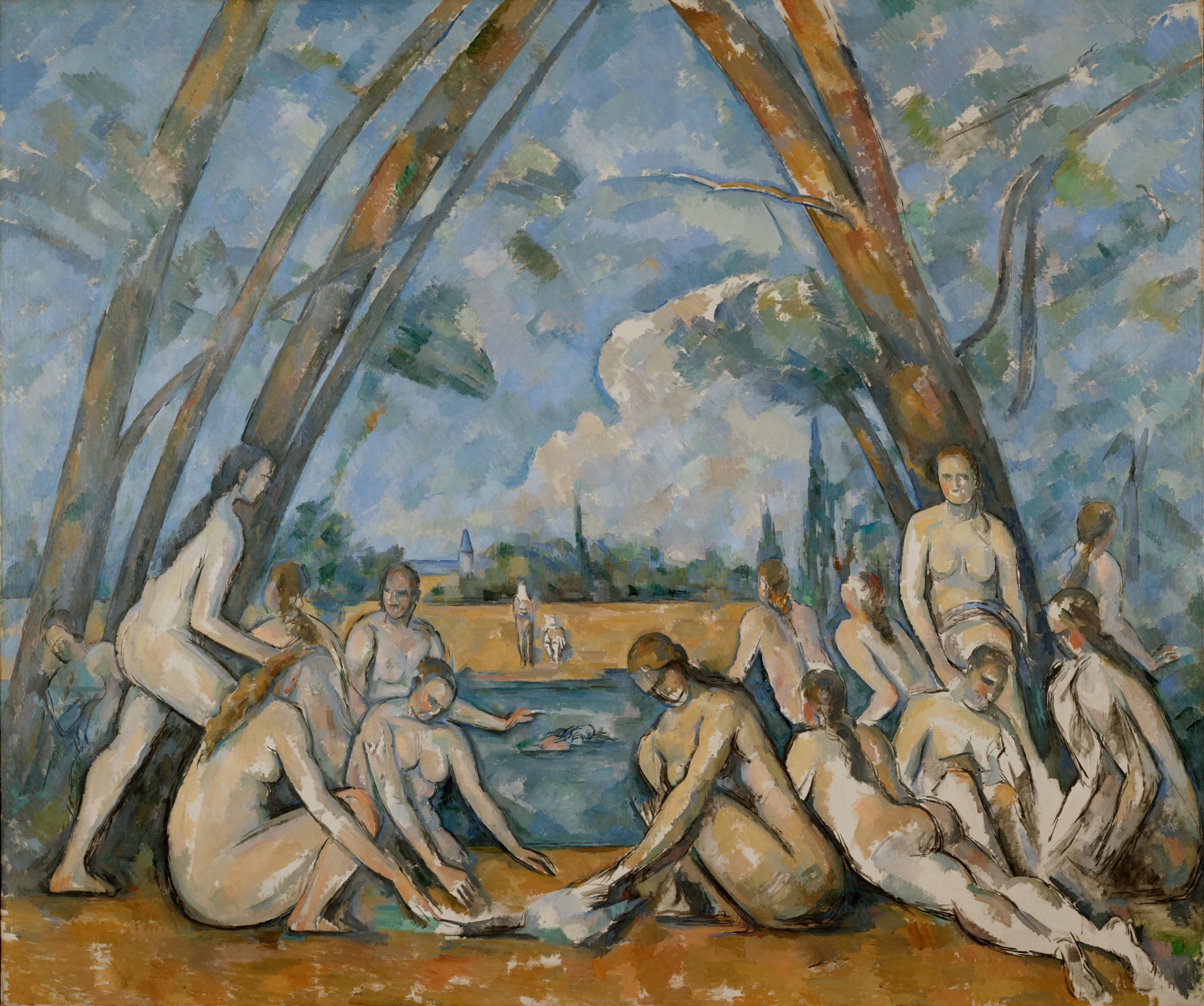
Bathers by Paul Cézanne: Geometry of the Modern Nude
Paul Cézanne
In Bathers, Paul Cézanne arranges a circle of generalized nudes beneath arching trees that meet like a <strong>natural vault</strong>, staging bathing as a timeless rite rather than a specific story. His <strong>constructive brushwork</strong> fuses bodies, water, and sky into one geometric order, balancing cool blues with warm ochres. The scene proposes a measured <strong>harmony between figure and landscape</strong>, a culmination of Cézanne’s search for enduring structure <sup>[1]</sup><sup>[2]</sup>.
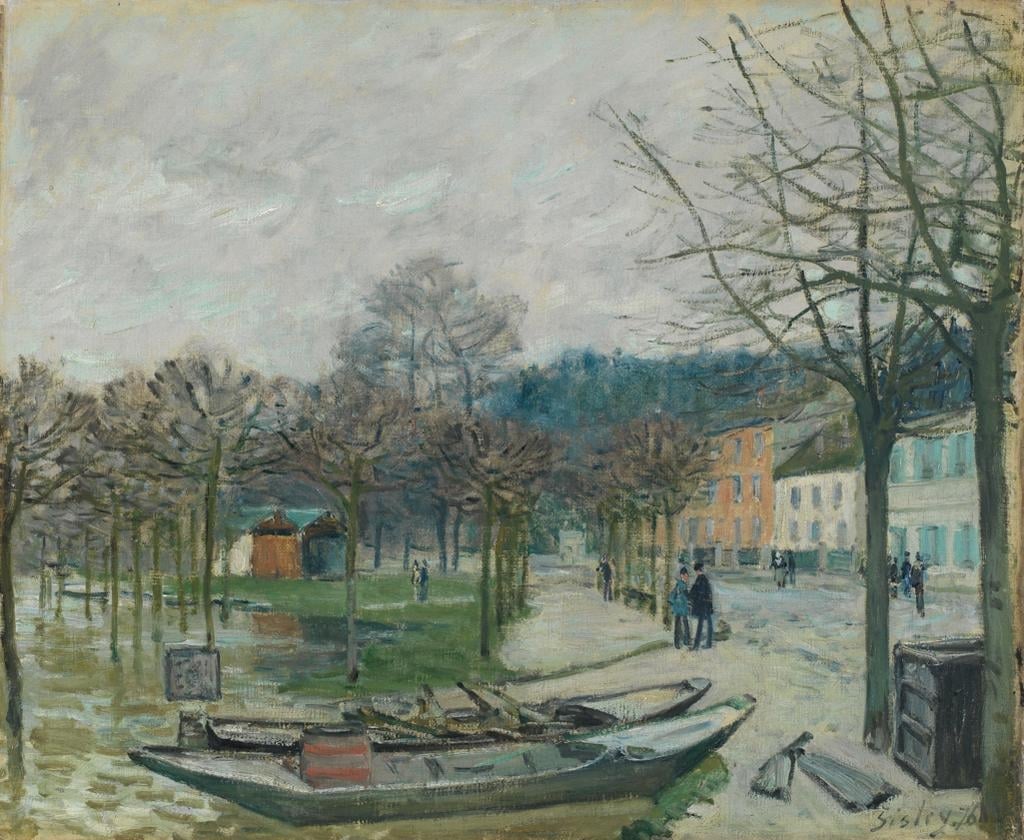
Flood at Port-Marly
Alfred Sisley (1876)
In Flood at Port-Marly, Alfred Sisley turns a flooded street into a reflective stage where <strong>human order</strong> and <strong>natural flux</strong> converge. The aligned, leafless trees function like measuring rods against the water, while flat-bottomed boats replace carriages at the curb. With cool, silvery strokes and a cloud-laden sky, Sisley asserts that the scene’s true drama is <strong>atmosphere</strong> and <strong>adaptation</strong>, not catastrophe <sup>[1]</sup><sup>[2]</sup><sup>[4]</sup>.
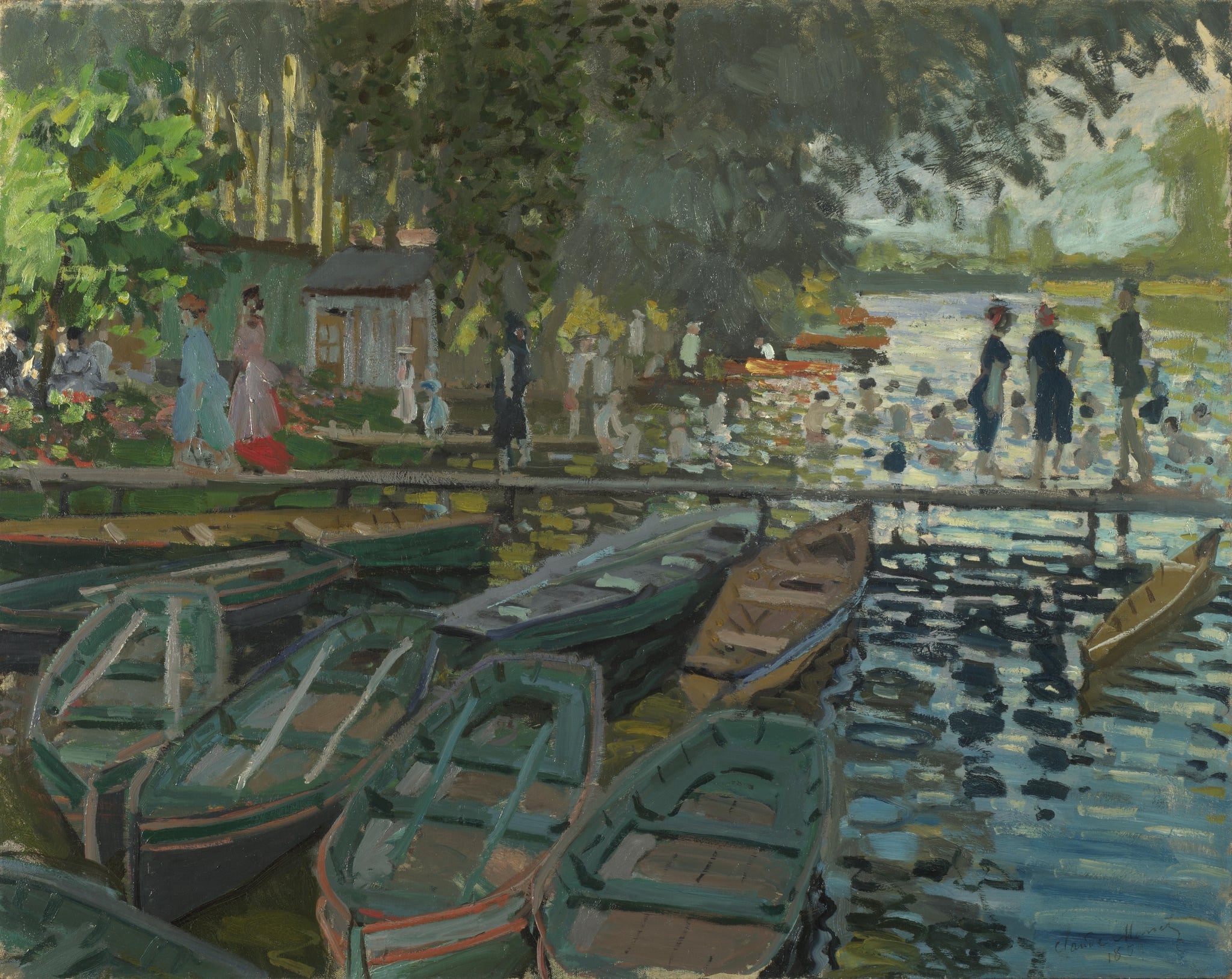
La Grenouillère
Claude Monet (1869)
Monet’s La Grenouillère crystallizes the new culture of <strong>modern leisure</strong> on the Seine: crowded bathers, promenading couples, and rental boats orbit a floating resort. With <strong>flickering brushwork</strong> and a high-key palette, Monet turns water, light, and movement into the true subjects, suspending the scene at the brink of dissolving.
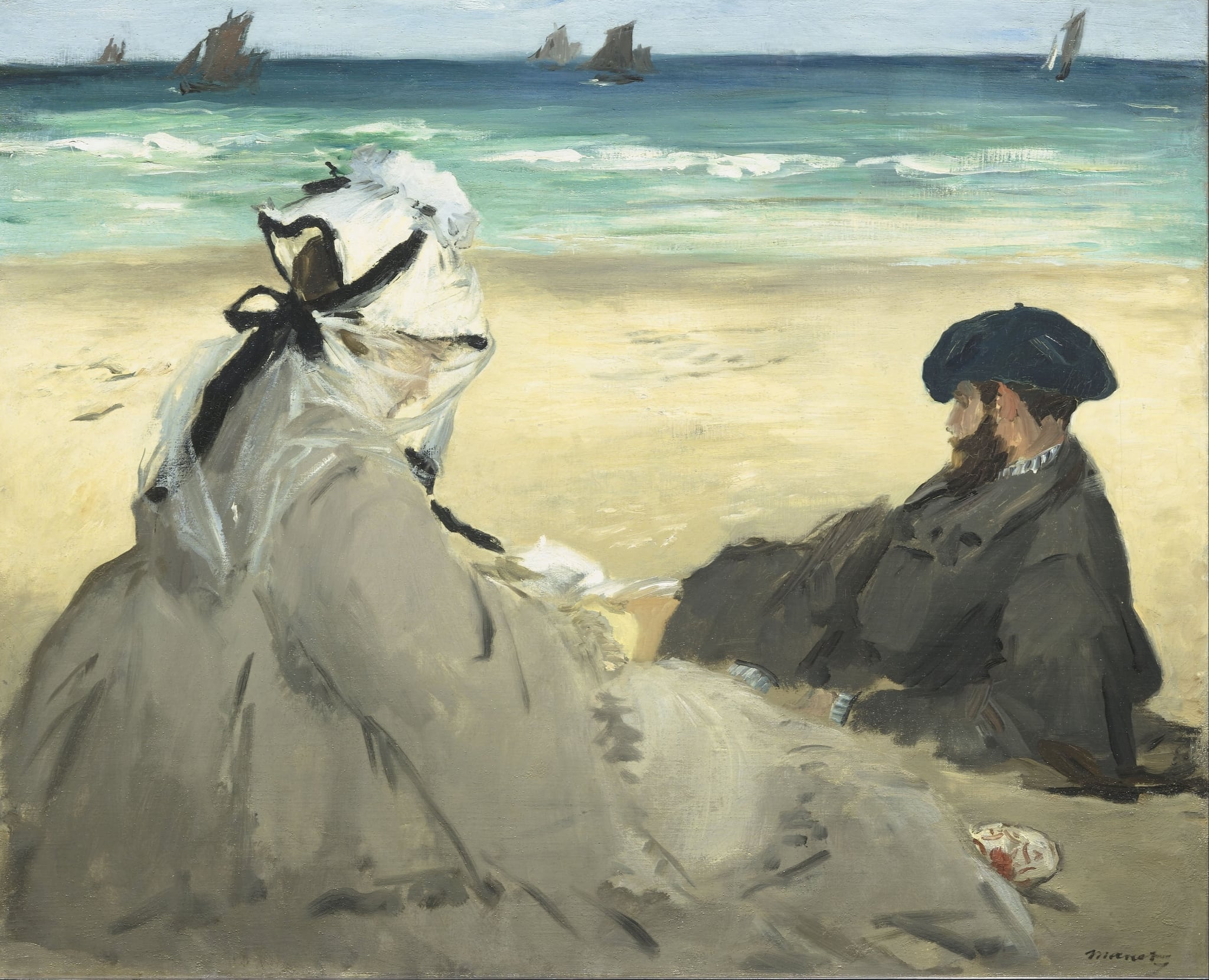
On the Beach
Édouard Manet (1873)
On the Beach captures a paused interval of modern leisure: two fashionably dressed figures sit on pale sand before a <strong>banded, high-horizon sea</strong>. Manet’s <strong>economical brushwork</strong>, restricted greys and blacks, and radical cropping stage a scene of absorption and wind‑tossed motion that feels both intimate and detached <sup>[1]</sup>.
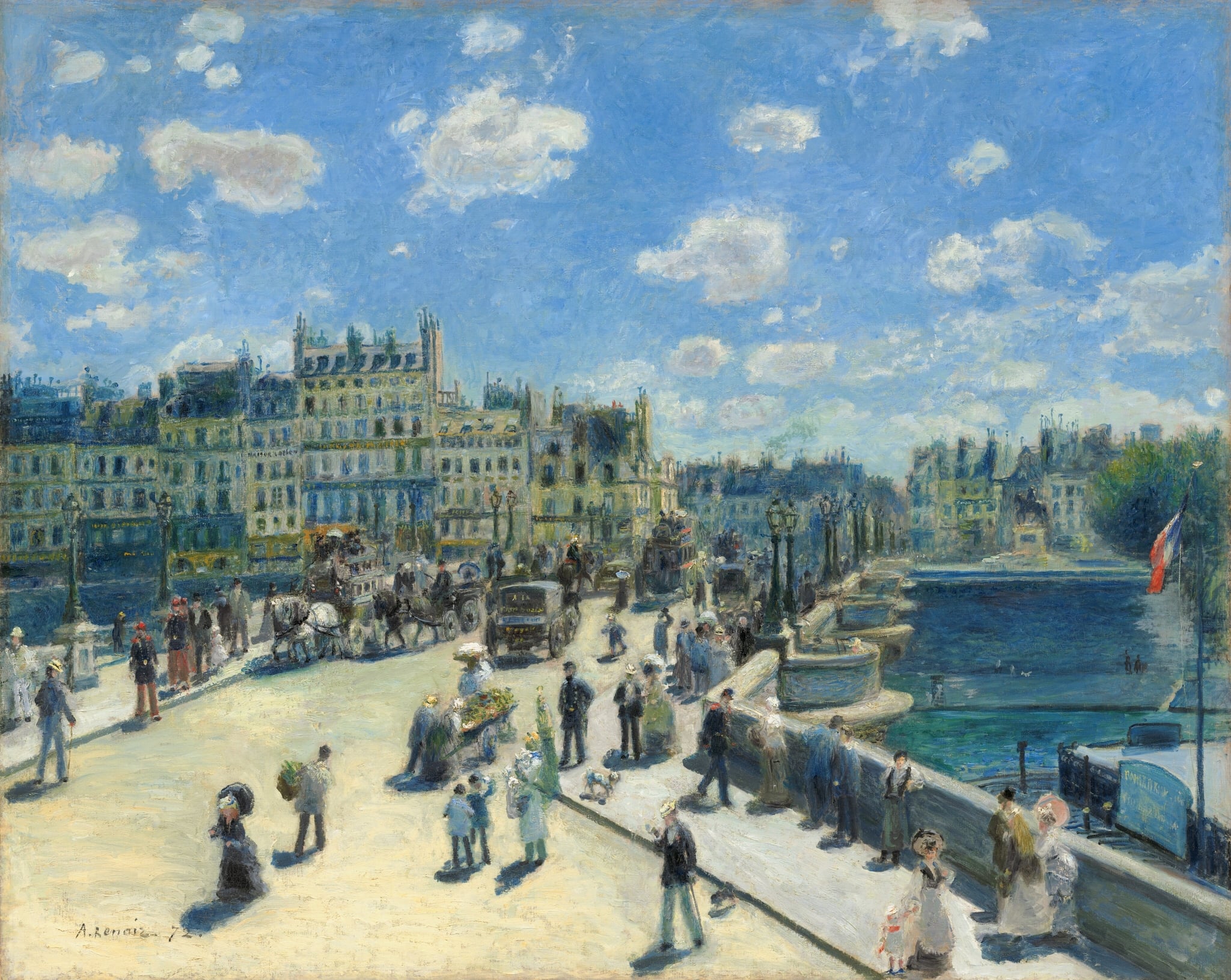
Pont Neuf Paris
Pierre-Auguste Renoir (1872)
In Pont Neuf Paris, Pierre-Auguste Renoir turns the oldest bridge in Paris into a stage where <strong>light</strong> and <strong>movement</strong> bind a city back together. From a high perch, he orchestrates crowds, carriages, gas lamps, the rippling Seine, and a fluttering <strong>tricolor</strong> so that everyday bustle reads as civic grace <sup>[1]</sup>.
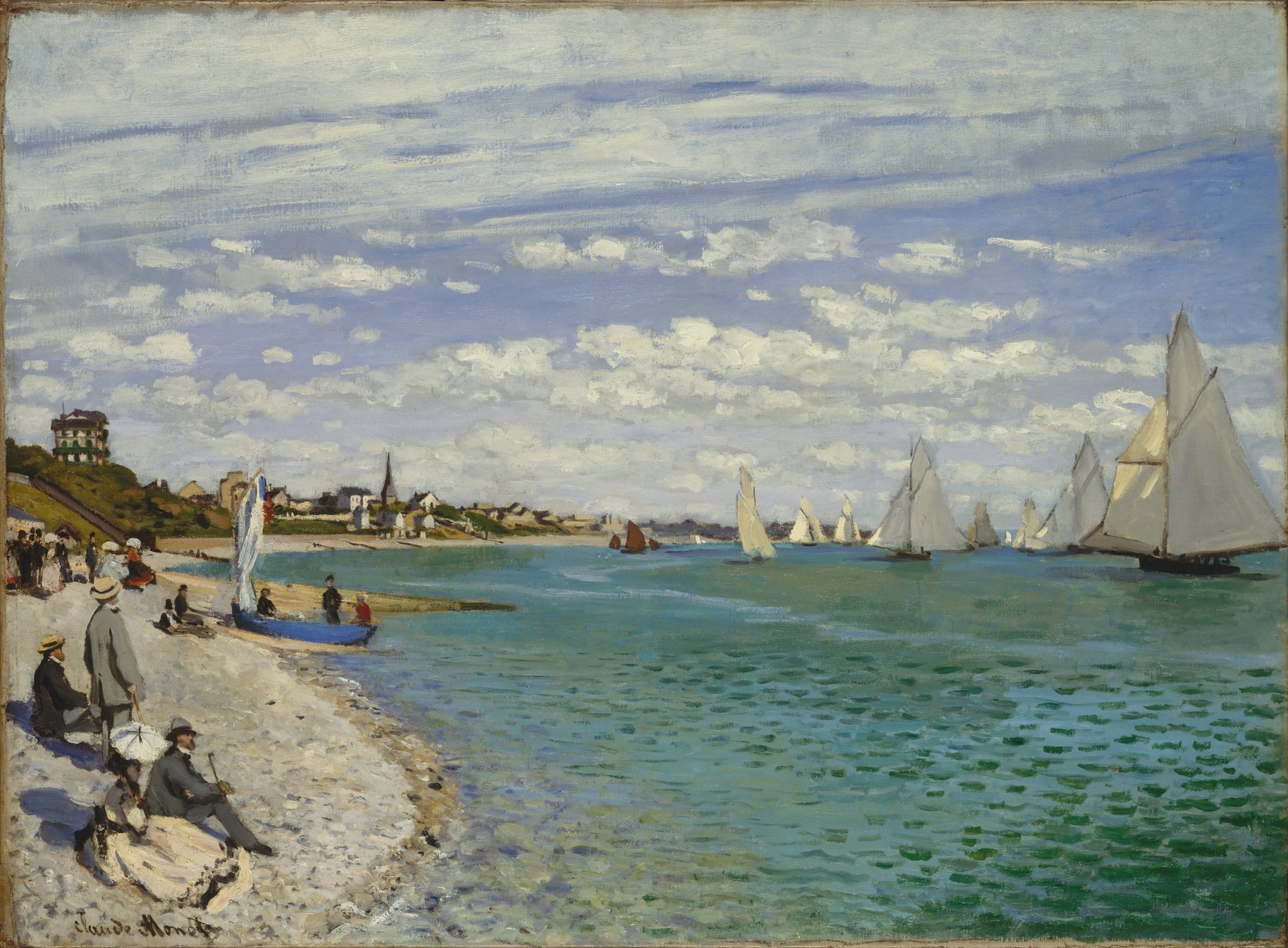
Regatta at Sainte-Adresse
Claude Monet (1867)
On a brilliant afternoon at the Normandy coast, a diagonal <strong>pebble beach</strong> funnels spectators with parasols toward a bay scattered with <strong>white-sailed yachts</strong>. Monet’s quick, broken strokes set <strong>wind, water, and light</strong> in synchrony, turning a local regatta into a modern scene of leisure held against the vastness of sea and sky <sup>[1]</sup><sup>[2]</sup>.
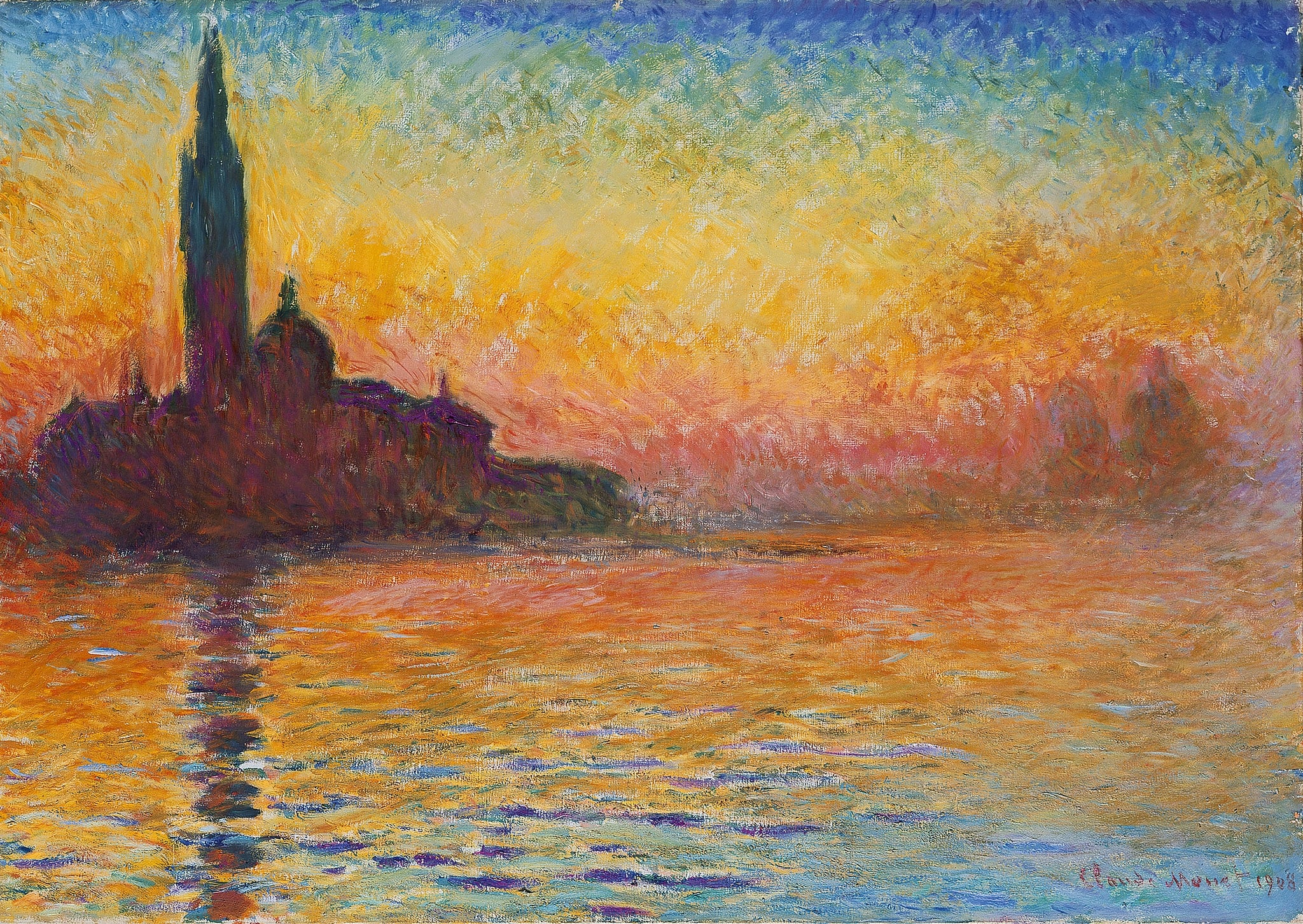
San Giorgio Maggiore at Dusk
Claude Monet (1908–1912)
Claude Monet’s San Giorgio Maggiore at Dusk fuses the Benedictine church’s dark silhouette with a sky flaming from apricot to cobalt, turning architecture into atmosphere. The campanile’s vertical and its wavering reflection anchor a sea of trembling color, staging a meditation on <strong>permanence</strong> and <strong>flux</strong>.
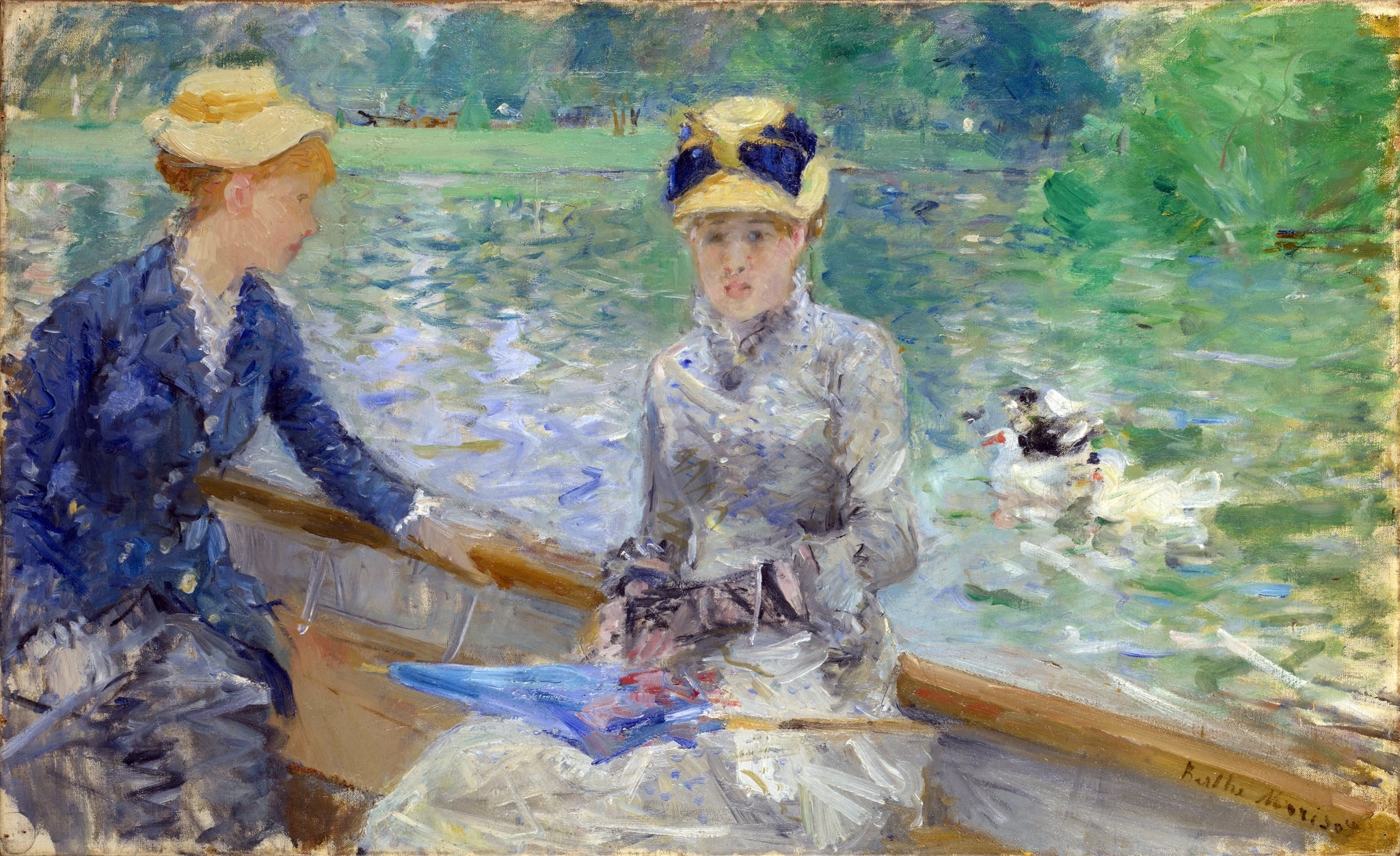
Summer's Day
Berthe Morisot (about 1879)
Two women drift on a boat in the Bois de Boulogne, their dresses, hats, and a bright blue parasol fused with the lake’s flicker by Morisot’s swift, <strong>zig‑zag brushwork</strong>. The scene turns a brief outing into a poised study of <strong>modern leisure</strong> and <strong>female companionship</strong> in public space <sup>[1]</sup>.
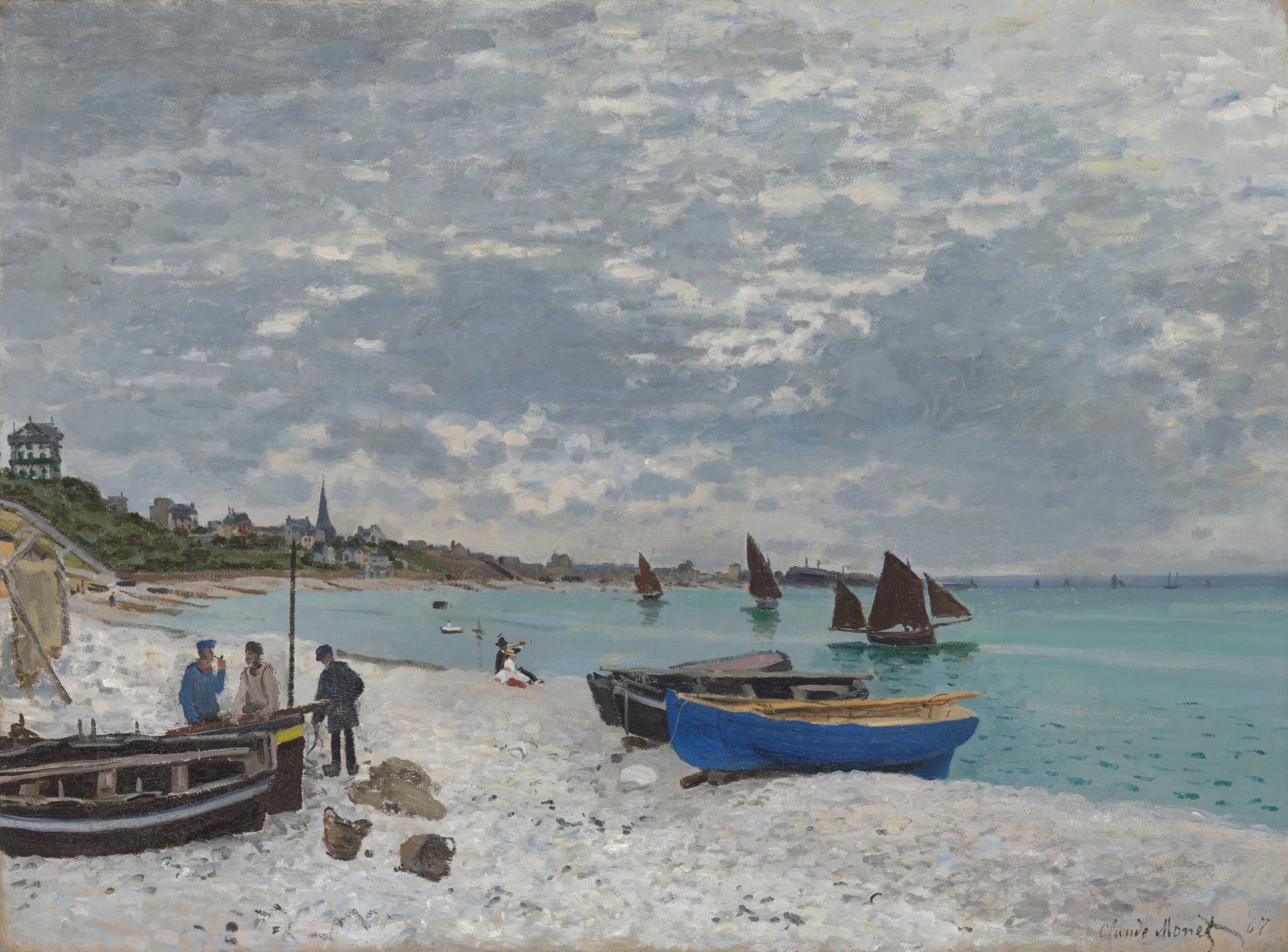
The Beach at Sainte-Adresse
Claude Monet (1867)
In The Beach at Sainte-Adresse, Claude Monet stages a modern shore where <strong>labor and leisure intersect</strong> under a broad, changeable sky. The bright <strong>blue beached boat</strong> and the flotilla of <strong>rust-brown working sails</strong> punctuate a turquoise channel, while a fashionably dressed pair sits mid-beach, spectators to the traffic of the port. Monet’s brisk, broken strokes make the scene feel <strong>caught between tides and weather</strong>, a momentary balance of work, tourism, and atmosphere <sup>[1]</sup><sup>[2]</sup>.
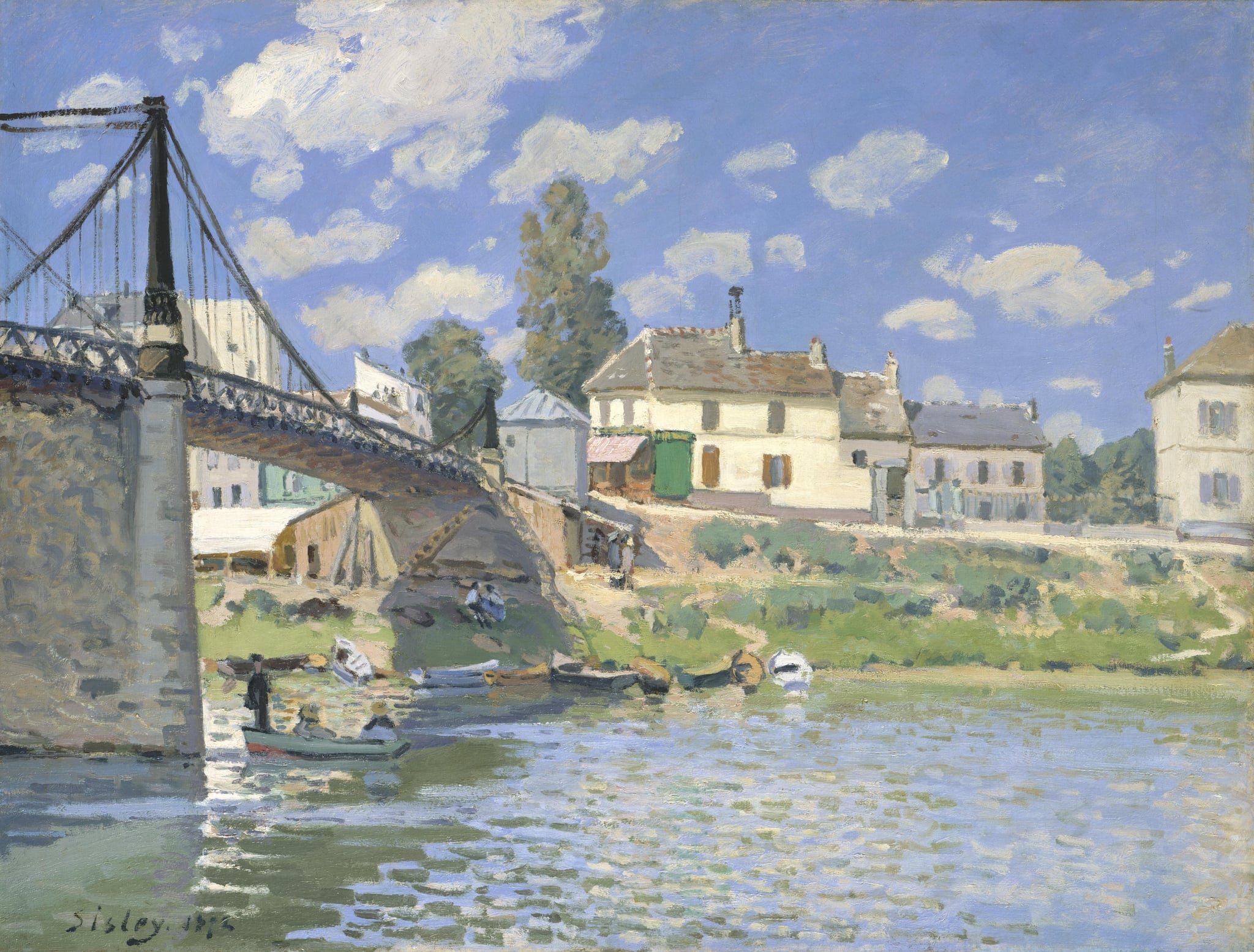
The Bridge at Villeneuve-la-Garenne
Alfred Sisley (1872)
Alfred Sisley's The Bridge at Villeneuve-la-Garenne crystallizes the encounter between <strong>modern engineering</strong> and <strong>riverside leisure</strong> under <strong>Impressionist light</strong>. The diagonal suspension bridge, dark pylons, and filigreed truss command the left foreground while small boats skim the Seine, their wakes breaking into shimmering strokes that echo the sky.
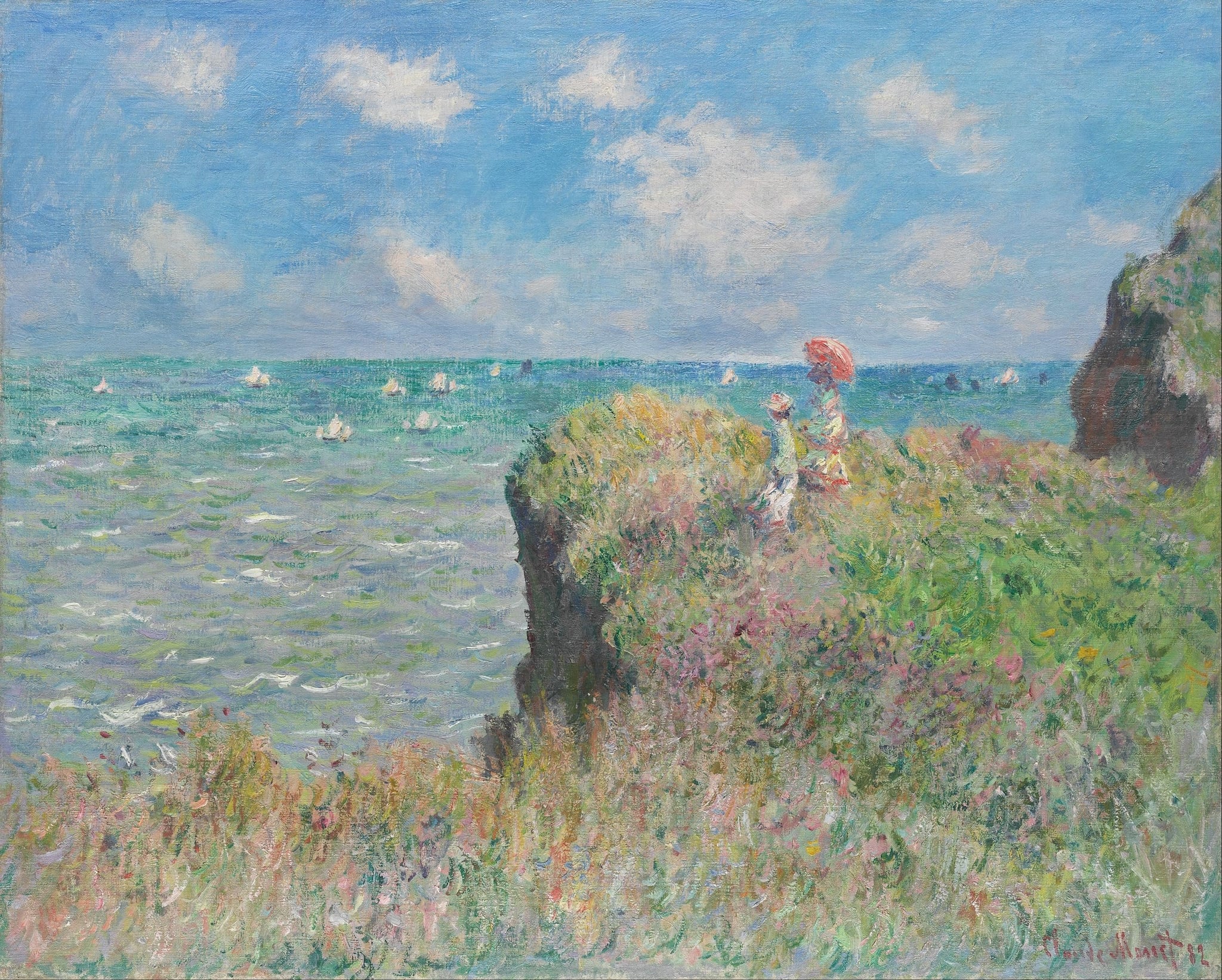
The Cliff Walk at Pourville
Claude Monet (1882)
Claude Monet’s The Cliff Walk at Pourville renders wind, light, and sea as interlocking forces through <strong>shimmering, broken brushwork</strong>. Two small walkers—one beneath a pink parasol—stand near the <strong>precipitous cliff edge</strong>, their presence measuring the vastness of turquoise water and bright sky dotted with white sails. The scene fuses leisure and the <strong>modern sublime</strong>, making perception itself the subject <sup>[1]</sup><sup>[2]</sup>.
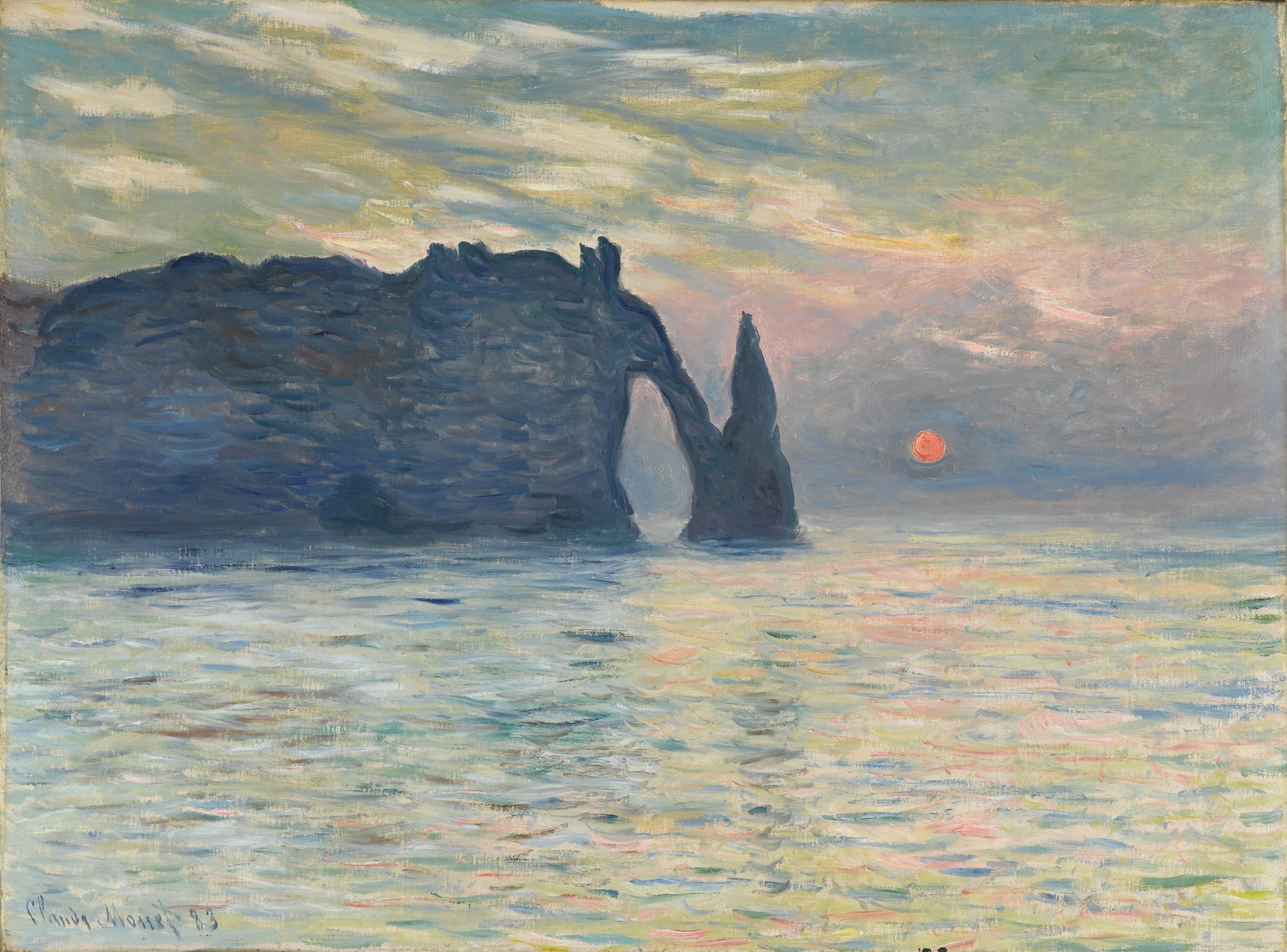
The Cliff, Etretat
Claude Monet (1882–1883)
<strong>The Cliff, Etretat</strong> stages a confrontation between <strong>permanence and flux</strong>: the dark mass of the arch and needle holds like a monument while ripples of coral, green, and blue light skate across the water. The low <strong>solar disk</strong> fixes the instant, and Monet’s fractured strokes make the sea and sky feel like time itself turning toward dusk. The arch reads as a <strong>threshold</strong>—an opening to the unknown that organizes vision and meaning <sup>[1]</sup><sup>[2]</sup>.
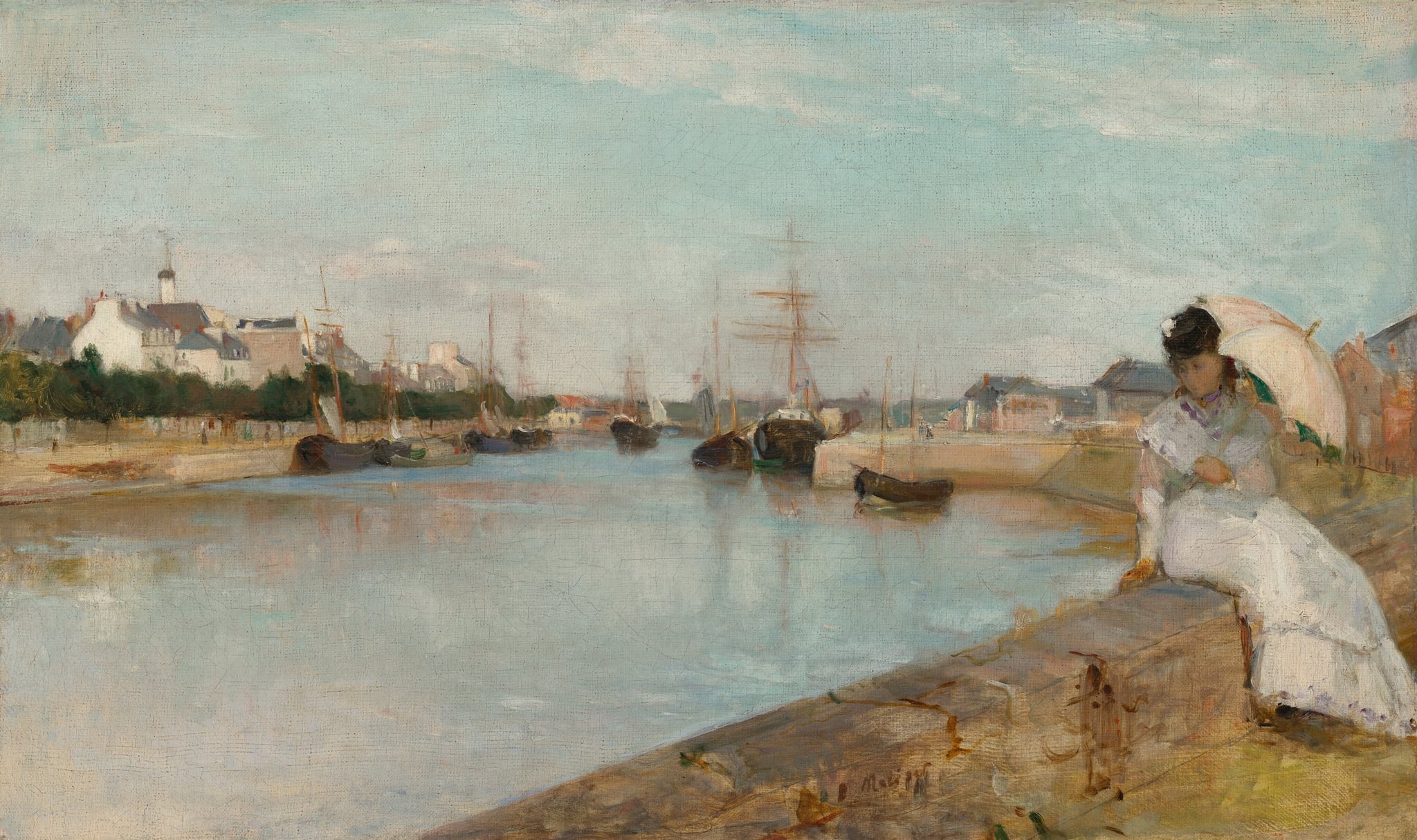
The Harbour at Lorient
Berthe Morisot (1869)
Berthe Morisot’s The Harbour at Lorient stages a quiet tension between <strong>private reverie</strong> and <strong>public movement</strong>. A woman under a pale parasol sits on the quay’s stone lip while a flotilla of masted boats idles across a silvery basin, their reflections dissolving into light. Morisot’s <strong>pearly palette</strong> and brisk brushwork make the water read as time itself, holding stillness and departure in the same breath <sup>[1]</sup>.
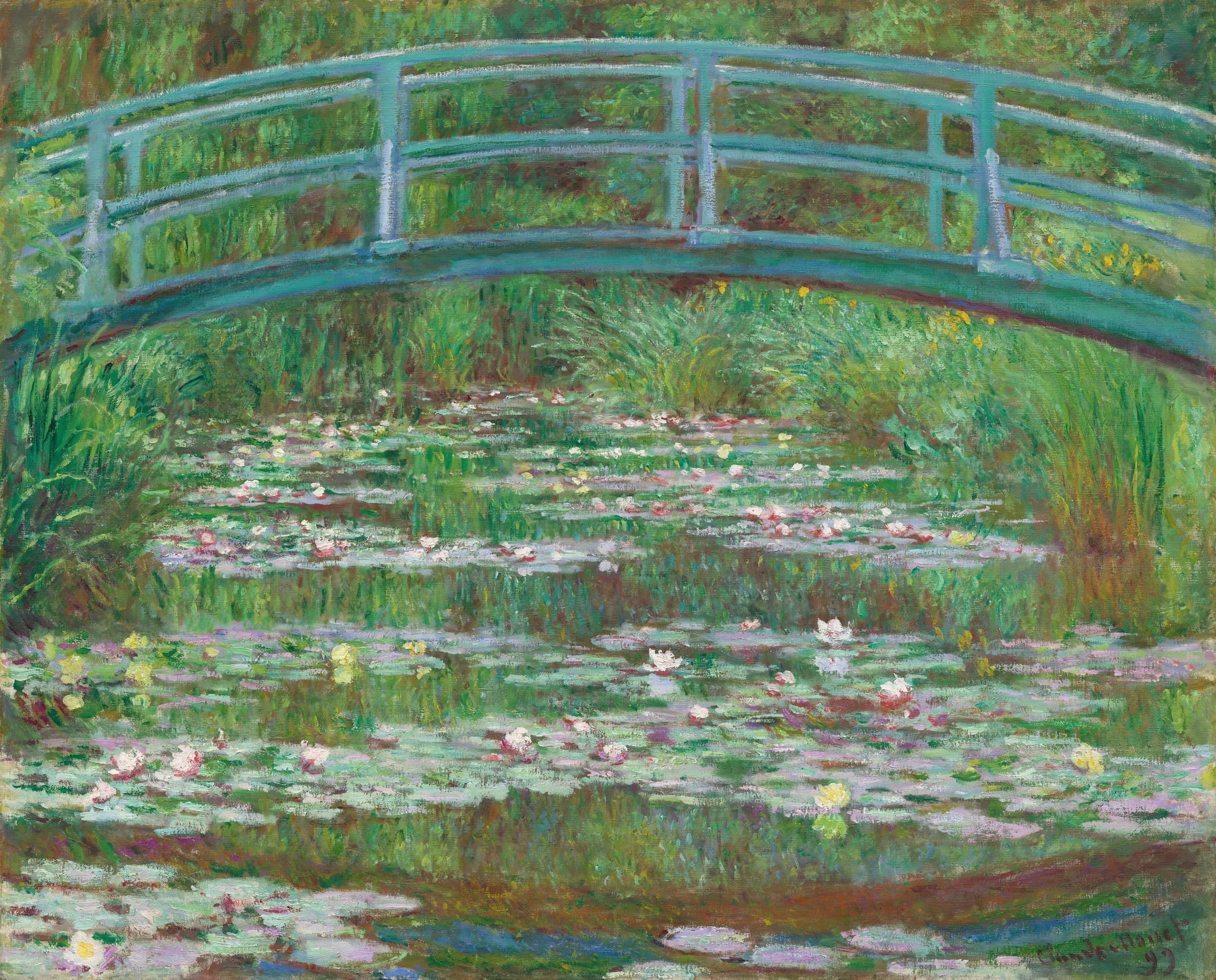
The Japanese Footbridge
Claude Monet (1899)
Claude Monet’s The Japanese Footbridge turns his Giverny garden into an <strong>immersive field of perception</strong>: a pale blue-green arc spans water crowded with lilies, while grasses and willows dissolve into vibrating greens. By eliminating the sky and anchoring the scene with the bridge, Monet makes <strong>reflection, passage, and time</strong> the picture’s true subjects <sup>[1]</sup><sup>[2]</sup>.
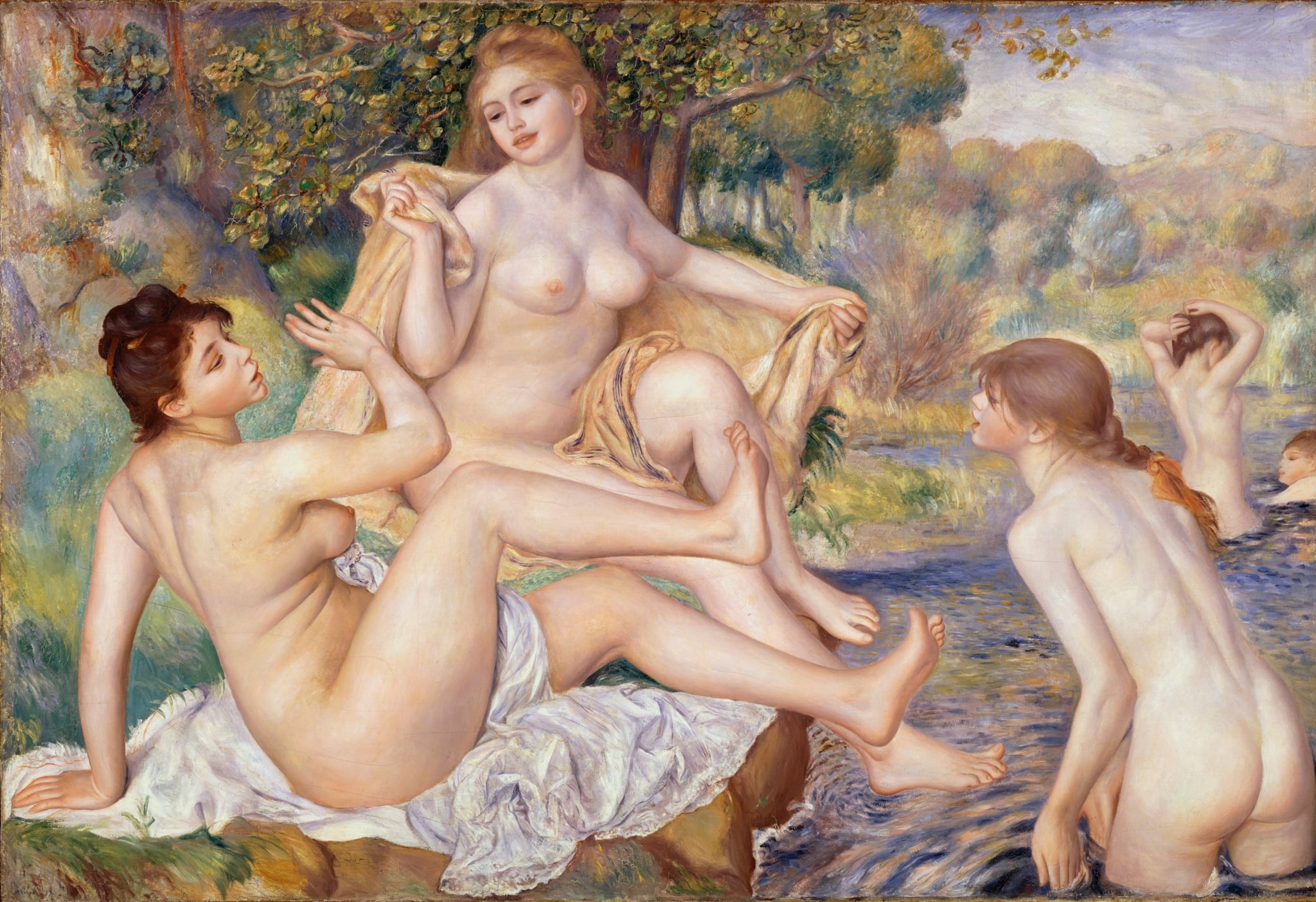
The Large Bathers
Pierre-Auguste Renoir (1884–1887)
Pierre-Auguste Renoir’s The Large Bathers unites modern bodies with a pastoral grove to stage an <strong>Arcadian ideal</strong>. Three monumental nudes form interlocking curves and triangles while two background figures splash and groom, fusing <strong>sensual warmth</strong> with <strong>classical order</strong> <sup>[1]</sup><sup>[2]</sup>.
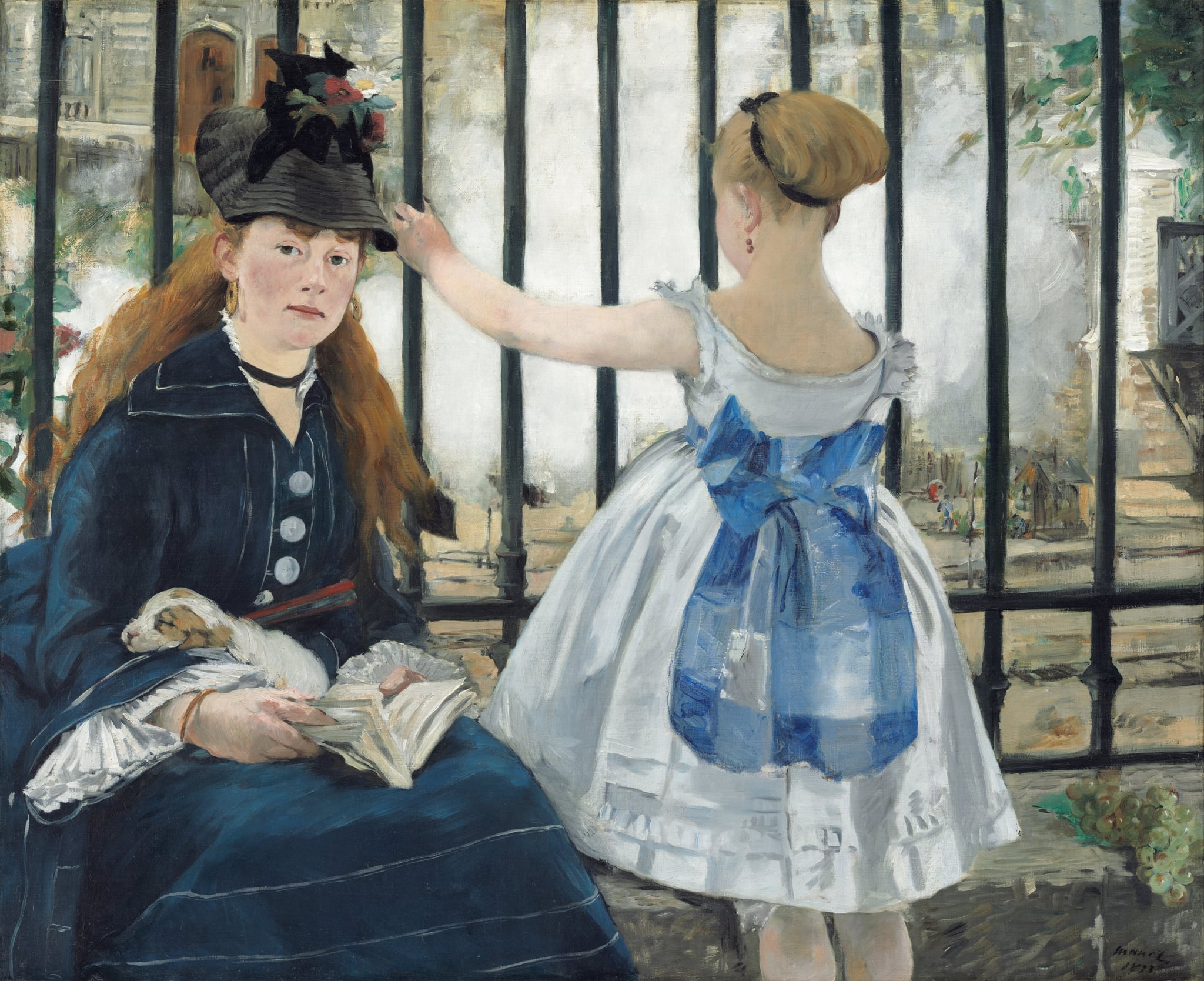
The Railway
Édouard Manet (1873)
Manet’s The Railway is a charged tableau of <strong>modern life</strong>: a composed woman confronts us while a child, bright in <strong>white and blue</strong>, peers through the iron fence toward a cloud of <strong>steam</strong>. The image turns a casual pause at the Gare Saint‑Lazare into a meditation on <strong>spectatorship, separation, and change</strong> <sup>[1]</sup><sup>[3]</sup>.
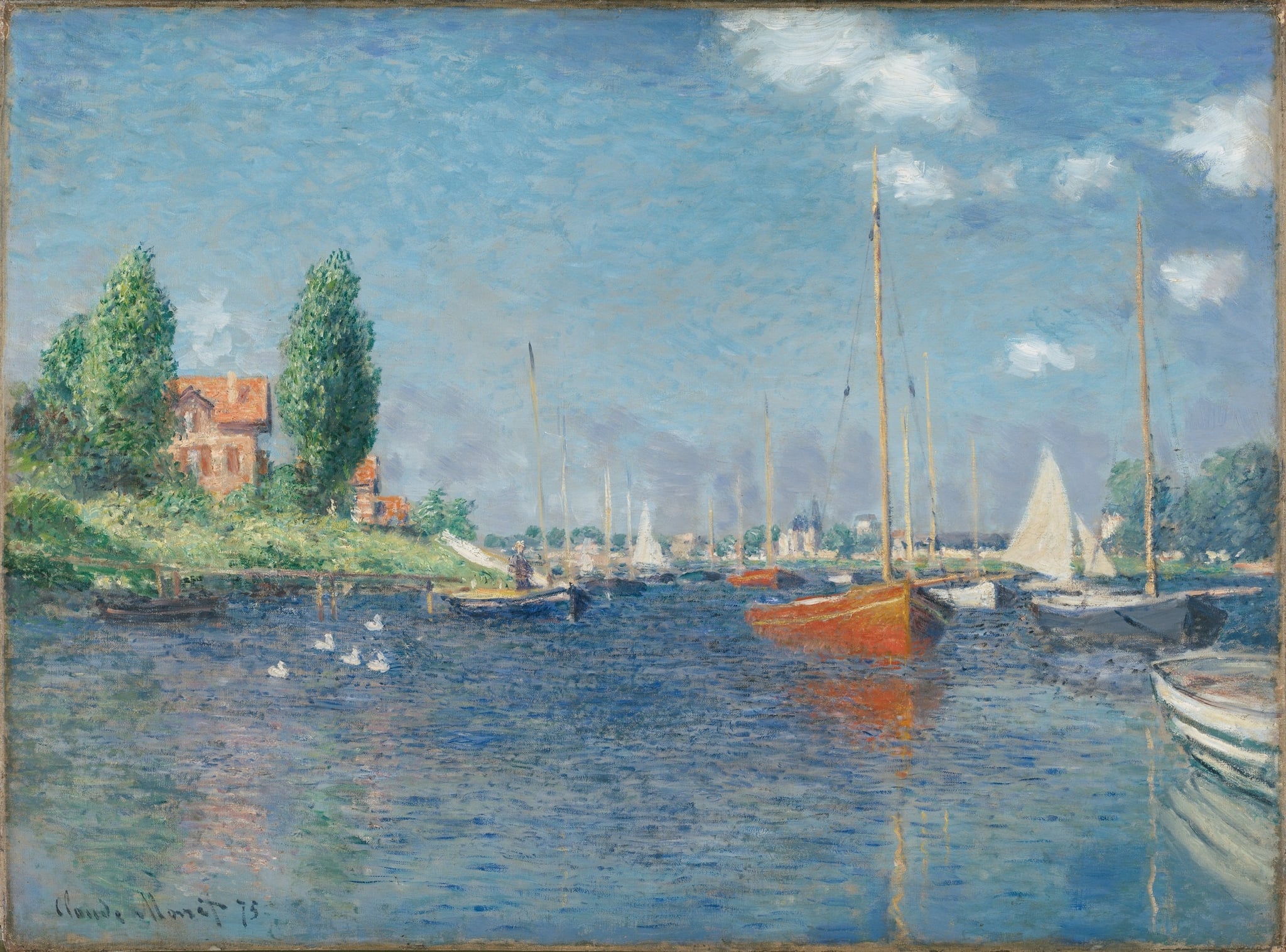
The Red Boats, Argenteuil
Claude Monet (1875)
Claude Monet’s The Red Boats, Argenteuil crystallizes a luminous afternoon on the Seine, where two <strong>vermilion hulls</strong> anchor a scene of leisure and light. The tremoring <strong>reflections</strong> and vertical <strong>masts/poplars</strong> weave nature and modern recreation into a single atmospheric field <sup>[1]</sup>.
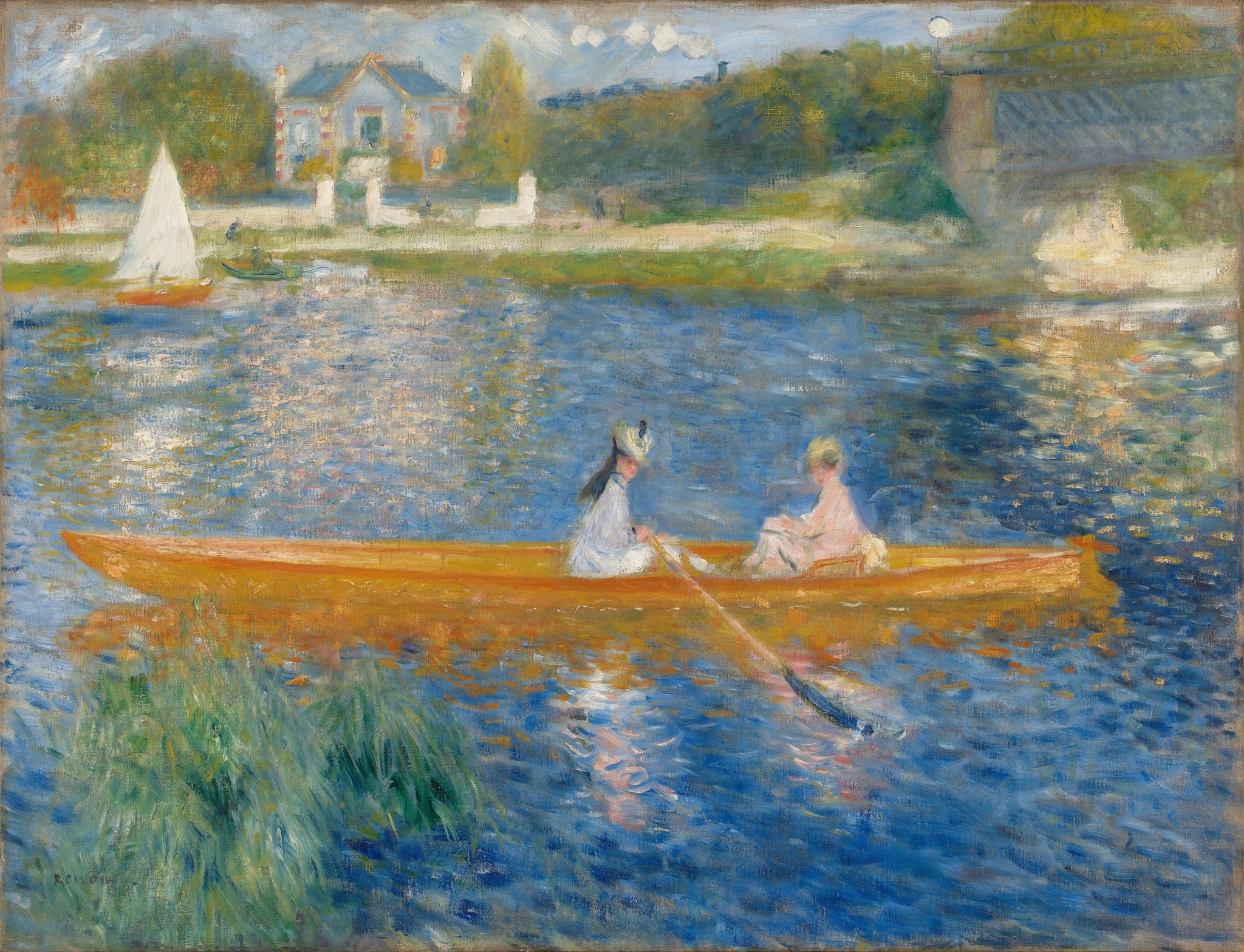
The Skiff (La Yole)
Pierre-Auguste Renoir (1875)
In The Skiff (La Yole), Pierre-Auguste Renoir stages a moment of modern leisure on a broad, vibrating river, where a slender, <strong>orange skiff</strong> cuts across a field of <strong>cool blues</strong>. Two women ride diagonally through the shimmer; an <strong>oar’s sweep</strong> spins a vortex of color as a sailboat, villa, and distant bridge settle the scene on the Seine’s suburban edge <sup>[1]</sup>. Renoir turns motion and light into a single sensation, using a high‑chroma, complementary palette to fuse human pastime with nature’s flux <sup>[1]</sup><sup>[2]</sup>.
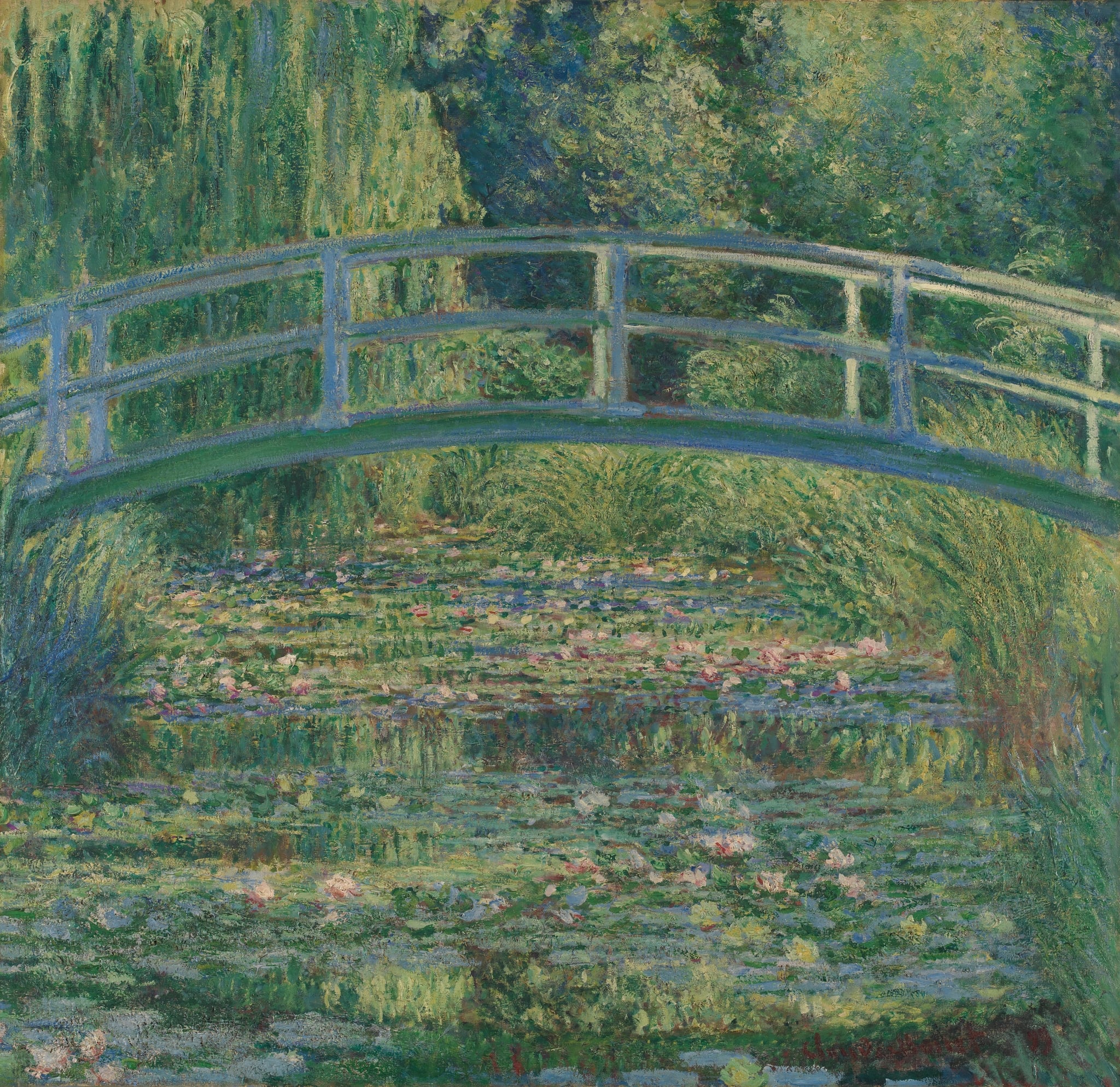
The Water Lily Pond
Claude Monet (1899)
Claude Monet’s The Water Lily Pond transforms a designed garden into a theater of <strong>perception and reflection</strong>. The pale, arched <strong>Japanese bridge</strong> hovers over a surface where lilies, reeds, and mirrored willow fronds dissolve boundaries between water and sky, proposing <strong>seeing itself</strong> as the subject <sup>[1]</sup><sup>[3]</sup>.
Related Themes
Related Symbolism Categories
Femininity
In late nineteenth‑century painting, femininity is articulated not as an essence but as a mutable ensemble of fashion, gesture, and setting, through which modern artists probe women’s visibility, labor, and agency within emerging urban and suburban worlds.
Interiority
“Interiority” symbols in modern painting transform gesture, gaze, and domestic props into visual indices of inward life, staging psychological depth, self-consciousness, and mediated subjectivity within scenes of everyday modernity.
Landscape
Landscape symbolism in modern painting transforms rivers, trees, bridges, and distant horizons into active sign-systems for labor, leisure, perception, and cyclical time, reworking inherited Arcadian and religious motifs under industrial and Impressionist conditions.
Within the long history of Western art, water has shifted from a largely allegorical element—host to nymphs, personifications, and sacred rites—to a privileged medium for registering modern experience itself. By the later nineteenth century, rivers, seas, and ponds no longer simply accommodate stories; they become the story, the mutable surface on which time, labor, and perception are written. In Impressionist and Post‑Impressionist practice especially, water ceases to be a neutral backdrop. It is reconceived as an optical field, a site of social choreography, and a visual metaphor for the instability of modern life. The symbols in this category—boats and bridges, horizons and reflections, ponds and floods—articulate that shift, turning the motif of water into a complex semiotic system.
Several works here mobilize bridges to figure the new infrastructures that reorder space and social life. In Georges Seurat’s Bathers at Asnières, the Seine is not an Arcadian stream but the “city’s lifeline,” animated by bridges (rail and road) that signal “modern infrastructure and connection.” Iconographically, these distant spans align the workers’ leisure with the industrial horizon of chimneys and boats, making the river a shared resource for both labor and respite. Semiotic tension arises from this juxtaposition: the water reads at once as a classical bathing site and as a modern transit corridor. Bridges operate similarly in Alfred Sisley’s Flood at Port-Marly, albeit more obliquely. Here, “reflections on floodwater” stage “nature’s re‑inscription of the built world,” so that the urban order is literally doubled and destabilized by inundation. The gridded rows of trees and façades, momentarily converted into an amphibious space plied by boats rather than carriages, demonstrate how modern connectivity rests on unstable ground; water temporarily rewrites the city’s rational diagram.
Claude Monet’s work concentrates this infrastructural symbolism into a more introspective register. In The Water Lily Pond (invoked in the entry on water lilies and the arched Japanese footbridge), the bridge is no longer a vehicle for traffic but “a calm, human-made anchor amid natural flux and a sign of cultural hybridity.” Iconographically indebted to japonisme, it frames a horizonless pond whose reflective pond surface collapses distinctions between up and down, depth and surface. Semiotics here shift from Seurat’s social connectivity to perceptual ambiguity: water is less a conduit than a mirror. The water lilies themselves “punctuate the surface like pauses in a visual phrase,” registering “ephemeral beauty” and the temporality of looking. Rather than stabilizing the world, the bridge and lilies organize a controlled uncertainty, where perception must constantly renegotiate what is solid and what is reflected.
Water as mirror—and as a metaphor for the instability of perception—also structures Monet’s and Sisley’s open-air river and coastal scenes. In Sisley’s Flood at Port-Marly, “reflections on floodwater” and the street’s provisional canalization suggest that modernity entails continual adaptation to flux. The doubled trees and façades function semiotically as a palimpsest: the built environment is seen twice, once as structure, once as shimmering image, underscoring the contingency of human order. Monet’s Venetian San Giorgio Maggiore at Dusk radicalizes this logic. There, water reflections and a “vanished horizon (sky–water fusion)” fuse architecture and atmosphere into a single vibrating field. The campanile’s silhouette and its “wavering vertical reflection” stand as a minimal armature of permanence, yet the painting’s meaning lies in how that stability is constantly threatened by chromatic dissolution. Water serves as an allegory of time: the basilica’s endurance is only legible through its ceaseless reappearance in the mobile, reflective basin.
Alongside these reflective and infrastructural codes, a second cluster of symbols turns water into a theater of social relations—especially the newly codified practices of leisure and work along rivers and coasts. Monet’s La Grenouillère is paradigmatic. The floating resort is accessed via a gangplank/footbridge, “a threshold or social hinge linking shade and glare, nature and commerce, spectators and bathers.” The shaded “green rental rowboats” in the foreground index a commodified mobility—boats for hire—that mediates access to suburban escape. Semiotic emphasis falls on passage: to cross the plank is to traverse classed spaces and temporal regimes, from workday to weekend. Water here is not only the physical support for pleasure craft; it symbolizes the liquidity of social boundaries in the emergent culture of urban recreation.
Renoir and Morisot refine this social semiotics at a more intimate scale. In Renoir’s Pont Neuf Paris, the Seine appears as “flux and reflection—nature mirroring the city’s light and color,” but the crucial symbol is the Pont Neuf (the bridge/parapet) as locus of “connection and cohesion.” The river’s rippling surface catches and redistributes urban light, visually binding the city’s disparate populations who cross and pause along the parapet. Water thus becomes an optical metaphor for civic reciprocity, while the bridge stages that reciprocity in embodied form. Morisot’s Summer’s Day shifts to the scale of the “small boat/skiff,” understood as “a threshold/liminal space—public yet intimate—enabling female companionship within the city’s recreation.” The lake’s shimmering water and reflections fuse boat and figures in a single calligraphic surface, proposing a relational model of perception in which environment and subject co-constitute one another. Iconographically, the skiff offers women a circumscribed but genuine autonomy; semiotically, the rippling water signifies the fragile, negotiated character of that autonomy in public space.
The coastal canvases heighten the tension between water as workplace and water as playground. In Monet’s The Beach at Sainte-Adresse, the blue beached boat is designated as “workaday craft,” standing for “present-tense labor and the coastal economy brought up onto shore between tides.” Its saturated hull color anchors the composition between the fashionable sitters and the “rust-brown working sails offshore.” The shore, in this iconography, is a hinge between economies: the beached boat marks labor “paused rather than absent,” while the turquoise channel carries ongoing traffic. The banded, high-horizon sea in Manet’s On the Beach deploys a related but more abstract code. There, horizontal water bands “compress depth and turn nature into tonal fields,” registering a disenchanted modern gaze in which the sea is grasped as planar expanse rather than romantic abyss. Boats skimming the horizon read as schematic signs of mobility; the water is less an existential sublime than a modern screen, a flattened ground against which solitary figures negotiate interiority.
Across these examples, one can trace a historical evolution in the symbolism of water. In Cézanne’s Bathers, the flowing water/stream still carries vestiges of classical meaning: “renewal, sensuality, and passage between states” within a quasi-architectural grove, where bodies and landscape are welded into a timeless order. By contrast, in Seurat, Monet, Sisley, Renoir, and Morisot, water’s iconography is decisively modernized. It comes to signify measurable duration (horizontal water bands), social mobility (rowboats, skiffs, white-sailed yachts), and cognitive uncertainty (reflections, horizonless ponds, vanished horizons). The element that once symbolized baptismal purification or mythic origins is reinterpreted as an analytic tool: a changing surface through which artists probe how the modern world is built, inhabited, and seen. In that sense, the nineteenth-century reinvention of water’s symbolism tracks the broader shift from narrative to perception, from fixed allegory to the unstable, yet insistently material, flux of modern life.