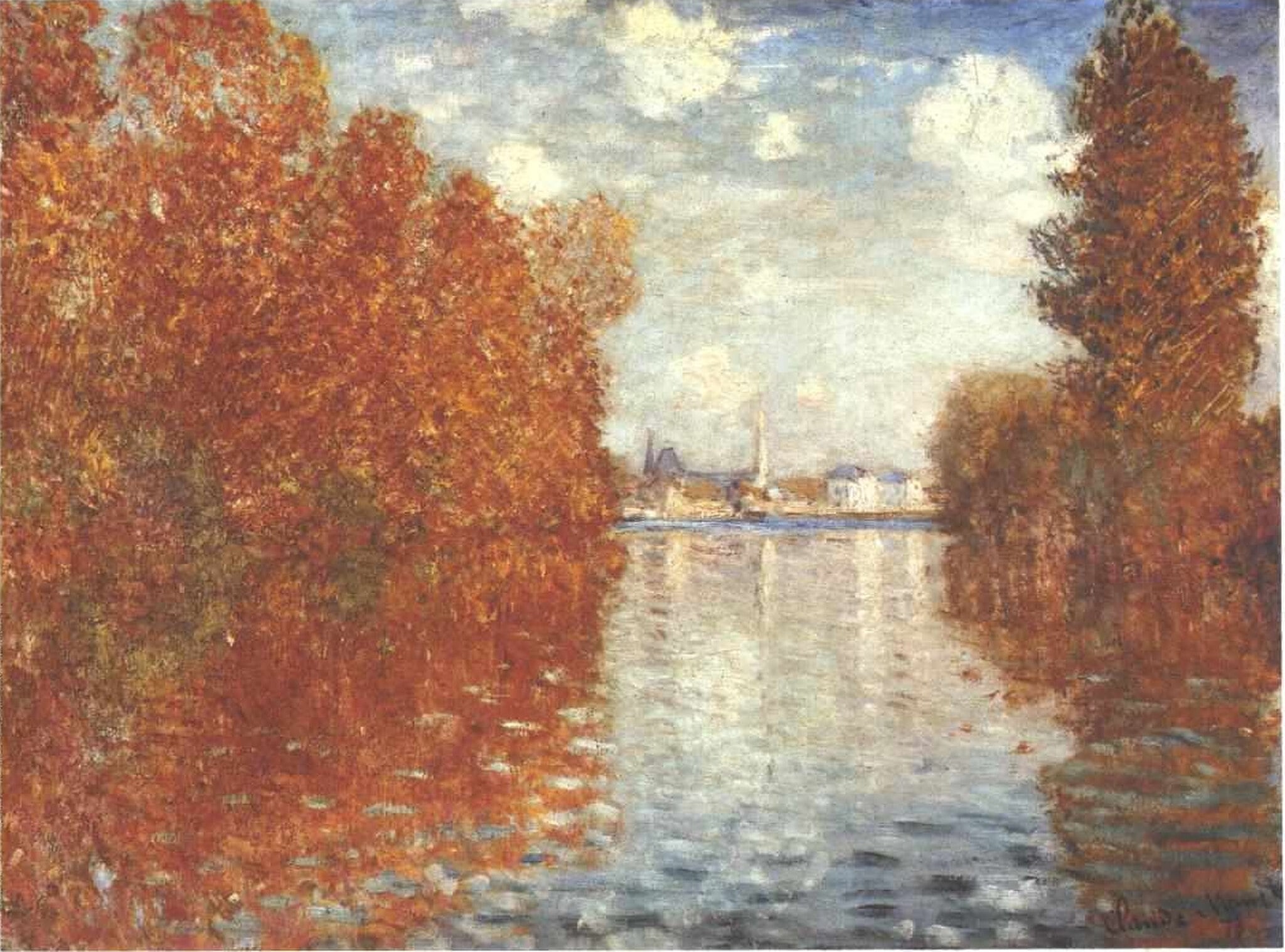
Converging Banks (Corridor Composition) Symbolism
Converging Banks (Corridor Composition) describes a spatial setup in which parallel edges—often riverbanks—narrow into the distance to form a corridor that directs the viewer’s gaze. In art history, this device marks a threshold between zones of space and light, heightening focus through perspective and contrast. Artists use it to build visual tension while leading the eye toward a decisive area of illumination or activity.
Converging Banks (Corridor Composition) in Autumn Effect at Argenteuil
In Autumn Effect at Argenteuil (1873) by Claude Monet, the Seine becomes a luminous corridor: blazing autumn foliage presses in from both banks while the water’s broken reflections pull the eye forward. Monet stages a measured passage from these narrowed banks to a light-struck town on the horizon, and the complementary orange–blue contrasts sharpen the sense of threshold and arrival. Painted from his studio boat, the channeled view aligns with the Impressionist pursuit of fleeting effects of light and air, using the corridor composition to fuse movement, tension, and destination along a single optical path.