Autumn Effect at Argenteuil

by Claude Monet

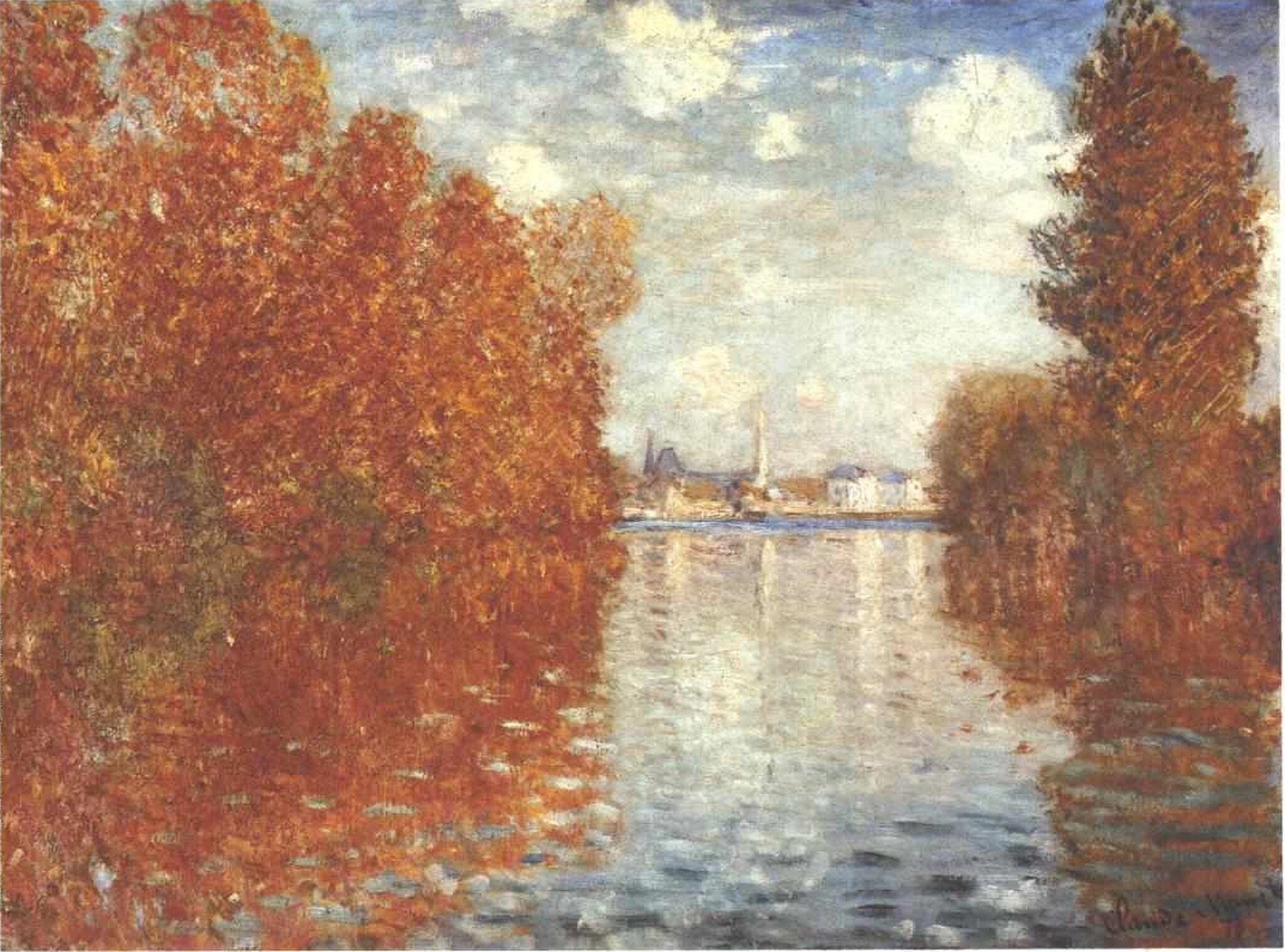
Autumn Effect at Argenteuil presents a luminous channel of the Seine flanked by blazing foliage, its surface vibrating with broken reflections. Monet turns the scene into an optical drama of complementary orange–blue contrasts, staging a passage from the narrowed banks to a light-struck town on the horizon. Painted from his studio boat, the work distills the Impressionist belief that truth resides in fleeting effects of light and air [1][2].

Study Print Studio

Create a personal study print

Build a companion study sheet around the part of this painting that speaks to you most. Choose a detail, shape an interpretation, and walk away with something personal and display-worthy.

Fast Facts

Year
1873
Medium
Oil on canvas
Dimensions
55 x 74.5 cm
Location
The Courtauld, London
See all Claude Monet paintings in London
Autumn Effect at Argenteuil by Claude Monet (1873) featuring Autumn Foliage (Orange Masses), Blue Water Channel, Broken Reflections, Converging Banks (Corridor Composition)

Click on any numbered symbol to learn more about its meaning

Meaning & Symbolism

Monet organizes the composition as a gently closing corridor: masses of copper and rust leaves press in from left and right, while a central waterway carries the gaze forward to small white houses and a pale spire. This narrowing sets up a purposeful tension—nature encroaches as settlement beckons—resolving not in hard outlines but in radiance. Thick, parallel strokes on the water splice steel-blues with the trees’ orange reflections, so that cool and warm hues flicker in equilibrium. The sky’s broken clouds repeat as tremulous silvers below, making the river a mirror that edits and recomposes what it shows. The result is a scene that seems to breathe, its edges dissolving where color meets light. Monet heightens this vibration by scratching into wet paint to articulate the foliage, a tactile inscription that turns leaves into tremors of energy rather than botanical detail 12. Painted from his studio boat on a quiet side channel, the viewpoint sits low and floating; the spectator, like the painter, experiences the world as passing sensation rather than surveyed terrain 2. The chromatic logic is declarative. Orange foliage and blue water are complementary, a pairing that creates maximum optical resonance while also staging a seasonal dialectic: autumn’s embers against winter’s cool approach 1. This is not a melancholy elegy but a modern calibration of forces—warmth retained in reflection even as the river carries time forward. Within Impressionist discourse, reflections are not mere accessories; they are metaphors for perception’s instability. Here the doubled trees and sky announce that reality arrives to us mediated by atmosphere and motion, a proposition that Monet makes legible through paint itself 3. Yet the image also selects its modernity. Argenteuil was a hub of railways, bridges, and industry, but Monet frames a pastoral side channel, allowing the town’s signs—a few roofs and a spire—to appear as distant harmonies rather than disruptions 23. Scholars have read this Argenteuil strategy as a “suburban pastoral,” an artful smoothing of modern life into nature’s terms; the painting’s ordered banks and calibrated color sustain that reading while keeping faith with Impressionism’s radical focus on the effectthe momentary, the contingent, the seen 3. Structurally, the canvas confirms how Monet’s supposed spontaneity rests on compositional discipline: the corridor format funnels attention, the horizon is stabilized by a slim blue band of mid-river, and the vertical of the spire anchors the flux of strokes around it. In this balance of order and sensation lies the work’s durable charge, an argument that modern truth is not an inventory of things but the registration of light-in-time—a claim Monet advances from a boat, on a river that never stays the same 123.

Explore Deeper with AI

Ask questions about Autumn Effect at Argenteuil

Popular questions:

Powered by AI • Get instant insights about this artwork

💬 Ask questions about this artwork!

Interpretations

Historical Context: Argenteuil as Laboratory

Argenteuil in the early 1870s functioned as an open-air studio for Monet and peers, where suburban expansion met riverine calm. The proximity to Paris by rail fostered frequent returns and exchanges, yet the painter often chose quieter reaches to test color and light. Painting from the studio boat is crucial: a modern, mobile platform that enabled serial observation of atmospheric change and the crafting of an "effect" on site. Shown in the 1876 Impressionist exhibition, the canvas helped codify a practice centered on transient conditions and suburban modernity. The result is not topography but a deliberately staged encounter with time and weather—an ethos that defined Impressionism’s classic phase 123.

Source: The Courtauld; National Gallery of Art (Paul Hayes Tucker); National Gallery, London

Modernity Selected: The Suburban Pastoral

T.J. Clark’s notion of the "suburban pastoral" clarifies how this work negotiates modern life. Argenteuil teemed with bridges and factories, yet Monet’s view edits them out, allowing just roofs and a spire to register as distant harmonies. This selective framing is ideological as well as optical: it transforms the modern suburb into a pastoral corridor where labor and infrastructure recede behind foliage and light. Rather than denial, it is a strategy of deflection—absorbing modernity into atmospheric order. The painting thus becomes a social image smoothed into natural terms, aligning perception with desire for equilibrium even as the industrial world surrounds the scene beyond the frame 14.

Source: T.J. Clark; The Courtauld

Leisure Lens: Work Performed as Recreation

Robert Herbert’s account of Impressionism’s leisure culture helps read the bateau-atelier as a hybrid of labor and pastime. Monet paints from a pleasure-craft vantage, converting recreational mobility into a working method. The composition’s low, gliding perspective stages viewing as a leisurely drift, while chromatic play and reflections perform the experiential tempo of suburban boating. In this sense, the painting doubles leisure: it depicts a leisure space and converts looking into a leisurely act, synchronizing painter, spectator, and site. Such alignment supports an economy of modern leisure in which sensation—rather than narrative—anchors meaning and value in the image 15.

Source: Robert L. Herbert; The Courtauld

Medium Reflexivity: Paint as Perception Engine

The surface declares its means. Thick, parallel strokes braid sky-silver with arboreal orange, while sgraffito cuts articulate leaves as vibrations rather than facts. Reflections function not as duplicates but as procedures of seeing: a painterly demonstration that reality is encountered through flicker, overlay, and delay. In this sense, the river is both motif and method—its broken mirror licenses broken brushwork, turning medium into metaphor. The canvas thus operates reflexively, making the viewer apprehend perception as constructed, contingent, and time-bound; it is a picture about how pictures make appearances happen in the first place 26.

Source: National Gallery of Art (Paul Hayes Tucker); The Courtauld (Collection Record)

Structure Beneath Spontaneity

Paul Hayes Tucker emphasizes how Monet’s apparent immediacy rests on compositional discipline. Here a corridor format funnels sight; a slim, stable horizon band and the spire’s vertical counter the lateral flicker of strokes. Such scaffolding enables high-key color to remain legible, letting complementary orange/blue vibrate without dissolving the scene. The painting models a calibrated equilibrium between order and flux—an architecture for contingency. This is key to Impressionism’s claim to modern truth: not inventorying objects but staging optical events within compositional armatures that keep sensation coherent, repeatable, and communicable to viewers in a gallery context 26.

Source: National Gallery of Art (Paul Hayes Tucker); The Courtauld (Collection Record)

Related Themes

About Claude Monet

Claude Monet (1840–1926) led Impressionism’s pursuit of open-air painting and optical immediacy, especially during his Argenteuil years focused on modern leisure and light. He later developed serial studies of changing conditions, culminating in the Water Lilies cycle [2].
View all works by Claude Monet

More by Claude Monet

Haystacks Series by Claude Monet | Light, Time & Atmosphere by Claude Monet

Haystacks Series by Claude Monet | Light, Time & Atmosphere

Claude Monet

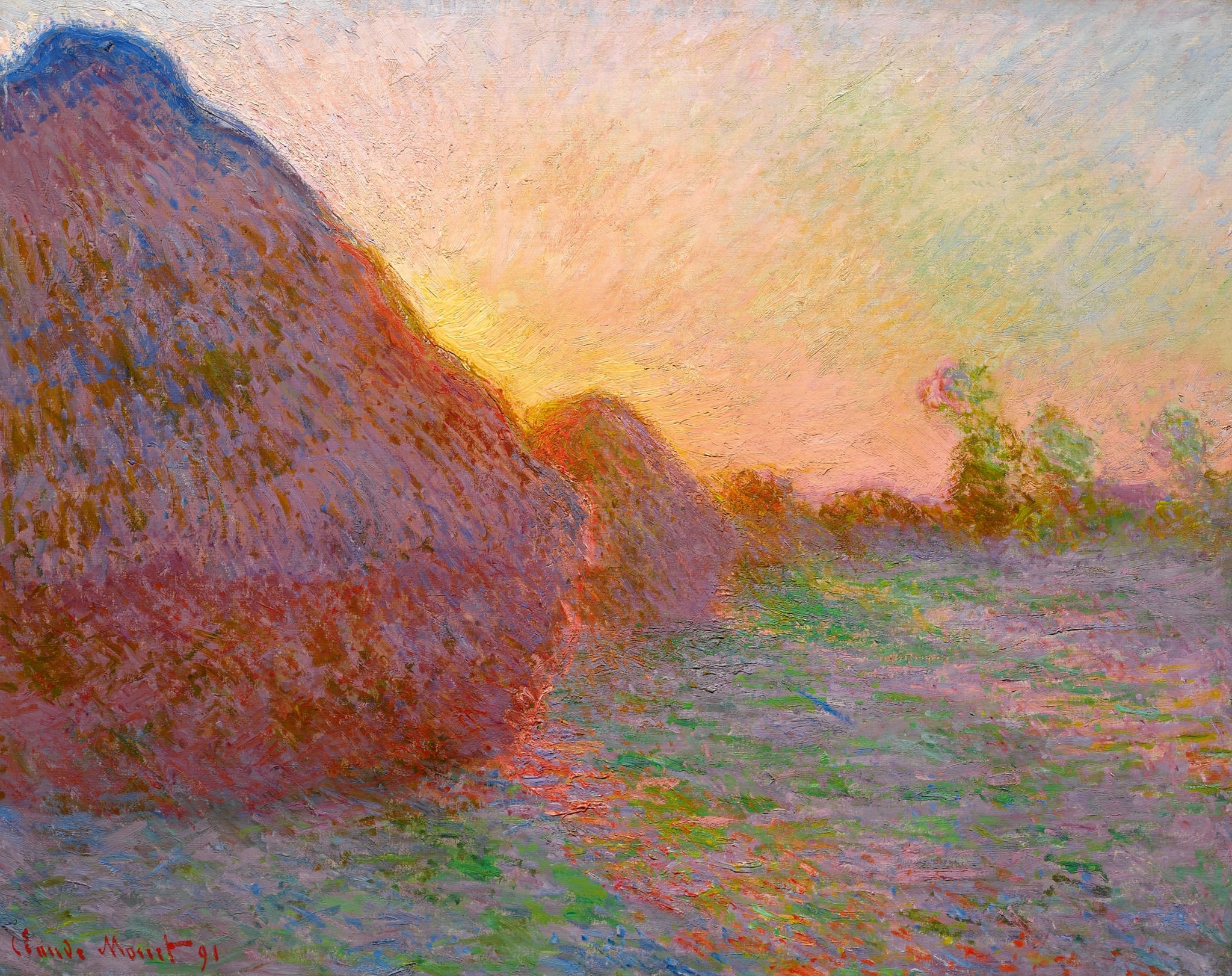
Claude Monet’s <strong>Haystacks Series</strong> transforms a routine rural subject into an inquiry into <strong>light, time, and perception</strong>. In this sunset view, the stacks swell at the left while the sun burns through the gap, making the field shimmer with <strong>apricot, lilac, and blue</strong> vibrations.
Women in the Garden by Claude Monet

Women in the Garden

Claude Monet (1866–1867)

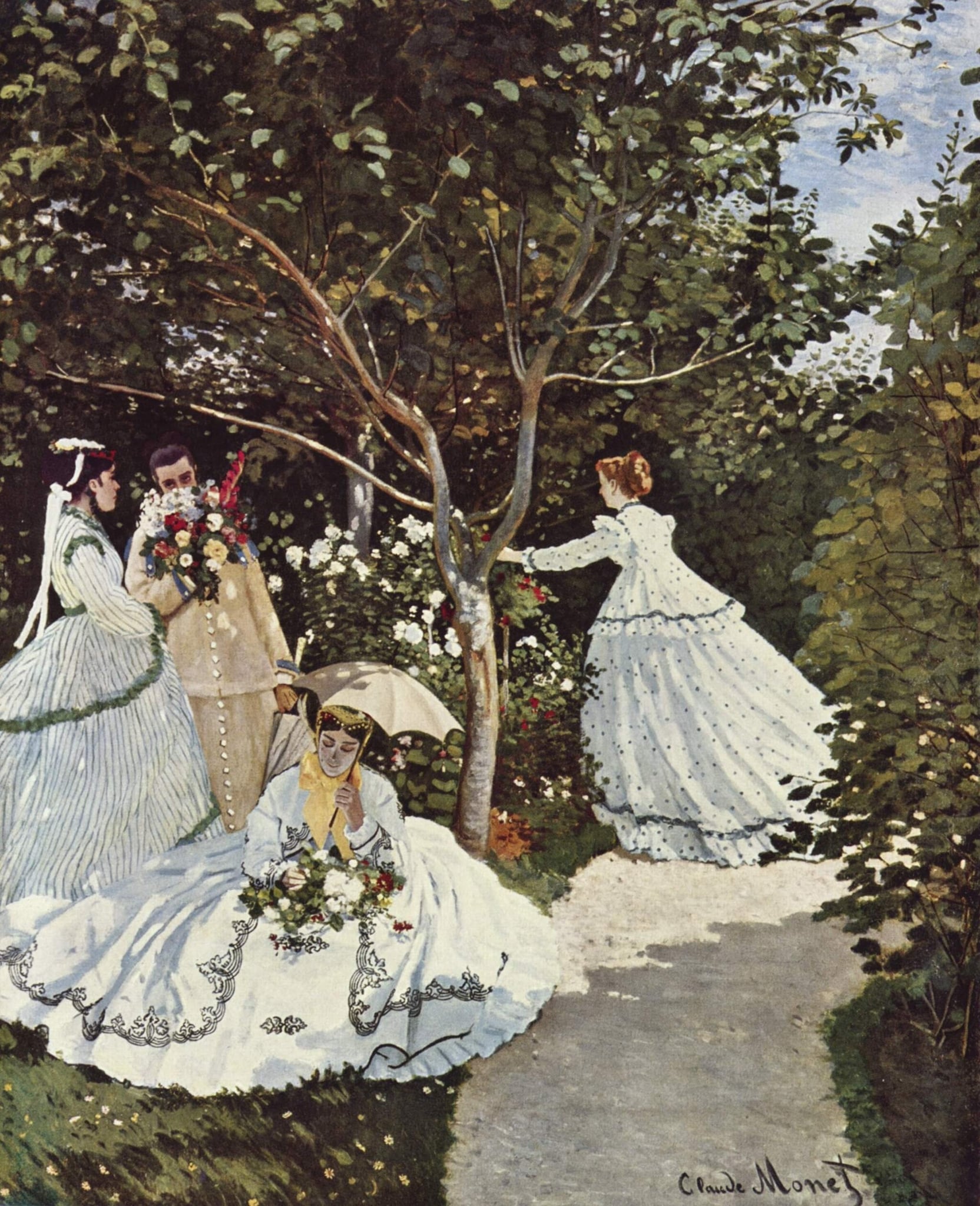
Claude Monet’s Women in the Garden choreographs four figures in a sunlit bower to test how <strong>white dresses</strong> register <strong>dappled light</strong> and shadow. The path, parasol, and clipped flowers frame a modern ritual of leisure while turning fashion into an instrument of <strong>perception</strong>. The scene reads less as portraiture than as a manifesto for painting the <strong>momentary</strong> outdoors <sup>[1]</sup><sup>[3]</sup>.
The Train in the Snow (The Locomotive) by Claude Monet

The Train in the Snow (The Locomotive)

Claude Monet (1875)

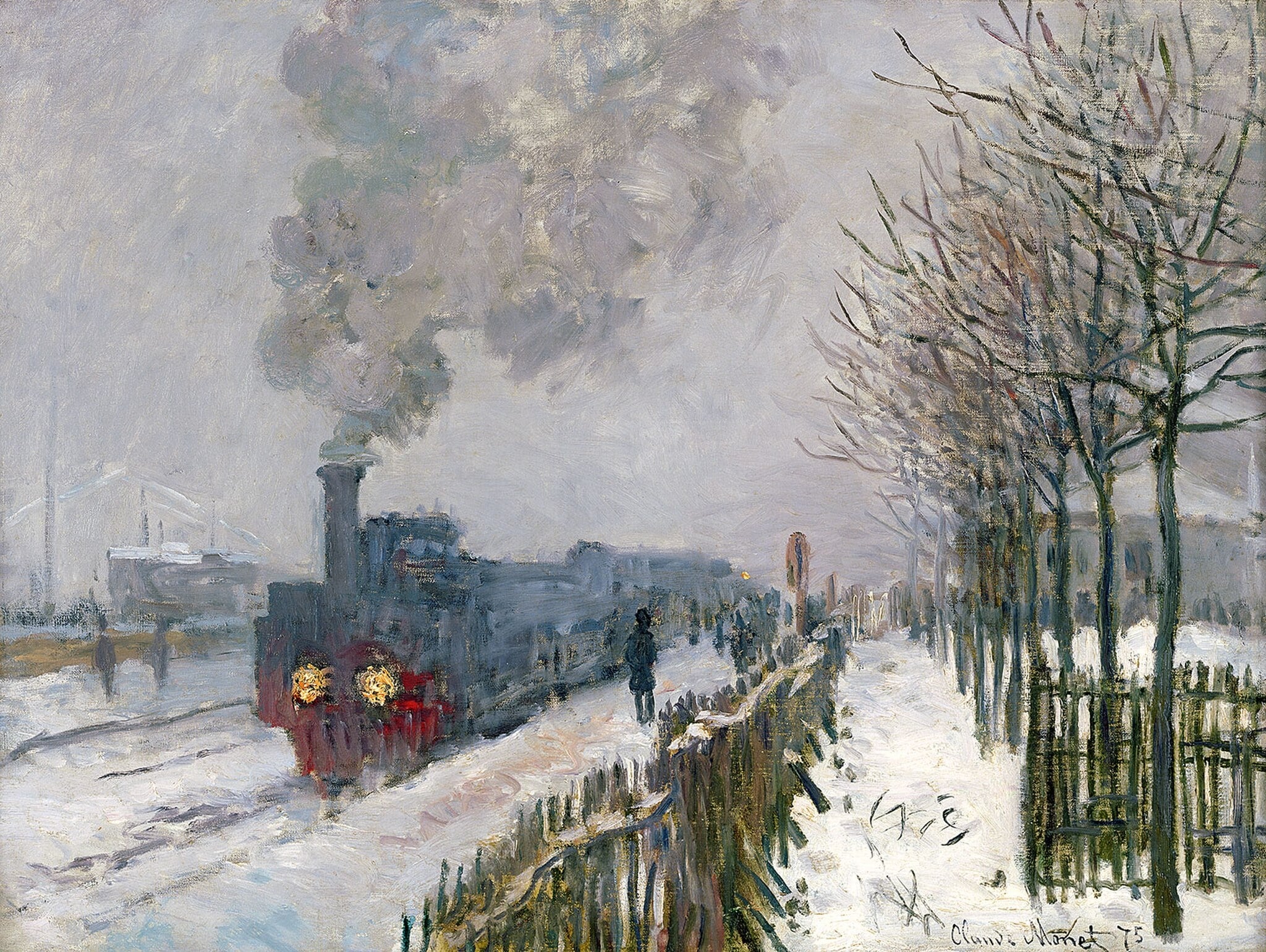
Claude Monet’s The Train in the Snow (The Locomotive) (1875) turns a suburban winter platform into a study of <strong>modernity absorbed by atmosphere</strong>. The engine’s twin yellow headlights and a smear of red push through a world of greys and violets as steam fuses with the low sky, while the right-hand fence and bare trees drill depth and cadence into the scene <sup>[1]</sup><sup>[4]</sup>. Monet fixes not an object but a <strong>moment of perception</strong>, where industry seems to dematerialize into weather <sup>[1]</sup><sup>[2]</sup>.
The Artist's Garden at Giverny by Claude Monet

The Artist's Garden at Giverny

Claude Monet (1900)

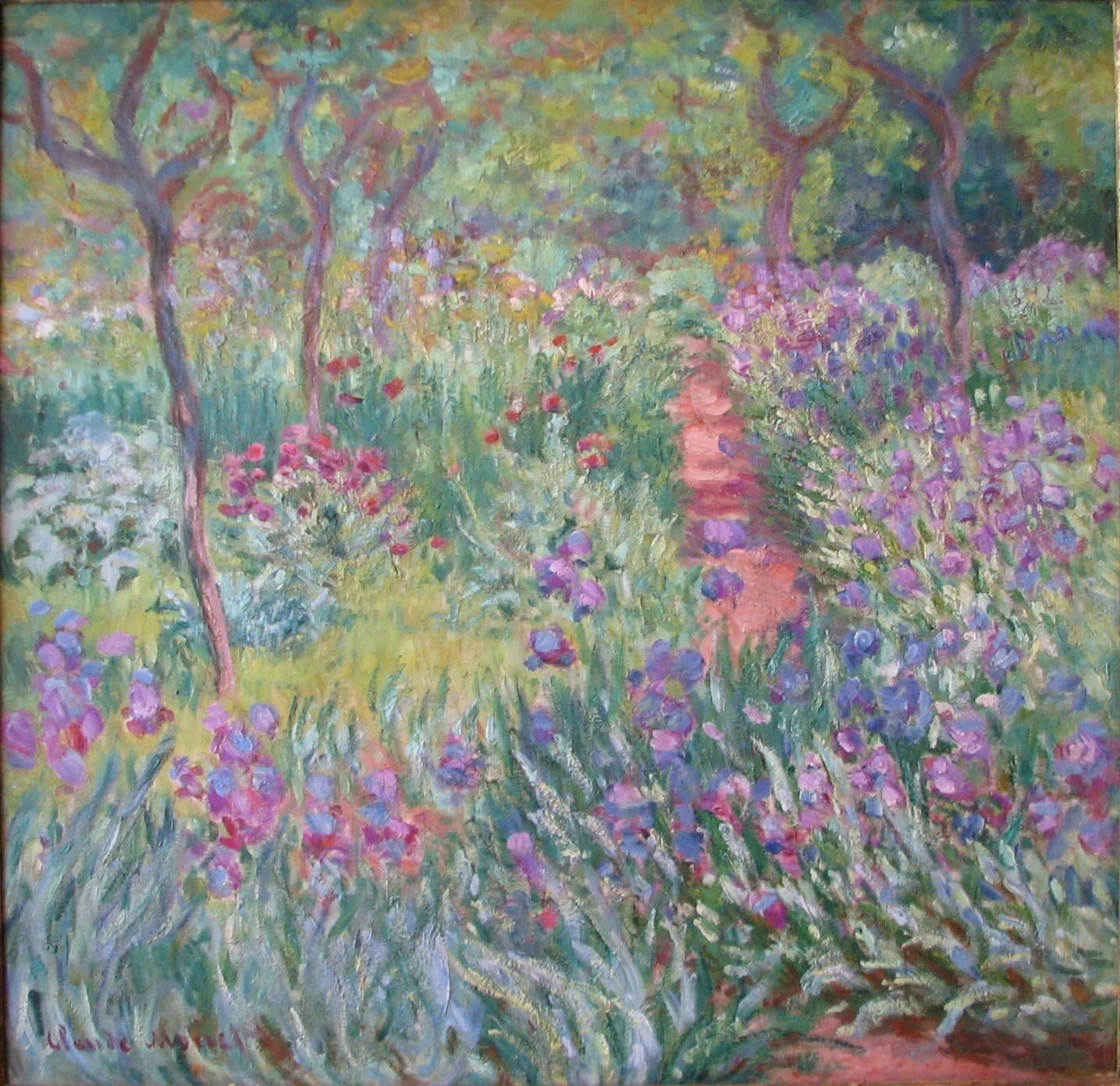
In The Artist's Garden at Giverny, Claude Monet turns his cultivated Clos Normand into a field of living color, where bands of violet <strong>irises</strong> surge toward a narrow, rose‑colored path. Broken, flickering strokes let greens, purples, and pinks mix optically so that light seems to tremble across the scene, while lilac‑toned tree trunks rhythmically guide the gaze inward <sup>[1]</sup><sup>[3]</sup>.
Water Lilies by Claude Monet

Water Lilies

Claude Monet (1899)

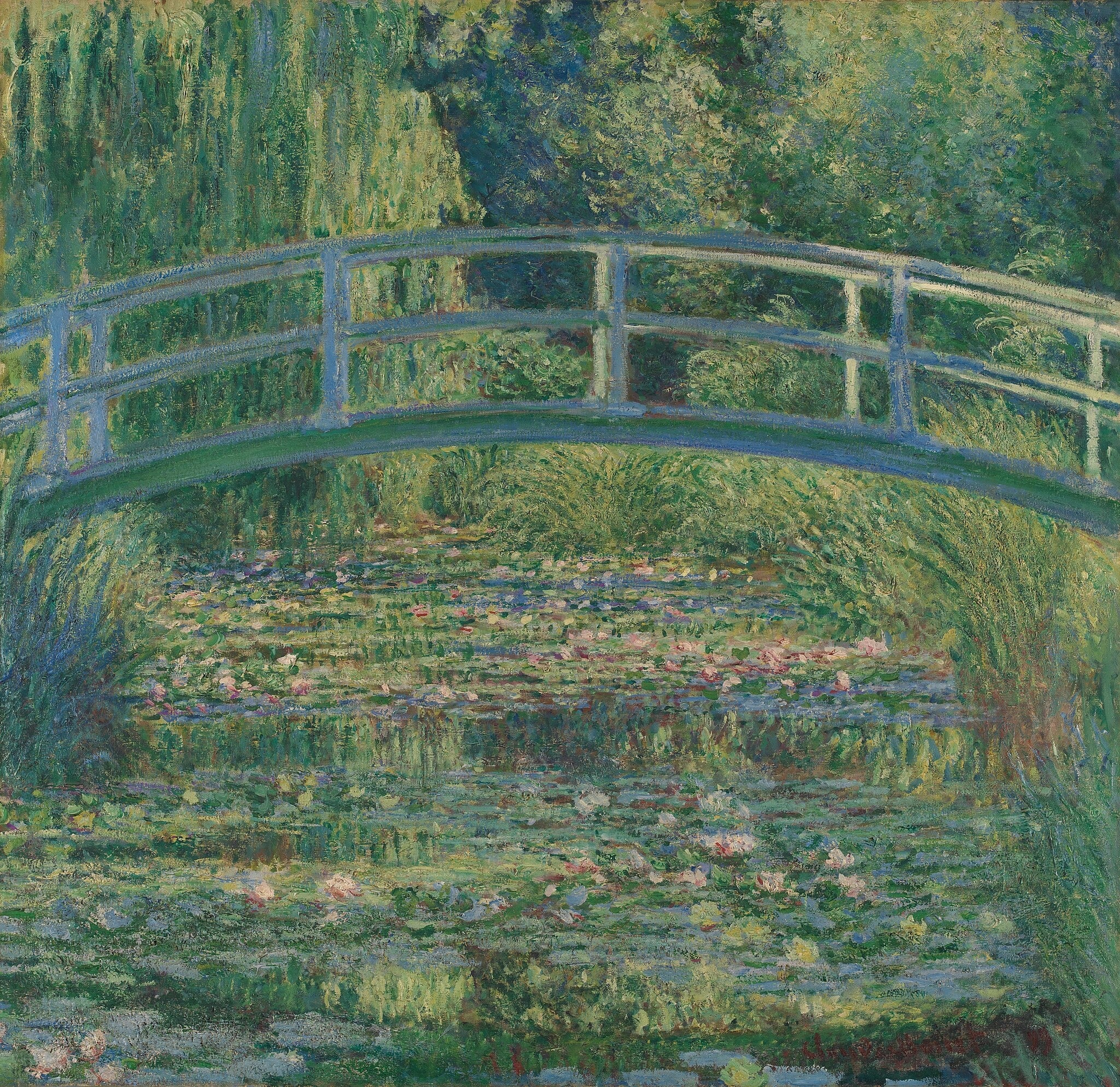
<strong>Water Lilies</strong> centers on an arched <strong>Japanese bridge</strong> suspended over a pond where lilies and rippling reflections fuse into a single, vibrating surface. Monet turns the scene into a study of <strong>perception-in-flux</strong>, letting water, foliage, and light dissolve hard edges into atmospheric continuity <sup>[1]</sup><sup>[3]</sup>.
The Grand Canal by Claude Monet

The Grand Canal

Claude Monet (1908)

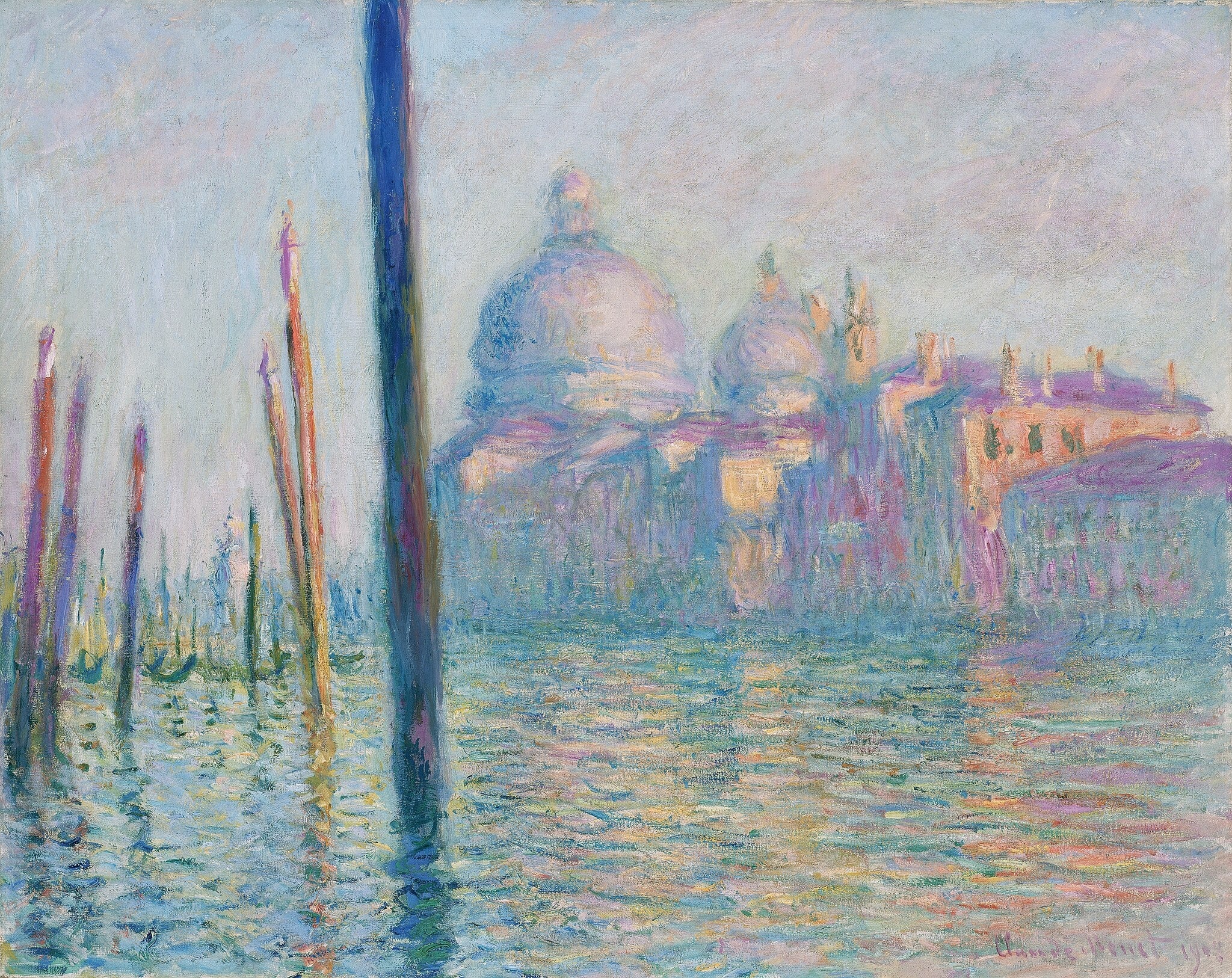
Claude Monet’s The Grand Canal turns Venice into <strong>pure atmosphere</strong>: the domes of Santa Maria della Salute waver at right while a regiment of <strong>pali</strong> stands at left, their verticals reverberating in the water. The scene asserts <strong>light over architecture</strong>, transforming stone into memory and time into color <sup>[2]</sup><sup>[3]</sup>.