Antibes

by Claude Monet

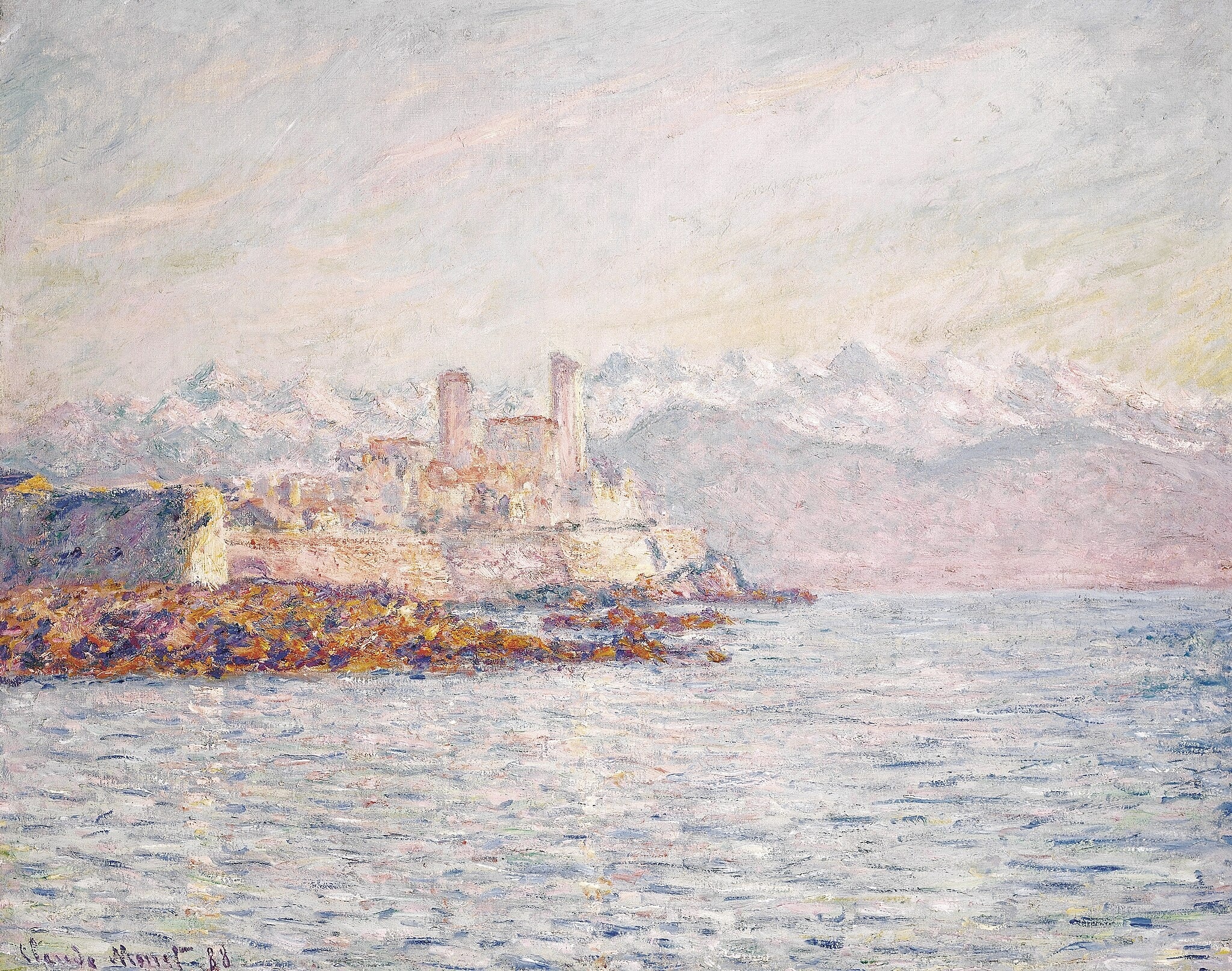
Monet’s Antibes turns a fortified headland into a luminous apparition: towers, ramparts, sea, and Alps dissolve into trembling strokes of lilac, lemon, blue‑green, and rose. By fusing stone and atmosphere, Monet makes the southern light itself the painting’s true subject [1][2].

Study Print Studio

Create a personal study print

Build a companion study sheet around the part of this painting that speaks to you most. Choose a detail, shape an interpretation, and walk away with something personal and display-worthy.

Fast Facts

Year
1888
Medium
Oil on canvas
Dimensions
65.5 × 92.4 cm
Location
The Courtauld Gallery, London
See all Claude Monet paintings in London
Antibes by Claude Monet (1888) featuring Fortified towers and ramparts, Mediterranean sea, Southern light/sky, Alps on the horizon

Click on any numbered symbol to learn more about its meaning

Meaning & Symbolism

Monet builds Antibes around a poised contradiction: the town’s vertical towers stand like anchors while every other surface seems to breathe. In the image, the headland projects from the left as a ramparted mass whose edges are softened by buttery yellows and rose‑violets; the sea, scored with fast, horizontal strokes, flickers between blue‑green and lilac, mirroring a pale lemon sky. A chain of mauve‑pink Alps rides the horizon, their snowy crests keyed so close to the sky that distance is felt as a veil rather than a line. Even the ochre rocks at the spit’s base scintillate with orange‑violet complements, so the eye never settles on masonry alone. The signature “Claude Monet 88” at lower left affirms the winter–spring campaign when he pursued these effects in changing conditions 1. What reads first is not fortification but light under pressure—the sun’s force turning matter into atmosphere. Monet had written from Antibes about painting a “little fortified town all golden in the sun” against “blue and pink mountains,” and this canvas enacts that statement with a calibrated chord of warm against cool 2. The towers persist as silhouettes, yet their solidity is released into vibrating touches; the sea’s horizontal cadence, by contrast, stabilizes the field, binding sky and land into one climatic envelope. The result is a meditation on time: history’s stone appears momentary, while transient light achieves the status of form. That inversion explains the painting’s stakes in Monet’s broader project. In Antibes he was, as curators note, testing the South’s intense colours and atmosphere, pitting oranges and pinks against blues and greens to translate luminosity rather than to inventory architecture 12. The canvas demonstrates how chromatic intervals can register wind, moisture, and glare: thin lemon laid into the upper sky suggests late afternoon warmth; violet notes in the distant range record aerial haze; blue‑green breaks across the water carry the sea’s chop and reflected light. This is not topography so much as a color‑structured climate. The meaning of Antibes, then, is that human settlement can be seen as at peace with elemental forces when looked at through light—history softened, not erased, by nature’s diurnal theater. And why Antibes is important is twofold. First, it shows Monet consolidating a serial method—multiple Antibes views made from January to May 1888 and quickly exhibited by his dealer—treating each canvas as a stanza in a cycle of weather and hour 24. Second, it advances Impressionism’s core wager that truth in painting resides in perception’s temporality: that stone becomes most itself when rendered as flicker, that distance is best told by color, and that place is a rhythm of changing relations rather than a fixed outline. In this harmony of cool and warm, anchored verticals and sliding horizontals, Antibes resolves into luminous stillness, a brief truce between enduring walls and the endlessly moving Mediterranean 12.

Explore Deeper with AI

Ask questions about Antibes

Popular questions:

Powered by AI • Get instant insights about this artwork

💬 Ask questions about this artwork!

Interpretations

Historical Context: Serial method meets the modern market

Monet’s Antibes campaign was structured like a cycle, quickly mobilized for display and sale. After four months on site, he returned to Paris where Boussod, Valadon & Cie. (managed by Theo van Gogh) acquired and exhibited ten Antibes marines in June 1888—evidence of a dealer system primed for serial modern landscapes 4. Joachim Pissarro later compared the Mediterranean sequence to a tightly composed poem whose parts “could not be separated,” underscoring Monet’s deliberately modular practice 7. In this frame, Antibes is not a solitary view but a node in a market-savvy constellation: variations of hour, wind, and haze that both satisfy Impressionism’s temporal ethos and offer collectors a curated spectrum of effects. Seriality here is not redundancy; it’s a modern strategy for making climate legible—and ownable—one canvas at a time 457.

Source: The Courtauld Gallery; Cleveland Museum of Art; Joachim Pissarro

Symbolic Reading: Monet and Neptune’s sea

Richard Thomson situates Monet’s Mediterranean ventures within the cultural imaginary of Neptune’s sea, an other light that tested northern painters’ habits 3. In Antibes, Monet’s own letters amplify this mythic struggle: “I joust and fight with the sun. And what sun there is here!” he wrote in 1888, calling the place féerique, or fairylike 2. The painting’s chromatic bravura—rose‑violet ramparts, lemon sky, mauve Alps—reads as a negotiation with a maritime deity’s domain, where the sea’s glare and the mistral’s breath overturn studio conventions. Rather than assert dominion, Monet yields to the coast’s animating powers, converting fortification into vibration. The mythic register clarifies why architecture dissolves: the true subject is a southern marine potency that makes stone appear provisional beneath a godlike light 23.

Source: Richard Thomson; NGV/MFA curatorial texts (artist letters)

Formal Analysis: Color as climate instrument

Antibes operates like an optical barometer. Monet orchestrates complementary intervals—orange‑violet in rocks, blue‑green against pinks—to code distance, humidity, and glare rather than to map contours 1. Thin lemon in the zenith warms the air mass; lilac streaks in the water indicate chop and reflected haze; near‑tonal Alps register as veiled, not linear, recession. This substitution of chromatic relation for drawing aligns with Impressionism’s wager that color can carry empirical data about atmosphere—a mimesis of climate rather than of masonry. The result is a unified “envelope,” where sea and sky merge through value and temperature, and the town’s edges are read as gradients, not borders. In this key, Monet’s brush is a meteorological device, translating light pressure and moisture into legible hue 1.

Source: The Courtauld Gallery

Medium Reflexivity: Painting time, not things

Antibes visualizes “perception’s temporality”: the idea that truth in painting resides in the unstable now of seeing 26. Monet’s facture—short, directionally keyed strokes—parcels the view into temporal packets: verticals that persist as silhouettes; horizontals that steady the field; and scintillating interstices where light abrades form. Rather than a topographic document, the canvas is a record of attention moving through changing illumination. This is painting about its own means: how pigment can both state and unmake form as the hour advances. By privileging optical thresholds (glare, haze, reflection), Monet folds the ontology of Impressionism into the scene, making medium and motif congruent. Antibes thus teaches us to read the surface not as finish but as an index of time’s passage across matter 26.

Source: NGV/MFA curatorial texts; The Met Heilbrunn Timeline of Art History

Environmental Reading: Wind-scripted littoral

The wind‑bent coastal tree is not mere framing; it is an ecological sensor that scripts the littoral climate into the composition 1. Its darker, cooler greens calibrate the painting’s value range, intensifying the town’s solar golds while registering the mistral’s torque across the shore ecology. Against this animated vegetal mass, ramparts soften into particulate light, and the sea’s horizontal cadence binds sky to water, forming a single atmospheric envelope. Read environmentally, Antibes shows a coast in dynamic equilibrium: built stone asserts human order, while wind, moisture, and glare continually renegotiate the edge. The foreground tree makes the climatic agency visible, converting landscape from backdrop to active system—proof that in Monet’s South, nature’s motion is the primary architect of what we see 12.

Source: The Courtauld Gallery; NGV/MFA curatorial texts

Related Themes

About Claude Monet

Claude Monet (1840–1926) led Impressionism’s pursuit of open-air painting and optical immediacy, especially during his Argenteuil years focused on modern leisure and light. He later developed serial studies of changing conditions, culminating in the Water Lilies cycle [2].
View all works by Claude Monet

More by Claude Monet

Haystacks Series by Claude Monet | Light, Time & Atmosphere by Claude Monet

Haystacks Series by Claude Monet | Light, Time & Atmosphere

Claude Monet

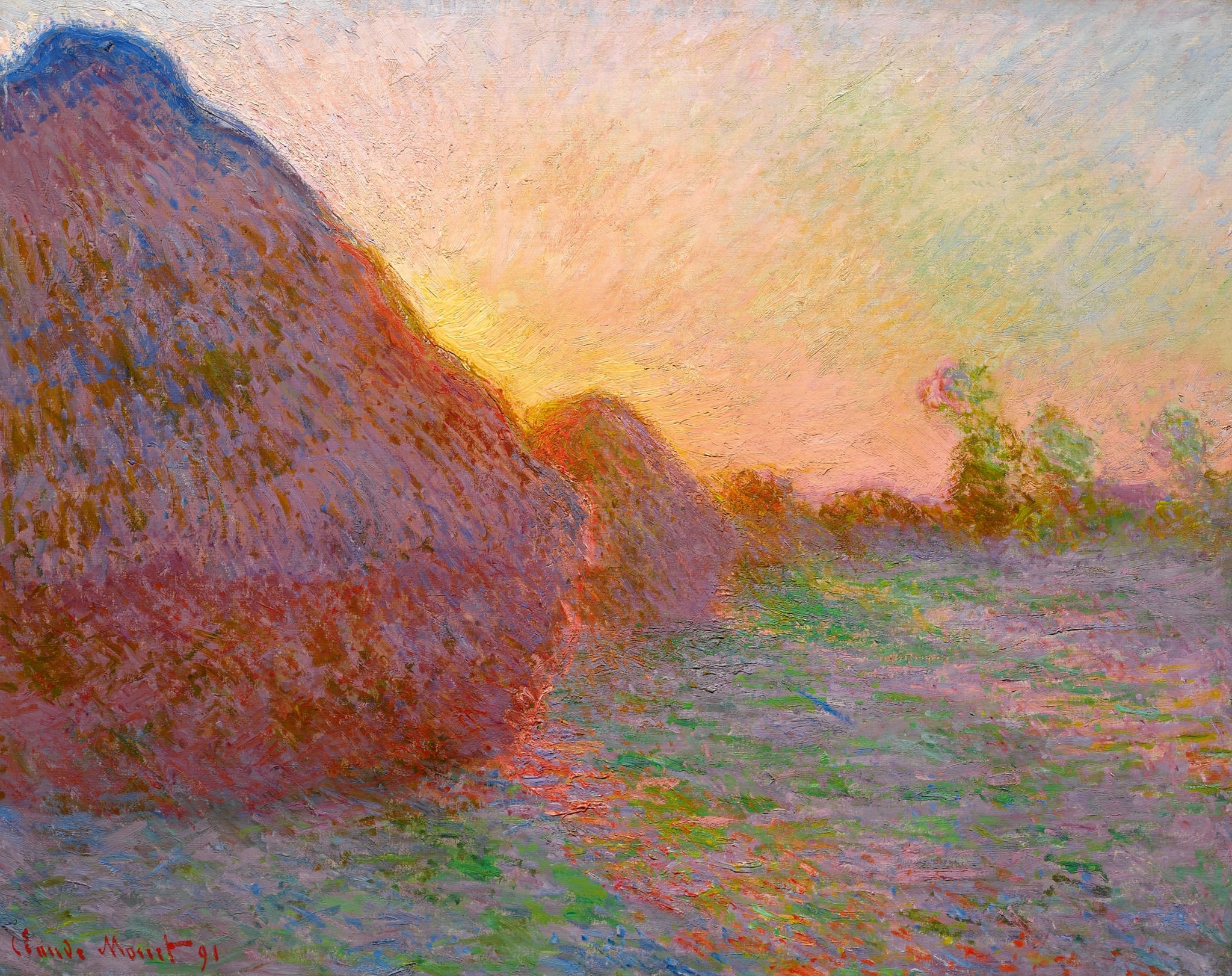
Claude Monet’s <strong>Haystacks Series</strong> transforms a routine rural subject into an inquiry into <strong>light, time, and perception</strong>. In this sunset view, the stacks swell at the left while the sun burns through the gap, making the field shimmer with <strong>apricot, lilac, and blue</strong> vibrations.
Women in the Garden by Claude Monet

Women in the Garden

Claude Monet (1866–1867)

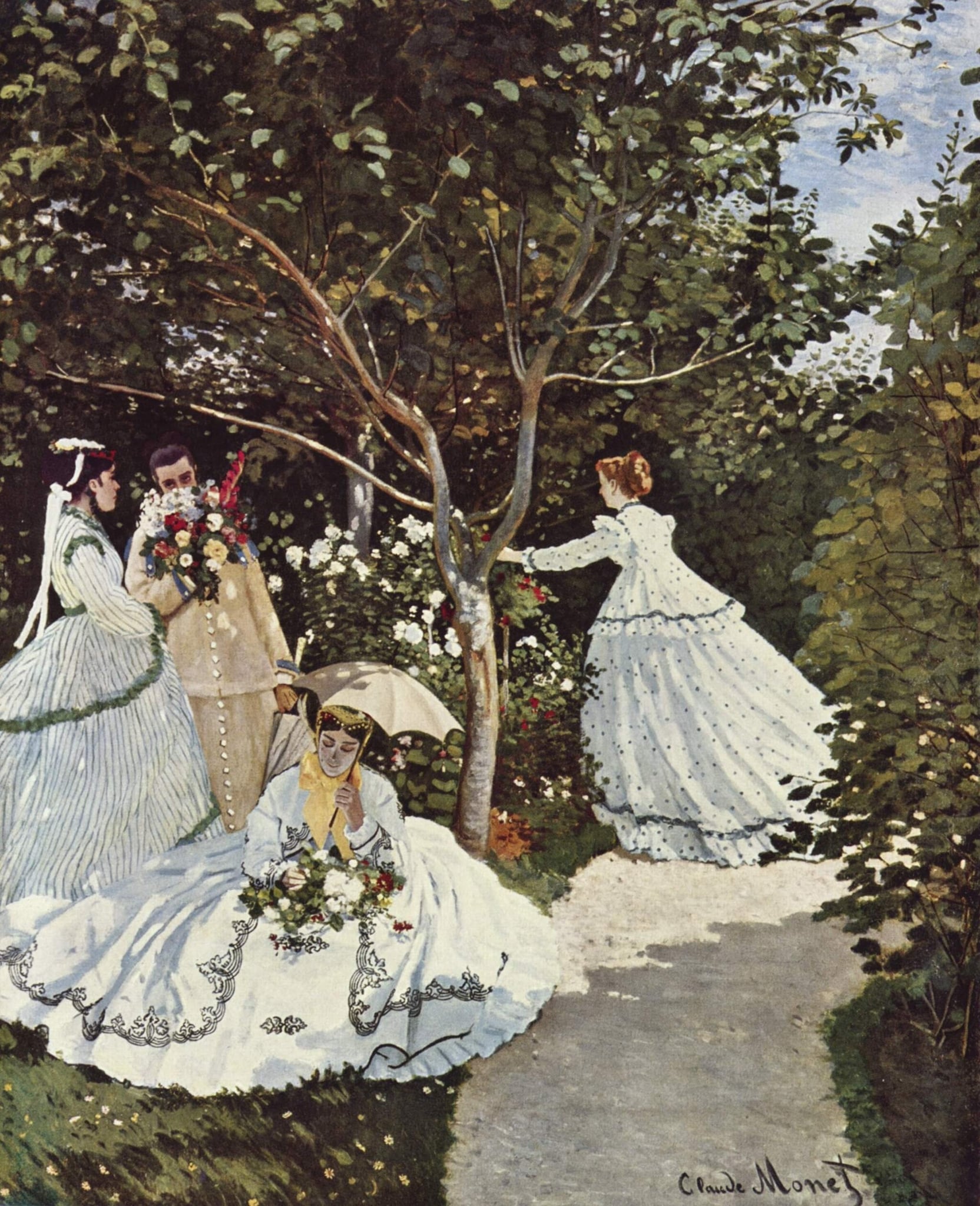
Claude Monet’s Women in the Garden choreographs four figures in a sunlit bower to test how <strong>white dresses</strong> register <strong>dappled light</strong> and shadow. The path, parasol, and clipped flowers frame a modern ritual of leisure while turning fashion into an instrument of <strong>perception</strong>. The scene reads less as portraiture than as a manifesto for painting the <strong>momentary</strong> outdoors <sup>[1]</sup><sup>[3]</sup>.
The Train in the Snow (The Locomotive) by Claude Monet

The Train in the Snow (The Locomotive)

Claude Monet (1875)

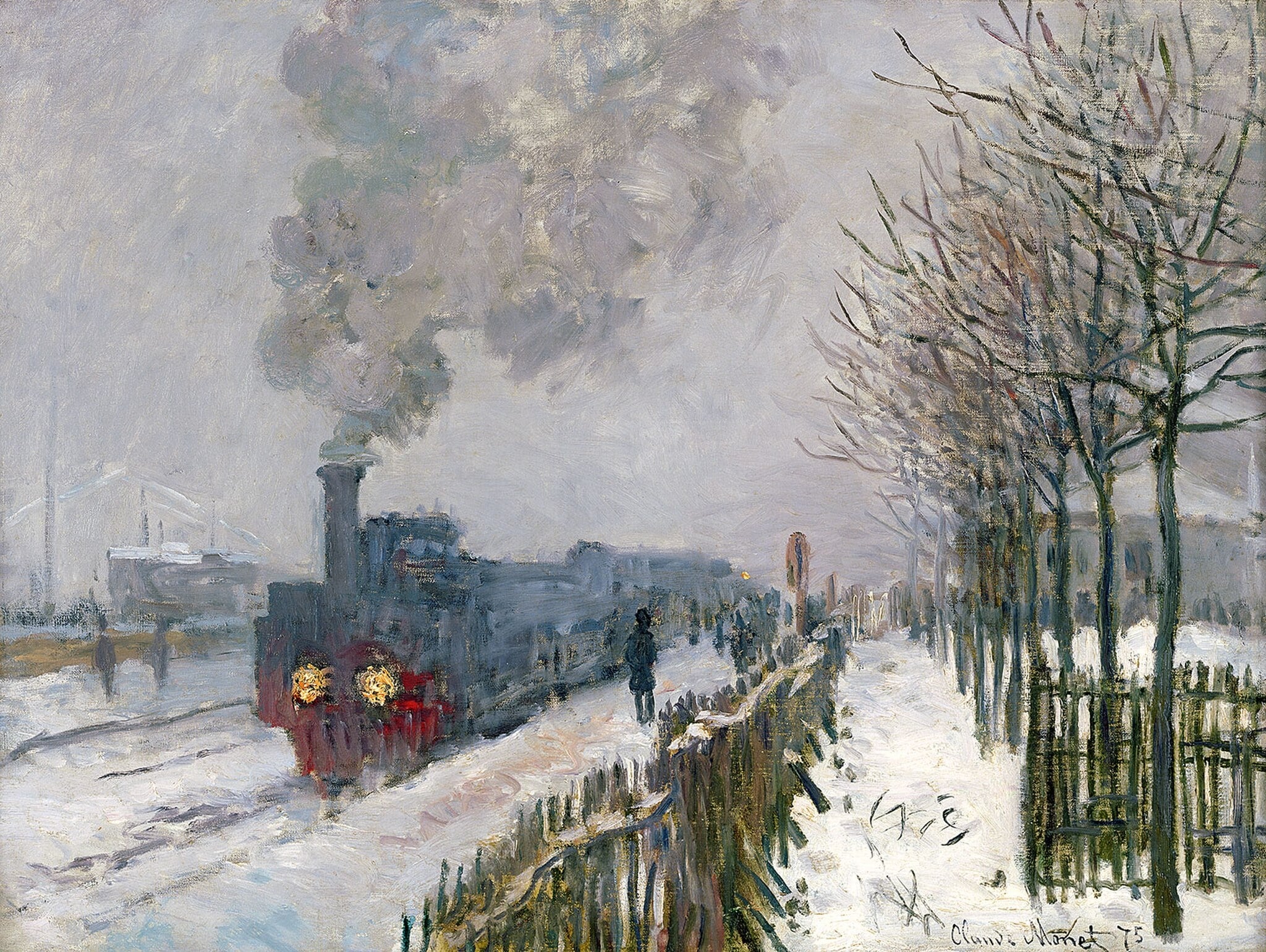
Claude Monet’s The Train in the Snow (The Locomotive) (1875) turns a suburban winter platform into a study of <strong>modernity absorbed by atmosphere</strong>. The engine’s twin yellow headlights and a smear of red push through a world of greys and violets as steam fuses with the low sky, while the right-hand fence and bare trees drill depth and cadence into the scene <sup>[1]</sup><sup>[4]</sup>. Monet fixes not an object but a <strong>moment of perception</strong>, where industry seems to dematerialize into weather <sup>[1]</sup><sup>[2]</sup>.
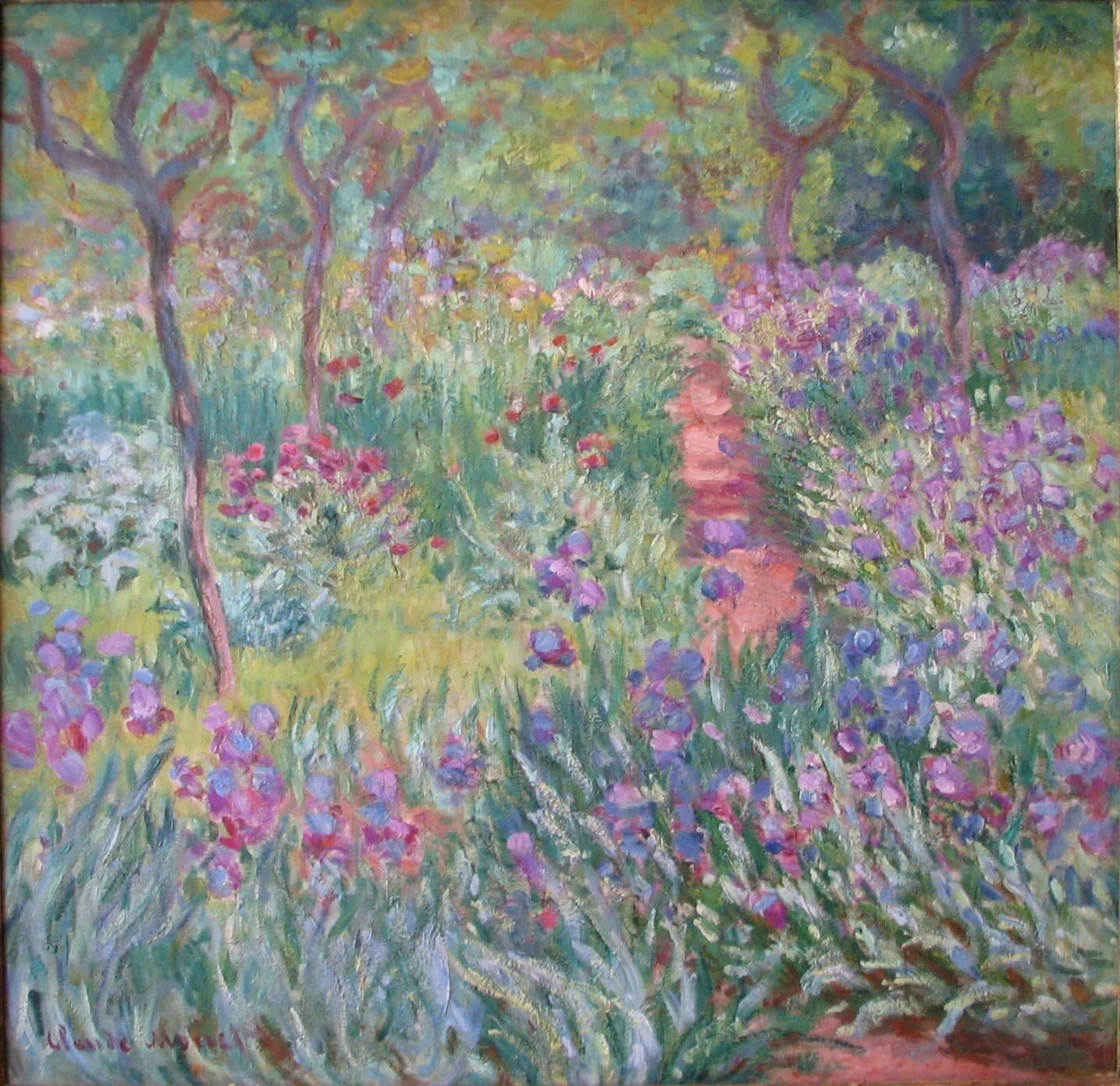
The Artist's Garden at Giverny by Claude Monet

The Artist's Garden at Giverny

Claude Monet (1900)

In The Artist's Garden at Giverny, Claude Monet turns his cultivated Clos Normand into a field of living color, where bands of violet <strong>irises</strong> surge toward a narrow, rose‑colored path. Broken, flickering strokes let greens, purples, and pinks mix optically so that light seems to tremble across the scene, while lilac‑toned tree trunks rhythmically guide the gaze inward <sup>[1]</sup><sup>[3]</sup>.
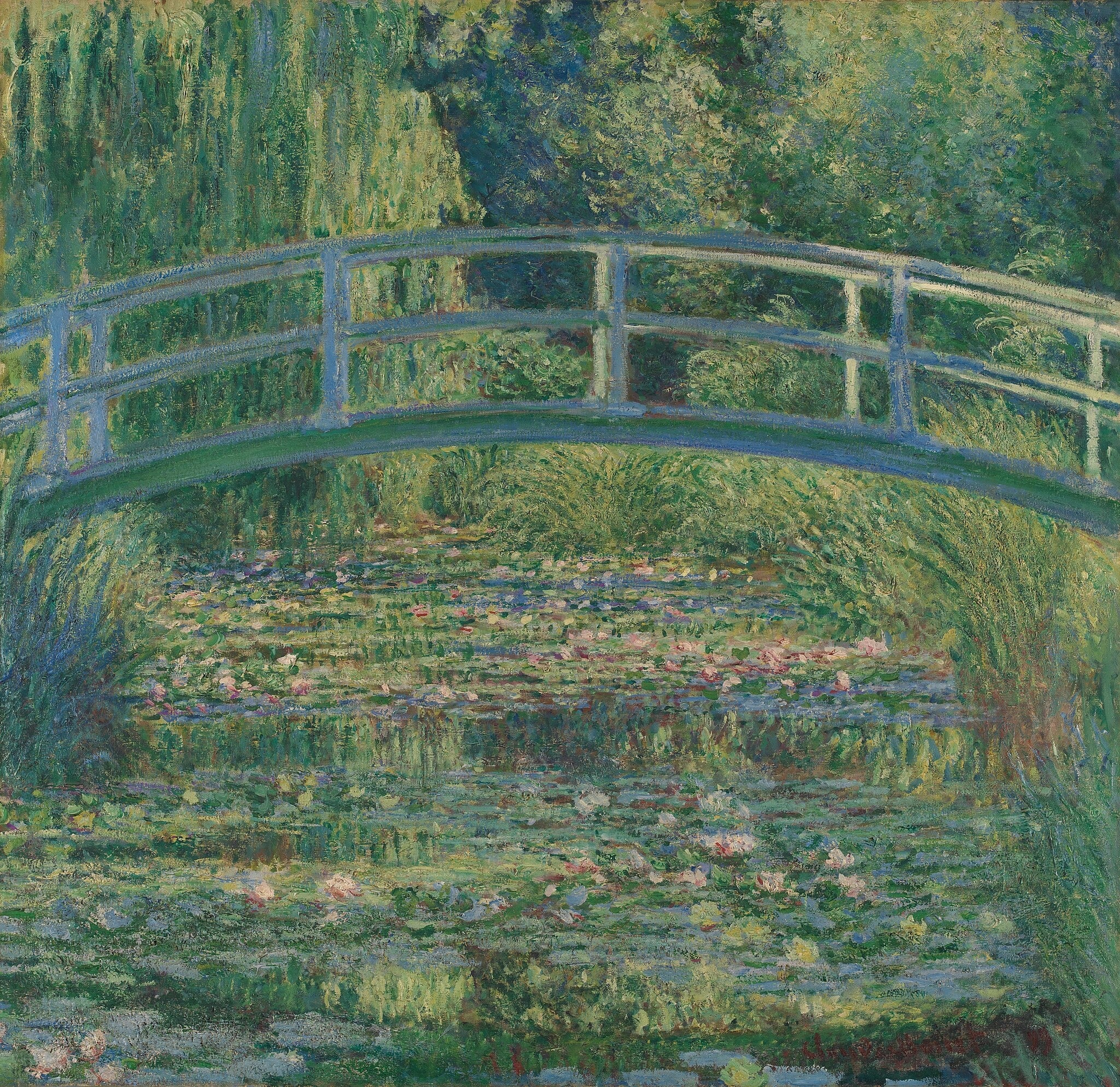
Water Lilies by Claude Monet

Water Lilies

Claude Monet (1899)

<strong>Water Lilies</strong> centers on an arched <strong>Japanese bridge</strong> suspended over a pond where lilies and rippling reflections fuse into a single, vibrating surface. Monet turns the scene into a study of <strong>perception-in-flux</strong>, letting water, foliage, and light dissolve hard edges into atmospheric continuity <sup>[1]</sup><sup>[3]</sup>.
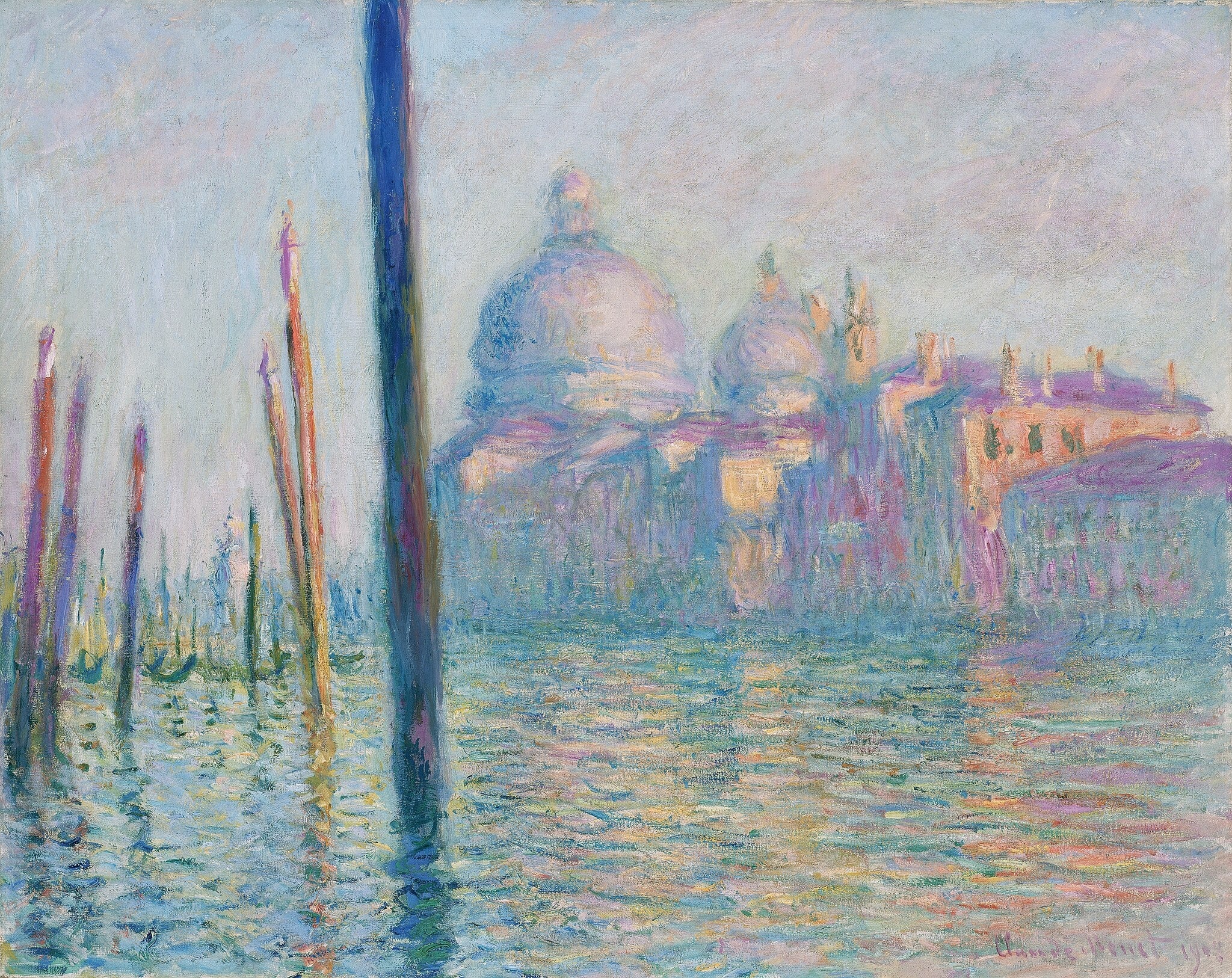
The Grand Canal by Claude Monet

The Grand Canal

Claude Monet (1908)

Claude Monet’s The Grand Canal turns Venice into <strong>pure atmosphere</strong>: the domes of Santa Maria della Salute waver at right while a regiment of <strong>pali</strong> stands at left, their verticals reverberating in the water. The scene asserts <strong>light over architecture</strong>, transforming stone into memory and time into color <sup>[2]</sup><sup>[3]</sup>.