Chrysanthemums

by Claude Monet

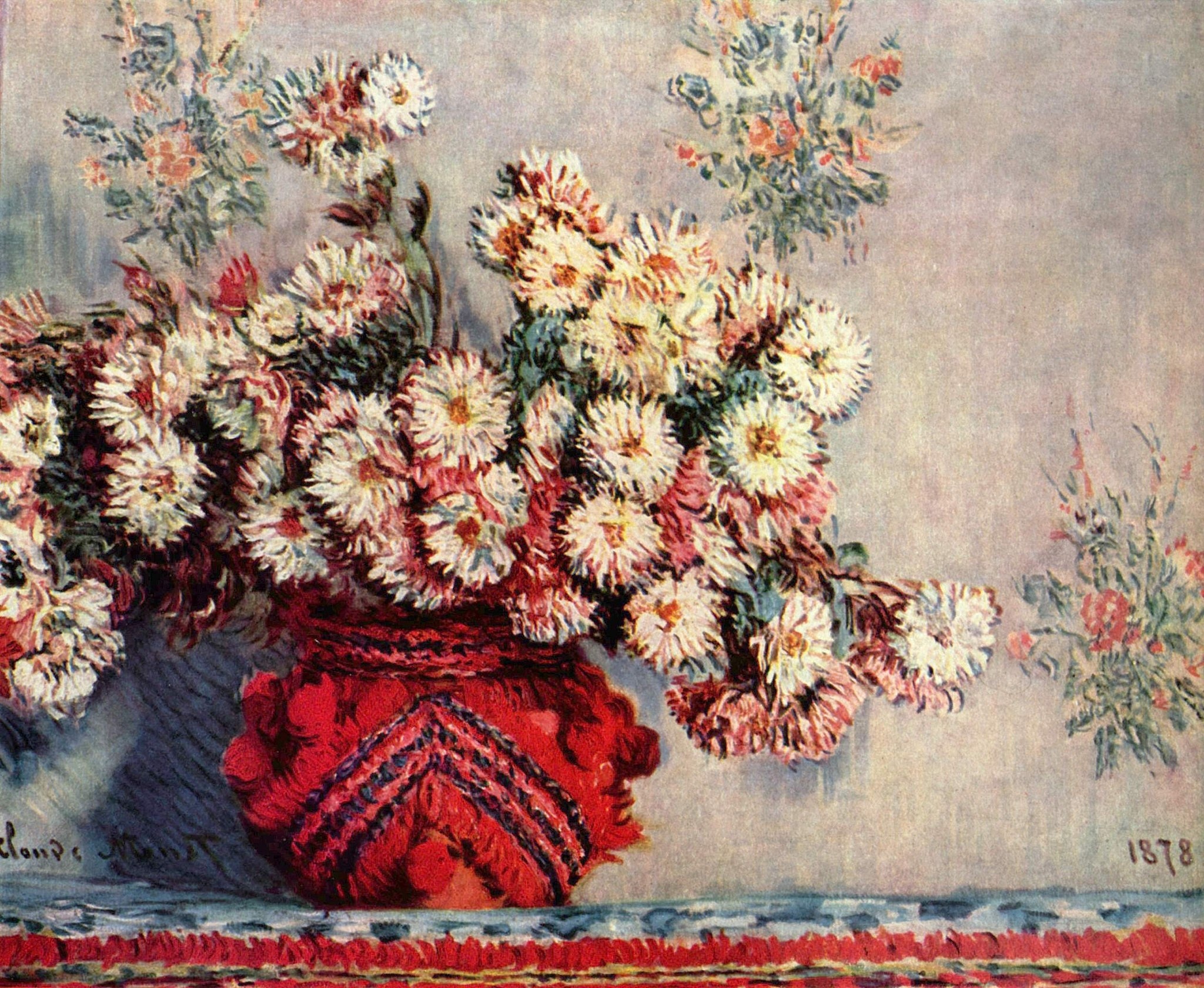
Claude Monet’s Chrysanthemums fixes a burst of late‑season bloom in a scarlet, plush‑textured vase against a cool blue‑gray wall where faint floral sprigs echo the bouquet. The painting privileges vibration of color over contour, turning still life into a decorative field. It condenses autumnal abundance and the fleetingness of light into a single, shimmering sensation [1][2].
💰

Market Value

$10-18 million

How much is Chrysanthemums worth?

Study Print Studio

Create a personal study print

Build a companion study sheet around the part of this painting that speaks to you most. Choose a detail, shape an interpretation, and walk away with something personal and display-worthy.

Fast Facts

Year
1878
Medium
Oil on canvas
Dimensions
54.3 × 65.2 cm
Location
Musée d’Orsay, Paris
See all Claude Monet paintings in New York
Chrysanthemums by Claude Monet (1878) featuring Chrysanthemum blooms, Scarlet plush vase, Echoing wall sprigs, Blue‑gray wall ground

Click on any numbered symbol to learn more about its meaning

Meaning & Symbolism

Seen up close, the bouquet does not sit inside the red vase so much as explode outward from it: feathery whites tinged with rose and ochre push past the vessel’s rim, their edges frayed into the air. The scarlet vase—padded, tasseled, and banded—anchors the bottom register with saturated heat, while the wall behind stays a cool, receding blue‑gray. Monet threads quick, granular touches through each bloom so that petals read as light events, not botanical facts; the result is a hum of whites that never settle into outline. On the wall, ghostly clusters repeat the bouquet’s forms at a remove, as if the image had bled beyond its object. This echoing device flattens depth and fuses object with décor, a choice consistent with the nineteenth‑century Japonisme that Monet avidly absorbed—surface pattern, cropped motifs, and an emphasis on harmony over modeling 4. Even the rug‑like band along the table’s edge participates, its stripes chattering in the same key of broken strokes, so that vessel, flowers, wall, and support sing as one chromatic chord. That chord communicates more than style. Chrysanthemums in Japanese culture signify autumn and endurance; their imperial and festival associations cast these blooms as emblems of late‑season radiance held bravely against the oncoming cold 5. Monet leverages that charge: the bouquet’s fullness is exuberant but precarious, its outer heads already paling at the tips. In France, chrysanthemums would soon accrue funerary overtones through Toussaint customs, a social meaning that shades the canvas with a discreet memento mori without determining it 7. What predominates is Monet’s insistence that painting’s decorative totality can carry sensation more powerfully than linear description. Between 1878 and the early 1880s he produced roughly twenty floral still lifes, shown and championed by Durand‑Ruel, precisely because they advanced Impressionism’s coloristic experiment inside the home, where buyers could live with it daily 2. John House later called these canvases among the movement’s most lavish and radical still lifes, and the reason is legible here: Monet dissolves hierarchy (object versus background), redefines finish as a field of touches, and makes color‑relation itself the subject 6. In doing so, he forges a bridge from the intimacies of table arrangements to the immersive décor of his later garden series at Giverny, where surface, motif, and atmosphere merge on a grand scale 34.

Explore Deeper with AI

Ask questions about Chrysanthemums

Popular questions:

Powered by AI • Get instant insights about this artwork

💬 Ask questions about this artwork!

Interpretations

Historical Context: Dealer Strategy and the Domestic Avant‑Garde

Between 1878 and 1883 Monet produced roughly twenty floral still lifes that Paul Durand‑Ruel used to reposition Impressionism as a liveable modernism—works designed for salons rather than the Salon. The Met records the 1882 Chrysanthemums shown at Durand‑Ruel (Paris, 1883) and with Les XX (Brussels, 1886), marking early international traction for these decorative experiments 1. Far from minor studio exercises, John House judged these bouquets among the Impressionists’ most lavish and radical still lifes, precisely because they challenged hierarchy (object vs. background) through color chords and all‑over facture 3. Seen this way, Chrysanthemums is both market‑savvy and aesthetically insurgent: a canvas that lets bourgeois interiors host avant‑garde optics, converting private domesticity into a testing ground for Impressionist color theory.

Source: The Metropolitan Museum of Art; John House

Japonisme and the Flat Decorative Field

Monet’s echoing wall sprigs and the suppression of contour enact a Japoniste logic: forms migrate into pattern, depth yields to surface cadence, and the picture reads as a continuous textile‑like field. Sylvie Patin situates Monet’s chrysanthemum still lifes within a shift “from still life to landscape,” where decorative totality supersedes volumetric modeling 4. Scholarship on Japonisme underscores how European artists borrowed Japanese strategies—cropped motifs, asymmetry, and planar emphasis—to reframe painting as ornamental space rather than window 5. In Chrysanthemums, the red vase, table band, and wall register as coordinated motifs, not separate zones; the result is a unified décor that anticipates Monet’s later immersive ensembles. The bouquet doesn’t just sit in a room—it becomes the room’s rhythm.

Source: Art Institute of Chicago (Sylvie Patin); Penn State Open Publishing (Japonisme dissertation)

Symbolic Reading: Autumnal Radiance, Imperial Echoes, and Toussaint

The chrysanthemum’s Japanese valence—autumn, endurance, and imperial insignia—inflects Monet’s choice of cultivar with a seasonal nobility that suits his decorative ambitions 6. Yet in France chrysanthemums increasingly signaled All Saints’ Day offerings by the early 20th century, lending still lifes a funerary aftertaste without dictating grief as subject 7. Holding both meanings together sharpens the painting’s tension: late‑season brilliance meets cultural memory of commemoration. Monet’s picture thus stages a controlled ephemerality—blooms at peak, already paling at the fringe—which viewers in Paris and, later, New York could read across cultures. The canvas sustains its charge by staying emblematic rather than allegorical: autumn is felt as color duration, mortality as a soft undertow of seasonal rite.

Source: Minneapolis Institute of Art; The Arts Society

Technical/Formal Analysis: Color‑Relation as Subject

Monet builds the bouquet from rapid, granular strokes that disintegrate edges into optical noise, making hue adjacency—not outline—the engine of form. House’s formulation clarifies why this reads as radical: finish is redefined as a field of touches, dissolving still‑life hierarchy into a single chromatic system 3. In this key, the scarlet vase anchors a hot register while the cool wall recedes, but harmonizes through repeated, high‑keyed flecks—an orchestration rather than depiction 1. This operational logic links the still life to Monet’s later garden series, where lilies and foliage become continuous color‑events across mural‑scale surfaces 9. Chrysanthemums is thus a proof‑of‑concept: a domestic‑scale lab where color‑relations stand in for motif, and perception becomes the motif.

Source: John House; The Metropolitan Museum of Art; National Gallery of Art (Washington)

Psychological Interpretation: Vétheuil’s Pressures and Poise

Painted in the wake of Monet’s 1878 move to Vétheuil—and near the 1879 death of Camille—these floral works align with a period of material strain and private sorrow 89. Rather than overt elegy, Chrysanthemums offers composure under pressure: dense, radiant blooms contained by a tasseled vessel, their tips paling—an image of steadiness edged by decline. The turn to still life provided controllable conditions (light, placement, repetition) during instability, while also generating saleable pictures for Durand‑Ruel’s clientele 1. Reading the canvas through this biographical lens doesn’t reduce it to grief; instead it clarifies the work’s psychic economy: sensation held taut, exuberance metered by discipline. The painting’s serenity is achieved, not given—an equilibrium of color and touch that steadies the viewer as much as the artist.

Source: National Galleries of Scotland; National Gallery of Art (Washington); The Metropolitan Museum of Art

Version Studies: Multiple ‘Chrysanthemums’ and Shifting Emphases

Monet painted several Chrysanthemums; the 1878 Musée d’Orsay canvas (smaller, signed and dated) entered Dr. Paul Gachet’s collection that year, while the larger 1882 Met version circulated via Durand‑Ruel and Les XX 12. Recognizing these iterations matters: the Met’s scarlet vase and wall sprigs stress decorative spread and planar echo, whereas the Orsay panel is compositionally tighter. Title duplication reveals Monet’s iterative method—testing scale, backdrop, and chroma to calibrate how far the bouquet can become ambient pattern without losing presence. Provenance and exhibition histories also map two early pathways for Impressionist still life: intimate medical/artist networks (Gachet) and the dealer‑driven international market (Paris–Brussels). Reading across versions makes the series itself an argument about how decoration becomes modern.

Source: Musée d’Orsay; The Metropolitan Museum of Art

Related Themes

About Claude Monet

Claude Monet (1840–1926) led Impressionism’s pursuit of open-air painting and optical immediacy, especially during his Argenteuil years focused on modern leisure and light. He later developed serial studies of changing conditions, culminating in the Water Lilies cycle [2].
View all works by Claude Monet

More by Claude Monet

Boating by Claude Monet

Boating

Claude Monet (1887)

Monet’s Boating crystallizes modern leisure as a drama of perception, setting a slim skiff and two pale dresses against a field of dark, mobile water. Bold cropping, a thrusting oar, and the complementary flash of hull and foliage convert a quiet outing into an experiment in <strong>modern vision</strong> and the <strong>materiality of water</strong> <sup>[1]</sup><sup>[2]</sup>.

The Thames below Westminster by Claude Monet

The Thames below Westminster

Claude Monet (about 1871)

Claude Monet’s The Thames below Westminster turns London into <strong>light-made architecture</strong>, where Parliament’s mass dissolves into mist and the river shivers with <strong>industrial motion</strong>. Tugboats, a timber jetty with workers, and the rebuilt Westminster Bridge assert a modern city whose power is felt through atmosphere more than outline <sup>[1]</sup>.

Haystacks Series by Claude Monet | Light, Time & Atmosphere by Claude Monet

Haystacks Series by Claude Monet | Light, Time & Atmosphere

Claude Monet

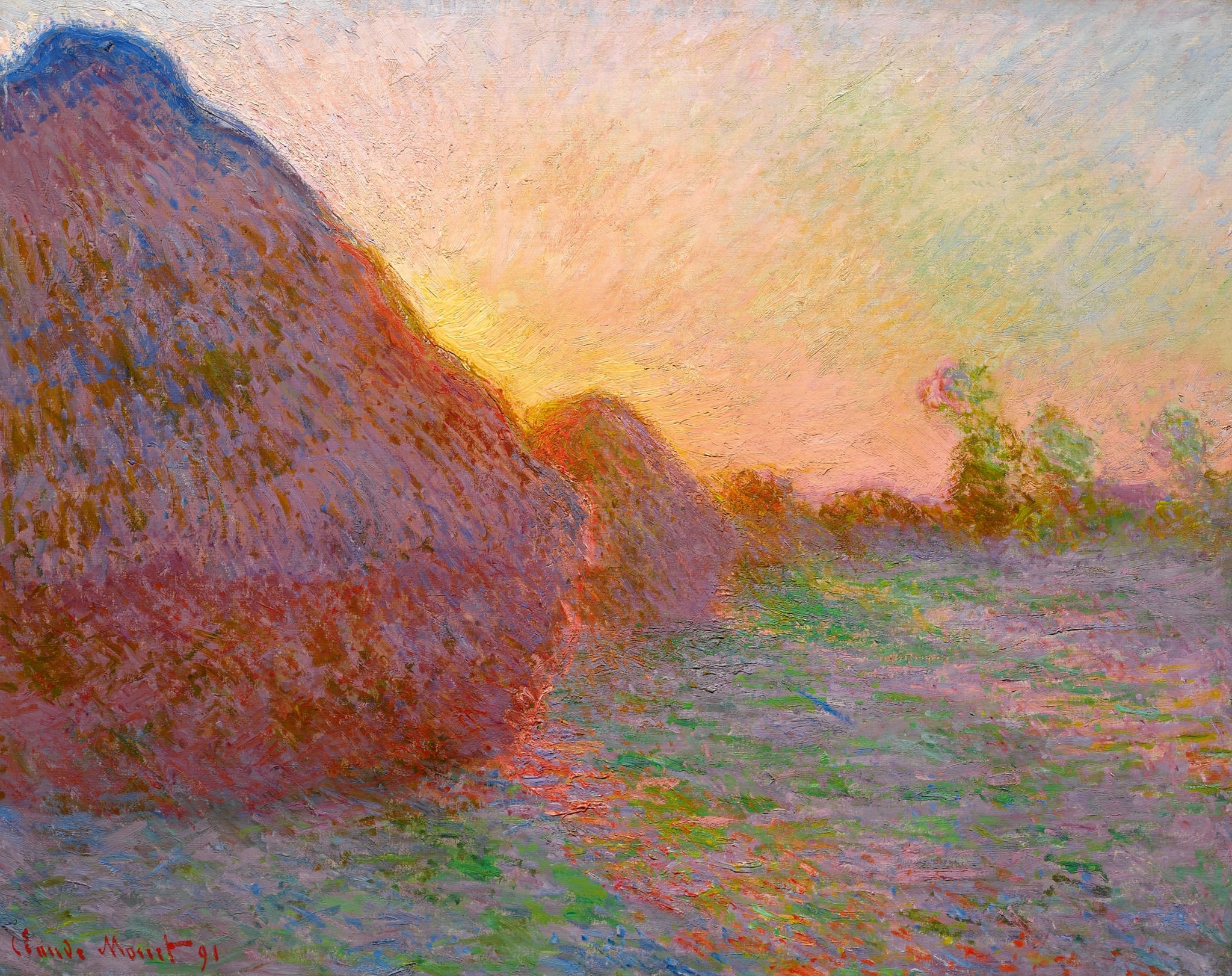
Claude Monet’s <strong>Haystacks Series</strong> transforms a routine rural subject into an inquiry into <strong>light, time, and perception</strong>. In this sunset view, the stacks swell at the left while the sun burns through the gap, making the field shimmer with <strong>apricot, lilac, and blue</strong> vibrations.
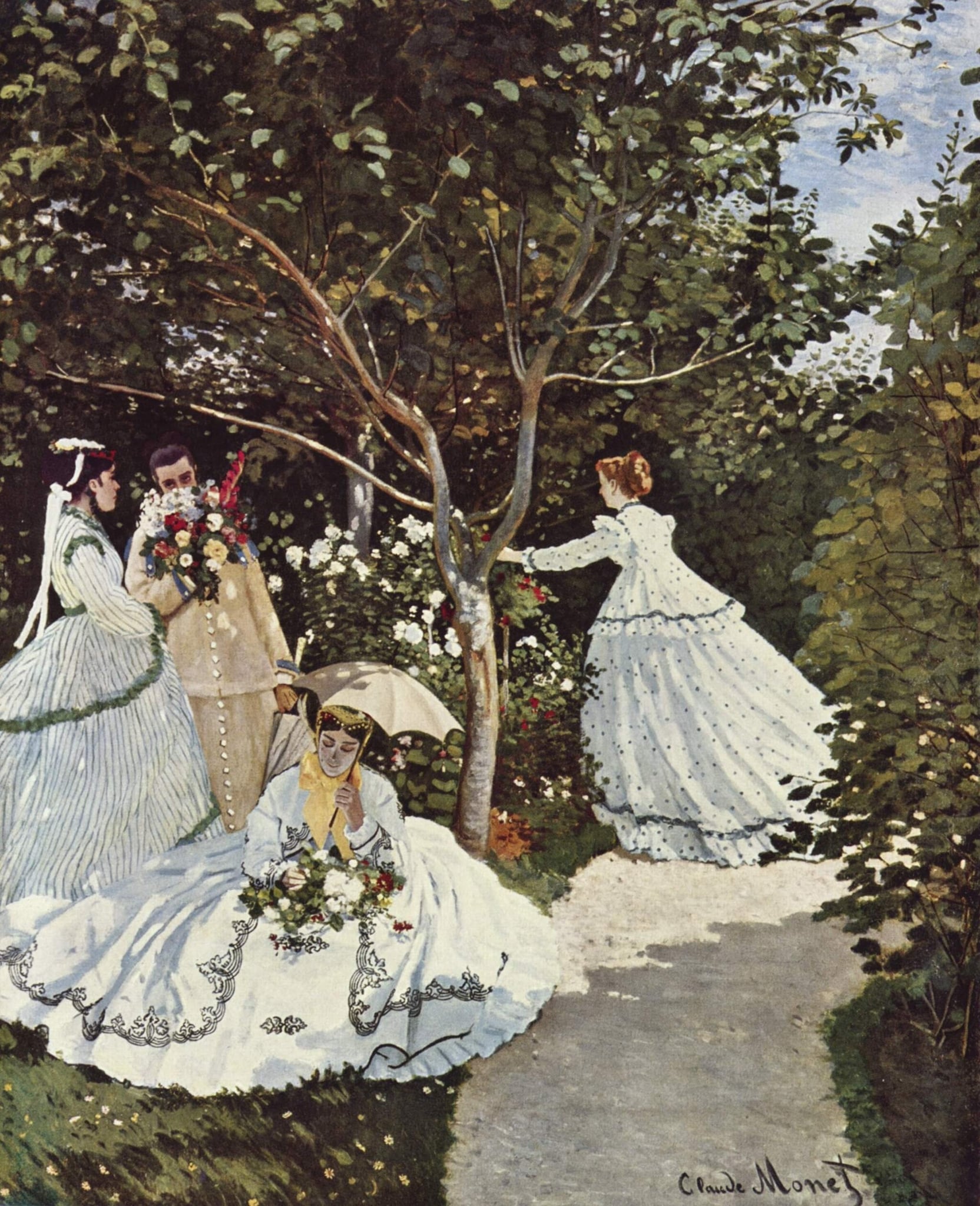
Women in the Garden by Claude Monet

Women in the Garden

Claude Monet (1866–1867)

Claude Monet’s Women in the Garden choreographs four figures in a sunlit bower to test how <strong>white dresses</strong> register <strong>dappled light</strong> and shadow. The path, parasol, and clipped flowers frame a modern ritual of leisure while turning fashion into an instrument of <strong>perception</strong>. The scene reads less as portraiture than as a manifesto for painting the <strong>momentary</strong> outdoors <sup>[1]</sup><sup>[3]</sup>.
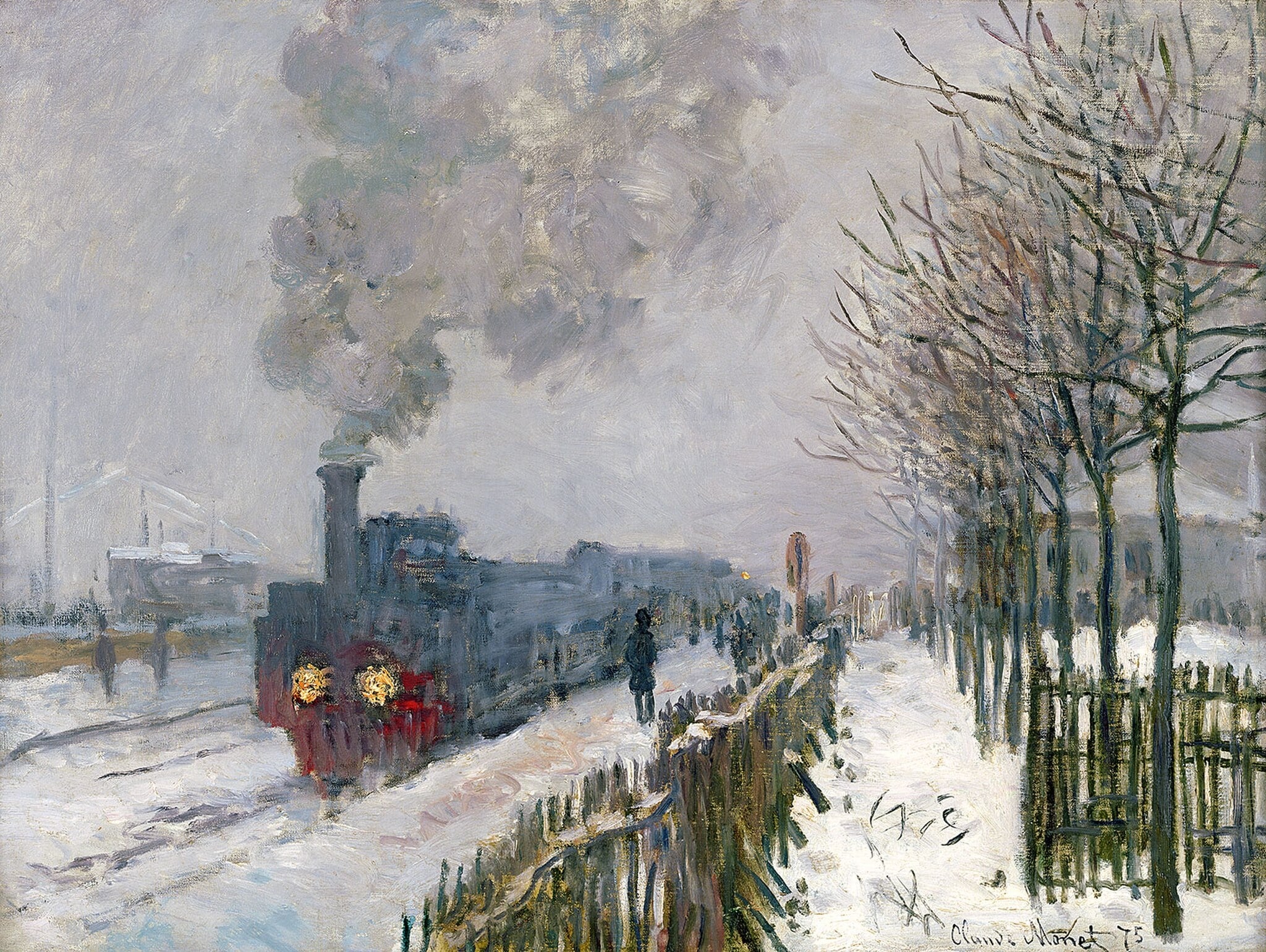
The Train in the Snow (The Locomotive) by Claude Monet

The Train in the Snow (The Locomotive)

Claude Monet (1875)

Claude Monet’s The Train in the Snow (The Locomotive) (1875) turns a suburban winter platform into a study of <strong>modernity absorbed by atmosphere</strong>. The engine’s twin yellow headlights and a smear of red push through a world of greys and violets as steam fuses with the low sky, while the right-hand fence and bare trees drill depth and cadence into the scene <sup>[1]</sup><sup>[4]</sup>. Monet fixes not an object but a <strong>moment of perception</strong>, where industry seems to dematerialize into weather <sup>[1]</sup><sup>[2]</sup>.
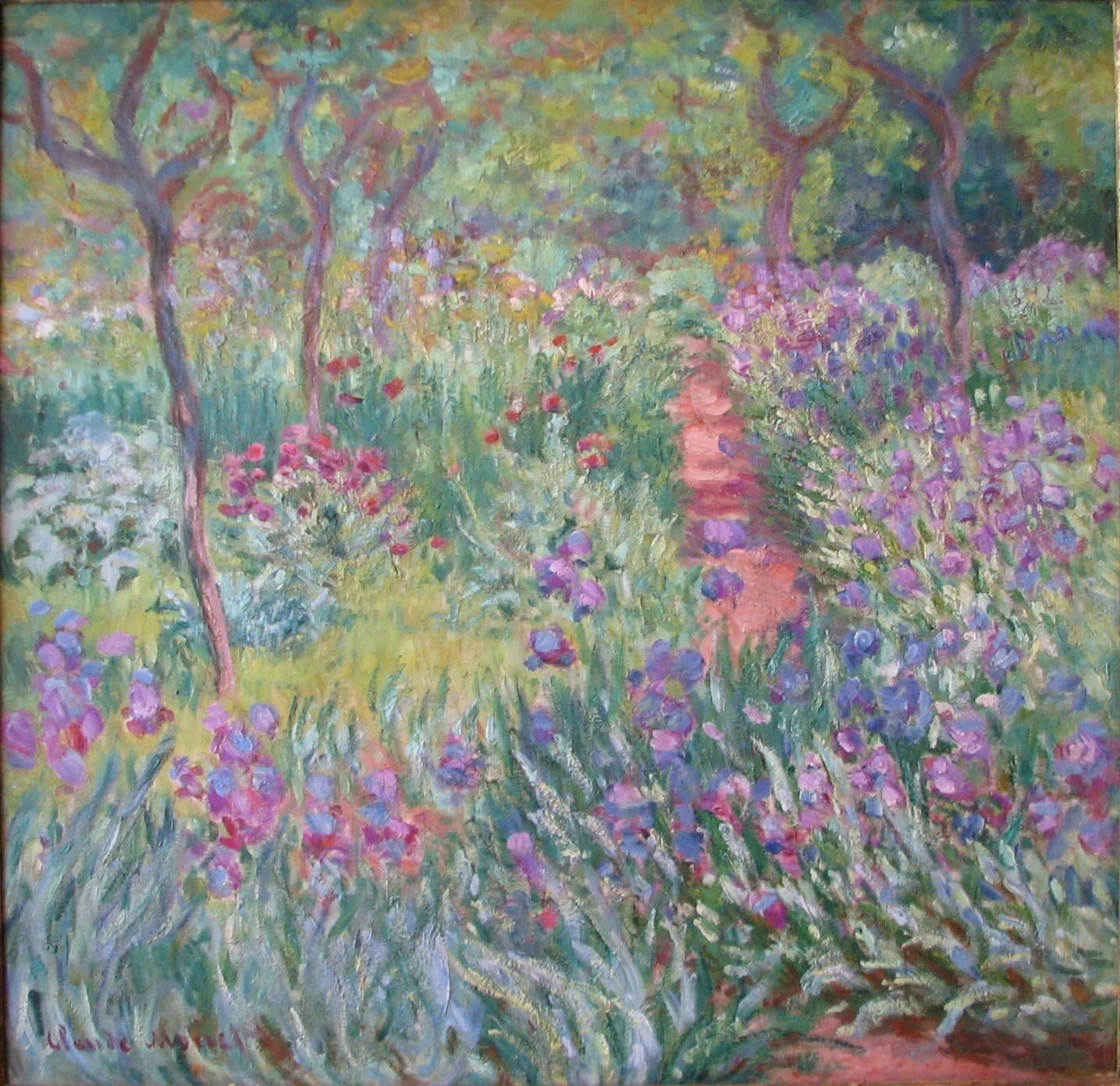
The Artist's Garden at Giverny by Claude Monet

The Artist's Garden at Giverny

Claude Monet (1900)

In The Artist's Garden at Giverny, Claude Monet turns his cultivated Clos Normand into a field of living color, where bands of violet <strong>irises</strong> surge toward a narrow, rose‑colored path. Broken, flickering strokes let greens, purples, and pinks mix optically so that light seems to tremble across the scene, while lilac‑toned tree trunks rhythmically guide the gaze inward <sup>[1]</sup><sup>[3]</sup>.