Ice Floes

by Claude Monet

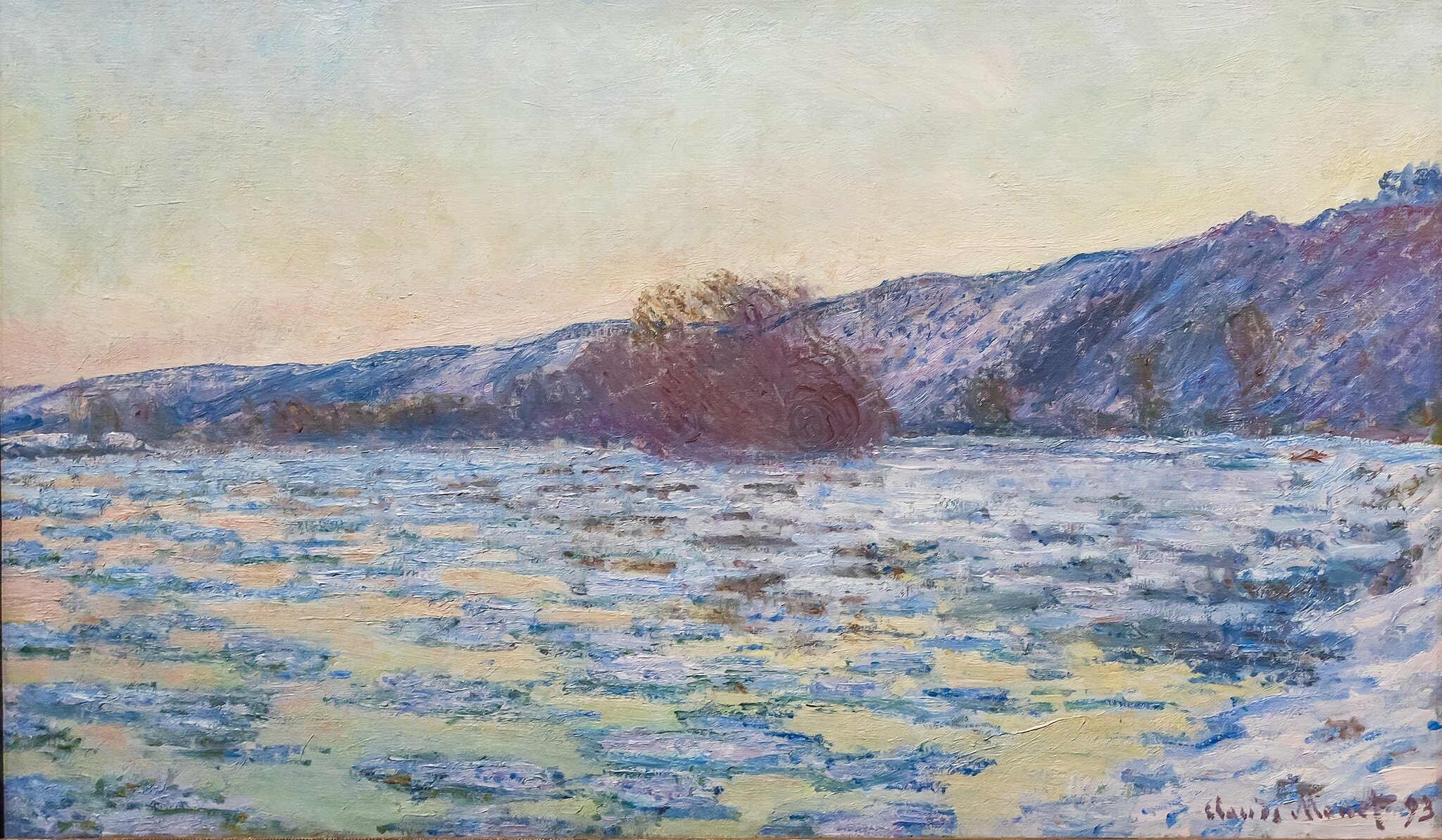
Claude Monet’s Ice Floes turns a thawing Seine into a theater of transition: pale ice plates drift over mint‑green water beneath a high horizon and a russet clump of trees that warms the scene’s chill palette. With short, glancing strokes, Monet makes the floes shimmer between stillness and motion, converting a winter morning into a meditation on change and endurance.

Fast Facts

Year
1893
Medium
Oil on canvas
Dimensions
66 x 100.3 cm
Location
The Metropolitan Museum of Art, New York
See all Claude Monet paintings in New York
Ice Floes by Claude Monet (1893) featuring Broken ice floes, High horizon / compressed ridge, Russet clump of trees

Click on any numbered symbol to learn more about its meaning

Meaning & Symbolism

At first glance, Ice Floes reads as a calm river landscape; in fact it is a precise construction of thresholds. Monet hitches meaning to contrasts: a horizon set unusually high compresses the violet ridge so that the river becomes a broad plane where motion is patterned. Across this plane, broken plates of ice—laid with quick, square strokes—interrupt reflections and create a lateral rhythm that rivals classical depth cues. The eye toggles between the recession of the Seine and the painting’s gridded surface, a productive friction that makes the viewer feel the scene’s unstable equilibrium between freeze and thaw. In the center, a smoldering, russet clump of trees concentrates warmth against pervasive blues and mint greens; their chromatic counterpoint stages the contest of temperatures that drives seasonal change. Above, a sky washed with cream, rose, and faint lemon denies hard contours; forms appear to dissolve into atmosphere, asserting that nothing in nature is fixed—even the border between river and bank wavers under the flux of light. This balance is not anecdotal but programmatic. In letters cited by the Met, Monet notes the thaw beginning January 23, 1893 and describes producing more than a dozen canvases in a few weeks, a serial practice that elevates time as subject and treats each painting as a discrete registration of a shifting constellation of light, ice, and water 1. The broken floes become modular units—visual “notes” arranged across a reflective staff—prefiguring the motivic logic of the later Nymphéas, where floating lilies replace ice as the agents that organize the surface while loosening depth 4. That continuity matters: it shows Monet using ordinary upheaval on the Seine to prototype a modern pictorial space in which surface and perception take precedence over narrative incident. Historically, Ice Floes also converses with Monet’s earlier winter at Vétheuil (1879–80), when extreme cold produced a dramatic débâcle he painted in a concentrated series variously counted at about twenty works 235. Those canvases, forged amid personal austerity, already pressed land high and scattered floes into shimmering fields; the 1893 return near Giverny refines the idea with greater chromatic delicacy and a more assured orchestration of painterly modules 1. In this painting, the absence of figures is deliberate: light and temperature carry emotion. The river is not a stage for human drama but a symbol of endurance and renewal, where rupture (the cracked ice) is the very mechanism of continuity (the river’s reopening). By rendering a humble winter morning as a poised, flickering mosaic, Monet argues that meaning in nature arises where states meet and exchange. That is why Ice Floes is important: it crystallizes Impressionism’s wager that seeing—keen, sustained, serial—can reveal the structure of change itself, and in doing so, it maps a path from plein‑air observation to the abstracted, all‑over surfaces that would shape modern painting 14.

Explore Deeper with AI

Ask questions about Ice Floes

Popular questions:

Powered by AI • Get instant insights about this artwork

💬 Ask questions about this artwork!

Interpretations

Formal Analysis: Pattern vs. Depth

Monet sets a high horizon to compress land and transform the Seine into a pictorial field where broken floes act like planar modules. Short, square strokes stitch ice to reflection, producing a lateral rhythm that rivals linear recession. This oscillation draws the eye between the river’s recession and the painting’s gridded surface, a dynamic UMMA identifies as central to Monet’s optical modernity. The ice units read as both objects and marks, toggling mimesis and facture; reflections become intervals in a visual measure, not merely mirrored detail. By subordinating topographic specificity to a pattern of strokes and temperature contrasts, Monet codes space as a procedural surface—something built by looking, not simply found in nature 3.

Source: University of Michigan Museum of Art (UMMA)

Historical Context: Two Winters, Two Tones

The 1879–80 débâcle unfolded amid Monet’s severe hardship at Vétheuil after Camille’s death, infusing those canvases with an austere, wintry gravitas even as they remain empirical studies 6. By contrast, the 1893 Giverny thaw (beginning January 23) found Monet secure and methodical; in a letter he notes completing more than a dozen thaw pictures within weeks, revealing a mature serial discipline 1. Reading Ice Floes against this arc clarifies how the later campaign refines the earlier: chromatic delicacy, steadier orchestration of modules, and a quieter, programmatic tone replace overt drama. The subject stays the same—ice breaking on the Seine—but its affective register shifts from survival to measured inquiry, showing how biography and circumstance recalibrate Impressionist looking 16.

Source: The Metropolitan Museum of Art; The Frick Collection

Time Studies: Serial Method as Concept

Monet’s letters place the 1893 canvases within a narrow thaw window, underscoring a practice where “time is the material” of painting: the motif is not a place alone but a sequence of states 1. The Fondation Beyeler extends this, noting how the floating forms across reflective water establish a modular score that can be reconfigured from day to day, turning each canvas into a temporal index of changing light, ice, and wind 4. This is not anecdotal storytelling but a phenomenology of duration: color temperature, value shifts, and the spacing of floes become instruments to register elapsed time. Ice Floes thus belongs to Monet’s broader serial logic—haystacks, poplars, cathedrals—where perception under shifting conditions becomes the work’s primary content 14.

Source: The Metropolitan Museum of Art; Fondation Beyeler

Toward the Nymphéas: Motif as Module

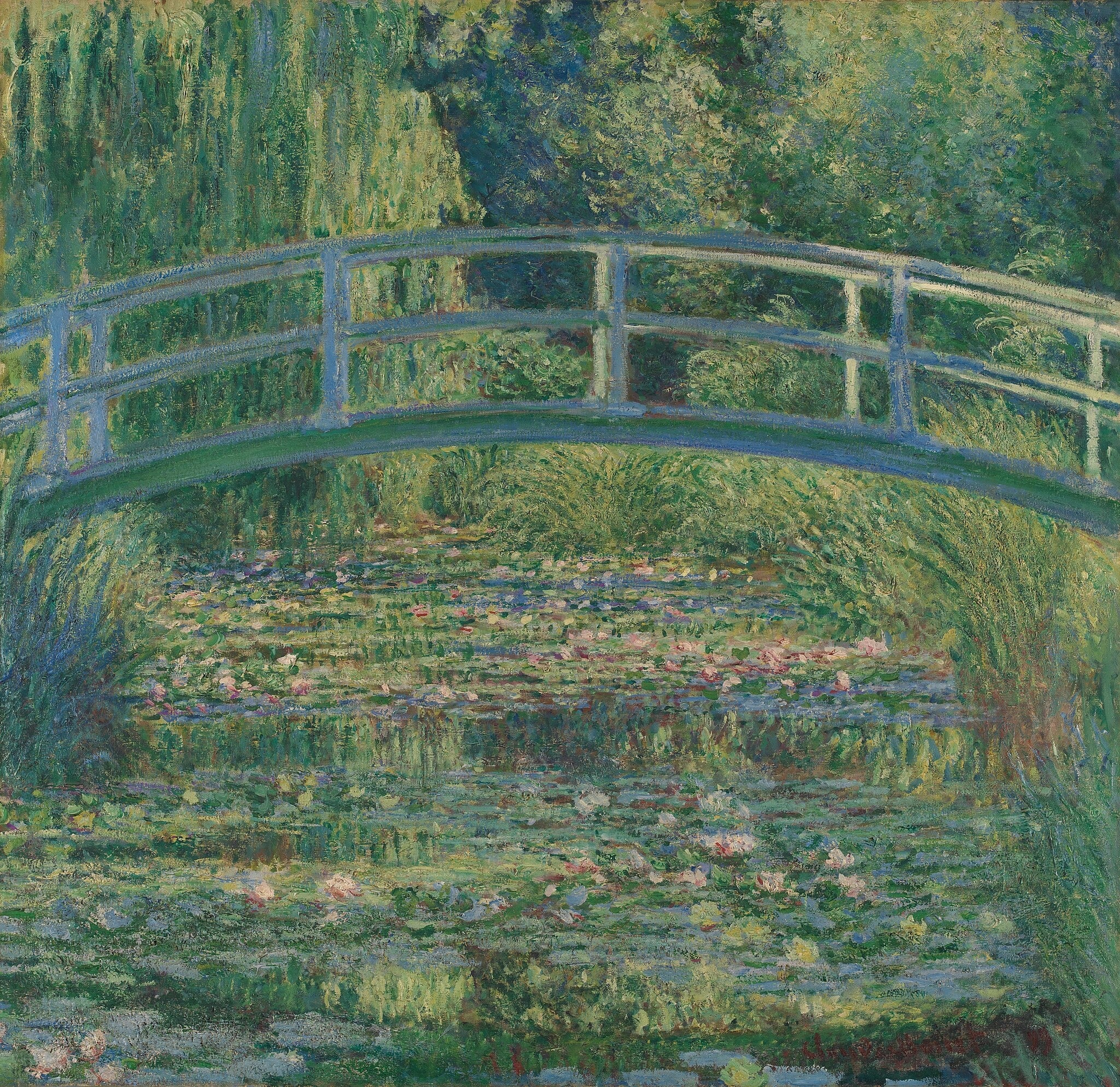
Curators at the Fondation Beyeler trace a direct line from these floes to the later Nymphéas: both deploy discrete, floating units on a reflective plane to loosen depth and orchestrate surface 4. In Ice Floes, the plates of ice are motivic units—repeatable, variable, and distributable—prefiguring how lilies will later function as agents of composition rather than mere botanical facts. As the ground dissolves and the sky’s contour softens, space becomes an all-over field where sensation accumulates laterally. The painting therefore reads as a prototype of modern pictorial space, anticipating the lily panels’ immersive horizontality and the priority of perceptual pattern over topographic mapping 34.

Source: Fondation Beyeler; University of Michigan Museum of Art (UMMA)

Environmental Aesthetics: Everyday Sublime

The débâcle was a brutal natural event—ice breaking and heaping with real force—yet Monet translates this into an ordered spatial structure, finding sublimity in the ordinary river’s upheaval 5. MFA Houston stresses the scope and ambition of the series across 1880 and 1893, framing the river as a laboratory for water, reflection, and light over years of return 7. In Ice Floes, the contest of temperatures—warm trees against mint and violet blues—becomes a climatic drama without heroics, an ecological narrative of rupture and renewal. The result is an environmental poetics: a painting that visualizes how transitional states, not static views, disclose the character of a place, making seasonal flux the engine of form and feeling 57.

Source: Calouste Gulbenkian Museum; Museum of Fine Arts, Houston

Networks of Collection: The Havemeyer Thread

The Met’s 1893 Ice Floes entered via the Havemeyer bequest, tying it to a broader American network that championed Monet’s serial investigations 1. At Shelburne, Electra Havemeyer Webb—daughter of the Met’s Havemeyer patrons—secured an 1880 Les glaçons, extending the family’s curatorial through-line from the dramatic Vétheuil débâcle to the analytic Giverny thaw 8. This provenance lens reframes Ice Floes as part of a collecting program that recognized Monet’s modular, serial logic early on, shaping how U.S. audiences encountered his shift from topographic description to surface orchestration. The Havemeyer thread thus historicizes reception: patronage and display contexts helped canonize the ice pictures as hinges between Impressionist observation and the modern, all-over field 18.

Source: The Metropolitan Museum of Art; Shelburne Museum

Related Themes

About Claude Monet

Claude Monet (1840–1926) led Impressionism’s pursuit of open-air painting and optical immediacy, especially during his Argenteuil years focused on modern leisure and light. He later developed serial studies of changing conditions, culminating in the Water Lilies cycle [2].
View all works by Claude Monet

More by Claude Monet

Boating by Claude Monet

Boating

Claude Monet (1887)

Monet’s Boating crystallizes modern leisure as a drama of perception, setting a slim skiff and two pale dresses against a field of dark, mobile water. Bold cropping, a thrusting oar, and the complementary flash of hull and foliage convert a quiet outing into an experiment in <strong>modern vision</strong> and the <strong>materiality of water</strong> <sup>[1]</sup><sup>[2]</sup>.

The Thames below Westminster by Claude Monet

The Thames below Westminster

Claude Monet (about 1871)

Claude Monet’s The Thames below Westminster turns London into <strong>light-made architecture</strong>, where Parliament’s mass dissolves into mist and the river shivers with <strong>industrial motion</strong>. Tugboats, a timber jetty with workers, and the rebuilt Westminster Bridge assert a modern city whose power is felt through atmosphere more than outline <sup>[1]</sup>.

Haystacks Series by Claude Monet | Light, Time & Atmosphere by Claude Monet

Haystacks Series by Claude Monet | Light, Time & Atmosphere

Claude Monet

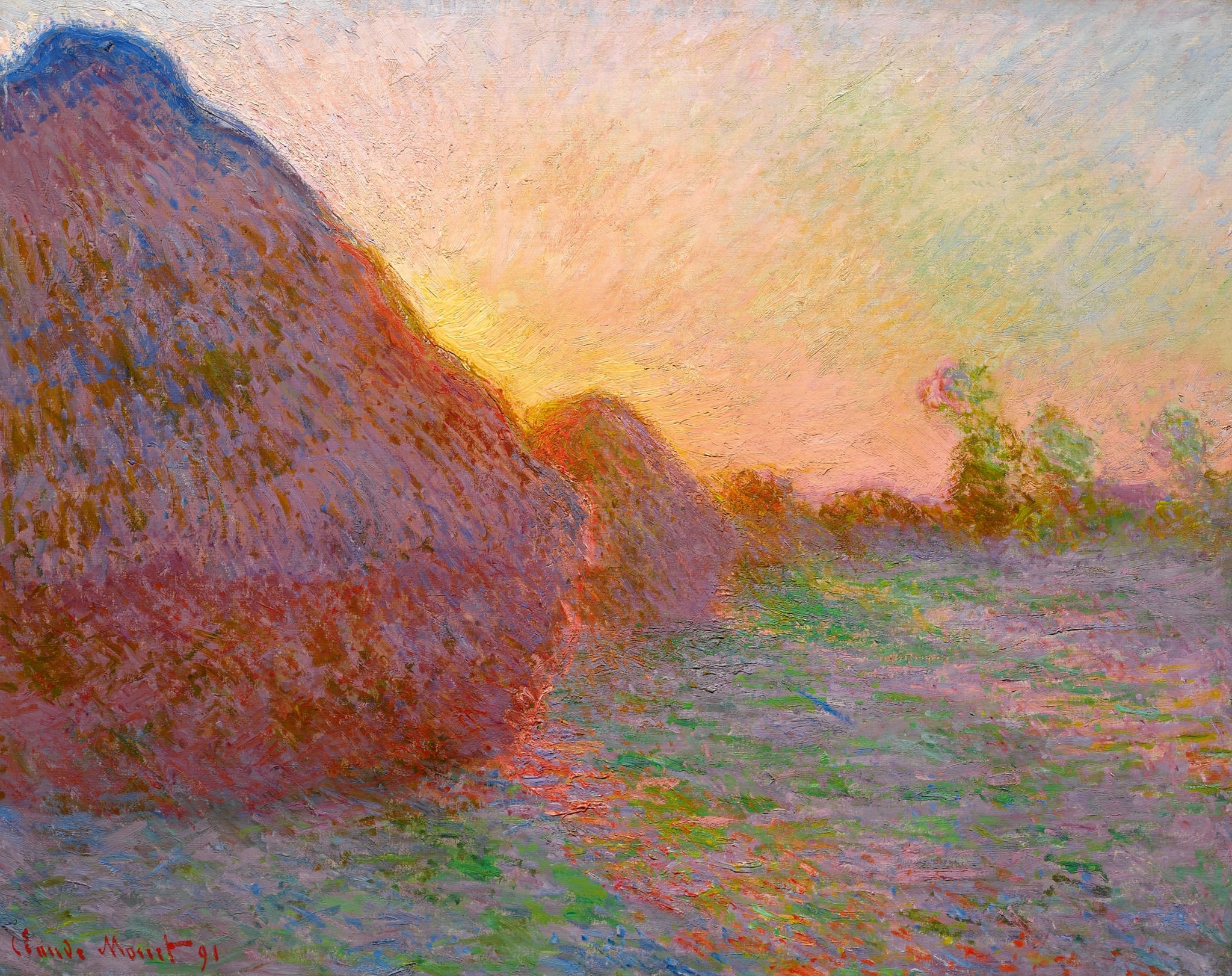
Claude Monet’s <strong>Haystacks Series</strong> transforms a routine rural subject into an inquiry into <strong>light, time, and perception</strong>. In this sunset view, the stacks swell at the left while the sun burns through the gap, making the field shimmer with <strong>apricot, lilac, and blue</strong> vibrations.
Women in the Garden by Claude Monet

Women in the Garden

Claude Monet (1866–1867)

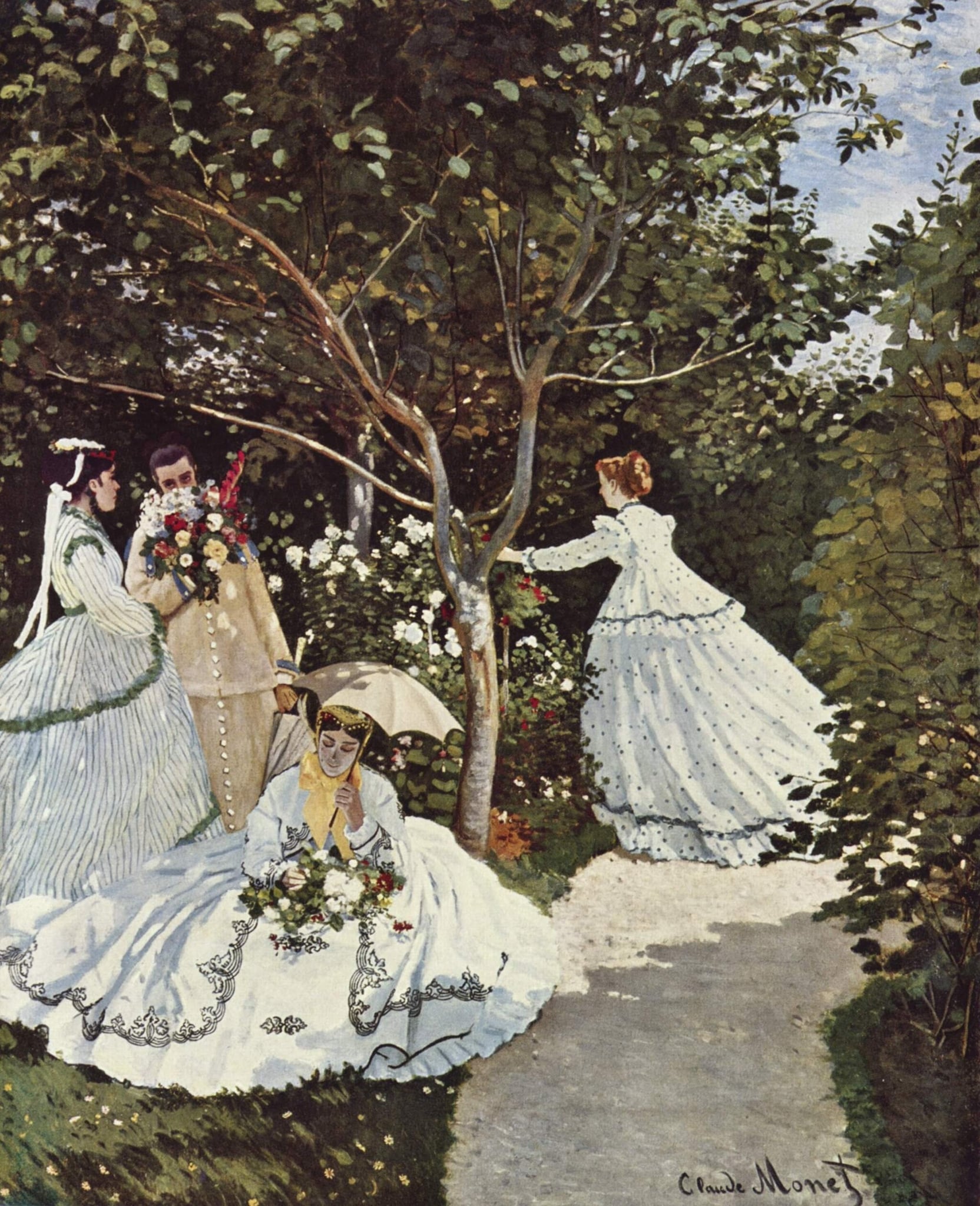
Claude Monet’s Women in the Garden choreographs four figures in a sunlit bower to test how <strong>white dresses</strong> register <strong>dappled light</strong> and shadow. The path, parasol, and clipped flowers frame a modern ritual of leisure while turning fashion into an instrument of <strong>perception</strong>. The scene reads less as portraiture than as a manifesto for painting the <strong>momentary</strong> outdoors <sup>[1]</sup><sup>[3]</sup>.
The Train in the Snow (The Locomotive) by Claude Monet

The Train in the Snow (The Locomotive)

Claude Monet (1875)

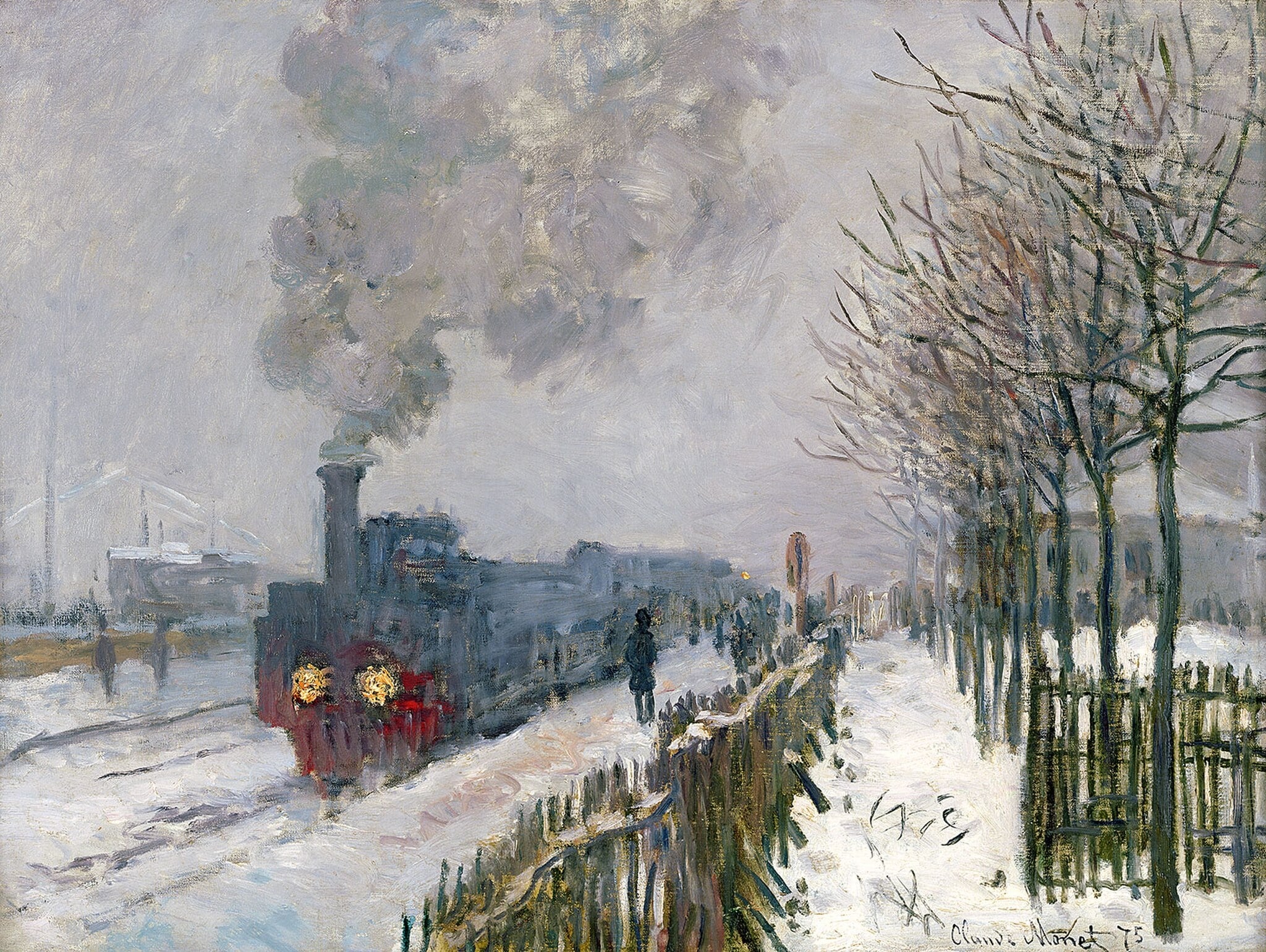
Claude Monet’s The Train in the Snow (The Locomotive) (1875) turns a suburban winter platform into a study of <strong>modernity absorbed by atmosphere</strong>. The engine’s twin yellow headlights and a smear of red push through a world of greys and violets as steam fuses with the low sky, while the right-hand fence and bare trees drill depth and cadence into the scene <sup>[1]</sup><sup>[4]</sup>. Monet fixes not an object but a <strong>moment of perception</strong>, where industry seems to dematerialize into weather <sup>[1]</sup><sup>[2]</sup>.
The Artist's Garden at Giverny by Claude Monet

The Artist's Garden at Giverny

Claude Monet (1900)

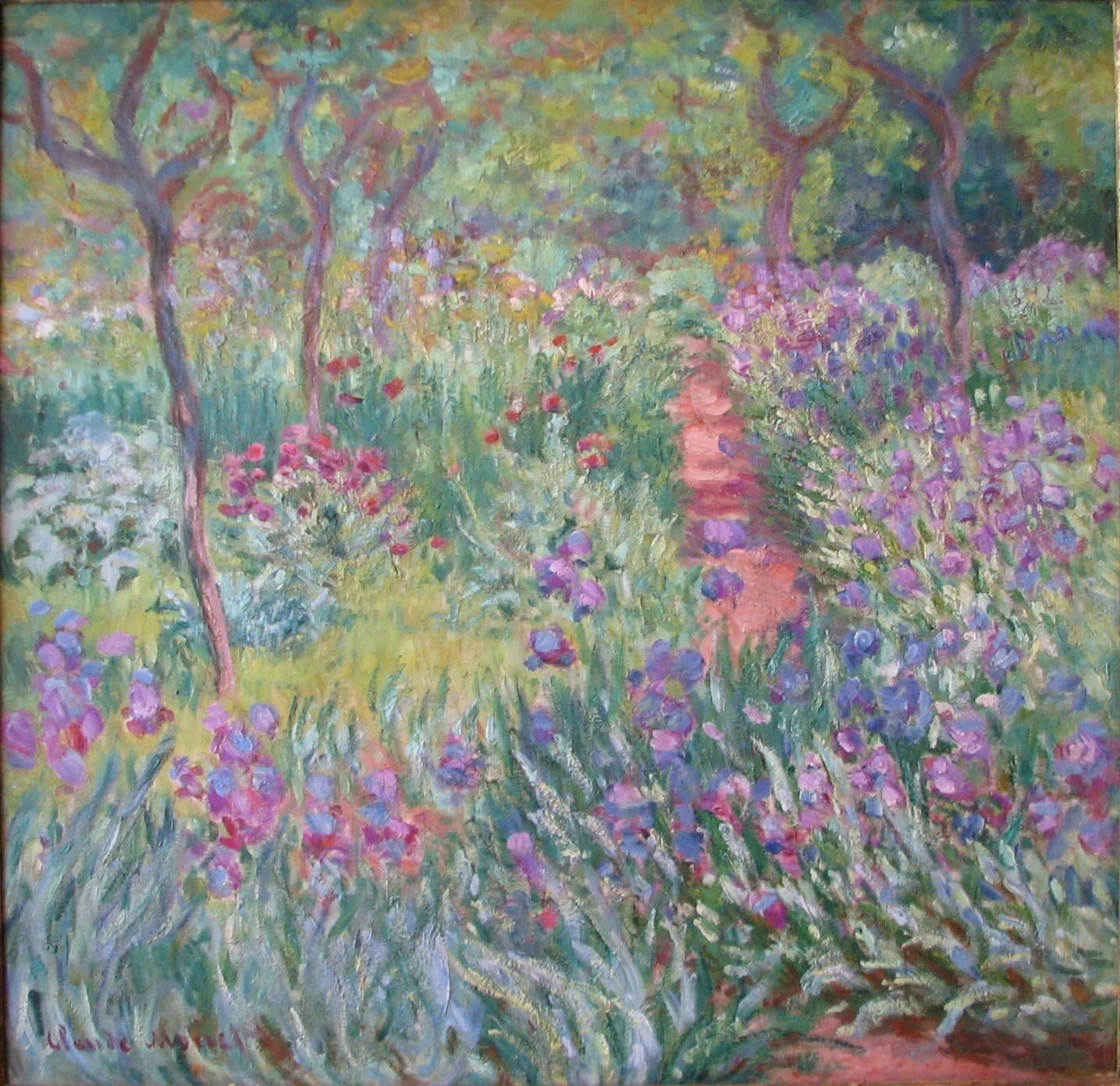
In The Artist's Garden at Giverny, Claude Monet turns his cultivated Clos Normand into a field of living color, where bands of violet <strong>irises</strong> surge toward a narrow, rose‑colored path. Broken, flickering strokes let greens, purples, and pinks mix optically so that light seems to tremble across the scene, while lilac‑toned tree trunks rhythmically guide the gaze inward <sup>[1]</sup><sup>[3]</sup>.