Landscape: The Parc Monceau

by Claude Monet

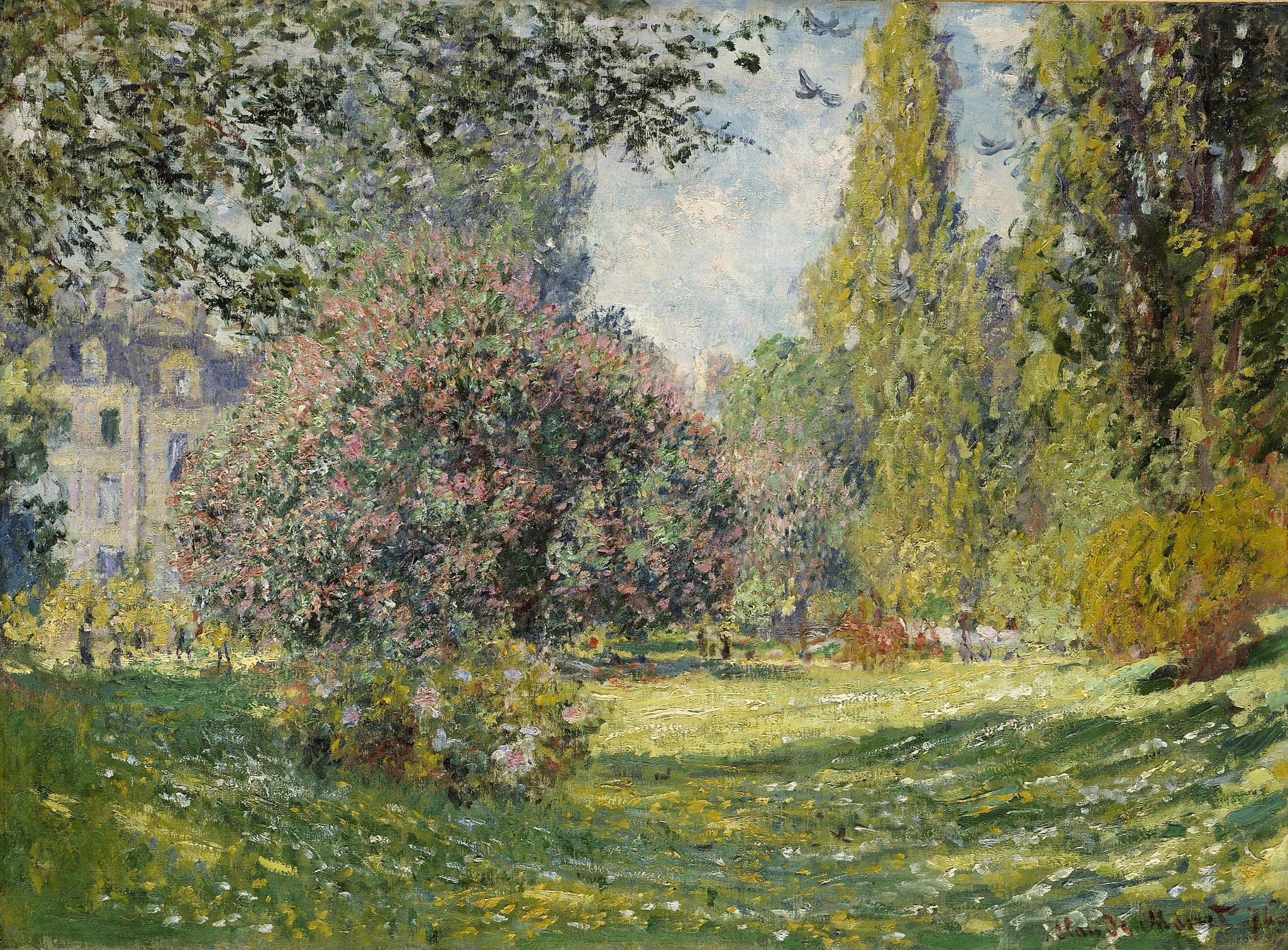
Claude Monet’s Landscape: The Parc Monceau distills a spring afternoon into a choreography of flickering light and urban leisure. A diagonal of brightness pulls the eye from the shaded foreground toward a radiant lawn, where a voluminous, flowering shrub anchors the scene and a softened townhouse tethers nature to the city [1]. Monet turns perception itself into subject, making time and weather the picture’s active protagonists [5].

Fast Facts

Year
1876
Medium
Oil on canvas
Dimensions
59.7 × 82.6 cm
Location
The Metropolitan Museum of Art, New York
See all Claude Monet paintings in New York
Landscape: The Parc Monceau by Claude Monet (1876) featuring Blooming shrub, Diagonal sunlit lawn, Overhead canopy, Townhouse façade

Click on any numbered symbol to learn more about its meaning

Meaning & Symbolism

Monet organizes Landscape: The Parc Monceau as a calibrated passage from shade to glare, using the sloped lawn’s diagonal to enact time’s flow. The shaded foreground is ribbed with brisk, lemon and sap-green touches; these quick, parallel marks read as blades flickering in a breeze. That current of light carries us to the clearing, where paint thickens and warms into a saturated, almost prismatic blooming shrub—a chromatic fulcrum of pinks, violets, and blue-greens that declares spring’s renewal. Above, a dense overhead canopy works as repoussoir, compressing the top edge so the luminous wedge of sky feels discovered rather than given. To the right, tall poplars are striated with vertical, high-key dabs, their oscillating highlights registering as sunlit leaves rather than discrete forms. The brushwork’s “flicker”—its refusal to settle—translates mobile light into matter, making the act of seeing the painting’s core drama 5. Monet punctuates this sensory field with precise urban signs. On the left, the softened façade of a townhouse emerges through foliage; its pale rectangles and mansard roof are just legible enough to certify place, rooting the idyll in one of Paris’s most fashionable quarters 12. The distant strollers—small, generalized silhouettes—index modern leisure without individuated portraiture, aligning with Impressionism’s social optics, where parks function as stages for regulated recreation and visual pleasure 3. This balance of cultivated greenery and elite architecture encodes the park as a designed threshold between private wealth and public amenity, a keystone of Haussmann’s remake of Paris 36. By setting his vantage partly under shade—the “painter’s blind” effect—Monet dramatizes the sensation of stepping into light, a perceptual narrative that anticipates his serial method of the 1880s–90s 25. The composition’s strong diagonals, planar contrasts, and silhouetting foliage foreshadow his later interest in bolder two-dimensional motifs, even as the surface remains a vibrating skin of color 2. Historically, why Landscape: The Parc Monceau is important is bound to its date and exhibition. Painted in 1876 and shown in the 1877 Impressionist exhibition, it belongs to Monet’s pivot from suburban Argenteuil to distinctly urban motifs, a shift that culminates in the Gare Saint-Lazare series 15. In this context, Parc Monceau becomes a proof-of-concept site where the mutable optics of weather meet the codified choreography of city life. Social art history has argued that such park images helped script post–Second Empire Paris as pacified and respectable, recasting contested ground as a pleasure ground of light and order; Monet’s tiny, decorous figures and domesticated nature comport with that reimaging, even as the paint’s restless surface keeps contingency in view 34. The painting thus occupies a double register: it is both a sensuous notation of a spring hour and a modern proposition about how a great city should look and feel—open, cultivated, and shared. Monet’s achievement is to bind these claims to vision itself: the picture convinces not by argument but by the palpable quickness of its light, which makes present the very time the modern city seeks to organize 135.

Explore Deeper with AI

Ask questions about Landscape: The Parc Monceau

Popular questions:

Powered by AI • Get instant insights about this artwork

💬 Ask questions about this artwork!

Interpretations

Historical Context (Social Optics of the Third Republic Park)

Read as a post‑Commune image, Parc Monceau operates as visual pacification: a once‑contested city now appears orderly, respectable, and shared. Impressionist parks, as Robert Herbert argues, staged bourgeois leisure—regulated promenades, curated vistas, and codified recreation 3. T. J. Clark’s broader thesis on modern‑life painting clarifies how such scenes negotiate class and civic spectacle, recoding public space after upheaval 4. With documented summary executions in Parc Monceau during the Semaine sanglante (May 1871), the 1876 canvas’s decorum gains historical friction: Monet’s tiny, well‑behaved figures and cultivated greenery help overwrite trauma with an image of urban harmony 78. The work thus functions doubly—as sensuous notation of a spring hour and as a civic reassurance aligned with Haussmann’s program of parks as instruments of social order 36.

Source: Robert L. Herbert; T. J. Clark; Commune-history sources; The Met publication

Formal Analysis (Threshold Optics and the Painter’s Blind)

Monet constructs a threshold drama: shade to glare along the sloped lawn’s diagonal, framed by an overhead canopy and vertical poplars. This repoussoir compresses the scene, making the sky feel discovered rather than given—an effect that turns the viewer into a stroller stepping from cover into light. Auction scholarship terms this a “painter’s blind,” a vantage partially concealed by foliage to intensify perceptual contrast 9. The Met’s discussion of related 1878 versions links this to Monet’s experiments with two‑dimensional motifs and planar contrasts, which anticipate his bolder 1880s–90s structures 2. In this key, the picture is a study in passage—between value zones, spatial registers, and moments—where seen light is the protagonist and composition the stage 29.

Source: The Met (1878 Parc Monceau); Christie’s catalogue essay

Symbolic Reading (Designed Nature and Urban Horticulture)

The canvas’s chromatic fulcrum—the blooming shrub—is not merely seasonal flourish; it is a sign of the designed English‑garden lineage of Parc Monceau and the Haussmannian goal of grafting cultivated nature onto the city 16. The prismatic pinks, violets, and blue‑greens read as horticultural display, a civic investment in spectacle and health. Situated beside a legible townhouse, the planting advertises a public amenity that flatters adjacent property, visualizing the mutual reinforcement of green infrastructure and urban capital 16. Monet’s broken touches “naturalize” this design, translating municipal planning into optical pleasure. The shrub thus encodes a policy: parks as engines of social and economic improvement, where seasonal renewal doubles as urban renewal 16.

Source: The Metropolitan Museum of Art; Met publication ‘Public Parks, Private Gardens’

Class Analysis (Permeable Boundaries of Wealth)

The softened façade of a townhouse at left functions like an urban signature: just enough architecture to certify an elite perimeter while keeping it decorously veiled by foliage 1. This visual tact mirrors the park’s socio‑spatial contract: private wealth abuts public pleasure, and each legitimates the other. Herbert’s social reading of Impressionist parks helps parse these permeable boundaries—leisure here is respectable because it is supervised by design and adjacent to property 3. Monet’s recession of individuated figures into generalized silhouettes avoids portraiture’s claims, shifting emphasis from person to polity. In this light, the painting’s “idyll” is also a map of class choreography wherein cultivated nature mediates access, visibility, and comfort for a bourgeois public 13.

Source: The Metropolitan Museum of Art; Robert L. Herbert

Phenomenology of Seeing (Optical Time and Urban Tempo)

The lawn’s flicker—brisk lemon and sap‑green striations—refuses to settle into fixed detail, turning movement of light and breeze into painterly matter. The Met’s essay on Monet underscores his drive to capture the act of perceiving nature, not its stable outline 5. In the Parc Monceau series, this means binding the city’s temporality—traffic of weather, footsteps, and hours—to the canvas’s surface tempo, which the 1878 notes describe as increasingly planar and high‑contrast 2. The result is a phenomenology of urban presentness: instead of narrative incident, we get duration as sensation, a modern optics that equates seeing with time passing. Brushwork becomes a metronome, counting the city by strokes of light 25.

Source: The Met (Monet essay); The Met (1878 Parc Monceau)

Related Themes

About Claude Monet

Claude Monet (1840–1926) led Impressionism’s pursuit of open-air painting and optical immediacy, especially during his Argenteuil years focused on modern leisure and light. He later developed serial studies of changing conditions, culminating in the Water Lilies cycle [2].
View all works by Claude Monet

More by Claude Monet

Boating by Claude Monet

Boating

Claude Monet (1887)

Monet’s Boating crystallizes modern leisure as a drama of perception, setting a slim skiff and two pale dresses against a field of dark, mobile water. Bold cropping, a thrusting oar, and the complementary flash of hull and foliage convert a quiet outing into an experiment in <strong>modern vision</strong> and the <strong>materiality of water</strong> <sup>[1]</sup><sup>[2]</sup>.

The Thames below Westminster by Claude Monet

The Thames below Westminster

Claude Monet (about 1871)

Claude Monet’s The Thames below Westminster turns London into <strong>light-made architecture</strong>, where Parliament’s mass dissolves into mist and the river shivers with <strong>industrial motion</strong>. Tugboats, a timber jetty with workers, and the rebuilt Westminster Bridge assert a modern city whose power is felt through atmosphere more than outline <sup>[1]</sup>.

Haystacks Series by Claude Monet | Light, Time & Atmosphere by Claude Monet

Haystacks Series by Claude Monet | Light, Time & Atmosphere

Claude Monet

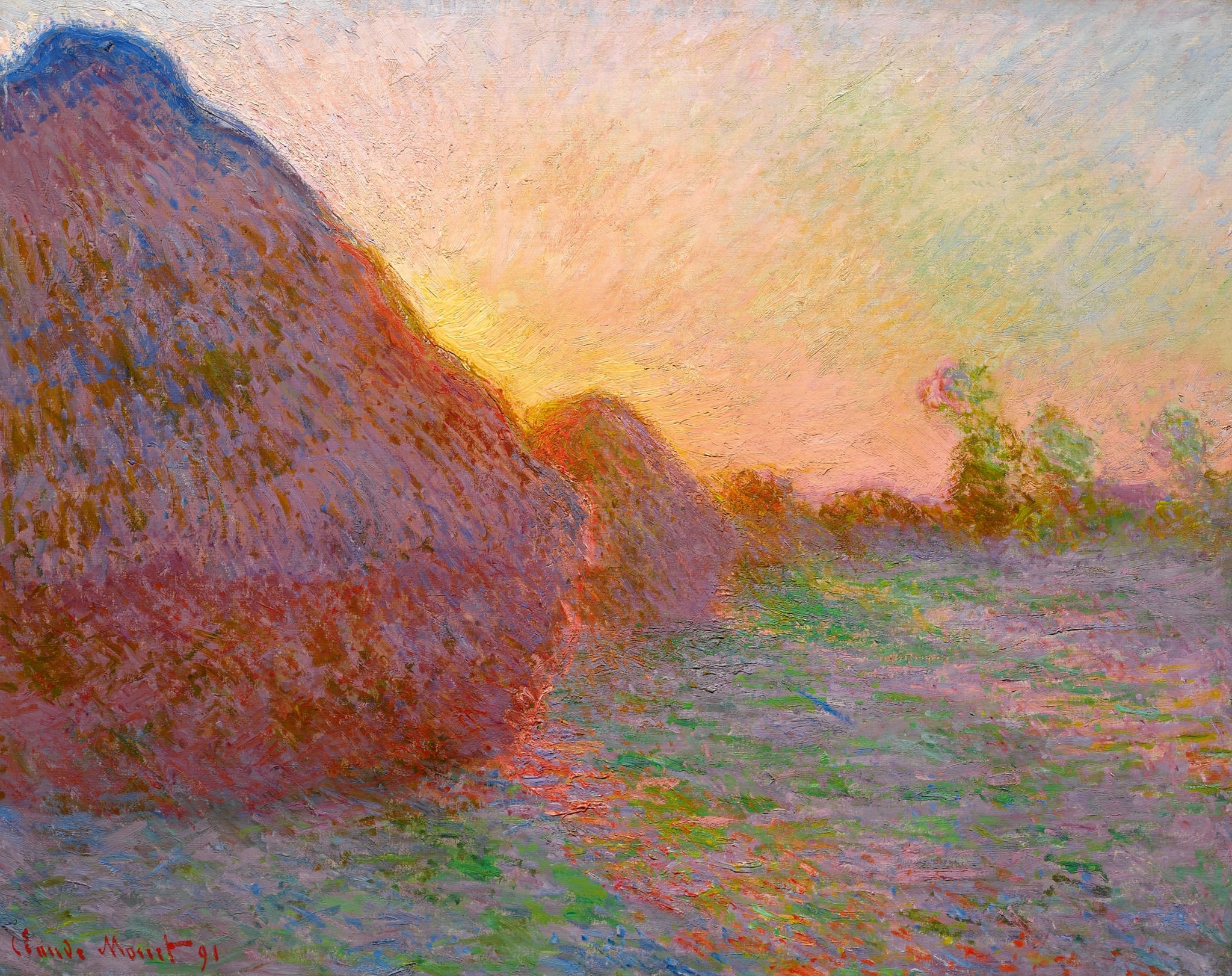
Claude Monet’s <strong>Haystacks Series</strong> transforms a routine rural subject into an inquiry into <strong>light, time, and perception</strong>. In this sunset view, the stacks swell at the left while the sun burns through the gap, making the field shimmer with <strong>apricot, lilac, and blue</strong> vibrations.
Women in the Garden by Claude Monet

Women in the Garden

Claude Monet (1866–1867)

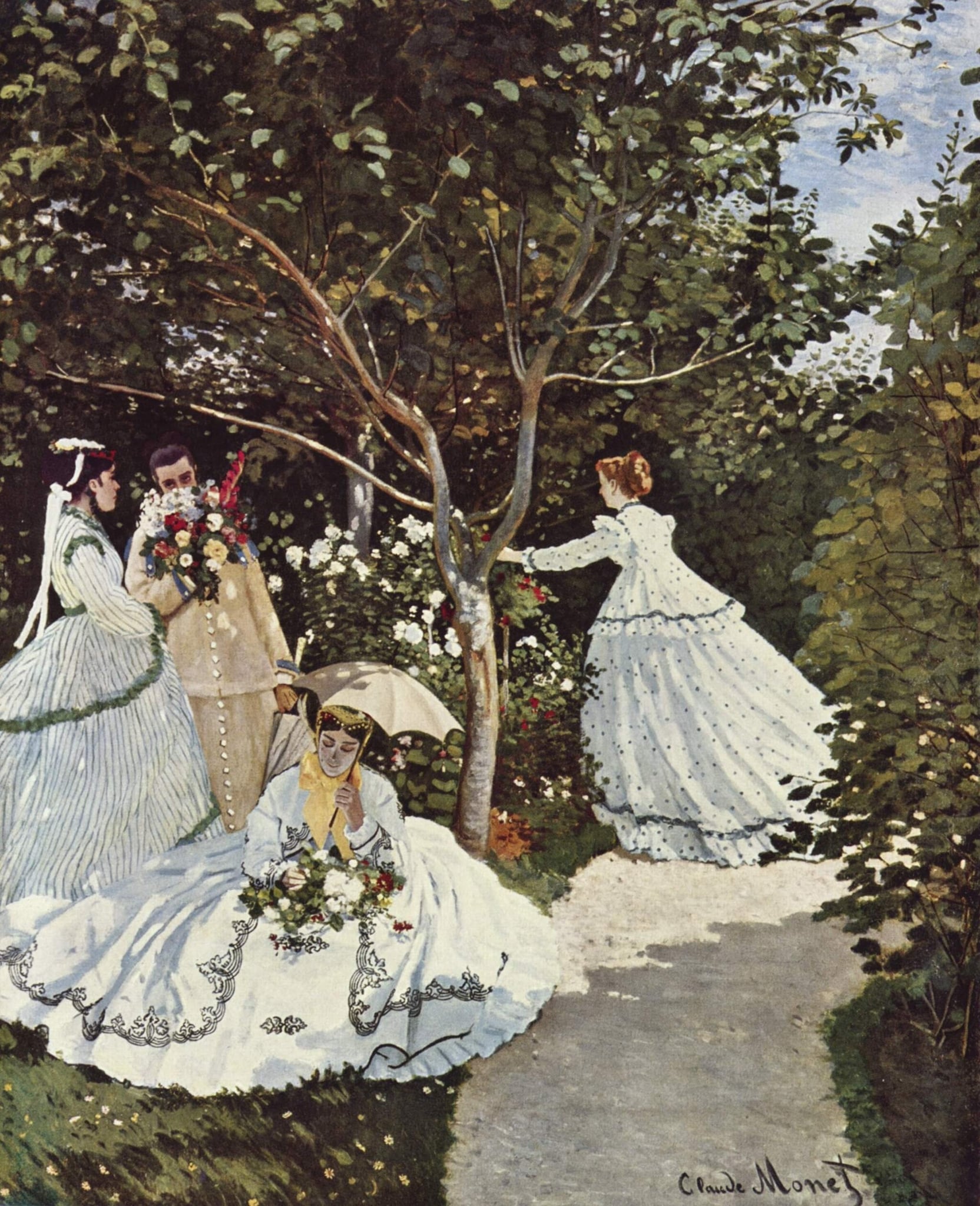
Claude Monet’s Women in the Garden choreographs four figures in a sunlit bower to test how <strong>white dresses</strong> register <strong>dappled light</strong> and shadow. The path, parasol, and clipped flowers frame a modern ritual of leisure while turning fashion into an instrument of <strong>perception</strong>. The scene reads less as portraiture than as a manifesto for painting the <strong>momentary</strong> outdoors <sup>[1]</sup><sup>[3]</sup>.
The Train in the Snow (The Locomotive) by Claude Monet

The Train in the Snow (The Locomotive)

Claude Monet (1875)

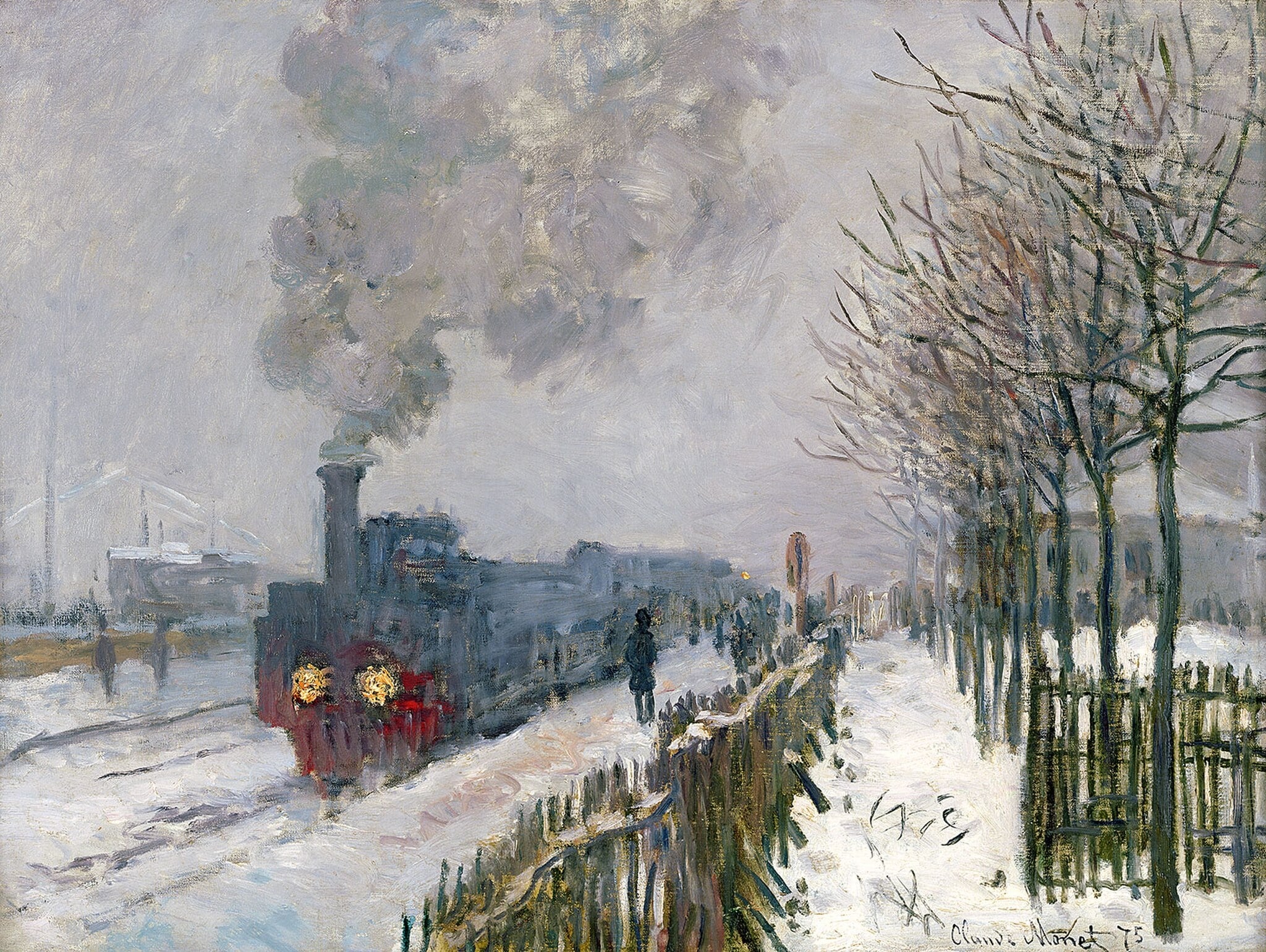
Claude Monet’s The Train in the Snow (The Locomotive) (1875) turns a suburban winter platform into a study of <strong>modernity absorbed by atmosphere</strong>. The engine’s twin yellow headlights and a smear of red push through a world of greys and violets as steam fuses with the low sky, while the right-hand fence and bare trees drill depth and cadence into the scene <sup>[1]</sup><sup>[4]</sup>. Monet fixes not an object but a <strong>moment of perception</strong>, where industry seems to dematerialize into weather <sup>[1]</sup><sup>[2]</sup>.
The Artist's Garden at Giverny by Claude Monet

The Artist's Garden at Giverny

Claude Monet (1900)

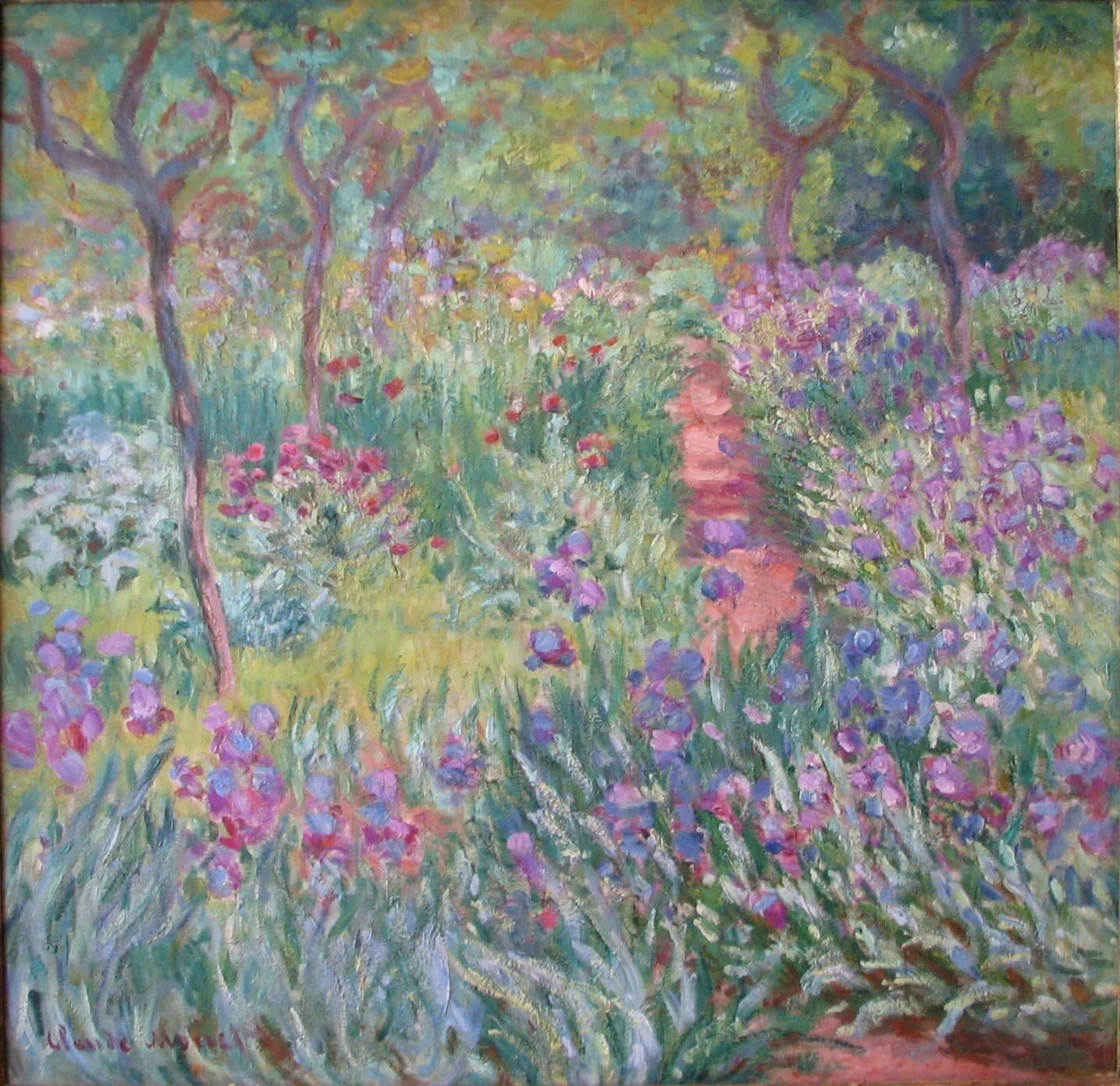
In The Artist's Garden at Giverny, Claude Monet turns his cultivated Clos Normand into a field of living color, where bands of violet <strong>irises</strong> surge toward a narrow, rose‑colored path. Broken, flickering strokes let greens, purples, and pinks mix optically so that light seems to tremble across the scene, while lilac‑toned tree trunks rhythmically guide the gaze inward <sup>[1]</sup><sup>[3]</sup>.