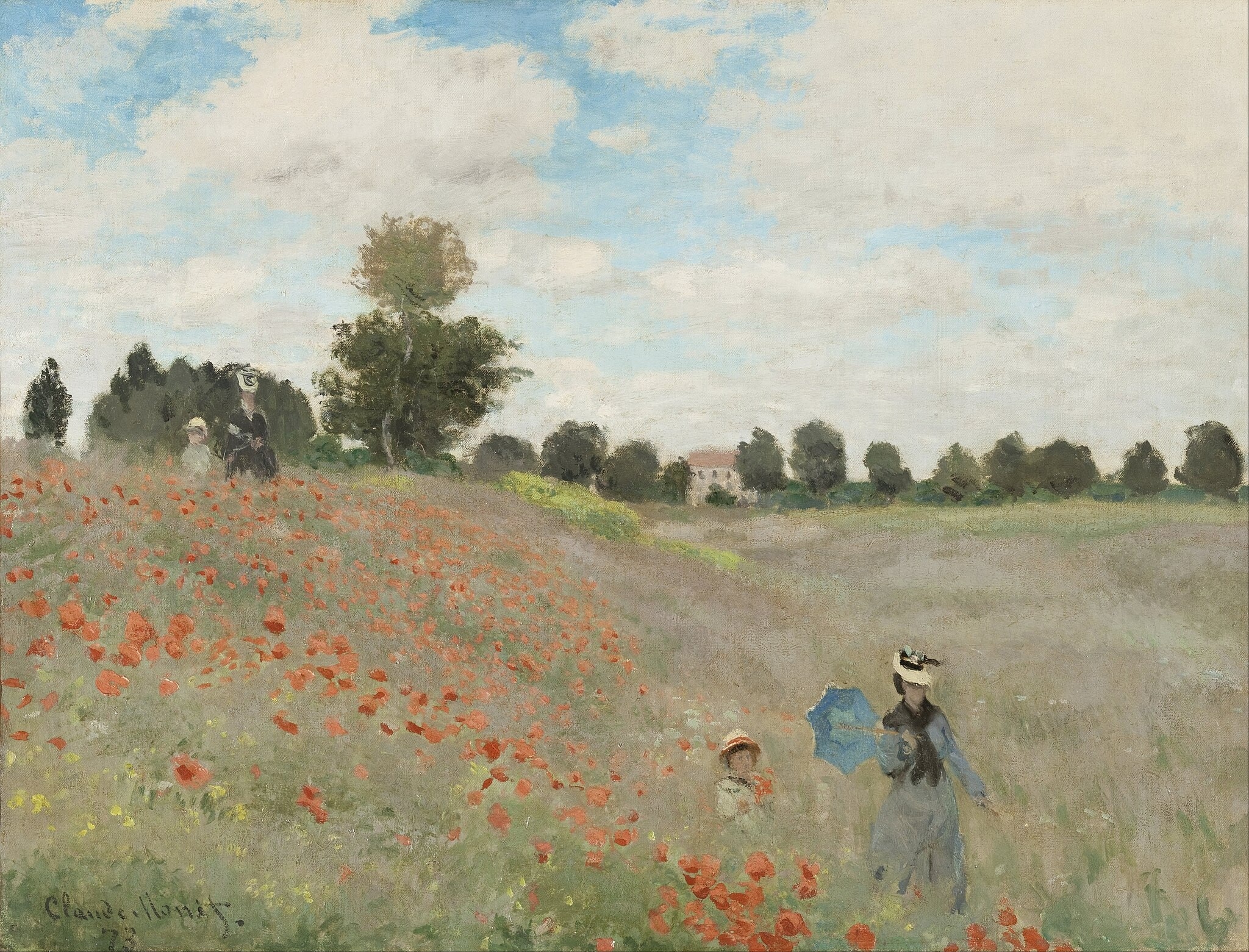
Poppy Fields near Argenteuil

by Claude Monet

A modern pastoral where color and weather become the subject: in Poppy Fields near Argenteuil (1873), Monet arrays red poppies along a diagonal slope beneath an immense, changeable sky. Two promenading figures recur across the hill, turning a stroll into a rhythm of time and movement [1][2].

Fast Facts

Year
1873
Medium
Oil on canvas
Dimensions
50.0 × 65.3 cm
Location
Musée d’Orsay, Paris
See all Claude Monet paintings in New York
Poppy Fields near Argenteuil by Claude Monet (1873) featuring Blue parasol, Diagonal embankment (slope)

Click on any numbered symbol to learn more about its meaning

Meaning & Symbolism

Monet builds the painting on a decisive diagonal: a red-sprinkled band of poppies climbs from the lower left toward the center, tipping the viewer’s body forward as if caught mid-step. Along this incline, the woman in a blue parasol and a child appear near the right foreground and again higher on the hill, a visual echo that converts space into successive instants. This doubling is not a narrative of two families but a registration of the same pair seen a few moments apart, so that the promenade itself becomes the clock. Above them, a vast sky broken by passing clouds occupies nearly half the canvas, its pale blues and greys modulating the field’s color and implying flickers of sun and shadow across the grass. Monet’s red–green complement—poppies sparking against cool meadow tones—enacts the law of simultaneous contrast, so that color does the work of time: the reds seem to advance and recede, pulsing like the wind that ruffles hats, ribbons, and blooms 2. The result is a painting in which seeing is an event rather than a record. What appears at first glance to be rustic countryside is in fact the modern fringe of Paris. The low horizon lines up villas and a fringing row of trees, while the sloped “field” is an engineered embankment, a talus created by recent works at Argenteuil—one of the suburbs transformed by rail access and Haussmann-era expansion 234. Monet situates leisurely strolling within this hybrid zone: cultivated manners and fashionable accessories (the bright blue parasol) meet infrastructural terrain. The canvas therefore participates in the social history of Impressionism that locates modern identity in suburban leisurethe afternoon walk, boating, garden visiting—activities enabled by trains and new urban planning 5. Yet the harmony Monet achieves is double-edged. As critics have noted, Argenteuil images can both reveal and softly mythologize the coexistence of industry and nature: the embankment is legible, but it is also softened into herbaceous color and air, a reconciliation whose ease invites debate about whether Impressionism clarifies or idealizes modernity 67. Within that tension, the painting declares a program central to the first Impressionist exhibition of 1874: to replace anecdote with experience. Monet’s facture—short, broken strokes, dissolving contours—lets edges yield to atmosphere so that the figures feel embedded in the same optical field as the poppies and clouds. The blue parasol is not only a social sign but a chromatic instrument, striking cool notes against greens and echoing the sky’s patches of azure; its tilt implies a slight gust, coordinating human gesture with weather. Even the poppies’ short season becomes a metaphor for impermanence, their flare-and-fade cycle mirrored by cloud shadows skimming the slope. In short, why Poppy Fields near Argenteuil is important is that it makes the conditions of looking—light, air, time, and modern setting—the actual content of the picture. Exhibited in 1874, it stood as a lucid demonstration that painting could register momentary life at the city’s edge with the authority of sensation itself 12.

Explore Deeper with AI

Ask questions about Poppy Fields near Argenteuil

Popular questions:

Powered by AI • Get instant insights about this artwork

💬 Ask questions about this artwork!

Interpretations

Social History of Leisure

Read through Robert L. Herbert’s lens, the picture codifies a new leisure sphere at Paris’s edge: a genteel promenade in engineered countryside made accessible by rail. The paired figures—probably Camille and Jean Monet—signal family respectability, while the parasol, ribbons, and measured gait broadcast class-coded comportment. Rather than anecdote, Monet offers a sociological slice: time outdoors as a cultivated habit of the bourgeois day. Crucially, the field is not a pristine rustic site but a managed environment—evidence that leisure depends on public works and mobility networks. The painting thus visualizes how modern identity is performed through relaxed movement, tasteful accessories, and selective attention to nature’s charms, an ethos Herbert identifies as central to Impressionism’s social world 25.

Source: Robert L. Herbert, Yale University Press

Modernity’s Soft Focus

T. J. Clark prompts a more skeptical reading: Monet’s fusion of villas, embankment, and herbaceous color proposes an agreeable harmony between industry and landscape that can mythologize modernity. The embankment is legible, yet dissolved into atmospheric strokes that reconcile infrastructure with meadow and sky. Such reconciliation—pleasurable to the eye—may occlude labor, displacement, and capital behind suburban improvements. In this view, Coquelicots becomes a pastoral of modernization, smoothing tensions even as it acknowledges them. The critical question Clark raises is whether Impressionism’s optical pleasure is also an ideology of ease, a way of seeing that naturalizes change and renders it beautiful, thereby moderating social contradictions at the city’s edge 26.

Source: T. J. Clark (summarized in Journal of Social History review)

Optics as Content

RMN–GrandPalais links Monet’s red–green pairs to Chevreul’s law of simultaneous contrast, making color the engine of meaning. The poppies’ cadmium-like reds spark against cool greens, vibrating forward and back as clouds thin or thicken, so that hue and value shifts perform the scene’s tempo. This isn’t illustration; it’s an optical event where brushstroke, complement, and atmospheric modulation turn perception into narrative. The doubled figures reinforce that story: two positions along the diagonal echo the way red accents recur across the slope, creating a rhythm of sight. In sum, Monet replaces academic contour with broken facture to register the micro-changes by which light makes and unmakes form—painting as a calibrated instrument of seeing 2.

Source: RMN–GrandPalais (Panorama de l’art)

Suburban Engineering as Landscape

The so-called “field” is an embankment (talus) produced by recent works at Argenteuil—an infrastructural surface masquerading as meadow. Read with site histories of Argenteuil, the low horizon’s villas and tree line become markers of a suburb reshaped by Haussmann-era logics and short train times from Paris. Monet’s decision to devote nearly half the canvas to sky amplifies the dialog between engineered ground and meteorological flux: the built and the breathable. Paul Hayes Tucker underscores Argenteuil as a laboratory where Monet tested how to fuse urban modernity with landscape conventions. Here, infrastructure is not excluded; it is aestheticized—a field of brush and color where modern planning meets the painter’s weather 247.

Source: RMN–GrandPalais; Musée de l’Orangerie; Paul Hayes Tucker

Family, Memory, and Time

If the walkers are, as many sources suggest, Camille and Jean, their doubling turns the promenade into a mnemonic sequence—two beats of presence across a slope that reads as a gentle climb through time. The repetitions rhyme with poppy bursts and cloud shadows, suggesting how family life is registered in fleeting impressions rather than staged tableaux. Biographically, Monet’s Argenteuil years consolidated both his circle and his method; the habitual outing becomes a structure for seeing, a domestic ritual that aligns body, weather, and looking. The result is a quiet phenomenology of kinship: motion, care, and guidance materialized as a diagonal path under a mutable sky, an everyday choreography remembered by the eye 23.

Source: RMN–GrandPalais; The Met Heilbrunn Timeline

Exhibition Stakes, 1874

Shown at the first Impressionist exhibition (1874), Coquelicots served as a manifesto for replacing anecdote with experience. The painting’s low horizon and expansive, cloud-laced sky proclaim plein-air immediacy; its broken touch and dissolved contour assert that modern truth lies in perceptual becoming, not fixed outlines. By choosing the modern fringe as subject and calibrating color to atmospheric change, Monet offered viewers a new criterion of pictorial authority: the sensation of the moment. The work’s exhibition context thus matters—what was on trial was whether painting could register urbanizing nature with the fidelity of sight itself, making everyday leisure at the city’s edge worthy of the Salon’s rival platform 12.

Source: Musée d’Orsay; RMN–GrandPalais

Related Themes

About Claude Monet

Claude Monet (1840–1926) led Impressionism’s pursuit of open-air painting and optical immediacy, especially during his Argenteuil years focused on modern leisure and light. He later developed serial studies of changing conditions, culminating in the Water Lilies cycle [2].
View all works by Claude Monet

More by Claude Monet

Boating by Claude Monet

Boating

Claude Monet (1887)

Monet’s Boating crystallizes modern leisure as a drama of perception, setting a slim skiff and two pale dresses against a field of dark, mobile water. Bold cropping, a thrusting oar, and the complementary flash of hull and foliage convert a quiet outing into an experiment in <strong>modern vision</strong> and the <strong>materiality of water</strong> <sup>[1]</sup><sup>[2]</sup>.

The Thames below Westminster by Claude Monet

The Thames below Westminster

Claude Monet (about 1871)

Claude Monet’s The Thames below Westminster turns London into <strong>light-made architecture</strong>, where Parliament’s mass dissolves into mist and the river shivers with <strong>industrial motion</strong>. Tugboats, a timber jetty with workers, and the rebuilt Westminster Bridge assert a modern city whose power is felt through atmosphere more than outline <sup>[1]</sup>.

Haystacks Series by Claude Monet | Light, Time & Atmosphere by Claude Monet

Haystacks Series by Claude Monet | Light, Time & Atmosphere

Claude Monet

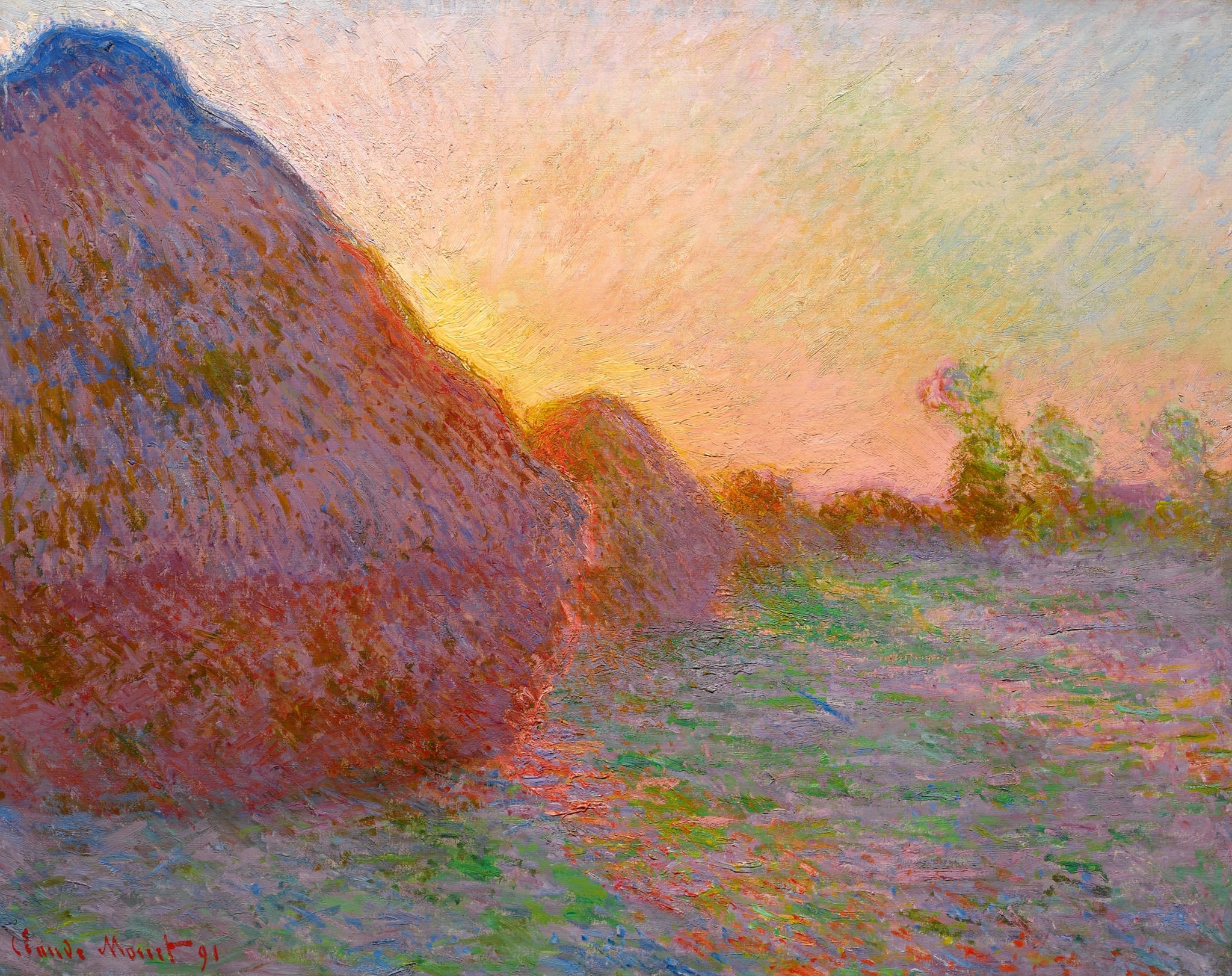
Claude Monet’s <strong>Haystacks Series</strong> transforms a routine rural subject into an inquiry into <strong>light, time, and perception</strong>. In this sunset view, the stacks swell at the left while the sun burns through the gap, making the field shimmer with <strong>apricot, lilac, and blue</strong> vibrations.
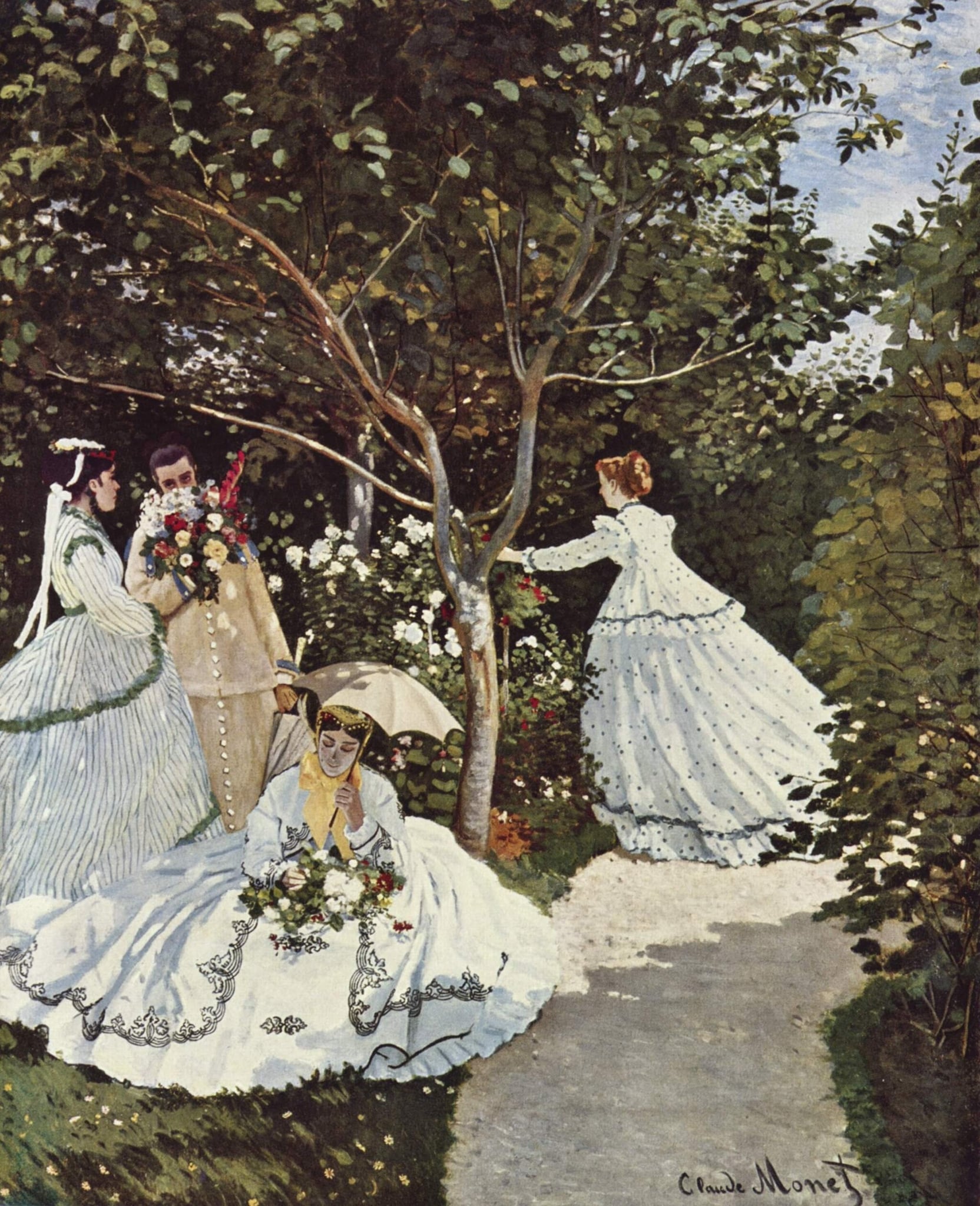
Women in the Garden by Claude Monet

Women in the Garden

Claude Monet (1866–1867)

Claude Monet’s Women in the Garden choreographs four figures in a sunlit bower to test how <strong>white dresses</strong> register <strong>dappled light</strong> and shadow. The path, parasol, and clipped flowers frame a modern ritual of leisure while turning fashion into an instrument of <strong>perception</strong>. The scene reads less as portraiture than as a manifesto for painting the <strong>momentary</strong> outdoors <sup>[1]</sup><sup>[3]</sup>.
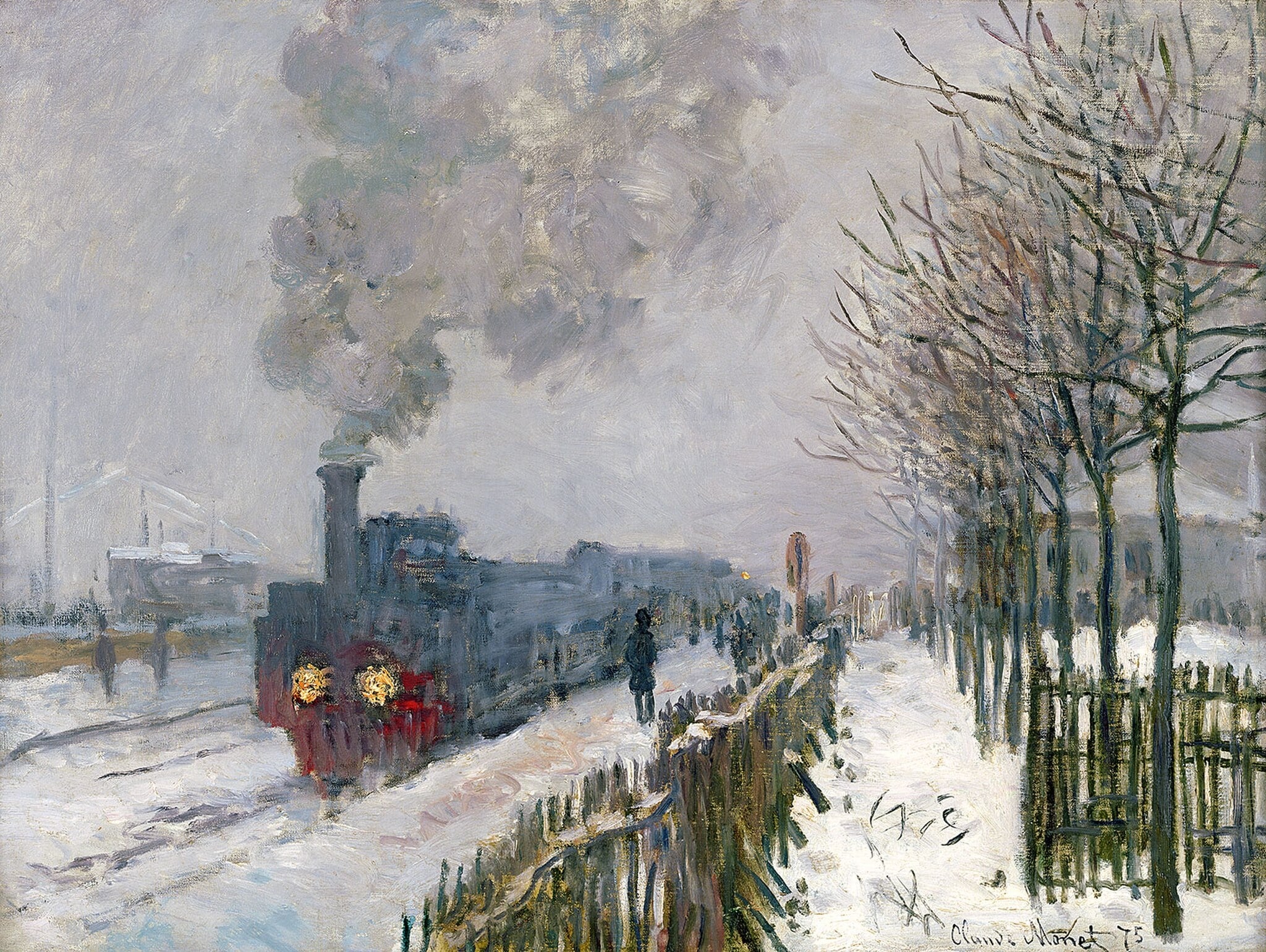
The Train in the Snow (The Locomotive) by Claude Monet

The Train in the Snow (The Locomotive)

Claude Monet (1875)

Claude Monet’s The Train in the Snow (The Locomotive) (1875) turns a suburban winter platform into a study of <strong>modernity absorbed by atmosphere</strong>. The engine’s twin yellow headlights and a smear of red push through a world of greys and violets as steam fuses with the low sky, while the right-hand fence and bare trees drill depth and cadence into the scene <sup>[1]</sup><sup>[4]</sup>. Monet fixes not an object but a <strong>moment of perception</strong>, where industry seems to dematerialize into weather <sup>[1]</sup><sup>[2]</sup>.
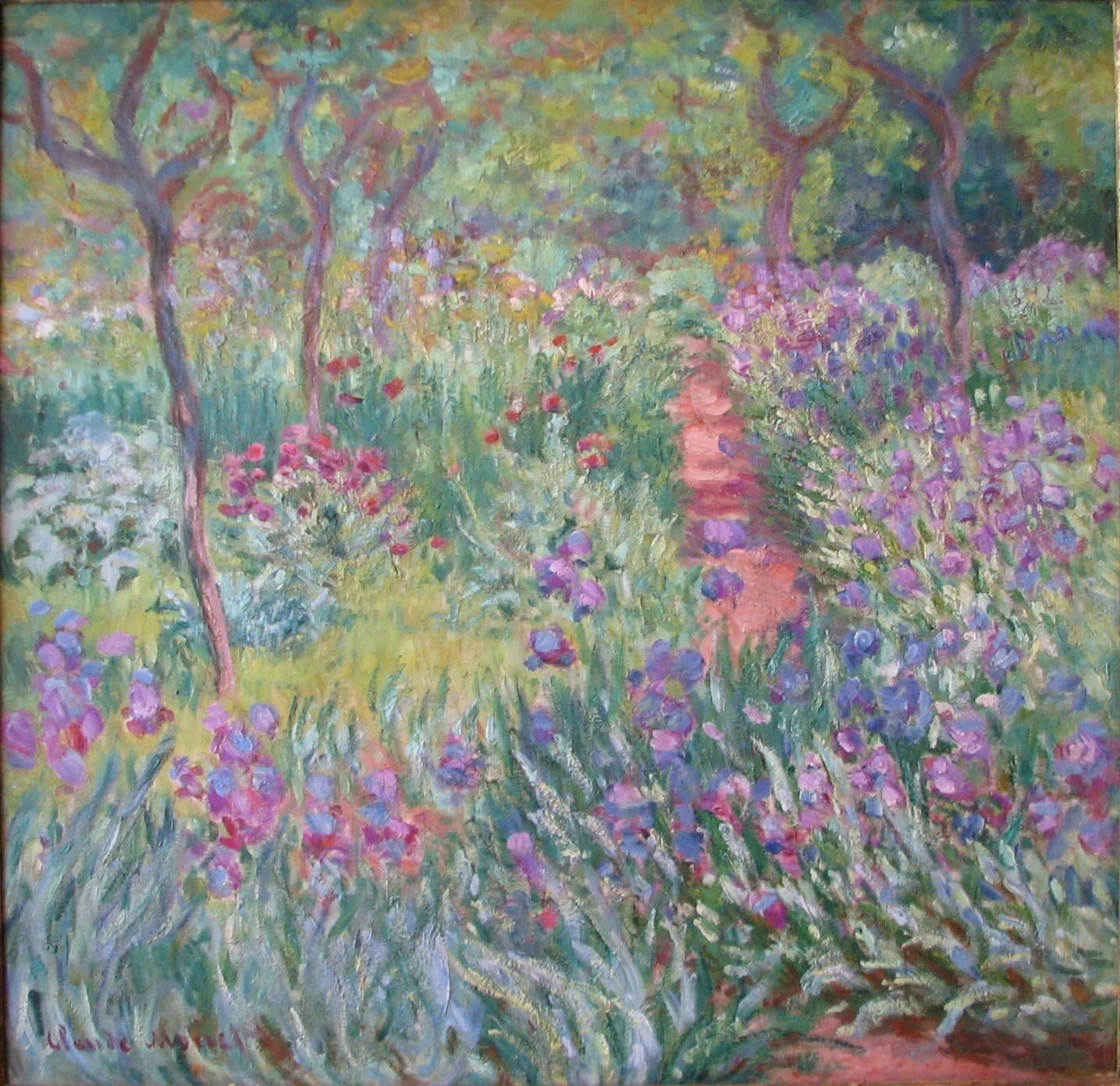
The Artist's Garden at Giverny by Claude Monet

The Artist's Garden at Giverny

Claude Monet (1900)

In The Artist's Garden at Giverny, Claude Monet turns his cultivated Clos Normand into a field of living color, where bands of violet <strong>irises</strong> surge toward a narrow, rose‑colored path. Broken, flickering strokes let greens, purples, and pinks mix optically so that light seems to tremble across the scene, while lilac‑toned tree trunks rhythmically guide the gaze inward <sup>[1]</sup><sup>[3]</sup>.