Spring (Fruit Trees in Bloom)

by Claude Monet

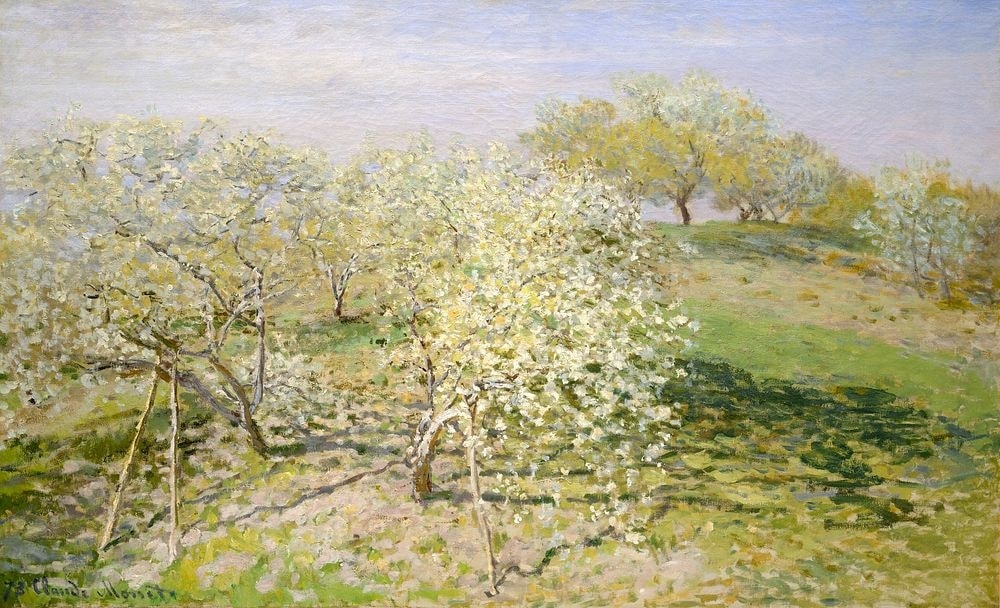
Claude Monet’s Spring (Fruit Trees in Bloom) captures a hillside orchard at Argenteuil where pale blossoms flicker across a diagonal slope under a pearly, breathable sky. The canvas privileges light over contour, letting trunks, stakes, and petal-clusters resolve through vibrating touches of color that register passing air and sun [1][2]. The scene fixes a radiant instant while acknowledging its fragility.

Fast Facts

Year
1873
Medium
Oil on canvas
Dimensions
62.2 × 100.6 cm
Location
The Metropolitan Museum of Art, New York
See all Claude Monet paintings in New York
Spring (Fruit Trees in Bloom) by Claude Monet (1873) featuring White blossoms, Support stakes, Diagonal hillside, Dappled shadows

Click on any numbered symbol to learn more about its meaning

Meaning & Symbolism

Monet composes the orchard as a diagonal plane that rises from lower left to upper right, tipping the viewer into a shallow, sunstruck amphitheater of trees. The nearest trunks are lightly propped with stakes, a factual sign of cultivation that anchors human care within nature’s surge. Across these supports and branches, Monet scatters touches of white, cream, and lemon—petal and light becoming indistinguishable. Cool violets and gray-lilacs pool as shadows on the ground, while higher on the slope the greens thin and warm, dissolving into a soft, vaporous sky. This is not a botany lesson. The Met notes that the species cannot be determined, evidence of Monet’s choice to render bloom as luminous effect rather than botanical detail 1. The orchard’s dapple is achieved through strokes that refuse contour, a hallmark of Monet’s Argenteuil practice that the Met and Smarthistory identify as the classic Impressionist facture—swift, visible marks that prize perception in flux over finish 24. The image thus reads as a pact between eye and atmosphere: forms hover, hover again, then resolve only as the light resolves. Within that pact lies the painting’s thematic core. The orchard is both promise and passing. The white spray of petals declares the season’s ascent, but the looseness of the strokes—like particles blown across air—insists on transience. Monet’s choice of a high horizon and open sky enlarges the feeling of breathable space; yet the faint, pearly tonality suggests humidity and evanescence, as if the bloom could lift into mist at any moment. This tension between cultivation and contingency structures the scene: the stakes show planning; the petals show what eludes plans. Argenteuil, a modern suburban edge where gardens and leisure met industry, was precisely the terrain where Monet and peers stabilized the Impressionist language in the early 1870s 3. In that context, Spring (Fruit Trees in Bloom) is exemplary: it binds a contemporary, worked landscape to a new pictorial logic that makes the viewer feel time passing in light. The painting therefore functions less as a view of trees than as a demonstration of how seeing happens—in flicker, in adjacency, in the merger of white blossom and sun. It advances Monet’s broader pursuit, emphasized in the Met’s account of his career, of translating changing conditions of weather and season into paint so directly that narration becomes unnecessary 2. The orchard’s diagonal thrust, the interlaced shadows, the suspended contours together embody an ethics of looking: to attend to the instant is to accept its disappearance. That acceptance—rendered here with buoyant color and air—is what gives the canvas its quiet gravity and its continuing force as a touchstone of Impressionism 1234.

Explore Deeper with AI

Ask questions about Spring (Fruit Trees in Bloom)

Popular questions:

Powered by AI • Get instant insights about this artwork

💬 Ask questions about this artwork!

Interpretations

Historical Context

Painted in 1873 at Argenteuil, this canvas belongs to the moment when Monet and peers consolidated Impressionism on Paris’s suburban fringe. Argenteuil’s mix of gardens, new transport, and weekend leisure provided a laboratory for subjects responsive to weather and time, setting up the First Impressionist Exhibition of 1874 23. The orchard’s diagonal sweep and luminous palette converse with this milieu: a modern, worked landscape seen through a brisk, outdoor method. Economic scaffolding mattered too—dealer Paul Durand‑Ruel’s purchases in 1872–73 stabilized Monet’s practice, enabling sustained plein‑air experiments on sizable supports 2. Rather than rural nostalgia, the painting reads as a contemporary landscape—suburban, cultivated, and open to traffic of air and spectators—where the modern eye could test what it could hold before light changed 23.

Source: The Metropolitan Museum of Art; National Gallery of Art (Paul Hayes Tucker)

Formal Analysis

Monet builds the scene through a diagonal plane and a high horizon, tilting the viewer into a shallow bowl of trees while thinning greens ascend into a soft, vaporous sky. Contour is consistently deferred: blossoms are color notes, not botanical outlines, so that petal and sunlight merge 1. This refusal of enclosing line exemplifies classic Impressionist facture—“swift, visible marks” that privilege perception in flux over academic finish 4. Cool violets pool in the ground’s shade, counterpointing warm, lemony lights that flicker across branches. The result is not a taxonomy but a spatial atmosphere where forms cohere only as the light coheres. Even the tree stakes function formally, punctuating the slope with verticals that anchor the eye amid the painting’s lateral shimmer 14.

Source: The Metropolitan Museum of Art; Smarthistory

Eco‑Critical Reading

The orchard’s stakes quietly declare horticultural management, but the painting subordinates that control to a weather‑driven surface where contingency reigns. In this reading, Argenteuil’s cultivated ground becomes a site where human planning meets the unruliness of air, pollen, and light—an early modern negotiation between domesticated nature and environmental flux 13. Monet’s choice to render bloom as effect rather than species resists extractive knowledge (naming, fixing) in favor of experiential attention, aligning the work with an ethics of looking that accepts the world’s instability 12. The sky’s vapor and the petal‑light blur imply that any yield (fruit, knowledge, image) depends on conditions beyond human command—an ecological humility legible in paint handling as much as in motif 13.

Source: The Metropolitan Museum of Art; National Gallery of Art (Paul Hayes Tucker)

Optics & Phenomenology

Monet stages the canvas as an experiment in “how seeing happens.” The eye is asked to hover—to let forms resolve only as light resolves—mirroring the temporal structure of perception itself 24. Broken strokes model the micro‑durations of looking; adjacent touches of warm and cool register ambient shifts rather than fixed local color. The high horizon and open, breathable sky extend phenomenological space, encouraging a bodily sense of air and moisture—a vaporous envelope that mediates every encounter with form 12. In this sense, the painting is less orchard than atmospheric interface, a field where viewer, weather, and motif co‑produce meaning over time. That co‑production, central to Impressionist ambition, renders narrative unnecessary; the event is vision unfolding in the present 24.

Source: The Metropolitan Museum of Art (Timeline essay); Smarthistory

Social Geography: Labor and Leisure

Argenteuil was a “modern suburban edge” where gardens and leisure met industry, and the painting encodes that hinge quietly 23. The propped trunks indicate labor—care, cultivation, seasonal maintenance—while the expansive air and diagonal slope invite leisurely looking. Monet fuses these spheres by making horticultural detail serve optical play: stakes punctuate the rhythm that the strolling eye enjoys 1. Rather than depict workers or tourists, he stages a surface where suburban modernity reads as a balance of tending and time‑off, of productivity and sensation. The work thus participates in Impressionism’s broader social project: elevating ordinary, accessible spaces of the modern periphery into subjects worthy of high painting, seen at the pace of a walk beneath changeable skies 234.

Source: The Metropolitan Museum of Art; National Gallery of Art (Paul Hayes Tucker); Smarthistory

Related Themes

About Claude Monet

Claude Monet (1840–1926) led Impressionism’s pursuit of open-air painting and optical immediacy, especially during his Argenteuil years focused on modern leisure and light. He later developed serial studies of changing conditions, culminating in the Water Lilies cycle [2].
View all works by Claude Monet

More by Claude Monet

Boating by Claude Monet

Boating

Claude Monet (1887)

Monet’s Boating crystallizes modern leisure as a drama of perception, setting a slim skiff and two pale dresses against a field of dark, mobile water. Bold cropping, a thrusting oar, and the complementary flash of hull and foliage convert a quiet outing into an experiment in <strong>modern vision</strong> and the <strong>materiality of water</strong> <sup>[1]</sup><sup>[2]</sup>.

The Thames below Westminster by Claude Monet

The Thames below Westminster

Claude Monet (about 1871)

Claude Monet’s The Thames below Westminster turns London into <strong>light-made architecture</strong>, where Parliament’s mass dissolves into mist and the river shivers with <strong>industrial motion</strong>. Tugboats, a timber jetty with workers, and the rebuilt Westminster Bridge assert a modern city whose power is felt through atmosphere more than outline <sup>[1]</sup>.

Haystacks Series by Claude Monet | Light, Time & Atmosphere by Claude Monet

Haystacks Series by Claude Monet | Light, Time & Atmosphere

Claude Monet

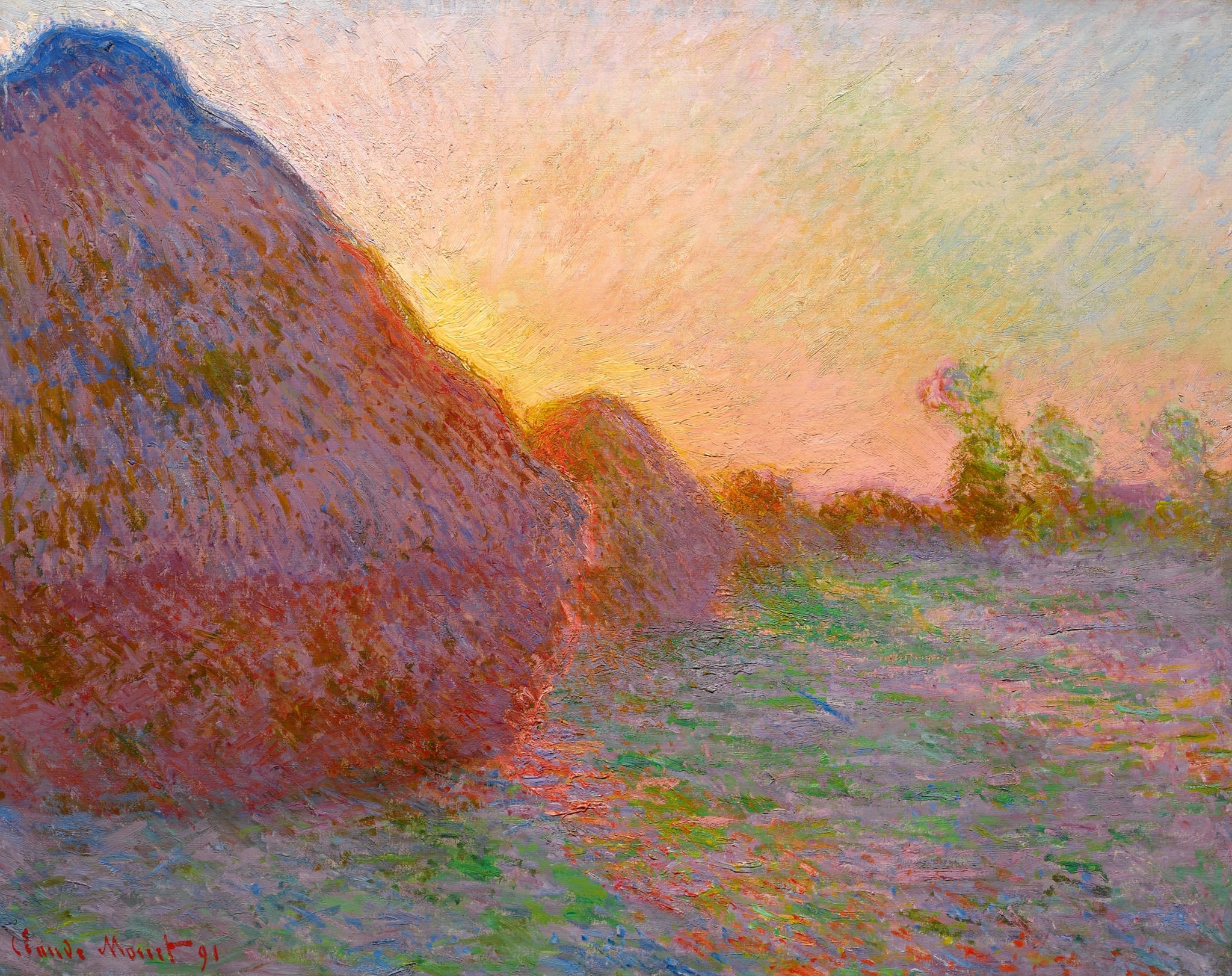
Claude Monet’s <strong>Haystacks Series</strong> transforms a routine rural subject into an inquiry into <strong>light, time, and perception</strong>. In this sunset view, the stacks swell at the left while the sun burns through the gap, making the field shimmer with <strong>apricot, lilac, and blue</strong> vibrations.
Women in the Garden by Claude Monet

Women in the Garden

Claude Monet (1866–1867)

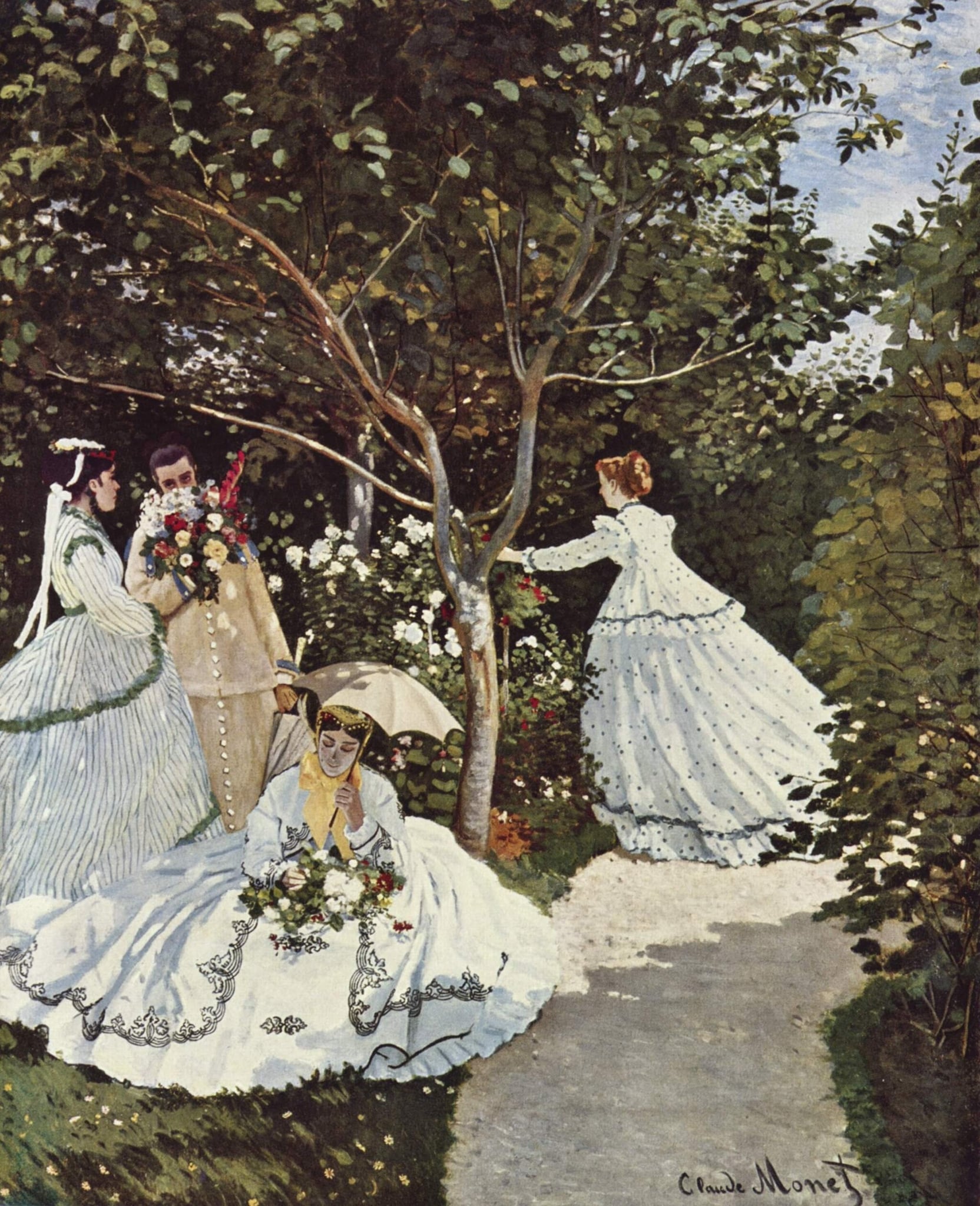
Claude Monet’s Women in the Garden choreographs four figures in a sunlit bower to test how <strong>white dresses</strong> register <strong>dappled light</strong> and shadow. The path, parasol, and clipped flowers frame a modern ritual of leisure while turning fashion into an instrument of <strong>perception</strong>. The scene reads less as portraiture than as a manifesto for painting the <strong>momentary</strong> outdoors <sup>[1]</sup><sup>[3]</sup>.
The Train in the Snow (The Locomotive) by Claude Monet

The Train in the Snow (The Locomotive)

Claude Monet (1875)

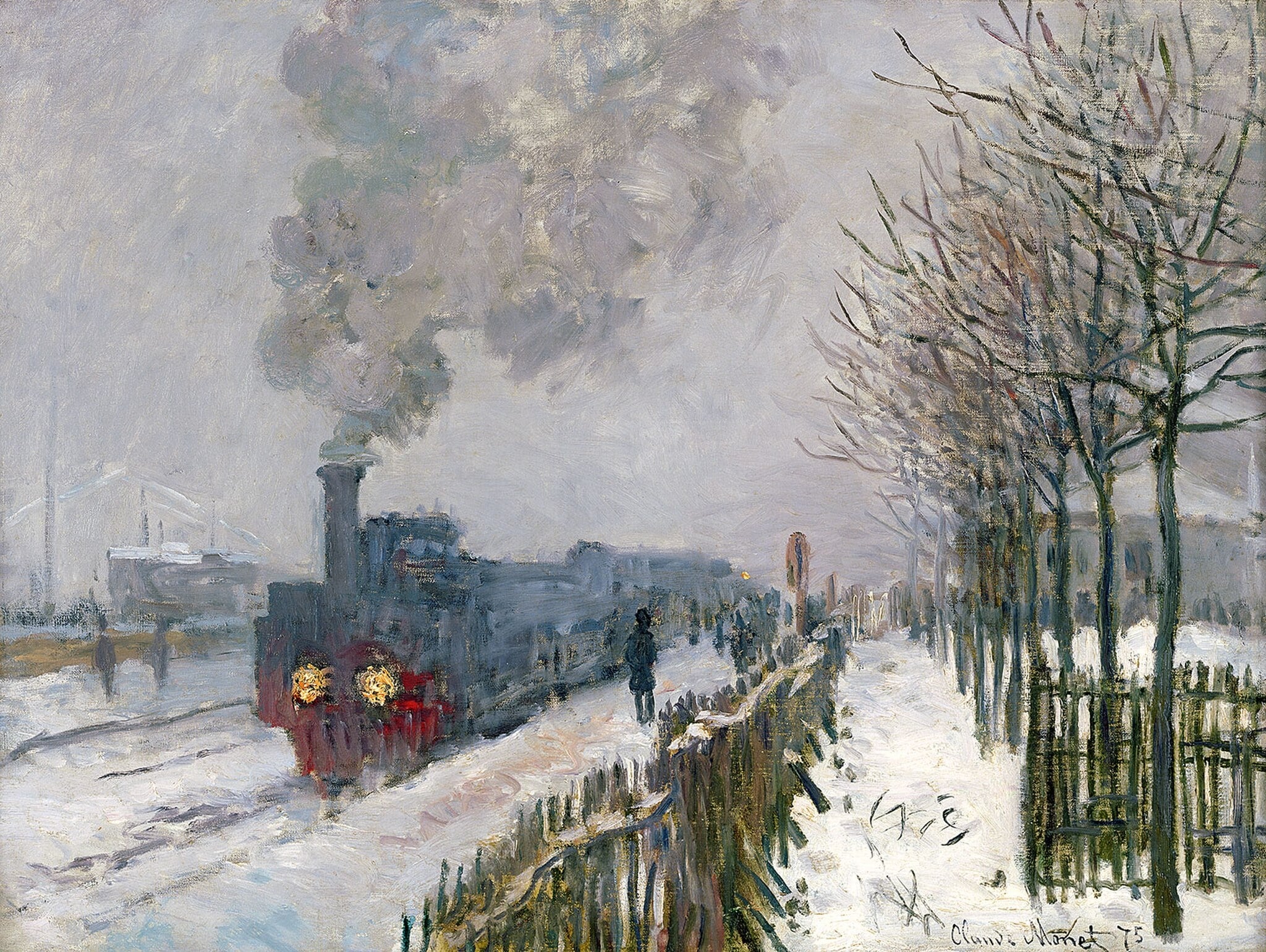
Claude Monet’s The Train in the Snow (The Locomotive) (1875) turns a suburban winter platform into a study of <strong>modernity absorbed by atmosphere</strong>. The engine’s twin yellow headlights and a smear of red push through a world of greys and violets as steam fuses with the low sky, while the right-hand fence and bare trees drill depth and cadence into the scene <sup>[1]</sup><sup>[4]</sup>. Monet fixes not an object but a <strong>moment of perception</strong>, where industry seems to dematerialize into weather <sup>[1]</sup><sup>[2]</sup>.
The Artist's Garden at Giverny by Claude Monet

The Artist's Garden at Giverny

Claude Monet (1900)

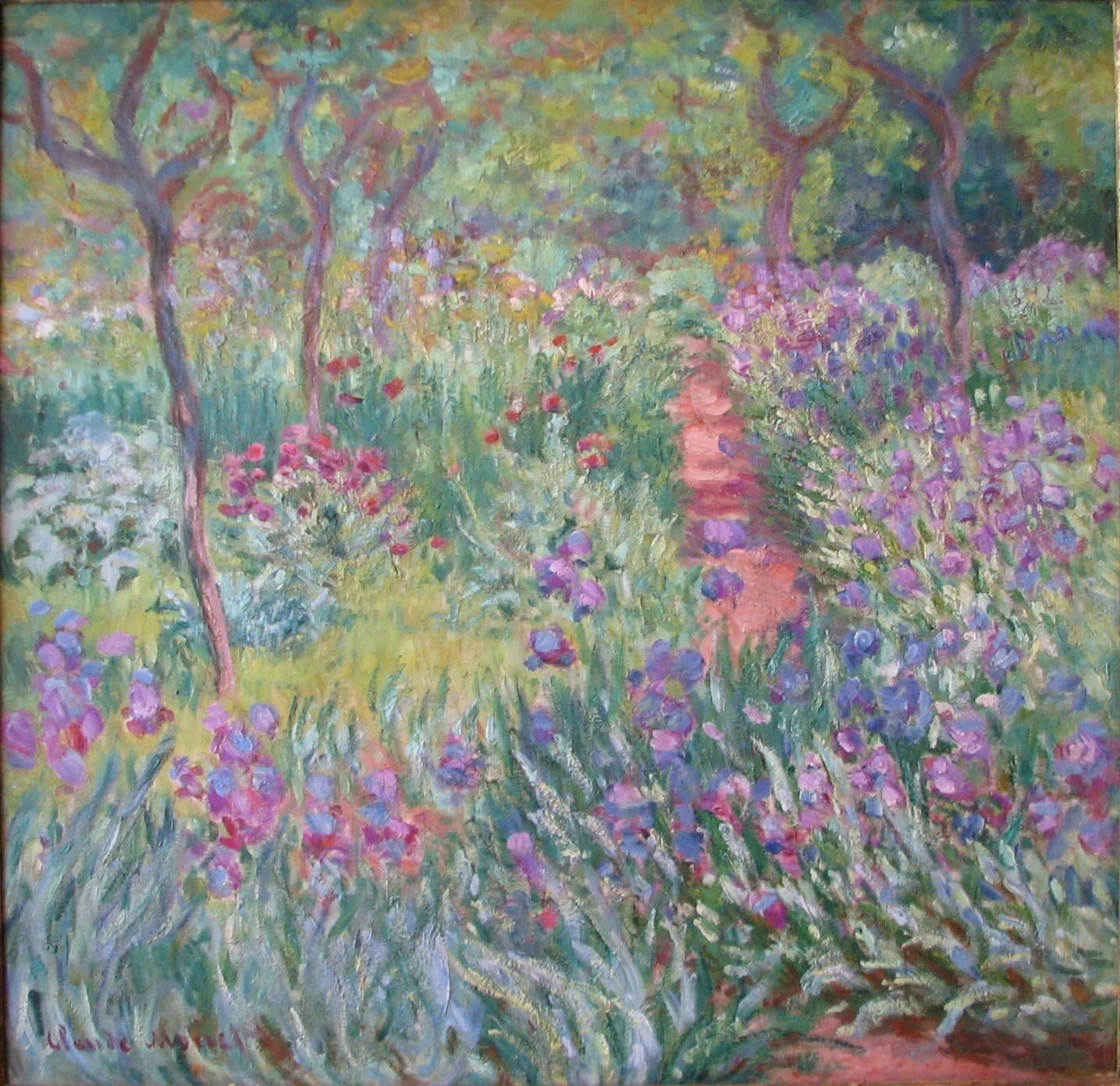
In The Artist's Garden at Giverny, Claude Monet turns his cultivated Clos Normand into a field of living color, where bands of violet <strong>irises</strong> surge toward a narrow, rose‑colored path. Broken, flickering strokes let greens, purples, and pinks mix optically so that light seems to tremble across the scene, while lilac‑toned tree trunks rhythmically guide the gaze inward <sup>[1]</sup><sup>[3]</sup>.