The Palazzo Ducale, Seen from San Giorgio Maggiore

by Claude Monet

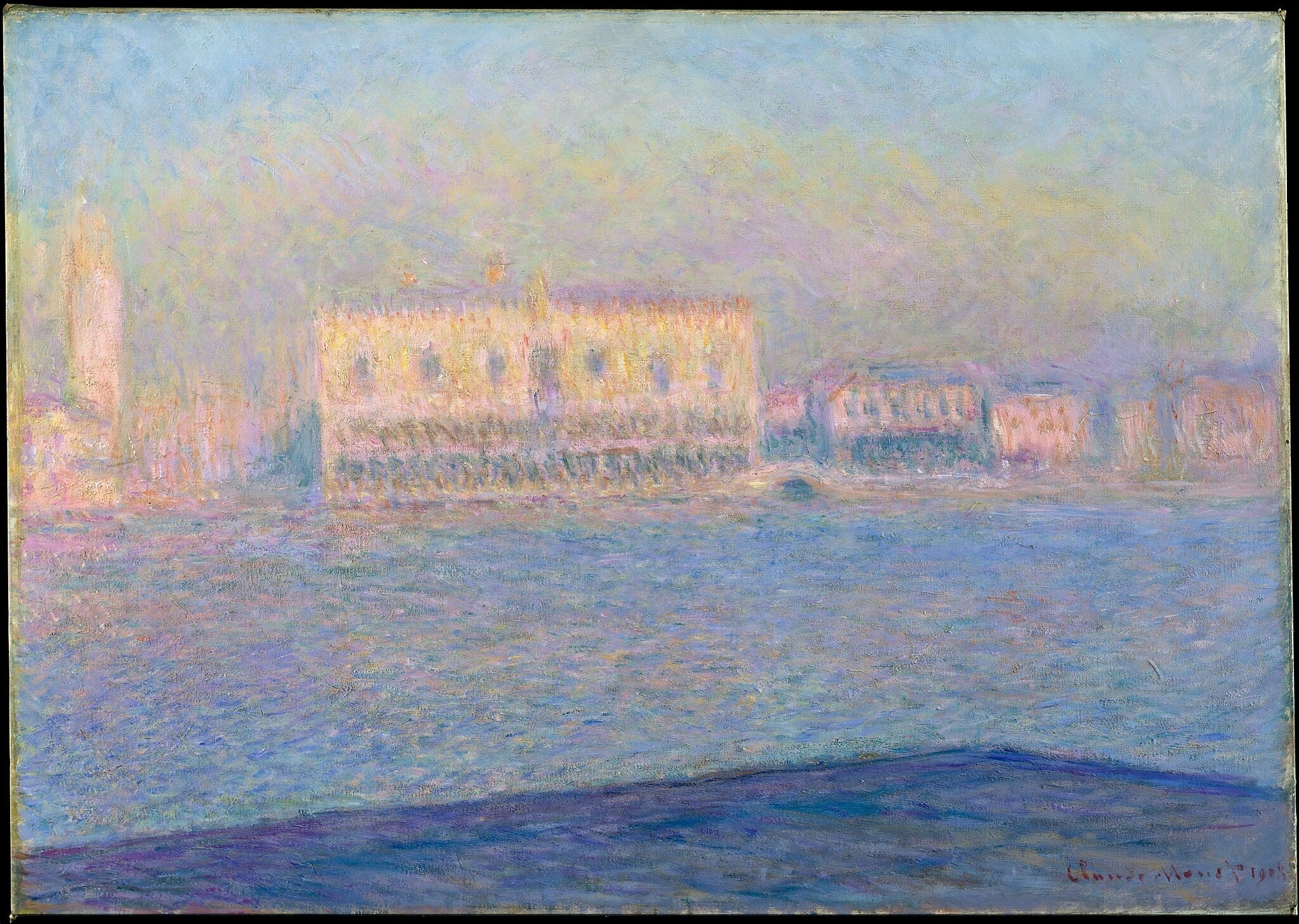
In The Palazzo Ducale, Seen from San Giorgio Maggiore, Claude Monet turns Venice into a theater of light and time. The Doge’s Palace glows as a pale, honeyed rectangle while the lagoon’s rippling violets and blues swallow stone into shimmer. A dark triangular quay in the foreground steadies the eye, making the city seem to hover above water.

Study Print Studio

Create a personal study print

Build a companion study sheet around the part of this painting that speaks to you most. Choose a detail, shape an interpretation, and walk away with something personal and display-worthy.

Fast Facts

Year
1908
Medium
Oil on canvas
Dimensions
65.4 × 100.6 cm
Location
Solomon R. Guggenheim Museum (Thannhauser Collection), New York
See all Claude Monet paintings in New York
The Palazzo Ducale, Seen from San Giorgio Maggiore by Claude Monet (1908) featuring Doge’s Palace (glowing façade), Campanile/bell tower, Lagoon’s rippling surface, Dark triangular quay

Click on any numbered symbol to learn more about its meaning

Meaning & Symbolism

Monet positions us across the Bacino di San Marco, where the lagoon fills most of the canvas, a field of striated blues, violets, and rose that seems to pulse up from the surface. Across this expanse, the Doge’s Palace sits like a pale, glowing tablet—its façade simplified to bands and small dark fenestrations, its crenellations kissed with warm strokes. To the left, the tall bell tower softens into an upright flame; to the right, smaller facades are submerged in a lavender‑green vapor. The architectonics are legible but secondary; the optical event—the vibration of reflected sky in water, the pink‑lemon corona around edges, the light pooling at the palace’s base—dominates. Monet’s broken facture converts reflection into substance, so that the lagoon reads less as a mirror than as the city’s generative medium. The low, dark, triangular quay in the foreground quietly asserts material ground and, by contrast, makes the monumental waterfront appear to float. That compositional tension—anchored wedge versus hovering mass—dramatizes the painting’s thesis: Venice persists, but only as a configuration within moving air and water. This emphasis aligns with Monet’s late practice, in which the essential subject became light and time’s passage was staged through series of a single motif 4. Venice in 1908 offered him a ready architecture for such orchestration: a planar façade across a broad waterfield, perfect for testing hours and weathers. Letters from the trip stress the city’s “unique light,” and museum accounts record that he began each day with this view, then reworked the canvases in Giverny, distilling perception through memory before the acclaimed 1912 Bernheim‑Jeune show 1235. That process resonates in the image’s doubleness: it looks witnessed—note the sharp, cool band near the waterline, the flicks of orangey roofline—but also remembered, its details suspended in a harmonious mist. The Doge’s Palace, emblem of republican power, becomes an apparition of authority, its permanence redefined as a rhythm of color that can only be seen in a moment and painted across months or years 12. In this way, the picture reframes civic grandeur as a renewable event: history is not stone alone but a pact between monument, weather, and the beholder’s changing eye. Visually, Monet’s strategy is precise. He lowers contrast in the distance to collapse edges; he warms the palace with pale ochres and roses so it breathes against a cooler, bluish surround; he thickens the pigment where light concentrates, particularly along the façade’s middle band, so the surface itself shimmers. The lagoon bears lateral strokes that braid cool blue with lilac and intermittent pink—minute time‑signs of wind and wake, not transcribed literally but constructed to feel inevitable. The dark wedge at the bottom is not merely a quay; it is a metronome for the eye, a planar counterpoint that calibrates the immensity of water and the evanescence of skyline. Through these choices Monet asserts that what endures in Venice is not masonry but sensation structured by looking. That is why the palace can both appear and recede, why the campanile can be a column of light rather than brick, and why the picture holds together: its architecture is optical law, not linear detail. In sum, the canvas is a meditation on transience and resilience—the city endlessly changing in hue, endlessly the same in form—renewed moment by moment by the play of color across the lagoon 124.

Explore Deeper with AI

Ask questions about The Palazzo Ducale, Seen from San Giorgio Maggiore

Popular questions:

Powered by AI • Get instant insights about this artwork

💬 Ask questions about this artwork!

Interpretations

Historical Context: Venice 1908 to Paris 1912

Monet’s sole Venetian campaign (Oct–Dec 1908) produced a cluster of canvases he worked on site but withheld from the market, refining them over several years in Giverny before unveiling twenty‑nine at Bernheim‑Jeune in 1912. This delay reflects a late‑career insistence on serial coherence and finish, not plein‑air spontaneity. Letters from December 1908 praise Venice’s “unique light,” signaling why the Palazzo Ducale from San Giorgio—flat façade over a broad waterfield—became his morning anchor motif. Installed in Paris as a calibrated suite, the pictures announced a modern grammar of urban vision: architecture parsed through atmosphere and memory rather than topographic detail 1346.

Source: The Metropolitan Museum of Art; Bernheim‑Jeune DoME database; MoMA catalogue; Art Institute of Chicago (Monet letters)

Symbolic Reading: Authority as Appearance

The Doge’s Palace—traditional emblem of civic power—is rendered as a luminous tablet that hovers and dissolves, converting sovereignty into an event of light. This dematerialization is not decorative but ideological: political permanence is redescribed as contingent, co‑produced by weather and beholder. Such a reading aligns with late Monet’s broader move to make light the essential subject; the palace’s legibility persists, yet its authority flickers within color and haze. In this optic, Venice’s republican grandeur is a renewable event, apprehended in moments but sustained by repetition across the series—a rhythm rather than a stone fact 145.

Source: The Metropolitan Museum of Art; MoMA; Douglas Cooper (Metropolitan Museum Journal)

Formal Analysis: Constructed Optics, Not Transcription

Monet engineers the image through calibrated contrasts—warming the palace with pale ochres and rose against a cooler basin, compressing distant value ranges to collapse edges, and thickening pigment at illuminated bands to make the surface itself shimmer. The lagoon’s lateral strokes braid lilac, blue, and pink as small temporal signs of wind and wake, yet these are constructed to feel inevitable, not copied. The result privileges “optical law” over linear detail: forms cohere as effects of adjacency and vibration. The low dark wedge functions as a planar counterpoint, a measured accent that metrically anchors the otherwise hovering waterfront 15.

Source: The Metropolitan Museum of Art; Douglas Cooper (Metropolitan Museum Journal)

Memory-Work and Serial Method

Though initiated en plein air, the Venice canvases were resolved from memory in Giverny, sharpening harmonies and suppressing anecdote. This split temporality—on‑site sensation, studio distillation—produces images that look witnessed yet remembered, their specifics suspended in atmospheric accord. As with Rouen and London, Monet’s serialism stages time: multiple canvases of a fixed motif plot shifts in hour and weather as variations in chroma and facture. The Palazzo Ducale vantage, begun each day, became a laboratory for temporal comparison, yielding pictures that are less about place‑portrait than about how vision stores, edits, and replays light 14.

Source: MoMA (catalogue discussion of late city series); The Metropolitan Museum of Art

Display and Reception: The Suite as Argument

The 1912 Bernheim‑Jeune exhibition mattered not just for acclaim but for its serial hanging, which taught viewers to read differences of hour, weather, and chromatic key as the work’s true content. The Palazzo Ducale canvases conversed across the room, the suite operating like a comparative instrument where each picture calibrated the next. This curatorial logic reframed urban painting as an epistemology of perception: not a single definitive view, but a set of contingent iterations proving that form is conditioned by light. Contemporary accounts and later scholarship treat this show as a capstone in Monet’s serial practice and its public legibility 34.

Source: Bernheim‑Jeune DoME database; MoMA

Modern Spectatorship: Distance, Speed, and the Basin

Seen from San Giorgio, the palace is flattened into a stage‑frontal plane while the basin expands into a field of micro‑events—ripples, wakes, refracted clouds—analogous to the quickened temporality of modern urban life. Monet’s broken facture and lowered contrast translate speed and atmospheric drift into retinal vibration. The distant, across‑the‑water vantage enforces a mode of spectatorship in which architecture is apprehended as a moving envelope of air and light, not as masonry. Scholars situate this within late Monet’s evolution toward inventive construction, where perception is orchestrated rather than merely recorded 15.

Source: The Metropolitan Museum of Art; Douglas Cooper (Metropolitan Museum Journal)

Related Themes

About Claude Monet

Claude Monet (1840–1926) led Impressionism’s pursuit of open-air painting and optical immediacy, especially during his Argenteuil years focused on modern leisure and light. He later developed serial studies of changing conditions, culminating in the Water Lilies cycle [2].
View all works by Claude Monet

More by Claude Monet

Boating by Claude Monet

Boating

Claude Monet (1887)

Monet’s Boating crystallizes modern leisure as a drama of perception, setting a slim skiff and two pale dresses against a field of dark, mobile water. Bold cropping, a thrusting oar, and the complementary flash of hull and foliage convert a quiet outing into an experiment in <strong>modern vision</strong> and the <strong>materiality of water</strong> <sup>[1]</sup><sup>[2]</sup>.

The Thames below Westminster by Claude Monet

The Thames below Westminster

Claude Monet (about 1871)

Claude Monet’s The Thames below Westminster turns London into <strong>light-made architecture</strong>, where Parliament’s mass dissolves into mist and the river shivers with <strong>industrial motion</strong>. Tugboats, a timber jetty with workers, and the rebuilt Westminster Bridge assert a modern city whose power is felt through atmosphere more than outline <sup>[1]</sup>.

Haystacks Series by Claude Monet | Light, Time & Atmosphere by Claude Monet

Haystacks Series by Claude Monet | Light, Time & Atmosphere

Claude Monet

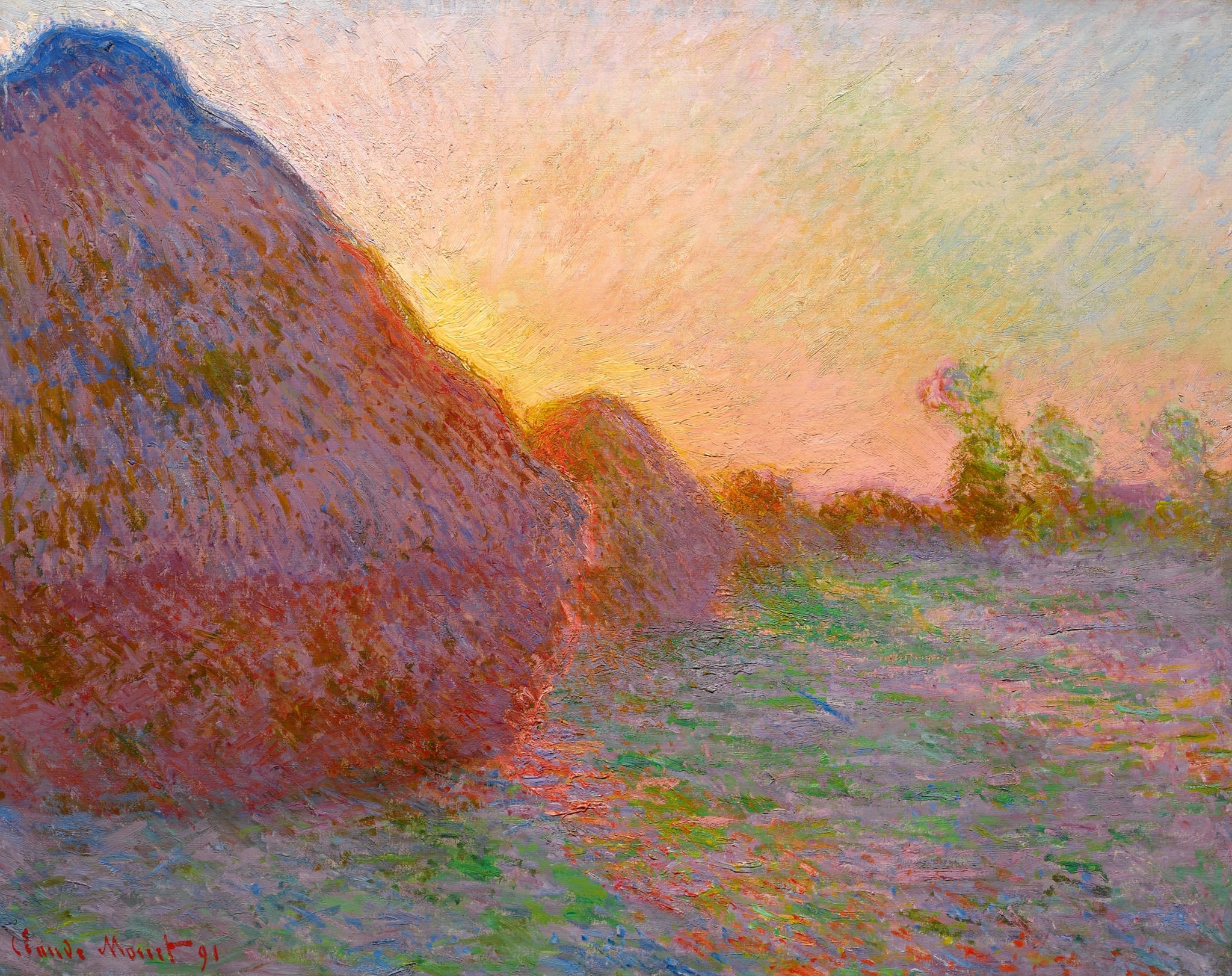
Claude Monet’s <strong>Haystacks Series</strong> transforms a routine rural subject into an inquiry into <strong>light, time, and perception</strong>. In this sunset view, the stacks swell at the left while the sun burns through the gap, making the field shimmer with <strong>apricot, lilac, and blue</strong> vibrations.
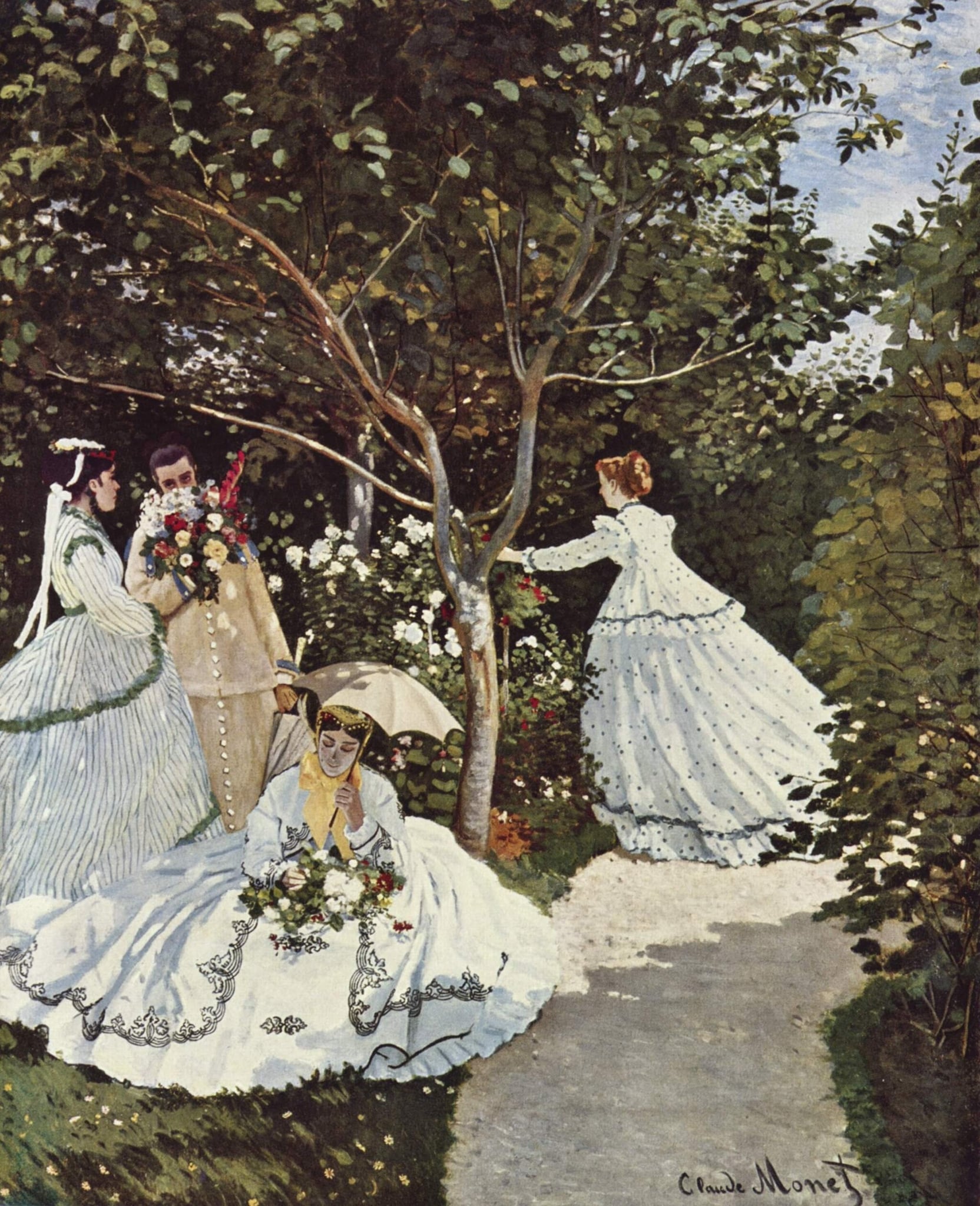
Women in the Garden by Claude Monet

Women in the Garden

Claude Monet (1866–1867)

Claude Monet’s Women in the Garden choreographs four figures in a sunlit bower to test how <strong>white dresses</strong> register <strong>dappled light</strong> and shadow. The path, parasol, and clipped flowers frame a modern ritual of leisure while turning fashion into an instrument of <strong>perception</strong>. The scene reads less as portraiture than as a manifesto for painting the <strong>momentary</strong> outdoors <sup>[1]</sup><sup>[3]</sup>.
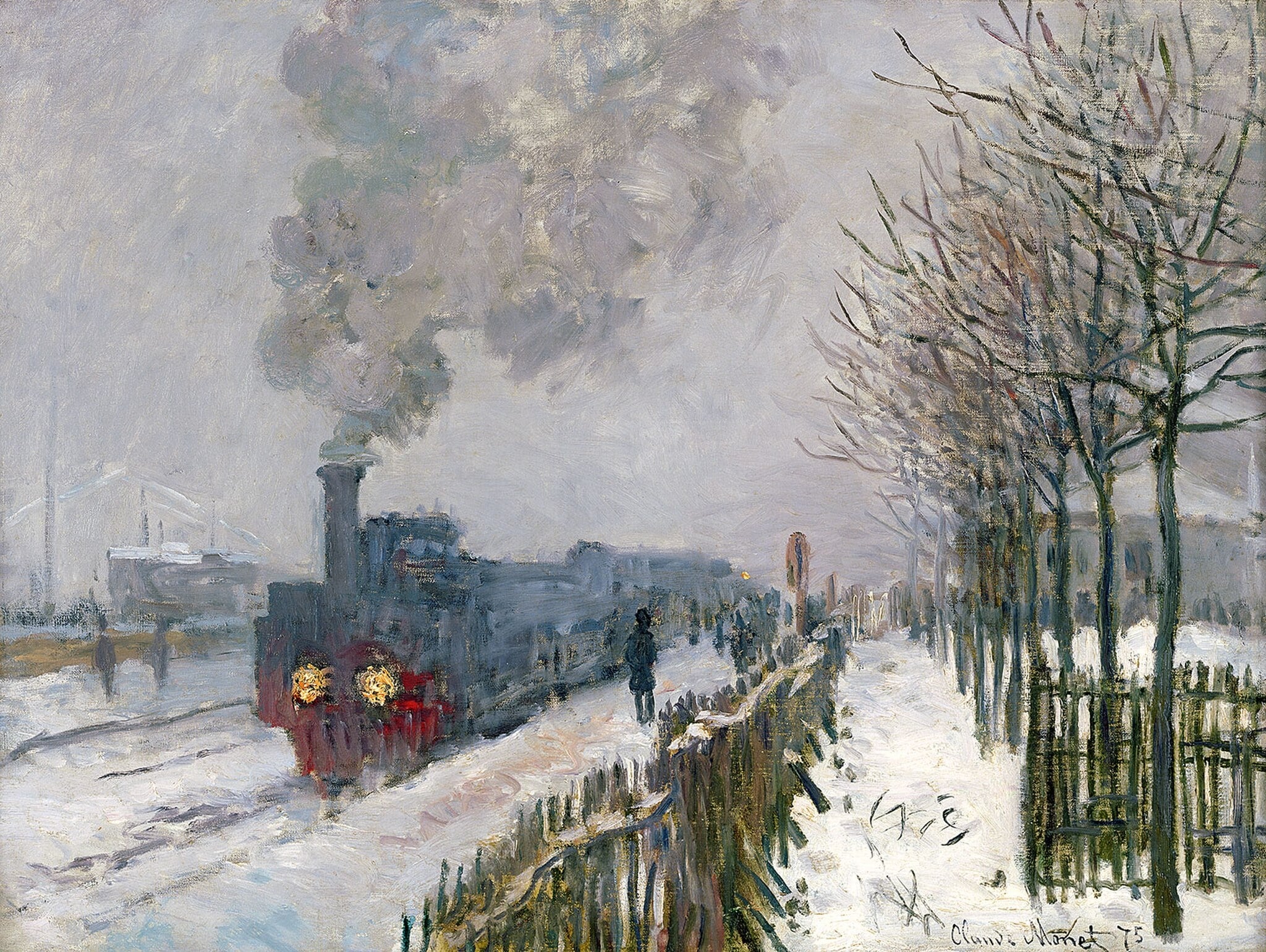
The Train in the Snow (The Locomotive) by Claude Monet

The Train in the Snow (The Locomotive)

Claude Monet (1875)

Claude Monet’s The Train in the Snow (The Locomotive) (1875) turns a suburban winter platform into a study of <strong>modernity absorbed by atmosphere</strong>. The engine’s twin yellow headlights and a smear of red push through a world of greys and violets as steam fuses with the low sky, while the right-hand fence and bare trees drill depth and cadence into the scene <sup>[1]</sup><sup>[4]</sup>. Monet fixes not an object but a <strong>moment of perception</strong>, where industry seems to dematerialize into weather <sup>[1]</sup><sup>[2]</sup>.
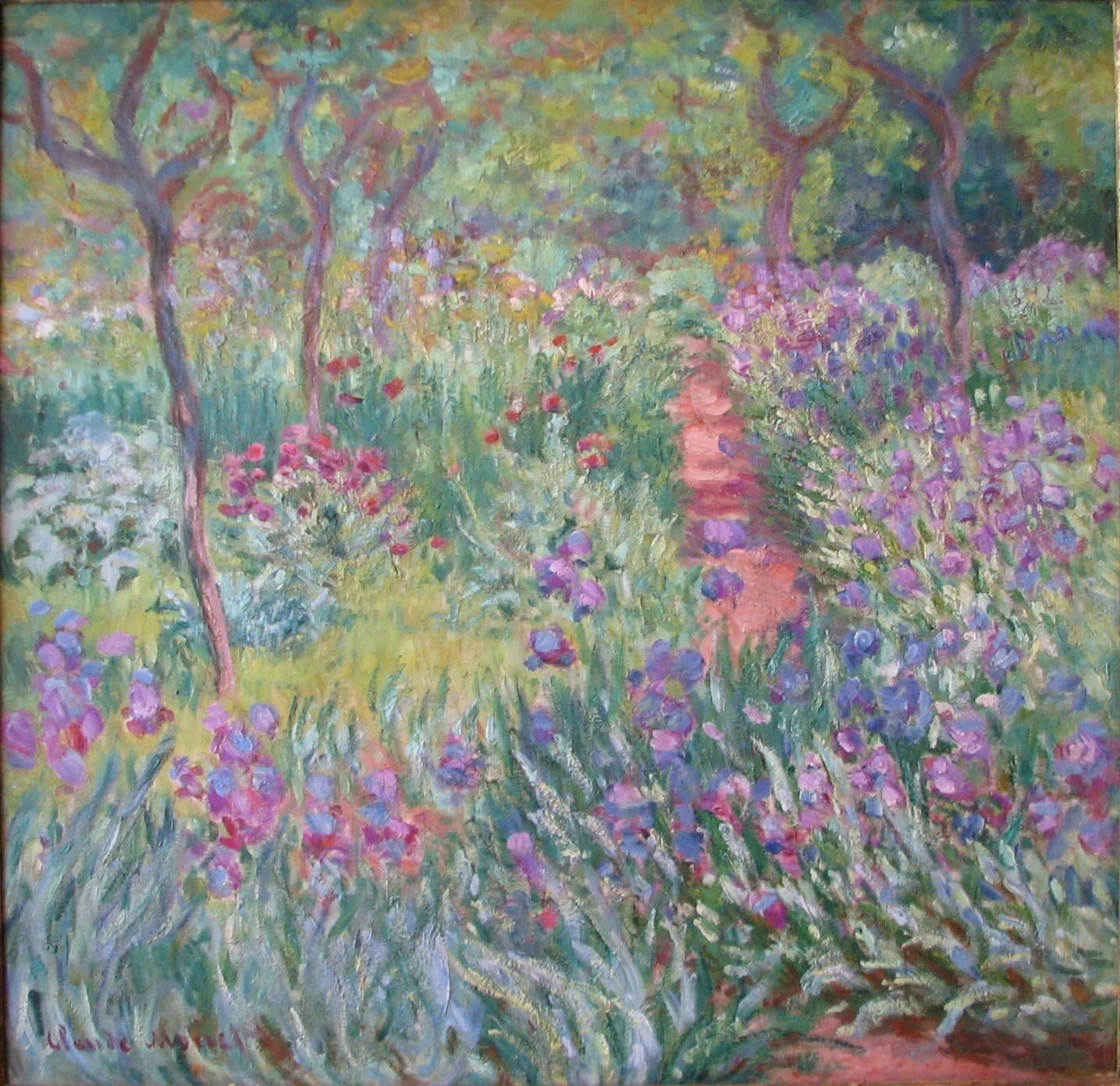
The Artist's Garden at Giverny by Claude Monet

The Artist's Garden at Giverny

Claude Monet (1900)

In The Artist's Garden at Giverny, Claude Monet turns his cultivated Clos Normand into a field of living color, where bands of violet <strong>irises</strong> surge toward a narrow, rose‑colored path. Broken, flickering strokes let greens, purples, and pinks mix optically so that light seems to tremble across the scene, while lilac‑toned tree trunks rhythmically guide the gaze inward <sup>[1]</sup><sup>[3]</sup>.