The Valley of the Nervia

by Claude Monet

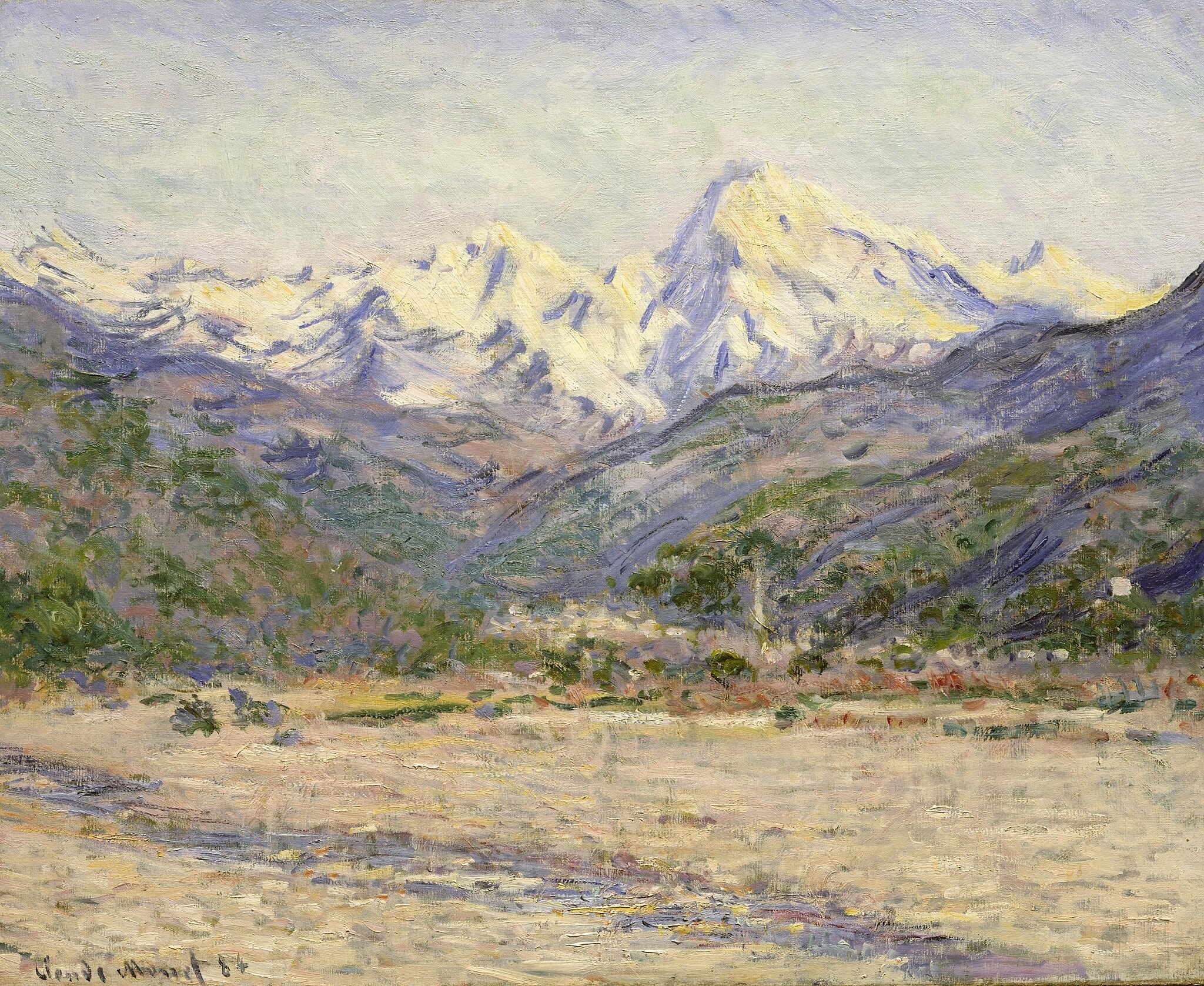
Claude Monet’s The Valley of the Nervia is a high‑key meditation on atmosphere as structure: snow‑lit Maritime Alps rise above a pale, stony riverbed, their mass defined by air and light rather than contour. Through quick, broken strokes of violet, blue, and lemon, Monet fuses fleeting afternoon shimmer with the valley’s geologic permanence [1][2].

Fast Facts

Year
1884
Medium
Oil on canvas
Dimensions
66 × 81.3 cm
Location
The Metropolitan Museum of Art, New York
See all Claude Monet paintings in New York
The Valley of the Nervia by Claude Monet (1884) featuring Snow‑capped Maritime Alps, Dry Riverbed with Meltwater Streaks, Valley Vegetation, Distant Village Strip (Camporosso)

Click on any numbered symbol to learn more about its meaning

Meaning & Symbolism

Monet composes the scene as a vertical ascent from matter to light. The widest band—the foreground riverbed of the Nervia—is rendered as a hushed expanse of beige and pearl with thin lavender streaks, reading as scant meltwater moving across dry stone; this near‑emptiness slows the eye, staging a long inhale before the middle distance gathers form. There, small, tufted greens and cool violets knot into the valley’s flanks, while a faint, low strip of ochres and greys suggests the tucked‑in buildings of Camporosso, deliberately reduced to scale to keep human presence subordinate to process. Above, the Maritime Alps flare into lemon‑tinged whites that catch the late‑winter sun, their planes not outlined but breathed into being by temperature shifts—violet shadows, pale blues, and creamy highlights that turn air into structure 1. The effect is not topographic description but an argument: permanence (rock) is legible only through transience (light). That argument emerged from Monet’s Riviera sojourn of early 1884, when he confessed to working through “experiments” prompted by the region’s brilliant clarity and difficult vegetation. The high‑key palette here—cool violets, crystalline blues, and the citrine glints on snow—answers that challenge, extending his chromatic range beyond the damp greys of the north. The brushwork is clipped and cumulative: short, scumbled notes knit into chromatic chords that register distance as atmospheric thinning rather than linear recession, a hallmark of Impressionist seeing intensified by Mediterranean light 2. In this respect, The Valley of the Nervia operates like a proto‑serial inquiry. It belongs to a cluster of inland motifs Monet pursued alongside coastal gardens and Dolceacqua views, each testing how the same geology reads under shifting hours and weathers; the Nervia canvas fixes one such interval with analytic clarity while implying the series it could join 24. Formally, Monet treats the composition as a temporal gradient. The low, nearly monochrome foreground reads as the present—quiet, provisional, almost blank—while the middle band, braided with greens and violets, signals seasonal change as melt descends toward the plain. The radiant summit is the canvas’s temporal horizon: winter persisting and dissolving at once, clarified by sun that both reveals and erodes. By suppressing anecdote—no travelers in the bed, no heroic framing trees—Monet rejects picturesque storytelling in favor of a phenomenological drama: light sorting matter, season modulating color, attention calibrating seeing. This modern “nature without narrative” stakes a claim for landscape as an autonomous field of knowledge, not a backdrop for human action 12. In short, the meaning of The Valley of the Nervia is the transformation of place into a study of time; its importance is the way it consolidates Monet’s Mediterranean breakthroughs—air as architecture, color as measure—paving the path to his later, methodical cycles of changing light 23.

Explore Deeper with AI

Ask questions about The Valley of the Nervia

Popular questions:

Powered by AI • Get instant insights about this artwork

💬 Ask questions about this artwork!

Interpretations

Historical Context

In early 1884 Monet based himself in Bordighera, working at a torrid pace and describing the Riviera as a place of “experiments” under a “fantastic light.” The Valley of the Nervia belongs to this inland foray, away from gardens and coast, where he tested how southern clarity and unfamiliar vegetation altered his habitual Northern palette. Letters cited by scholars describe the need for a “palette of diamonds and jewels,” a telling phrase for the canvas’s high‑key violets, crystalline blues, and citrine snow. The work thus functions as a field note from Monet’s first Mediterranean campaign—an encounter that expanded his chromatic range, recalibrated his handling of distance, and seeded the serial logic he would soon formalize in the 1890s 2.

Source: Art Institute of Chicago

Technical Analysis

Monet constructs the image through broken, cumulative touch: short, scumbled strokes knit into chromatic chords that render mass via atmospheric temperature rather than contour. Technical studies of contemporaneous Bordighera canvases show a method of initial lay‑in, then dry‑over‑wet adjustments to tune local color and aerial perspective—procedures consistent with the Nervia surface’s clipped, layered notes. The Met underscores his reliance on “light, bright tones” for snow and high air; here, cool violets articulate shadow planes while creamy, lemon‑tinged whites catch reflective glare, turning “air into structure.” The result is a disciplined optical mechanism, where the eye reads distance through thinning pigment and cooled hues, not linear recession 12.

Source: Metropolitan Museum of Art; Art Institute of Chicago

Serial Methodology

Although not part of a titled series, The Valley of the Nervia participates in Monet’s emergent comparative logic: returning to allied motifs (Nervia valley, Dolceacqua) under varied hours and weathers to test the readability of enduring forms in changing light. Exhibition scholarship frames the 1884 campaign as a turning point toward systematic seriality later seen in haystacks and cathedrals. Placed against related Nervia subjects—e.g., the Dolceacqua views—the canvas reads like one plate in an unwritten suite: geology held constant while atmospheric variables are tuned. This serial impulse is methodological, not anecdotal; it treats landscape as a repeatable experiment rather than a singular vista 234.

Source: Joachim Pissarro; Art Institute of Chicago; National Gallery (London)

Environmental Interpretation

The near‑empty riverbed of the Nervia registers hydrologic timing: late‑winter snow retained aloft, scant meltwater threading a stony floor below. Monet’s banded composition—quiet foreground, greening mid‑valley, radiant peaks—functions like a vertical climate section, mapping gradients of temperature and moisture. Human settlement is minimized to a thin, ochre strip (Camporosso), making seasonal process the protagonist. This reading aligns with the Met’s identification of snowy Maritime Alps and inland vantage, situating the canvas at the hinge of thaw. Monet’s “experiments” in this campaign thus include testing how Mediterranean air and seasonal flux can be made legible by color temperature alone, without recourse to narrative cues 12.

Source: Metropolitan Museum of Art; Art Institute of Chicago

Reception and Artistic Positioning

Scholars note that Monet shipped many Riviera canvases to Paris even before returning, with dealers like Durand‑Ruel championing the new Mediterranean pictures. The Nervia works, by extending Monet’s chromatic bandwidth beyond “damp greys,” contributed to a reception that recognized the Riviera campaign as a breakthrough in palette and light management. Tucker’s synthesis stresses the output’s volume and ambition—roughly a painting every two days—signaling not touristic views but a programmatic exploration. In this frame, The Valley of the Nervia exemplifies how Monet positioned himself: advancing Impressionist optics into unfamiliar climates to refresh both market and method, prefiguring the disciplined cycles of the 1890s 2.

Source: Art Institute of Chicago (via Paul Hayes Tucker)

Related Themes

About Claude Monet

Claude Monet (1840–1926) led Impressionism’s pursuit of open-air painting and optical immediacy, especially during his Argenteuil years focused on modern leisure and light. He later developed serial studies of changing conditions, culminating in the Water Lilies cycle [2].
View all works by Claude Monet

More by Claude Monet

Boating by Claude Monet

Boating

Claude Monet (1887)

Monet’s Boating crystallizes modern leisure as a drama of perception, setting a slim skiff and two pale dresses against a field of dark, mobile water. Bold cropping, a thrusting oar, and the complementary flash of hull and foliage convert a quiet outing into an experiment in <strong>modern vision</strong> and the <strong>materiality of water</strong> <sup>[1]</sup><sup>[2]</sup>.

The Thames below Westminster by Claude Monet

The Thames below Westminster

Claude Monet (about 1871)

Claude Monet’s The Thames below Westminster turns London into <strong>light-made architecture</strong>, where Parliament’s mass dissolves into mist and the river shivers with <strong>industrial motion</strong>. Tugboats, a timber jetty with workers, and the rebuilt Westminster Bridge assert a modern city whose power is felt through atmosphere more than outline <sup>[1]</sup>.

Haystacks Series by Claude Monet | Light, Time & Atmosphere by Claude Monet

Haystacks Series by Claude Monet | Light, Time & Atmosphere

Claude Monet

Claude Monet’s <strong>Haystacks Series</strong> transforms a routine rural subject into an inquiry into <strong>light, time, and perception</strong>. In this sunset view, the stacks swell at the left while the sun burns through the gap, making the field shimmer with <strong>apricot, lilac, and blue</strong> vibrations.
Women in the Garden by Claude Monet

Women in the Garden

Claude Monet (1866–1867)

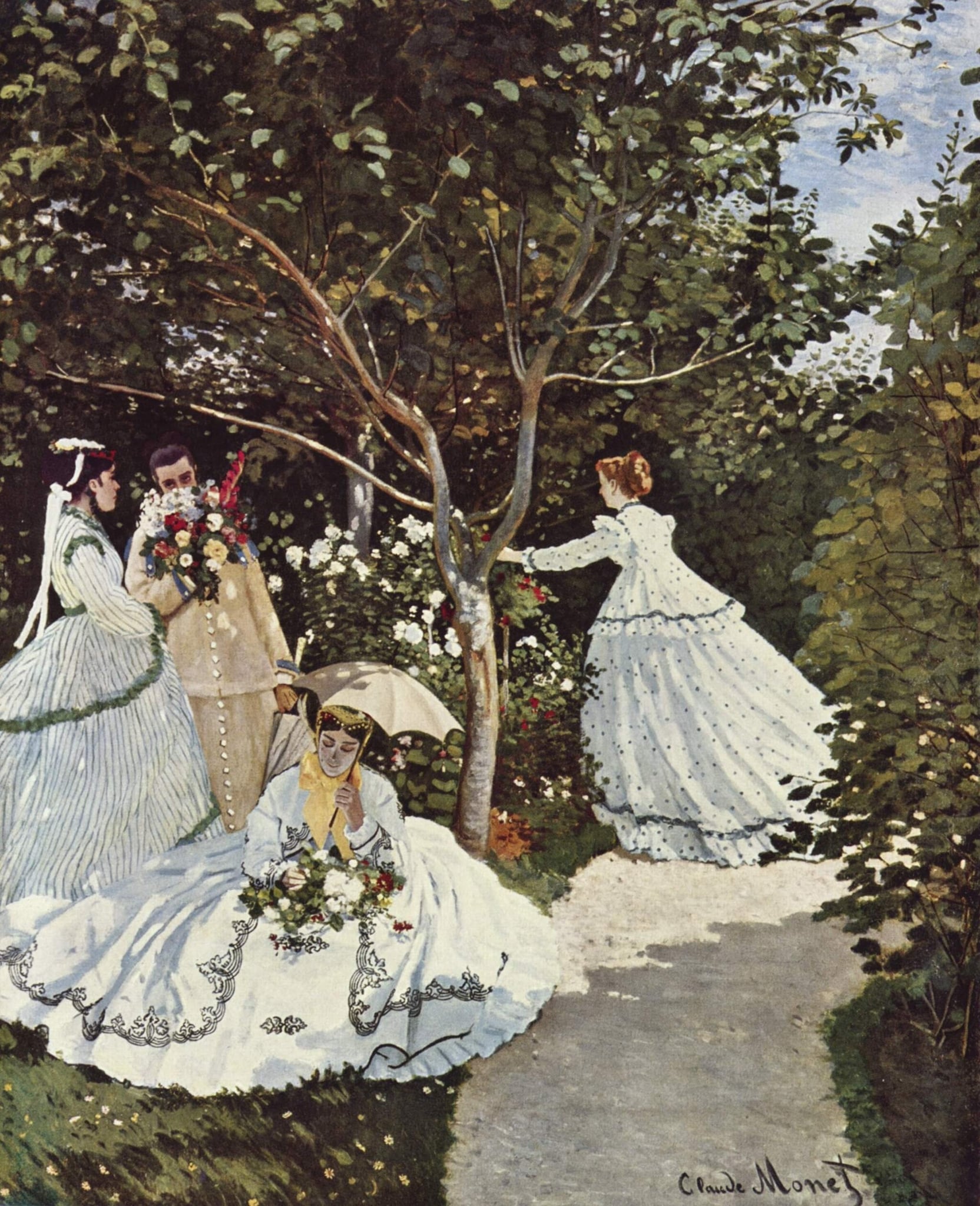
Claude Monet’s Women in the Garden choreographs four figures in a sunlit bower to test how <strong>white dresses</strong> register <strong>dappled light</strong> and shadow. The path, parasol, and clipped flowers frame a modern ritual of leisure while turning fashion into an instrument of <strong>perception</strong>. The scene reads less as portraiture than as a manifesto for painting the <strong>momentary</strong> outdoors <sup>[1]</sup><sup>[3]</sup>.
The Train in the Snow (The Locomotive) by Claude Monet

The Train in the Snow (The Locomotive)

Claude Monet (1875)

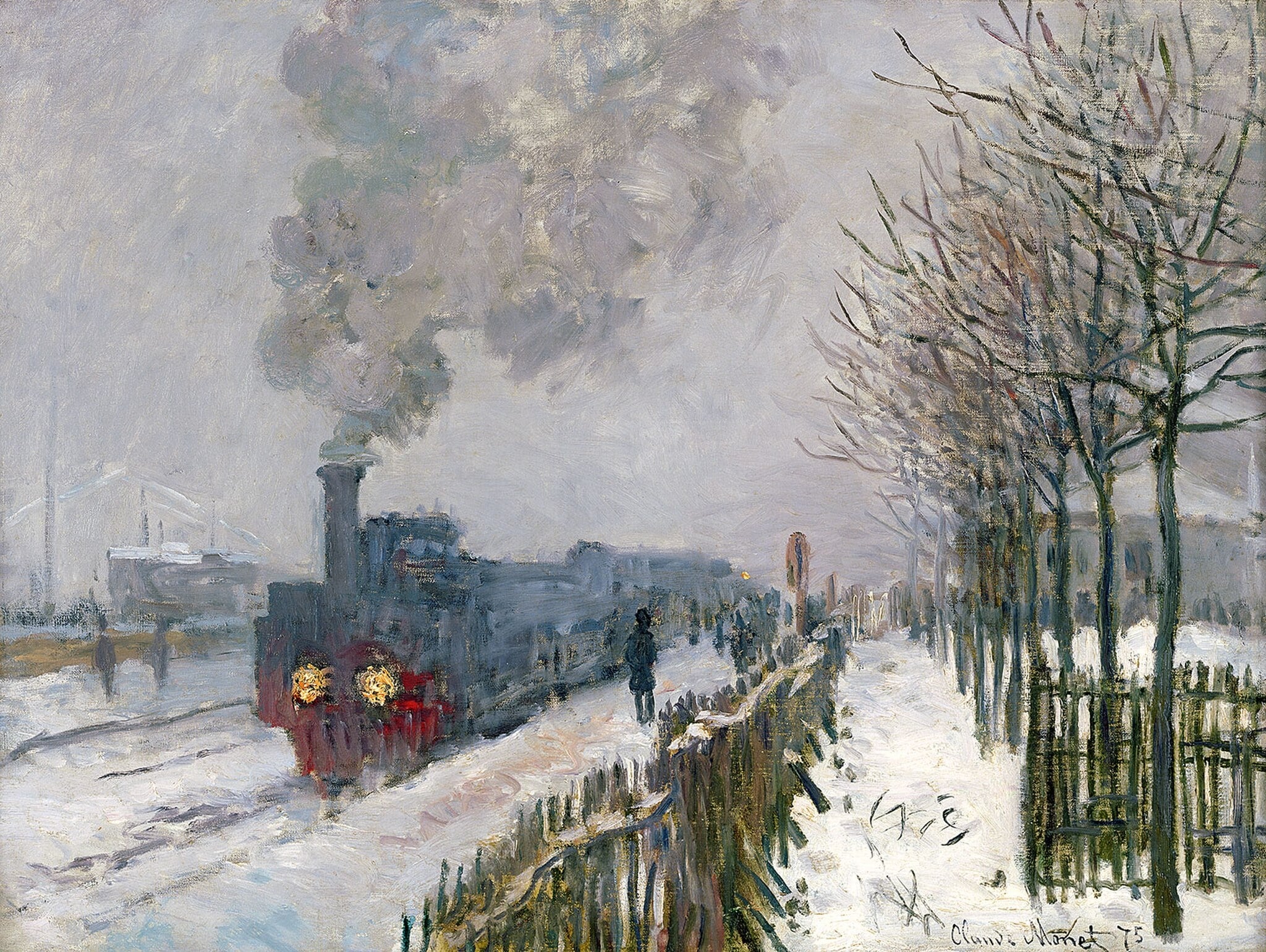
Claude Monet’s The Train in the Snow (The Locomotive) (1875) turns a suburban winter platform into a study of <strong>modernity absorbed by atmosphere</strong>. The engine’s twin yellow headlights and a smear of red push through a world of greys and violets as steam fuses with the low sky, while the right-hand fence and bare trees drill depth and cadence into the scene <sup>[1]</sup><sup>[4]</sup>. Monet fixes not an object but a <strong>moment of perception</strong>, where industry seems to dematerialize into weather <sup>[1]</sup><sup>[2]</sup>.
The Artist's Garden at Giverny by Claude Monet

The Artist's Garden at Giverny

Claude Monet (1900)

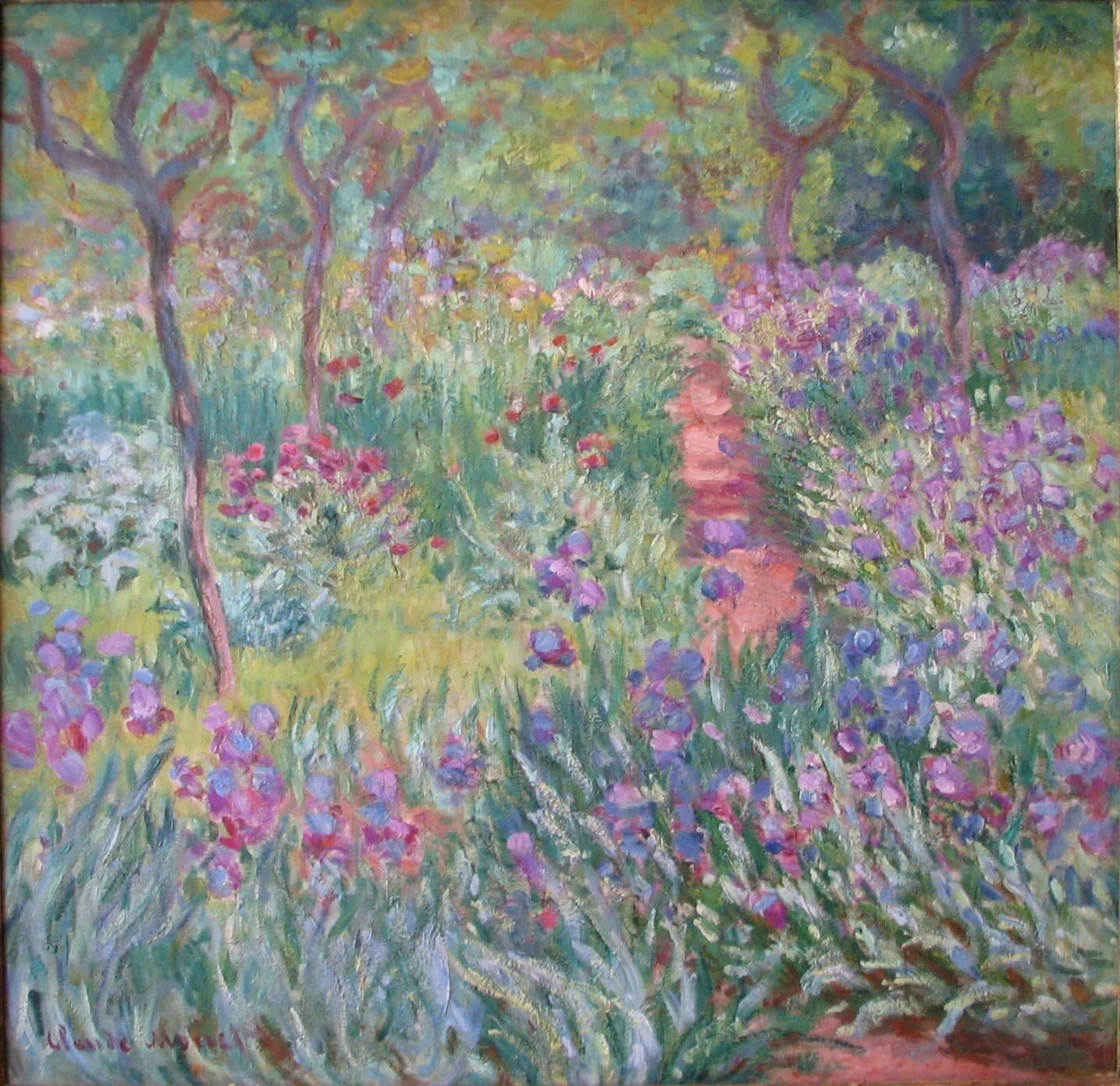
In The Artist's Garden at Giverny, Claude Monet turns his cultivated Clos Normand into a field of living color, where bands of violet <strong>irises</strong> surge toward a narrow, rose‑colored path. Broken, flickering strokes let greens, purples, and pinks mix optically so that light seems to tremble across the scene, while lilac‑toned tree trunks rhythmically guide the gaze inward <sup>[1]</sup><sup>[3]</sup>.