Water Lilies (triptych)

by Claude Monet

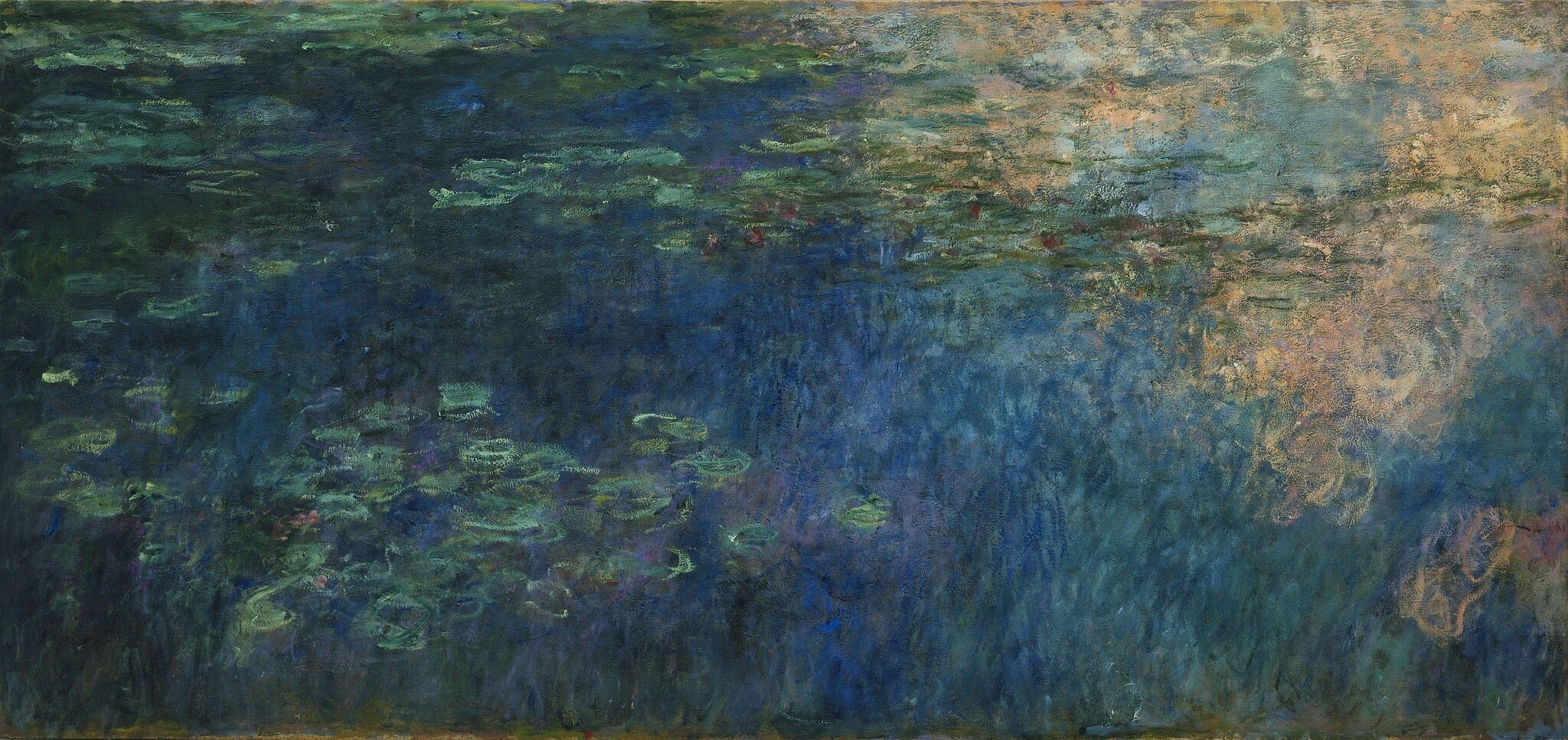
Water Lilies (triptych) dissolves banks and horizon into an immersive field of reflected sky and water. Across three mural‑scale panels, layered blues and greens are punctuated by floating pads while peach‑lavender light gathers at the right, turning the pond into a living mirror [1][3].

Fast Facts

Year
1914–1926
Medium
Oil on canvas
Dimensions
Each panel 200 × 424.8 cm; overall 200 × 1,276 cm
Location
The Museum of Modern Art, New York
See all Claude Monet paintings in New York
Water Lilies (triptych) by Claude Monet (1914–1926) featuring Lily pads, Peach–lavender reflection, Crimson blooms, Horizonless expanse

Click on any numbered symbol to learn more about its meaning

Meaning & Symbolism

Monet composes the triptych as a continuous, horizon‑less expanse so that the eye cannot rest on a conventional foreground or distance. In the image, the left and center panels are saturated with deep ultramarines and teals, a submerged tangle of vertical strokes that read as weeds and currents; the pads hover as small, circular flares of pale green, intentionally scarce, like visual punctuation rather than botanical description. On the right, a bloom of peach and lavender light drifts across the water, its scumbled, granular touch insisting that what we see is not sky or pond but the act of reflection itself. This structure asserts a proposition: nature here is not a view to be framed but an environment to be entered, where seeing is durational and unstable. The viewer’s movement across the three panels becomes part of the work’s grammar, stringing together passages of color like clauses in a sentence, so that meaning arises from pacing and attention rather than from depicted objects 13. Monet’s late project deliberately fuses sensory immersion with ethical aspiration. Conceived within the same program that yielded the Orangerie’s Grandes Décorations—offered as a post‑Armistice gift—this triptych operationalizes peace through absorption: the scale stills the body; the surface complexity quiets the mind; the absence of banks or horizon removes narrative distraction 23. In this light, the scattered pads and faint crimson blooms function as anchors amid flux, implying that serenity is not the negation of change but a way of dwelling within it. Monet’s varied handling—dragged, feathered, and stippled paint—records weather, season, even his own shifting sight, turning the canvas into a palimpsest of hours and years. Thus the painting declares that beauty persists because it is contingent and perishable, always remade by light and looking. The work’s importance also lies in how its procedures anticipate modernist abstraction. The all‑over spread, the near‑continuous skin of touch, and the decentered composition model strategies later claimed by large‑scale abstract painting. Yet the triptych refuses pure non‑reference: those cool pads and the warm right‑hand reflection tether the field to lived nature, keeping sensation accountable to the world. In short, the meaning of Water Lilies (triptych) is that perception is relational, time‑bound, and ethically laden; why Water Lilies (triptych) is important is that it pioneers an art of immersive attention that bridges Impressionism and the spatial ambitions of later modernism, inviting viewers to practice a form of looking that is at once contemplative and contemporary 14.

Explore Deeper with AI

Ask questions about Water Lilies (triptych)

Popular questions:

Powered by AI • Get instant insights about this artwork

💬 Ask questions about this artwork!

Interpretations

Reception & Modernist Genealogy

Far from a late pastoral, Monet’s triptych became a prototype for postwar abstraction. When MoMA acquired its Water Lilies in 1959, curators framed the work’s all‑over field, mural scale, and decentered composition as antecedents to Pollock and Newman, recoding Impressionism as a radical investigation of surface and immersion rather than plein‑air description. The triptych’s panoramic spread models “continuous touch” and dehierarchized composition, qualities that mid‑century critics would valorize as modernist. Its prominence at MoMA, intensified by the museum’s 1958 fire that destroyed other Monets, helped canonize late Monet as a bridge between 19th‑century optical study and 20th‑century spatial ambition—an art of sustained attention that reoriented how viewers inhabit large paintings 12.

Source: MoMA; Ann Temkin

Technical Layers & Revision as Meaning

Cleveland’s imaging of the Agapanthus left panel reveals suppressed agapanthus leaves beneath later repainting, showing Monet deliberately dissolving named flora into a more continuous aqueous field. This is not cosmetic editing but a conceptual pivot: he trades botanical legibility for a rhythmic matrix of strokes that prioritizes reflection, movement, and duration. The layered surface operates as pentimento—a visible memory of choices—so that the painting reads like a time‑based record rather than a single optical instant. By allowing underlayers to ghost through, Monet literalizes the idea of a pictorial palimpsest, making process inseparable from perception. The result corroborates the late Nymphéas as experiments in how pictures can hold both specificity and near‑abstraction at mural scale 4.

Source: Cleveland Museum of Art

Civic Memorial & Politics of Peace

The triptych’s ethos belongs to a broader program culminating in the Orangerie: an offering to the French state immediately after the Armistice. Rather than figural allegory, Monet proposes a politics of absorption—a horizonless, contemplative environment where viewers recalibrate after wartime rupture. Installed at mural scale, the lilies become a counter‑memorial that works through silence, duration, and sensory plenitude. This strategy responds to trauma not with narrative heroics but with attentive calm, aligning aesthetic immersion with civic healing. The historical record—Monet’s 1918 letter, the 1920 agreement, and the 1927 opening—anchors this reading, situating the triptych’s serenity within a deliberate national framework of reconciliation and reflection 36.

Source: Musée de l’Orangerie; National Gallery (London)

Phenomenology of Viewing

Monet composes for the moving spectator. The triptych’s lateral spread and lack of horizon deny a fixed viewpoint, requiring viewers to stitch chromatic passages through bodily pacing—an early instance of what later theory calls a durational field. Reflection replaces motif as the image’s engine; the eye oscillates between surface incident (strokes, scumbles) and optical depth (mirrored sky, weed tangles), producing ambiguous spatial registers that never fully resolve. This choreography turns looking into an event unfolding in time, aligning with museum accounts of the work’s immersive, environment‑like design. The painting thus functions less as a window than as a situation that trains attention—an ethics of perception grounded in patience and responsiveness to change 26.

Source: MoMA; National Gallery (London)

Aging Vision & Chromatic Strategy

Monet’s late panels are inseparable from his cataract‑altered sight and 1923 surgery. Medical histories note yellowed lenses desaturating blues and amplifying warmth; after surgery (and corrective lenses), blues return with force. Across the triptych, the push‑pull between turquoises/ultramarines and warm peach‑violets can be read as both environmental effect and perceptual recalibration. Rather than a deficit narrative, this is a productive constraint: shifts in chroma, touch, and edge acuity become vehicles to test how painting can register time in the body—weather outside and vision inside. Biography and ophthalmology clarify why the surface reads as variable and exploratory, strengthening interpretations that tie the work’s instability to lived perception 78.

Source: PBS NewsHour (ophthalmic scholarship); Encyclopaedia Britannica

Related Themes

About Claude Monet

Claude Monet (1840–1926) led Impressionism’s pursuit of open-air painting and optical immediacy, especially during his Argenteuil years focused on modern leisure and light. He later developed serial studies of changing conditions, culminating in the Water Lilies cycle [2].
View all works by Claude Monet

More by Claude Monet

Boating by Claude Monet

Boating

Claude Monet (1887)

Monet’s Boating crystallizes modern leisure as a drama of perception, setting a slim skiff and two pale dresses against a field of dark, mobile water. Bold cropping, a thrusting oar, and the complementary flash of hull and foliage convert a quiet outing into an experiment in <strong>modern vision</strong> and the <strong>materiality of water</strong> <sup>[1]</sup><sup>[2]</sup>.

The Thames below Westminster by Claude Monet

The Thames below Westminster

Claude Monet (about 1871)

Claude Monet’s The Thames below Westminster turns London into <strong>light-made architecture</strong>, where Parliament’s mass dissolves into mist and the river shivers with <strong>industrial motion</strong>. Tugboats, a timber jetty with workers, and the rebuilt Westminster Bridge assert a modern city whose power is felt through atmosphere more than outline <sup>[1]</sup>.

Haystacks Series by Claude Monet | Light, Time & Atmosphere by Claude Monet

Haystacks Series by Claude Monet | Light, Time & Atmosphere

Claude Monet

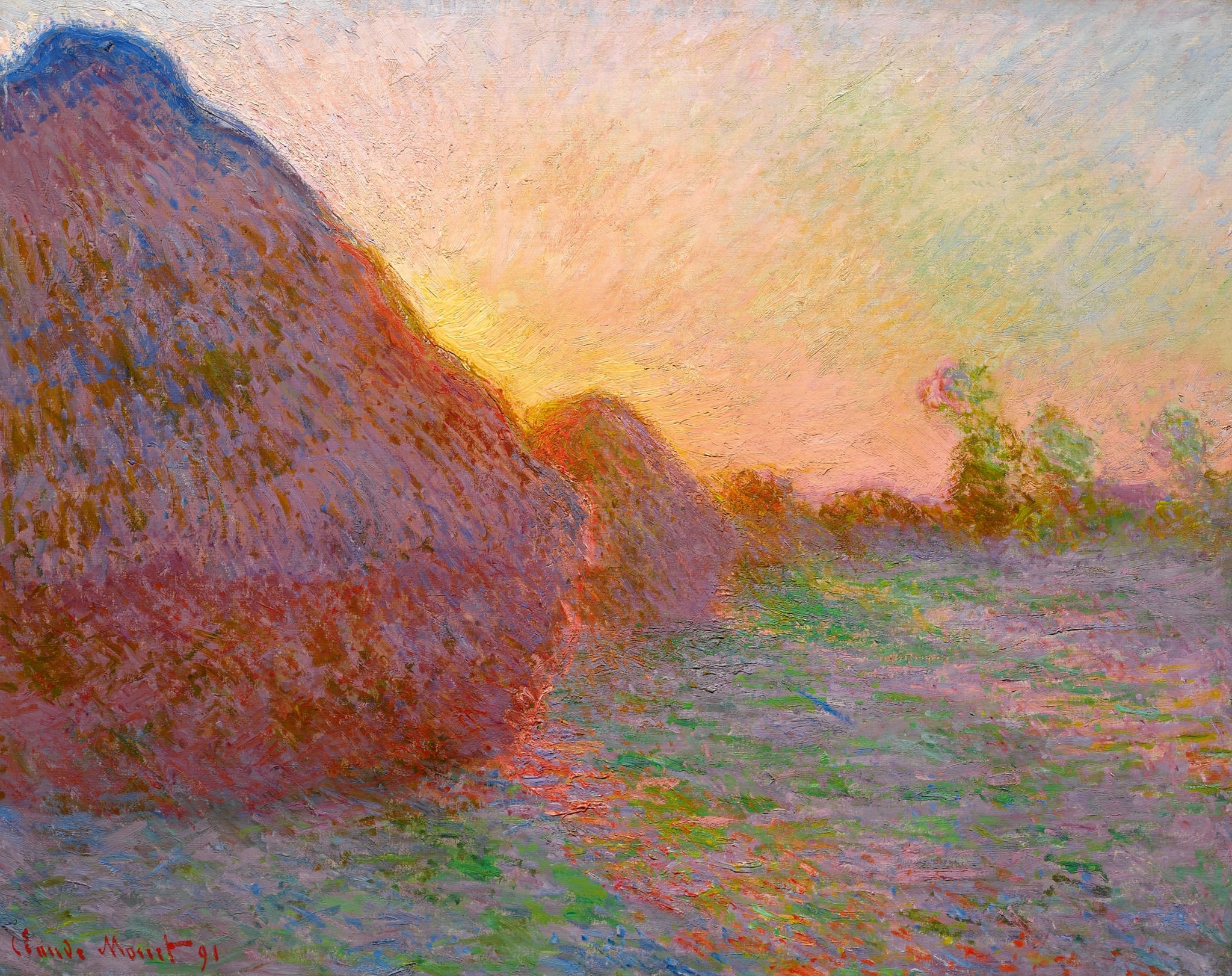
Claude Monet’s <strong>Haystacks Series</strong> transforms a routine rural subject into an inquiry into <strong>light, time, and perception</strong>. In this sunset view, the stacks swell at the left while the sun burns through the gap, making the field shimmer with <strong>apricot, lilac, and blue</strong> vibrations.
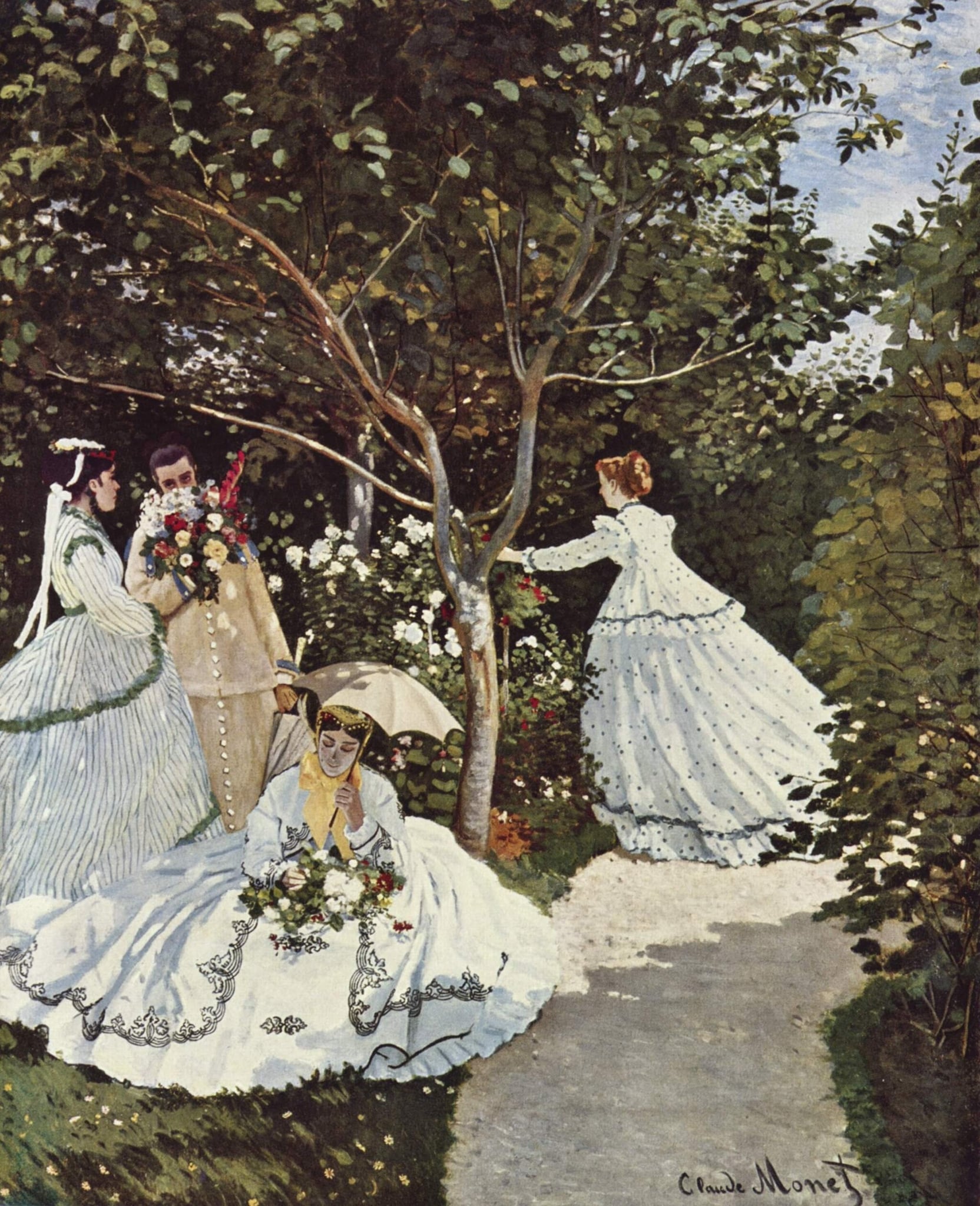
Women in the Garden by Claude Monet

Women in the Garden

Claude Monet (1866–1867)

Claude Monet’s Women in the Garden choreographs four figures in a sunlit bower to test how <strong>white dresses</strong> register <strong>dappled light</strong> and shadow. The path, parasol, and clipped flowers frame a modern ritual of leisure while turning fashion into an instrument of <strong>perception</strong>. The scene reads less as portraiture than as a manifesto for painting the <strong>momentary</strong> outdoors <sup>[1]</sup><sup>[3]</sup>.
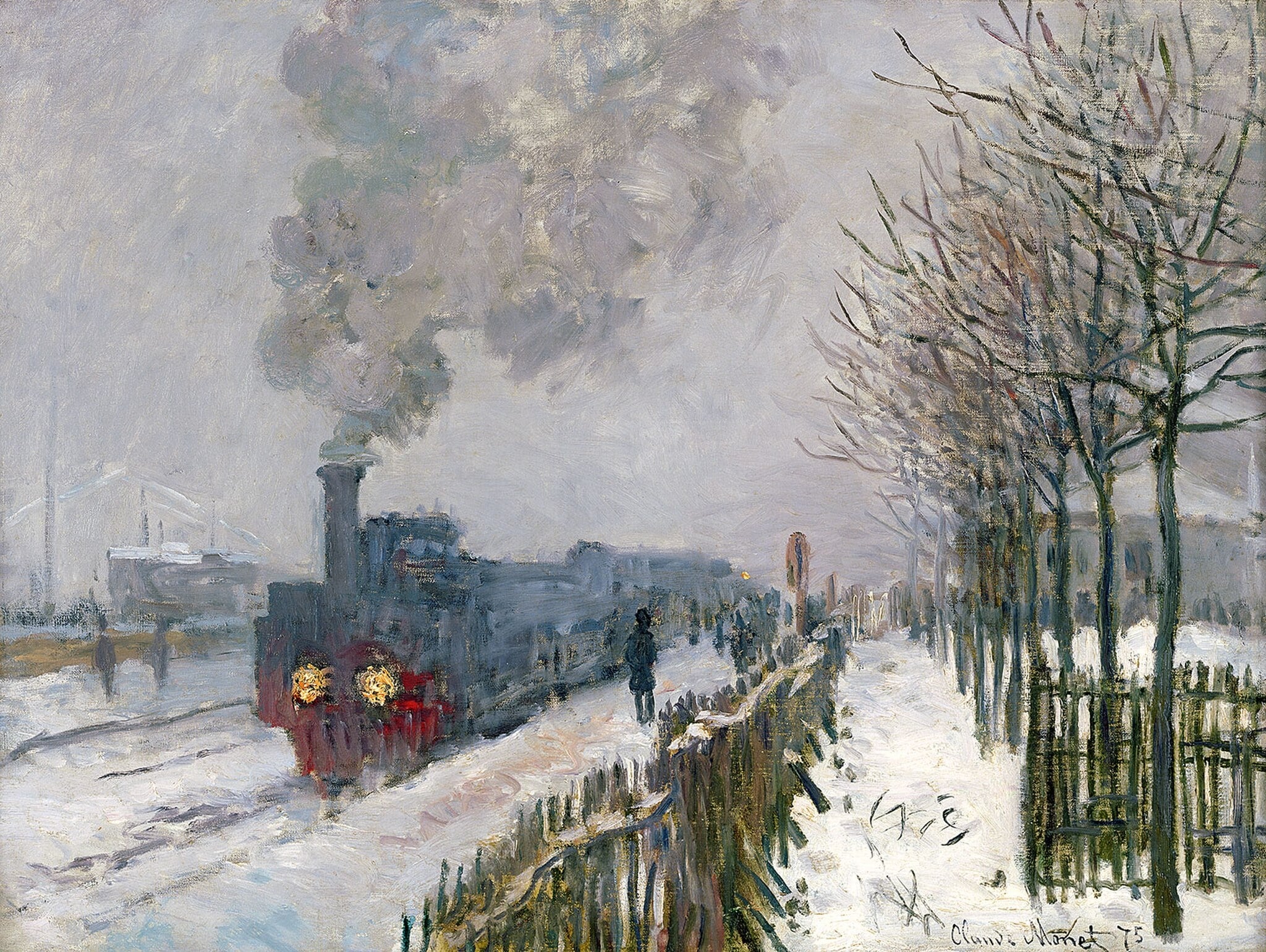
The Train in the Snow (The Locomotive) by Claude Monet

The Train in the Snow (The Locomotive)

Claude Monet (1875)

Claude Monet’s The Train in the Snow (The Locomotive) (1875) turns a suburban winter platform into a study of <strong>modernity absorbed by atmosphere</strong>. The engine’s twin yellow headlights and a smear of red push through a world of greys and violets as steam fuses with the low sky, while the right-hand fence and bare trees drill depth and cadence into the scene <sup>[1]</sup><sup>[4]</sup>. Monet fixes not an object but a <strong>moment of perception</strong>, where industry seems to dematerialize into weather <sup>[1]</sup><sup>[2]</sup>.
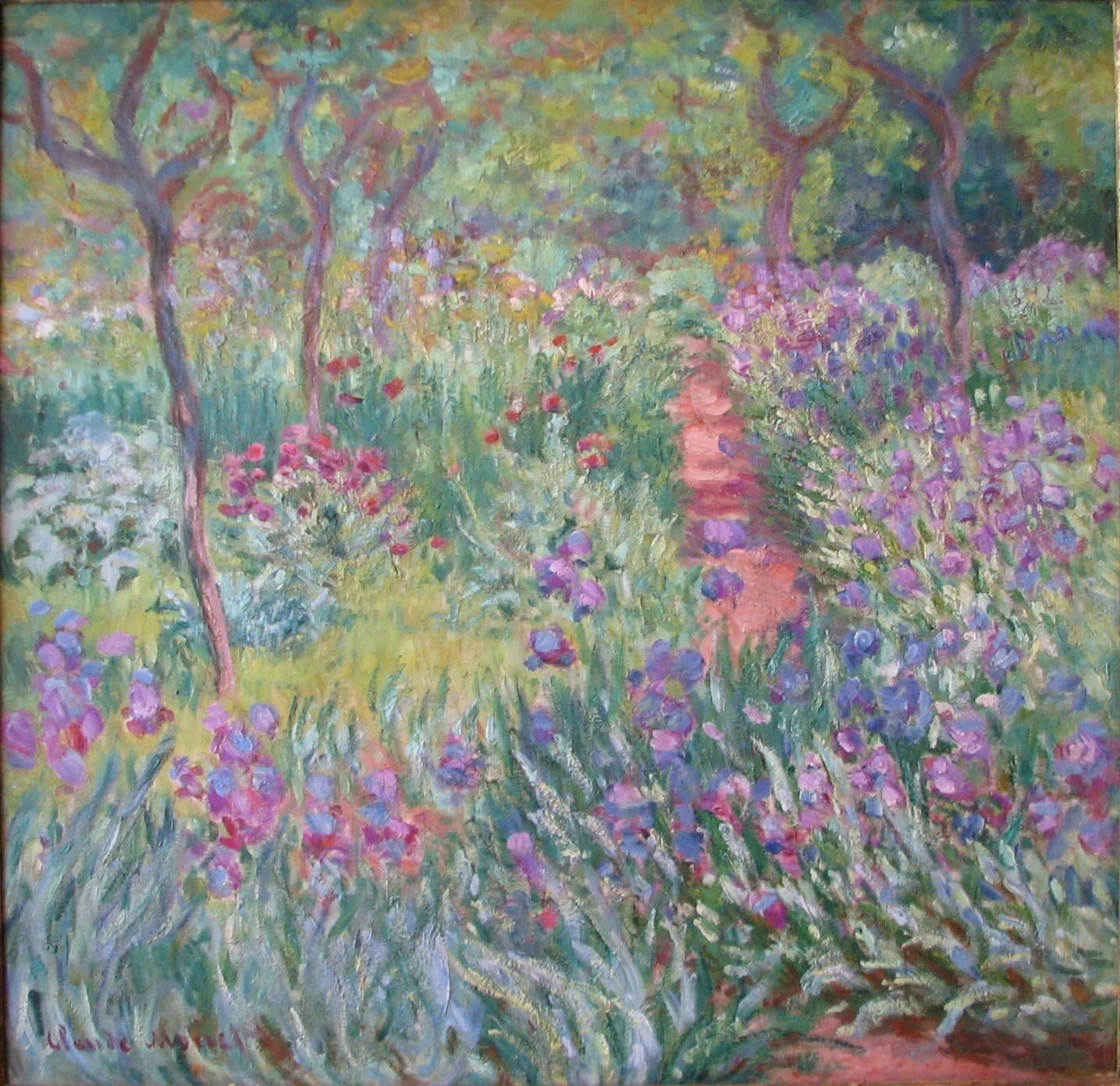
The Artist's Garden at Giverny by Claude Monet

The Artist's Garden at Giverny

Claude Monet (1900)

In The Artist's Garden at Giverny, Claude Monet turns his cultivated Clos Normand into a field of living color, where bands of violet <strong>irises</strong> surge toward a narrow, rose‑colored path. Broken, flickering strokes let greens, purples, and pinks mix optically so that light seems to tremble across the scene, while lilac‑toned tree trunks rhythmically guide the gaze inward <sup>[1]</sup><sup>[3]</sup>.