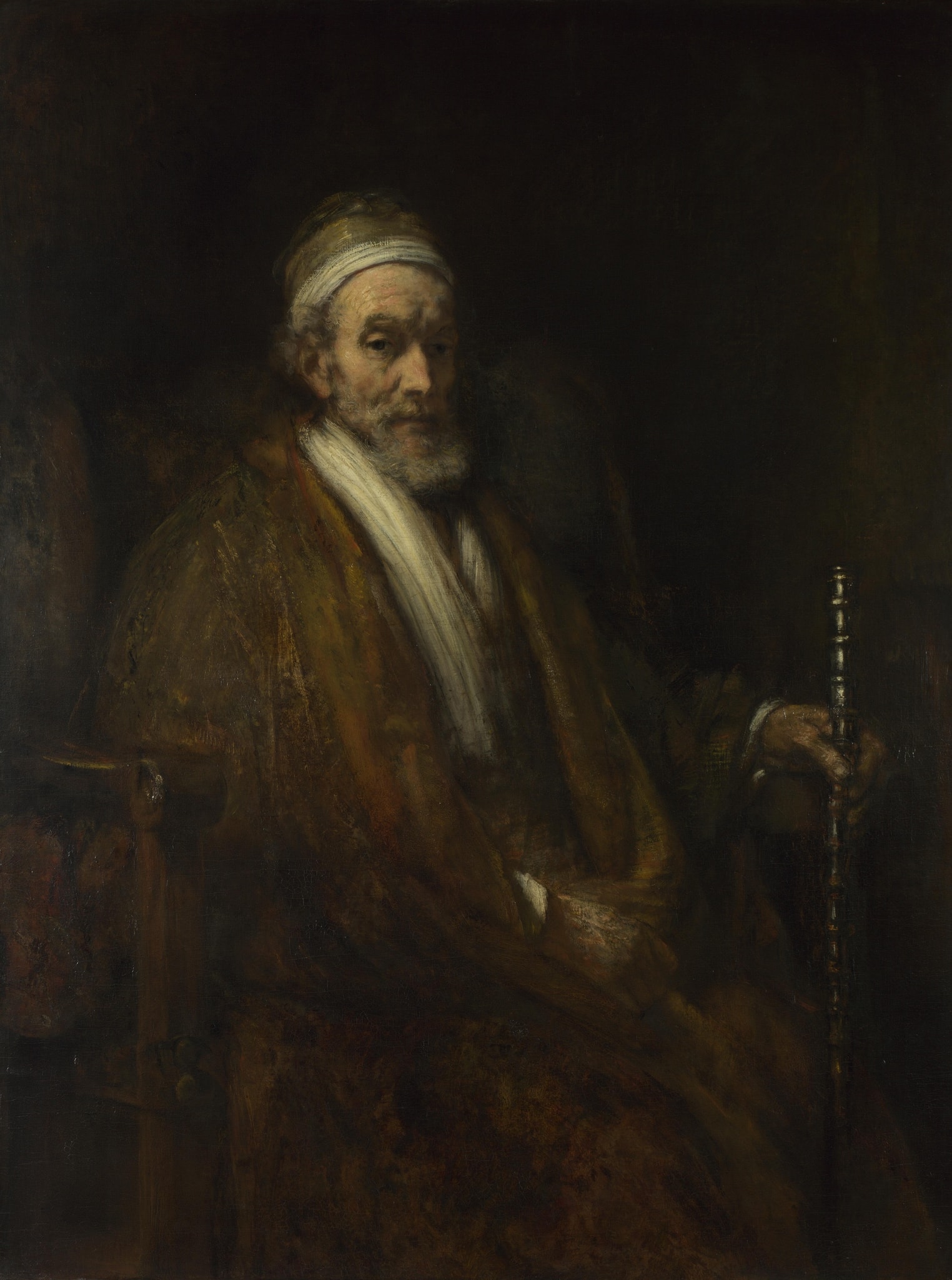
Portrait of Jacob Trip

by Rembrandt van Rijn

In Portrait of Jacob Trip, Rembrandt van Rijn distills worldly rank into quiet authority and moral gravity. A narrow beam lifts the sitter’s brow, nose, and beard while the rest recedes, so that character—not costume—carries the image [1][2]. The lightly held, scepter‑like staff and tabbaard‑like robe project power tempered by age and introspection [1][5].

Study Print Studio

Create a personal study print

Build a companion study sheet around the part of this painting that speaks to you most. Choose a detail, shape an interpretation, and walk away with something personal and display-worthy.

Fast Facts

Year
c. 1661
Medium
Oil on canvas
Dimensions
130.5 × 97 cm
Location
National Gallery, London
See all Rembrandt van Rijn paintings in London
Portrait of Jacob Trip by Rembrandt van Rijn (c. 1661) featuring Staff (scepter-like cane), Tabbaard-like robe, White scarf/stole, Indoor cap

Click on any numbered symbol to learn more about its meaning

Meaning & Symbolism

Rembrandt organizes the composition as a theater of conscience. A cool shaft of light lands on the furrowed forehead, the bridge of the nose, and the wiry beard, before dissolving across a chalk‑white scarf; the eyes glance sideways, steady but inward. The robe—broad, brown‑gold, and tabbaard‑like—is laid in with tactile, scumbled strokes that evoke sober learning even as the silkiness suggests quiet wealth. A pale indoor cap compresses the head, concentrating attention on thought rather than finery. The right hand emerges from shadow to clasp a long, straight staff whose precise, metallic highlights read like insignia rather than medical support—an emblem of office more than frailty 15. At the left, the blocky chair post anchors the body, but its rough, later adjustments and softened contours keep the setting provisional, as if the world around the sitter is yielding to darkness 2. Within this carefully restricted stage, meaning accrues from late‑style decisions. Compared with its pendant of Margaretha de Geer, this canvas is markedly economical in the handling of flesh and hands; the paint’s “unfinished” candor—visible in the frayed edges of the robe and the tremulous outline of the hand—shifts value from surface polish to inner presence 134. That economy aligns with Rembrandt’s late practice, which privileges radical surface and expressive light over meticulous finish, and it resonates with the picture’s historical moment: made around the sitter’s death in 1661, the portrait reads as composed under pressure of time, whether from life or from prior likenesses 124. The result is a calibrated image of patriarchal authority at dusk: the scepter‑like staff declares public power, while the encroaching shadow and indoor cap confess private vulnerability. Power, here, is not shouted by emblems but earned by the weathering inscribed across the brow. The commission context sharpens this argument. Intended for the new Trippenhuis—a house whose architecture flaunted cannon‑shaped chimneys and peace imagery—the portrait projects dynastic solidity without ostentation: global wealth (silk, imported textures) is translated into moral sobriety (tabbaard code) 1. In this light, the painting functions as a public ethic in private dress. Light plays the adjudicator: it ratifies what endures (mind, judgment, restraint) and lets the rest dissolve. That ethical chiaroscuro, together with the pendant’s more animated presence, turns the pair into a program about worldly station and the waning of life—how authority persists even as the body yields 13. Such synthesis—of symbol (staff), costume code (tabbaard), and late technique—explains why Portrait of Jacob Trip stands as a keystone of Rembrandt’s final decade: it redefines grandeur as moral weight, rendered by paint that seems to think as it describes 45.

Explore Deeper with AI

Ask questions about Portrait of Jacob Trip

Popular questions:

Powered by AI • Get instant insights about this artwork

💬 Ask questions about this artwork!

Interpretations

Technical/Process Reading: Making Under Pressure

The canvas records a living process: trimmed edges, a double ground, and notable pentimenti—especially the right hand’s earlier position and the late insertion of the chair—index decisions in flight rather than workshop routine. Such adjustments, visible in raking light and documented in the National Gallery’s catalogue, align with Rembrandt’s late habit of leaving revision legible as meaning. The “unfinished” economy of flesh and hand, set against exacting highlights on the staff, calibrates attention: mind and office are clarified while the world blurs. Whether painted rapidly near Jacob Trip’s death or built upon a prior likeness, the surface reads as time‑stamped—the paint’s breaks and reworkings becoming a register of urgency, not deficiency. In this lens, facture itself bears witness to a life nearing closure, with process as narrative 26.

Source: National Gallery, London (MacLaren/Brown catalogue); Journal of Historians of Netherlandish Art

Costume Iconography: Tabbaard Code Meets Global Silk

Rembrandt fuses two sartorial registers. The robe’s tabbaard‑like cut invokes a conservative icon of learning and probity recognizable to Dutch viewers, while the likely padded silk—an import associated with Asian trade—quietly discloses global capital. Marieke de Winkel’s work on dress codes clarifies how the tabbaard signaled moral gravity in portraiture, often preferred by sober elites. Here, the luxurious fabric is visually subdued by scumble and brown‑gold tonality; the cap domesticates the scene, pushing status toward intellect. This hybrid costume thus moralizes wealth, translating mercantile success into an ethic of restraint. The result suits a family whose Trippenhuis would trumpet power yet court public virtue: prosperity shown as inward ballast, not spectacle 13.

Source: National Gallery, London; Marieke de Winkel (NKJ 46)

Political Economy: The Arms Magnate and the Peace House

Jacob Trip’s fortune in iron and arms shadows the portrait’s quiet grandeur. In the Trippenhuis—adorned with cannon‑shaped chimneys and peace emblems—the canvas would have read as corporate self‑governance: the sitter’s straight staff works like a pared‑down scepter, asserting order without blare. This is post‑bankruptcy Rembrandt, too, whose clientele prized ethical display over courtly glitter. Light ratifies what counts—judgment, steadiness—while the material world recedes into the dark. Within a house that architecturally staged the paradox of war profits underwriting peace, Rembrandt supplies the human corollary: a patriarch whose authority appears earned, not merely owned. The painting thus participates in a broader program of merchant‑republic virtue, translating commerce into conscience 147.

Source: National Gallery, London; Trippenhuis architecture sources; Rembrandt: The Late Works (NG)

Late Style and Temporality: Painting as Timekeeper

The portrait’s economy—thinly stated hands, frayed robe edges, abrupt transitions—belongs to Rembrandt’s late manner, where expressive light and radical surface eclipse meticulous finish. In such works, temporality is active: paint models not just skin but the erosion of time. Given Jacob Trip’s death in 1661, curators propose scenarios from life‑sittings under duress to posthumous synthesis from prototypes. Either way, the work courts immediacy over polish. The pendant’s contrast—Margaretha’s readier presence—intensifies this temporal asymmetry: paired canvases become a diptych of vitality and ebb. The theatre of conscience is, here, also a clock: highlights flare on brow and staff like last signals before dusk, making mortality the engine of style 124.

Source: National Gallery, London (object page and exhibition materials); MacLaren/Brown (NG Catalogue)

Representation Debate: From Prototype to Presence

The portrait may compound direct observation with prototype mediation, drawing on earlier likenesses (Cuyp, Maes) common in patrician portrait cycles. Rather than diminishing authenticity, such synthesis underscores Rembrandt’s late priority: inward presence over outward finish. The slightly generalized anatomy and the emphatic, almost metallic staff suggest a negotiated image—part archival identity, part painterly thinking—appropriate to a commission likely orchestrated by sons for the Trippenhuis. The result strains the boundary between mimesis and authority symbol: where exact physiognomy thins, emblem and light thicken. Rembrandt’s signature, securely read under UV, anchors authorship even as facture flaunts constructedness; truth becomes assembled, not merely copied, an ethic of likeness suited to dynastic remembrance 21.

Source: National Gallery, London (MacLaren/Brown catalogue; object page)

Gendered Pendants: Domestic Sovereignty in Two Keys

As pendant to Margaretha de Geer, Jacob’s portrait forms a program of domestic sovereignty. Her more animated presence and articulate hands answer his inward turn and fading physicality, distributing household power across complementary temperaments. The staging is not symmetrical display but ethical dialogue: Margaretha as active custodian of continuity; Jacob as emblem of waning yet legitimate authority. In the Trippenhuis, these roles would have broadcast dynastic steadiness without court excess. The staff’s emblematic glint and her engaged address become a binary of office and voice—public weight and private governance—binding marriage to civic identity. Such pairing reframes grandeur as a shared moral enterprise, reinforcing the Republic’s ideal of household virtue as the seedbed of public order 18.

Source: National Gallery, London (both object pages)

Related Themes

About Rembrandt van Rijn

Rembrandt van Rijn (1606–1669) was a leading Dutch Golden Age painter and printmaker whose Amsterdam years (from 1631) produced virtuosic portraits and ambitious history paintings. In the early 1630s he favored polished finishes, saturated color, and theatrical staging—qualities on display in this 1633 canvas. Although prolific, this is his only known painted seascape [2][4].
View all works by Rembrandt van Rijn

More by Rembrandt van Rijn
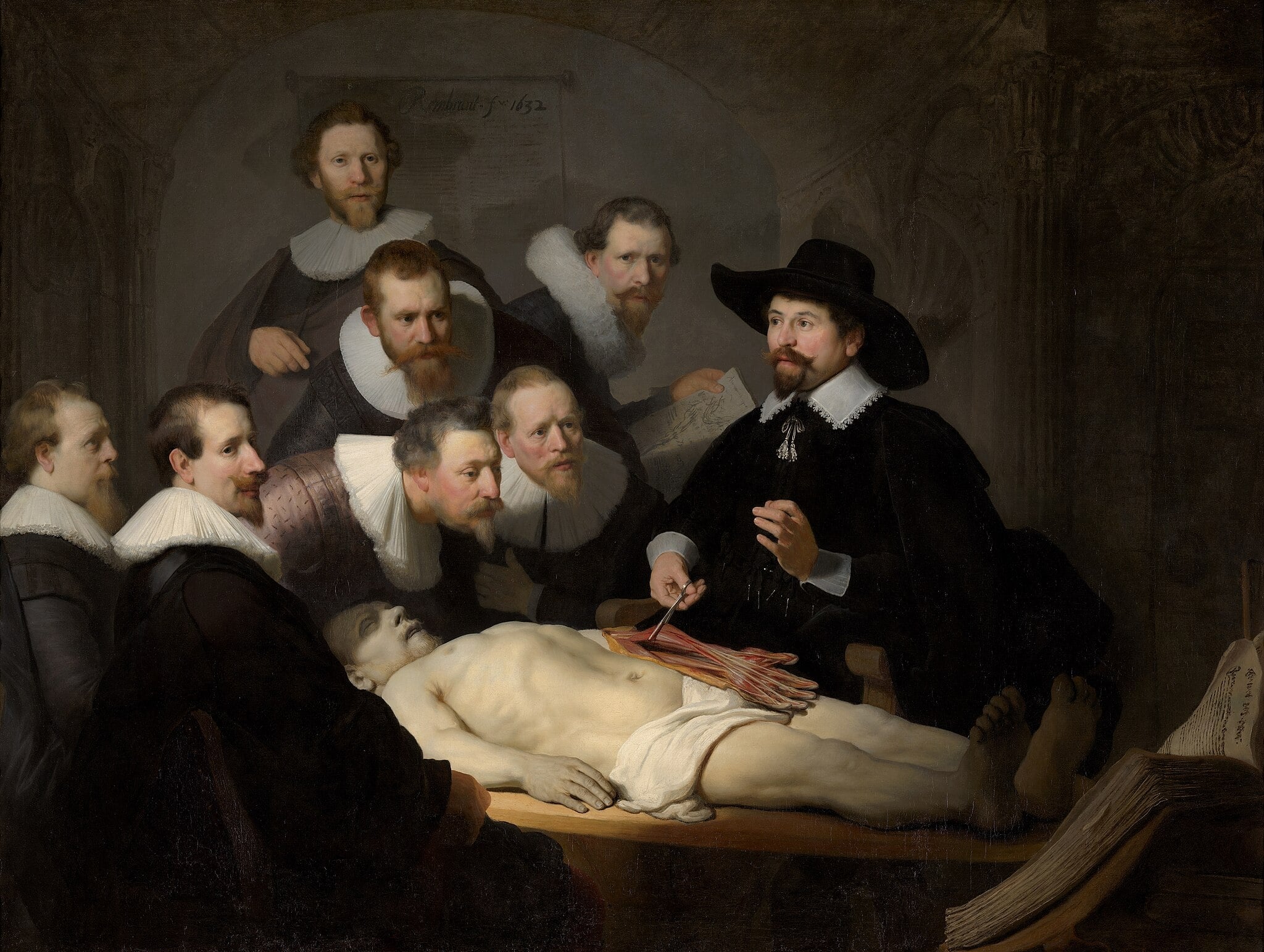
The Anatomy Lesson of Dr. Nicolaes Tulp by Rembrandt van Rijn

The Anatomy Lesson of Dr. Nicolaes Tulp

Rembrandt van Rijn (1632)

Rembrandt van Rijn turns a civic commission into a drama of <strong>knowledge made visible</strong>. A cone of light binds the ruff‑collared surgeons, the pale cadaver, and Dr. Tulp’s forceps as he raises the <strong>forearm tendons</strong> to explain the hand. Book and body face each other across the table, staging the tension—and alliance—between <strong>textual authority</strong> and <strong>empirical observation</strong> <sup>[1]</sup><sup>[2]</sup>.
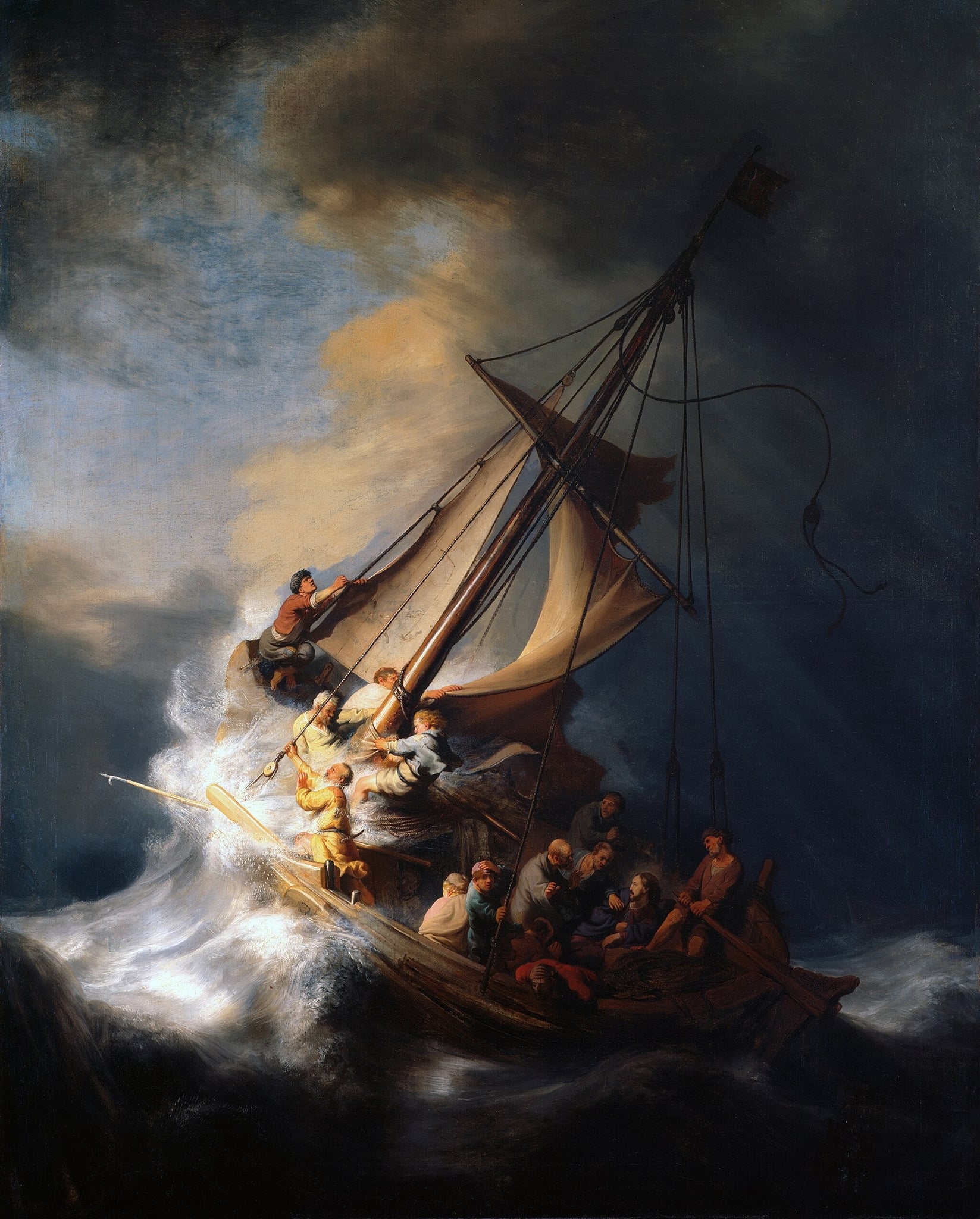
The Storm on the Sea of Galilee by Rembrandt van Rijn

The Storm on the Sea of Galilee

Rembrandt van Rijn (1633)

Rembrandt van Rijn’s The Storm on the Sea of Galilee stages a clash of <strong>human panic</strong> and <strong>divine composure</strong> at the instant before the miracle. A torn mainsail whips across a steeply tilted boat as terrified disciples scramble, while a <strong>serenely lit Christ</strong> anchors a pocket of calm—an image of faith holding within chaos <sup>[1]</sup><sup>[3]</sup>. It is Rembrandt’s only painted seascape, intensifying its dramatic singularity in his oeuvre <sup>[2]</sup>.
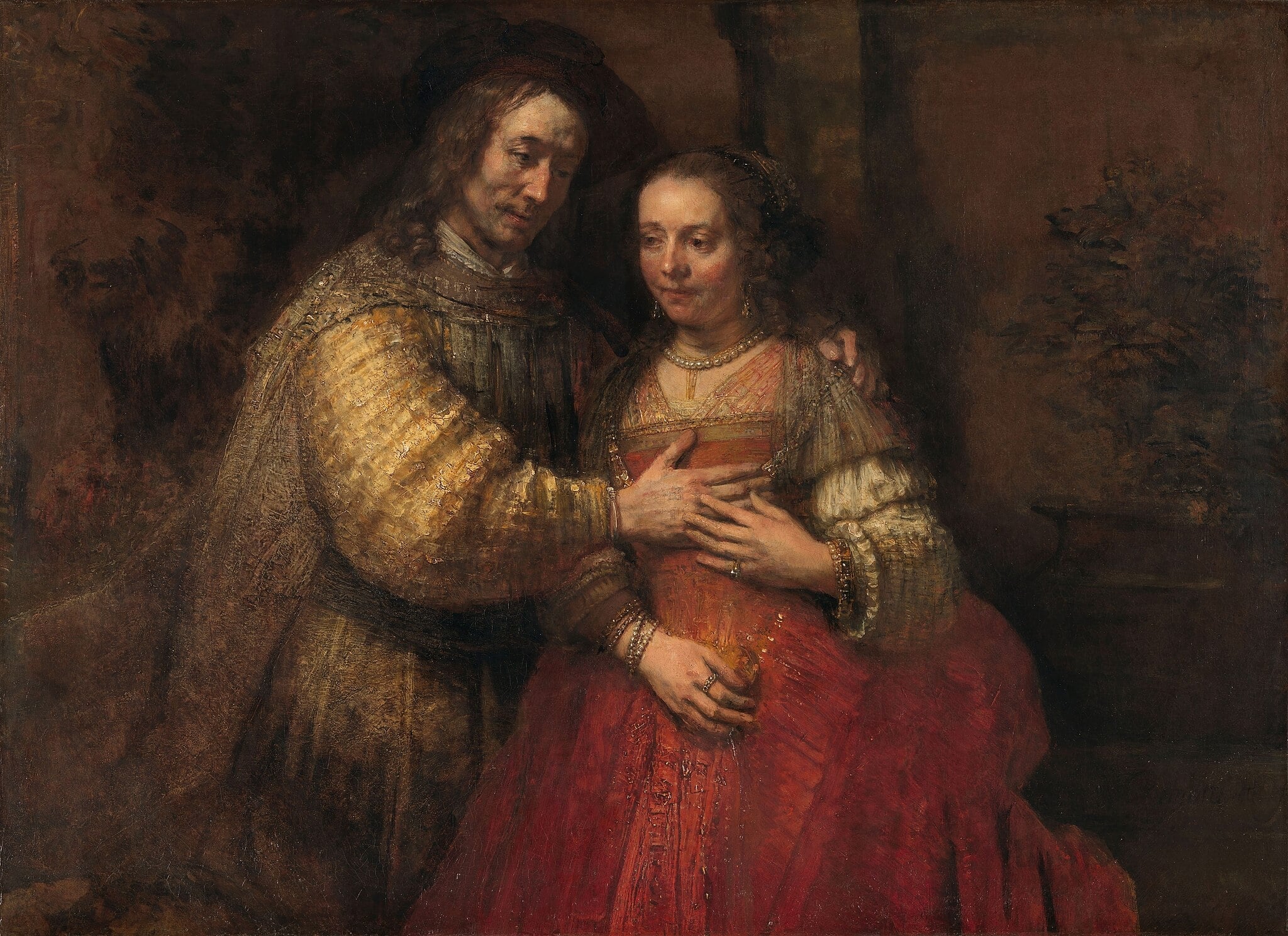
The Jewish Bride by Rembrandt van Rijn

The Jewish Bride

Rembrandt van Rijn (c. 1665–1669)

The Jewish Bride by Rembrandt van Rijn stages an intimate covenant: two figures, read today as <strong>Isaac and Rebecca</strong>, seal their union through touch rather than spectacle. Light concentrates on faces and hands, while the man’s glittering <strong>gold sleeve</strong> and the woman’s <strong>coral-red gown</strong> turn paint itself into a metaphor for fidelity and tenderness <sup>[1]</sup><sup>[3]</sup>. This late masterpiece embodies Rembrandt’s <strong>material eloquence</strong>—impasto as feeling—within a hushed, dark setting <sup>[1]</sup><sup>[2]</sup>.
The Return of the Prodigal Son by Rembrandt van Rijn

The Return of the Prodigal Son

Rembrandt van Rijn (c. 1661–1669 (probably completed by 1669))

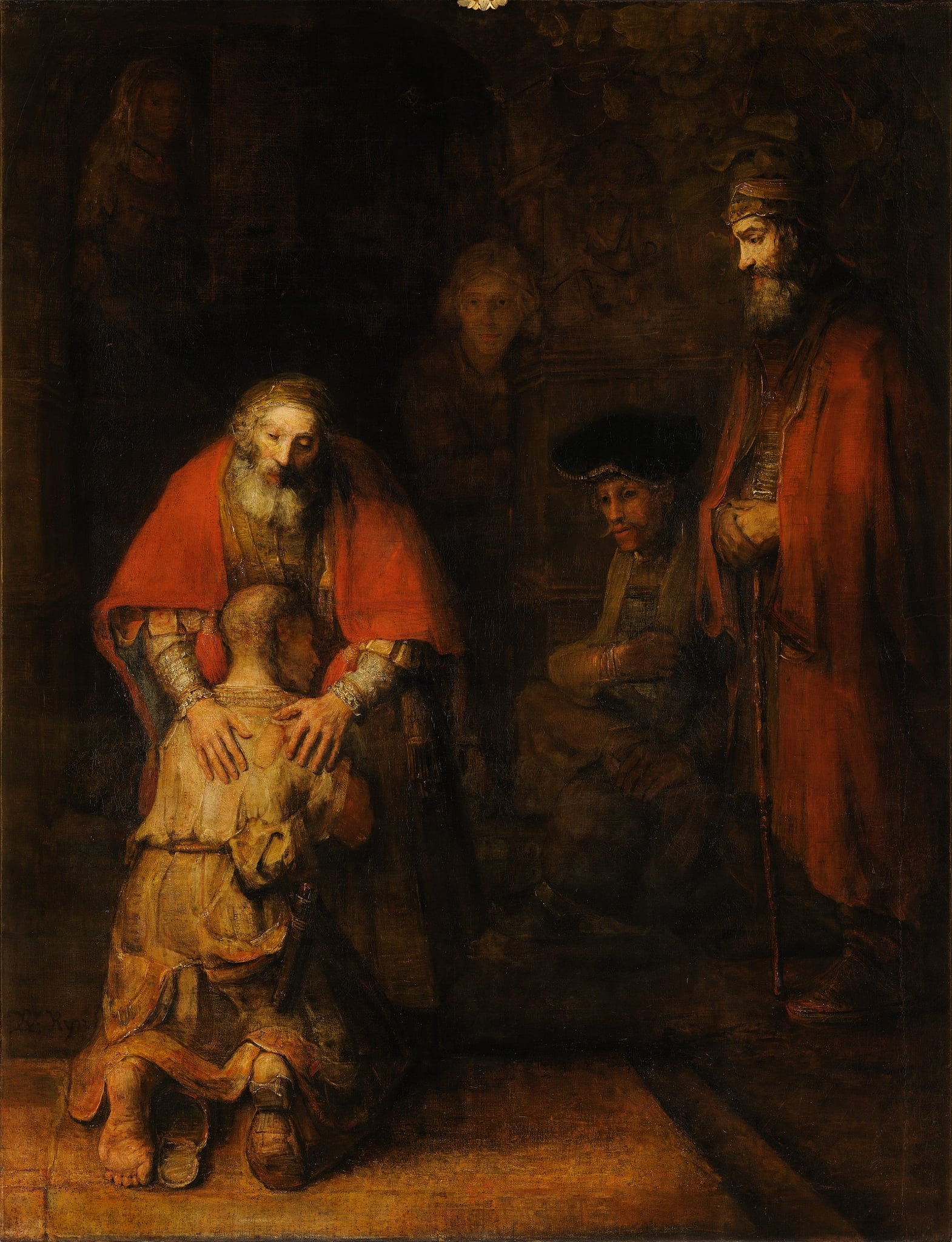
Rembrandt van Rijn’s The Return of the Prodigal Son is a late-life meditation on <strong>mercy</strong>, <strong>homecoming</strong>, and <strong>restored dignity</strong>. In a hush of dusk-like light, a ragged son kneels into his father’s <strong>embrace</strong>, while an upright elder brother holds back in shadow. The image concentrates meaning in illuminated <strong>faces, hands, and feet</strong>, turning a parable into a timeless human reckoning. <sup>[1]</sup><sup>[2]</sup>
Self-portrait (with tousled hair) by Rembrandt van Rijn

Self-portrait (with tousled hair)

Rembrandt van Rijn (c. 1628)

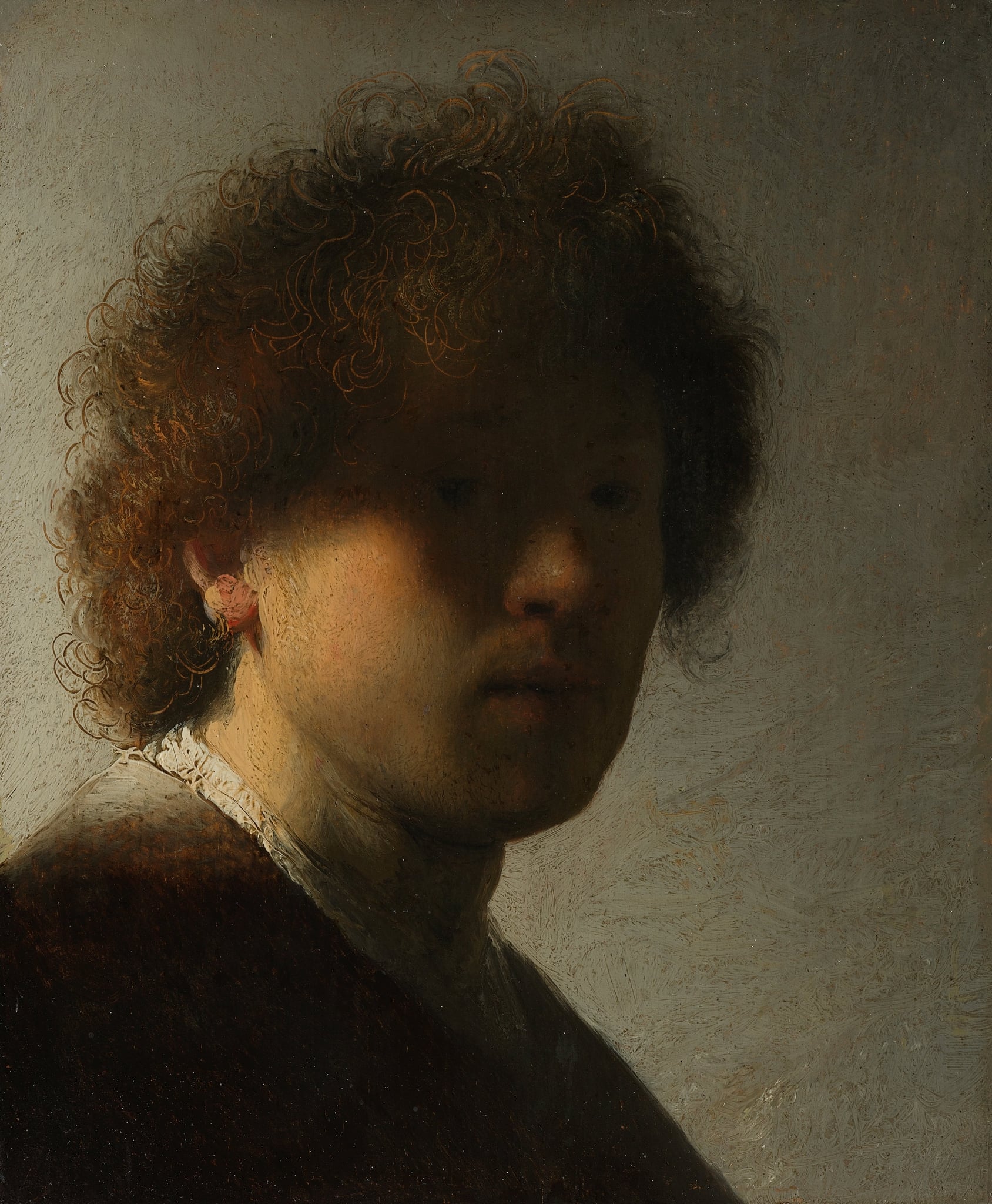
A young Rembrandt van Rijn tests how <strong>light both reveals and withholds</strong> by letting his face emerge from darkness while his <strong>scratched, backlit curls</strong> flare like a rough halo. The small oak panel makes <strong>process itself the subject</strong>, turning hair, stubble, and a raking highlight into a statement of identity-in-formation <sup>[1]</sup><sup>[5]</sup>.
Portrait of Haesje Jacobsdr van Cleyburg by Rembrandt van Rijn

Portrait of Haesje Jacobsdr van Cleyburg

Rembrandt van Rijn (1634)

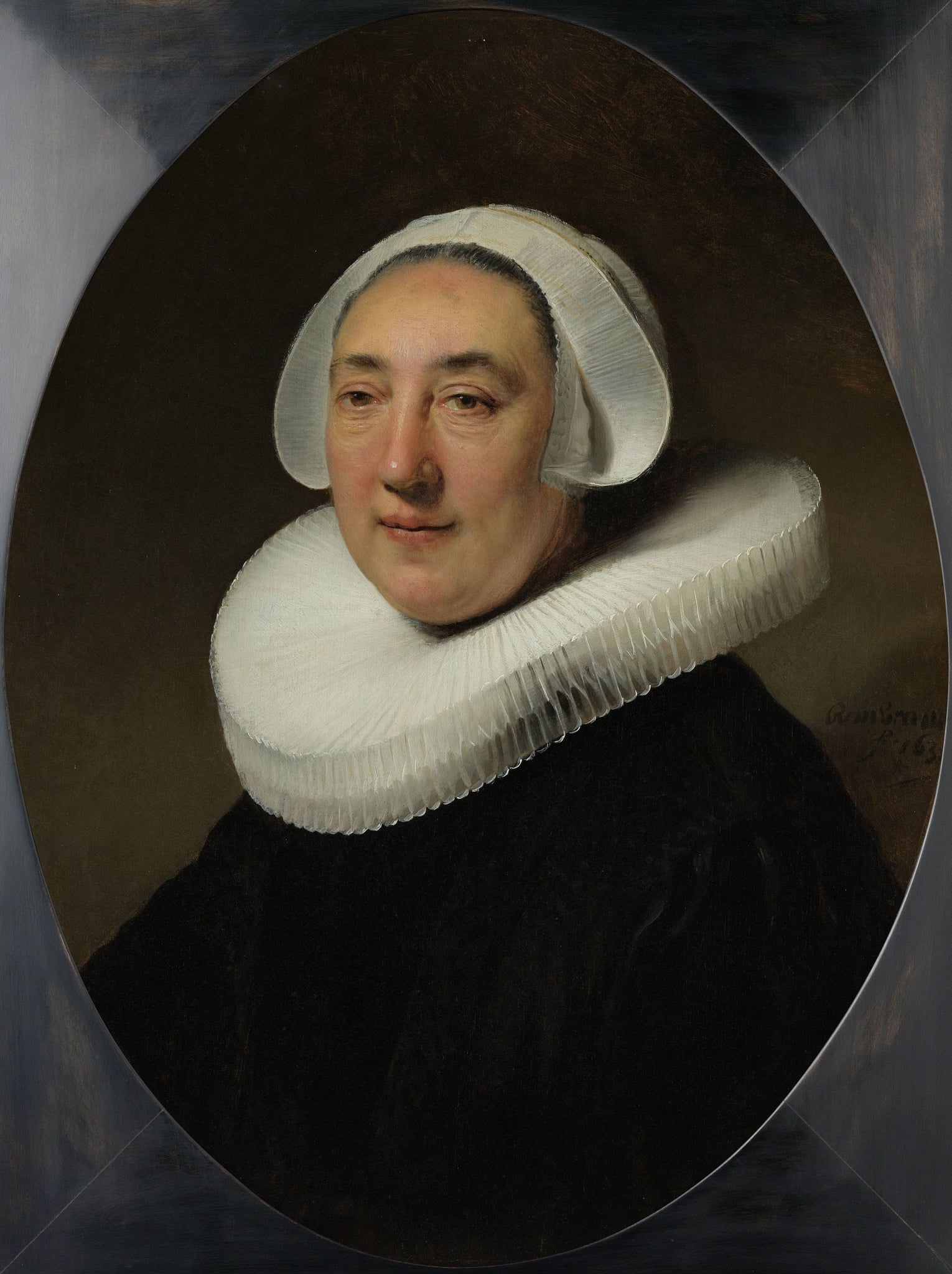
Rembrandt’s 1634 Portrait of Haesje Jacobsdr van Cleyburg stages a Dutch burgher within a feigned <strong>oval</strong> opening, illuminated by selective <strong>chiaroscuro</strong> that models warm skin against brilliant <strong>millstone ruff</strong> and sober black dress. The painting balances <strong>modesty and status</strong>, making virtue visible while quietly declaring prosperity through immaculate linen and craft <sup>[1]</sup><sup>[4]</sup>.