Daubigny's Garden

by Vincent van Gogh

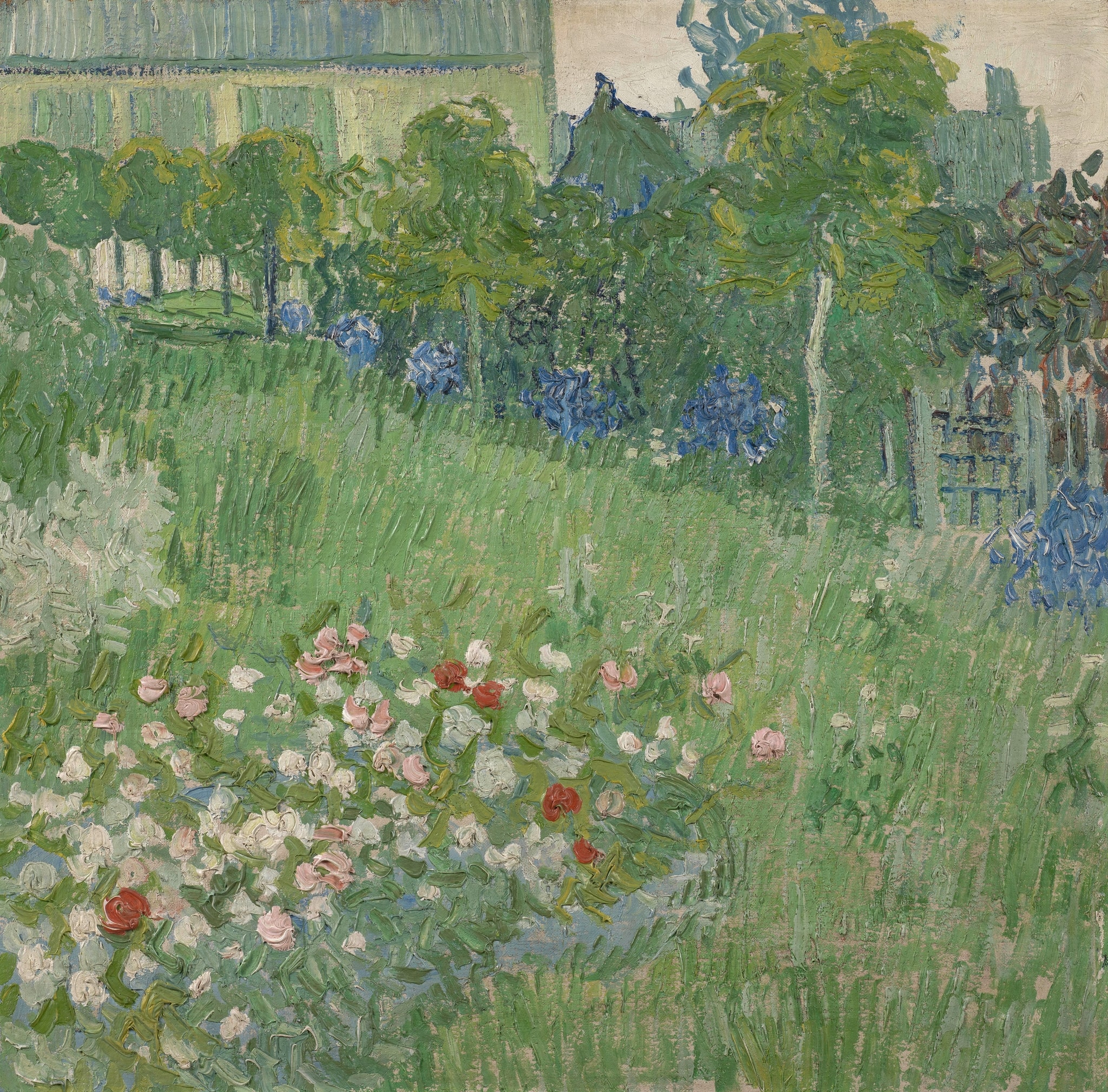
In Daubigny's Garden, Vincent van Gogh forges a living field of green where short, pulsating strokes turn grass, hedge, and trees into a single, breathing organism. A rose bed of pale pinks and reds pools in the foreground, while cobalt-blue flowers puncture the middle hedge, and the pale façade and roof beyond seal the garden into an intimate retreat [1][2].

Study Print Studio

Create a personal study print

Build a companion study sheet around the part of this painting that speaks to you most. Choose a detail, shape an interpretation, and walk away with something personal and display-worthy.

Fast Facts

Year
1890
Medium
Oil on canvas
Dimensions
51 x 51.2 cm
Location
Van Gogh Museum, Amsterdam
See all Vincent van Gogh paintings in Amsterdam
Daubigny's Garden by Vincent van Gogh (1890) featuring Rose bed, Cobalt-blue flowers, Hedge band, Slim tree trunks

Click on any numbered symbol to learn more about its meaning

Meaning & Symbolism

Van Gogh anchors the scene with the rose bed at lower left—a shallow oval of whites, blush pinks, and small crimsons—set against fast, vertical and slanting strokes of grass. This floral eddy functions as a heartbeat: it extracts warmth from a field otherwise keyed to layered greens, and it cues the eye to travel upward, where a continuous hedge rises and breaks into clumps of intense ultramarine-blue blossoms. That blue counter-rhythm, placed in the mid-band, works like a musical bass line under the treble of the roses, stabilizing the tilted lawn and preventing the green mass from collapsing into sameness. The hedge, slim tree trunks, and the pale house and roof beyond press close to the picture plane, producing an intentional compression that seals the garden as a cultivated, bounded retreat. The small wedge of pale sky at top right registers not as open distance but as a final, cool plate of air—Van Gogh’s famed “pale green” sky idea in the double-square versions refracted here into a subdued, chalky light 123. Material choices intensify that meaning. Lacking standard canvas, Van Gogh mounted this study on a red-and-white striped tea towel and primed it with a deliberate pink ground (lead white and red lake). He then dragged and stacked greens so that glints of pink inflect the interstices, activating the surface with a low inner hum; even with some fading of the red lake today, the mechanism remains legible as a chromatic engine. This is not decoration; it is method made visible—color built over counter-color to literalize sensation. The result exemplifies why Daubigny's Garden is important to understanding Van Gogh’s late Post‑Impressionism: touch becomes structure, and color organizes space more decisively than line. The hedge reads as a band not because it is outlined, but because blue punctures and green strata declare its plane. The house beyond, brushed as broad panels of desaturated green, becomes a calm wall against which the garden’s gusts can register, a sympathetic listener rather than a narrative subject 14. Historically, the picture is an homage with teeth. Van Gogh arrived in Auvers in May 1890 and quickly sought Daubigny’s home and garden—signaling allegiance to an older landscape ethic grounded in direct study. In his final letter he described the subject in a panoramic double-square version—rose bed, hedge, lime trees, house, a bench with three chairs, a figure with a yellow hat, and even a black cat—calling it one of his most carefully conceived canvases 2. The square study here distills that inventory to essentials visible in the image: the roses, hedge and trees, the house with greenish roof, and the gate at right. The omissions sharpen the thesis. Without figure or furniture, the garden itself carries the drama, its motions encoded in the speed and pressure of the brush. That is the meaning of Daubigny’s Garden as Van Gogh paints it: a conversation across generations, but also a wager that intensified seeing can hold renewal and melancholy at once—roses blooming in the foreground even as the compressed space and heavy, rhythmic strokes transmit an urgency to grasp beauty before it slips. This dual register—sanctuary and agitation, homage and reinvention—secures the work’s place among the late Auvers canvases and clarifies why Daubigny’s Garden is important within the broader project of Post‑Impressionism: it proves that vision, materially built, can carry feeling without allegory 1234.

Explore Deeper with AI

Ask questions about Daubigny's Garden

Popular questions:

Powered by AI • Get instant insights about this artwork

💬 Ask questions about this artwork!

Interpretations

Technical/Material Analysis

Van Gogh’s material setup is not incidental but programmatic: a red‑and‑white striped tea towel serves as support, over which he lays a deliberate pink ground (lead white + red lake) to torque the greens above into vibration. As the green strokes skip and stack, pink inflects the interstices, producing a low chromatic “hum.” Even with fading of the red lake, the system remains legible as a built engine of sensation. This self‑conscious staging of grounds, supports, and visible gaps turns the painting into a demonstration of how color is constructed, not merely applied—a key Post‑Impressionist move in which facture itself becomes the carrier of meaning and mood 14.

Source: Van Gogh Museum; The Metropolitan Museum of Art

Format, Seriality, and Revision

Daubigny’s Garden unfolds across a square study and two double‑square panoramas cut from the same bolt of canvas as other late works—evidence of a serial, panoramic ambition in Auvers. The double‑square breadth lets Van Gogh stage a mid‑band hedge as a stabilizing horizon while testing motif variations (e.g., the black cat noted in his sketch), then revising—“painted out later,” per the editors—toward a leaner, more structural field. The sequence shows him thinking compositionally in formats: the square compresses and anchors; the panorama disperses and counterbalances. Seriality here is a laboratory for decisions about rhythm, horizon, and motif load, not a mere repetition of a favorite view 23.

Source: Fondation Beyeler (Rudolf Staechelin Collection); Van Gogh Letters

Homage and Genealogy (Barbizon to Post‑Impressionism)

By seeking out Daubigny’s garden on arrival in Auvers, Van Gogh activates a lineage from Barbizon plein‑air naturalism to his own color‑structured modernism. The subject—a domestic garden with hedge, lime trees, and house—signals fidelity to on‑site study; the treatment—color as architecture, touch as plane—asserts a break. This is homage sharpened into critique: Daubigny’s ethos of direct landscape is retained, yet the organizing authority shifts from tonal atmosphere to chromatic construction. The garden thus becomes a stage where a 19th‑century landscape ethic is both honored and reauthored, clarifying Van Gogh’s place inside and against tradition 14.

Source: Van Gogh Museum; The Metropolitan Museum of Art

Affect and Late‑Auvers Temporality

In roughly seventy days at Auvers, Van Gogh painted with extraordinary intensity; this canvas absorbs that temporal compression into form. The pressed‑forward hedge, the slight lawn tilt, and insistent, rhythmic strokes convey a charged stillness: a haven that vibrates. His own note of a “pale green” sky describes not meteorology but an enveloping key that binds ground to air. Rather than allegory, affect is carried by facture and tonal unity—beauty seized in passing, anxious to endure. Read against the final weeks’ pace and strain, the garden becomes a sanctuary that knows its own fragility, a living study in renewal under the shadow of time 26.

Source: Van Gogh Letters; Van Gogh Museum (Biography: Final Months in Auvers)

Omission as Meaning (Figures, Furniture, Cat)

Van Gogh’s sketch inventory—bench, three chairs, a figure with a yellow hat, even a black cat—indexes possibilities for staging sociability in the garden. The square study, however, pointedly omits these, forcing roses, hedge, and house to carry the drama. The absence is constructive: by withdrawing narrative prompts, he intensifies the painting’s internal dynamics (color counterpoints, tactile pressure) and reframes the garden as a site of perceiving rather than of anecdote. In the double‑squares the cat appears then is removed, marking revision toward an image where structure outlives story, and where habitation is sensed through order and touch, not through depicted actors 12.

Source: Van Gogh Museum; Van Gogh Letters

Related Themes

About Vincent van Gogh

Vincent van Gogh (1853–1890) developed a radical, emotion‑driven use of color after moving from Paris to Arles in 1888, seeking southern light and an artists’ community. In Arles he created the Sunflowers series to decorate the Yellow House ahead of Gauguin’s visit. His late work fused impasto, high chroma, and symbolic motifs that shaped modern painting [2][5].
View all works by Vincent van Gogh

More by Vincent van Gogh
Café Terrace at Night by Vincent van Gogh

Café Terrace at Night

Vincent van Gogh (1888)

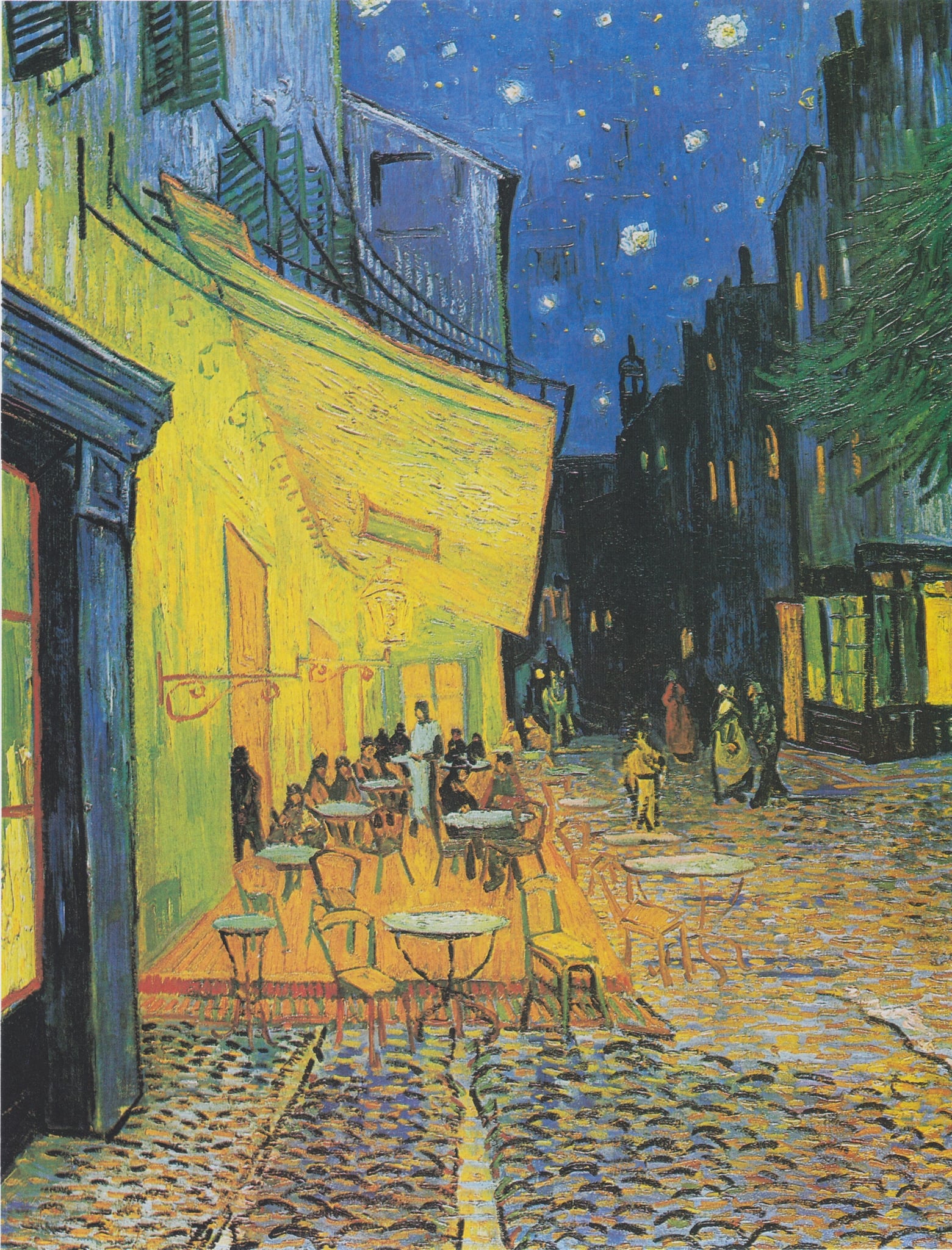
In Café Terrace at Night, Vincent van Gogh turns nocturne into <strong>luminous color</strong>: a gas‑lit terrace glows in yellows and oranges against a deep <strong>ultramarine sky</strong> pricked with stars. By building night “<strong>without black</strong>,” he stages a vivid encounter between human sociability and the vastness overhead <sup>[1]</sup><sup>[2]</sup>.
Red Cabbages and Onions by Vincent van Gogh

Red Cabbages and Onions

Vincent van Gogh (1887)

In Red Cabbages and Onions, Vincent van Gogh turns everyday produce into a drama of <strong>complementary color</strong> and <strong>restless brushwork</strong>. Hot red contours cinch violet cabbages and pale yellow bulbs against a cool, striated blue table, while a mustard‑yellow patch in the upper right tilts the space and sharpens the chromatic clash. The result asserts ordinary food as a locus of <strong>resilience</strong> and <strong>experimentation</strong> <sup>[1]</sup><sup>[2]</sup>.

Irises by Vincent van Gogh

Irises

Vincent van Gogh (1889)

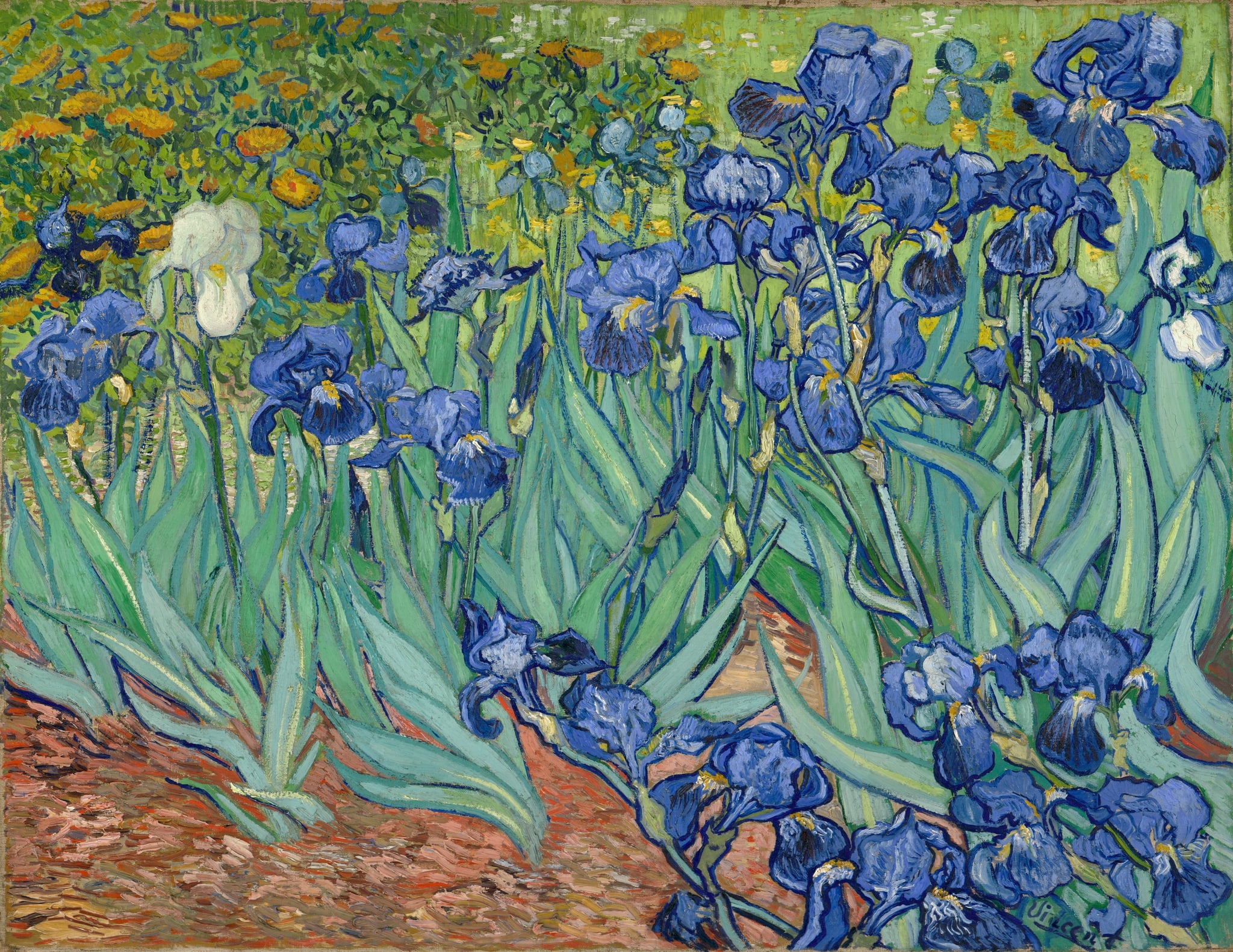
Painted in May 1889 at the Saint-Rémy asylum garden, Vincent van Gogh’s <strong>Irises</strong> turns close observation into an act of repair. Dark contours, a cropped, print-like vantage, and vibrating complements—violet/blue blossoms against <strong>yellow-green</strong> ground—stage a living frieze whose lone <strong>white iris</strong> punctuates the field with arresting clarity <sup>[1]</sup><sup>[2]</sup>.
Sunflowers by Vincent van Gogh

Sunflowers

Vincent van Gogh (1888)

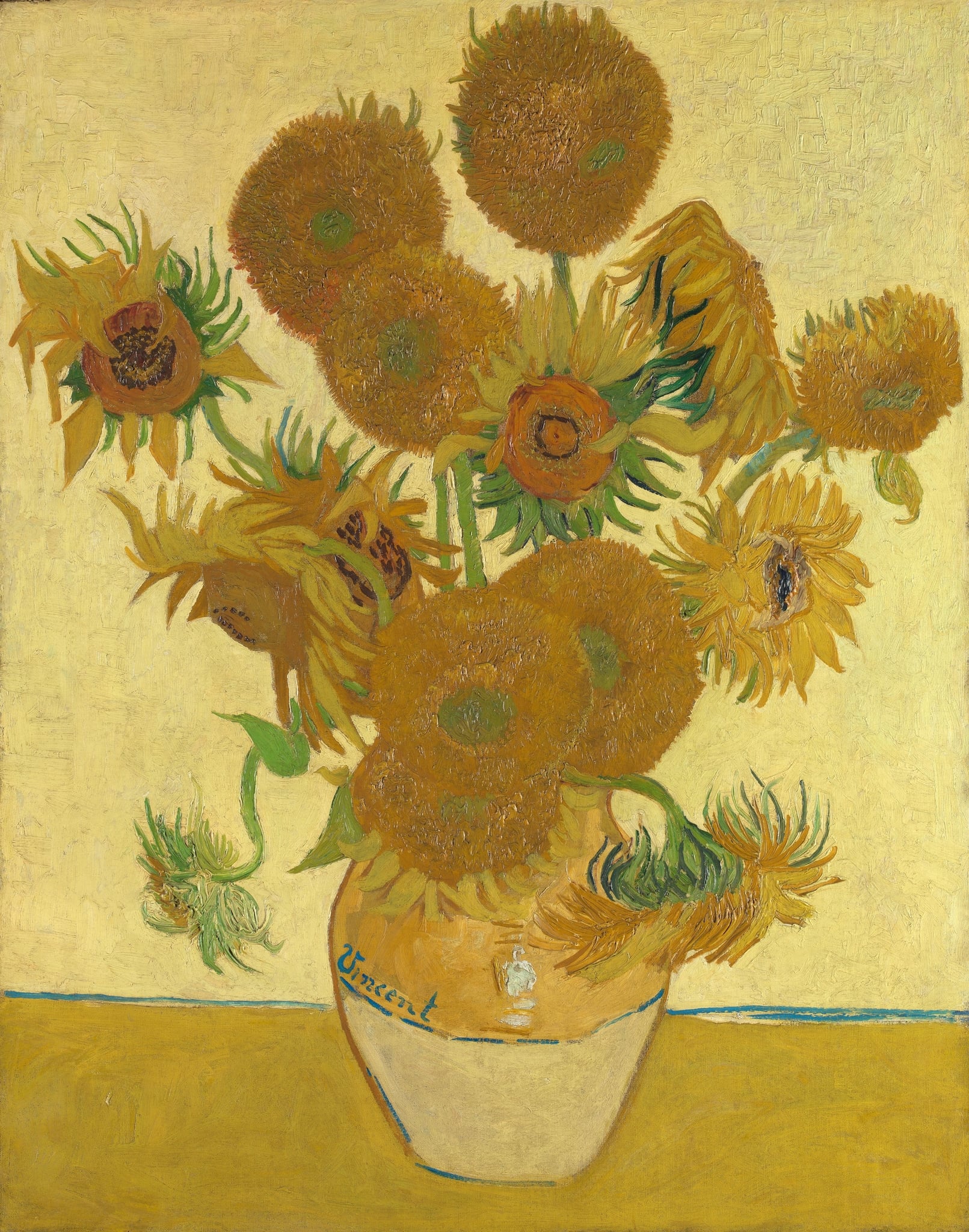
Vincent van Gogh’s Sunflowers (1888) is a <strong>yellow-on-yellow</strong> still life that stages a full <strong>cycle of life</strong> in fifteen blooms, from fresh buds to brittle seed heads. The thick impasto, green shocks of stem and bract, and the vase signed <strong>“Vincent”</strong> turn a humble bouquet into an emblem of endurance and fellowship <sup>[1]</sup><sup>[2]</sup>.

Garden with Courting Couples: Square Saint-Pierre by Vincent van Gogh

Garden with Courting Couples: Square Saint-Pierre

Vincent van Gogh (1887)

In Garden with Courting Couples: Square Saint-Pierre, Vincent van Gogh turns a small Montmartre park into a stage where <strong>spring</strong>, <strong>intimacy</strong>, and <strong>urban leisure</strong> converge. Short, shimmering strokes fuse pink chestnut blossoms, curving paths, and paired figures into one pulse of <strong>renewal</strong> and <strong>togetherness</strong> <sup>[1]</sup><sup>[2]</sup>.

In the Café: Agostina Segatori in Le Tambourin by Vincent van Gogh

In the Café: Agostina Segatori in Le Tambourin

Vincent van Gogh (1887 (Jan–Mar))

Van Gogh casts Agostina Segatori at a tiny, tambourine‑like café table, turning Le Tambourin into a <strong>stage of modern life</strong>. Cool greens and greys make the red <strong>flame‑plume hat</strong> and the foaming <strong>beer</strong> flare, while folded arms and a set‑aside <strong>parasol</strong> register private fatigue amid public display <sup>[1]</sup><sup>[2]</sup><sup>[3]</sup>.