Eugène Boch

by Vincent van Gogh

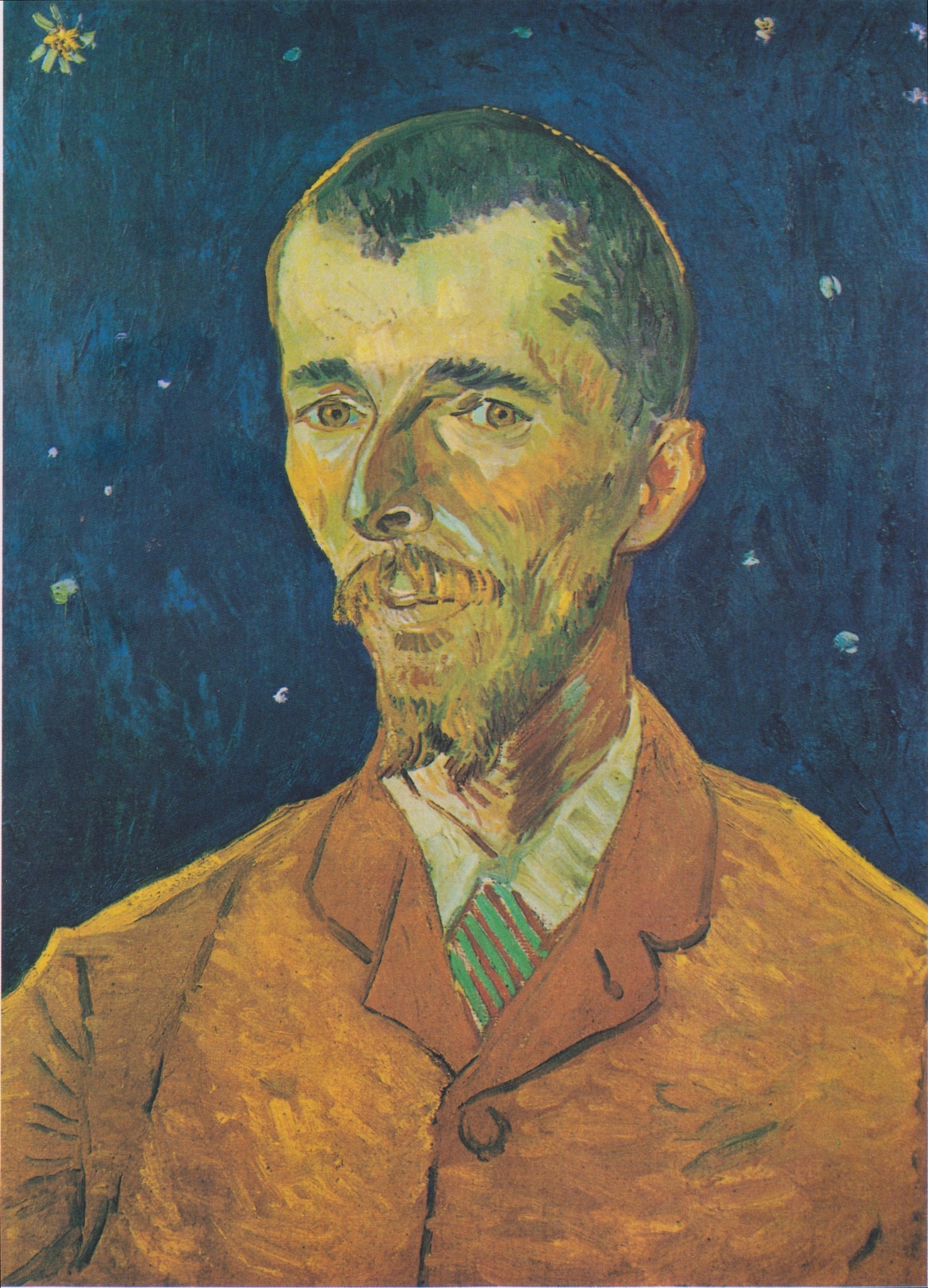
Vincent van Gogh’s 1888 portrait of Eugène Boch turns a friend into a visionary presence: a glowing, ocher head set before an infinite blue pricked with stars. The lone bright star at upper left and the cobalt field make the warm face and jacket vibrate from the night, declaring art as vocation rather than mere likeness [1][2].

Study Print Studio

Create a personal study print

Build a companion study sheet around the part of this painting that speaks to you most. Choose a detail, shape an interpretation, and walk away with something personal and display-worthy.

Fast Facts

Year
1888
Medium
Oil on canvas
Dimensions
60.3 × 45.4 cm
Location
Musée d’Orsay, Paris
See all Vincent van Gogh paintings in Paris
Eugène Boch by Vincent van Gogh (1888) featuring Lone bright star, Infinite blue night, Illuminated forehead and face, Green-striped tie and stiff collar

Click on any numbered symbol to learn more about its meaning

Meaning & Symbolism

Van Gogh engineers a deliberate collision between the everyday and the visionary. The canvas stages Boch’s angular, sulphur‑lit face and ocher jacket against a dense, marine blue that Van Gogh explicitly conceived as “infinity,” punctuated by a single radiant star in the upper left 12. The warm–cool confrontation is purposeful: oranges and yellows pitched against cobalt generate optical vibration so the head seems to lift off the surface, not by conventional modeling but by complementary contrast. The green‑striped tie and stiff collar insist on an ordinary, contemporary identity, yet the illuminated forehead and tense, directional strokes make the visage read as a thinking lamp—consciousness made visible. In letters written days apart, Van Gogh rejects “locally true” color for tones that suggest emotion, linking this portrait to his night pictures; the star and the deep blue are not background but thesis, an emblem for vocation and faith in art 23. The slight tremor in the eyes, set within acid greens and ochers, conveys nervous refinement; the beard and cheek planes break into faceted highlights, implying energy that comes as much from within as from the star without. The composition advances Van Gogh’s vision of the Artist‑Poet within the utopian “Studio of the South.” He cast Boch as the poet and intended the picture as a pendant to his portrait of Milliet, the lover—archetypes that he literally hung above his own bed, making them part of his lived environment and artistic creed 15. In this scheme, the lone star operates as a heraldic device, identifying not status but calling, while the ultramarine void substitutes the studio wall to proclaim a space of inward, limitless work 14. The portrait’s brushwork tightens across the jacket into short, urgent strokes, quickens into swirls and eddies in the sky, and softens around the eyes, creating a rhythm that binds earthbound matter to cosmological atmosphere. Such orchestration refutes the caricature of Van Gogh as purely impulsive; as scholars of his nocturnes stress, he arranges, enlarges, and simplifies to build symbol from color and stroke 4. Within the Arles year, when he pursued intense chromatic experiments and sought a community of painters, Eugène Boch becomes manifesto: an image that declares how painting can represent night by light, and likeness by idea. That is why Eugène Boch is important—because it fuses friendship, program, and poetics into a single, lucid emblem of modern portraiture 1346.

Explore Deeper with AI

Ask questions about Eugène Boch

Popular questions:

Powered by AI • Get instant insights about this artwork

💬 Ask questions about this artwork!

Interpretations

Formal Analysis

Van Gogh engineers an optical architecture in which complementary contrasts do the lifting. The ocher jacket and sulphur-lit flesh strike against a rich cobalt/ultramarine so that the head separates from the picture plane without academic modeling—an effect of simultaneous contrast and tightly varied brush pressures. Across the jacket, strokes are clipped and parallel; around the brow they lengthen and soften; in the blue they broaden into eddies, building a tempo that moves from mass to atmosphere. This calibrated staging contradicts the cliché of impulsivity: as Richard Thomson notes for the nocturnes, Van Gogh “arranges, enlarges, and simplifies” to convert color and stroke into symbolically legible form. Here, facture is not residue of feeling but a designed conduit of meaning, making the head appear to emit and receive light at once 453.

Source: MoMA; Richard Thomson

Symbolic Reading

The single star acts like a heraldic charge identifying calling rather than rank; Boch is cast as “The Poet,” a modern Dante. In letters Van Gogh planned “a star in the depths of an azure sky,” and the Musée d’Orsay underscores that he replaced the studio wall with infinity, making the blue not backdrop but thesis. Medievalizing scholarship has connected Vincent’s phrase “a Dante‑like face” to his crafting of a contemporary tre corone—poet, lover, painter—within the Studio of the South. In this key, the ultramarine field is both cosmos and device, a color‑ground that confers vocation while the star signals guidance and fidelity to art. Symbol and sitter interlock: cosmic emblem crowns everyday attire, translating biography into emblematic identity 127.

Source: Musée d’Orsay; Van Gogh Letters; Studies in Medievalism (Cambridge)

Historical Context

Conceived in Arles during the utopian Studio of the South, the portrait functioned within a live ecology of images. Van Gogh intended Boch (the Poet) as a pendant to Milliet (the Lover); miniature versions hang above his bed in the first Bedroom in Arles, literalizing his program as décor and dogma. This was also a social currency: Boch sat twice in one day; later, after Vincent’s death, Johanna van Gogh‑Bonger gifted the canvas back to Boch, who eventually bequeathed it to the French state—a networked trajectory from intimate manifesto to national patrimony. The Van Gogh Museum’s contemporaries catalogue reconstructs the role of friendships (via Dodge MacKnight) and portrait exchange in sustaining Vincent’s ambitions for a southern community of painters 681.

Source: Van Gogh Museum; Wikipedia (Bedroom in Arles); Musée d’Orsay

Psychological Interpretation

The portrait mobilizes period physiognomic cues to image intellect as light. The illuminated forehead, tense planar breaks in cheek and beard, and the slight tremor in the eyes create a field of inward agitation—“refined and nervous.” Set against the star‑studded ultramarine, the head reads as a cerebral luminary, a “thinking lamp.” Such sign‑making aligns with Van Gogh’s own metaphors for night as an arena where inner illumination becomes visible, and with broader 19th‑century discourses that located temperament and genius in cranial emphasis and gaze. The green‑striped tie and stiff collar tether this psychic charge to modern sociability; their ordinariness prevents mystic dissolution, anchoring vision to a living, working personality—an artist’s mind at work in real time 1024.

Source: Authenticity & Medievalism scholarship; Van Gogh Letters; MoMA

Theory of Color and Meaning

Van Gogh explicitly frames the portrait as an experiment in non‑local color “suggesting emotion,” aligning it with his nocturnes (Night Café, Sower). The chromatic grammar—orange/yellow vs. cobalt/ultramarine—is not descriptive but semantic: warmth carries presence and mortal thought; blue carries infinity and vocation. The single star punctuates the field as a node of value, while the blue’s saturation calibrates depth without chiaroscuro. In this sense the work is a treatise on mimesis: likeness is secured not by tonal modeling but by relational color that makes the head both appear and signify. As Colors of the Night materials stress, Van Gogh sought to picture night by light; here that axiom migrates into portraiture, where identity is rendered by idea structured as color 345.

Source: Van Gogh Letters; MoMA; Richard Thomson

Related Themes

About Vincent van Gogh

Vincent van Gogh (1853–1890) developed a radical, emotion‑driven use of color after moving from Paris to Arles in 1888, seeking southern light and an artists’ community. In Arles he created the Sunflowers series to decorate the Yellow House ahead of Gauguin’s visit. His late work fused impasto, high chroma, and symbolic motifs that shaped modern painting [2][5].
View all works by Vincent van Gogh

More by Vincent van Gogh
Café Terrace at Night by Vincent van Gogh

Café Terrace at Night

Vincent van Gogh (1888)

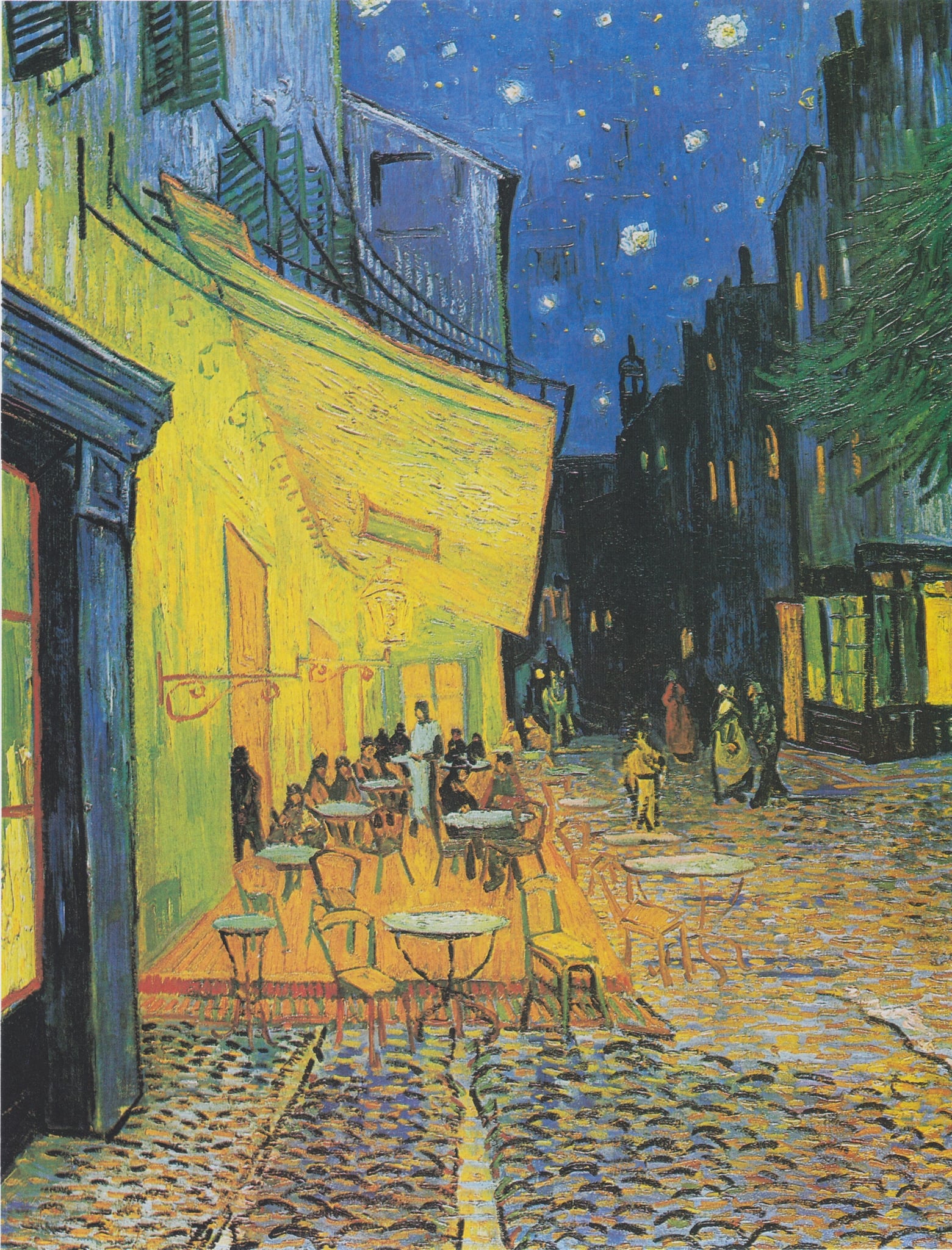
In Café Terrace at Night, Vincent van Gogh turns nocturne into <strong>luminous color</strong>: a gas‑lit terrace glows in yellows and oranges against a deep <strong>ultramarine sky</strong> pricked with stars. By building night “<strong>without black</strong>,” he stages a vivid encounter between human sociability and the vastness overhead <sup>[1]</sup><sup>[2]</sup>.
Red Cabbages and Onions by Vincent van Gogh

Red Cabbages and Onions

Vincent van Gogh (1887)

In Red Cabbages and Onions, Vincent van Gogh turns everyday produce into a drama of <strong>complementary color</strong> and <strong>restless brushwork</strong>. Hot red contours cinch violet cabbages and pale yellow bulbs against a cool, striated blue table, while a mustard‑yellow patch in the upper right tilts the space and sharpens the chromatic clash. The result asserts ordinary food as a locus of <strong>resilience</strong> and <strong>experimentation</strong> <sup>[1]</sup><sup>[2]</sup>.

Irises by Vincent van Gogh

Irises

Vincent van Gogh (1889)

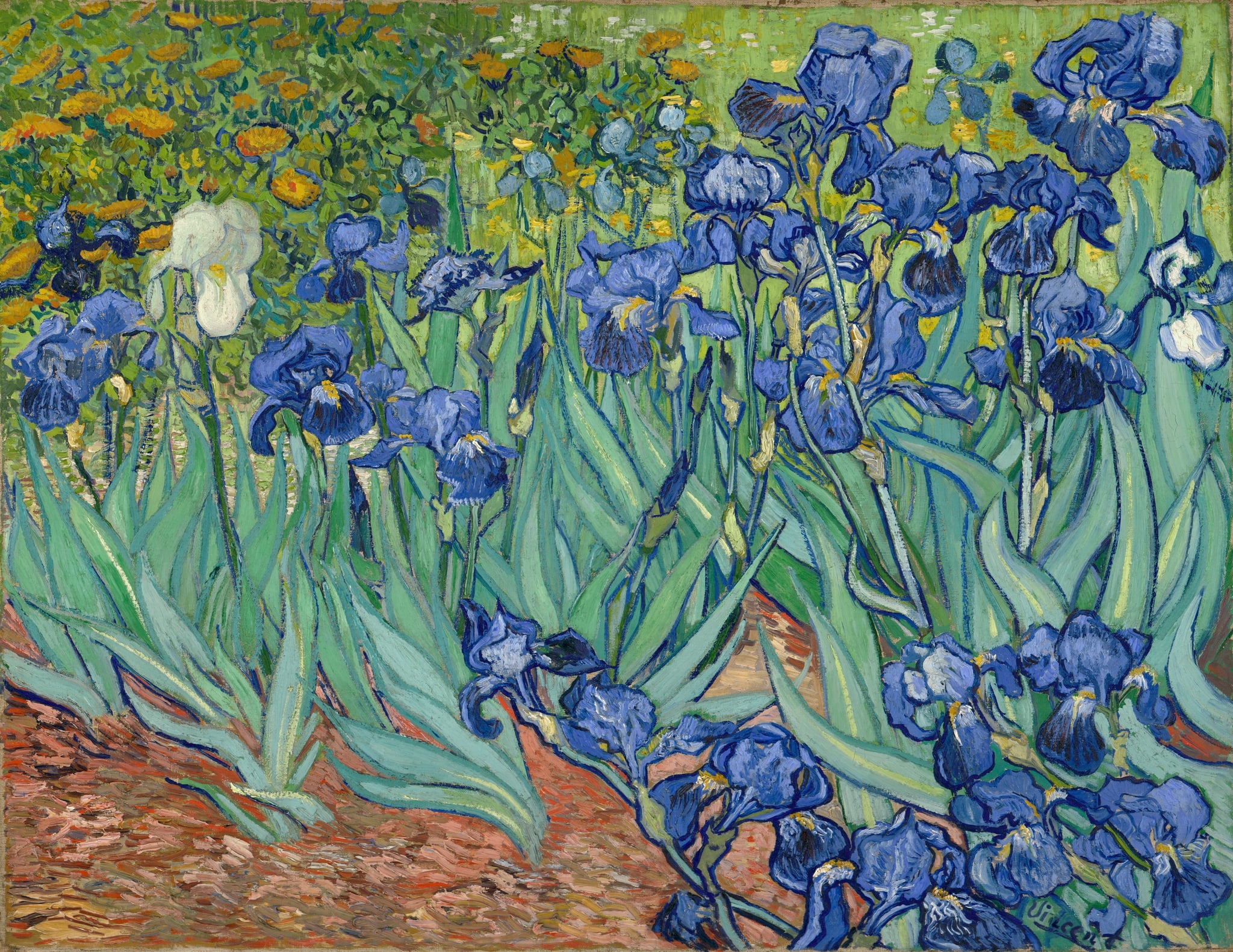
Painted in May 1889 at the Saint-Rémy asylum garden, Vincent van Gogh’s <strong>Irises</strong> turns close observation into an act of repair. Dark contours, a cropped, print-like vantage, and vibrating complements—violet/blue blossoms against <strong>yellow-green</strong> ground—stage a living frieze whose lone <strong>white iris</strong> punctuates the field with arresting clarity <sup>[1]</sup><sup>[2]</sup>.
Sunflowers by Vincent van Gogh

Sunflowers

Vincent van Gogh (1888)

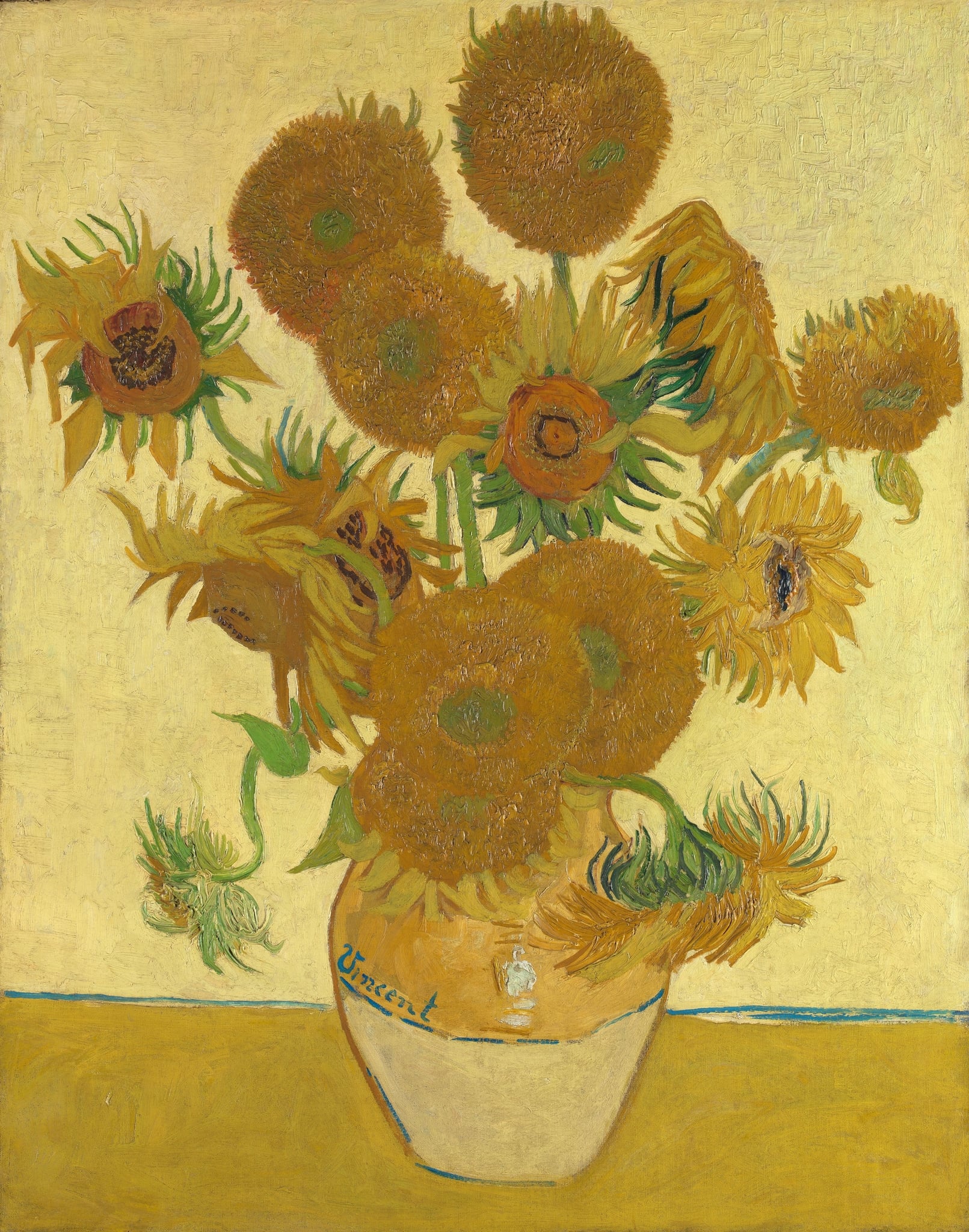
Vincent van Gogh’s Sunflowers (1888) is a <strong>yellow-on-yellow</strong> still life that stages a full <strong>cycle of life</strong> in fifteen blooms, from fresh buds to brittle seed heads. The thick impasto, green shocks of stem and bract, and the vase signed <strong>“Vincent”</strong> turn a humble bouquet into an emblem of endurance and fellowship <sup>[1]</sup><sup>[2]</sup>.

Garden with Courting Couples: Square Saint-Pierre by Vincent van Gogh

Garden with Courting Couples: Square Saint-Pierre

Vincent van Gogh (1887)

In Garden with Courting Couples: Square Saint-Pierre, Vincent van Gogh turns a small Montmartre park into a stage where <strong>spring</strong>, <strong>intimacy</strong>, and <strong>urban leisure</strong> converge. Short, shimmering strokes fuse pink chestnut blossoms, curving paths, and paired figures into one pulse of <strong>renewal</strong> and <strong>togetherness</strong> <sup>[1]</sup><sup>[2]</sup>.

In the Café: Agostina Segatori in Le Tambourin by Vincent van Gogh

In the Café: Agostina Segatori in Le Tambourin

Vincent van Gogh (1887 (Jan–Mar))

Van Gogh casts Agostina Segatori at a tiny, tambourine‑like café table, turning Le Tambourin into a <strong>stage of modern life</strong>. Cool greens and greys make the red <strong>flame‑plume hat</strong> and the foaming <strong>beer</strong> flare, while folded arms and a set‑aside <strong>parasol</strong> register private fatigue amid public display <sup>[1]</sup><sup>[2]</sup><sup>[3]</sup>.