Landscape with Ploughman

by Vincent van Gogh

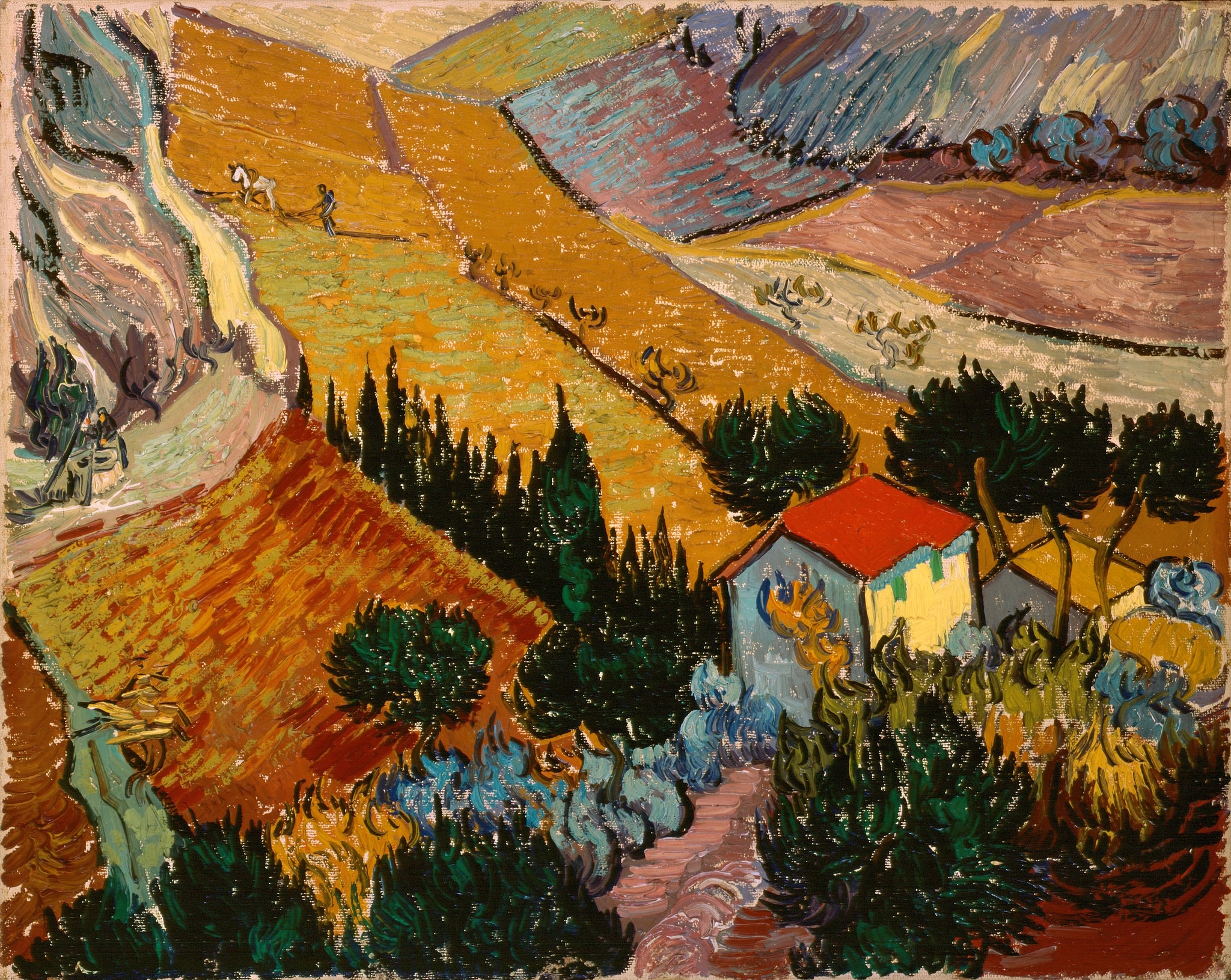
Landscape with Ploughman compresses a steep Provençal valley into a vibrating mosaic of fields where a tiny figure with a white horse furrows the slope. Van Gogh turns cypress spires, a flame‑red roof, and banded plots into a pulse of human labor within restless nature [1][5]. The painting fuses elevated viewpoint and directional brushwork to stage endurance as pattern and rhythm.

Study Print Studio

Create a personal study print

Build a companion study sheet around the part of this painting that speaks to you most. Choose a detail, shape an interpretation, and walk away with something personal and display-worthy.

Fast Facts

Year
1889
Medium
Oil on canvas
Dimensions
33 × 41.4 cm
Location
State Hermitage Museum, Saint Petersburg
See all Vincent van Gogh paintings in London
Landscape with Ploughman by Vincent van Gogh (1889) featuring Ploughman with white horse, Cypress spires, Red‑roofed house, Diagonal furrows and banded fields

Click on any numbered symbol to learn more about its meaning

Meaning & Symbolism

Van Gogh constructs meaning here by mapping labor onto landscape structure. From an elevated, almost aerial viewpoint, the hillside is broken into tilted bands—ochres, rusts, and pale violets—that read like interlocking facets. The ploughman and his white horse, set midway up the left slope, are not narrative protagonists so much as metronomes that measure the field’s tempo; their path is cut in urgent strokes that repeat the field’s diagonal thrust. This compositional compression—high horizon, steep tilt, patchwork segmentation—converts cultivation into a system of visual beats, asserting that work is woven into the land’s order rather than imposed upon it 15. Van Gogh’s own writing from early September 1889 underscores this program: he pairs “purplish ploughed earth” with “yellow stubble,” presenting chromatic oppositions as emblems of seasonal rhythm and perseverance 34. The painting enacts those oppositions through complementary chords—yellow‑orange fields against blue‑green shrubs; a red roof anchoring a field of greens—so that color itself becomes a thesis about endurance and renewal. Technique is argument. Thick, directional strokes ripple across the plots like waves; cypresses rise as flamelike spires; shrubs curl in smoky eddies along the paths. The facture animates inert ground, implying that nature labors too. Smarthistory’s technical studies of Van Gogh’s Saint‑Rémy ploughman canvases demonstrate how raking light reveals ridged strokes that channel movement—precisely the effect visible in the furrows and tree masses here, where gesture fuses human and vegetal energies 6. The small house with its incandescent red roof and cool shadowed walls functions as a stabilizing counterform, a human foothold that neither dominates nor disappears. Its cubic certainty and the cypress palisade beside it set a measure of order against the fields’ undulation, proposing that stability and striving are complementary states rather than rivals. Culturally and biographically, the picture voices recovery. Painted during Van Gogh’s Saint‑Rémy year, shortly after episodes of illness, the ploughman motif marks his return to sustained work and his insistence on finding purpose in disciplined repetition 57. Critics have read related canvases from September–October 1889 as declarations of resumed effort following crisis; that reading fits the present work’s dramaturgy, where a diminutive laborer persists within an overwhelming terrain yet is energized by it 7. The aerial tilt—“seen from above”—also nudges the scene toward abstraction, a hallmark of Van Gogh’s mature Saint‑Rémy synthesis: nature is rendered not as topographic record but as a patterned vitality charged with spiritual import 5. Cypresses, so characteristic of Provence, stand here as vertical flames that recur across his late landscapes, signposting continuity within change 5. Ultimately, the meaning of Landscape with Ploughman is ethical and existential. The tiny figure, almost absorbed into the fields, becomes an emblem of a human scale of hope—sowing, turning, returning—nested within the earth’s larger pulse. The painting’s insistent diagonals and vibrating complements do not just depict a valley; they legislate a rhythm in which effort and season interlock. That is why Landscape with Ploughman is important: it distills Van Gogh’s Saint‑Rémy project—color as conviction, line as labor, viewpoint as insight—into a compact credo of persistence that continues to read as both personal testimony and universal cycle 135.

Explore Deeper with AI

Ask questions about Landscape with Ploughman

Popular questions:

Powered by AI • Get instant insights about this artwork

💬 Ask questions about this artwork!

Interpretations

Formal Analysis: Chromatic Counterpoint as Structure

Beyond complementaries for their own sake, Van Gogh uses color to legislate spatial and ethical order. The yellow–violet and red–green oppositions act like counterpointed voices: warm fields surge forward while cool shrubs and shadows retard motion, producing alternating “beats” that the ploughman’s diagonal path syncopates. This is not merely depiction but a color‑governed meter that binds human effort to seasonal change. Letters from early September 1889 explicitly pair “purplish ploughed earth” with “yellow stubble,” signaling a programmatic chromatic grammar for labor and renewal; Saint‑Rémy canvases consistently exploit such polarities to clarify form while intensifying mood. In this picture the house’s incandescent red roof functions as a tonal anchor—an islet of stability in a sea of vibrating complements—so that color both organizes the ground and ethicizes it as perseverance made visible 123.

Source: The Met (Heilbrunn Timeline of Art History); Van Gogh Letters; Museum of Fine Arts, Boston

Technical/Material Reading: Facture as Kinetic Field

Under raking light, related Saint‑Rémy ploughman canvases reveal ridged impasto that channels direction like furrows in paint. That insight clarifies this work’s argument: the earth’s “motion” is not an illusionistic effect but a material condition of the surface. Thick, directional strokes traverse plots in waves; cypress forms are built as flamelike spires by stacked, ductile marks. Such facture performs labor—paint is pushed, dragged, and corrugated—so that the act of making mirrors the act depicted. The result is medium reflexivity: the painting demonstrates how gesture can be an engine of landscape meaning, collapsing the divide between human and vegetal energies into one vibrating skin. Technique, here, is not ornament; it is ontology—how the land exists on the canvas as worked, rhythmic matter 4.

Source: Smarthistory (technical study with MFA Boston)

Viewpoint & Modern Visuality: Aerial Tilt as Map-Thinking

The “seen from above” tilt doesn’t just dramatize slope; it imports a cartographic logic into painting. Parcels become tesserae, paths become vectors, and the ploughman–horse unit serves as a scale marker that lets viewers read distance like a map. This modernized pastoral subsumes anecdote to pattern, aligning Van Gogh’s Saint‑Rémy synthesis—heightened contour, planar compression, chromatic orchestration—with a quasi‑abstract overview. The Hermitage canvas’s high horizon and tilted bands therefore enact a new surveying gaze, one part devotional to place, one part analytical, converting local agriculture into a legible system of flows. Such elevated vision—neither topographical exactitude nor pure fantasy—models the artist’s desire to grasp nature’s structure while intensifying its felt rhythm through design 16.

Source: The Met (Heilbrunn Timeline of Art History); State Hermitage Museum

Iconographic Lineage: Millet, Cycles, and the Ethics of Toil

Van Gogh’s ploughman stands in dialogue with Millet’s peasant cycle, yet the emphasis shifts from moralizing genre to cosmic cadence. Letters from early September 1889 frame the motif through paired hues—“yellow stubble” versus “purplish earth”—as signs of seasonal turnover. The Boston “Enclosed Field with Ploughman” commentary consolidates this: agrarian figures (sower, reaper, ploughman) map human life onto the year’s revolving tasks. In the Hermitage picture, that program is distilled: the figure is diminutive, almost absorbed by the land, yet the diagonal tempo and chromatic pulses elevate his action into rite. Rather than narrate a day’s work, the canvas codifies repetition as dignity, translating peasant labor into a cyclical ethic legible in color, contour, and compressed space 23.

Source: Museum of Fine Arts, Boston; Van Gogh Letters (Van Gogh Museum/Huygens Institute)

Psychological/Biographical Lens: Recovery as Discipline

Christie’s dates a related ploughman canvas to early September 1889 as Van Gogh’s first sustained return to work after crisis, a reading that illuminates this variant’s dramaturgy: a small agent persevering within an overwhelming but energizing terrain. The motif becomes a self‑portrait by proxy, where disciplined repetition—furrow after furrow, stroke after stroke—rehearses recovery. Letters from this period describe cautious resumption and a narrowed repertoire drawn from the asylum’s environs, which the artist amplifies into mythic rhythm via tilted planes and vibrating complements. The painting thus externalizes a mental state: order wrested from turmoil through measured effort, with the red‑roofed house functioning as a cognitive anchor—stability neither dominating nor receding, but coexisting with flux 52.

Source: Christie’s (lot essay on Laboureur dans un champ); Van Gogh Letters

Reception/Provenance: Trophy Art and the Politics of Visibility

The Hermitage canvas’s 20th‑century fate—once in Otto Krebs’s collection, long presumed lost, then revealed among Soviet-seized “trophy art” in 1995—casts its pastoral ethic into a geopolitical register. A painting about cultivation and renewal accrued a history of displacement, secrecy, and postwar power, reminding viewers that artworks’ meanings travel with their custodial narratives. Its reemergence altered scholarly access and public memory: a Saint‑Rémy experiment in color and rhythm reentered discourse through the politics of restitution debates and national collections. Thus the image’s quiet ploughing now also indexes bureaucratic afterlives, where visibility is contingent on conflict, archive, and state policy—an inadvertent allegory of how cultural labor can be interrupted and later resumed on a historical scale 768.

Source: Apollo Magazine; State Hermitage Museum; The Independent

Related Themes

About Vincent van Gogh

Vincent van Gogh (1853–1890) developed a radical, emotion‑driven use of color after moving from Paris to Arles in 1888, seeking southern light and an artists’ community. In Arles he created the Sunflowers series to decorate the Yellow House ahead of Gauguin’s visit. His late work fused impasto, high chroma, and symbolic motifs that shaped modern painting [2][5].
View all works by Vincent van Gogh

More by Vincent van Gogh
Café Terrace at Night by Vincent van Gogh

Café Terrace at Night

Vincent van Gogh (1888)

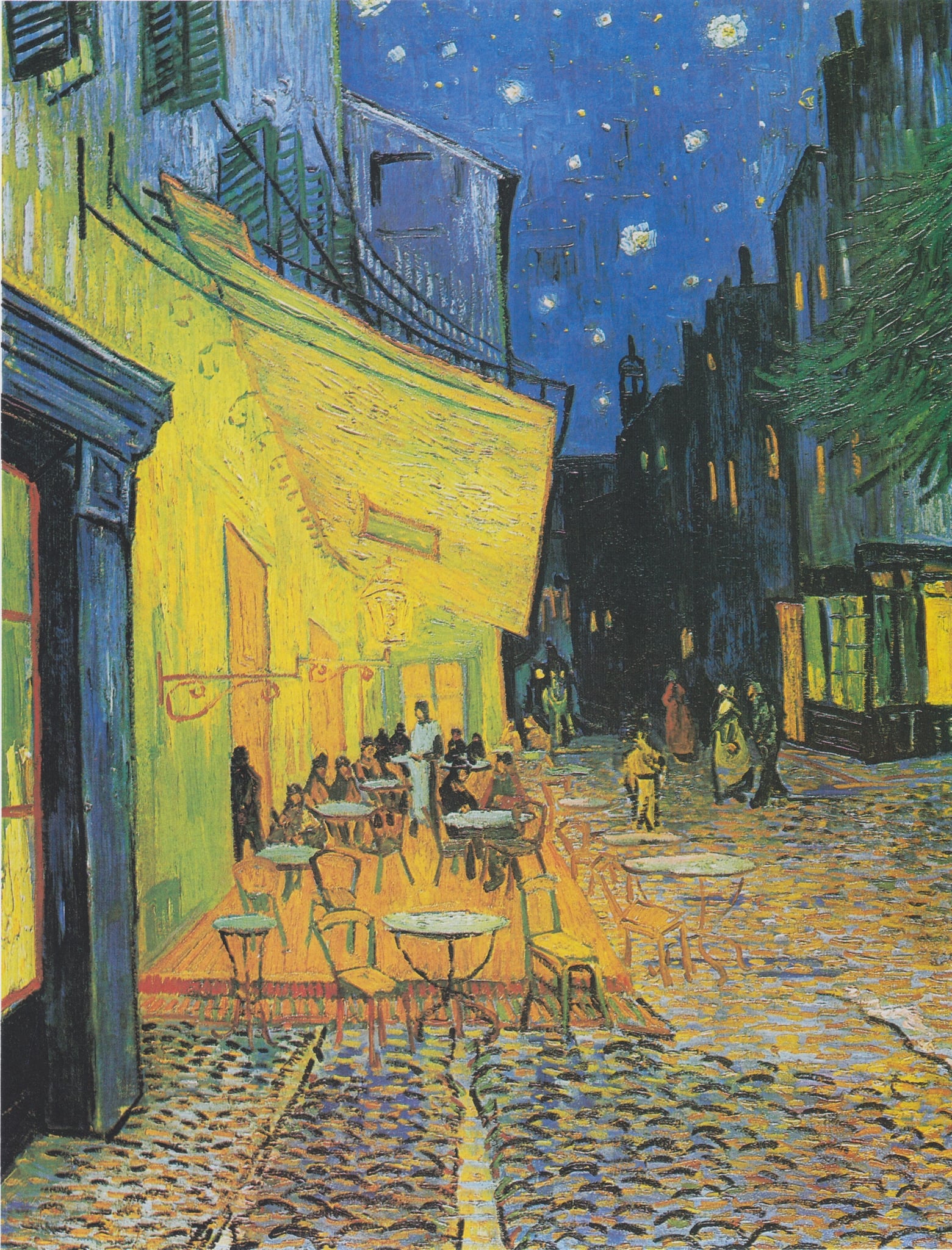
In Café Terrace at Night, Vincent van Gogh turns nocturne into <strong>luminous color</strong>: a gas‑lit terrace glows in yellows and oranges against a deep <strong>ultramarine sky</strong> pricked with stars. By building night “<strong>without black</strong>,” he stages a vivid encounter between human sociability and the vastness overhead <sup>[1]</sup><sup>[2]</sup>.
Red Cabbages and Onions by Vincent van Gogh

Red Cabbages and Onions

Vincent van Gogh (1887)

In Red Cabbages and Onions, Vincent van Gogh turns everyday produce into a drama of <strong>complementary color</strong> and <strong>restless brushwork</strong>. Hot red contours cinch violet cabbages and pale yellow bulbs against a cool, striated blue table, while a mustard‑yellow patch in the upper right tilts the space and sharpens the chromatic clash. The result asserts ordinary food as a locus of <strong>resilience</strong> and <strong>experimentation</strong> <sup>[1]</sup><sup>[2]</sup>.

Irises by Vincent van Gogh

Irises

Vincent van Gogh (1889)

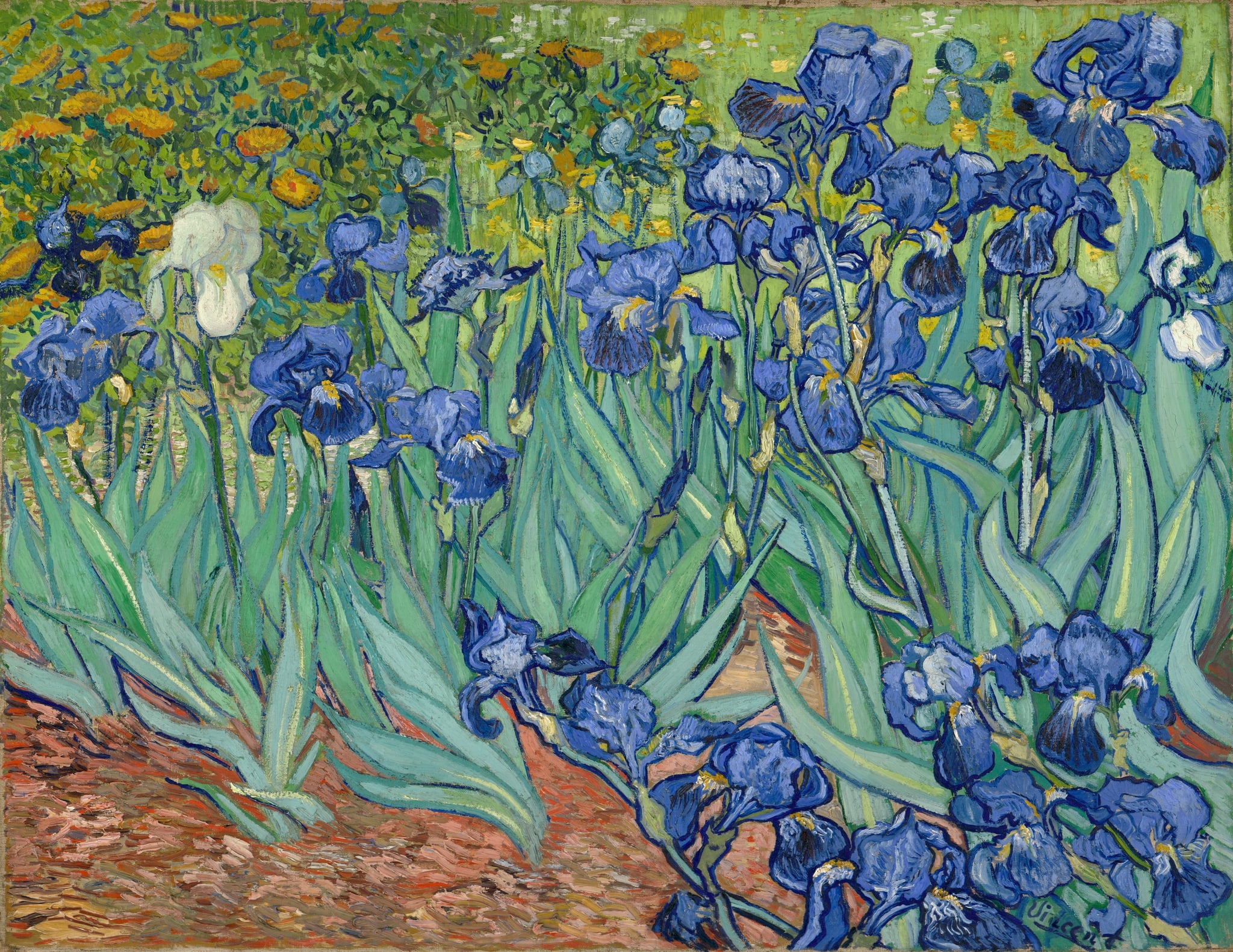
Painted in May 1889 at the Saint-Rémy asylum garden, Vincent van Gogh’s <strong>Irises</strong> turns close observation into an act of repair. Dark contours, a cropped, print-like vantage, and vibrating complements—violet/blue blossoms against <strong>yellow-green</strong> ground—stage a living frieze whose lone <strong>white iris</strong> punctuates the field with arresting clarity <sup>[1]</sup><sup>[2]</sup>.
Sunflowers by Vincent van Gogh

Sunflowers

Vincent van Gogh (1888)

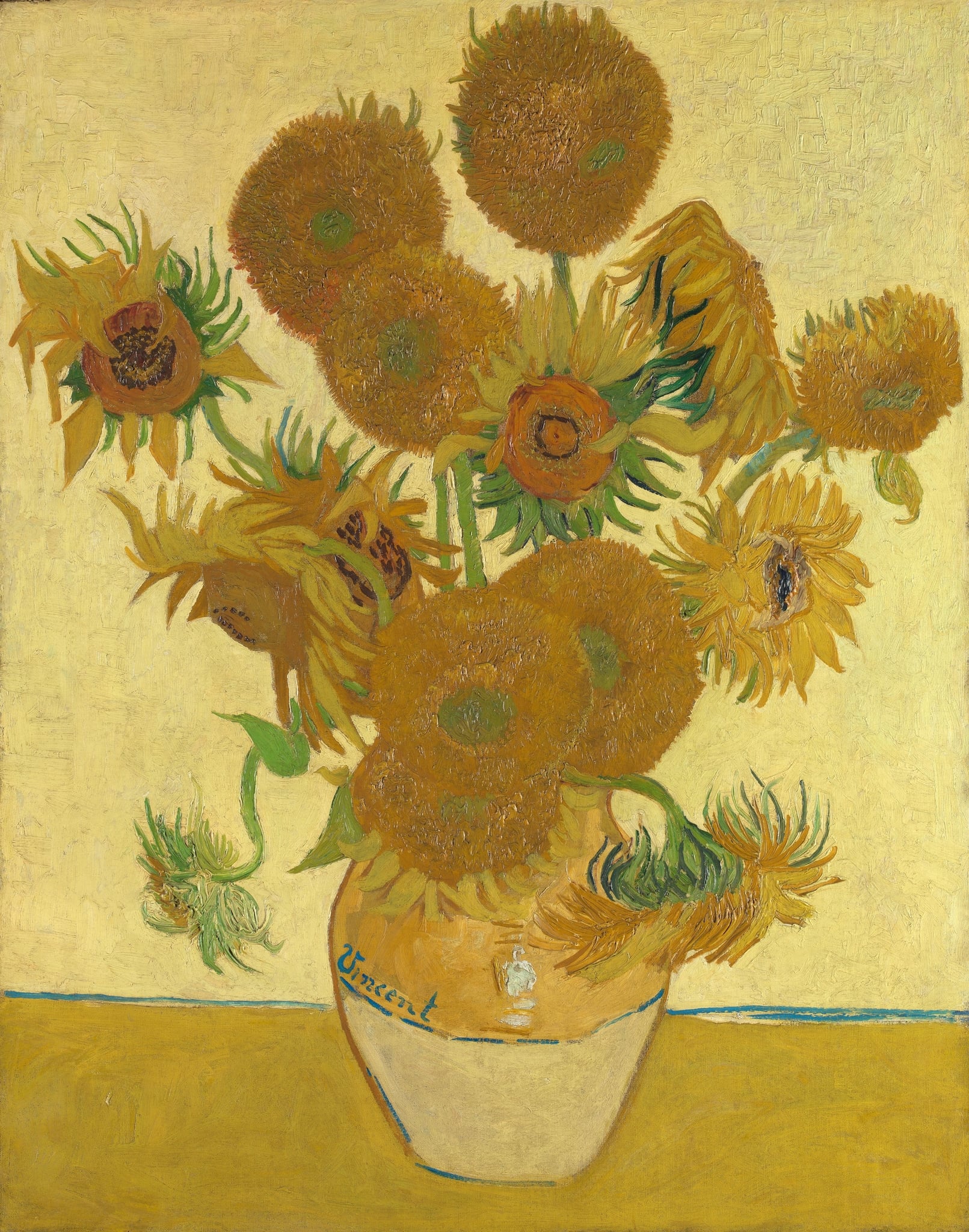
Vincent van Gogh’s Sunflowers (1888) is a <strong>yellow-on-yellow</strong> still life that stages a full <strong>cycle of life</strong> in fifteen blooms, from fresh buds to brittle seed heads. The thick impasto, green shocks of stem and bract, and the vase signed <strong>“Vincent”</strong> turn a humble bouquet into an emblem of endurance and fellowship <sup>[1]</sup><sup>[2]</sup>.

Garden with Courting Couples: Square Saint-Pierre by Vincent van Gogh

Garden with Courting Couples: Square Saint-Pierre

Vincent van Gogh (1887)

In Garden with Courting Couples: Square Saint-Pierre, Vincent van Gogh turns a small Montmartre park into a stage where <strong>spring</strong>, <strong>intimacy</strong>, and <strong>urban leisure</strong> converge. Short, shimmering strokes fuse pink chestnut blossoms, curving paths, and paired figures into one pulse of <strong>renewal</strong> and <strong>togetherness</strong> <sup>[1]</sup><sup>[2]</sup>.

In the Café: Agostina Segatori in Le Tambourin by Vincent van Gogh

In the Café: Agostina Segatori in Le Tambourin

Vincent van Gogh (1887 (Jan–Mar))

Van Gogh casts Agostina Segatori at a tiny, tambourine‑like café table, turning Le Tambourin into a <strong>stage of modern life</strong>. Cool greens and greys make the red <strong>flame‑plume hat</strong> and the foaming <strong>beer</strong> flare, while folded arms and a set‑aside <strong>parasol</strong> register private fatigue amid public display <sup>[1]</sup><sup>[2]</sup><sup>[3]</sup>.