Riverbank with Trees

by Vincent van Gogh

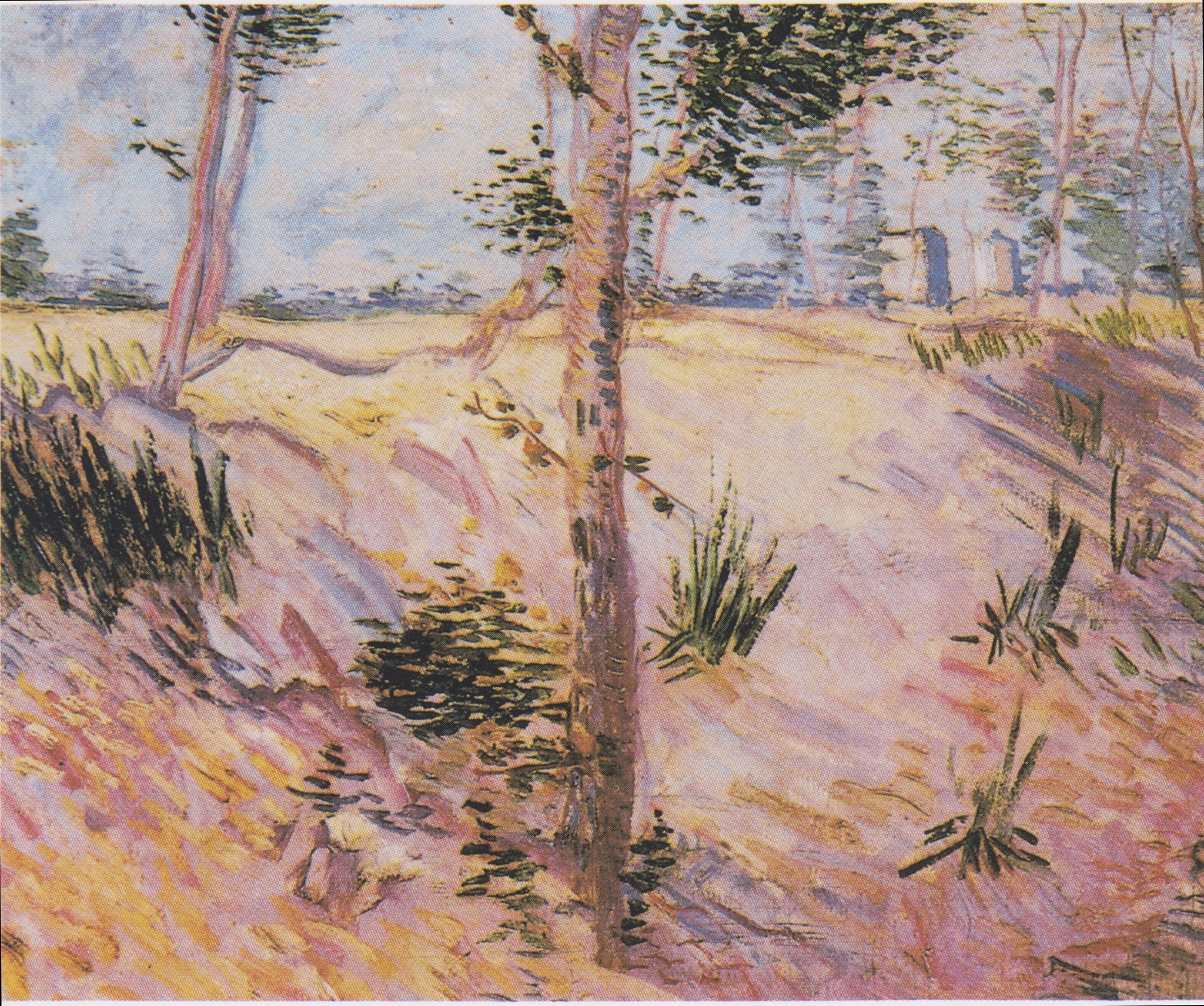
Riverbank with Trees is a compact 1887 study in which Vincent van Gogh turns a modest Seine embankment into a field of vibration and light. Diagonal sweeps of lilac and ochre sand collide with staccato foliage and a single upright trunk, fusing observation with sensation [1][2].

Study Print Studio

Create a personal study print

Build a companion study sheet around the part of this painting that speaks to you most. Choose a detail, shape an interpretation, and walk away with something personal and display-worthy.

Fast Facts

Year
1887
Medium
Oil on canvas
Dimensions
37 × 45.5 cm (alt. record 36.5 × 45 cm)
Location
Rijksmuseum, Amsterdam
See all Vincent van Gogh paintings in Amsterdam
Riverbank with Trees by Vincent van Gogh (1887) featuring Central upright tree trunk, Diagonal sandy embankment, Staccato foliage/leaf flecks, Dark hollow/shadow

Click on any numbered symbol to learn more about its meaning

Meaning & Symbolism

Van Gogh structures the scene around a slender, bark‑scored trunk planted near the center, a vertical that fixes the viewer’s eye while the rest of the surface flickers. Around it, the sandy embankment lifts diagonally from lower left to upper right, built from quick, angled strokes of lilac, rose, ochre, and pale yellow that refuse to settle into a single tone. The eye reads these marks not as inert matter but as heat and breeze made visible. Tufts of grass jab into the slope as dark, calligraphic bursts; a shallow, darker hollow gathers tight black‑green strokes that compact the picture’s energy before it disperses again across the sun‑struck sand. Above, a high, airy blue sky is mottled with light; on the horizon, tree forms dissolve into small, vibrating touches. This division of stroke types—dots and flecks for foliage, brisk dashes for soil, broader strokes for sky—enacts a deliberate code of perception that van Gogh refined along the Seine in 1887 under Neo‑Impressionist influence 25. The motif is a riverbank, but the subject is sensation. The picture’s modernity is compositional as well as technical. Van Gogh crops close to the bank, lowering the viewpoint and pushing the horizon up, so that the frame captures a borderland rather than a postcard vista. The Seine at Asnières functioned as a physical and cultural threshold, where leisure and industry intermingled on the edge of Paris; even when factories and bridges stay offstage, this edge quality persists in the way the ground and sky squeeze the image into a shallow, frontal stage 14. In Riverbank with Trees, the diagonal sweep of sand becomes a vector of time—of passing light—while the central trunk acts as a compositional metronome, counting beats against the restless rhythm of marks. That stabilizing vertical is not a literary symbol but a formal emblem of endurance inside a world of flux, a role trees often play in van Gogh’s nature imagery even when no explicit allegory is intended 2. By yoking a steady axis to flicker and drift elsewhere, he locates equilibrium inside instability—the very balance that would preoccupy him from Paris through Arles. Materially, the painting declares a method learned in 1887: work en plein air along the Seine with a field easel; sketch the placement quickly; then differentiate touch by element—short, dotted or comma‑like marks for foliage; longer, slanted strokes for ground; more open, broader handling for the sky 5. In this canvas, the lilac‑rose notes in the sand are not pastel softeners but chromatic counterpoints that heighten the yellows and greens, a colorist decision typical of van Gogh’s shift “from dark to light” in Paris 6. The result is a small panel that registers wind and heat as palpably as objects. Its importance within his oeuvre is diagnostic: it shows him testing how far touch and color alone can carry meaning before resorting to narrative cues. The Rijksmuseum rightly stresses its function as a close‑up study of a Seine bank where he trials bright, vibrating color, short strokes, and a modern cut of the scene 1. Read today, Riverbank with Trees demonstrates how van Gogh’s Paris laboratory distilled the felt weather of the mind into paint, turning a scrap of river edge into an enduring proposition about seeing in the modern world 234.

Explore Deeper with AI

Ask questions about Riverbank with Trees

Popular questions:

Powered by AI • Get instant insights about this artwork

💬 Ask questions about this artwork!

Interpretations

Formal Analysis

Riverbank with Trees organizes perception through a Divisionist syntax: dotted or comma‑like touches for foliage, slanted dashes for the sandy bank, more open strokes for sky—a triadic handling that lets viewers parse light, air, and ground by touch alone 2. Color functions contrapuntally: lilac‑rose flecks in the sand intensify adjacent yellows and greens, a high‑key strategy from Van Gogh’s Paris turn “from dark to light” 5. The centralized, bark‑scored trunk locks a vibrating field into balance, acting as an axial counterweight to the diagonal bank. Rather than decorate, these choices operationalize sensation—turning brush and hue into carriers of heat shimmer and breeze. The result is a small panel that reads like a score: tempo (stroke length), timbre (pigment mixtures), and rhythm (mark density) performing seeing in time 12.

Source: Van Gogh Museum; Rijksmuseum

Historical Context

Painted along the Seine at Asnières in summer 1887, the picture belongs to a cluster of roughly forty works where Van Gogh trialed high‑key palettes and broken touch amid a rapidly modernizing suburb 34. Asnières was a liminal zone—cafés, rowing clubs, factories, bridges—where leisure and industry collided. Even without smokestacks in frame, the low vantage and close crop stage the bank as a modern edge, compressing depth and accelerating the scan of the eye, akin to how urban speed conditioned looking in the 1880s 34. In this setting, Van Gogh adopted and adapted Neo‑Impressionist tactics visible along the river (Seurat, Signac), but redirected them to quick en plein air studies. The painting thus records not just a site, but a historical tempo: suburban expansion, optical science, and new pictorial cuts coalescing at the water’s edge 34.

Source: Van Gogh Museum; Art Institute of Chicago

Medium Reflexivity

The work “declares its method”: field easel on site, rapid layout, then differentiated stroke-families keyed to element—material procedures that become legible content 6. In sister Seine studies, underdrawing in graphite and modular touches reveal a process designed to translate phenomena into repeatable marks (dots, dashes, strokes) 6. Here, that partitioning reads as a deliberate code of perception, making the canvas both image and diagram of looking 2. The lilac‑rose accents serve chromatic counterpoint rather than local color, signaling that color relations—not object imitation—drive meaning 5. In short, Riverbank with Trees is a reflexive exercise: a painting about how painting can register wind and heat without resorting to narrative, its surface inviting viewers to “read” technique as subject 256.

Source: Van Gogh Museum

Comparative Influence and Divergence

Van Gogh’s 1887 Seine practice engages Neo‑Impressionism—adopting Seurat/Signac’s optical division of tone—yet diverges from Pointillist systemization in favor of tempo and touch responsive to motif 23. Dots and flecks articulate foliage vibration; longer strokes tally the bank’s drift; broader sky handling breathes—an elastic grammar rather than a fixed grid. High‑key complements (lilac/rose against yellow/green) intensify luminosity without strict chromoluminarist doctrine 5. This hybridization underscores authorship: Van Gogh absorbs the movement’s optical insights but keeps hand and speed visible, preserving en plein air immediacy. Riverbank with Trees thus sits at a crossroads—less a doctrinaire Pointillist exercise than a personal idiom that weds scientific color to embodied mark, anticipating the expressive intensities of Arles 235.

Source: Van Gogh Museum

Psychological Interpretation (with caveat)

Without Paris‑period letters tying this panel to a fixed program, psychological readings must proceed cautiously 7. Yet the composition’s stabilized vertical (the slender trunk) against a field of flicker suggests a recurring Van Gogh strategy: locating an axis of endurance within flux 2. The diagonal bank—“a vector of time”—and the restless, subdivided marks externalize transient weather and, by extension, a mobile inner state—the “felt weather of the mind” carried by touch and color 2. Museum texts affirm that in Paris he sought to express moods through chroma and brushwork; here, sensation becomes structure 25. The picture thereby models equilibrium under instability: a poised self amid passing light, achieved not by symbol but by the calibrated pressure, length, and direction of the stroke 257.

Source: Van Gogh Museum; Will Atkinson

Related Themes

About Vincent van Gogh

Vincent van Gogh (1853–1890) developed a radical, emotion‑driven use of color after moving from Paris to Arles in 1888, seeking southern light and an artists’ community. In Arles he created the Sunflowers series to decorate the Yellow House ahead of Gauguin’s visit. His late work fused impasto, high chroma, and symbolic motifs that shaped modern painting [2][5].
View all works by Vincent van Gogh

More by Vincent van Gogh
Café Terrace at Night by Vincent van Gogh

Café Terrace at Night

Vincent van Gogh (1888)

In Café Terrace at Night, Vincent van Gogh turns nocturne into <strong>luminous color</strong>: a gas‑lit terrace glows in yellows and oranges against a deep <strong>ultramarine sky</strong> pricked with stars. By building night “<strong>without black</strong>,” he stages a vivid encounter between human sociability and the vastness overhead <sup>[1]</sup><sup>[2]</sup>.
Red Cabbages and Onions by Vincent van Gogh

Red Cabbages and Onions

Vincent van Gogh (1887)

In Red Cabbages and Onions, Vincent van Gogh turns everyday produce into a drama of <strong>complementary color</strong> and <strong>restless brushwork</strong>. Hot red contours cinch violet cabbages and pale yellow bulbs against a cool, striated blue table, while a mustard‑yellow patch in the upper right tilts the space and sharpens the chromatic clash. The result asserts ordinary food as a locus of <strong>resilience</strong> and <strong>experimentation</strong> <sup>[1]</sup><sup>[2]</sup>.

Irises by Vincent van Gogh

Irises

Vincent van Gogh (1889)

Painted in May 1889 at the Saint-Rémy asylum garden, Vincent van Gogh’s <strong>Irises</strong> turns close observation into an act of repair. Dark contours, a cropped, print-like vantage, and vibrating complements—violet/blue blossoms against <strong>yellow-green</strong> ground—stage a living frieze whose lone <strong>white iris</strong> punctuates the field with arresting clarity <sup>[1]</sup><sup>[2]</sup>.
Sunflowers by Vincent van Gogh

Sunflowers

Vincent van Gogh (1888)

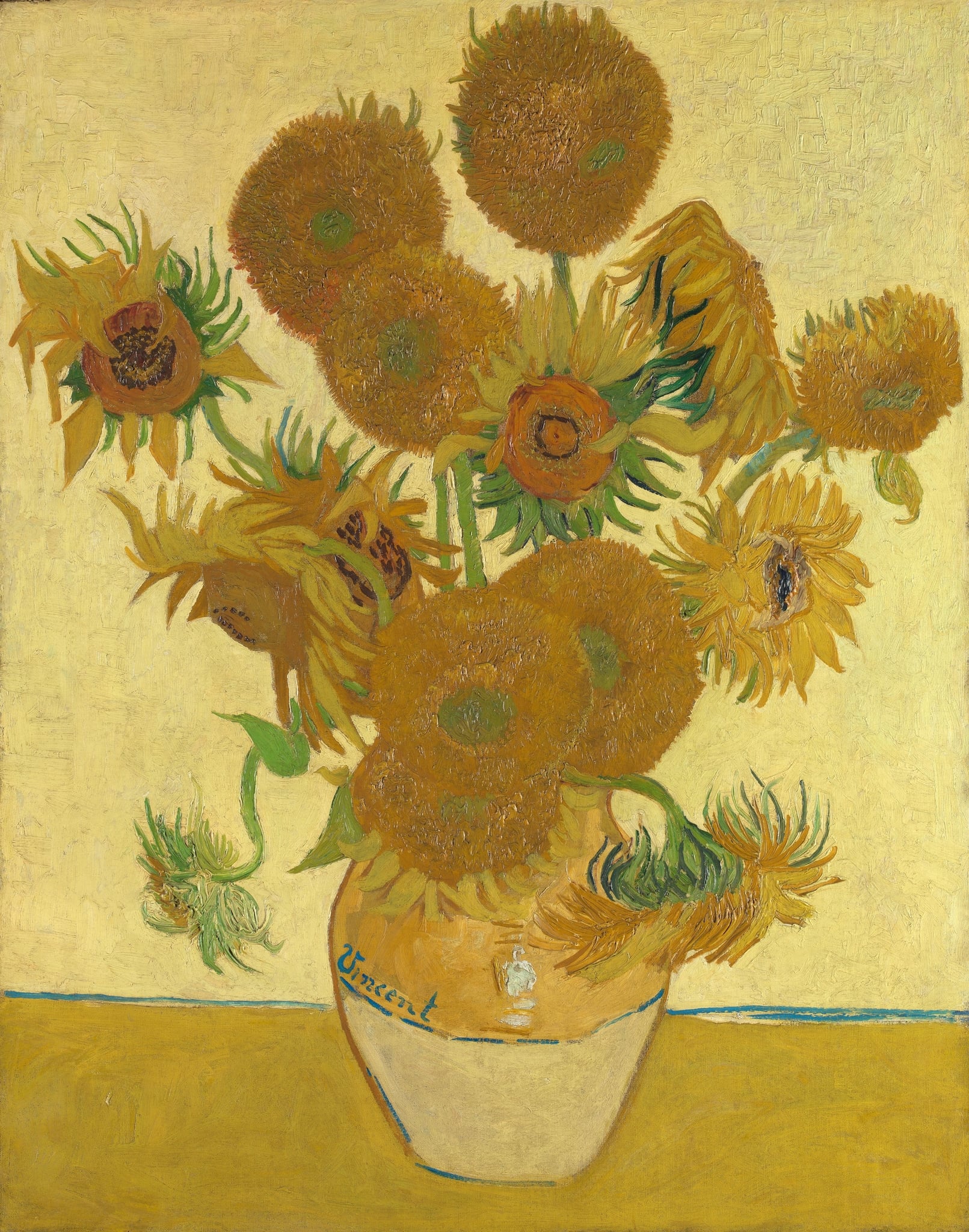
Vincent van Gogh’s Sunflowers (1888) is a <strong>yellow-on-yellow</strong> still life that stages a full <strong>cycle of life</strong> in fifteen blooms, from fresh buds to brittle seed heads. The thick impasto, green shocks of stem and bract, and the vase signed <strong>“Vincent”</strong> turn a humble bouquet into an emblem of endurance and fellowship <sup>[1]</sup><sup>[2]</sup>.

Garden with Courting Couples: Square Saint-Pierre by Vincent van Gogh

Garden with Courting Couples: Square Saint-Pierre

Vincent van Gogh (1887)

In Garden with Courting Couples: Square Saint-Pierre, Vincent van Gogh turns a small Montmartre park into a stage where <strong>spring</strong>, <strong>intimacy</strong>, and <strong>urban leisure</strong> converge. Short, shimmering strokes fuse pink chestnut blossoms, curving paths, and paired figures into one pulse of <strong>renewal</strong> and <strong>togetherness</strong> <sup>[1]</sup><sup>[2]</sup>.

In the Café: Agostina Segatori in Le Tambourin by Vincent van Gogh

In the Café: Agostina Segatori in Le Tambourin

Vincent van Gogh (1887 (Jan–Mar))

Van Gogh casts Agostina Segatori at a tiny, tambourine‑like café table, turning Le Tambourin into a <strong>stage of modern life</strong>. Cool greens and greys make the red <strong>flame‑plume hat</strong> and the foaming <strong>beer</strong> flare, while folded arms and a set‑aside <strong>parasol</strong> register private fatigue amid public display <sup>[1]</sup><sup>[2]</sup><sup>[3]</sup>.