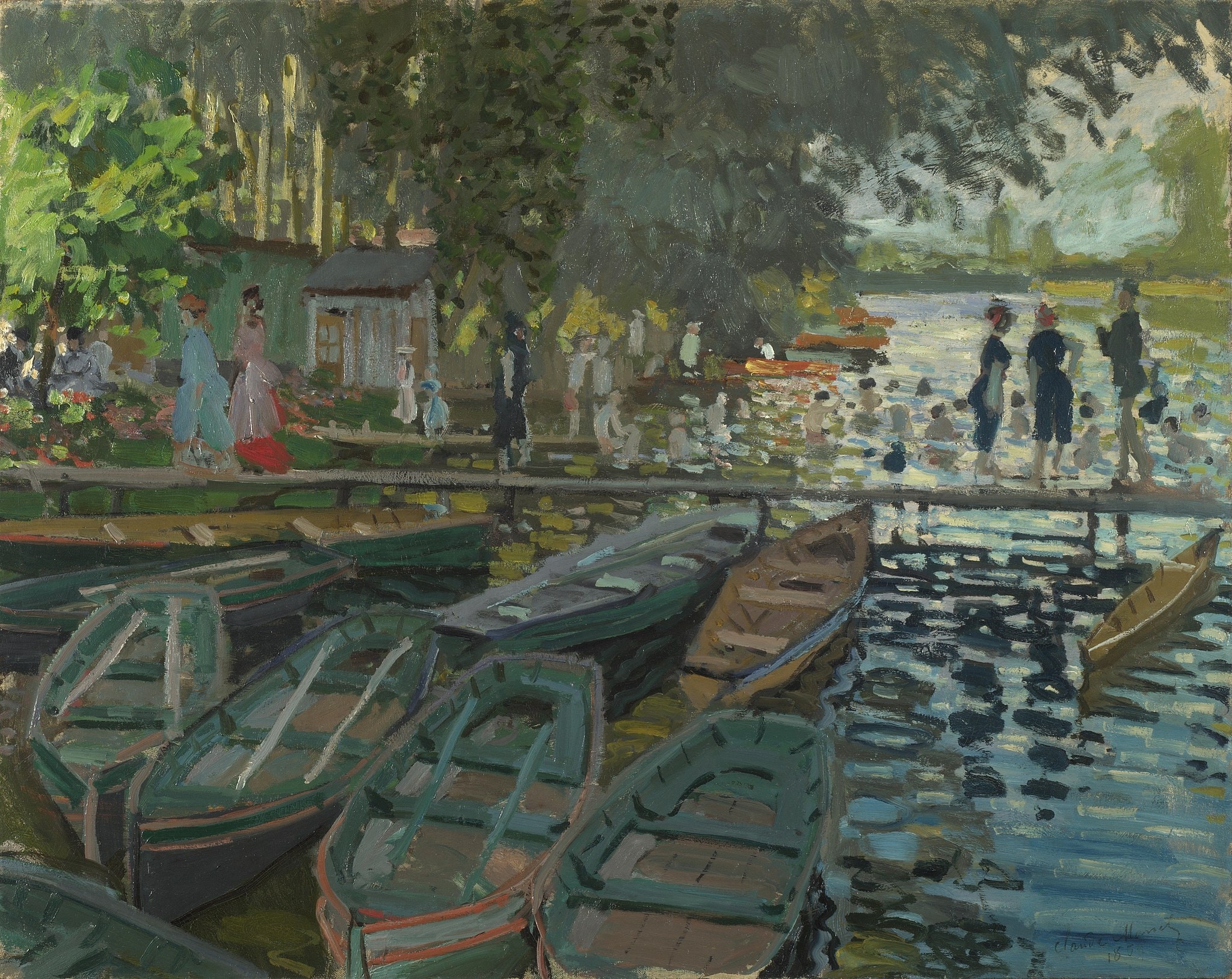
Bathers at La Grenouillère

by Claude Monet

Claude Monet’s Bathers at La Grenouillère stages modern leisure on the Seine as a theater of light, motion, and sociability. Foregrounded green rowboats, a narrow footbridge, and clustered bathers turn the resort’s engineered setting into a manifesto for on‑the‑spot vision and the fleeting present [1]. Painted outdoors in 1869 with rapid strokes, it crystallizes the emergence of Impressionism [1].

Study Print Studio

Create a personal study print

Build a companion study sheet around the part of this painting that speaks to you most. Choose a detail, shape an interpretation, and walk away with something personal and display-worthy.

Fast Facts

Year
1869
Medium
Oil on canvas
Dimensions
73 × 92 cm
Location
National Gallery, London
See all Claude Monet paintings in London
Bathers at La Grenouillère by Claude Monet (1869) featuring Moored rowboats, Narrow footbridge/pier, Bathers in the inlet, Dappled water reflections

Click on any numbered symbol to learn more about its meaning

Meaning & Symbolism

Monet anchors the scene with a dark raft of rowboats in the lower left and right, their curved hulls rhyming with the water’s faceted blues and olives. That pairing is strategic: the repeat of crescent forms asserts a world shaped by rhythms rather than by outlines. The slim footbridge that slices across the mid‑ground functions as a social threshold—on its left, strolling figures in light dresses drift beneath foliage; on its right, compact silhouettes lean toward the glimmering inlet, where heads and shoulders dot the surface like buoyant notes. By pushing the most legible bodies to the far bank and dissolving their edges in reflected light, Monet declares that the real protagonist is the river’s flicker, the quick cognition of sun and shade that remakes the scene at every instant 1. The resort’s distinctive features—the bridge and the circular islet nicknamed the “Camembert” just out of frame—were purpose‑built for recreation, and Monet leverages them as signs of engineered leisure in the new suburban belt reached by rail from Paris 14. In this sense the bridge is not a quaint motif but an emblem of crowd choreography and access, part of the same system that delivers the rentable boats massed in front. Technically, the work performs its own thesis. Broad, flat strokes in the trees and water and quick, notational marks for figures advertise a method enabled by mid‑century tools—ready‑made paint tubes and flat‑ferrule brushes—allowing speed, portability, and repeated returns to the motif at different moments 1. Conservation analysis confirms a palette keyed to cobalt blue for the water’s mid‑tones, Prussian blue for the deepest accents, and lead white for the scintillant highlights that skate across the Seine; the material choices heighten the sensation of cool shade countered by sun‑struck ripples 3. These are not neutral optics. As Robert Herbert argued, Impressionist river scenes index the rise of canotage and the leisure economy of the Second Empire; the boats and bathers here do not symbolize mythic pleasure but rather the commodification of free time—hiring a skiff, congregating at a floating café just beyond the frame 4. T. J. Clark’s account of modern life sharpens the point: the painting stages the politics of looking in public, with mixed classes and anonymous bodies occupying a shared, provisional space. The compressed crowd at the water’s edge and the near‑anonymous strollers on the left model a new spectatorship in which everyone watches—and is watched—while nothing holds still for long 5. This canvas is also self‑conscious about artistic purpose. In a letter of 25 September 1869, Monet called his open‑air works at La Grenouillère “bad sketches” for a larger Salon picture; both the London canvas and its close New York counterpart are identified with those rapid studies 12. The phrase is revealing: he names them “bad” by academic standards of finish, yet their very roughness proves decisive. By prioritizing the instantaneous—the scattered sun on the right bank, the tremor of reflections under the bridge, the half‑legible hats and parasols—Monet turns transience into content and method at once. That is why Bathers at La Grenouillère is important: it fuses modern subject matter with a modern way of seeing, making the optical event—more than individual anecdote—the carrier of meaning. The work thus reads as a compact manifesto for early Impressionism, in which the river’s surface becomes a clock of light, registering the tempo of contemporary life before it slips away 15.

Explore Deeper with AI

Ask questions about Bathers at La Grenouillère

Popular questions:

Powered by AI • Get instant insights about this artwork

💬 Ask questions about this artwork!

Interpretations

Technical/Material Study

Conservation reveals a palette keyed to cobalt blue for mid‑water passages and Prussian blue for darker accents, with lead white activating high‑value scintillation; these choices engineer a cool–warm oscillation that reads as real‑time flicker 3. Flat‑ferrule brushes lay broad, planar strokes in foliage and water, while small, brisk touches articulate figures and bridge supports. Tube paints and portability enable rapid wet‑into‑wet adjustments on site, making facture an index of passing light rather than post‑studio revision 13. Even varnish history matters: cleaning campaigns have clarified tonal intervals essential to perceiving the scene’s micro‑tempi. Materially and optically, the painting is a device for producing—and perceiving—instability, where pigment chemistry underwrites phenomenology.

Source: National Gallery Technical Bulletin

Formal Analysis

Monet’s composition turns form into meter. Crescent hulls in the foreground syncopate with water’s faceted blues; the footbridge operates as a transversal that arrests, then relaunches, the eye’s drift across the mid‑ground. Figures are rendered as notational silhouettes, their partial legibility subordinated to a larger rhythm of reflections and foliage. The left–right bifurcation does more than separate strollers from bathers; it stages two regimes of looking—glancing and gazing—underwritten by a strict pictorial scaffolding that prevents the scene from dissolving into mere shimmer. Such orchestration anticipates Monet’s later serial strategies, where limited motifs are reorganized to test optical variables rather than narrative incident 1. In short, structure doesn’t oppose spontaneity here; it calibrates it, letting fractured brushwork cohere without reverting to academic contour.

Source: National Gallery, London

Social History of Leisure

Read through Robert Herbert’s lens, the site is a diagram of Second Empire leisure: rail access from Saint‑Lazare, rentable skiffs, and a floating café choreograph paid recreation as an emerging norm of urban life. La Grenouillère’s mix of casual bathers and promenaders aligns with the era’s canotage craze, while contemporary accounts toggled between fascination and disdain for its fashionable crowds. Monet’s choice to keep the restaurant just offstage underscores how infrastructure frames the experience even when not pictured. Leisure here is not timeless otium but a purchased interval, visible in the standardized boats and the crowd’s managed circulation 14. The painting thus records a cultural shift in which free time itself becomes a commodity that can be scheduled, consumed, and displayed.

Source: Robert L. Herbert

Politics of Spectatorship

Following T. J. Clark, the picture choreographs a modern economy of looking. The bridge concentrates bodies into a frieze of watchers and the watched, while the bathers’ bobbing heads turn the river into a field of provisional identities. No figure anchors narrative; instead, anonymity and crowd density stage a public sphere where class differences are proximate but unstable, negotiated through posture, distance, and attire. Monet’s recession of legible faces to the far bank—dissolved by reflected light—literalizes the difficulties of recognition in mass leisure. The image becomes an ethics of vision: to see modernity is to accept partial information, mutual exposure, and the risk of misreading in shared spaces 15.

Source: T. J. Clark

Comparative/Collaborative Lens

Monet’s 25 September 1869 letter calling these canvases “bad sketches” points to a working rhythm shared with Renoir at the site: multiple quick variants, near‑identical motifs, divergent emphases 12. The London and Met versions bracket choices of cropping, crowd density, and the Camembert/bridge axis, functioning like controlled experiments in optical priority. The rumored larger, more “finished” Salon composition (now lost) suggests Monet tested whether immediacy could scale to academic expectations; its rejection clarifies why he later doubled down on the study’s virtues 12. Seen together, the variants constitute a prototype for Monet’s serial method: repetition as inquiry, where motif is stable but conditions—light, touch, vantage—do the expressive work.

Source: The Metropolitan Museum of Art; National Gallery, London

Urbanism & Infrastructure

The resort’s pontoon bridge and “Camembert” islet translate civil engineering into crowd management: entries, pauses, overlooks, and bottlenecks render the river a programmable stage for sociability 1. By massing rentable boats at the picture’s edge, Monet shows circulation as commodity—flow you can buy. The right‑edge elision of the floating café keeps commerce present as pressure rather than illustration, tightening the link between vision and access. As suburban belts expanded by rail, such nodes offered metropolitan pleasures in periurban dress; Monet’s cropping foregrounds how seeing modern nature involves negotiating infrastructural frames—bridges, docks, timetables—through which leisure is delivered 14.

Source: National Gallery, London; Robert L. Herbert

Related Themes

About Claude Monet

Claude Monet (1840–1926) led Impressionism’s pursuit of open-air painting and optical immediacy, especially during his Argenteuil years focused on modern leisure and light. He later developed serial studies of changing conditions, culminating in the Water Lilies cycle [2].
View all works by Claude Monet

More by Claude Monet

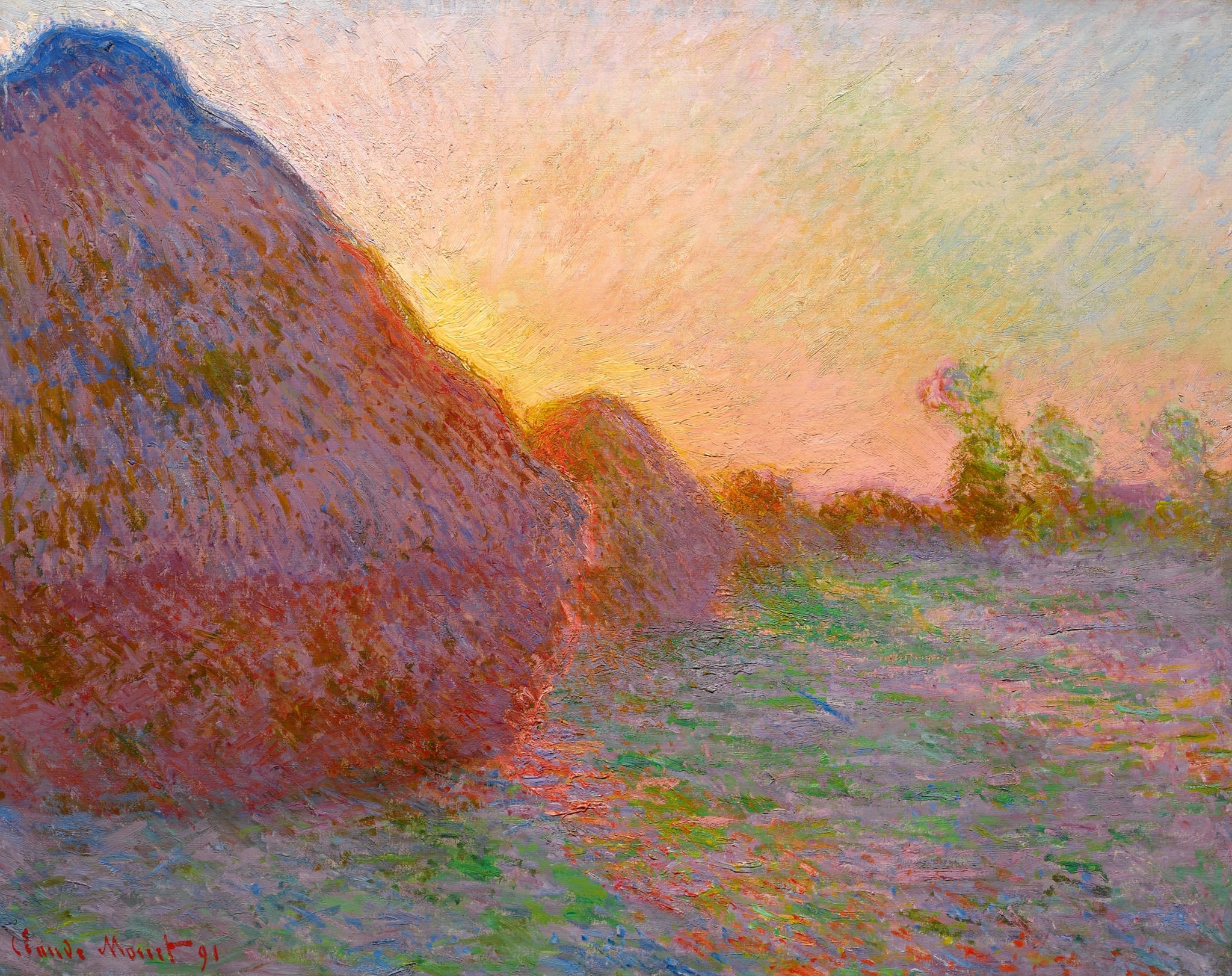
Haystacks Series by Claude Monet | Light, Time & Atmosphere by Claude Monet

Haystacks Series by Claude Monet | Light, Time & Atmosphere

Claude Monet

Claude Monet’s <strong>Haystacks Series</strong> transforms a routine rural subject into an inquiry into <strong>light, time, and perception</strong>. In this sunset view, the stacks swell at the left while the sun burns through the gap, making the field shimmer with <strong>apricot, lilac, and blue</strong> vibrations.
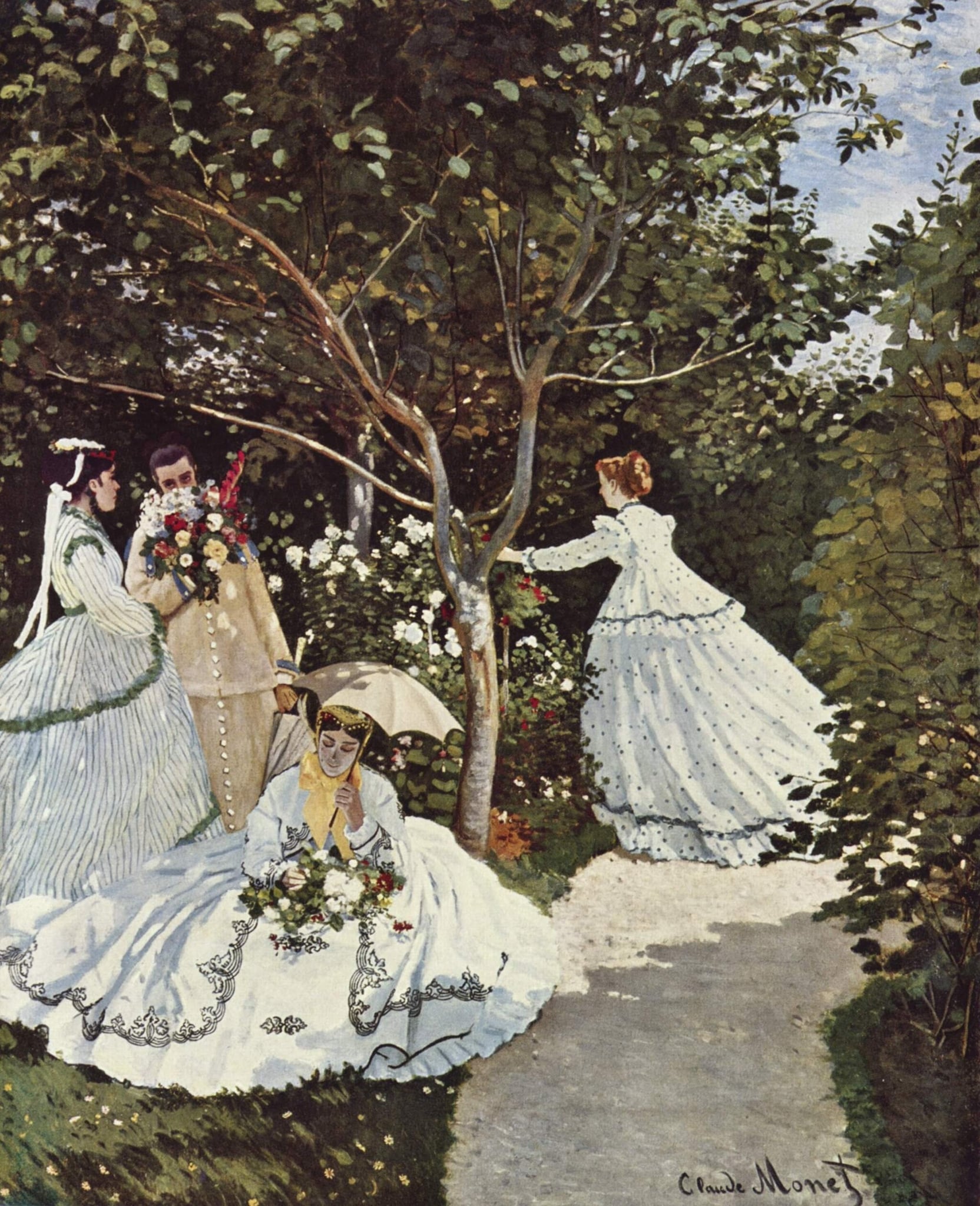
Women in the Garden by Claude Monet

Women in the Garden

Claude Monet (1866–1867)

Claude Monet’s Women in the Garden choreographs four figures in a sunlit bower to test how <strong>white dresses</strong> register <strong>dappled light</strong> and shadow. The path, parasol, and clipped flowers frame a modern ritual of leisure while turning fashion into an instrument of <strong>perception</strong>. The scene reads less as portraiture than as a manifesto for painting the <strong>momentary</strong> outdoors <sup>[1]</sup><sup>[3]</sup>.
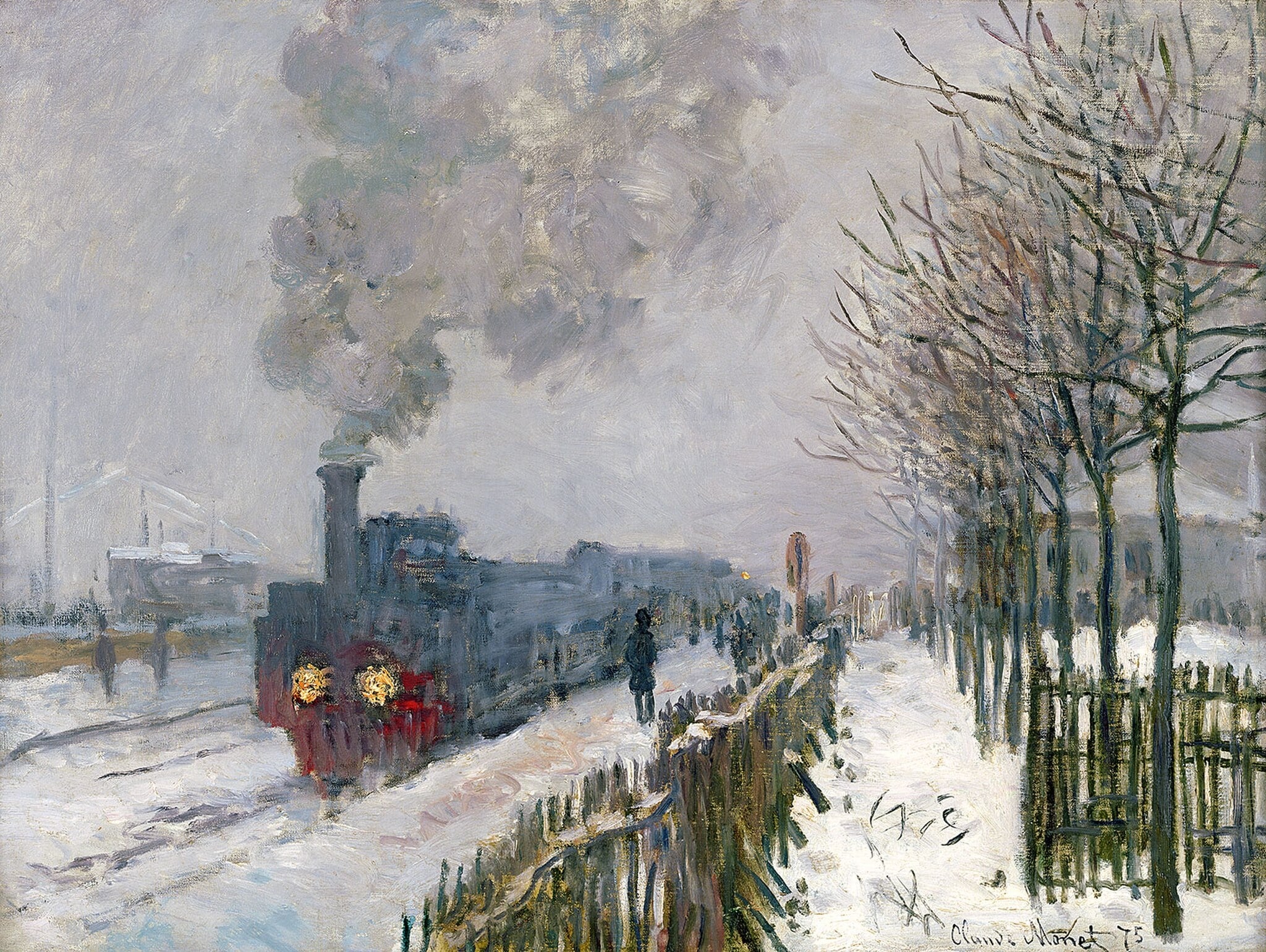
The Train in the Snow (The Locomotive) by Claude Monet

The Train in the Snow (The Locomotive)

Claude Monet (1875)

Claude Monet’s The Train in the Snow (The Locomotive) (1875) turns a suburban winter platform into a study of <strong>modernity absorbed by atmosphere</strong>. The engine’s twin yellow headlights and a smear of red push through a world of greys and violets as steam fuses with the low sky, while the right-hand fence and bare trees drill depth and cadence into the scene <sup>[1]</sup><sup>[4]</sup>. Monet fixes not an object but a <strong>moment of perception</strong>, where industry seems to dematerialize into weather <sup>[1]</sup><sup>[2]</sup>.
The Artist's Garden at Giverny by Claude Monet

The Artist's Garden at Giverny

Claude Monet (1900)

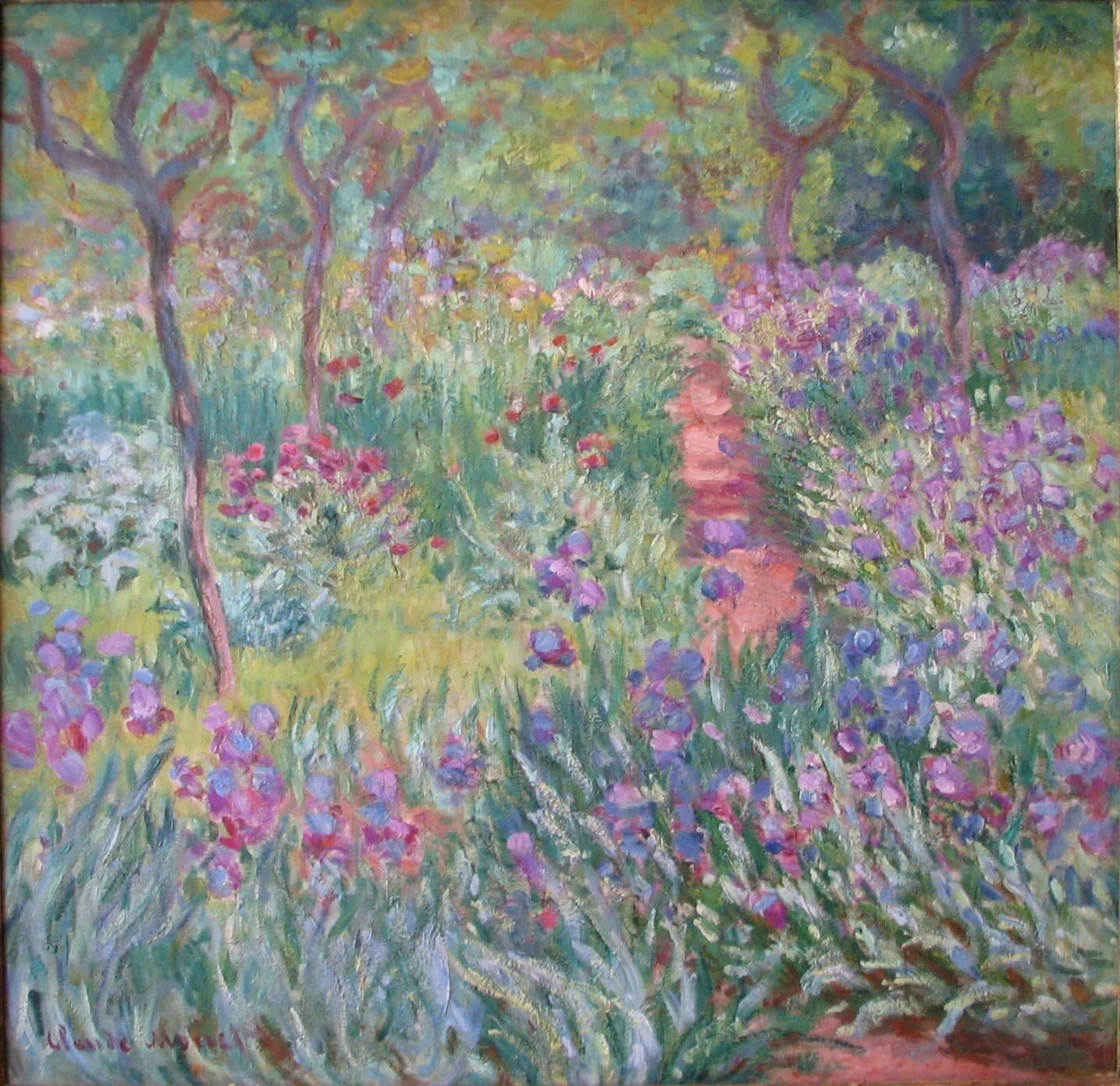
In The Artist's Garden at Giverny, Claude Monet turns his cultivated Clos Normand into a field of living color, where bands of violet <strong>irises</strong> surge toward a narrow, rose‑colored path. Broken, flickering strokes let greens, purples, and pinks mix optically so that light seems to tremble across the scene, while lilac‑toned tree trunks rhythmically guide the gaze inward <sup>[1]</sup><sup>[3]</sup>.
Water Lilies by Claude Monet

Water Lilies

Claude Monet (1899)

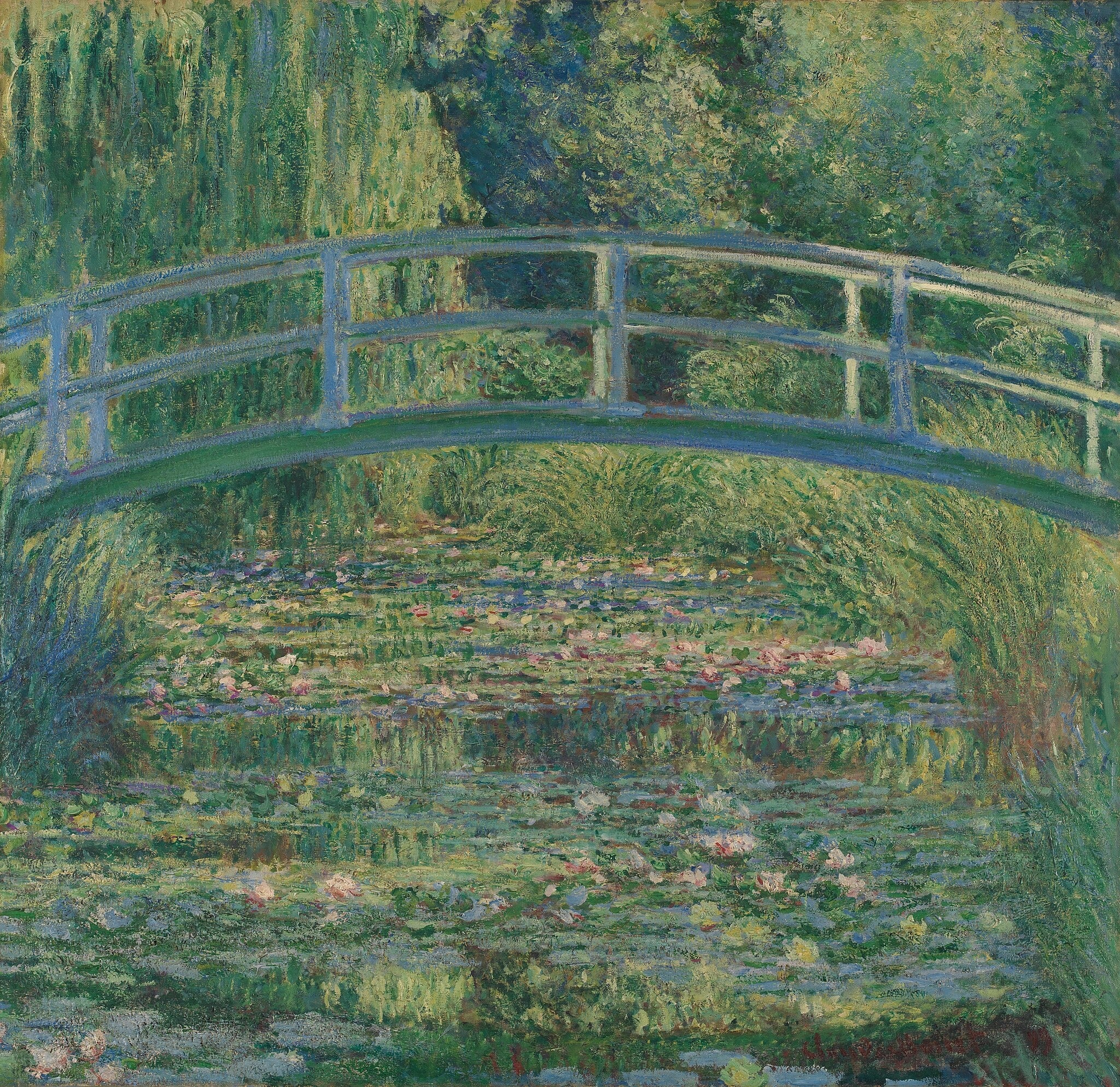
<strong>Water Lilies</strong> centers on an arched <strong>Japanese bridge</strong> suspended over a pond where lilies and rippling reflections fuse into a single, vibrating surface. Monet turns the scene into a study of <strong>perception-in-flux</strong>, letting water, foliage, and light dissolve hard edges into atmospheric continuity <sup>[1]</sup><sup>[3]</sup>.
The Grand Canal by Claude Monet

The Grand Canal

Claude Monet (1908)

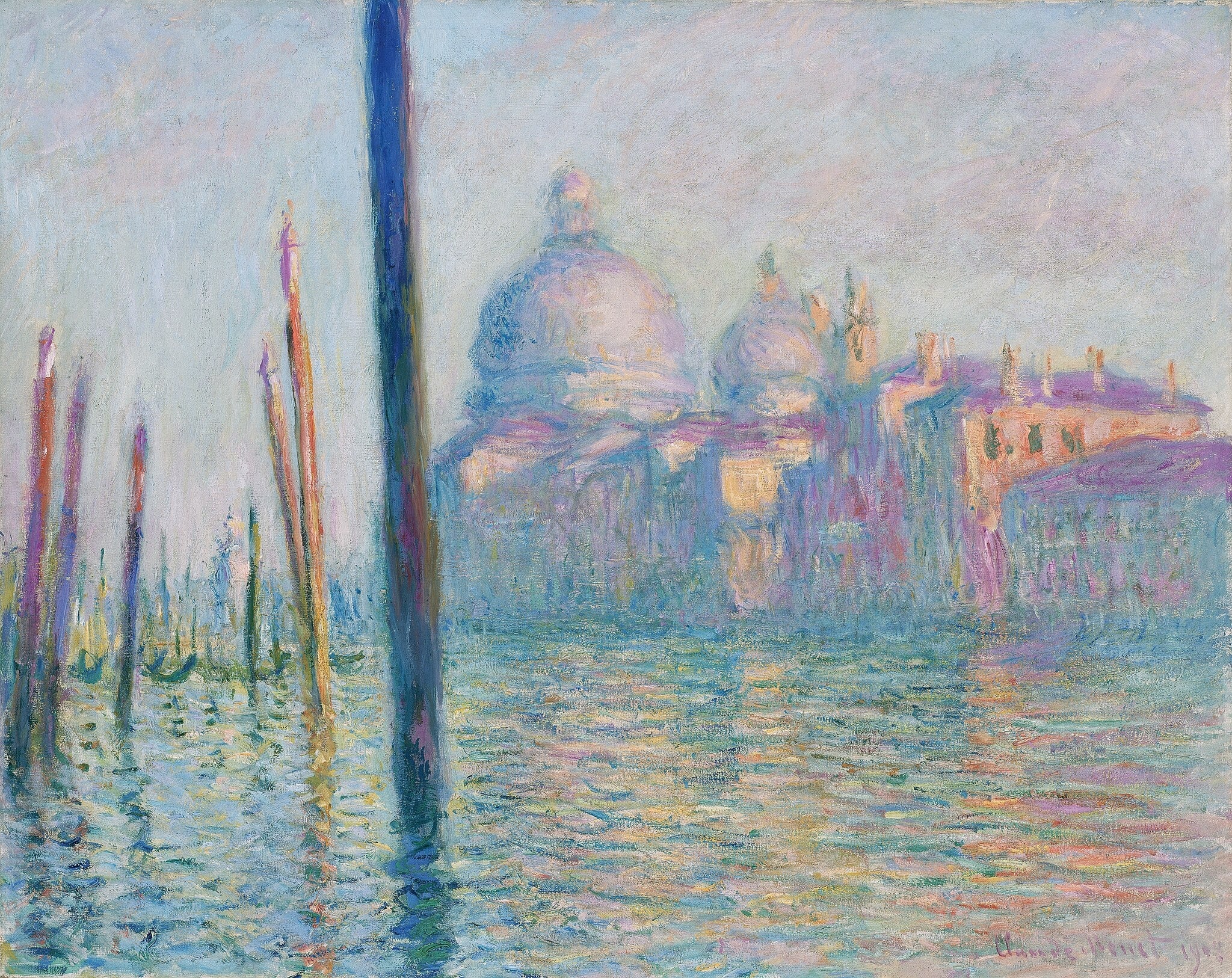
Claude Monet’s The Grand Canal turns Venice into <strong>pure atmosphere</strong>: the domes of Santa Maria della Salute waver at right while a regiment of <strong>pali</strong> stands at left, their verticals reverberating in the water. The scene asserts <strong>light over architecture</strong>, transforming stone into memory and time into color <sup>[2]</sup><sup>[3]</sup>.