Snow Scene at Argenteuil

by Claude Monet

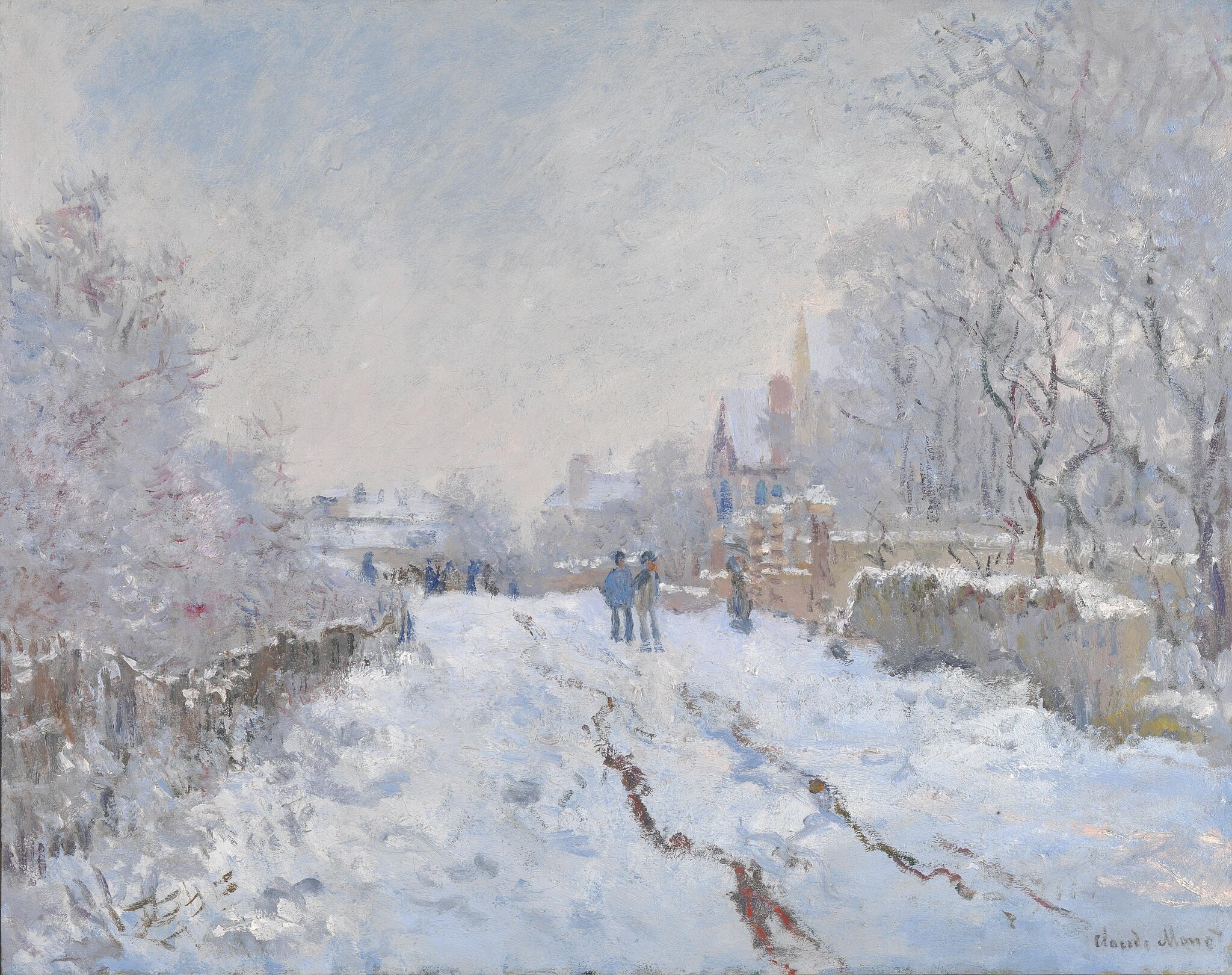
Claude Monet’s Snow Scene at Argenteuil distills a winter afternoon into a field of shimmering perception, where air, light, and snow merge. Russet cart tracks vein the road while blue‑grey figures drift toward a misted church spire, binding ordinary movement to a larger atmospheric whole.

Study Print Studio

Create a personal study print

Build a companion study sheet around the part of this painting that speaks to you most. Choose a detail, shape an interpretation, and walk away with something personal and display-worthy.

Fast Facts

Year
1875
Medium
Oil on canvas
Dimensions
71.1 × 91.4 cm
Location
National Gallery, London
See all Claude Monet paintings in London
Snow Scene at Argenteuil by Claude Monet (1875) featuring Sinuous wheel-ruts, Veiled church spire, Frosted trees with violet/rose tints

Click on any numbered symbol to learn more about its meaning

Meaning & Symbolism

Monet stages Boulevard Saint‑Denis as a theater of perception rather than a tale of events. The road does not simply recede; its sinuous brown wheel‑ruts act like warm capillaries, pulsing depth into the scene and calibrating time as recent passages score the snow 1. Figures in dark coats and one in clearer blue step forward or cluster mid‑distance, registering human persistence but refusing heroism; they function as notes within a chromatic chord. That blue is not incidental: it reverberates in the shadowed snow, in the faint blue panes of the church, and in the damp edges of the trees, creating compositional ligatures that carry the eye from foreground to spire and back again 1. On both sides, trees filmed with frost flicker with violet and rose tints, proof that white is never neutral; it is a prism that receives and re‑casts ambient light. Monet thickens paint in the foreground, letting the snow’s crust gather tactile weight, then thins it as the view breathes outward, so that the fog softens newly built houses and fences into near‑abstraction. Modern Argenteuil—rail lines behind the painter, a quick train from Paris—remains present yet masked by weather, a signature Impressionist mediation of modernity’s hard edges 12. This orchestration constitutes the meaning of Snow Scene at Argenteuil: community and continuity persist, but they do so as part of an atmospheric commons. The church spire does not dominate as a medieval monument; it hovers, half‑dissolved, a vertical of memory within a suburb under transformation. In that tension—between the solidity of built form and the evanescence of climate—Monet articulates a modern metaphysics: identity arises from passages, not from permanence. The painting’s color economy codifies this claim. Cool whites and pearl greys build the envelope; small, strategically placed reds (in the ruts, the tree twigs, and brickwork) supply a rhythm that binds the field without tipping it toward narrative incident 1. The result is a pictorial ethics of attention: to walk this boulevard is to measure oneself against light’s changing terms, to accept that footprints and cart tracks are truths precisely because they will vanish. This is why Snow Scene at Argenteuil is important in the Argenteuil corpus: it scales up Monet’s winter investigations from study to statement, proving that the suburb’s ordinary street—no spectacle, no crisis—can bear the weight of modern painting’s central question: how to picture time as lived sensation 12. Scholars have noted that snow offered Monet an optical laboratory for chromatic shadows and reflections; here he advances that research by turning the entire surface into a harmonized sensorium 23. The falling hush—registered not by flakes but by the press of a low, bleached sky—compresses foreground and distance, making every echo of blue or rose carry farther. Related winter boulevards in Boston and elsewhere confirm his interest in Japanese print‑like intervals—figures spaced along a lane, architecture filtered through weather—but this canvas enlarges the effect into a full atmospheric field where scale serves sensation 41. Thus, the painting is not a postcard of snow; it is a manifesto that meaning resides in the fleeting accord between human passage, communal anchors, and the mutable skin of light that binds them 12.

Explore Deeper with AI

Ask questions about Snow Scene at Argenteuil

Popular questions:

Powered by AI • Get instant insights about this artwork

💬 Ask questions about this artwork!

Interpretations

Formal Analysis

Monet organizes the surface through chromatic ligatures—echoes of the central figure’s blue in the church windows, tree shadows, and cool notes across the snow, while small reds in twigs, ruts, and brickwork supply a counter‑rhythm that binds the field 1. The wavy, sinuous wheel‑ruts are both vector and meter: they steer the gaze into depth and index time’s recent passages, turning recession into an active perceptual event 1. Paint handling shifts from impastoed crust in the foreground to thinned, breathed‑on strokes in distance, so that form loosens as the eye travels—an orchestration that privileges the envelope of light over discrete objects. In this key Argenteuil canvas, composition is achieved less by contour than by value harmonies and temperature modulations, a lesson in how Impressionist facture converts place into a calibrated sensorium of light 1.

Source: National Gallery, London

Historical Context

Set on Boulevard Saint‑Denis with the station behind Monet’s back, the canvas captures Argenteuil at the hinge of modernization—commuter rails, new housing, mixed industry—yet masked by weather into tonal unity 12. Snow and fog perform a historical mediation: the visible signs of the new suburb are softened without being denied, producing an image of modernity present but veiled 1. This balance typifies Argenteuil in the mid‑1870s, when Monet and peers forged Impressionism’s subjects—commuting, leisure, and suburban streets—as much through conditions of light and climate as through iconographic selection 2. Choosing a large format for an otherwise ordinary street amplifies the claim that the modern periphery merits epic attention even when no spectacle, no crisis occurs: atmosphere itself is the event through which a transforming society becomes picturable 12.

Source: National Gallery, London; National Gallery of Art (Washington)

Technical/Optical Study

Monet’s winter canvases function as an optical laboratory for turning “white” into a spectrum—blue‑violet shadows, rose inflections, and reflected colors that make snow behave like a prism 13. Here, the artist calibrates facture to optical effect: dense, granular touches in the near field deliver tactile cold, while lighter scumbles and wet‑into‑wet passages let distance dissolve 13. These effects are not decoration but method: they test how minor chromatic shifts can sustain tonal unity across a bleached day. Scholarship on Effets de neige stresses how snow intensifies problems of local vs. reflected color, temperature contrast, and value compression—problems Monet solves through repeating accents and restrained gamut, producing a surface that reads as both meteorology and method at once 31.

Source: Impressionists in Winter (Phillips Collection catalogue, via Christie's); National Gallery, London

Transnational Lens (Japonisme)

Related Argenteuil winters reveal Japanese print–like intervals—figures spaced along lanes, attenuated verticals, and weather as graphic screen—an influence that clarifies Monet’s spacing here: pedestrians act as rhythmic modules rather than protagonists 41. The boulevard becomes a sequence of pauses across a shallow, tonally coherent field, akin to ukiyo‑e strategies that let negative space and atmosphere do narrative work. The result is a European street filtered through transnational optics: silhouettes simplified, architecture flattened by fog, and emphasis on pattern (tracks, trunks) over contour fidelity 4. Monet does not imitate a print; he absorbs its intervallic logic to extend Impressionism’s interest in the between—between figures, between tones, between weather and built form—turning Argenteuil into a quiet theater of modular perception 41.

Source: Museum of Fine Arts, Boston; National Gallery, London

Social Trace & Phenomenology

The street’s sinuous brown wheel‑ruts and scattered footprints are indexical signs of recent labor and passage, modest residues that carry social meaning while structuring depth 15. Rather than heroic workers, Monet gives us imprints—a phenomenology of the ordinary in which community is legible through marks that will vanish. Comparable Argenteuil snow streets confirm his interest in how infrastructural modernity (boulevards, spurs) hosts humble, time‑sensitive traces that double as compositional devices 5. The painting advocates an ethics of looking: to see rightly is to attend to the weak signals—damped reds, faint blues, compacted snow—through which a suburb discloses its shared life. In this register, atmosphere is not backdrop but social medium, binding houses, church, and passerby into one lived, melting present 15.

Source: National Gallery, London; Nelson-Atkins Museum of Art

Related Themes

About Claude Monet

Claude Monet (1840–1926) led Impressionism’s pursuit of open-air painting and optical immediacy, especially during his Argenteuil years focused on modern leisure and light. He later developed serial studies of changing conditions, culminating in the Water Lilies cycle [2].
View all works by Claude Monet

More by Claude Monet

Haystacks Series by Claude Monet | Light, Time & Atmosphere by Claude Monet

Haystacks Series by Claude Monet | Light, Time & Atmosphere

Claude Monet

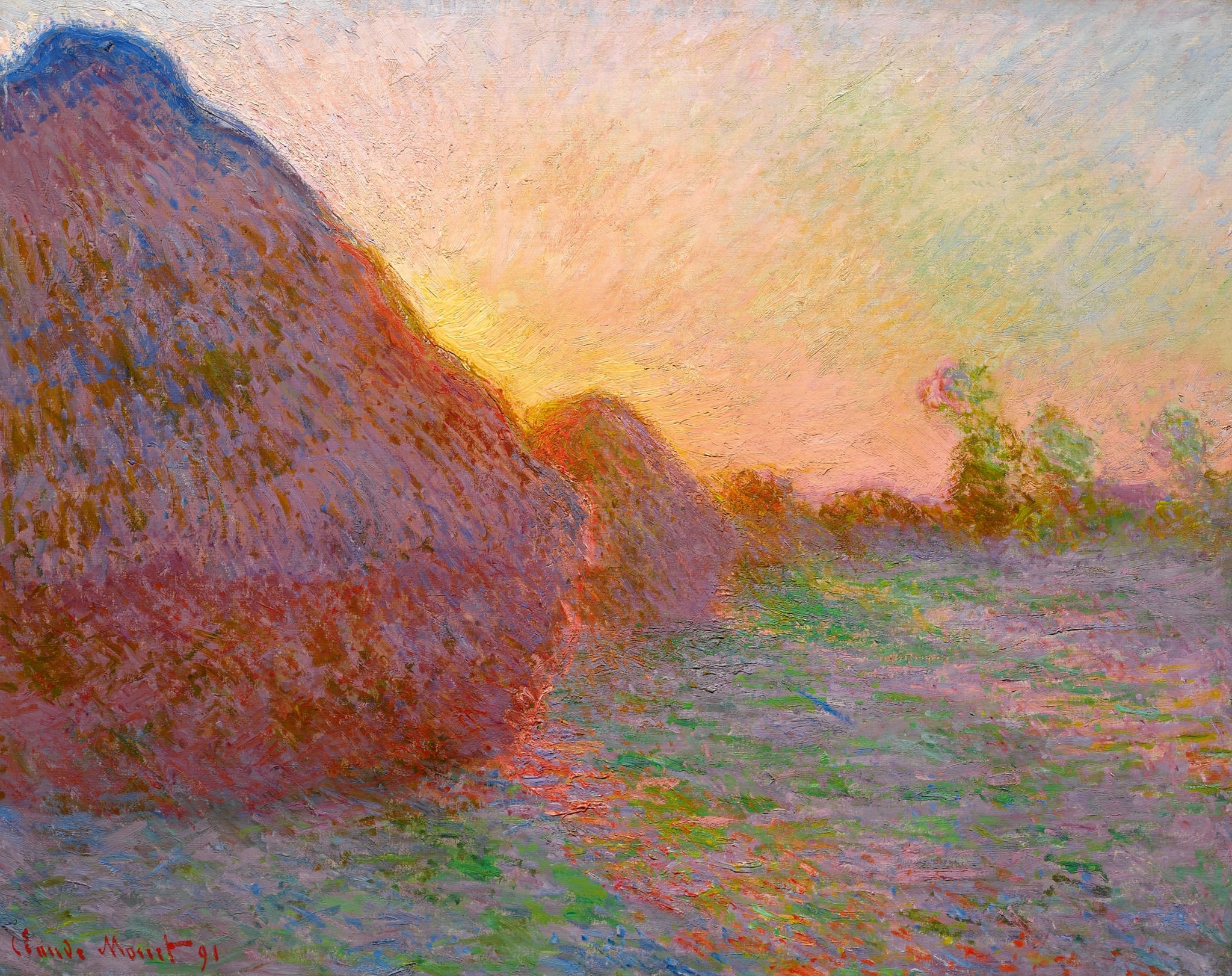
Claude Monet’s <strong>Haystacks Series</strong> transforms a routine rural subject into an inquiry into <strong>light, time, and perception</strong>. In this sunset view, the stacks swell at the left while the sun burns through the gap, making the field shimmer with <strong>apricot, lilac, and blue</strong> vibrations.
Women in the Garden by Claude Monet

Women in the Garden

Claude Monet (1866–1867)

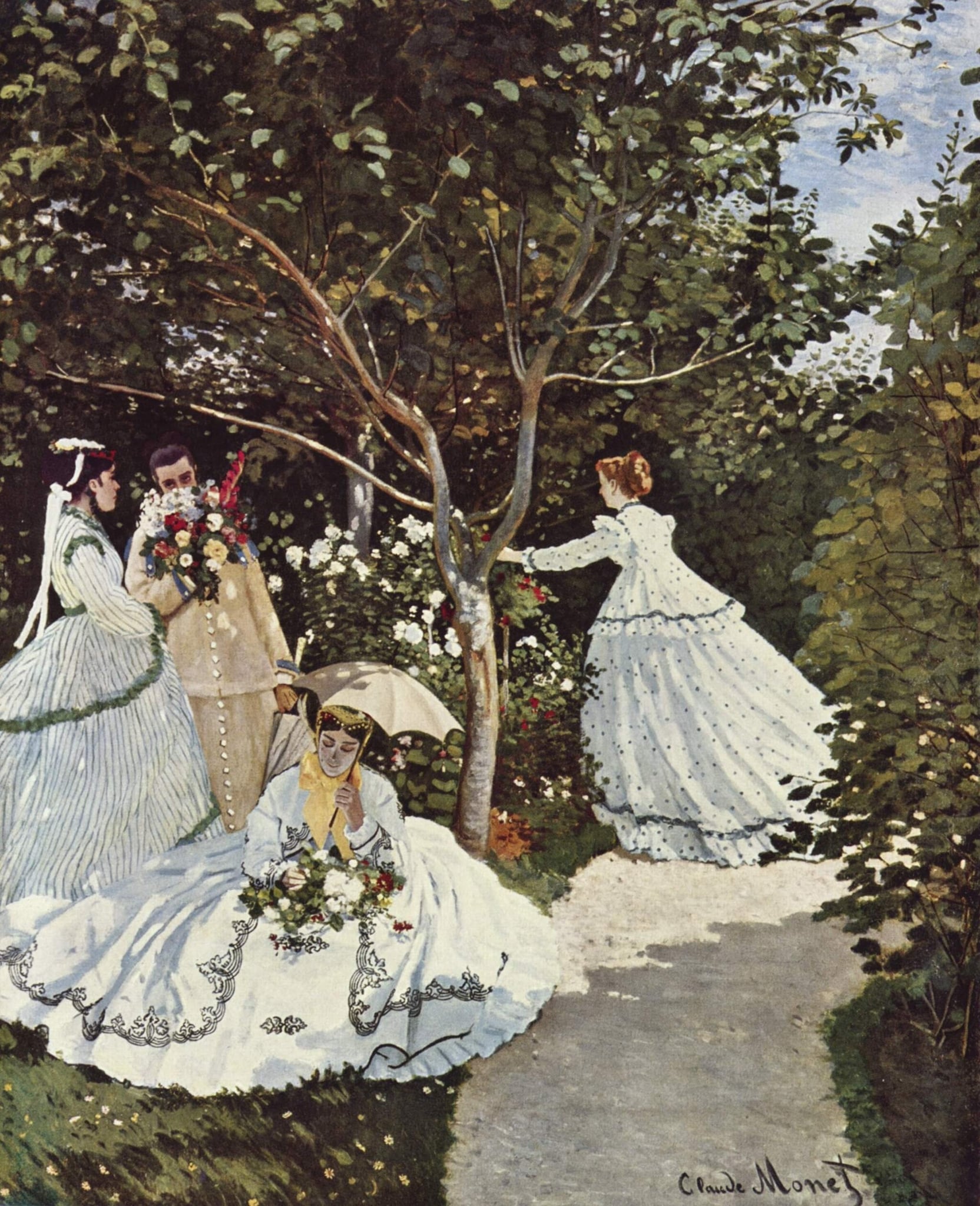
Claude Monet’s Women in the Garden choreographs four figures in a sunlit bower to test how <strong>white dresses</strong> register <strong>dappled light</strong> and shadow. The path, parasol, and clipped flowers frame a modern ritual of leisure while turning fashion into an instrument of <strong>perception</strong>. The scene reads less as portraiture than as a manifesto for painting the <strong>momentary</strong> outdoors <sup>[1]</sup><sup>[3]</sup>.
The Train in the Snow (The Locomotive) by Claude Monet

The Train in the Snow (The Locomotive)

Claude Monet (1875)

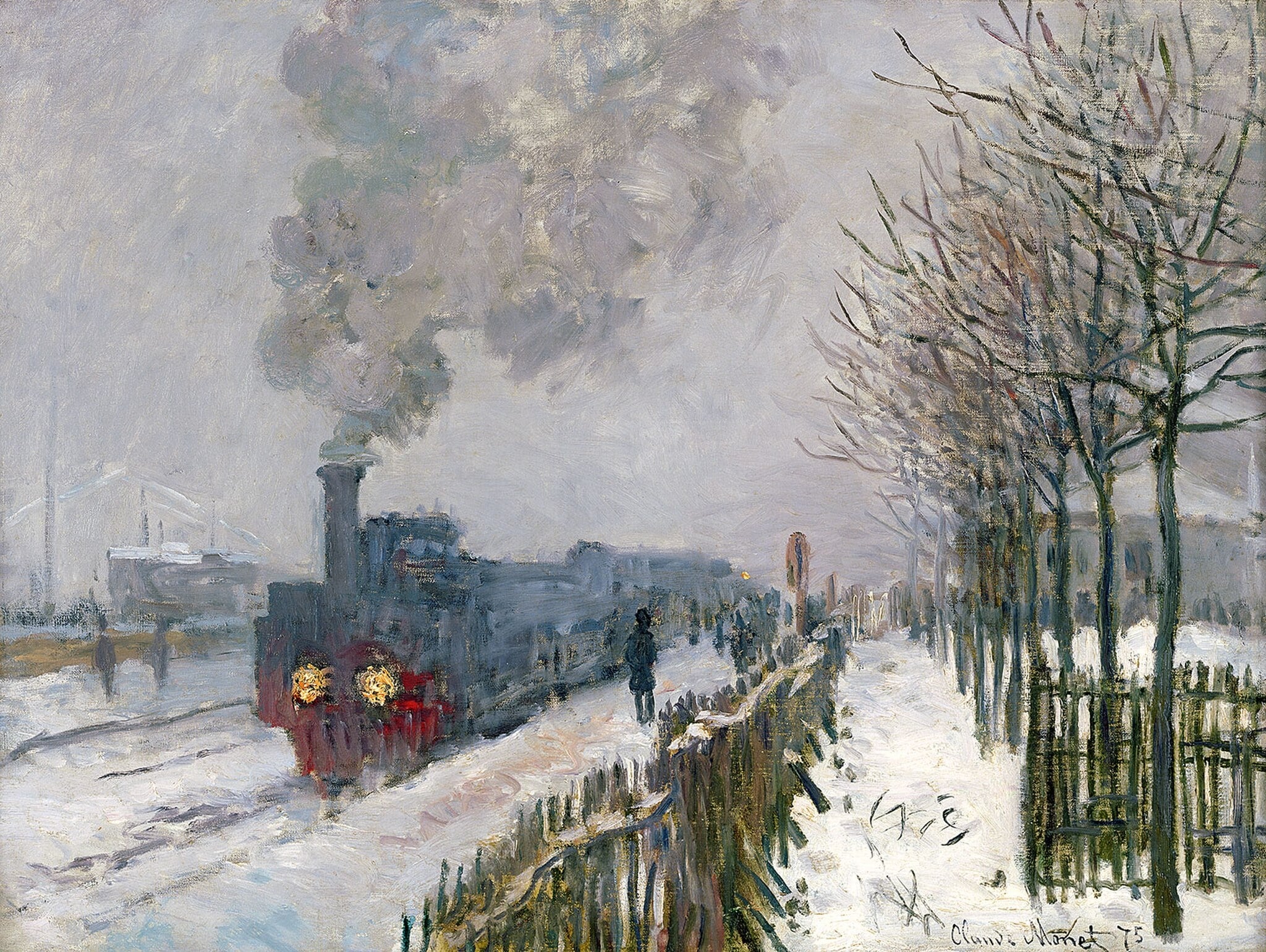
Claude Monet’s The Train in the Snow (The Locomotive) (1875) turns a suburban winter platform into a study of <strong>modernity absorbed by atmosphere</strong>. The engine’s twin yellow headlights and a smear of red push through a world of greys and violets as steam fuses with the low sky, while the right-hand fence and bare trees drill depth and cadence into the scene <sup>[1]</sup><sup>[4]</sup>. Monet fixes not an object but a <strong>moment of perception</strong>, where industry seems to dematerialize into weather <sup>[1]</sup><sup>[2]</sup>.
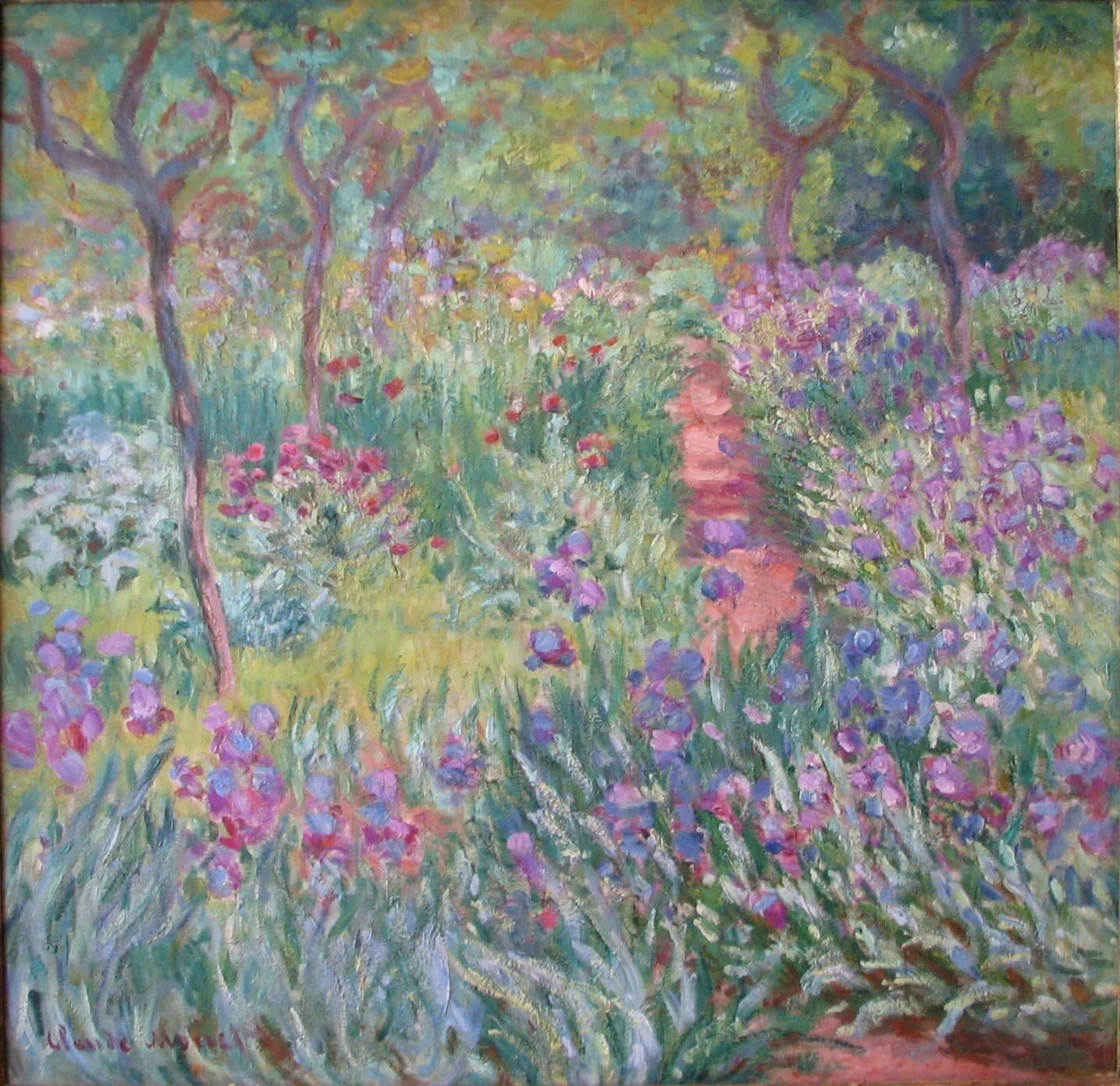
The Artist's Garden at Giverny by Claude Monet

The Artist's Garden at Giverny

Claude Monet (1900)

In The Artist's Garden at Giverny, Claude Monet turns his cultivated Clos Normand into a field of living color, where bands of violet <strong>irises</strong> surge toward a narrow, rose‑colored path. Broken, flickering strokes let greens, purples, and pinks mix optically so that light seems to tremble across the scene, while lilac‑toned tree trunks rhythmically guide the gaze inward <sup>[1]</sup><sup>[3]</sup>.
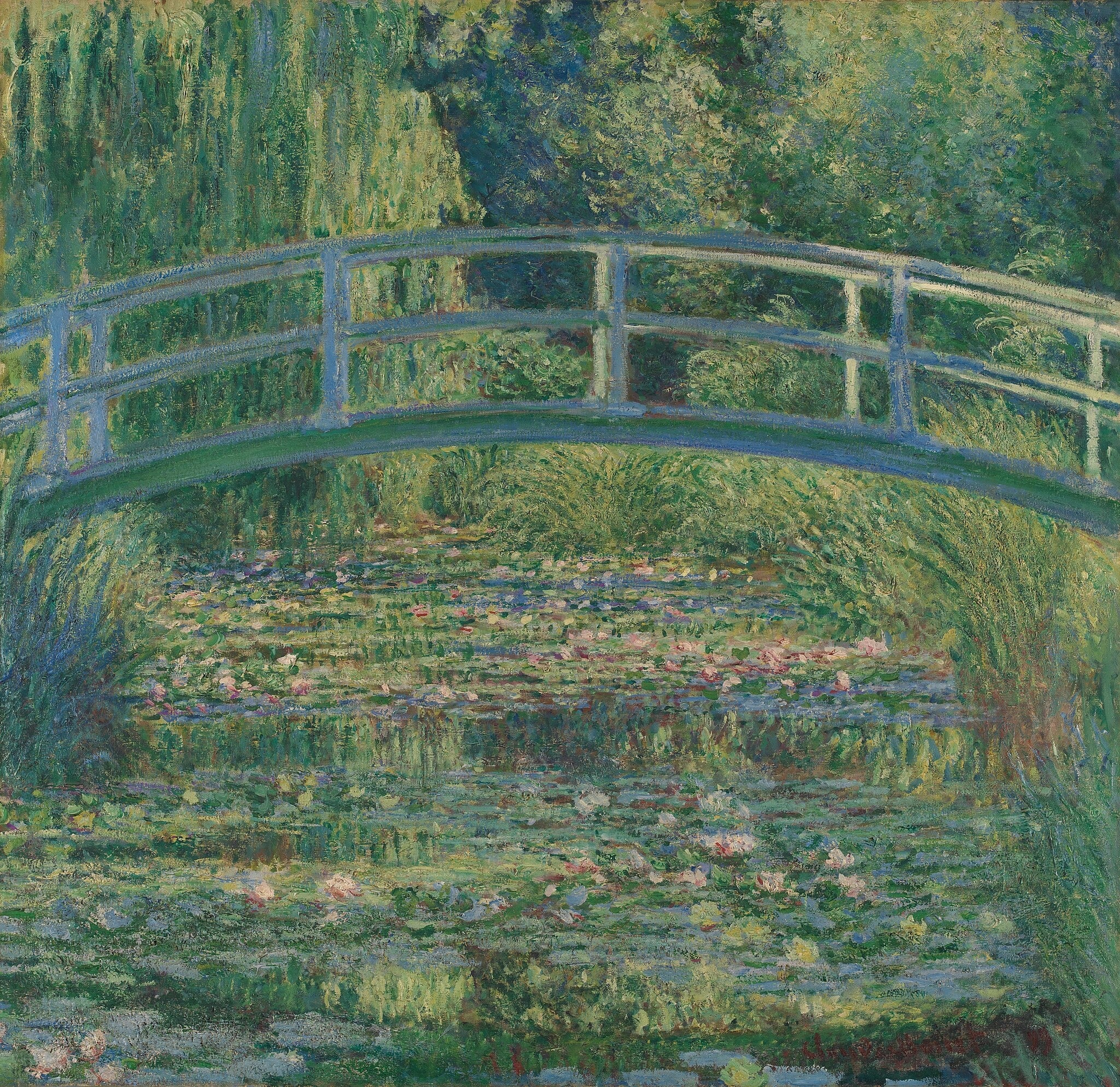
Water Lilies by Claude Monet

Water Lilies

Claude Monet (1899)

<strong>Water Lilies</strong> centers on an arched <strong>Japanese bridge</strong> suspended over a pond where lilies and rippling reflections fuse into a single, vibrating surface. Monet turns the scene into a study of <strong>perception-in-flux</strong>, letting water, foliage, and light dissolve hard edges into atmospheric continuity <sup>[1]</sup><sup>[3]</sup>.
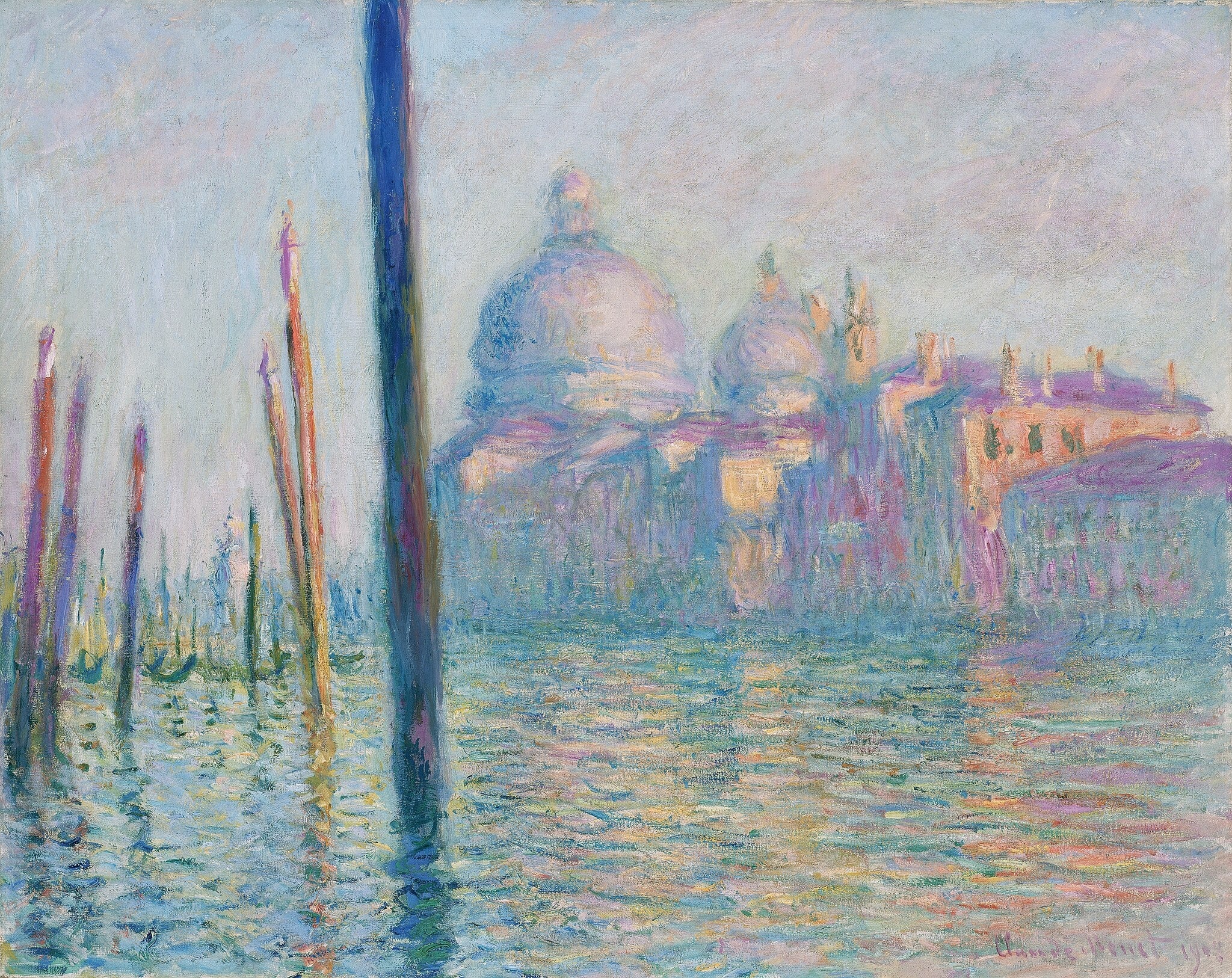
The Grand Canal by Claude Monet

The Grand Canal

Claude Monet (1908)

Claude Monet’s The Grand Canal turns Venice into <strong>pure atmosphere</strong>: the domes of Santa Maria della Salute waver at right while a regiment of <strong>pali</strong> stands at left, their verticals reverberating in the water. The scene asserts <strong>light over architecture</strong>, transforming stone into memory and time into color <sup>[2]</sup><sup>[3]</sup>.