The Rocks at Pourville, Low Tide

by Claude Monet

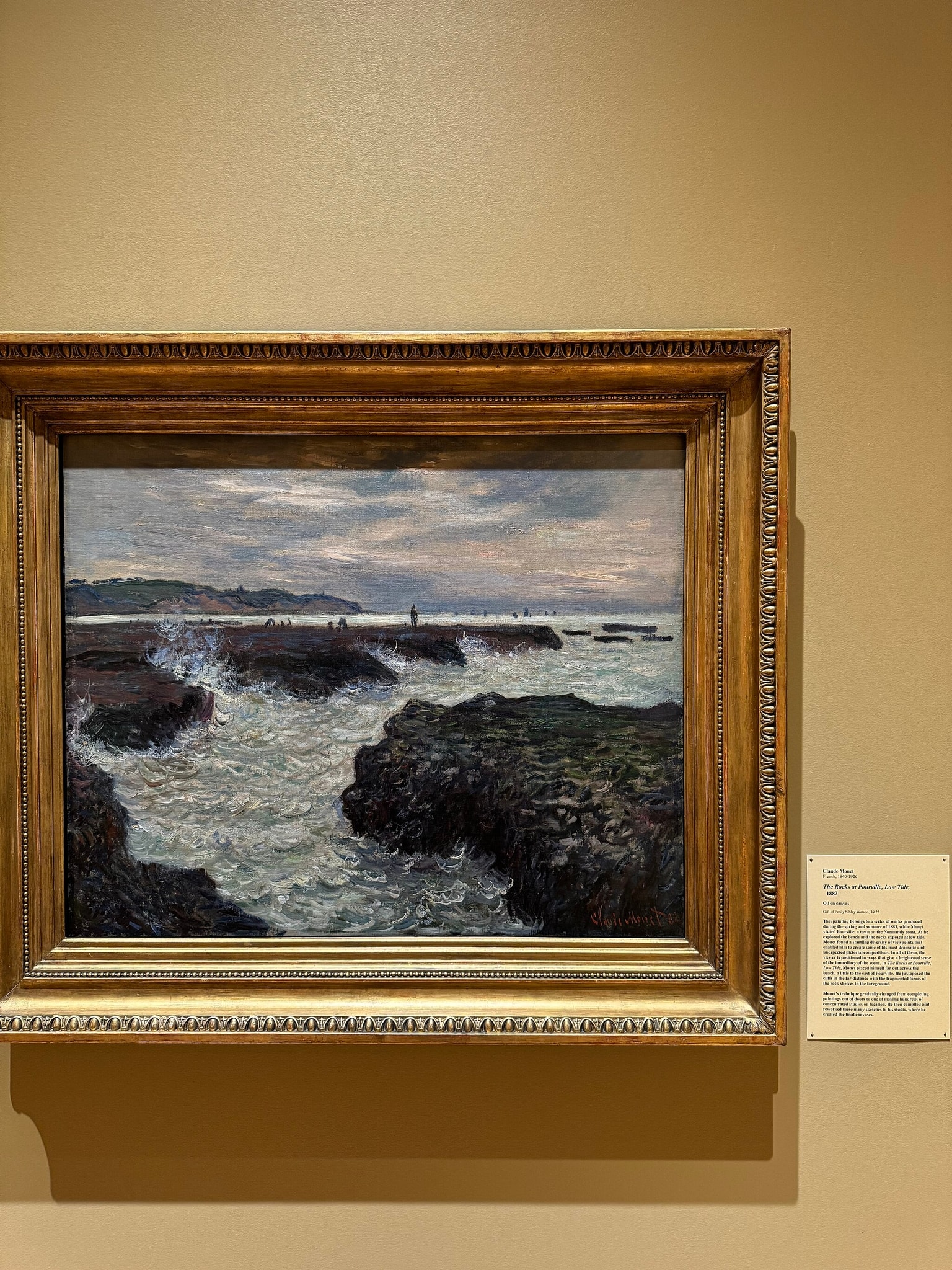
Claude Monet’s The Rocks at Pourville, Low Tide renders the Normandy foreshore as a meeting of endurance and flux—dark, seaweed-laden rocks cleave through foaming, mobile surf beneath a cool, pewter sky. Tiny silhouettes along the horizon reduce human presence to scale and rhythm, centering nature’s temporal pulse.

Fast Facts

Year
1882
Medium
Oil on canvas
Dimensions
64.3 × 78.7 cm
Location
Memorial Art Gallery of the University of Rochester, Rochester, NY
See all Claude Monet paintings in New York
The Rocks at Pourville, Low Tide by Claude Monet (1882) featuring Jagged, seaweed-dark rock ledges, Churning white surf, Pewter, overcast sky, Human silhouettes on the horizon

Click on any numbered symbol to learn more about its meaning

Meaning & Symbolism

Monet composes the scene as intersecting vectors of force. The foreground is anchored by jagged, seaweed-darkened shelves that thrust diagonally into the picture, their near-black masses catching only scant green highlights. Against them, the surf churns in tightly loaded strokes of white and gray, a dense scumble that reads as both foam and pigment. This collision—knife-edged rock and viscous water—turns material into meaning: paint behaves like the sea it depicts, asserting flux as form 25. At low tide, the coast reveals what high water conceals—slick ledges, tidal channels, weeds—and Monet leverages that exposure to mark time itself. The ebb is not anecdote but measurement; each revealed surface is an index of hours and weather, aligning with the artist’s broader 1880s turn to coastal motifs as laboratories of changing conditions 24. The sky, a spread of pewter, mauve, and pale blue, is not backdrop but a binding atmosphere whose cool tonality reappears as flicker on the foam, welding upper and lower registers into a single, mutable system 2. Human beings appear only as thin, upright strokes along the horizon—a few dark notes spaced across the tidal flat. They supply scale, not story, reinforcing nature’s immensity while signaling littoral use at a specific moment of the day’s cycle 3. This selective minimalism aligns with Monet’s modern strategy on the Normandy coast: painting in tourist-thick places while stripping out overt signage of leisure to focus on elemental geology and weather—an aesthetic of omission that keeps attention on experience rather than anecdote 5. The painting’s drama therefore does not depend on storm or catastrophe, as in Courbet’s theatrically breaking seas, but on sustained, bodily felt energy made visible through brushwork—the sea understood as a field of forces, inherited yet transformed from earlier “marines” into Impressionist immediacy 6. In this way, the meaning of The Rocks at Pourville, Low Tide is not coded symbolism; the rocks do not stand for steadfastness so much as enact it, while the surf does not signify change so much as perform it in the very handling of paint 5. Why The Rocks at Pourville, Low Tide is important emerges from its place in Monet’s 1882 Pourville campaigns and in the evolution of his method. Working virtually on the shingle—he wrote that the waves reached the foot of his lodging—Monet could calibrate canvases to near-instant shifts of tide and sky, sharpening the on-site, serial responsiveness that would culminate in his great series of the 1890s and beyond 32. During the very month he rejoined the Impressionists’ seventh exhibition, he remained on the coast painting, delegating installation to Renoir—evidence of a career strategy that privileged sustained observation over metropolitan presence 7. In Rochester’s canvas, the diagonal rock ledges serve as an armature for seeing time, the milky sluices record transient turbulence, and the horizon figures punctuate duration rather than plot. Light, rather than narrative, binds the whole: a unified, modern meditation on time’s ebb and flow, achieved by letting observation, site, and paint do the meaning-making 25.

Explore Deeper with AI

Ask questions about The Rocks at Pourville, Low Tide

Popular questions:

Powered by AI • Get instant insights about this artwork

💬 Ask questions about this artwork!

Interpretations

Tourism and Selective Vision

Robert Herbert shows how Monet painted in fully modern, tourist-saturated Normandy while withholding explicit signage of leisure to construct nature-centered images. In The Rocks at Pourville, Low Tide, that tactic becomes a visual ethic: bathers and walkers shrink to a few vertical dashes, and infrastructure disappears, leaving geology, tide, and weather to carry meaning. This selective framing is not escapist; it registers the coast as a site remade by modern travel even as Monet trains perception on elemental processes—exposure, flow, surf energy. The result is a picture that mediates between modernity and nature through an aesthetic of omission, allowing viewers to encounter the coast as a laboratory of looking rather than a postcard of resort life 12.

Source: Robert L. Herbert; Art Institute of Chicago (Monet Online Scholarly Catalogue)

Serial Time and the Tide as Meter

Paul Hayes Tucker argues that Monet’s 1880s coastal work sharpened the temporal thinking that drives his later series. Pourville provided a built-in meter of change—the tide—so that each exposed ledge or silvery sluice records an instant within a cycle. Working on-site across rapidly shifting conditions, Monet rehearsed a serial responsiveness that culminates in the 1890s ensembles. In 1882 he even remained at the shore during the 7th Impressionist exhibition, delegating installation to Renoir, a career choice that favored process over presence. This painting’s diagonal rock armature and milky water passages operate like time registers, converting observation into a portable method for seeing duration in paint 314.

Source: Paul Hayes Tucker; NGV; Art Institute of Chicago

Material Performance: From Courbet to Monet

Curators link Monet’s marines to Courbet’s earlier “sea pieces,” where the subject is force itself. But Monet radicalizes this legacy by letting the handling do the heavy lifting: dense scumbles that read as foam, dragged pigment that behaves like surge, and broken, cool harmonies that weld sky to sea. The drama comes not from shipwreck narratives but from painterly kinetics—a modern phenomenology of looking in wind and spray. Compared with Courbet’s theatrical breakers, Monet’s low-tide stage is tighter and more analytical: rock planes anchor, tonal flickers bind atmospheres, and the eye tracks vectors rather than plot. The canvas becomes a field of forces, translating marine energy into strokes, loads, and edges 51.

Source: Brooklyn Museum; Art Institute of Chicago

Horizon Figures: Scale, Labor, and Leisure

Museum readings note that tiny horizon marks in Monet’s Pourville scenes often denote bathers or shellfish gatherers—people who punctuate the littoral without commanding it. In this canvas, those minuscule strokes act as temporal and spatial indices: they set the coastline’s scale, hint at the hour in the tide cycle, and blur leisure with informal labor typical of tidal flats. Their near-erasure is strategic, keeping the work’s focus on conditions—foam, slick rock, atmosphere—while still acknowledging the human routines that synchronize to ocean rhythms. The result is a modern, anti-heroic staffage that measures experience rather than tells a story, a cue to read the scene phenomenologically, not narratively 21.

Source: Cleveland Museum of Art; Art Institute of Chicago

Exhibition Strategy and the Coastal Laboratory

During March 1882, Monet rejoined the Impressionists yet stayed at the coast, asking Renoir to install his works while he kept painting. That choice underscores a strategic shift: privilege on-site calibration of canvases to rapidly changing tide and sky over metropolitan presence. Pourville’s hotel-on-the-shingle vantage (waves at the house’s foot, as his letter notes) compressed observation distance and intensified responsiveness. The painting reads as a field note from this laboratory: diagonal ledges act as a repeatable armature, while surf passages track transient turbulence that could be pursued across multiple starts. By aligning practice with place, Monet refined a method of iteration that would power his 1890s series 421.

Source: National Gallery of Victoria (timeline); Cleveland Museum of Art; Art Institute of Chicago

Related Themes

About Claude Monet

Claude Monet (1840–1926) led Impressionism’s pursuit of open-air painting and optical immediacy, especially during his Argenteuil years focused on modern leisure and light. He later developed serial studies of changing conditions, culminating in the Water Lilies cycle [2].
View all works by Claude Monet

More by Claude Monet

Boating by Claude Monet

Boating

Claude Monet (1887)

Monet’s Boating crystallizes modern leisure as a drama of perception, setting a slim skiff and two pale dresses against a field of dark, mobile water. Bold cropping, a thrusting oar, and the complementary flash of hull and foliage convert a quiet outing into an experiment in <strong>modern vision</strong> and the <strong>materiality of water</strong> <sup>[1]</sup><sup>[2]</sup>.

The Thames below Westminster by Claude Monet

The Thames below Westminster

Claude Monet (about 1871)

Claude Monet’s The Thames below Westminster turns London into <strong>light-made architecture</strong>, where Parliament’s mass dissolves into mist and the river shivers with <strong>industrial motion</strong>. Tugboats, a timber jetty with workers, and the rebuilt Westminster Bridge assert a modern city whose power is felt through atmosphere more than outline <sup>[1]</sup>.

Haystacks Series by Claude Monet | Light, Time & Atmosphere by Claude Monet

Haystacks Series by Claude Monet | Light, Time & Atmosphere

Claude Monet

Claude Monet’s <strong>Haystacks Series</strong> transforms a routine rural subject into an inquiry into <strong>light, time, and perception</strong>. In this sunset view, the stacks swell at the left while the sun burns through the gap, making the field shimmer with <strong>apricot, lilac, and blue</strong> vibrations.
Women in the Garden by Claude Monet

Women in the Garden

Claude Monet (1866–1867)

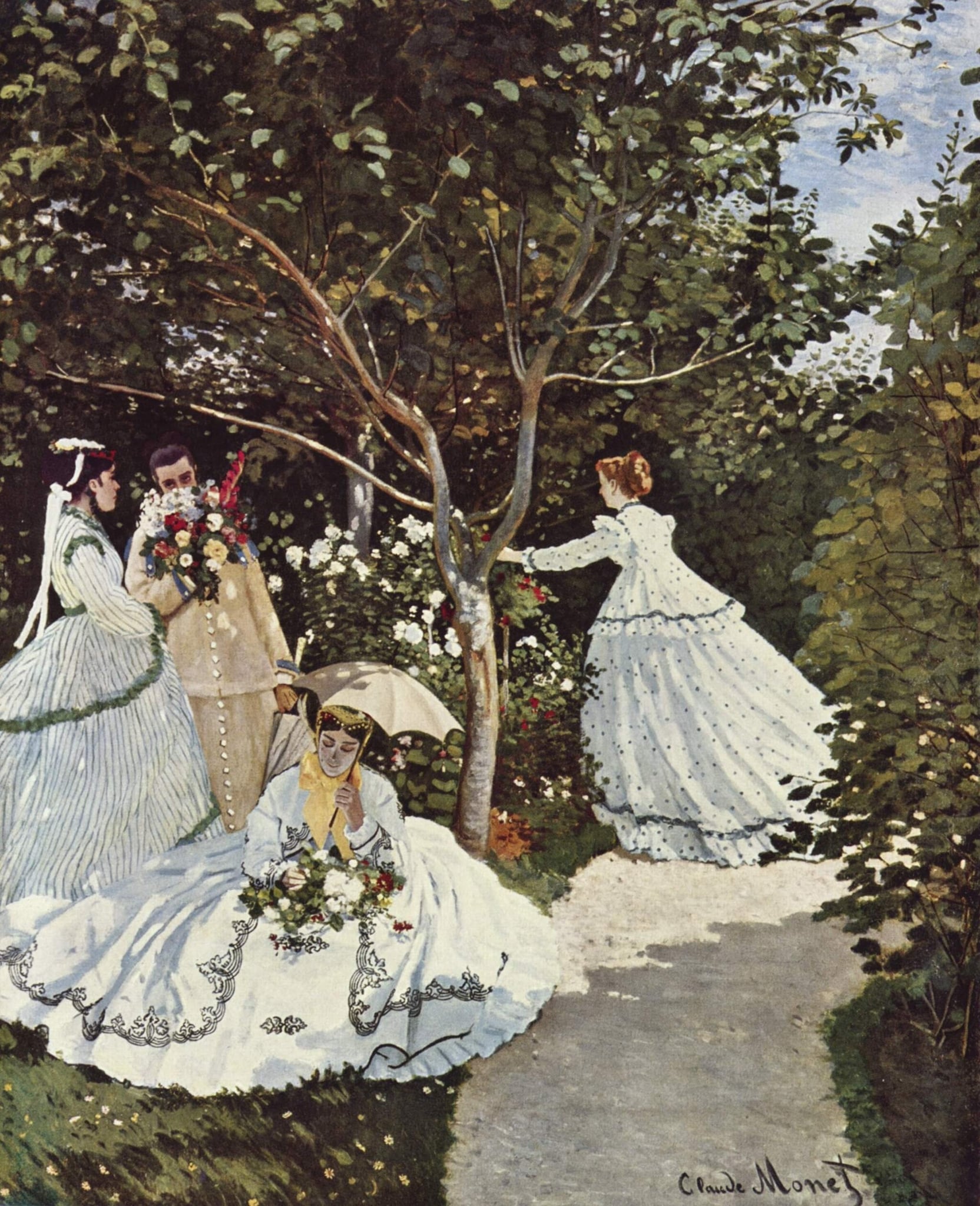
Claude Monet’s Women in the Garden choreographs four figures in a sunlit bower to test how <strong>white dresses</strong> register <strong>dappled light</strong> and shadow. The path, parasol, and clipped flowers frame a modern ritual of leisure while turning fashion into an instrument of <strong>perception</strong>. The scene reads less as portraiture than as a manifesto for painting the <strong>momentary</strong> outdoors <sup>[1]</sup><sup>[3]</sup>.
The Train in the Snow (The Locomotive) by Claude Monet

The Train in the Snow (The Locomotive)

Claude Monet (1875)

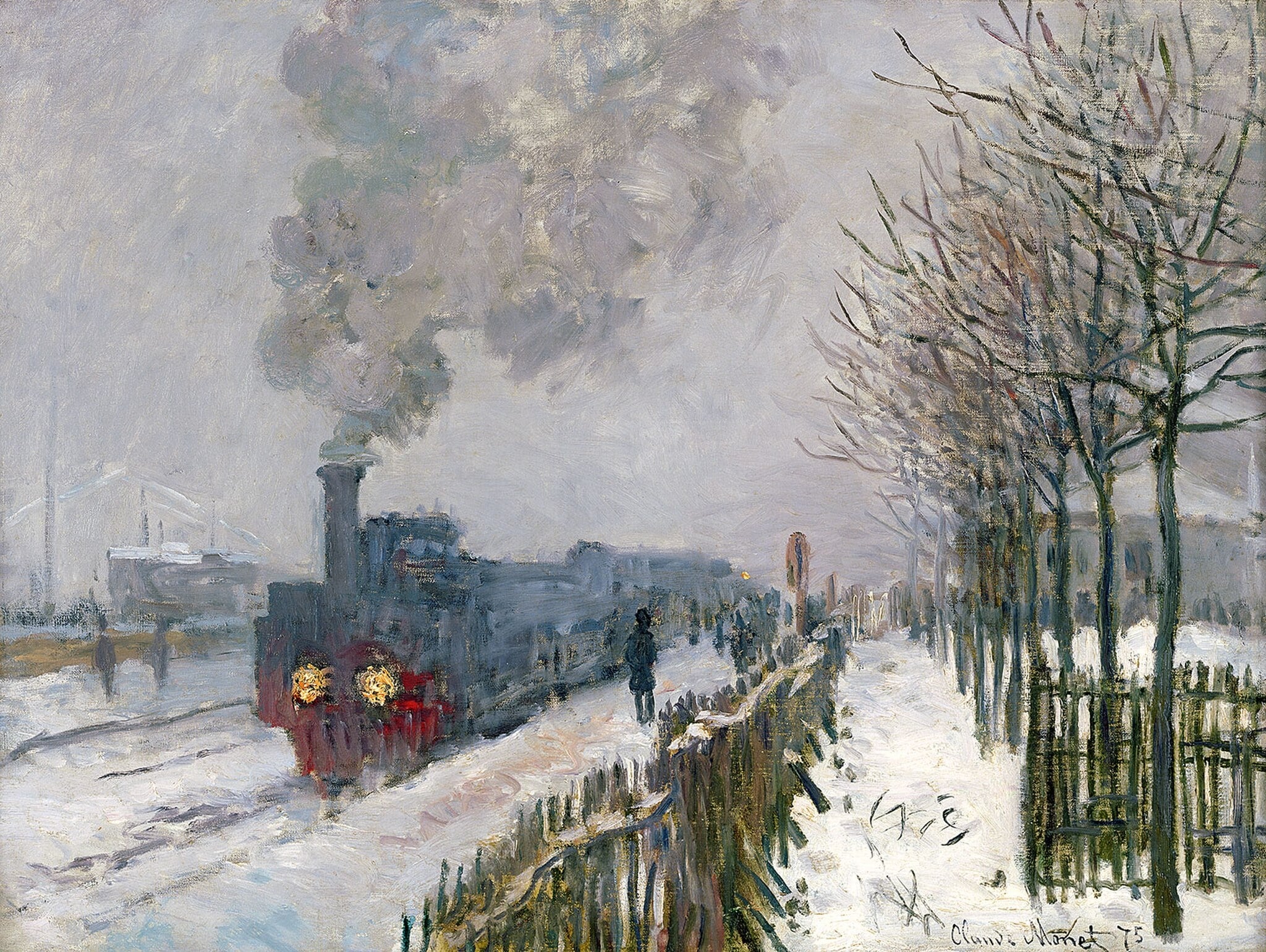
Claude Monet’s The Train in the Snow (The Locomotive) (1875) turns a suburban winter platform into a study of <strong>modernity absorbed by atmosphere</strong>. The engine’s twin yellow headlights and a smear of red push through a world of greys and violets as steam fuses with the low sky, while the right-hand fence and bare trees drill depth and cadence into the scene <sup>[1]</sup><sup>[4]</sup>. Monet fixes not an object but a <strong>moment of perception</strong>, where industry seems to dematerialize into weather <sup>[1]</sup><sup>[2]</sup>.
The Artist's Garden at Giverny by Claude Monet

The Artist's Garden at Giverny

Claude Monet (1900)

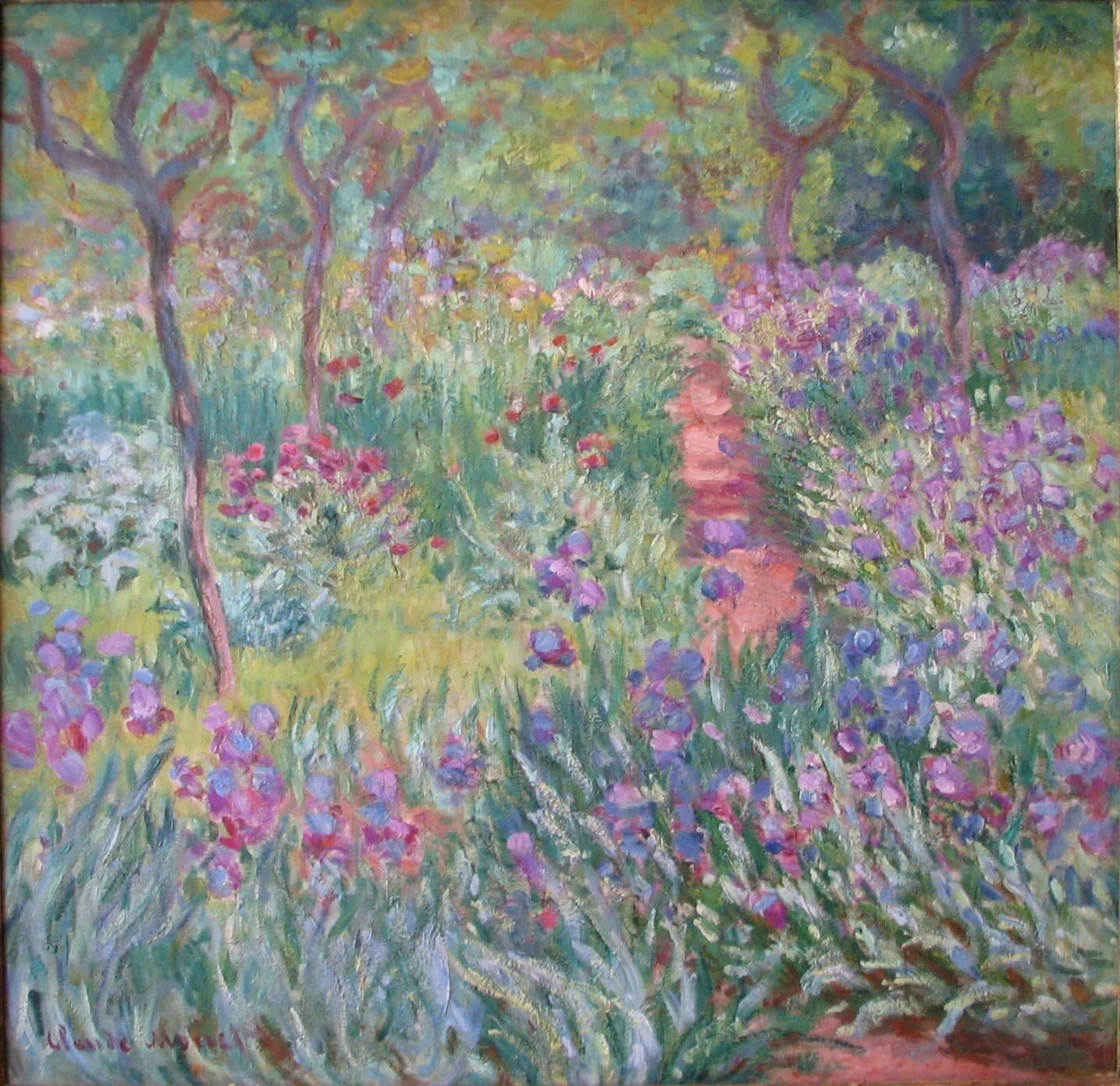
In The Artist's Garden at Giverny, Claude Monet turns his cultivated Clos Normand into a field of living color, where bands of violet <strong>irises</strong> surge toward a narrow, rose‑colored path. Broken, flickering strokes let greens, purples, and pinks mix optically so that light seems to tremble across the scene, while lilac‑toned tree trunks rhythmically guide the gaze inward <sup>[1]</sup><sup>[3]</sup>.