Vétheuil in Winter

by Claude Monet

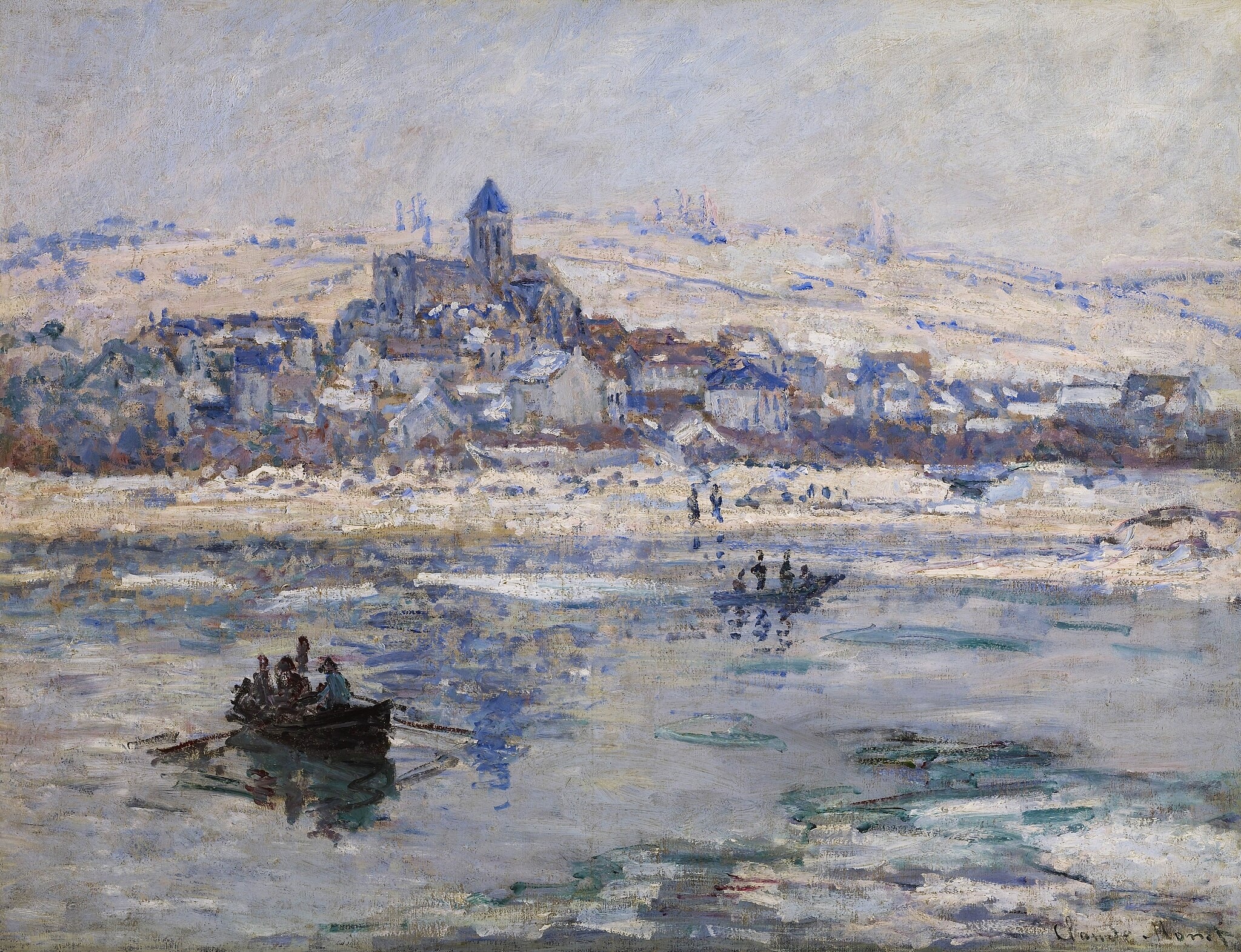
Claude Monet’s Vétheuil in Winter renders a riverside village in a silvery, frost-laden light, where the Seine carries broken ice past clustered houses and the tall church tower. The scene’s granular blue-green palette and softened edges make the town appear to crystallize out of air and water, while small boats and figures signal quiet persistence.
💰

Market Value

$25-45 million

How much is Vétheuil in Winter worth?

Study Print Studio

Create a personal study print

Build a companion study sheet around the part of this painting that speaks to you most. Choose a detail, shape an interpretation, and walk away with something personal and display-worthy.

Fast Facts

Year
1878–79
Medium
Oil on canvas
Dimensions
68.6 x 89.9 cm
Location
The Frick Collection, New York
See all Claude Monet paintings in New York
Vétheuil in Winter by Claude Monet (1878–79) featuring Church tower, Boats with rowers, Broken ice floes, Partial river reflections

Click on any numbered symbol to learn more about its meaning

Meaning & Symbolism

From its vantage across the Seine, Vétheuil in Winter organizes the town around the stone church whose blue-tipped tower rises like a metronome of civic time. That vertical, slightly off-center, steadies a composition otherwise ruled by horizontal sheets of river and distant hill. At the painting’s base, green-gray water mottled with scattered plates of ice carries faint reflections of the boats and bank—echoes that stop short of full mirror clarity. Monet’s brushwork remains loose yet deliberate, laying down lavender, slate, and pale ocher in short, granular strokes that cause roofs, walls, and snow-scrubbed paths to cohere only as the eye adjusts to the prevailing cold light. The boats—one close and dark with clustered rowers, another midstream with figures reduced to dabs—anchor the foreground and midground, pulling vision across the icy span toward the populated shore. These small human punctuations, confirmed by the Frick’s description of two boats crossing the river, register daily labor persisting despite the freeze and measure the breadth of the channel against the compact town mass 1. The effect is a visual dialectic: the church proposes stability; the river insists on motion. Monet’s handling makes weather the engine of meaning. He suppresses dramatic chiaroscuro in favor of a fused, silvery atmosphere, compressing the palette to blue-green-white so that boundaries soften and forms emerge through temperature rather than contour 2. This atmospheric logic carries ethical weight: life continues, but gently, without spectacle. The viewer reads time not as narrative event but as optical transition—the river’s thawing skin, the way snow on the opposite bank absorbs sky tint, the smudged tracks of figures along the shore. Historically, the winters of 1878–79 and 1879–80 were unusually severe; ice choked the Seine, and Monet, newly settled in Vétheuil and financially strained, turned those conditions into sustained inquiry, soon developing his celebrated ice-floe series that critics recognized for their intense melancholy and force 24. The present canvas anticipates that turn: its broken surfaces and drifting forms already test the structural possibilities of fragmentation that would later inform the horizonless water-lily fields 2. Biographical currents flow beneath the scene as well—Monet’s first wife, Camille, died in Vétheuil in 1879, and the church that centers the town also anchors that memory, lending the vertical a gravity of continuity in mourning, even if Monet never states symbolic intent outright 6. In this way, the painting declares a program central to Monet’s mature practice. It privileges the act of seeing over the cataloging of objects, using repeated motifs—the church, the boats, the frozen river—from a stable viewpoint to test how weather re-describes a place 24. Compared with the companion summer view from nearly the same position, the winter canvas tightens forms and restrains reflections, proving that season can recalibrate both color and structure without sacrificing legibility 2. The result is not a picturesque postcard of cold but a measured study of resilience: a village that does not dramatize its hardship, a river that does not cease its passage, a painter who, through disciplined attention, discovers continuity inside change. That is the meaning of Vétheuil in Winter and why Vétheuil in Winter is important: it codifies Monet’s method of converting climate, labor, and local architecture into a living register of time, inaugurating the sustained serial vision that would shape Impressionism’s legacy 1245.

Explore Deeper with AI

Ask questions about Vétheuil in Winter

Popular questions:

Powered by AI • Get instant insights about this artwork

💬 Ask questions about this artwork!

Interpretations

Formal Analysis: Serial Vision and Optical Economy

Vétheuil in Winter refines a serial method: a stable viewpoint parsed by seasonal optics. Compared with the near-identical summer vantage, the winter canvas tightens volumes and restrains reflections, translating space through temperature shifts rather than contour. This is not just a cool palette; it is an economy of means—short, granular strokes and a blue-green-white gamut that produce a fused, silvery atmosphere where legibility arises as the eye acclimates. Such handling exemplifies John House’s point that Monet privileges “the act of seeing” over the inventory of things, making perception itself the subject. The winter/summer pairing demonstrates how motif constancy enables form to flex with climate, prefiguring later serial cycles where time is measured as optical change rather than narrative event 21.

Source: Susan Grace Galassi, The Frick Collection

Environmental History: Freeze, Thaw, and Climatic Truth

The painting documents the exceptional winters of 1878–79 and 1879–80, when the Seine froze and later broke in dramatic débâcles. Monet’s ice-strewn river is not anecdote but an index of weather extremes that seeded his 1880 Ice Floes series, praised for its “intense melancholy.” The fractured surfaces visible here are a prelude to that inquiry: the river becomes a register of climatic process, from arrested flow to thaw. Christie’s and Orsay records for related snowscapes corroborate the meteorological severity, while Frick scholarship links these conditions to Monet’s pivot toward sustained atmospheric study. Reading the canvas ecocritically, the work converts landscape into time-sensitive evidence, where seasonal volatility writes itself into color, facture, and compositional spread 2571.

Source: The Frick Collection; Musée d’Orsay; Eliza Rathbone (via Christie’s)

Social History: Labor after Leisure

The small boats cutting the icy channel signal work, not the leisure boating of Argenteuil. At Vétheuil, Monet pivots from modern pleasures to the durability of everyday labor within a rural economy, compressing human presence to dabs that still structure depth and scale. The Frick notes two boats crossing the river; their trajectories stitch the foreground to the town, making toil a compositional hinge. The National Gallery of Art situates Vétheuil as a career inflection where Monet turned from metropolitan spectacle to sustained engagement with place and atmosphere. In this reading, the painting is a social landscape: the cold narrows choice, yet traffic persists—an art of resilience without rhetoric, focused on continuity of work amid constraint 13.

Source: The Frick Collection; National Gallery of Art (Washington)

Sacred Topography and Private Mourning

The abbey church’s vertical—“a metronome of civic time”—is also a sacred axis within the town’s daily rhythms. While Monet disavowed overt symbolism, the Vétheuil church inevitably bears biographical freight: Camille Monet died in 1879 and is buried in Vétheuil. The centered tower thus reads as a communal anchor that can hold private grief, fusing civic continuity with memorial gravity. Frick scholarship emphasizes the church as the visual keystone across seasons; the Beyeler biography supplies the proximate loss that shades the winter view. Rather than allegory, the canvas offers situated memory: a place seen in the weather of mourning, where architectural stability frames the fugitive optics of snow and thaw 126.

Source: The Frick Collection; Fondation Beyeler

Medium and Trajectory: From Broken Ice to Broken Field

Monet’s granular facture, dispersed in short, cool strokes, articulates planes by temperature and vibration, not line. The ice’s broken surfaces and drifting forms test how fragmentation can still yield coherence—an experiment that migrates, structurally, to the horizonless water-lily fields decades later. Galassi ties this winter inquiry to the subsequent Ice Floes and ultimately to the late decorative cycles, arguing that Monet discovers structure in lateral spread and optical weave. The winter canvas thus marks a technical hinge: mimesis cedes ground to perceptual construction, where painting becomes an event of seeing assembled from chromatic particles, edging Impressionism toward the conditions of abstraction without abandoning motif 2.

Source: Susan Grace Galassi, The Frick Collection

Patronage and Reception: Melancholy Marketed, Stability Secured

Sold to Dr. Georges de Bellio in December 1879, the canvas entered a network of early Impressionist patronage that buffered Monet’s precarious finances. Critical reception soon validated the winter river works: in 1882, J.-K. Huysmans praised Monet’s execution and the “intense melancholy” of the ice-floe paintings, framing cold-water optics as a modern emotional register. The Frick’s 1942 acquisition later canonized the work within an American collection context, where it now stands as the museum’s only Monet. This trajectory—early avant-garde support, sympathetic criticism, institutional anchoring—maps how a local, weather-bound experiment became a touchstone for serial modern vision and for the market’s embrace of atmospheric specificity 421.

Source: National Gallery (London) IFS dossier; The Frick Collection

Related Themes

About Claude Monet

Claude Monet (1840–1926) led Impressionism’s pursuit of open-air painting and optical immediacy, especially during his Argenteuil years focused on modern leisure and light. He later developed serial studies of changing conditions, culminating in the Water Lilies cycle [2].
View all works by Claude Monet

More by Claude Monet

Boating by Claude Monet

Boating

Claude Monet (1887)

Monet’s Boating crystallizes modern leisure as a drama of perception, setting a slim skiff and two pale dresses against a field of dark, mobile water. Bold cropping, a thrusting oar, and the complementary flash of hull and foliage convert a quiet outing into an experiment in <strong>modern vision</strong> and the <strong>materiality of water</strong> <sup>[1]</sup><sup>[2]</sup>.

The Thames below Westminster by Claude Monet

The Thames below Westminster

Claude Monet (about 1871)

Claude Monet’s The Thames below Westminster turns London into <strong>light-made architecture</strong>, where Parliament’s mass dissolves into mist and the river shivers with <strong>industrial motion</strong>. Tugboats, a timber jetty with workers, and the rebuilt Westminster Bridge assert a modern city whose power is felt through atmosphere more than outline <sup>[1]</sup>.

Haystacks Series by Claude Monet | Light, Time & Atmosphere by Claude Monet

Haystacks Series by Claude Monet | Light, Time & Atmosphere

Claude Monet

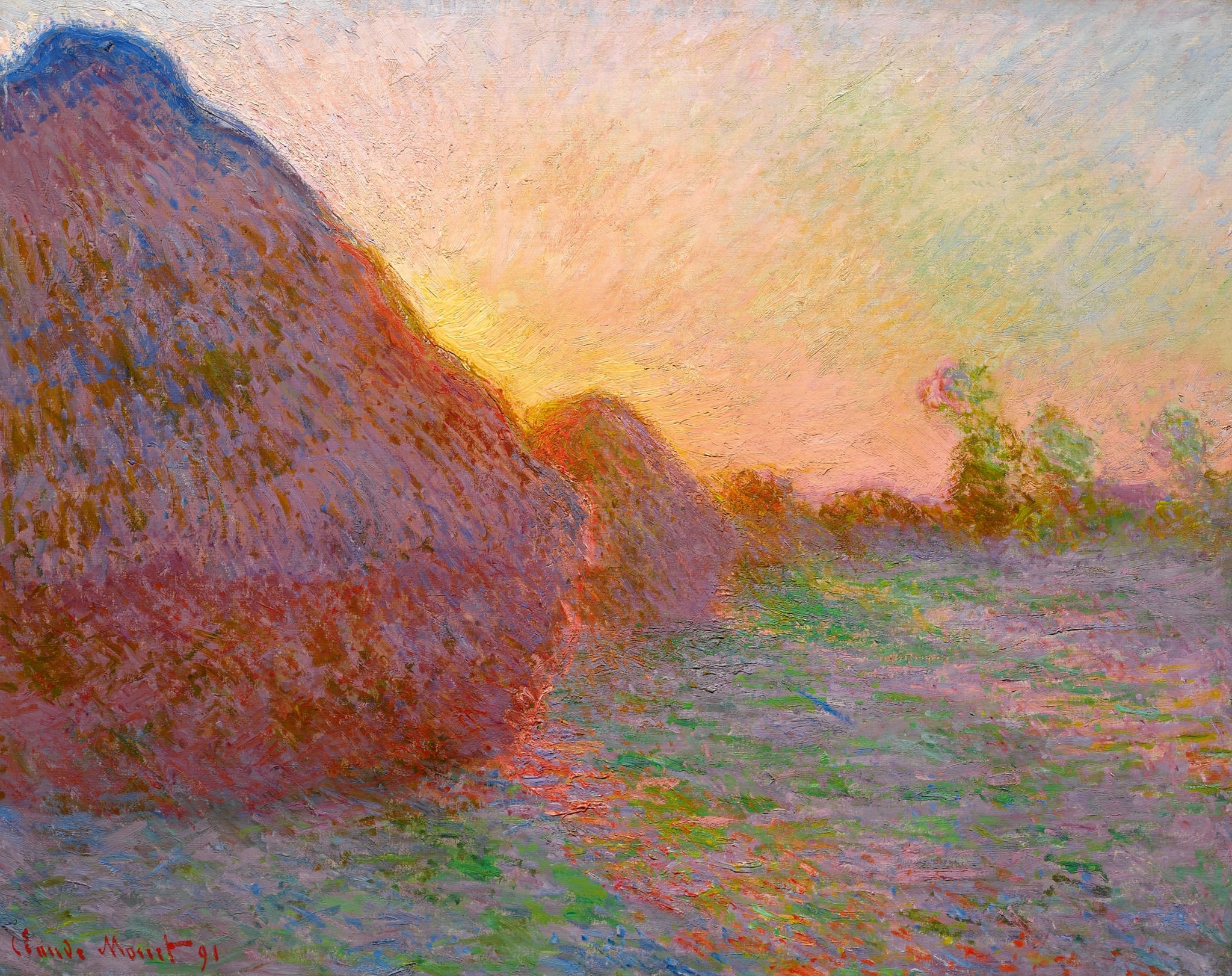
Claude Monet’s <strong>Haystacks Series</strong> transforms a routine rural subject into an inquiry into <strong>light, time, and perception</strong>. In this sunset view, the stacks swell at the left while the sun burns through the gap, making the field shimmer with <strong>apricot, lilac, and blue</strong> vibrations.
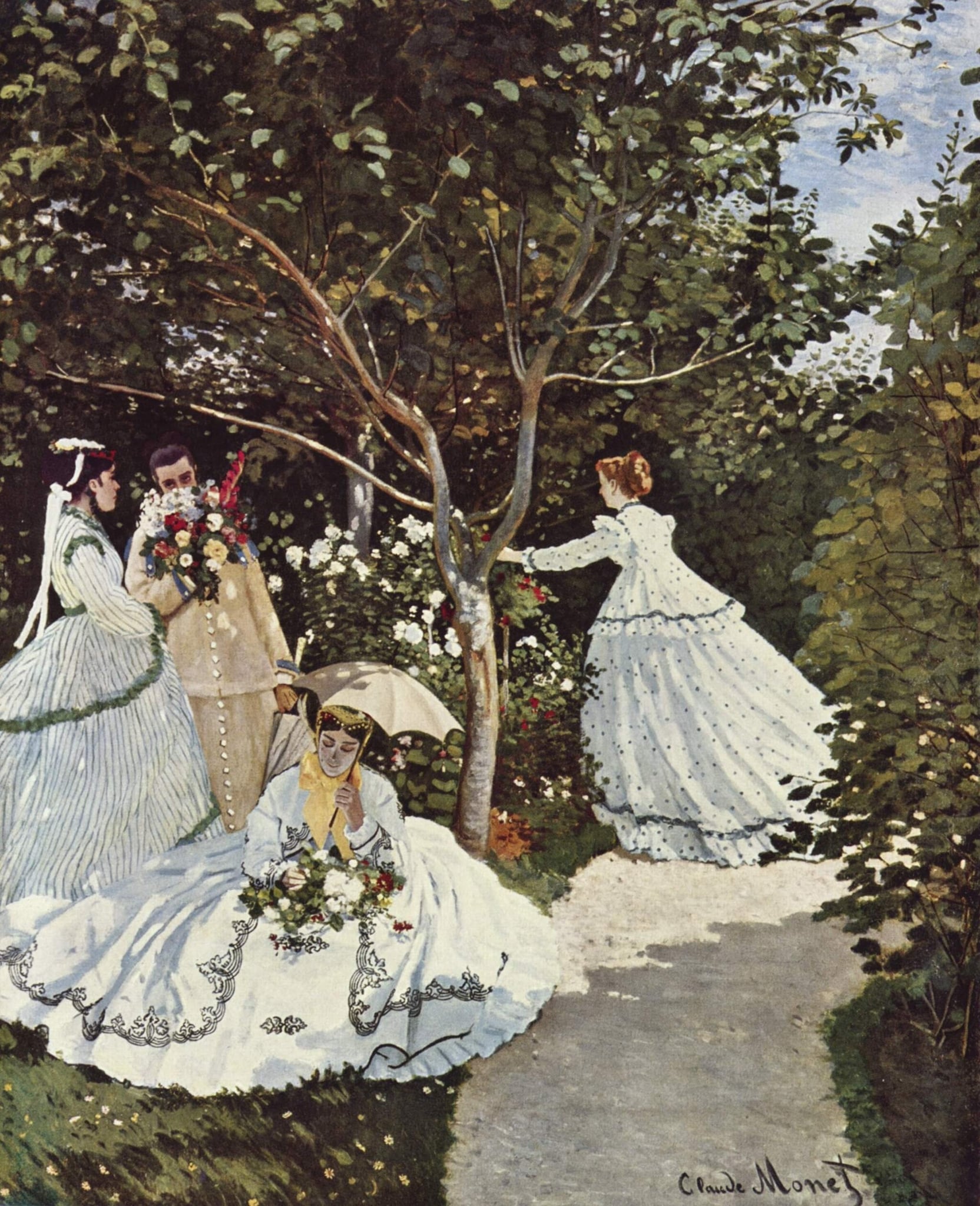
Women in the Garden by Claude Monet

Women in the Garden

Claude Monet (1866–1867)

Claude Monet’s Women in the Garden choreographs four figures in a sunlit bower to test how <strong>white dresses</strong> register <strong>dappled light</strong> and shadow. The path, parasol, and clipped flowers frame a modern ritual of leisure while turning fashion into an instrument of <strong>perception</strong>. The scene reads less as portraiture than as a manifesto for painting the <strong>momentary</strong> outdoors <sup>[1]</sup><sup>[3]</sup>.
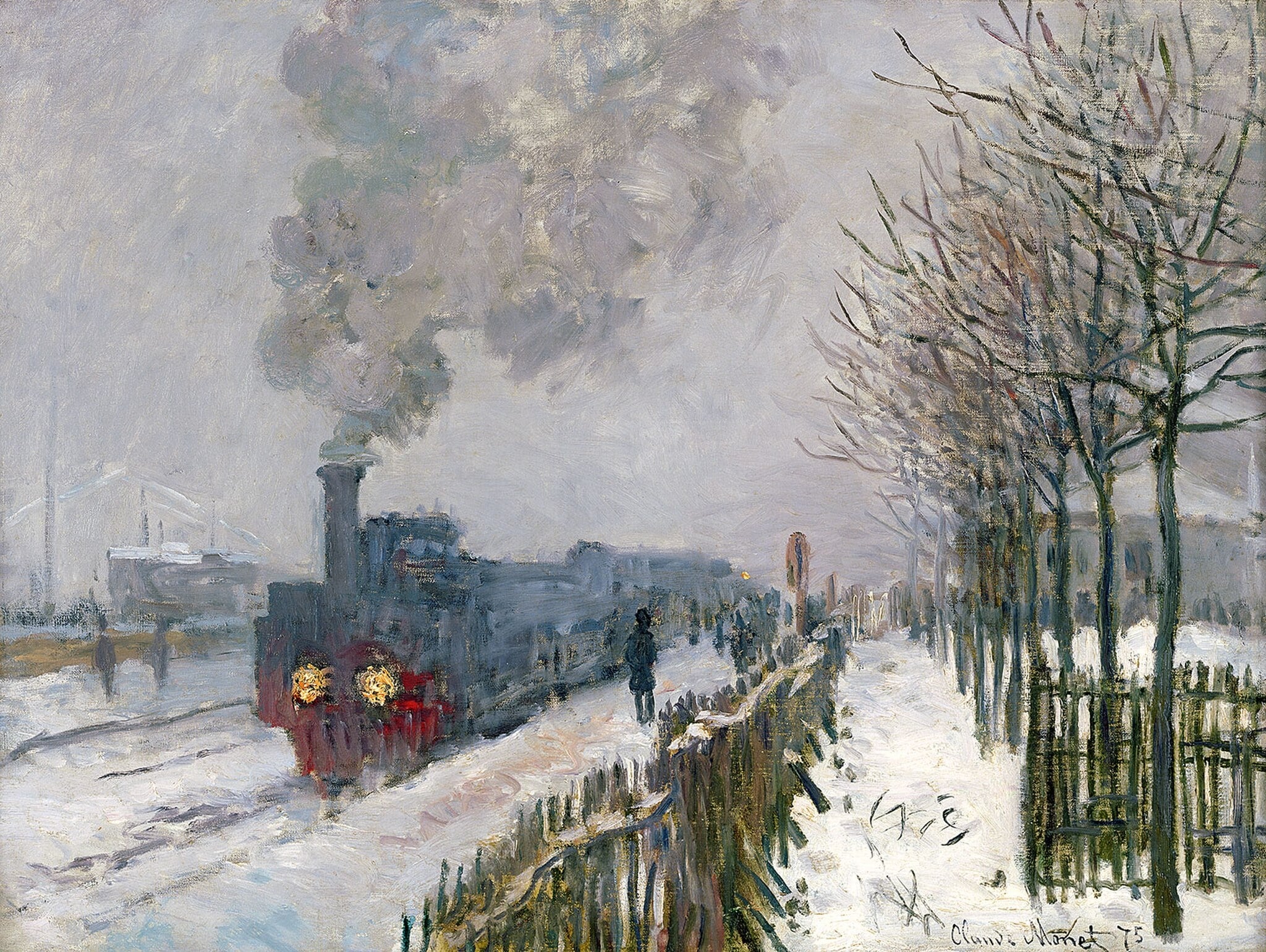
The Train in the Snow (The Locomotive) by Claude Monet

The Train in the Snow (The Locomotive)

Claude Monet (1875)

Claude Monet’s The Train in the Snow (The Locomotive) (1875) turns a suburban winter platform into a study of <strong>modernity absorbed by atmosphere</strong>. The engine’s twin yellow headlights and a smear of red push through a world of greys and violets as steam fuses with the low sky, while the right-hand fence and bare trees drill depth and cadence into the scene <sup>[1]</sup><sup>[4]</sup>. Monet fixes not an object but a <strong>moment of perception</strong>, where industry seems to dematerialize into weather <sup>[1]</sup><sup>[2]</sup>.
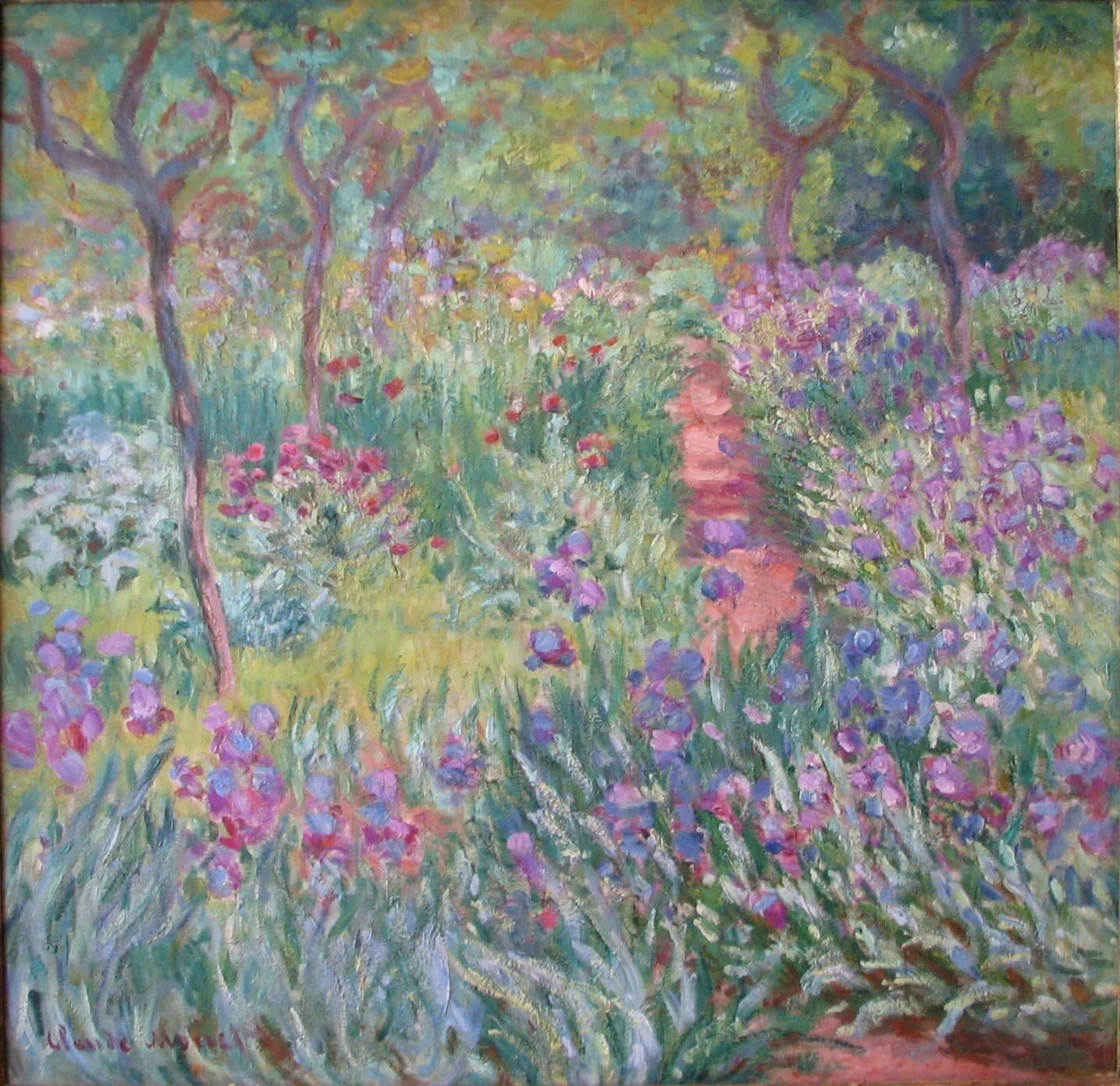
The Artist's Garden at Giverny by Claude Monet

The Artist's Garden at Giverny

Claude Monet (1900)

In The Artist's Garden at Giverny, Claude Monet turns his cultivated Clos Normand into a field of living color, where bands of violet <strong>irises</strong> surge toward a narrow, rose‑colored path. Broken, flickering strokes let greens, purples, and pinks mix optically so that light seems to tremble across the scene, while lilac‑toned tree trunks rhythmically guide the gaze inward <sup>[1]</sup><sup>[3]</sup>.