The Sick Child

by Edvard Munch

The Sick Child condenses a bedside vigil into a stark drama of love and helplessness. A pale, copper-haired girl glows against a chalky pillow while a bowed caregiver clasps her hand; the scraped, striated paint makes grief feel present and eroding at once [1][2]. Sparse props—a bottle, a glass, a thin red line—stand as mute emblems of medicine’s limits.
💰

Market Value

$25-60 million

How much is The Sick Child worth?

Study Print Studio

Create a personal study print

Build a companion study sheet around the part of this painting that speaks to you most. Choose a detail, shape an interpretation, and walk away with something personal and display-worthy.

Fast Facts

Year
1885–86
Medium
Oil on canvas
Dimensions
120 × 118.5 cm
Location
Nasjonalmuseet (National Museum), Oslo
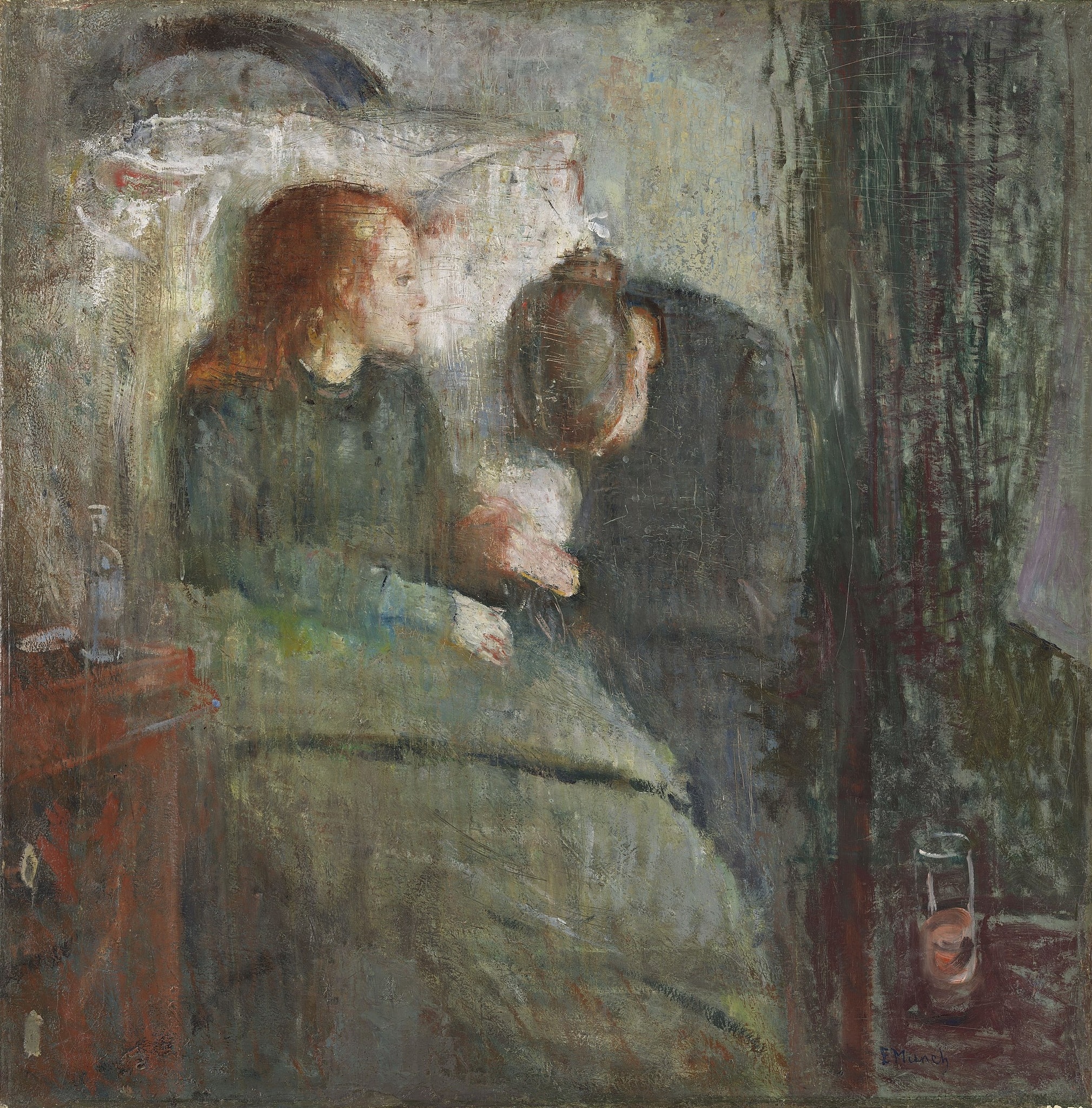
The Sick Child by Edvard Munch (1885–86) featuring Radiant head against white pillow, Clasped Hands, Medicine bottle, Thin red line/thread

Click on any numbered symbol to learn more about its meaning

Meaning & Symbolism

Munch structures the image around a diagonal of diminishing life. The girl’s pale profile, lit like a small halo against the scored white pillow, turns toward the windowed void while her hand slackens into the clasp of the adult at her side. That bowed figure—face buried, neck bent—creates a downward vector that pulls the viewer along the edge of the bed, as if time itself is sliding away. The blanket’s chill greens and bruised violets steep the air in illness, and the room tightens around them so that escape is refused. At the left edge, a bottle sits on a worn red table; at the lower right, a glass or candle catches a last ember of color. These ordinary tools of care become symbols of futility, placed conspicuously yet powerless to intervene. What we witness is not narrative action but the irreversible fact of parting, staged through composition and color rather than anecdotal detail 12. The paint surface enacts the work’s ethics of memory. Munch scraped, scumbled, and dragged pigments so that vertical striations veil the forms; faces and fabrics seem to waver in and out of fixation, like recollections fraying under grief. Institutional accounts note how he labored over the canvas for more than a year, alternating thick, pastose strokes with rubbed, abraded passages; the result reads as an image both half‑remembered and half‑witnessed 1. This facture is programmatic: Munch later affirmed that he painted not what he saw but what he had seen, a credo that anchors the canvas as his breakthrough from naturalism toward expression of interior states 34. The tight focus on touch—the joined hands at center—becomes the painting’s ethical core, the single remaining bridge between the living and the leaving. Around it, Munch organizes visual signs of sanctity and sickness: the radiant head against the pillow has been read as almost saint‑like, while the dominant green blanket marks corporeal decline 2. Even the small red thread of pigment near the table sharpens the sense of life’s ebb, a last, fragile pulse against encroaching gray‑green. Why The Sick Child is important is bound up with this synthesis of symbol, surface, and biography. The motif originates in the death of Munch’s sister Sophie from tuberculosis, but the canvas refuses portraiture’s consolations; it becomes an archetype of grief that inaugurates the artist’s lifelong “Frieze of Life” concerns—love, anxiety, illness, death 14. Its scandal on debut, due to the seemingly “unfinished” handling, marked a historical turn: finish yields to feeling, description to affective truth 1. The painting’s continued reprises in later versions and prints confirm that Munch treated it as a laboratory for testing how memory can be made visible—sometimes adding, sometimes subtracting symbolic frames across media 23. In the Oslo canvas before us, the scraped wall, the receding diagonal, and the mute still‑life of care cohere into a single, devastating statement: love endures, but it cannot arrest the quiet inevitability of death.

Explore Deeper with AI

Ask questions about The Sick Child

Popular questions:

Powered by AI • Get instant insights about this artwork

💬 Ask questions about this artwork!

Interpretations

Historical Context (Medical-Humanities Lens)

Tuberculosis shaped 19th‑century domestic life and visual culture; Munch’s scene enters that wider epidemiological imaginary while refusing genre certainties. Rather than the didactic “sickbed” narratives common in Scandinavia, he stages a compressed, affective interior where caregiving is gendered, intimate, and socially legible yet structurally inadequate against TB’s course. The stripped furnishings, the bottle, and the collapsed posture activate a public health subtext—care labor performed within middle‑class respectability but without cures. Read against contemporaneous TB discourse, the painting converts a family tragedy into a cultural document: an image of slow time, convalescence, and the social dramaturgy of terminal illness, all condensed into chroma and touch rather than medical detail 25.

Source: Postgraduate Medical Journal; Gothenburg Museum of Art

Materiality as Memory (Conservation/Process Reading)

The work’s authority lies in its stratified surface. Over more than a year, Munch laid down pastose strokes, then scraped, scumbled, and abraded them, leaving vertical striations that veil and reveal in alternating bands. This visible palimpsest converts facture into epistemology: the painting looks the way remembering feels—hesitant, interrupted, and ethically reluctant to over‑define a face that grief can scarcely hold. Far from “unfinished,” the broken skin of paint is programmatic, foregrounding process as content and aligning the picture with Symbolist strategies that externalize inner states. The viewer reads not optical description but temporal layers, a record of revision in which memory is both made and unmade on the canvas 1.

Source: Nasjonalmuseet (National Museum, Oslo)

Media Translation and Framing (Print Culture)

Munch’s prints expose how the motif’s meaning changes with its frame. In the 1894 drypoint, he briefly appended a miniature landscape beneath the bed—a lyrical outside that sets nature’s renewal against human decline—then later cut it away. Across states and techniques (drypoint, lithograph, etching), he modulates contour, tonality, and the density of hatchings to recalibrate distance and immediacy. These experiments are not reproductive but interpretive, treating medium as a variable that can thicken or thin grief’s pressure. The removal of the landscape is especially telling: the consolation of “elsewhere” is withdrawn, returning us to the bare interior and the ethical focus on touch 389.

Source: British Museum; National Galleries of Scotland; MoMA

Reception and the Turn to Affective Truth (Modernism)

Exhibited in 1886 as Study, the painting scandalized audiences who read its erasures and drips as incompetence; history now reads those marks as the signature of a breakthrough. Here, “finish” yields to feeling: Munch displaces naturalist polish with an expressive syntax of abrasion and pallor that anticipates Expressionism while rooted in Symbolist interiority. This reception history—outrage, then canonization—tracks a pivotal revaluation of pictorial criteria in Northern Europe, where truth became affective rather than optical. The Sick Child thus functions as a threshold work, redefining what counts as completeness and inaugurating a modernist ethics of the seen versus the remembered 16.

Source: Nasjonalmuseet; Encyclopaedia Britannica

Sanctity and Sickness (Iconographic Reading)

The child’s head, “radiant” against the white pillow, functions as a secular nimbus: a visual sanctification produced by luminance and contrast rather than explicit devotionals. Set against the dominant green of the blanket—long associated here with chill and pathology—the image negotiates sacred and medical registers without narrative piety. This chromatic dyad (white/green) binds purity to decline; the bowed caregiver reads as a silent pietà transposed to a bourgeois bedroom. Such iconographic slippages clarify how Munch fuses Symbolist sign‑making with lived ritual—vigil, touch, and waiting—elevating ordinary care to near‑liturgical intensity while refusing miraculous release 12.

Source: Gothenburg Museum of Art; Nasjonalmuseet

Trauma, Repetition, and the Frieze of Life (Psychological Interpretation)

Munch’s credo—he paints what he had seen—anchors a practice of repetition across decades: six painted versions and many prints return to the scene as if to metabolize loss. This seriality reads as both artistic laboratory and psychic re-enactment, where small shifts in palette, contour, and framing test how memory alters with time. Folded into the larger Frieze of Life program, the motif articulates a grammar—love, anxiety, illness, death—through which the self is continually re‑authored. By revisiting The Sick Child in the 1890s, 1907, and the 1920s, Munch documents grief’s afterlives: not closure, but evolving forms of recollection and meaning‑making 14.

Source: Nasjonalmuseet; MUNCH (Munchmuseet)

Related Themes

About Edvard Munch

Edvard Munch (1863–1944) was a Norwegian painter and printmaker whose "Frieze of Life" cycle explored love, anxiety, and death. Shaped by early family losses and fin-de-siècle circles in Paris and Berlin, he pushed Symbolist subjects into an expressive language of distortion and color that helped catalyze modern Expressionism [5][1].
View all works by Edvard Munch

More by Edvard Munch

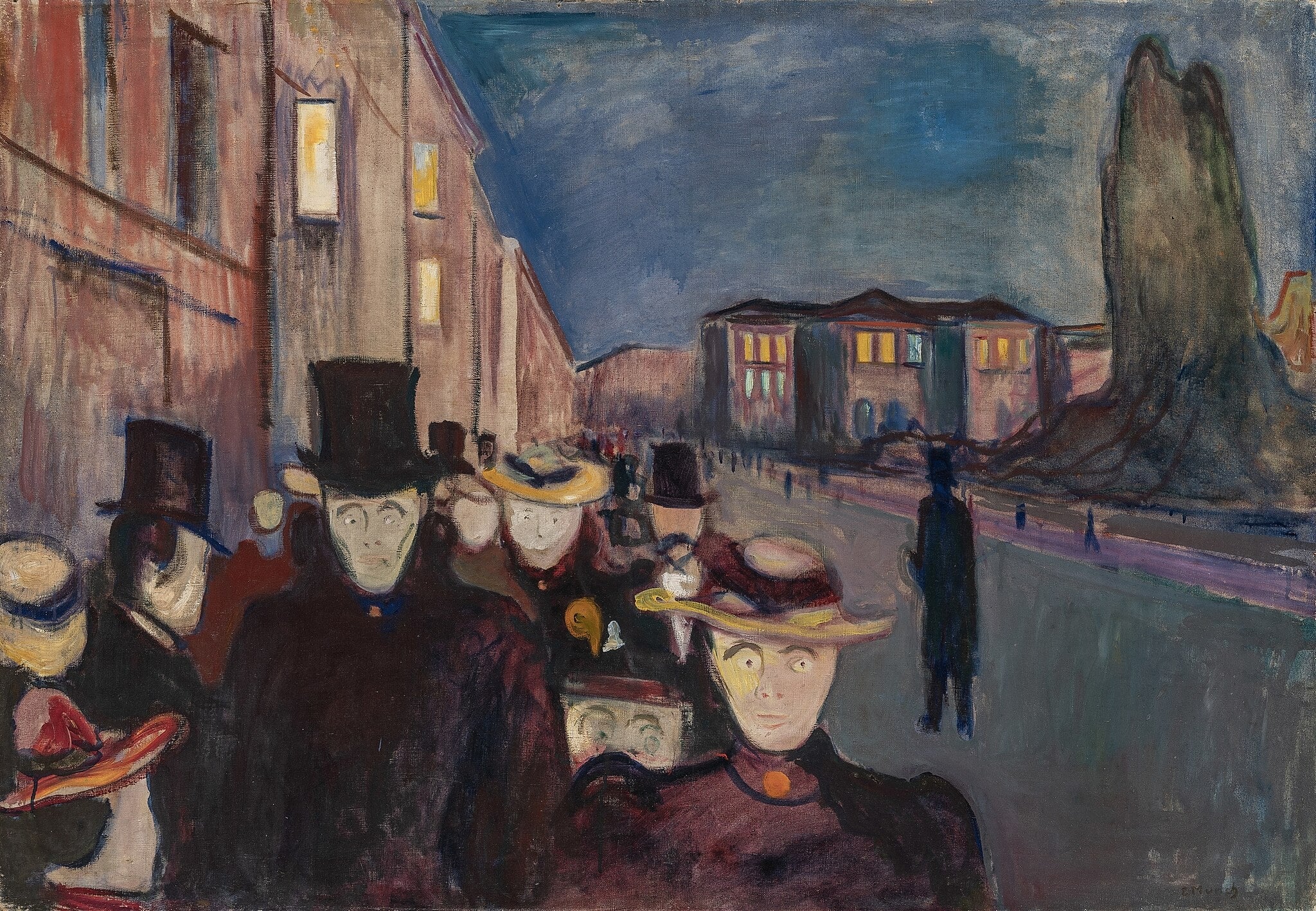
Evening on Karl Johan by Edvard Munch

Evening on Karl Johan

Edvard Munch (1892)

Evening on Karl Johan by Edvard Munch stages a fashionable Oslo boulevard as a scene of <strong>urban dread</strong>. A mask-faced crowd in top hats surges forward while an <strong>isolated silhouette</strong> recedes at right, and tilted buildings glow with jaundiced windows under a cold blue sky. Munch converts a social promenade into a <strong>symbol of alienation</strong> through compressed space, skewed color, and nervous brushwork <sup>[1]</sup><sup>[2]</sup><sup>[3]</sup><sup>[4]</sup>.

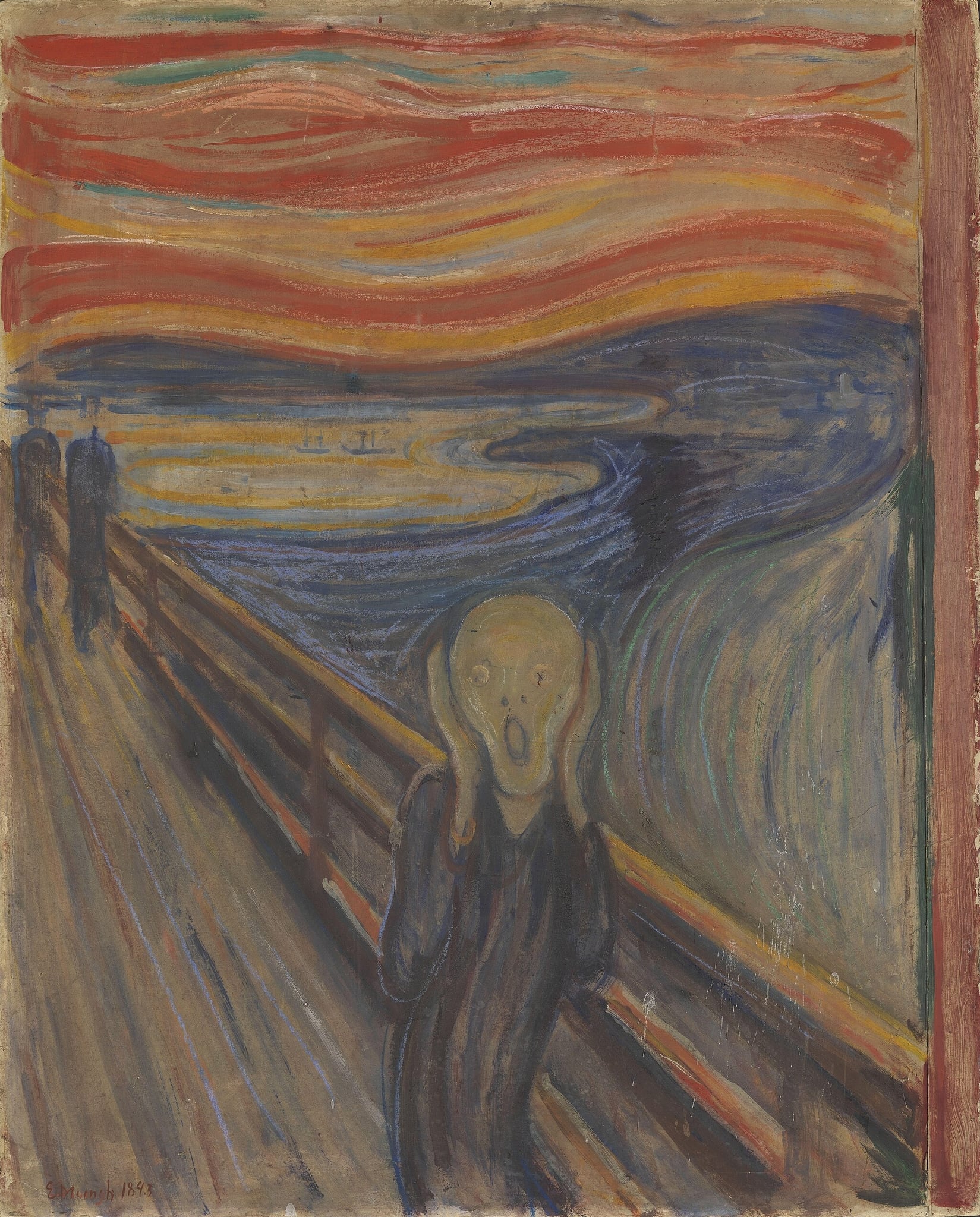
The Scream by Edvard Munch

The Scream

Edvard Munch (1893)

Edvard Munch’s The Scream condenses modern dread into an image where the self and the world collapse: an androgynous, skull-like figure grips its head as a <strong>blood-red sky</strong> and <strong>vibrating shoreline</strong> pulse around it. The rigid, receding bridge rails counter the turbulence, staging a clash between <strong>inner panic</strong> and <strong>outer reality</strong> <sup>[1]</sup><sup>[2]</sup>.
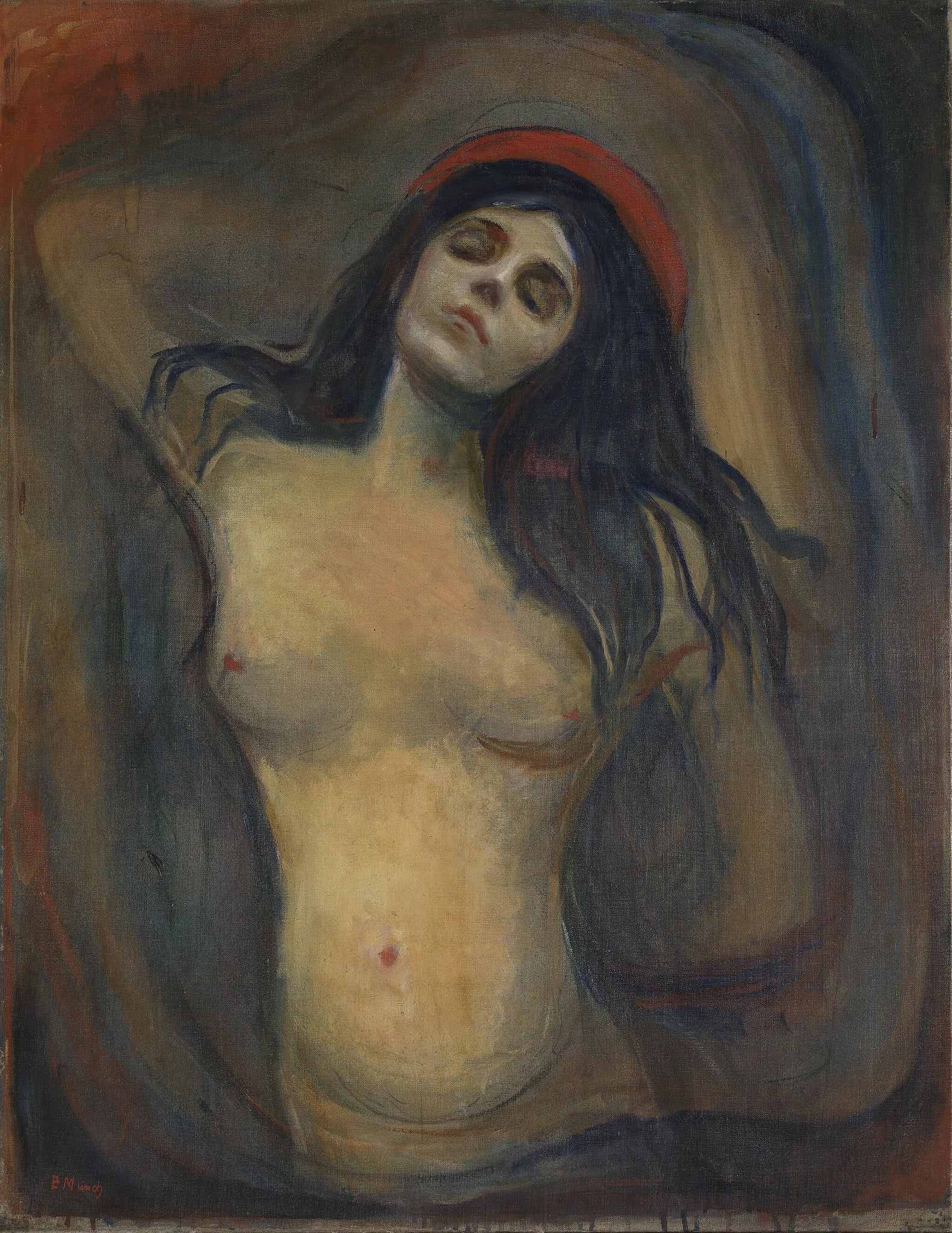
Madonna by Edvard Munch

Madonna

Edvard Munch (1894)

Munch’s Madonna stages a collision of <strong>sanctity and sensuality</strong>: a half-length nude, eyes closed, tilts into a crimson nimbus while a dark, tidal field seems to carry her body. With smeared contours and a sparse palette, the figure hovers between emergence and dissolution, turning the Virgin’s icon into a modern emblem of <strong>eros, creation, and death</strong> <sup>[1]</sup><sup>[2]</sup><sup>[3]</sup>.
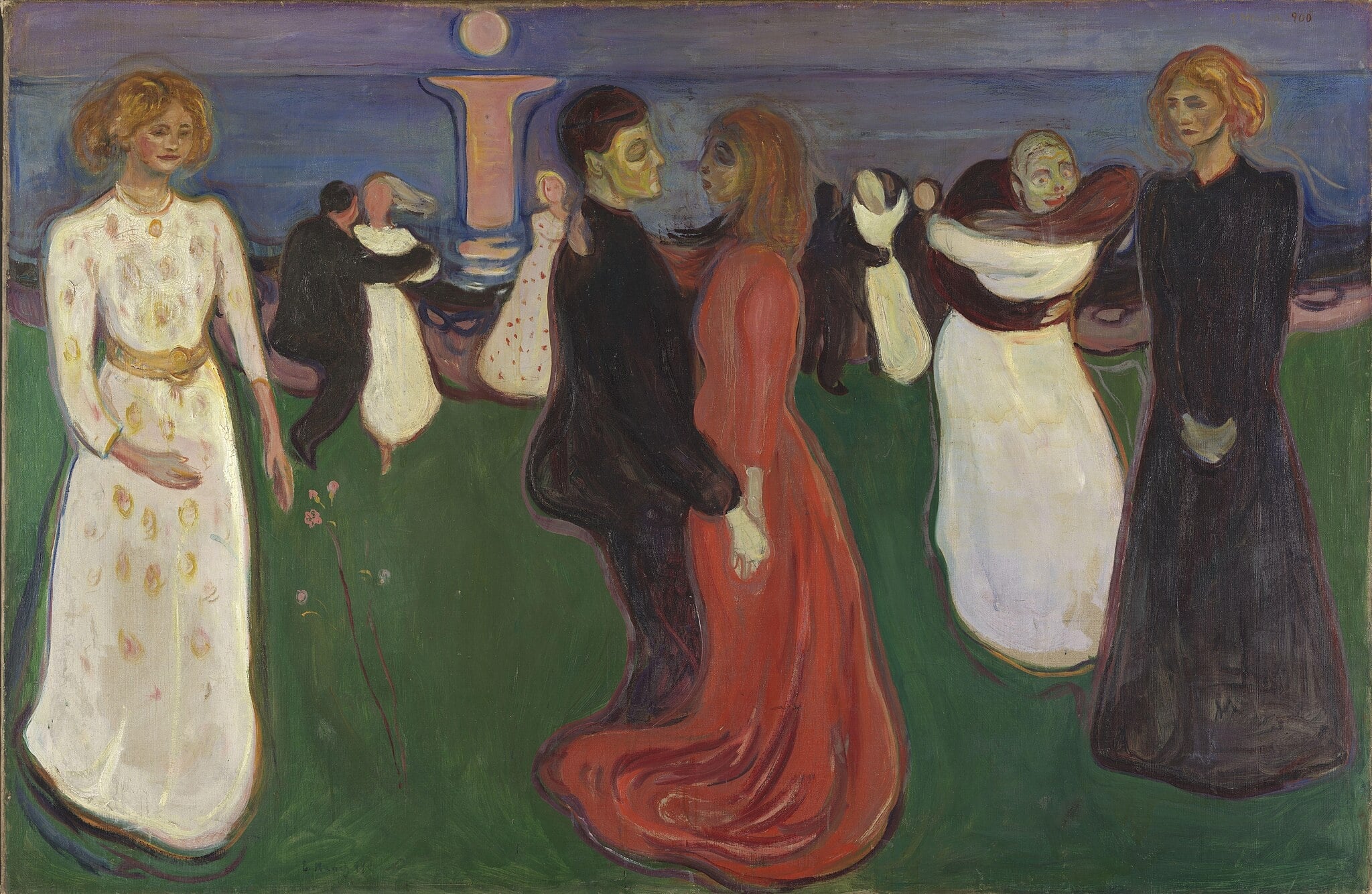
The Dance of Life by Edvard Munch

The Dance of Life

Edvard Munch (1899–1900)

The Dance of Life compresses <strong>youth, passion, and renunciation</strong> into a single moonlit scene on the Åsgårdstrand shore. A pale girl in white, a red‑clad woman entwined with a dark-suited man, and a withdrawn figure in black form a symbolic arc that binds love to <strong>time and mortality</strong> <sup>[1]</sup><sup>[2]</sup>.